Survey of London: Volume 26, Lambeth: Southern Area. Originally published by London County Council, London, 1956.
This free content was digitised by double rekeying. All rights reserved.
'Vauxhall and South Lambeth: Introduction and Vauxhall Manor', in Survey of London: Volume 26, Lambeth: Southern Area, ed. F H W Sheppard (London, 1956), British History Online https://www.british-history.ac.uk/survey-london/vol26/pp57-59 [accessed 30 April 2025].
'Vauxhall and South Lambeth: Introduction and Vauxhall Manor', in Survey of London: Volume 26, Lambeth: Southern Area. Edited by F H W Sheppard (London, 1956), British History Online, accessed April 30, 2025, https://www.british-history.ac.uk/survey-london/vol26/pp57-59.
"Vauxhall and South Lambeth: Introduction and Vauxhall Manor". Survey of London: Volume 26, Lambeth: Southern Area. Ed. F H W Sheppard (London, 1956), British History Online. Web. 30 April 2025. https://www.british-history.ac.uk/survey-london/vol26/pp57-59.
In this section
CHAPTER II - Vauxhall and South Lambeth
The description of the development of this area is keyed to a plan (fig. 19) which is based on the map of Vauxhall Manor drawn by Thomas Hill in 1681. (fn. 1) The numbers in brackets in the text which follows refer to the plot numbers marked on the plan.
The map of 1681 shows the Manor bounded on the west by the Thames and the common sewer called Battersea ditch. The ditch was also the boundary between the parishes of Lambeth and Battersea, and the borough boundary follows its course. In 1584 it was the subject of a lawsuit brought by Elizabeth Roydon, who held the Manor of Battersea, against Laurence Palmer and others, owners and occupiers of land in Lambeth and Clapham. (fn. 2) The dispute concerned the responsibility for paying for the scouring of the ditch and the maintenance of two sluices. According to the evidence submitted in the case, the sewer drained lands in Battersea, Clapham and Lambeth, which were “drowned” if the sluices were not kept in good repair. On the north the Manor was separated from Kennington Manor by the northern arm of Vauxhall Creek (sometimes called the River Effra) which divided into two streams, just west of where the Oval now lies, before entering the Thames. The three main roads shown on the plan—Wandsworth Road, South Lambeth Road, and Clapham Road—are all of considerable antiquity (see fig. 1); the bridges which carried them over Vauxhall Creek are also shown. At the junction of Wandsworth Road and South Lambeth Road, where the railway bridge now stands, was Cox’s Bridge, sometimes called Vauxhall Bridge. (fn. 3) In 1340 the Abbot of Westminster was charged with the repair of “cokkesbrugge”, (fn. 4) and in 1504 one of his successors was paying rent to the Prior and Convent of Christ Church, Canterbury, for a wharf which he held at “cokkes brugge”. (fn. 5) At the beginning of the 17th century a dispute arose about the maintenance of the bridge, for by reason of the “enundacion and outrage of waters” it had become “prostrate and throwne downe” and the fallen stones were hindering the flow of water. (fn. 6) The Commissioners of Sewers judged that the responsibility for repair lay with the Crown and referred to land previously held by the Abbot of Westminster then in the hands of the King, but the surveyor appointed to examine the case could not find the land in question, even by “dilligent enquiery”, and denied the Crown’s liability. The bridge over Vauxhall Creek in Clapham Road is also shown on the map; it was called Merton Bridge and took its name from the Merton Road, i.e. Clapham Road. A lane is also shown marking the line of the present Lansdowne Way (Green Lane).
VAUXHALL MANOR
The area beside the Thames near the present Vauxhall Bridge known as “Vauxhall” seems originally to have been part of the extensive Manor of South Lambeth, which was held in the 13th century by the de Redvers family. (fn. 7) The name “Vauxhall” (Fauxhall) is derived from Falkes de Breaute, the second husband of Margaret, widow of Baldwin de Redvers. (fn. 8) According to an inquisition relating to the de Redvers’ possessions taken in 1263, (fn. 9) the Manor of South Lambeth included lands at Streatham and Mitcham, but no mention is made of Vauxhall, though de Bréaute’s lands had reverted to the de Redvers family after his death. (fn. 10) In 1293 South Lambeth Manor and the Manor of “la Sale Faukes” passed, probably by trickery, to Edward I. (fn. 11) Whilst the Manor of South Lambeth disappeared almost immediately afterwards, Vauxhall acquired a definite manorial status which there is no evidence that it possessed hitherto. Courts were held there from 1340 onwards (fn. 12) and in 1362 the Manor was granted by Edward the Black Prince to the Prior and Convent of Christ Church, Canterbury, to maintain a chantry in the Cathedral crypt. (fn. 13) From this date Vauxhall Manor included the areas now known as Vauxhall and South Lambeth, and (more significant) lands in Streatham and Mitcham.
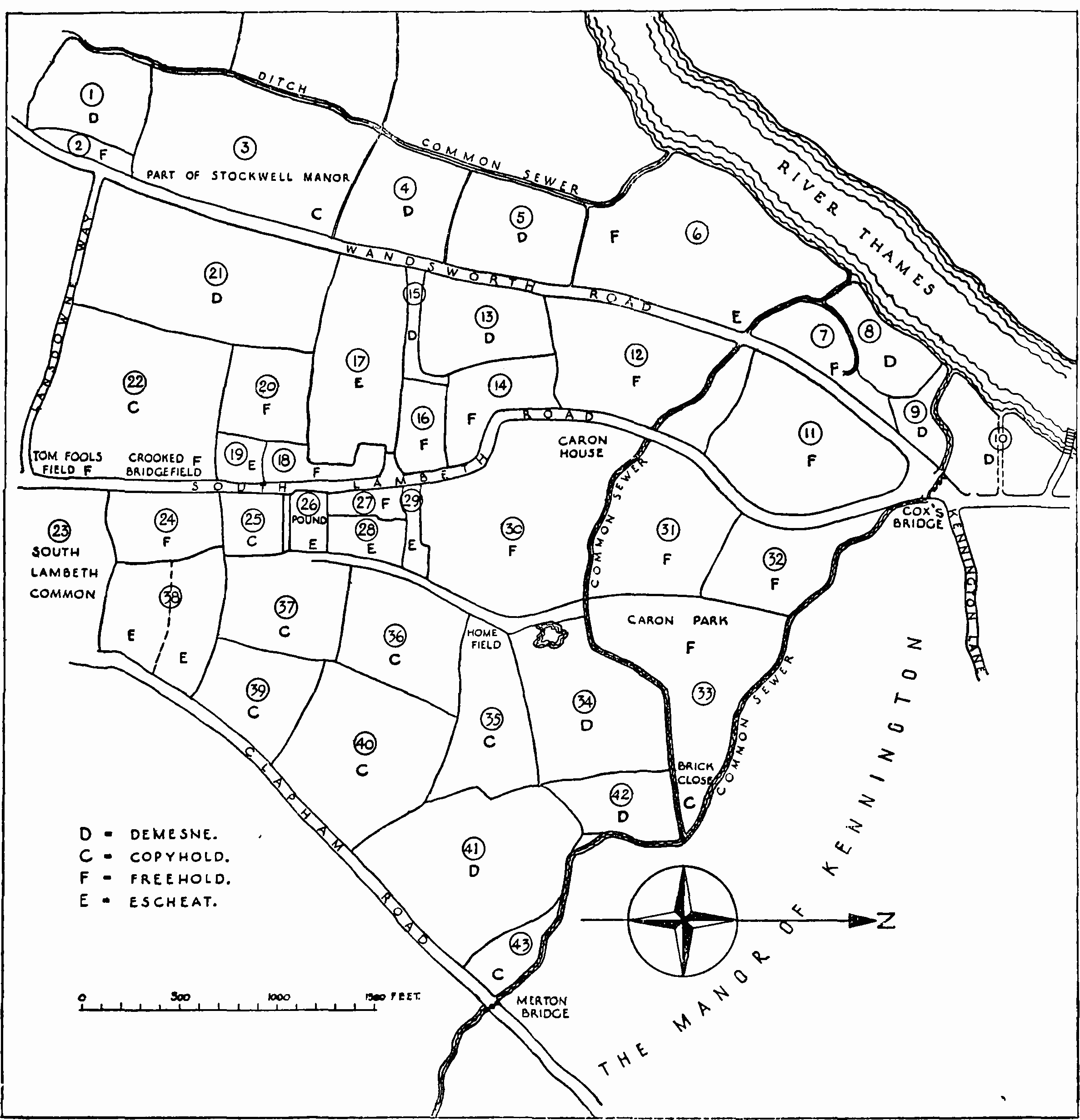
Vauxhall Manor. The plots are referred to in the text by the numbers on this plan, which is based on a map of Vauxhall Manors drawn by Thomas Hill in 1681. Plots 3 consists of a detached portion of Stockwell Manor and a piece of copyhold of Vauxhall Manor
A grant of land in Stockwell made by William de Redvers early in the 13th century, (fn. 14) and the fact that Isabel de Fortibus (who, as Baldwin de Redvers’ sister, held South Lambeth Manor) died at Stockwell in 1293, (fn. 11) both suggest that at this date Stockwell was also part of South Lambeth Manor, but there is evidence that about 1294 Stockwell also became a separate manor (see page 81).
The conclusion which may be tentatively drawn from the fragmentary evidence is that until the end of the 13th century the de Redvers’ Manor of South Lambeth included the areas now known as Vauxhall and Stockwell as well as certain lands in Streatham and Mitcham; that it was split up soon after it came into the hands of the King in 1293—hence its disappearance as a Manor— and that the Manors of Vauxhall (which included lands in Streatham and Mitcham) and Stockwell took its place. The term “South Lambeth” has survived as a vague geographical expression denoting the area on either side of South Lambeth Road; this district was part of Vauxhall Manor. The lands belonging to the Manor in Streatham and Mitcham do not fall within the scope of this volume.
Vauxhall Manor was transferred after the Dissolution to the Dean and Chapter of Christ Church, Canterbury, (fn. 15) but some lands in Lambeth Marsh, originally belonging to the Manor, were granted to the Archbishop of Canterbury (fn. 16) and absorbed into the demesne lands of Lambeth Manor. (fn. 17) Most of the demesne lands of Vauxhall were sold off at the beginning of the 19th century but the copyhold lands remained part of the capitular estates until vested in the Ecclesiastical Commissioners in 1862. (fn. 18) No trace has been found of a sale of the Manor during the Commonwealth period, but from 1651–2 John Adrian, and from 1653–9 Henry Hampson, appear in the court rolls as Lords of the Manor. (fn. 19)
Manorial administration is not a matter of primary concern in a work of this nature, but one or two points of general interest emerge from the records consulted. When Vauxhall was still part of South Lambeth Manor the freeholders had to perform certain services. They had to plough twice a year, provide two oxen for one day in the autumn to carry the Lord’s hay, and to provide two boon-days at which all their tenants were to attend, and carry the Lord’s hay one day in the year. (fn. 9) For all except the last service they were provided with their estovers (food and drink). These services were eventually commuted. In the 16th century freeholders still owed suit of court, and paid heriots and reliefs when they fell due. (fn. 5) Copyhold tenure was by Borough English, i.e. the youngest son inherited, and if there were no sons, the property was divided among the daughters. The fine series of manorial accounts and rentals preserved in the Library of the Dean and Chapter include accounts for the repair of the barn, which had a mud wall and was thatched with reeds. (fn. 20) The office of bedell for both the Manors of Vauxhall and Walworth (which was also owned by the Dean and Chapter) was usually held by the same person, often a tenant. (fn. 21)
In Vauxhall, inclosure was well advanced by the beginning of the 16th century. (fn. 22) The Prior and Convent owned many manors scattered throughout south-east England which were administered by laymen on the spot, and were visited perhaps only once or twice a year by the Convent’s officers. After inclosure the closes were leased, and the rents provided a regular income which was of more use to absentee landlords than the old services in kind.