Survey of London: Volume 26, Lambeth: Southern Area. Originally published by London County Council, London, 1956.
This free content was digitised by double rekeying. All rights reserved.
'Myatt's Fields, Denmark Hill and Herne Hill: Introduction and Myatt's Fields area', in Survey of London: Volume 26, Lambeth: Southern Area, ed. F H W Sheppard (London, 1956), British History Online https://www.british-history.ac.uk/survey-london/vol26/pp141-145 [accessed 1 May 2025].
'Myatt's Fields, Denmark Hill and Herne Hill: Introduction and Myatt's Fields area', in Survey of London: Volume 26, Lambeth: Southern Area. Edited by F H W Sheppard (London, 1956), British History Online, accessed May 1, 2025, https://www.british-history.ac.uk/survey-london/vol26/pp141-145.
"Myatt's Fields, Denmark Hill and Herne Hill: Introduction and Myatt's Fields area". Survey of London: Volume 26, Lambeth: Southern Area. Ed. F H W Sheppard (London, 1956), British History Online. Web. 1 May 2025. https://www.british-history.ac.uk/survey-london/vol26/pp141-145.
In this section
CHAPTER V - Myatt‘s Fields Area, Denmark Hill and Herne Hill
This district probably formed part of the Manor of Milkwell, a relatively small Manor which lay partly in Lambeth and partly in Camberwell; its history is so obscure that its position cannot be indicated with any precision.
In 1291 the Manor of Milkwell belonged to the Hospital of St. Thomas, Southwark, and was taxed at £1 5s. (fn. 1) In 1305 it was granted by the Hospital to St. Mary Overy Priory at a yearly rent of 10s. (fn. 2) At the Dissolution it was valued at £5 2s. (fn. 3) In 1540 the Manor “and the wood called Mylkewell woodde, in the parish of Lambeth, belonging to the said late monastery’ of St. Mary Overy, was granted to Sir Thomas Wyatt, to be held by knight service for a rent of 10s. 9d. (fn. 4) In 1550 custody of the Manor was granted to Richard Duke during the minority of Thomas Duke, son and heir of George Duke deceased. (fn. 5) It was described in 1609, after the death of Thomas Duke, as consisting of six messuages, eight cottages, five barns, five gardens, 150 acres of land, 20 acres of meadow, 200 acres of pasture, 30 acres of wood in Milkwell, Camberwell and Lambeth, parcel of lands of the late Priory of St. Mary Overy. Duke also died seized of 20 acres of land, seven acres of pasture, three acres of meadow in Camberwell and Lambeth, formerly parcel of the lands of the monastery of Bermondsey (St. Saviour's). Save for 25 acres the Manor was held of the King in chief for a tenth part of a knight's fee at an annual rent of 40s. 9d. (fn. 6) Thomas Duke's heir, Sir Edward Duke, sold a small portion of the Manor to Edward Alleyn of Dulwich, (fn. 7) and the remainder to Robert Cambell, alderman of London. (fn. 8) By his will (fn. 9) the latter left his lands in Lambeth Dean and Camberwell to his son James, whose widow Theophila was granted letters of administration of his estate in 1660. (fn. 10) Theophila Cambell, who was commonly called Lady Cambell, died in 1670 or 1671, leaving three daughters, Theophila, Philippa and Isabella. (fn. 11) The Manor of Milkwell appears to have been divided amongst these three daughters, for one third descended to Theophila (fn. 12) and in 1672 Richard Bassett, husband of Philippa, suffered a recovery of another third of the Manor. (fn. 13)
The later history of the Manor is very confused. One of the three daughters, Theophila, married Sir John Corbett, and in 1691 their son Robert Corbett sold his third of the Manor to John Godschall of London, merchant, for £3,680. (fn. 12) This property comprised some 124 acres in the areas later known as Denmark Hill and Herne Hill, and included a farm or Manor called Betton's. Despite its description in the deed of sale as part of the Manors of Betton's and Milkwell, an annual quit-rent of 6s. 8d. was payable to the Manor of Lambeth. (fn. 14) The Godschall family continued to hold this land until 1783, when William Man Godschall sold it to Samuel Sanders, (fn. 15) a timber merchant with premises on Pedlar‘s Acre, Lambeth. Shortly after the passing of the Lambeth Manor Inclosure Act of 1806, objections were raised that Sander‘s property was not part of the Manor, but he and one of his tenants attended one of the Inclosure Commissioner‘s meetings “and made it appear that the property was within the Manor of Lambeth and paid a quit-rent to the Lord’. (fn. 16)
The descents of the other two-thirds of the Manor of Milkwell are less clear. In the latter part of the 17th century Abraham Harrison, a goldsmith of Covent Garden, was buying land in Kent, (fn. 17) and by his will, dated 1717, he bequeathed a farm called Lambeth Dean Farm, then said to be part of an ancient manor, with 109 acres in Lambeth and Camberwell, to his son Thomas. (fn. 18) The property passed to Thomas's nephew James Harrison who sold it in 1747 to the executors of the will of Thomas Lord Wyndham, formerly Lord High Chancellor of Ireland, for £3,352. (fn. 19) In 1762 the property was conveyed to the use of Sir Wyndham Knatchbull Wyndham, (fn. 20) and a recovery was suffered to bar the entail. (fn. 21) Shortly afterwards Sir Wyndham

Fig. The Minet estate, 1841
died, leaving all his lands to his uncle Sir Edward Knatchbull. (fn. 22) In 1770 the latter sold the property to Hughes Minet, (fn. 23) whose descendants still own the greater part of it. Although no direct connection has been traced, it is probable that the Minet property was formerly part of the Manor of Milkwell.
Manning and Bray state that Milkwell Manor was acquired from the Cambell family by the Bowyers, from whom it descended to the Wyndhams and Smyths. (fn. 24) These last three families successively owned extensive property in Camberwell, together with a small piece in Lambeth south-east of Kennington Common. Part of their estate probably represents the final third of Milkwell Manor.
Building development in the area of the former Manor of Milkwell began at the end of the 18th century. In the Denmark Hill and Herne Hill areas it took the semi-rural form of large detached houses with large gardens. North of Coldharbour Lane there was not much development until after the formation of Camberwell New Road in 1818; building was on a more modest scale here, and mostly took the form of small terrace houses.
MYATT‘S FIELDS AREA
Much of this district is comprised in the Minet estate. The Minets were a French Huguenot family. After the Revocation of the Edict of Nantes in 1685, Isaac Minet, whose parents had kept a pharmacy in Calais, was imprisoned with his mother. They managed to escape to England, where some of Isaac's brothers had already established themselves. Isaac Minet had spent some months at Dover in his boyhood learning English, and he and his brother Ambroise set up a shop of “licors and parfumes” in London. Isaac's grandson, Hughes Minet, was born in Kent in 1731 (fn. 25) and it was he who in 1770 bought 109 (by a later measurement 118) acres of land from Sir Edward Knatchbull. (fn. 23) Most of the estate was in the parish of Camberwell, but the greater part of it is now in the borough of Lambeth. The relatively short frontage to Camberwell New Road was partially developed shortly after the authorization of the road in 1818 (fig. 45), but the flat, low ground did not attract the more prosperous classes who were migrating to the suburbs in the first half of the 19th century. In 1863 the opening of the Metropolitan Extensions of the London, Chatham and Dover Railway Company quickly created a very large demand for small suburban houses. Several acres along the south-east side of the estate were bought by the Railway Company, and the remainder was carefully laid out for residential use (fig. 46). Builders applied for plots which were granted on long leases; when the houses were finished they were sold by the builder and a direct lease was granted to the tenant by the freeholder, James Lewis Minet, or after his death in 1885, by his son William Minet. By 1871 most of the estate had been divided into plots and building was going on in Paulet Road, Knatchbull Road and the connecting streets. (fn. 26) James Lewis Minet provided a site for the Church of St. James's, Knatchbull Road, and bore the entire cost of building. In 1889 his son, William Minet, gave some 14½ acres known as Myatt's Fields to the London County Council for use as a permanent open space. The Minet Public Library was opened in the following year. The history of the estate provides a good example of the benefits which a public-spirited family of landlords could confer on their tenants.
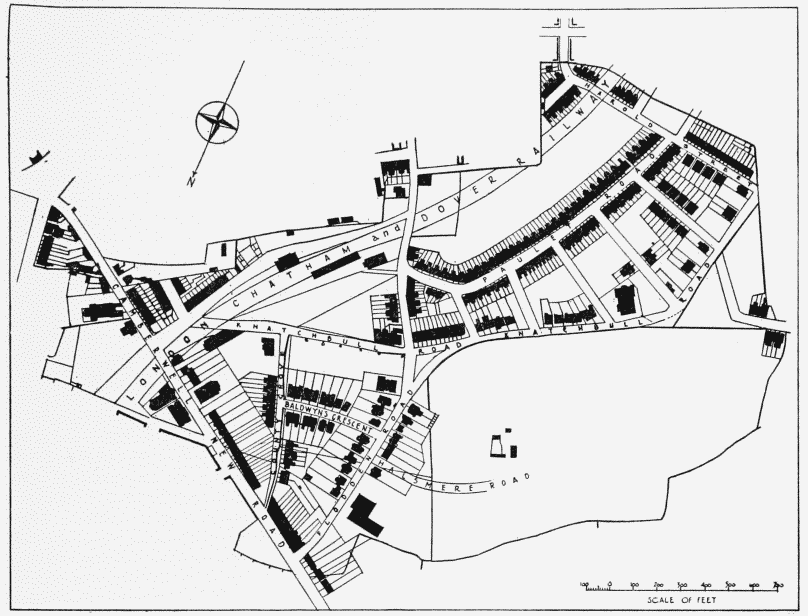
The Minet estate, 1885
Church of St. James The Apostle, Knatchbull Road
The site of this church was freely given by James Lewis Minet, who also bore the entire cost of the building. (fn. 27) The foundation stone was laid on June 19, 1869, and the church was consecrated on June 27, 1870; a consolidated chapelry was formed in 1874. (fn. 27) The architect was George Low and the builders Dove Brothers of Islington. (fn. 28) The church, which accommodates 780 people, (fn. 27) is designed in Decorated Gothic style with unusual detailing, and is faced with Kentish ragstone with Bath stone dressings. It has a clerestoried nave flanked by lean-to aisles terminating in short gabled transepts. At the north-west corner there is an almost free-standing steeple; the tower has octagonal corner buttresses finished with canopied pinnacles, and there are dormer windows in alternate faces of the octagonal stone spire. The interior of the church is plain and detailed in a rather mechanical manner; the sanctuary has an apsidal end and the transepts are separated from the aisles by two-bay transverse arcades.
Myatt's Fields
In 1889 William Minet gave 14½ acres of land to the London County Council for use as a permanent open space, and after the Metropolitan Public Gardens Association had spent some £10,000 on the layout of the park, it was opened on April 13, 1889. In 1935 Miss Susan Minet presented a further quarter of an acre near the junction of Knatchbull Road and Calais Street. (fn. 29) The name Myatt's Fields commemorates Joseph Myatt, a former tenant who had been famous for the rhubarb which he grew there.
The Minet Library, Knatchbull Road
The building which now houses the library was originally intended by William Minet to serve as a hall for the use of the tenants of the estate and as a church hall for St. James‘s, Knatchbull Road. Mr. Minet‘s wife died in 1887 before the hall was finished and he then decided to turn it into a library in memory of her. After building work had been interrupted for a time by the contractor's bankruptcy, Mr. Minet, who was much interested in the co-operative movement, conceived the idea of forming a private company on co-operative lines. The experiment proved successful and the library, which was designed by George Hubbard, was finished and opened in 1890. (fn. 30)
Until the constitution of the metropolitan boroughs in 1899 the library stood in the parish of Camberwell; it is now in the borough of Lambeth. In 1889 Mr. Minet offered to present it to the Camberwell Libraries Commissioners. (fn. 31) The latter asked the Lambeth Commissioners to share in the cost of maintenance, and application was made to the President of the Local Government Board, by whose help the necessary powers were inserted in the Public Libraries Amendment Act, 1889. (fn. 32) An agreement was then reached that there should be a Joint Committee consisting of equal numbers of Commissioners from the two parishes. This arrangement was in the first instance to last for ten years, after which it was to be terminated on either side by one year‘s notice, the building and contents then passing to the Commissioners to whom the notice was given. On June 25, 1890, Mr. William Minet conveyed the site and buildings to the two bodies of Commissioners. (fn. 31) In later years he gave to the library his important collection of Surrey archives. Many additions have been made to this valuable collection and the library is recognised by the Master of the Rolls as a repository for manorial records. The library was partially destroyed by incendiary bombs on December 8, 1940, but the entire Surrey collection was preserved.
The building is designed in Gothic Style and is octagonal with the ground floor raised above a semi-basement. It is built of red brick with stone dressings, and has a wing at the rear. Within the shell of the ground storey a temporary building has been erected to serve as a children's library.
Cormont Secondary School, Cormont Road
This school was built for the London School Board. The contractors were Holliday and Greenwood of Brixton, whose tender for a school for 894 children was for £18,601. (fn. 33) The architect was T. J. Bailey, (fn. 34) and the date of opening was January 10, 1898. (fn. 35) The school is a more elaborate version of Kennington Manor School. It comprises a lofty three-storey central block flanked by six-storey towers, which are linked to three-storey end pavilions by five-storey lavatory blocks.
St. Gabriel's College, Cormont Road
The foundation stone of St. Gabriel‘s Church Training College for women teachers was laid by Lady Cranborne, later Marchioness of Salisbury, in July 1899. The architect was Philip A. Robson, and the contractors for the main block were Messrs. J. Garrett and Son of Balham Hill. The chapel, which was the personal gift of Canon C. E. Brooke, vicar of St. John the Divine, Vassall Road, was erected shortly after the main block, and was dedicated in 1903. (fn. 36)
The building is typical of its period and employs mixed Gothic and Renaissance motifs. It is built of a hard red brick with sparingly used Portland stone dressings and is five storeys high, the top storey being a very recent addition. In the centre is a gabled porch with a three-centred arch and above a statue of St. Gabriel. It is approached by a double flight of steps supported on a wide segmental brick arch. The chapel comes forward at an angle to the main building and is more competent and more decidedly Gothic in character. It has gabled buttresses, lancet windows with traceried heads slightly recessed under stone relieving arches, and a canted east end where the three light window has curvilinear tracery. The steeply pitched roof is covered with green slates.