Survey of London: Volume 26, Lambeth: Southern Area. Originally published by London County Council, London, 1956.
This free content was digitised by double rekeying. All rights reserved.
'Norwood: Cemetery, schools and domestic and other buildings', in Survey of London: Volume 26, Lambeth: Southern Area, ed. F H W Sheppard (London, 1956), British History Online https://www.british-history.ac.uk/survey-london/vol26/pp180-187 [accessed 9 May 2025].
'Norwood: Cemetery, schools and domestic and other buildings', in Survey of London: Volume 26, Lambeth: Southern Area. Edited by F H W Sheppard (London, 1956), British History Online, accessed May 9, 2025, https://www.british-history.ac.uk/survey-london/vol26/pp180-187.
"Norwood: Cemetery, schools and domestic and other buildings". Survey of London: Volume 26, Lambeth: Southern Area. Ed. F H W Sheppard (London, 1956), British History Online. Web. 9 May 2025. https://www.british-history.ac.uk/survey-london/vol26/pp180-187.
In this section
SOUTH METROPOLITAN (OR NORWOOD) CEMETERY
The terrible overcrowding in many of London's graveyards prompted Parliament to authorizethe establishment of eight commercial cemetery companies in the vicinity of London (fn. 98) between 1832 and 1847. The first of these cemeteries was opened at Kensal Green, and the second was established at Norwood in 1836. (fn. 99) The South Metropolitan Cemetery Company was empowered to open a cemetery of up to 80 acres' extent in Surrey, within 10 miles of London, to build two chapels, and to raise capital up to £75,000. The land bought by the Company in 1836 and 1837 consisted of some 41 acres of copyhold land in Lambeth Manor which had formerly belonged to Lord Thurlow, and which had subsequently been surrendered by his trustees. (fn. 100) The land was enfranchised immediately after its purchase by the Company, and the great surrounding wall which still stands was built shortly afterwards. The cemetery was consecrated by the Bishop of Winchester on December 7, 1837. (fn. 101)
The Company's Surveyor was William (later Sir William) Tite, and the Church of England and Nonconformist Chapels standing on the summit of the hill at the east end of the cemetery were designed by him (see frontispiece).
Church of England Mortuary Chapel
The Church of England Chapel (Plate 28a), prominently sited on the highest ground of the cemetery, is an austere building of Gothic design with Decorated and Perpendicular detail. The materials used are grey brick with stone dressings. The west front contains a large five-light window deeply recessed within a wide and lofty archway, gabled and flanked by octagonal turrets rising into open lanterns with battlemented crowns. From either side of this front extend cloisters, each of five bays, the extreme north and south bays being emphasized by octagonal buttresses rising into pinnacles. The side walls of the chapel are pierced by five tall, narrow, two-light windows equally spaced between buttresses, and the walls are finished with plain parapets. The east end is dominated by a large five-light window and there are small octagonal piers at each corner.
The chapel has a lofty interior with two rows of panelled stalls at each side and a gallery across the west end. The roof is supported by shallow wood trusses carried on plain corbels with pendant terminals. The side walls are divided into bays by pairs of thin engaged shafts which correspond with the roof truss spacings. The chapel is heated by an embattled cast-iron stove of Gothic design. There are extensive catacombs beneath the chapel.
Included among the tablets on the wall is one to Sir William Tite, “Member of Parliament for the City of Bath, and Architect of the New Royal Exchange of London”, who died April 20, 1873, and was buried in a family vault here. The tablet, which is of white marble and bears Tite's coat of arms, has an inscription panel with a cusped head in Decorated style; it was designed by W. Harding.
Nonconformist Mortuary Chapel (now Crematorium)
The former Nonconformist Chapel (which was demolished in 1955) was a smaller and less imposing building erected in the same materials and style as the Church of England Chapel; there were catacombs beneath. It was orientated approximately north-south and on the east and west sides were five two-light mullioned and transomed Decorated windows, placed between buttresses; at the south end a short battlemented tower containing a flue was added later. At the north end cloisters extended east and west. The interior was similar in design and detail to the Church of England Chapel. The whole building was severely damaged by enemy action in the war of 1939–45 and is now being rebuilt to the designs of Alwyn Underdown. (fn. 102)
The stone gateway leading into Norwood Road which was designed by Tite, bears on either side the arms of the Sees of Canterbury and Winchester. The original lodge stood to the south of the gate. It was rebuilt in 1936 and destroyed by enemy action in 1944. The present offices were built in 1950. Upon the small square piece of land to the south of the lodge there formerly stood two pairs of large semi-detached houses built between 1824 and 1836. The houses were bought by the Company in 1936, and were destroyed by enemy action in 1944. (fn. 103)
Greek Mortuary Chapel
In 1842 a small piece of land in the north-east corner of the cemetery was acquired by the Brotherhood of the Greek Community in London. In 1872 an adjoining piece, making about one acre in all, was added, and in the same year Stephen Ralli obtained the permission of the Brotherhood to erect a small chapel dedicated to St. Stephen in memory of his son (fn. 104) (Plate 28b).
The chapel, which may have been designed by John Oldrid Scott, the architect of the Greek Cathedral of Saint Sophia, Bayswater, (fn. 105) is a correctly detailed small stone building having at its north and south ends a Greek Doric tetra-style pedimented portico with columns in two rows. Low wings, with rusticated faces and pilasters at the corners, flank each side. The north portico, which contains the main entrance, has the further adornment of sculpture in the metopes and in the tympanum of the pediment. The interior has grey-painted walls and a richly coloured coffered ceiling with fret ornamentation. On the west wall is a white marble tablet commemorating the building of the chapel by Stephen and Marietta Ralli in memory of their eldest son Augustus, who died of rheumatic fever at Eton in 1872 aged 15 years. There is a simple etched window at the south end of the chapel which portrays Our Lord with two angels at His feet; it was executed by H. Warren Wilson in 1952. In the wings leading off the chapel are burial vaults, that on the west side belonging to the Ralli family.
The chapel is surrounded by many monuments of considerable size and diversity of design; one of them (Plate 29d) was erected by the Ralli family and designed by G. E. Street. (fn. 106)
In 1847 the parish of St. Mary-at-Hill in the City of London, one of whose churchwardens was then a director of the South Metropolitan Cemetery Company, acquired a small piece of land in the south-east corner of the cemetery. (fn. 107)
This cemetery was one of the first to install a crematorium. The first gas furnace was built by a French firm, Toisal Fraudet of Paris, and the first cremation took place in 1915. (fn. 108)
The experiment of establishing commercial cemetery companies was not widely followed after 1850. Up till then the idea was favourably viewed, and in 1847 a Cemetery Clauses Act was passed whose purpose was to supply general rules applicable to all public companies which might establish cemeteries in the future. (fn. 109) Shortly afterwards there was a sharp change of outlook. A Parliamentary Report summed up the new feeling when it stated that “the interrment of the dead is a most unfit subject for commercial speculation”. (fn. 98) In 1850 an Act of Parliament (fn. 110) constituted a Metropolitan Burial District and granted the General Board of Health power to provide burial grounds and to purchase the commercial cemeteries which had already been established. Only one-the Brompton-was acquired and the Act of 1850 was repealed in 1852, when the Vestries were permitted to establish Burial Boards. (fn. 111)
VOLUNTARY SCHOOLS
St. Luke's, West Norwood, C.E. Primary School, Elder Road
In 1810 the Lambeth Manor Inclosure Commissioners awarded a piece of land abutting on Elder Road to the Lambeth Vestry. When the church of St. Luke's was in course of erection in 1825 it was resolved at a meeting of the Vestry that the minister and churchwardens of the new church should be authorized to take possession of the land and make use of it for a school. The school (Plate 34b) was erected and opened in 1825, the cost being met by voluntary contributions. In 1850 an adjoining piece of land was leased for 99 years, and an infant school was built there; the freehold was acquired in 1895. (fn. 112) The single-storey building has a front of three bays with rusticated segmental arches and piers in stucco, surmounted by a stucco cornice and parapet, the central portion of which is raised and panelled to accommodate the original name, Norwood Infant School. The panels within the rusticated segmental arches are of brown brick, pierced by segmental-headed windows with bracketed stone sills. The stucco facing and parapet are returned one pier's width along the gable end, which is pierced by one large semi-circular window.
John Wesley Primary School, Eden Road
In 1860 a Methodist day school was opened in a loft over a stable at the corner of Chapel Road and Woodcote Place. In the following year a permanent building was erected at the rear of West Norwood Methodist Church, and the school was named Eden Road Wesleyan Day School. In 1951 the school was leased to the London County Council and re-named John Wesley Primary School. (fn. 92) It occupies an unpretentious stock brick building.
SCHOOLS BUILT BY THE SCHOOL BOARD FOR LONDON
Kingswood Primary School, Gipsy Road
This school was built by G. Ward of Dulwich to accommodate 600 children; the contractor's tender was for £5,978. (fn. 113) The architect was E. R. Robson, (fn. 114) and the date of opening was April 12, 1880. (fn. 115) The school was extended in 1904–5.
Paxton Primary School, Woodland Road
This school was built by Walls Bros. of Kentish Town, whose tender was for £9,879, for a school for 800 children. (fn. 116) The architect was T. J. Bailey, (fn. 114) and the date of opening January 10, 1887. (fn. 115)
Gipsy Hill Primary School, Gipsy Road
A school was originally opened on this site in 1875. (fn. 115) E. R. Robson being the architect. (fn. 114) In 1895–6 a Junior Mixed School was added; (fn. 117) T. J. Bailey was the architect, (fn. 114) and the builder, whose tender for a school for 410 children was for £10,254, was C. Cox of Hackney. This school was opened on August 24, 1896. (fn. 115) All of the buildings erected in 1875 have been replaced by later additions.
Rosendale Primary School, Rosendale Road
The site of this school was bought in 1894 for £2,800. The inhabitants of the adjacent houses protested unsuccessfully that the school would depreciate the value of their property and that there were “no poor children anywhere near”. Temporary iron school buildings for 360 children were opened in January 1897. The permanent school provided accommodation for 476 children and 276 infants, and was built by Treasure and Son of Holloway for £15,589. (fn. 118) The architect was T. J. Bailey (fn. 114) and the school was opened on January 8, 1990. (fn. 115)
INSTITUTIONS
Elderwood, Norwood House and Wood Vale
The scattered buildings covering several acres in the angle of Elder Road and Crown Dale are the descendants of the House of Industry for the Infant Poor which the Vestry established there in 1810. The old parish workhouse, which stood in Kennington on the south side of what is now Black Prince Road, was overcrowded and un-healthy, so the Vestry decided to move the pauper children away to the rural outskirts of the parish. Slightly over one acre of land on the west side of Elder Road was bought from John Barnard (to whom it had been allotted under the Inclosure Award) (fn. 119) and in 1810 the first children were admitted to a newly-built workhouse or school of industry. (fn. 120) More land was acquired in 1820 and the building was enlarged in 1824 and 1828; a school was formed in 1834. (fn. 121) Shortly afterwards the premises were taken over under the Poor Law Amendment Act by the Lambeth Board of Guardians. (fn. 122) In 1837 all the adult paupers whose labour had been used to run the workhouse were removed, hired labour being used instead. (fn. 123) In 1849–50 a new school-house was built, Mr. Rogers being the surveyor (fn. 124) and Joshua Higgs and Son the contractors. (fn. 125) This building survives as Elderwood; it is a two-storey stock brick building with long rows of neatly-proportioned windows facing Elder Road.
By 1882 the accommodation was no longer adequate and more land was bought and very large new three-storey buildings (now Wood Vale) were erected in 1883–4, Mr. Coe being the architect and Mr. Lucas the builder. The estimated cost of these buildings was £55,000. (fn. 126) They consist of a symmetrically arranged stock brick group sparsely ornamented with Classical detail. The centre block is surmounted by an open campanile with a ball finial. A number of buildings were erected later by the Board of Guardians, but only an Outdoor Relief Station facing Elder Road, designed in 1887 by Sidney R. J. Smith, (fn. 82) is of any architectural note.
In 1930 the entire group of buildings passed under the Local Government Act of 1929 to the London County Council. Besides the school (which was renamed Norwood Children's Home) there were then a home for the aged poor, a nursery and a children's infirmary. In 1949 the name of the school was changed to Wood Vale; it comprises a children's home and a primary school. The remainder of the buildings are now known as Elderwood and Norwood House, and are used as homes for the aged; Norwood House also accommodates homeless families.
Norwood Technical College, Knight's Hill
In 1851 the Trustees of the Society of Friends of Foreigners in Distress bought two acres of land on the east side of Knight's Hill from Henry Bacchus for £950. (fn. 127) Almshouses were erected on part of the land a few years later, but they had a short life and were demolished when Rothschild Street was formed in 1898. (fn. 128) In 1858 the trustees leased the southern part of their land for 80 years to Arthur Anderson, who erected Norwood Institute, the purpose of which was “to promote the moral, intellectual and social improvement of the Inhabitants residing within a radius of five miles” of the Institute. (fn. 129) In 1862 Anderson appointed trustees to superintend the Institute, and in 1894 they offered to transfer the lease to the Technical Education Board. This offer was accepted; the Institute was renamed Norwood Technical Institute, and was used as a school of domestic economy and commerce. After the freehold had been bought in 1901, the buildings were considerably enlarged by the Board, (fn. 130) and in 1904 the Institute passed to the London County Council Education Committee. Further additions to the buildings have since been made. In 1948 the name was changed to Norwood Technical College. The College occupies an asymmetrically arranged three-storey building with ragstone facings. There is a short battlemented tower at the south-west corner.
Jewish Orphanage, Knight's Hill
Formerly the Jewish Hospital and Orphan Asylum
The Jew's Hospital in Mile End Road, Stepney, was founded in 1795. (fn. 131) In 1859 and 1860 Barnett Meyers conveyed to trustees some nine acres of land between Knight's Hill and Canterbury Grove; six acres of this land were formerly part of Lord Thurlow's copyhold in Lambeth Manor, while the part fronting Canterbury Grove was part of Levehurst Manor, which had also formerly been the property of Lord Thurlow. The trustees were to use the land for the maintenance of the aged poor and the education and employment of children, as described in the foundation deed of the Mile End Hospital. (fn. 132) The foundation stone of the new hospital was laid on June 6, 1861 (fn. 82) by one of the trustees, Sir Anthony de Rothschild. Owing to the slope of the ground considerable excavations were needed, and the building cost some £23,000. The architects were Tillott and Chamberlain, and the builder was John Willson (Plate 32a). The entrance gate (now demolished) from Knight's Hill was the gift of Henry Keeling, the treasurer. (fn. 133) In 1862 a porter's lodge costing £323 was built by a builder named Wills, and £650 was spent on laying out and draining the grounds and building roads, Winn being the builder. Tillott and Chamberlain were the architects for both these schemes. (fn. 134) Further additions were made in 1874, (fn. 135) and in 1876 the Mile End and Norwood Asylums were amalgamated under the name of the Jews' Hospital and Orphan Asylum. A Centenary Hall and two wings were opened by the Duke of Cambridge on May 3, 1897. (fn. 136)
The orphanage is an imposing three-storey building with an attic storey set in a slated mansard roof. It resembles a Jacobean mansion and is built of red brick diapered with black brick, the window surrounds, corner quoins and other dressings being of Portland cement. The central projecting arcaded porch gives access to the entrance hall, above which is a synagogue. The north and south wings are fronted by canted bays extending through three storeys. An ogee-capped tower punctuates the south elevation and separates the original building from the plainer additions on the west side, which were erected in 1897. The twostorey lodge is designed in the same style as the main block.
St. Saviour's Almshouses (The United St. Saviour's College), Hamilton Road
These almshouses were originally founded in the parish of St. Saviour's Southwark, in the 16th, 17th and 18th centuries by Thomas Cure, Edward Alleyn, Henry Jackson, Henry Spratt and Henry Young. (fn. 137) After the purchase of their sites in Park Street by the Charing Cross Railway Company, all except Alleyn's were moved to Norwood. The earliest buildings there were completed in 1863 to the design of Edward Habershon; they comprised the chapel (fig. 61), flanked by 16 almshouses of the College or Hospital of the Poor. The west block, the western part of the north block, and the entrance lodge were built by 1866. Built into the wall of the west block are three inscribed stones:
1. THE GIFT OF HENRY SPRATT
CARPENTER 1709
2. THE GUIFT OF MR. HENRY IACKSON
BUILT IN THE YEARE 1685
3. THE GUIFT OF HENRY YOUNG IN
THE YEARE 1690
In 1862 the inmates of Edward Alleyn's alms-houses in Soap Yard, Southwark, were transferred to Gravel Lane, Southwark. Their new site was purchased by the South Eastern Railway Company in 1885, and the inmates were then moved to Hamilton Road. (fn. 137) They occupied the east block, which was opened in 1884; the architect was G. N. Mclntyre North, and the builder W. Marriage. In 1908 an eastern extension was added to the north block; this extension, and the recreation hall built in the north-west corner of the site in 1913, were designed by Henry Langston and Co. In 1931 the single-storey entrance lodge was replaced by a two-storey house designed by Arthur Cooksey and Partners. Five years later the south block flanking the chapel was rebuilt by the same architects and opened on October 16, 1937. The east block, destroyed by a flying bomb on July 22, 1944, was rebuilt by the same architects and opened on October 18, 1952. (fn. 138)
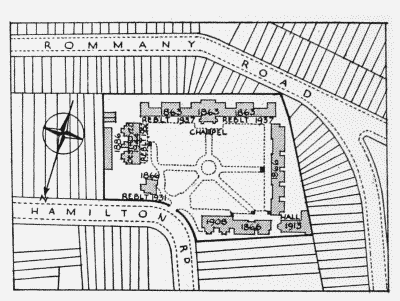
St. Saviour's Almshouses, lay-out plan
The almshouses are all of two storeys and built of red brick with red tiled roofs. The older blocks on the north and west sides show Gothic influence in their narrow stone-mullioned windows and pointed-arched doorways. Their roofs are punctuated by small gables over each house. The chapel, which has heavily buttressed walls, is surmounted by an attenuated flèche. There are traceried windows over the altar and entrance. The modern ranges flanking the chapel and the east block are lighted by windows with horizontal steel sashes. Their façades are relieved by the setting forward of the entrances and staircases.
The commemorative tablets from the old buildings in Southwark recording the gifts of Henry Jackson, Henry Spratt, Henry Young and a number of ratepayers in the parish of St. Saviour are incorporated in the north and west blocks. The stone commemorating Edward Alleyn's gift is set up in the centre of the wellkept garden. Beneath Alleyn's arms and the date 1646 it is inscribed as follows
THE GIFT OF EDWARD
ALLEYN ESQVIER
CHVRCH WARDENS AT THE
SAME TYME
CLEMANT RICHARDSON
IOHN HARDWICKE
WILLIAM CROFTS
WILLIAM CHAPPELL
RICHARD DREWRY
& IOHN ALLSY
British Home and Hospital for Incurables, Crown Lane
The British Home for Incurables was founded in 1861 and until 1894 occupied premises in Clapham Rise. (fn. 139) The buildings at Crown Lane were designed by Arthur Cawston, who died in a shooting accident in June 1894. (fn. 140) The hospital was opened by the Princess of Wales (later Queen Alexandra) on July 3, 1894; (fn. 141) a number of additions have been made later. The hospital consists of an asymmetrically arranged group of three-storey red brick and stone buildings which are plainly detailed in the Tudor and Jacobean styles. The quality of the design is domestic rather than institutional.
West Norwood Free Public Library, Knight's Hill
The site of this building was given by Frederick Nettlefold, who laid the foundation stone on November 26, 1887. (fn. 141) The architect was Sidney R. J. Smith, and the cost of the building was £4,050. (fn. 142) The library was the first to be provided by the Lambeth Public Libraries Commissioners, and was opened by Lord Northbrook and Sir Lyon (afterwards Lord) Playfair on July 21, 1888. (fn. 141) The contractors were F. and H. F. Higgs. (fn. 82) The building was extended southwards in 1936 to the designs of Osmond Cattlin, Lambeth Borough Engineer. (fn. 143)
The library is a three-storey building in Classical style showing Flemish influence, and is built of red brick with terracotta and Ham Hill stone dressings. It has a colonnaded entrance loggia with an enclosed balcony above. The balcony is fronted by tapering fluted piers bearing busts of famous men of letters. The piers are set forward at the centre and support a scrolled pediment. The wings flanking the entrance loggia are surmounted by broad overhanging dormer windows. The roof, which is of mansard type, is covered with red tiles.
Upper Norwood Public Library, Westow Hill
Designed by Edward Haslehurst in 1899 for the Libraries Commissioners of Lambeth and Croydon, (fn. 144) this is an uninteresting stone-dressed red brick building with effete Classical detail. It has two main storeys and is gabled on the main and side elevations.
DOMESTIC BUILDINGS
Peabody Buildings, Rosendale Road
This estate (fig. 62) comprises nearly twenty acres, including the garden allotments on Knight's Hill, and is a late example of the work of the Peabody Trust, whose first buildings were erected in Spitalfields in 1864. (fn. 145) The blocks of flats fronting Rosendale Road were designed by William Cubitt and Co. and were erected in 1901 (fn. 146) (plate 73b). In 1905 82 cottages were added, and another 64 in 1907–8; (fn. 145) they were designed by W. E. Wallis. (fn. 146) The estate is further from the centre of London than most of the Peabody Trust's buildings, and some difficulty was at first experienced in obtaining tenants. The estate includes a communal hall built in 1913, an unusual feature of the Trust's work. (fn. 145)
Nos. 119 and 121 Norwood Road
Formerly Norwood Lane
The site of these two houses formed part of Brockwell Green Farm, which was purchased by Lord Thurlow in 1785, and which was a detached portion of the Manor of Leigham Court and of the parish of Streatham. In 1826 Lord Thurlow's trustees entered into a provisional agreement (which was subsequently approved by the Court of Chancery) to sell 27 acres of the farm to John Prince of Leadenhall Street, (fn. 147) slopseller. (fn. 148) These two houses (fig. 63) were probably erected soon afterwards; they were certainly standing in 1836. (fn. 149) The interest of these paired houses lies in the unusual character of the front elevation, a Grecian design reflecting the influence of the late 18th century French architect Ledoux. The stucco-faced fronts combine to present a uniform composition of two storeys above a semi-basement, each story having six rectangular windows widely spaced at equal intervals. Each tier of windows is underlined by a plain sill-band, that to the ground floor being deeper than that to the first floor, which breaks forward below each window. Architraves are omitted but on the wall Face over each ground-floor window is a flat pediment. The overhanging eaves of the low-pitched roof are carried on widely spaced wood mutules. Each house has a side extension to the ground floor, from which projects an enclosed porch with columns, originally with Ionic capitals, framed by a plain architrave and surmounted by a flatt pitched corniced pediment. No.119 has, unfor unately, suffered considerable mutilation.
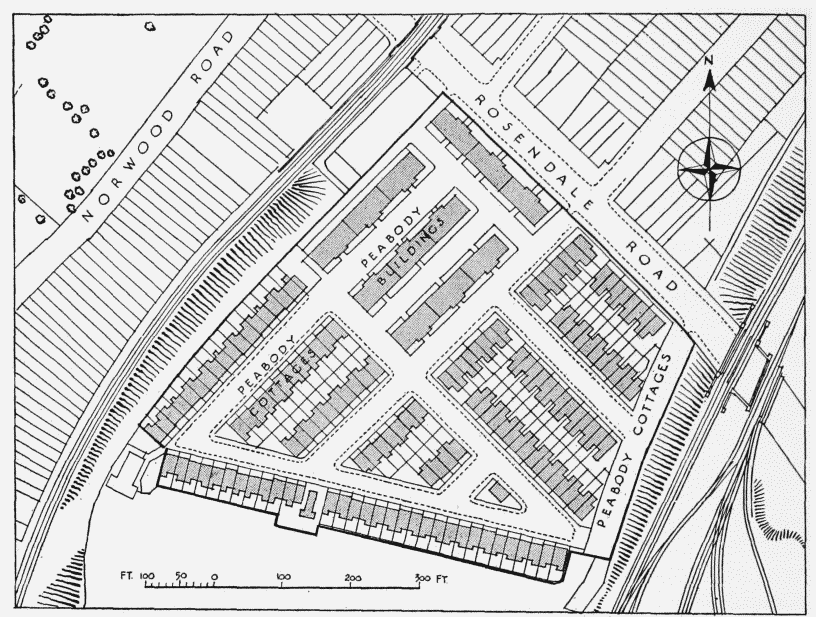
Peabody Estate, Rosendale Road, lay-out Plan
Nos. 212 and 214 Knight's Hill
The site of these houses formed part of Norwood Common, and under the Inclosure Award of 1810 was allotted to Mary Nesbit. She surrendered this and other land to George Bacchus in 1820. (fn. 150) these houses were probably built shortly before 1839. (fn. 151) they are a pair of plain stock brick houses, three storeys high with two storey wings, slightly recessed and containing the entrances. These have fluted quadrant reveals with dentilled caps, the dentils continuing across the transoms. No. 214 has original cast-iron window guards on the second floor and No. 212 has an entrance fanlight of circular pattern.
Nos. 3 and 5 Gipsy Road
The site of these houses formed part of Norwood Common, andunder the Aware of 1810 was allotted to Charles Field (fn. 152) of Lambeth Marsh, wax chandler. In 1811 he obtained licence to demise his property for 21 years, (fn. 153) but this was evidently too short a term for his purposes, for in 1834. he obtained another licence to demise this and adjoining land to John Loat of Balham Hill, builder, for 65 years from 1832. (fn. 154) These two houses were built under this licence and were described as “lately erected” in 1842. (fn. 155) They are paired houses of three storeys sharing a stock brick front of simple but good design which is adorned with a sill-bind to the first-floor windows, and a crowning triangular pediment with a lunette window in its tympanum. This central feature stands slightly forward from the flanking wings of two storeys which contain the entrance doorways.
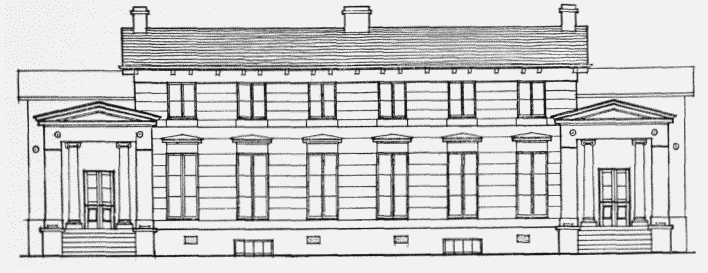
Nos. 119 and 121 Norwood Road, 1826–36
No. 109 Clive Road
Formerly Dudley House
This house was erected in 1882 and occupied by Ralph Gardiner, plasterer and builder. (fn. 156) The elaborate and rather bizarre plasterwork on the façade (Plate 58b) suggests that Gardiner intended it to advertise his skill.
POLICE STATION
No. 10 Gipsy Hill
Formerly Gipsy Hill Police Station
This building was designed by Charles Reeves, Meteopolitan Police Surveyor, and erected in 1854 at a cost of £2,461 (Plate 38a). It was converted for use as polkice flats in 1948. (fn. 157)
RAILWAY ARCHITECTURE
The first railway in Norwood was the West End of London and Crystal Palace Railway, which was opened in 1856; amongst its stations were those of West Norwood and Gipsy Hill. the lines built by the London, Chatham and Dover Company under its Metropolitan Extensions Act of 1860 ran slightly east of Norwood The line built by the London, Brighton and South Coast Railway from Peckham to Streatham involved the construction of several iron bridges, including one over Rosendale Road (Plate 39d), and a tunnel under Knight's Hill (Plate 39b). R.J. Hood was the engineer for this line, which was opened in 1868. A brick bridge (Plate 39c) across Rosendale Road carried the London, Chatham and Dover Company'a line from Herne Hill to Tulse Hill, which was opened in 1869. (fn. 158)
NORWOOD PARK
The 33½ acres of land which form this Park were bought by the London County Council in 1909 from the Ecclesiastical Commissioners for £15,000, (fn. 159) of which Lambeth Borough Council contributed £5,000 and £2,500 were collected by local subscription. (fn. 160) The Park was opened on June 14, 1911. (fn. 161)