Survey of London: Volume 37, Northern Kensington. Originally published by London County Council, London, 1973.
This free content was digitised by double rekeying. All rights reserved.
'The village centres around St. Mary Abbots church and Notting Hill Gate', in Survey of London: Volume 37, Northern Kensington, ed. F H W Sheppard (London, 1973), British History Online https://www.british-history.ac.uk/survey-london/vol37/pp25-41 [accessed 30 April 2025].
'The village centres around St. Mary Abbots church and Notting Hill Gate', in Survey of London: Volume 37, Northern Kensington. Edited by F H W Sheppard (London, 1973), British History Online, accessed April 30, 2025, https://www.british-history.ac.uk/survey-london/vol37/pp25-41.
"The village centres around St. Mary Abbots church and Notting Hill Gate". Survey of London: Volume 37, Northern Kensington. Ed. F H W Sheppard (London, 1973), British History Online. Web. 30 April 2025. https://www.british-history.ac.uk/survey-london/vol37/pp25-41.
In this section
CHAPTER I - The Village Centres around St. Mary Abbots Church and Notting Hill Gate
The Victorian church of St. Mary Abbots stands on approximately the same site as its predecessor, a small and modest brick church which had been largely rebuilt between 1683 and 1704, but with a building history dating back to the Middle Ages. A village settlement had grown up around this church, particularly along the highway between London and Hammersmith (now Kensington High Street) and at the southern end of the lane (now Kensington Church Street) which wound its way northwards from the church. By the end of the Middle Ages much of this land was copyhold of the manor of Abbots Kensington, some of it remaining so until the twentieth century.
The Manor of Abbots Kensington
In c. 1100 Aubrey de Vere, who was lord of the manor of Kensington, presented the church and lands in Kensington to the Abbey of St. Mary at Abingdon at the request of his dying son Godfrey, who had previously been cured of an illness by the abbot. This grant, which was confirmed by royal charter, gave rise to the subsequent use of the name Abbots Kensington for the new manor thereby created and to the designation of the church as St. Mary Abbots. There is some doubt about how much land was involved, but the clearest evidence indicates that the grant consisted principally of two hides and a virgate, or approximately 270 acres. (fn. 13)
The Abbey of Abingdon was dissolved in 1538 and for most of the sixteenth century the ownership of the manor was vested in the Crown. A succession of tenants held the manor on lease, until in September 1599 it was purchased by trustees acting for (Sir) Walter Cope, a politician of some influence at Court. (fn. 14) Cope had already acquired two manors or so-called manors to the north of the highway now known as Kensington High Street, those of West Town and Notting (Nutting, Knotting) Barns. In neither case do these appear to have been full manors, for there is no evidence that manorial courts were held in either, and in the fifteenth century both seem to have been connected with the manor of Kensington, which was still owned by the de Veres. (fn. 15) West Town, which Cope bought in 1591, consisted in modern topographical terms of the area between Kensington High Street and Holland Park Avenue to the west of Holland Walk. (fn. 16) Notting Barns, which Cope purchased in 1599, (fn. 17) lay to the north of Holland Park Avenue, but its extent is not certain. (fn. 1) By the 1670's, however, the manor of Abbots Kensington was regarded as encompassing the whole of the parish lying north of Kensington High Street. (fn. 19). This no doubt over-simplified interpretation of the manorial structure may have arisen because from the early seventeenth century Cope and his descendants owned both of the two main manors in the parish—Kensington (by that time known as Earl's Court (fn. 20) ) and Abbots Kensington—and the rights and extents of the two manors may have become confused by this common ownership.
When Cope became owner of the manor of Abbots Kensington in 1599, the tenant was Robert Horseman. The two men had been engaged in a lengthy feud, (fn. 21) and it was no doubt in order to secure an advantage over his adversary that Cope used his influence in high places to secure a grant of the manor from the Crown. Shortly afterwards, however, the dispute was taken to the Privy Council and Cope was required to sell to Horseman a substantial part of the manor. By the subsequent conveyance in November 1599 Horseman secured the fee simple of the house in which he was living and over two hundred acres of land. (fn. 22) This house, which was known as the Manor House or Parsonage House, stood a short distance to the north-west of the parish church and was probably the medieval manor house of Abbots Kensington. The name Parsonage House suggests, however, that it may also have been occupied at one time by incumbents of St. Mary Abbots. This was, in fact, the more frequently used name during the seventeenth century and the estate attached to the house came to be known as the Parsonage House estate. (fn. 23) The land sold by Cope's trustees to Horseman included not only a large part of the district now known as Campden Hill, but also areas north of the highway to Uxbridge (now Notting Hill Gate and Holland Park Avenue) which were within the manor of Abbots Kensington, particularly the Northlands (Norlands) and the North Crofts (now the area of Pembridge Square and Pembridge Gardens).
Horseman died in 1600, (fn. 24) and his son, also named Robert, sold the land to various purchasers. The Parsonage House itself, together with about seventy acres of land, was sold in 1616 to Sir Baptist Hicks (later first Viscount Campden) for £2,679. (fn. 25) Most of this land was absorbed into the Campden House estate and later formed the bulk of the Phillimore estate, but in 1656 the third Viscount Campden sold the Parsonage House and approximately eight acres to John Sams, a mercer, for £900. (fn. 26) Under the terms of Sams's will the property passed to his wife's family, named Booth. (fn. 27)
The Jones-Price estate
In 1722 the Booth family sold the Parsonage House and about four acres of adjoining land for £1,600 to John Jones, a Kensington bricklayer. (fn. 28) Four years previously Jones had purchased the freehold of the Crown Inn (formerly the Angel) in Kensington High Street, and in the stable-yard behind he laid out a cul-de-sac (now Kensington Church Court) and built fourteen houses there, ten on the north side and four on the south. (fn. 29) These houses were known at first as Jones's Buildings; none have survived. But the arched entrance to the court (originally the entrance to the stable-yard) has been preserved, although the arch itself and the adjoining premises to the north (formerly a police station) were rebuilt in 1872–3. (fn. 30) (fn. 2)
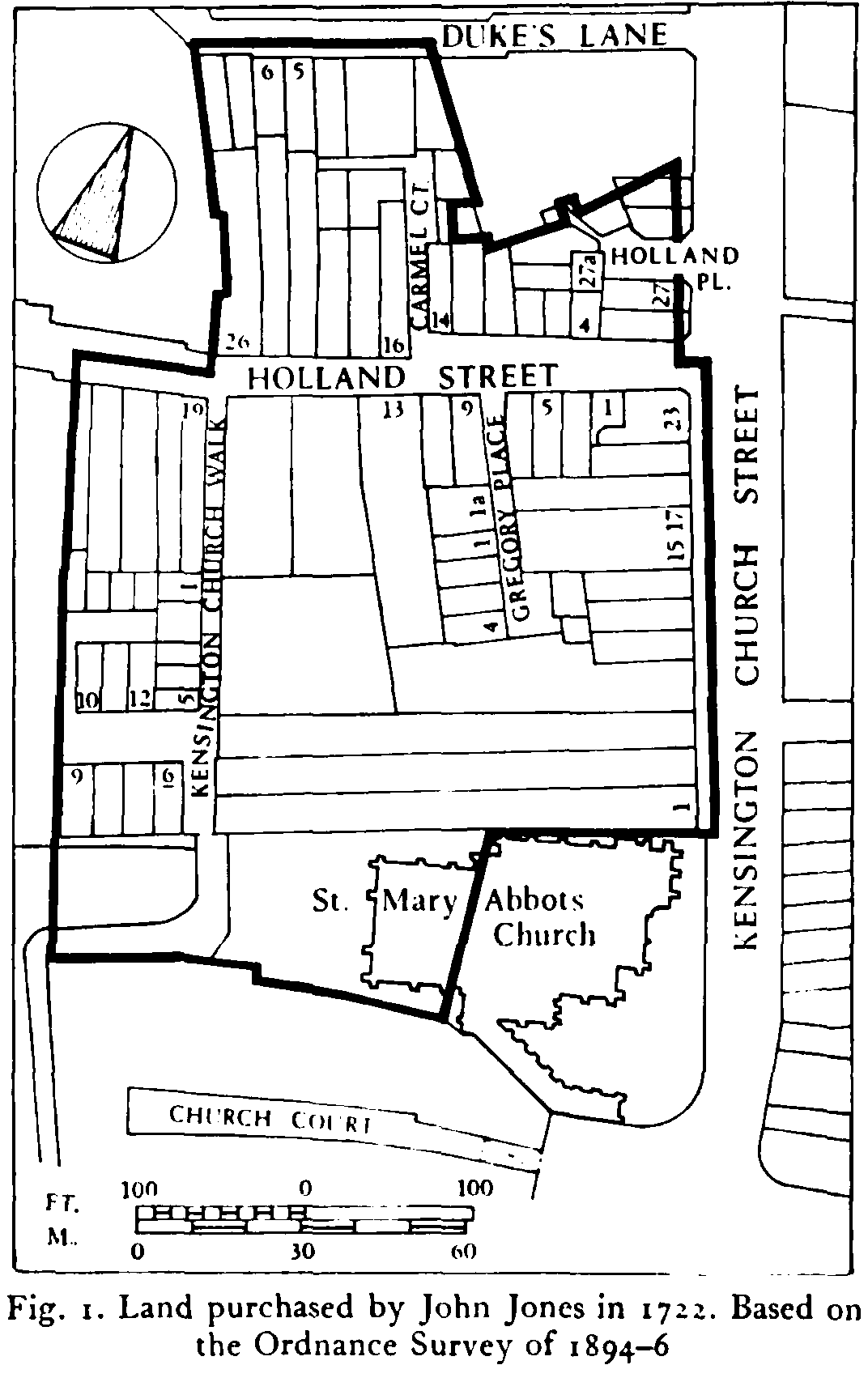
Land purchased by John Jones in 1722. Based on the Ordnance Survey of 1894–6
The extent of the area purchased by Jones in 1722 is indicated in fig. 1. (fn. 3) On a small-scale plan of 1717 the Parsonage House itself appears as a substantial U-shaped building situated close to Kensington Church Street, halfway between the old church and the present Holland Street. (fn. 33) But from the evidence of deeds it seems that the house was sited further west, between the modern Gregory Place and Kensington Church Walk, north of the churchyard and south of the now demolished No. 15 Holland Street. On the north side of the house was a large courtyard called Parson's Yard through which passed a public way from Kensington Church Street to Holland House. The name Parson's Yard was later applied to this way, which was re-named Holland Street in the early 1800s. (fn. 31) Soon after Sams had acquired the Parsonage House in 1656 it was divided in two and leased to tenants, and by 1722 many of the adjoining barns, stables and coach-houses were said to have been converted into houses. (fn. 23)
Jones demolished all the buildings on the estate, except the Parsonage House and an old conduit, and with the help of his nephew and son-in-law John Price, another Kensington bricklayer, he began to erect houses. (fn. 23) The first to be built, by November 1724, were on the south side of Holland Street (Nos.3–7 odd), the west side of Kensington Church Street (Nos. 9–23 odd) and in Gregory Place. (fn. 34) Of these Nos. 9–17 Kensington Church Street still remain but only the 'double house', now numbered 15 and 17, appears to retain (in its upper storeys) both its original brick front and segmental window openings. A few houses were let by Jones on long leases to building tradesmen who had, presumably, assisted in the work. (fn. 4) The corner house (No. 23), which was rebuilt in 1870, was originally an inn called at first the George and later the Catherine Wheel. (fn. 36)
On the north side of Holland Street Jones built Nos. 4–8 (even), since rebuilt, and behind them he laid out a stable-yard, now the site of Holland Place. (fn. 37) The original entrance to the yard was in Holland Street; the present entrance from Kensington Church Street was made in 1882 when that street was widened and the houses between Holland Street and Duke's Lane rebuilt. (fn. 38) Vestiges of Jones's stable buildings may survive in the weatherboarded house No. 27A Kensington Church Street. Jones may also have been responsible for building a dissenting meeting-house which stood on the site of the present Nos. 10 and 12 Holland Street by January 1725. (fn. 37)
The progress of this development was not entirely without incident. In July 1726 Jones pulled down some of the wall along the northern boundary of his estate and began work on four houses fronting on Duke's Lane (formerly Campden Lane). But he immediately encountered opposition from Lord Lechmere, the owner of Campden House, who claimed the lane was private and objected to Jones's using it to bring in cartloads of building materials (the way through Parson's Yard having apparently been blocked by the fall of a house there). Lord Lechmere complained to two justices of the peace that Jones had made a 'forcible and riotous' entry upon his land, and on the following day the justices, attended by a constable, were present when two of Jones's carts, laden with sand, were stopped at the entrance to the lane by workmen from Campden House. (fn. 23)
What happened next is disputed. Witnesses hostile to Jones later claimed that an unseemly fracas ensued 'with much rudeness and sauceyness in the lane'. Jones's workmen were said to have made 'very loud Huzzas and Shouts' ridiculing the justices and 'urging disrespectful words of Lord Lechmere', and Jones himself, who had been fetched from a barber's shop, climbed on to the scaffolding, and was seen to be encouraging his workmen to resist. One of the justices fined him £20 on the spot for obstruction and when Jones refused to pay he ordered the constable to take him to Newgate. Jones was 'put into a coach and hurried to Prison', but while the constable was talking to the turnkey 'he slipt away and went as fast as he could towards the Temple to his Lawyer' with one of Lord Lechmere's servants in hot pursuit. Jones later returned to Newgate with his Welsh lawyer, Thomas Vaughan, who paid the £20 and 'prevailed' upon the keeper (for 'a guinea fee') to enter Jones's name in the admissions book. Two days later Lord Lechmere filed a complaint in Chancery and was granted an injunction restraining Jones from proceeding with the building. Jones himself subsequently instituted proceedings against one of the justices for wrongful arrest. He tried unsuccessfully to bribe the constable to give evidence on his behalf, but another witness ('old Jasper Orchard') was persuaded to sign an affidavit in Jones's favour, having previously been plied with glasses of 'Welch Ale' at the George. (fn. 23) The outcome of these cases has not been traced; possibly they were still undecided when Jones died a few months later in March 1727.
In his will Jones bequeathed his Kensington property to his wife Rebecca and his son-in-law John Price, who together continued to build on the estate. (fn. 39) They completed the four houses in Duke's Lane (since rebuilt); (fn. 40) they laid out a passage (now Carmel Court) between Holland Street and Duke's Lane and built a house on the east side (now demolished), (fn. 41) (fn. 5) and in Holland Street they built Nos. 1 and 16–26 even (completed by 1728–9), (fn. 42) Nos. 10 and 12 (in existence by December 1736), and probably No. 2 (fn. 43) (Plate 38b ; fig. 2). Of these only Nos. 1, 2 and 16 have been completely rebuilt. Nos. 10 and 12 stand on the site of the earlier, short-lived, meeting-house.

Nos. 10–26 even Holland Street, elevations
This building activity was followed by a period of about twenty years in which no new houses appear to have been erected. During this time several parts of the estate were sold, including two plots of unbuilt land on the south side of Holland Street—the site of the present Nos. 19–25 (odd) in 1747, and the site of the now demolished Nos. 15 and 17 in 1758. (fn. 44) By 1760 the purchaser of the site of Nos. 19–25, Robert Pilkington, a gardener, had built two houses there. These were demolished when the present Nos. 19–25 were erected in the 1850's. (fn. 31) The sale of the freehold of No. 26 Holland Street in 1736 included the site of Nos. 7 and 8 Duke's Lane (Queen Anne's Cottages), which do not, however, appear to have been built until the late eighteenth century. (fn. 45)
None of this building had affected the Parsonage House itself, which under the terms of Jones's will had been bequeathed in trust to Price to provide an income for the maintenance of Jones's three grandchildren until the youngest should come of age. The house was then to be sold to raise funds for various bequests. (fn. 39) But provided he could pay these bequests Price was not obliged to sell the property, and he evidently did not do so. It is not known when the Parsonage House was demolished, but by 1760 Price had built six new houses (four in Kensington Church Street, and two in Holland Street) with gardens extending over the site. (fn. 46) The four houses in Kensington Church Street still survive (now Nos. 1–7 odd), though No. 1 has been refaced. In Holland Street, only one of the two (now No. 13) remains (Plate 38a fig. 3). These two, originally a semi-detached pair, were first occupied in 1764, No. 13 by Lady Mary Fitzgerald, and the adjoining house by a Colonel Pownall. (fn. 31) Pownall's house was rebuilt as two (now Nos. 9 and 11) in 1838–9 (Plate 38a), and at the same time four more houses were built in the garden behind (now Nos. 1–4 Gregory Place). (fn. 47) From 1894 to 1915 No. 13 was occupied by the artist Walter Crane, who decorated the walls with some of his celebrated wallpapers, none of which remains. (fn. 48)
In April 1763 Price offered to sell to the Vestry a plot of land on the south side of the estate, formerly part of the Parsonage House garden, for an extension to the churchyard of St. Mary Abbots. His offer was accepted, and in October, some months after his death, the land was conveyed to the Vestry by his executors and trustees. (fn. 49) In the following year most of the remaining parts of Price's estate were partitioned by his trustees and sold to Thomas Dade of Soho, carpenter, and Thomas Wilson of St. James's, Westminster, haberdasher. (fn. 50)
On the south side of Holland Street the ground between No. 13 and Kensington Church Walk remained undeveloped until 1833; when half the area was purchased by William Outhwaithe of Hammersmith, bricklayer, and the other half by Robert Hartley of Kensington, gentleman. (fn. 51) Outhwaithe immediately built No. 15 Holland Street on his plot and some years later, in 1846–7, Hartley built No. 17, a detached house known at first as Hartley Villa and later as Raimond House. (fn. 52) The "sites of both houses are now occupied by a block of flats, Ingelow House, named after Jean Ingelow, the poetess, a former occupant of No. 15. (fn. 53)
The west side of Ingelow House faces Kensington Church Walk which had existed as a cartway leading to the Parsonage House since at least 1726. In 1767 the vicar agreed to allow the Vestry to make 'a constant thoroughfare' through the churchyard from the south-east corner with a gate into Church Walk to be kept open during the day, (fn. 54) but the present extension through the churchyard to Kensington High Street was not made until after the Vestry had acquired the southern end of Paramour's Pingle in 1814 (see page 50). None of the present rather undistinguished buildings in Kensington Church Walk appear to be earlier in date than the mid nineteenth century. The little group of seven houses on the west side (Nos. 6–12 consec.) was erected in 1875–6 by Lucas and Son of Kensington Square, builders. (fn. 55)
The Conduit Close
Among the lands bought by Sir Baptist Hicks from Robert Horseman in 1616 was a four-acre field on the east side of Church Lane called 'the More', or Conduit Close. (fn. 25) In terms of the present topography the area of Conduit Close is bounded on the north by Hamilton House and Vicarage Court, on the south by the buildings on the north side of Old Court Place, on the east by the houses in Palace Green, and on the west by Kensington Church Street. In 1656 the third Viscount Campden sold part of this close to John Sams and another part to Thomas Hodges the vicar of Kensington. (fn. 56) Hodges subsequently purchased some of Sams's piece, and at the time of his death in 1672 he appears to have owned slightly less than half the area of Conduit Close. (fn. 57) By this time the rest had passed into the ownership of Sir Heneage Finch, later first Earl of Nottingham, whose son sold it to the Crown in 1689. (fn. 58) The barracks in Kensington Church Street now occupy this site (see page 192).
Hodges had built two fairly substantial houses on his part of the Conduit Close, both of which survived until the second half of the eighteenth century. (fn. 59) The 'upper house' (the northern, and larger, of the two) attracted some distinguished tenants including Lady Bellasyse (Baroness Osgodby), Sir Thomas Parker, later first Earl of Macclesfield, Sir Robert Eyre, lord chief justice of common pleas, and Anne, Countess of Salisbury, widow of the fifth Earl. (fn. 60) In deeds of the eighteenth century the site of this house was usually described as the Little Conduit Close. The 'lower house' appears from a schedule of fittings of 1717 to have consisted of two storeys and an attic with two principal rooms on each of the first two floors and four rooms in the attic. The fittings at that time included marble fire-places with Dutch tiles and wainscoted chimney-pieces decorated with 'landskips'. (fn. 61)
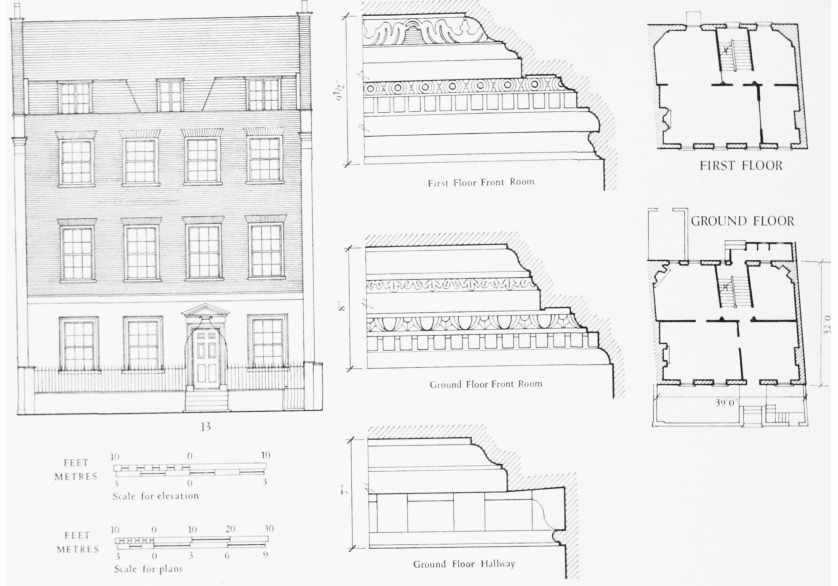
No. 13 Holland Street, plan, elevation and details
In 1675 Hodges's widow sold the two houses to Henry Hazard of Kensington, gentleman, though at the time of his death (in 1706) he appears to have retained only the 'lower house'. (fn. 62) The ownership of both houses was, however, reunited again in the second half of the eighteenth century under John Gorham of St. Andrew's, Holborn, a bricklayer. In 1764 Gorham bought the 'lower house', then described as 'lately decayed fallen or taken down', and rebuilt it, (fn. 63) (fn. c1) and in 1781 he bought and rebuilt the 'upper house'. (fn. 64) These two houses were later known as Maitland House and York House respectively. George III's daughter, Princess Sophia, lived at York House from 1839 until her death in 1848. Occupants of Maitland House have included James Mill and his son John Stuart Mill, and Sir David Wilkie, the artist. (fn. 53)
Both houses survived, with additions and alterations, until the early years of the twentieth century when the property was acquired for redevelopment. (fn. 65) The site is now occupied by York House Place, a block of flats called York House (1904–5, Durward Brown architect), (fn. 65) the Gas Light and Coke Company's neo-Georgian showrooms, now the North Thames Gas Board (1924–6, H. Austen Hall, architect, with stone carving by W. Aumonier, Plate 36d) (fn. 66) and Church Close, a Tudoresque block of shops and flats, with a central courtyard (1927–8, Yates, Cook and Darbyshire, architects). (fn. 67)
In the remaining area of the old village centre lying to the north of Kensington High Street the original pattern of settlement has been largely obscured by later rebuildings. On the east side of Kensington Church Street Nos. 2–28 (even) occupy the site of a group of copyhold houses of some antiquity, but no evidence has been found that any features earlier than the mid nineteenth century survive. Nos. 14–28 were rebuilt (in some cases possibly only refronted) as a result of road widening carried out in 1913. (fn. 68)
Further to the north, where Kensington Church Street curves to the north-west, some sites on both sides of the street (here anciently known as Love Lane) remained copyhold until the nineteenth century. To the west of Vicarage Gate the block of flats called Winchester Court was built on the site of a large house which had been converted into a convent in 1851 or 1852. The convent later became the Orphanage of St. Vincent de Paul. (fn. 69) Winchester Court was completed in 1935 to the designs of D. F. Martin-Smith in association with D. Beswick, and was described at the time as 'decidedly the most meritorious building to appear in this district for a long time'. (fn. 70) An unusual combination of brick and faience is used in the faç of the building, the ground and first floors being of black faience and the upper storeys of brick relieved by balconies of cream-coloured faience and narrow bands of blue faience.
To the north-west of Winchester Court was a terrace of houses called Wiple Place, now demolished. This was erected shortly before 1800 as a speculation by Charles Wiple of the City, a sugar-baker. (fn. 71) Although Wiple owned the freehold of the site when the terrace was built, the land appears at one time to have been copyhold. (fn. 72)
On the opposite (west) side of Kensington Church Street several buildings were erected at various dates on copyhold land. Some of these were later incorporated into the Pitt estate and are described in Chapter III. Two of the remainder, later Nos. 49 and 51 Church Street, were adapted in 1849 for use by the Kensington Dispensary (later the Kensington Dispensary and Children's Hospital), an institution which had been founded in a house in Holland Street in 1840 for the care of poor patients. In 1928 a new children's hospital was opened in Pangbourne Avenue (see page 317), the premises in Kensington Church Street having been vacated in 1925. The site is now occupied by Newton Court, a block of flats designed in 1926 by Wills and Kaula, architects. (fn. 73)
The drawings prepared for the Kensington Turnpike Trust by Joseph Salway in 1811 (Plate 44) show the north side of Kensington High Street when it still consisted of an attractive group of small-scale buildings of various dates. Of all the buildings depicted, only two, now numbered 98 and 100, survive (see page 61).
To the east of Kensington Church Street a major road widening scheme undertaken by the London County Council in 1902–5 (fn. 74) involved the clearance not only of nearly all the buildings along the north side of this part of Kensington High Street, but also of the narrow streets and alleys opening out of it, namely Kensington Place, Brown's Buildings and Clarence Place. Among the new buildings erected in place of those demolished were the Fire Brigade Station in Old Court Place to the designs of W. E. Riley, Superintending Architect of the London County Council, (fn. 75) Nos. 54–60 (even) Kensington High Street (Old Court Mansions) to the designs of Philip E. Pilditch (ground floor altered in 1963) (fn. 76) and Nos. 62–70 (even) Kensington High Street to the designs of Paul Hoffmann. (fn. 77) (fn. 6) Two buildings which survived road widening were the then recently completed (1894) Royal Palace Hotel, designed by Basil Champneys, (fn. 78) and the late seventeenth-century lodge at the west corner of Palace Avenue. Both were, however, demolished for the erection of the Royal Garden Hotel, which was completed in 1965 to the designs of Richard Seifert and Partners.
The Church of St. Mary Abbots
Plates 6, 7, 8, 9, 33a, 33b; fig. 4
The position of the church which was granted to the Abbey of Abingdon in c. 1100 is not known for certain. That either this church or a successor stood in the thirteenth century on the site of the present building is known from descriptions of the tower of the old church before its rebuilding in 1770–2 and from accounts by the builders of the Victorian church of stonework found when demolishing its predecessor. (fn. 79) This medieval church was largely rebuilt, except for the tower, between 1683 and 1704 (fn. 80) (Plate 6). When a survey of the building was made in 1866, it was found that many of the walls consisted of a thin skin of brickwork encasing a rubble core, indicating that in some cases the medieval walls may merely have been refaced with brick. (fn. 81)
The most distinguished part of the old church was the west tower, which was constructed in 1770–2 to the designs of John Smith, clerk of works at Kensington Palace. (fn. 82) It was built of brick with stone quoins and stringcourses dividing it into three stages; at the top was a battlemented parapet surmounted by a clock-turret on which stood a cupola containing the bells, the whole being topped by a weather vane. This elegant Georgian tower replaced a low stone structure, with a small spire which barely rose above the roof of the nave.
Despite several repairs to the fabric during the nineteenth century, the brick church was in 1866 declared to be unsafe by two architects—Gordon M. Hills and T. Hayter Lewis. The vicar, Archdeacon Sinclair, decided that a new church should be built on 'a scale proportioned to the opulence and importance of this great Metropolitan parish'. A building committee decided unanimously at its first meeting in May 1867 that the new church should be built on the site of the old, and engaged (Sir) George Gilbert Scott as architect. By the end of June, Scott had prepared plans and elevations. He estimated that the cost of the structure would be £35,000, an expenditure he thought necessary to make the church worthy of the importance of the parish. In July 1868 a meeting of parishioners approved a slightly amended design, and a faculty was secured to rebuild the church. (fn. 83)
The successive contracts for the construction of the church were concluded with Dove Brothers of Islington. Demolition of the old church took place in 1869 and the new building was sufficiently far advanced to be consecrated on 14 May 1872. The top stone of the spire was laid in an elaborate ceremony on 15 November 1879 to complete the main structure at a total cost, including fittings, of almost £45,000. Among the specialist firms employed were Farmer and Brindley, sculptors, Clayton and Bell, decorators, and Potter and Sons, smiths. (fn. 84)
In 1889–93 an arcaded cloister was built from the corner of Kensington High Street and Kensington Church Street to the south porch of the church. The architect was John Oldrid Scott, who also supervised the completion of the main body of the church after his father's death in 1878, and designed many of the fittings. The contractor for the cloister was John Thompson of Peterborough. (fn. 85)
St. Mary Abbots is a solid and impeccably detailed essay in the Early English style, with a six-bay clerestoried nave and aisles, two-bay projecting transepts (each bay under a separate gable), and a three-bay chancel with two-bay north and south aisles. The south chancel aisle is now a chapel, and the north now contains the organ and the sacristy.
The church is faced with Kentish ragstone and Bath stone dressings. The west front (Plate 7a) is symmetrical, flanked by buttresses crowned by octagonal spirelets, and by the low walls of the aisles. It is pierced by three large windows, each containing two lancet lights with a circular window above. A wheel window pierces the tall diapered gable which is surmounted by a cross of stone. The west doorway is richly carved with both foliate and naturalistic designs, and is surmounted by a gable capped by an elaborate cross. There are two wooden doors with great iron hinges and other furniture of foliate design. Between the doors is a trumeau above which is a seated Christus within a quatrefoil panel flanked by suppliant angels. The western walls of the aisles are each pierced by a window consisting of two lights with a sexfoil window above.
The great tower with spire (Plate 7b), unusually placed at the north-east corner of the church, is a conspicuous feature of this part of Kensington. (fn. 7) The massive tower consists of four stages, supported by large stepped angle buttresses slightly set back. Each face of the first, second and third stages is divided by a stepped buttress, and is pierced by small lancets set between the buttresses. The tall belfry stage is pierced on each face by deeply recessed arches carried on clustered shafts, and flanked by blind panels each containing two ornate niches originally intended for statuary. The central openings contain large pairs of lancets surmounted by roundels. Above the blind panels are quatrefoil panels set within circular frames. The belfry stage is crowned by a neat parapet of open arcading under a ball-flower cornice. The corner buttresses are capped by large octagonal spirelets. Within these spirelets at the base of the spire is an inner tier of crocketed pinnacles, and between these are the steeply gabled two-light openings of the upper belfry. The octagonal spire itself has two bands of lozenge diapering dividing it into three stages.

St. Mary Abbots Church, plan
The arcaded covered way added in 1889–93 (Plate 9b) is entered through a square, vaulted porchway with a gabled front and with octagonal corner turrets having pronounced colonnette shafts. Above, octagonal pinnacles rise from behind a battlemented parapet. The cloister continues at an angle to the porch, and each bay is stepped up slightly, as the floor is ramped, so that the approach to the south porch of the church itself is dramatic and mysterious. There are nine bays of this stone-vaulted covered way, the north side of which has open geometrical tracery with decorative iron-work in each bay, while the south side, apart from the first three bays, is solid. The south door of the church is set in a richly carved portal, with detached shafts supporting a richly carved arch. The dark wooden doors with elaborate wrought-iron hinges are excellent examples of Victorian crafts-manship and of Scott's detailing.
The interior (Plates 8, 9a) is commodious and stately, the walls being faced with smooth-dressed Bath stone. The detail is precise, but lacks variety. The west end of the nave, which is particularly impressive, has a doorway with two massive wooden doors set in pointed arches under rere-arches of flatter pitch divided by a trumeau, the whole being contained within a segmentally arched recess. Over the doors is a stringcourse above which rise three level windows of two lights each with simple geometrical plate tracery and roundels at the tops. Standing proud of this tracery are tall clustered colonnettes divided into three stages by roll-moulded shaft rings, and crowned by foliate capitals which support the rich tracery in front of the windows, giving an open-arch screen effect. In front of the mullions between each of the two-light windows is a free-standing cylindrical colonnette linked in two places to the mullions by little stone bridges level with the shaft rings. At the apex of each arch in the screen is a quatrefoil opening set immediately before each roundel. Above the central light, in the gable, is a large wheel window of five lobed lights recessed within a circle.
The arcades of the nave have pillars alternately quatrefoil and octagonal in plan. Over the arches is a roll-moulded stringcourse, above which is the clerestory, consisting of twelve windows each of two lancets and a quatrefoil. There is an arcade brought forward from the plate tracery of each window, giving lightness and delicacy to the detail. The aisle windows are pierced with paired lancets.
The nave roof is of wood, erected to designs by Romilly Craze in 1955, and replacing a timber roof destroyed in the war of 1939–45. Scott's original roof had transverse diagonal ribs, and was varnished and dark in colour. The new roof is a simple barrel vault which is canted in sections. The aisles retain their original roofs.
The large chancel arch has columns of marble marked off in four stages by roll-moulded shaft rings, and an elaborate hood mould.
The three-bay chancel has arcades on both sides, each of two bays, much more richly detailed than in the nave. The columns are composed of clustered colonnettes marked off by roll-moulded shaft rings at half their height. Grouped semi-circular shafts carry foliate capitals at stringcourse level, from which springs the quadripartite wooden vault of the chancel roof. The clerestory windows above the arcades consist of sexfoil roundels set in recessed pointed arches supported by attached colonnettes. The spandrels are filled with lush foliate carving.
The east bay of the chancel is richer still. The window mullions consist of several colonnettes, and the arches are fully moulded. There is no arcade as the chancel aisles are only two bays long. The geometrical east window is a lavish composition consisting principally of three main lights with a sexfoil and two small quatrefoil lights over them. This large window is flanked by single lights.
The chancel is furnished with a marble reredos and a finely carved and gilded altar. On the south side is a sedilia projecting forward from the wall, consisting of three cusped arches beneath steeply gabled canopies supported on slim colonnettes. There are iron grilles on either side of the chancel at the rear of the choir stalls.
The handsome wooden pulpit of 1697 comes from the old church. The baptismal font, carved by Farmer and Brindley, stands on a stone base and is carried on columns of polished marble; on top is a fine openwork canopy of wrought iron (Plate 33b).
Several monuments of interest survive from the old church. That to the seventh Earl of Warwick and Holland in the south transept, with a seated figure of white marble, is probably by J. B. Guelphi. Among some elaborate Baroque car-touches are those in memory of Thomas Henshaw, Colin Campbell and Philip and Elizabeth Colby. The severely classical monument to Aaron Mico (who died in 1658) is similar to the work of Joshua Marshall and is a good example of its period.
The stained glass windows were almost all by Clayton and Bell, and were mostly private gifts, although there were several erected by public subscription. The effect of the interior must have been very rich and sombre, but this has been dissipated to a considerable degree by the removal of the background glass, leaving the coloured figures on a clear glass ground in several windows in the nave, and by the pastel colours applied to the roof.
The tomb of Miss Elizabeth Johnstone, which stands in the churchyard to the north-west of the church, was designed by (Sir) John Soane in 1784-5 and carved by John Hinchcliffe the elder. Soane's own notes and drawings in Sir John Soane's Museum (Plate 33a) show a brick-lined vault covered with slabs of Portland stone on which rests a marble-faced sarcophagus, surrounded by iron railings. Only the sarcophagus is now visible in the churchyard. The monument was commissioned by the Earl of Bellamont, and Soane was paid £10 for his 'trouble'.
The Roman Catholic Church and Priory of Our Lady of Mount Carmel and St. Simon Stock, Kensington Church Street and Duke's Lane
Plate 27
The founder of this Carmelite community was Father Herman, who had been born Herman Cohen in Germany and had become a convert to Roman Catholicism, joining the order of Discalced Carmelites. He came to London in 1862 on the suggestion of Cardinal Wiseman and set up a temporary home with the Sisters of the Assumption in Kensington Square. In 1863 he rented a large house in Kensington Church Street on the site of the present Newton Court. The house, which had at one time been called Bullingham House but is not to be confused with the mansion of the same name on the Pitt estate (see page 50), had extensive grounds on its south side. The property, which was copyhold, was owned by Stephen Bird, a prominent local builder, who sold it to the Carmelites in 1864 for £3,500. The land was enfranchised, and Edward Welby Pugin provided designs for a church to be built in the grounds. Building began in 1865 and the opening ceremony took place on 16 July 1866. The church was built of stock bricks with stone dressings in a predominantly Early English style. It was lavishly fitted out over the course of several years, but was destroyed during the war of 1939–45. (fn. 86)
The present church was designed by Sir Giles Gilbert Scott, and was completed in July 1959. (fn. 87) The tall, gaunt exterior is faced with reddish-buff bricks and stone dressings. The style is a freely interpreted late Gothic, partly North European and partly Perpendicular in its origins. From the outside the church appears to consist of a very high clerestoried nave with steeply roofed lean-to aisles, each having three gables at right angles to the main body of the church. The interior is, in fact, aisleless, the dominant features being the pointed concrete arches which divide the church into seven bays and carry the steeply pitched roofs and the clerestory (Plate 27c). The ceiling above the clerestory is flat. The bases of these dominant arches are pierced by square-headed openings above which are pointed panels containing gilded and painted Stations of the Cross. Alternate bays of the side walls are occupied by chapels and confessionals.
Although the church is orientated east west, the liturgical 'east' is at the west end. The sanctuary is wide and shallow, lit by two tall windows that illuminate the large gilded angular reredos. The choir and organ gallery is at the 'west' end, over a small baptistry. There is a Lady Chapel 'north' of the sanctuary.
In 1875–6 the community obtained the copyhold interest in the remaining land along the north side of Duke's Lane for approximately £4,600. The property was subject to an existing lease and this may have delayed plans to build a new monastery on the site. In 1886, however, the copyhold was enfranchised, and the priory was built in 1886–9 by Edward Conder of Kingsland Road to the designs of Goldie, Child and Goldie. (fn. 88) It consists of a long range of five-storey stock-brick buildings with stone dressings in the Flamboyant style of sixteenth-century northern France (Plate 27a, b), and is connected by a corridor to the church.
Wesleyan Chapel, Clarence Place
Demolished
This chapel was built in 1836–8. (fn. c2) It was a small unpretentious building which seated only two hundred people, but it had a pleasing stucco front divided into three bays by Doric pilasters and crowned by a pediment.
Clarence Place was swept away by road improvements in 1902–5, but the chapel itself survived and was afterwards situated on the north side of a new street called Old Court Place. In c. 1905, however, it ceased to be used as a chapel, and the building was adapted for commercial purposes. It was demolished in 1962. (fn. 89)
Charity School, Kensington High Street
Also known as the National Schools. Plate 37d. Demolished
One of the best known buildings in Kensington until its demolition c. 1878 was the old parish charity school on the north side of Kensington High Street. The most notable feature of the building was a shallow bell-tower, capped by a broken pediment, rising through an open pediment—a fanciful device which led many authorities to the conclusion that it was designed by Sir John Vanbrugh. It was, in fact, the work of Nicholas Hawksmoor and was built in 1711–12, when he was clerk of works at Kensington Palace.
The charity school was founded in 1707. (fn. 90) Previously there had been a parish free school for poor children, which was held in a house on the north side of the High Street called the Catherine Wheel. (fn. 91) In 1709 the Vestry resolved that the trustees of the charity school, which appears to have been originally established in another building, should be allowed to rebuild the parish school-house and to have free use of it thereafter, provided that they agreed to teach the children of the free school there also. (fn. 92)
Rebuilding began in 1711, and an adjoining house, conveniently belonging to Richard Slater, a carpenter who was employed on the new building, was purchased to provide a bigger site. (fn. 8) The trustees resolved that 'the Designe of the said Building should be left to the care of Mr. Hawksmore'. Hawksmoor did not charge a fee, but the sum of £5 which he had pledged towards the cost of building was not collected. The total cost, including £97 paid to Slater for his house, was £1,180. (fn. 93) The charity school was built of brick with some stone dressings and consisted of three main storeys above a basement. The handsome street elevation was of three bays, the centre one projecting forward to form a porch at ground-floor level. Above the third storey this projection carried the two-stage bell-tower. In 1818 the upper stages of the tower above the roof ridge of the main building were removed. (fn. 94) The interior of the building was relatively plain, the only ornamental features of note being some panelling and a chimneypiece with engraved glass over it in the principal room on the first floor. (fn. 95)
As the population of Kensington grew the school had to expand. In 1804 a new girls' school was established in a house immediately to the west of the school-house which had been secured by the trustees in 1721. (fn. 96) Shortly afterwards the school adopted the teaching methods of the National Society formed in 1811, and in 1817–18 a new school was built to the designs of Thomas Hardwick on the site of a public house called the Coach and Horses, which stood to the west of the new girls' school and which was purchased by the trustees in 1816. (fn. 93) Further schools were built in Church Court and Edge Street, and in 1875 extensive new school buildings were erected in Church Court to the designs of Gordon M. Hills, the London diocesan architect. The builders were Stimpson and Company of Brompton Road. (fn. 98) The various buildings along the Kensington High Street frontage, including the school-house designed by Hawksmoor, were sold to the Kensington Vestry in 1875 and shortly afterwards demolished to make way for the Town Hall erected in 1878–80. The stone statues of a boy and a girl which had been made by the mason Thomas Eustace (fn. 99) and placed on the front of the charity school, were preserved and erected on the north elevation of the school in Church Court (now known as St. Mary Abbots School) facing the churchyard.
Royal Kent Theatre
Plate 34a, b. Demolished
This small theatre, which had a brief and chequered history, was situated on the west side of Brown's Buildings (now Old Court Place). The site of the theatre, measuring approximately 40 feet from east to west and 80 feet from north to south, was 120 feet north of Kensington High Street. Most of this site is now occupied by the roadway of Old Court Place, for the original street called Brown's Buildings was little wider than an alley, a fact which no doubt helps to explain the theatre's unprepossessing exterior (Plate 34a).
It was first opened in 1831 as the Royal Kensington Subscription Theatre, but within a year the lessee, John Colston, became insolvent. The interior was remodelled on the lines of the Olympic Theatre in Wych Street, the name was changed to the Royal Kent Theatre, apparently in deference to assistance given by the Duchess of Kent in obtaining a licence for public performances, and the theatre re-opened on Easter Monday 1834, when it was described as a 'very handsome little Theatre'. Its history was not happy, however, and it was closed from time to time. Even when performances did take place they were not always noteworthy for the events on stage. In 1838 the company engaged to perform ran off with the takings, and in 1842 the management felt it necessary to inform their customers of the presence of 'police constables in every part of the house to prevent any disturbances'.
The first owner of the freehold was Thomas Wetherell of Hammersmith, who also owned other property in the vicinity. In 1838 the theatre was advertised for sale freehold at an auction and one report stated that 1,100 guineas had been paid for it, but the sale could not have been carried out for Wetherell remained the freeholder until 1843, when another auction sale was forced on him by a mortgagee and the building changed hands for £720. The last known performance took place in October 1846, and in 1849 John Ridgway, a local builder, paid £500 for the building, which was described as 'not now used for Theatrical performances and . . . untenanted'. He demolished the theatre and had erected five houses in its place by the following year. (fn. 100)
Vestry Hall, Kensington High Street
Plate 37a
In 1851, when the Kensington Improvement Bill was before Parliament, the Vestry decided to build a new Vestry Hall in place of the room attached to the old parish church, which was no doubt considered unsuitable for the meetings of the improvement commissioners. A faculty was obtained allowing the use of the southern part of the burial ground which had been added to the churchyard in 1814, and the new hall was built there in 1851–2 to the designs of Benjamin Broadbridge, an architect who lived in Ladbroke Square. The builder was Thomas Corby of Pimlico. (fn. 101) The style of the building, which is faced with red bricks and stone dressings, was no doubt intended to be in keeping with the older domestic architecture of Kensington, such as Holland House and Campden House.
After the building of the new Town Hall in 1880 (see below) the Vestry Hall continued to be used for municipal purposes and from 1889 until 1960 it housed the central public library of Kensington. (fn. 102) In 1880 the elegant iron railings and gate piers in front of the building were removed because the Vestry considered that they impeded the approach to the new Town Hall. (fn. 103)
Town Hall, Kensington High Street
Plate 37b (fn. c3)
Within twenty years of its opening, the Vestry Hall built in 1851–2 was proving too small, and the Vestry decided to build a new hall in Kensington High Street on the site of the National Schools, which were being moved to Church Court. In 1875 the Vestry bought the school buildings from the trustees for £7,100, and also purchased two houses in Church Court in order to provide a slightly bigger site. (fn. 104)
The design of the Town Hall (as the new building was called to avoid confusion with the old Vestry Hall) was the result of an architectural competition which was particularly badly organized even at a time when such competitions were frequently mismanaged. Buildings in the Gothic or the Elizabethan style were specifically excluded and the cost was to be not more than £18,000. Of sixty-five entries received, The Architect thought that sixty were 'of commonplace mediocrity'. A professional adviser, John Whichcord, was appointed, but his opinions were entirely ignored by the vestrymen, who disliked his predilection for the Queen Anne style, fearing that a building which looked like a board school might result. They chose a design by Robert Walker, and in so doing fulfilled the worst fear of The Building News, which had hoped that 'a commonplace Italian design will not be selected'. (fn. 105)
Walker's design was modified somewhat, largely because the purchase of two further houses in Church Court enabled the building to be enlarged. The builders were Braid and Company of Chelsea, whose eventual contract was for £30,549. The foundation stone was laid in December 18–8 and the Town Hall was opened in August 1880. (fn. 106) In 1898–9 an extension was built at the rear by Leslie and Company of Kensington to the joint designs of William Weaver, the Vestry's surveyor, and William G. Hunt, a local architect. (fn. 107)
Notting Hill Gate and Kensington Gravel Pits
In strict usage Notting Hill Gate is the name of a short stretch of the main road which follows the course of the ancient highway from London to Acton and Uxbridge. This stretch extends from Kensington Palace Gardens in the east to Ladbroke Terrace in the west, and its name recalls the presence here of a succession of turnpike toll gates, the last of which was removed in 1864. The name Notting Hill Gate has, however, been commonly applied to the general district on either side of the road, and in this respect it is the modern equivalent of the name Kensington Gravel Pits, which was used into the nineteenth century. The ground on both sides of the roadway now called Notting Hill Gate was dug for gravel from at least the early seventeenth century, (fn. 108) and some of the pits survived as large ponds until well into the nineteenth century (Plates 1, 5a). The establishment of a small village settlement here may have preceded the discovery of beds of gravel, for the point at which the lane from the parish church (now the northern part of Kensington Church Street, formerly Silver Street) joined the Uxbridge highway formed a natural situation for such a settlement. As in the case of the village centre of St. Mary Abbots, much of the land here was copyhold of the manor of Abbots Kensington.
Road widening and large-scale rebuilding has destroyed most of the visual evidence of this village settlement, but it may still be discerned in the pattern of such streets as Kensington Mall, Rabbit Row and West Mall, and in a few old houses on the north side of Notting Hill Gate and the east side of Kensington Church Street. Most of the houses in the area were small cottages, but there was at least one of some size, which is usually referred to as Craven House.
This stood in an acre of ground on the east side of Kensington Church Street, on or near to the sites of the present Nos. 158–164 even (fig. 5). It was purchased in the seventeenth century by William, first Baron (and later first Earl of) Craven, from Sir Robert Hyde (1595–1665), a lawyer who had sheltered Charles II after the Battle of Worcester and who subsequently became chief justice of the King's Bench. (fn. 109) (fn. c6) When Lord Craven died unmarried in 1697, this estate passed to another branch of the family under a settlement of 1669. (fn. 110)
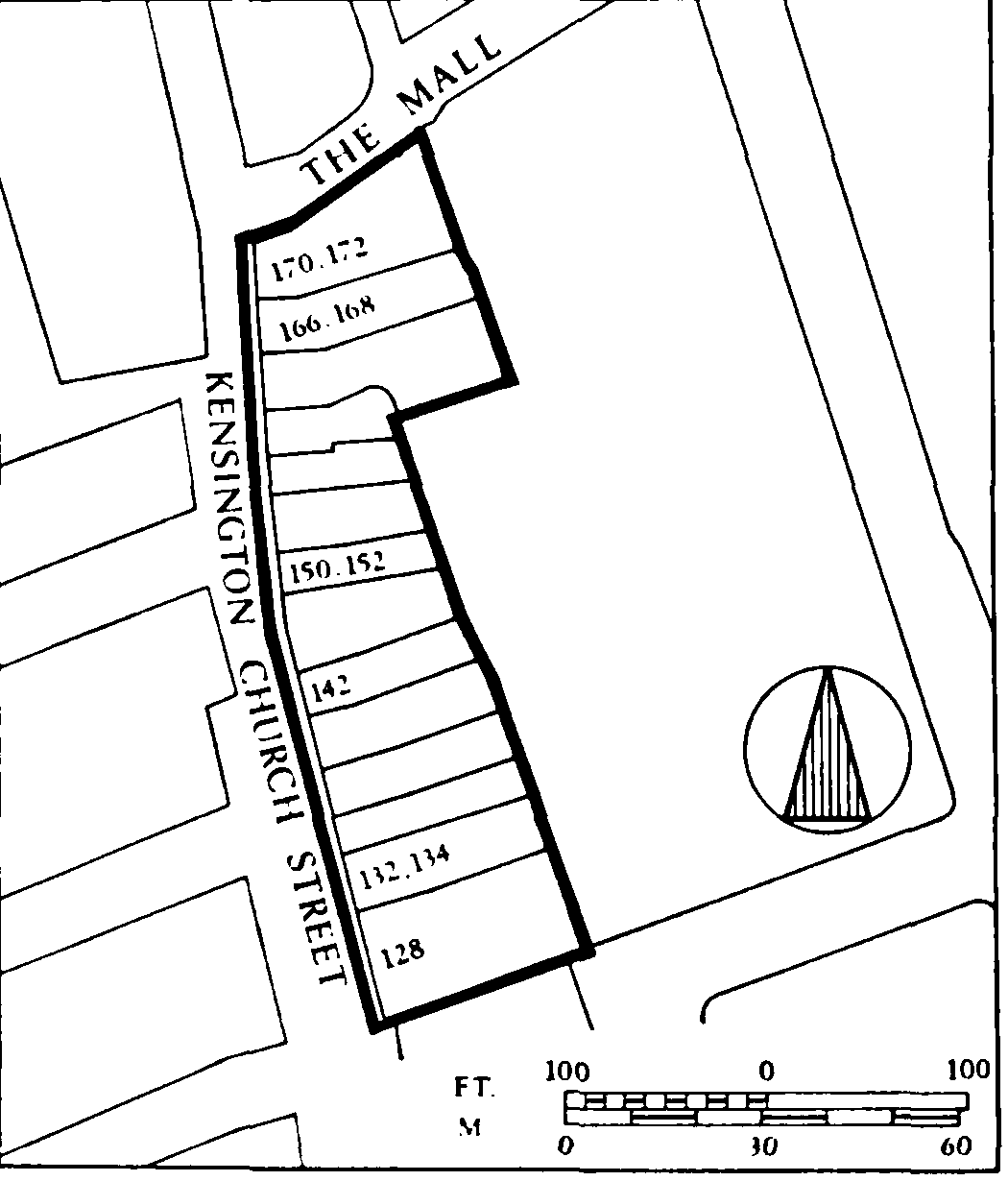
The Craven House estate. Based on the Ordnance Survey of 1862–72
In June 1736 the two members of the Craven family in whom the estate was then vested sold the property for £360 to the architect Isaac Ware, and six months later Ware conveyed a moiety of it to Charles Carne of St. Martin's in the Fields, glazier. (fn. 111) (Ware and Carne were subsequently engaged together in developing an estate in Chandos Street, Covent Garden, in 1737. (fn. 112) ) In August 1736 they entered into an agreement to let the estate at Kensington for building to Richard Gibbons of Bloomsbury, carpenter. Craven House was demolished and along the Church Street front Gibbons built twelve houses in two blocks of six, formerly Nos. 1–6 and 7–12 High Row, now Nos. 128–142 (even) and 152–168 (even) Kensington Church Street. Ware and Carne let the houses on seventy-one-year leases either to Gibbons, or at his request to the building tradesmen who had evidently assisted with the work. (fn. 9) There is no evidence that Ware exercised any control over the design of the houses. The last leases were granted in February 1737 and shortly afterwards Gibbons became bankrupt.
After the houses were built Ware and Carne sold most of the estate. The southern group of six houses (Nos. 128–142) was bought for £500 in October 1737 by James Allen of Dulwich, gentleman, who subsequently conveyed them in trust to Dulwich College to provide an income for a schoolmaster or schoolmistress to teach reading to poor children in Dulwich. The property is now owned by James Allen's Girls' School. (fn. 113) The northern group (Nos. 152–168) was bought by Martin Clare of St. Anne's, Soho, gentleman (founder of the Soho Academy), (fn. 114) and the small plot between the two groups (now the site of Yates's timber-yard, Nos. 144–148) was bought by James Swann of Kensington, gentleman. (fn. 115) No houses had been built here but by 1742 the site was occupied by a brewhouse. (fn. 116) Only a small piece of unbuilt land at the north end of the estate was not sold at this time. A detached house was later built here which may have been occupied at some time by Ware himself. (fn. 10)
Of the twelve houses built in 1736–7 only No. 138 (Plate 38d) retains something like its original appearance. In the adjoining house (No. 136) the window openings have been altered and at No. 152 a shop has been built out in front of the ground floor. The other houses have been either completely rebuilt or refronted. No. 128 (formerly No. 1 High Row) is basically the house built in 1736–7 though its present front is not original. It probably dates from about 1842 when the fourth storey and projecting wing appear to have been added. Residents of this house have included Muzio Clementi, the composer, William Horsley, the organist and composer, and his son John Callcott Horsley, the artist. Felix Mendelssohn, who was a friend of the Horsley family, paid several visits to the house. J. C. Horsley later built a studio behind the house with a large north-facing window which still survives. (fn. 118)
The street formerly known as The Mall included not only the short stretch now called Kensington Mall but also the northern part of Palace Gardens Terrace approximately as far south as the present Nos. 57 and 90, where until the 1850's the roadway ended at the edge of the open fields of the glebe lands. The east side of this road is now largely occupied by the ecclesiastical buildings which are described below. Nos. 116 and 118 Palace Gardens Terrace, which are approached by a right-of-way on the north side of the Essex Church, probably date from the early nineteenth century, together with part of No. 126 to the north, for in a will proved in 1833 the buildings on this site were described as 'three Cottages . . . erected and built upon the . . . Ground . . . whereon formerly stood an old decayed Cottage'. (fn. 119)
On the west side of the street Nos. 59–69 (odd) Palace Gardens Terrace and Mall Tavern were built as part of the speculations of Thomas Robinson, who was the principal developer of the Glebe and Sheffield House estates. Nos. 59 and 61 were erected on either side of the entrance to stables belonging to the de Murrietta family, who lived in Kensington Palace Gardens. Robinson was granted a ninety-nine-year lease of the sites by Mariano de Murrietta in 1854, and he in turn granted ninety-four-year leases of each house to the builder Thomas Stanway of Paddington, in 1859. (fn. 120) Nos. 63–69 and the public house were built on land purchased by Robinson in 1855. Thomas Stanway was also involved in their construction, but the principal builder appears to have been George Ingersent, who became the publican of Mall Tavern as soon as it was completed in 1856. (fn. 121)
A piece of land bounded by Kensington Mall, Rabbit Row, West Mall and Palace Gardens Terrace was purchased by Sir Samuel Morton Peto in 1863. (fn. 122) On the northern part of this land he had extensive stables built by the contractors Lucas Brothers for use in conjunction with the house which they were building for him at No. 12A Kensington Palace Gardens. (fn. 123) The site of the stables is now occupied by Broadwalk Court, a block of flats erected in 1934–5 to the designs of Robert Atkinson. (fn. 124)
On the southern part of Peto's land Lucas Brothers erected Mall Chambers (Plate 112b), a block of 'improved industrial dwellings', to the designs of James Murray, the architect of Peto's house. In December 1866, when the building was under construction, Peto sold the freehold of the site to the contractors for £3,350, no doubt because he was then in financial difficulties after the collapse of the firm of Overend and Gurney, and he may also have been indebted to Lucas Brothers for the building of his house. They apparently finished Mall Chambers as a speculation. (fn. 125) The Building News commented favourably on the accommodation provided, which was 'intended for a class somewhat above ordinary mechanics and labourers', but it considered that the exterior had 'rather the look of a warehouse'. (fn. 123) (fn. 11)
In the 1920's and 1930's the rapid growth of motor traffic made Notting Hill Gate a scene of increasing congestion. In 1937 the London County Council obtained statutory power to widen the street, and approved expenditure of over £1,000,000 for this purpose. But the outbreak of war in 1939 prevented the commencement of work, and approval for the project was not given by the Ministry of Transport (a substantial contributor to the cost) until 1957. The scheme involved the reconstruction by the London Transport Executive of the two underground stations as one interconnecting station with a concourse below the road, the widening of Notting Hill Gate for some 700 yards between Kensington Palace Gardens in the east and Ladbroke Terrace in the west, and the widening of short stretches of Kensington Church Street and Pembridge Road. The Council had begun to purchase the properties required for demolition in 1955, and in the following year, after finding that it would be under a statutory obligation to provide other housing for 460 persons who would be displaced, the Council resolved that a housing scheme for the provision of 118 dwellings at the Alton estate, Roehampton Lane, Wandsworth, should be submitted to the Ministry of Housing.
The reconstruction of the two underground stations began in 1957, and the road-works soon afterwards. Altogether some four and a half acres of surplus land became available for redevelopment, and the three largest sites, consisting of three and a half acres, were leased by the Council for ninety-nine years to Ravenscroft Properties Limited and City Centre Properties Limited. These three sites consisted of the area on the north side of Notting Hill Gate between Pembridge Road and Ladbroke Terrace, where shops and 145 dwellings were provided, some of the latter being in an eighteen-storey block; on the south side of Notting Hill Gate between Palace Gardens Terrace and Kensington Church Street, where shops and offices were built; and the area on the west side of Church Street, where offices predominated. The architects for the buildings on these three sites were Messrs. Cotton, Ballard and Blow. The road-works were completed by the end of 1960, and the buildings some two years later. (fn. 128)
Essex Church, Palace Gardens Terrace
This red-brick Unitarian church was erected in 1886–7 by John Chappell of Pimlico, builder, to the designs of T. Chatfield Clarke and Son. The site had been purchased in 1873 by Sir James Clark Lawrence, M.P., an alderman of the City of London, in order to provide a permanent home for a 'Free Christian Church' which had been founded in Kensington in 1867 and had subsequently met in various rooms and halls. (fn. 12) An iron church, which was opened in 1874, had to suffice until the funds to build a permanent church were provided by the sale of the Essex Street Chapel near the Strand. (fn. 130)
Second Church of Christ Scientist, Palace Gardens Terrace
The site on which this church stands has a short but varied ecclesiastical history. A chapel, which was described as 'a large, gloomy-looking structure of the Classical School', was erected here in 1861–2 under a ninety-year lease granted to Robert Offord of Kensington, who was the brother of the first minister, the Reverend John Offord of Plymouth. Although he was nominally a Baptist, Offord's ministry was basically non-denominational. In 1872, after a brief interlude under a Presbyterian minister, who also secured the freehold of the building, the chapel was purchased by a group of Swedenborgians who reopened it as the New Jerusalem Church. The chapel, which had one thousand sittings, proved too large for the needs of the community and in 1911 it was sold to the Christian Scientists. (fn. 131)
Plans for new buildings were drawn up by the architects, Sir John Burnet and Partners, but their execution was delayed by the war of 1914–18. Eventually the hall was completed by 1923 and the church by 1926 from designs by Thomas S. Tait, a partner in the firm. (fn. 132)
The complete group of dark-red brick buildings with stone dressings consists of a large church, vestibules, a hall, offices, and a house. The elements are disposed on two sides of an entrance court, the other two sides of which are formed by low walls and a screen of trees.
Externally there are motifs from Early Christian, Byzantine and Romanesque architecture, but the interior owes little to period precedent. The church itself is square on plan, and has raked floors with fixed seats. The principal feature of the interior is the organ, and the décor is uncompromisingly of the 1920's. The large window facing north, which is formed by four equal segmental arches, giving the effect of a shortened vesica piscis, is an unmistakable product of the 'Jazz Age'.
Gaumont (formerly Coronet) Theatre, Notting Hill Gate
Plate 34c
The Coronet Theatre was built for Edward George Saunders to the designs of the noted theatre architect, W. G. R. Sprague; the builder was W. Wallis of Balham. Designed to have a seating capacity of 1,143 and costing approximately £25,000, it was described effusively by The Era as 'a theatre of which the whole County of London may be proud'. It opened on 28 November 1898 with a performance of 'the celebrated Japanese opera' The Geisha, despite the fact that Saunders had not yet been granted a licence by the London County Council on account of the unfinished state of the building. A prosecution was brought against him by the Council and he was fined. In 1916 the theatre was adapted for use as a cinema, (fn. c7) and in 1950 the name was changed to the Gaumont. (fn. 133)