Survey of London: Volume 37, Northern Kensington. Originally published by London County Council, London, 1973.
This free content was digitised by double rekeying. All rights reserved.
'The Holland estate: Since 1874', in Survey of London: Volume 37, Northern Kensington, ed. F H W Sheppard (London, 1973), British History Online https://www.british-history.ac.uk/survey-london/vol37/pp126-150 [accessed 30 April 2025].
'The Holland estate: Since 1874', in Survey of London: Volume 37, Northern Kensington. Edited by F H W Sheppard (London, 1973), British History Online, accessed April 30, 2025, https://www.british-history.ac.uk/survey-london/vol37/pp126-150.
"The Holland estate: Since 1874". Survey of London: Volume 37, Northern Kensington. Ed. F H W Sheppard (London, 1973), British History Online. Web. 30 April 2025. https://www.british-history.ac.uk/survey-london/vol37/pp126-150.
In this section
Since 1874
When the Earl of Ilchester entered into possession of the Holland estate the total income from rents was £3,227 (of which approximately £130 was for property in Hammersmith). The rate of interest on the mortgage debt of £40,000 was at a stated 5 per cent, reducible to 4 per cent by punctual payment. Lady Holland's annuity had also to be paid, and was, in fact, to be secured by rent charges on the Earl's Dorset property. Holland House and its grounds had to be preserved, at least during Lady Holland's lifetime, and, far from gaining any immediate advantage, the Earl appears to have taken on a financial burden. The reversionary value of the estate was, of course, considerable, but the first building leases were not due to fall in until 1904. For several years little or no gain could be expected, and it appears that the Earl was in part motivated by the desire to preserve Holland House and its grounds from speculators. Owning extensive property in Dorset, he could afford to underwrite the relatively unprofitable Kensington estate until in the twentieth century its potential value could be realized by himself or his heirs. Lady Holland's was a most fortunate choice. After her death in 1889, the Earl and his successors lived in Holland House, and after the mansion had been largely destroyed by bombing during the war of 1939–45 its remains and its park were preserved for the enjoyment of the public.
Some immediate development of the estate was, however, necessary to offset the large outgoings, and had clearly been anticipated in the negotiations for the sale. (fn. 11) When more definite plans were announced later in 1874 Lady Holland objected, although it is difficult to see that she had any real cause for complaint. In the hope of reassuring her the Earl wrote, 'We [the Earl and his agent, Robert Driver] settled not to think of any of the land at present beyond the Little Holland house portion . . . and as we could not touch even that till after Xmas not be in a hurry to dispose of it hoping to get offers for a large class of house; the only piece we have offered at all at present is to V. Princeps [sic] to build a studio and house for Watts and that is not settled yet. We had no dealings with any builders, and as to £70 a year houses, the only plan my Agent drew out simply so as to get to the value of the land was villas with gardens £200 and over, the smallest we should think of but hoping to get offers for larger tenancies.' Lady Holland was not mollified, however, and when building was under way she wrote that 'all the building is a very bitter and sad pill to me'. (fn. 12)
The development in question was in Melbury Road, which was named after one of the Earl's properties in Dorset, and consisted of a mixture of houses designed by leading architects for successful artists, and in one case by an architect for his own residence, interspersed with large houses erected by builders as speculative ventures.
Little Holland House, which stood in the way of the new road, was demolished in 1875 (fn. 13) and the first house to be built was for George Frederic Watts. He had lived at Little Holland House for many years, and he transferred this name to his new house, which was designated No. 6 when numbers were assigned in 1878. The other artists' houses in Melbury Road which were begun in 1875 or 1876 were Nos. 2 and 4, a semi-detached pair, for (Sir) Hamo Thornycroft; No. 8 for Marcus Stone; No. 14 for Colin Hunter; No. 29 (originally No. 9) for William Burges; and No. 31 (originally No. 11) for (Sir) Luke Fildes. These houses are described on pages 142–9. Nos. 6 and 14 have been demolished.
While these important houses were being erected other plots in Melbury Road were taken by speculative builders for equally large, if aesthetically more pedestrian houses. George Martin of Putney built two red brick and stone houses on the north side of the road to the west of William Burges's Tower House. These (originally Nos. 5 and 7) were replaced by the neo-Georgian terrace, Nos. 19–27, in 1968–9. On the south side of the road, between Stone's and Hunter's houses, William Turner of Chelsea built two detached four-storey houses (Nos. 10 and 12). These were demolished c. 1964 for the erection of Stavordale Lodge. To the south of Colin Hunter's house, Turner also built the semi-detached pair, Nos. 16 and 18; William Holman Hunt lived in No. 18 from 1903 until his death in 1910. All of these houses were built under ninety-year leases at ground rents of between £70 and £100 with the first two years at half rent. (fn. 14)
The initial phase of building in Melbury Road was concluded with the erection of two more houses on the north side at the Addison Road end. George Stephenson of Chelsea gave notice of his intention to build two houses in 1879 and 1880, but apparently only completed one. This was the original No. 1, for which he was granted a ninety-year lease in January 1880. (fn. 15) The style of the house appears to have been derived from the work of J. J.Stevenson. In 1935 it was divided and is now known as East House and West House. No. 13 (originally No. 3) was probably completed by Lucas and Son of Kensington Square, and an eighty-seven-year lease was granted to James Stratton Thompson of Cromwell Road in 1882 at an annual ground rent of £100. (fn. 16)
The leasing of plots on the south side of Melbury Road necessitated the demolition of some of the farm buildings attached to Holland Farm. This survival of the estate's rural past had inevitably shrunk in area as building activity progressed. In 1854, when a new twenty-one-year lease was granted, the farm consisted of sixty-three acres, chiefly pasture, and was let at an annual rent of £250. (fn. 17) This lease, however, contained a provision that Lord Holland could take back any part of the farm for building purposes on granting the lessees an abatement of rent, and by the time the estate was sold in 1874, Holland Farm brought in only £112 in rent. (fn. 10) The farmhouse itself was rebuilt in 1859 (fn. 18) (it was later converted into the present No. 10A Holland Park Road, see page 136). As compensation for the loss of some of their land and buildings in 1875 the farm's tenants, Edmund Charles Tisdall and Elizabeth Tunks, were allowed to build a new dairy with a shop and cow-stalls on the island site bounded by Holland Lane, Melbury Road and Kensington High Street. (fn. 1) William Boutcher of Lancaster Road, Notting Hill, was the architect and Thomas Holland of Newland Terrace, Kensington, was the builder. (fn. 20) Boutcher provided a red-brick front with a curved gable to Kensington High Street to harmonize with the nearby lodges at the entrance to Holland Park, and the building survived, latterly in the possession of the United Dairies, until the 1960's, when it was demolished. The parkland of Holland House provided pasture for the cows when all other available land had been built upon, and Sir Luke Fildes's son could remember from his youth the tinkling of the cows' bells as they were brought down Holland Lane by the side of No. 31 Melbury Road. (fn. 21)
For a short distance Melbury Road took the course of Holland Lane and, therefore, skirted the front park of Holland House. A lodge had been built on the east side of Holland Lane (on the site of Nos. 41–45 Melbury Road) in 1864, (fn. 22) but no more building was undertaken there until after Lady Holland's death, no doubt because she had proved so sensitive about intrusions upon her view from the windows of Holland House. In 1892, however, No. 47 (originally No. 13) Melbury Road was built for Walford Graham Robertson, the artist and playwright, and this was followed shortly afterwards by Nos. 55 and 57 (formerly Nos. 15 and 17). These houses are described on pages 149–50.
The first occupant of No. 57 was (Sir) Ernest Debenham, who in 1900 took a lease of a piece of ground to the south of this house with the intention of having a new house built there. Despite securing a large piece of ground in Addison Road in 1905, on which he had a house built for him by Halsey Ricardo (see page 135), Debenham still retained the lease of this vacant plot in Melbury Road. He was allowed to build a temporary half-timbered studio there in 1910 for the artist G. Spencer Watson, who had taken up residence at No. 57. (fn. 23) Finally, in 1925, No. 59 (originally No. 19) Melbury Road was erected to the designs of Williams and Cox of Covent Garden. (fn. 24)
At the corner of Melbury Road and the north side of Holland Park Road stood a group of two-storey cottages built about 1825 by Joseph Guest, a carpenter, and Charles Tomlinson, a brick-layer (Plate 51a). (fn. 25) These survived until 1905, (fn. 2) an incongruous and no doubt somewhat displeasing intrusion into the world of the socially successful artists who lived in the expensive houses nearby. They were demolished for the erection of Nos. 20 and 22 Melbury Road and Nos. 2–8 (even) Holland Park Road (Plate 51b) to the designs of Charles J. C. Pawley, architect and surveyor, who built the new houses as a speculation. (fn. 27)
The presence in Holland Park Road of the residence of Leighton, the most esteemed of all late Victorian artists and President of the Royal Academy from 18–8 until 1896 (see pages 136–41), made that road a Mecca for aspiring artists. The south side consisted of a number of small houses at its eastern end, and the stables and coach-houses of St. Mary Abbots Terrace. Several of these were taken by artists during the last quarter of the nineteenth century and adapted for their own use. Some new studios were also built. All have now been demolished for the recent St. Mary Abbots Terrace development.
On the north side, to the west of the house built for Val Prinsep (see pages 141–2), stood a charity school which had been established in 1842 by Caroline Fox, the sister of the third Lord Holland, for the education of children of the labouring, manufacturing and other poorer classes of Kensington. When the school was taken over by the London School Board in 1876, the Board decided that the premises were no longer satisfactory and resolved to remove the school to a new site in Silver Street (now the northern end of Kensington Church Street). (fn. 28) The site in Holland Park Road was sold at auction in 1877 for £2,650, and the school buildings were replaced by the picturesque group of six two-storey studio residences arranged round a courtyard with an arched entrance, originally simply called 'The Studios' and now Nos. 20–30 (even) Holland Park Road. They were probably all built in 1878–9 by Arthur Langdale and Company of Brompton. (fn. 29) The house at the end of the courtyard, Court House or No. 24A Holland Park Road, was built in 1929 to the designs of A. M. Cawthorne. (fn. 30)
Nos. 32 and 34 Holland Park Road were built in 1900 to the designs of Albert E. Cockerell on a piece of ground which had been the entrance to a riding school situated at the back of Nos. 27–31 Addison Road. (fn. 31)
The importance of this small corner of the Holland estate as a centre for the artistic 'establishment' is indicated by the fact that in 1896, the year of Leighton's death, six Academicians were living in Holland Park Road and Melbury Road (Leighton, Prinsep, Thornycroft, Watts, Stone and Fildes) as well as one associate member (Hunter). J. J. Shannon was also to become an associate in the following year and a full Academician later. Of other artists who were not members of the Royal Academy, the most famous was probably Phil May, the cartoonist and illustrator, who lived at No. 20 Holland Park Road, then known as Rowsley House. In that year over twenty residents of these two streets can be identified as artists in the Post Office Directory.
In 1873 Charles Richard Fox died and shortly afterwards his house, No. 1 Addison Road, and its extensive grounds were sold for speculative building. As he had been granted the freehold by the third Lord Holland, the land no longer belonged to the Holland estate. (fn. 3) Building began in 1877 along the Uxbridge road frontage, and in 1879 the original northward continuation of Addison Road which had been closed since 1842 was reopened and named Holland Park Gardens. (fn. 33) This was also the name first adopted for the terraces built along the main road until they were renamed and renumbered as part of Holland Park Avenue in 1934. Nos. 94–100 (consec.) Addison Road were also built in c. 1880 (No. 96 since demolished). Some of the grounds which had formerly belonged to Fox's house were used for the Holland Park Tennis Club, and when the house was demolished a wing survived as the club-house and retained the address No. 1 Addison Road. The blocks of flats to the north of this, Holland Park Court and Carlton Mansions, were erected at the turn of the century to complete building on Fox's former land. (fn. 34)
Most of these buildings are of little architectural merit, but Nos. 133–159 (odd) Holland Park Avenue (originally Nos. 2–15 Holland Park Gardens) form a pleasant terrace of linked pairs of three-storey brick and stucco houses, set back from the main road; they were built between 1878 and 1881 and the builder was probably George H. Gorringe of Chelsea. (fn. 34)
Another building on the land which formerly belonged to Fox is the Cardinal Vaughan Memorial School, formerly known as Addison Hall. This terra-cotta-fronted building was erected partly as a school and partly as a hall for public entertainment in 1885. The proprietress of the school, called the Kensington Academy for Girls, was Miss Mary Grant. The architect was named as Hugh McLachlan, but Miss Grant claimed to have provided the specifications herself and had the hall built by direct labour. She had difficulties in securing a licence from the London County Council for public functions to be held in the hall in order to pay for her school, and in 1895 one of her mortgagees secured a foreclosure and took possession of the building. Miss Grant removed her school to No. 96 Addison Road, and the new owners shortly afterwards secured the requisite licence for public use of the hall, which was used for various entertainments, including dances, lectures and, occasionally, theatrical performances, until 1914, when the building was taken over for the newly formed Cardinal Vaughan Memorial School. (fn. 35) In 1961–3 additional buildings for the school were erected on the opposite side of Addison Road to the designs of David Stokes and Partners. (fn. 36)
The first large blocks of flats were introduced into the Holland Park area at the turn of the century when Oakwood Court was built (Plate 112d). The site of the flats, to the north of St. Barnabas' Church, no longer belonged to the estate, most of the land having been sold to James McHenry after his purchase of Oak Lodge. The Oakwood Court development brought about the final disappearance of the ponds called The Moats, which McHenry had converted into an ornamental lake, and necessitated the demolition of Oak Lodge and the three large houses in Addison Road to the north of it. The builders, who had acquired the freehold of the site, were the brothers William Henry and Edward James Jones of Victoria Street, Westminster. Notice of their intention to build the first blocks was given to the district surveyor in August 1899. An application made to the London County Council in 1900 by William G. Hunt, architect and surveyor, of Bedford Gardens, Kensington, for approval of the frontage line to Addison Road suggests that he may have been the author of the designs for most of the blocks, although these were built over a period of several years and other architects were involved. (fn. 37) The only radical departure from the initial design came in 1928–30 when Nos. 31–62 Oakwood Court were erected to the designs of Richardson and Gill. (fn. 38)
In the twentieth century the Holland estate has been further reduced in size by the sale of the few remaining freeholds to the west of Addison Road and several houses on the west side of Addison Road itself. Within the area retained, however, a vigorous policy of development has been pursued. The first new scheme of any size was Ilchester Place, which was completed in 1928 to the designs of Leonard Martin (Plate 50d). (fn. 39) Melbury Court was built at approximately the same time on part of the Kensington High Street frontage which had formerly belonged to the front park of Holland House; the design was by Francis Milton Cashmore of the architectural firm of Messrs. Joseph. (fn. 40) The southern part of Abbotsbury Road, named from one of the Dorset estates belonging to the Earl of Ilchester, was formed at the same time as Oakwood Court. Only a few houses were, however, built in the road before the war of 1939–45; Nos. 3–9 (odd) date from approximately 1924 and Nos. 8–10 and 24–28 (even) from the 1930's. (fn. 41)
The most significant effect of the war of 1939–1945 on the estate was the sale of Holland House. The mansion had been severely damaged by bombing and its restoration as a family residence did not seem feasible. Soon after the end of the war the London County Council began negotiations with the sixth Earl of Ilchester for the purchase of the house and its grounds in order to preserve a vital open space in this part of Kensington. Agreement was reached in 1951 for the sale of the house and fifty-two acres to the Council for £250,000 and the transaction was ratified by Act of Parliament in 1952. (fn. 42) A further Act in 1954 allowed the restored east wing of the house and part of the adjoining land to be used for the provision of youth hostel accommodation, and the King George VI Memorial Hostel, built to the designs of Sir Hugh Casson and Neville Conder, was opened by Her Majesty Queen Elizabeth II in 1959. (fn. 43)
During the 1950's and 62's building activity on the estate was as extensive as at any time since the 1870's. All of the houses and flats on the west side of Abbotsbury Road to the north of Oakwood Court, namely Nos. 17–137 (odd) Abbotsbury Road, Nos. 1–66 (consec.) Abbotsbury Close and Abbotsbury House, were built during these years by Wates Limited to the designs of Stone, Toms and Partners. The same firm of architects was responsible for the new St. Mary Abbots Terrace development, which, with Abbot's House and Kenbrook House, occupies the whole of the rectangular site bounded by Addison Road, Holland Park Road, Holland Lane and Kensington High Street, and which necessitated the demolition of all the existing buildings on that site. (fn. 44) Piecemeal redevelopment of several sites in Melbury Road also took place at this time, and the east side of Addison Road to the south of St. Barnabas' Church was completely rebuilt. Another large-scale development, Woodsford Square, was begun in 1968 on the site of Nos. 2–7 Addison Road, where Wates are at present (1972) building to the designs of Fry, Drew and Partners an intended total of 130 houses on a site formerly occupied by six houses and their grounds.
The Church of St. Barnabas, Addison Road
Plates 12, 33d, 33f; fig. 23
In 1822 the Vestry, concerned that the parish church and the small Brompton Chapel were the only institutions of the established church serving the religious needs of the rapidly growing population of Kensington, appointed a committee to consider what steps should be taken to remedy the situation. When the committee reported in 1823 it recommended that two new places of worship should be built, one at Brompton, and one near Earl's Court Lane. The Vestry resolved that only one was necessary, but changed its mind in 1825 when Lord Kensington offered to donate a site for a chapel at the south end of Warwick Square. (fn. 45) (fn. 4) The Commissioners for Building New Churches agreed to grant £10,000 towards the expense of building a church at Brompton and a chapel at the west end of the parish, and Lewis Vulliamy was appointed architect for the latter. In 1826, however, the site in Warwick Square was given up, possibly because Lord Kensington's development there was running into considerable difficulties which were involving him in litigation, and Lord Holland, a member of the original committee which recommended the building of two new places of worship, provided an alternative site in Addison Road. The vicar of Kensington, Archdeacon Pott, reported to the Commissioners that the new site was an excellent one, particularly as a road and sewer had already been constructed. (fn. 46)
Vulliamy had to submit several plans and specifications to the Commissioners before they were satisfied that he had achieved the requisite degree of economy 'consistent with giving to the Building the character of an Ecclesiastical Edifice'. (fn. 47) The preparation of the foundations had begun by October 1826, (fn. 48) although the formal conveyance of the land to the Commissioners did not take place until January 1827, (fn. 49) and building continued until 1829. The contractor for the whole works was William Woods, who received £10,012. His original contract was for £9,332 but the site proved to be not quite so ideal as was first thought and the presence of soft and wet clay and a vein of quicksand made extra foundations necessary. These were provided to specifications by Sir) Robert Smirke. Perhaps Lord Holland had neglected to inform the parochial authorities that the site had originally been covered by ponds. The clerk of works for most of the period when the church was under construction was George Gattward and the cost, including architect's fees and incidentals, was £10,938. (fn. 50) Apart from the Commissioners' grant, the cost of both St. Barnabas' and Holy Trinity, Brompton, which were built simultaneously, was borne by the parish out of a threepenny church rate. £10,000 was raised by a series of securities for £100 each at 4½ per cent. interest, but it was found necessary to raise an extra £3,500 by the same means to fit out the new churches for worship. (fn. 51) St. Barnabas', which was designed to seat 1,330 (818 in rented pews and 512 in free seats), was consecrated on 8 June 1829 and was designated a chapel-of-ease to St. Mary Abbots. A district chapelry was assigned to it in 1842 and this became a parish under the Act of 1856 for creating new parishes. (fn. 52)
The church is set on a bend in the road and its west façade rises from a sweep of steps directly from the pavement, appearing at an angle when approached from the south. The building is in the Tudor Gothic style, a fashionable choice for 1826, when (Sir) Charles Barry provided designs in the same architectural style for Holy Trinity, Cloudesley Square, Islington. The eight-bay side elevations of the have, with large windows set between narrow stepped buttresses, were originally surmounted by parapets pierced by trefoil openings similar to those on the west front, while the buttresses were capped by pinnacles, now removed, of 'diminutive and insignificant character'. (fn. 53) The present battlements on the north and south elevations were erected towards the end of the nine-teenth century. In order to counter the thrust of the broad spreading mass of the building, the tall and narrow buttresses are set close together. The close spacing and the height of the transomed three-light windows add to the effect of loftiness.
As there is no tower, special emphasis was given to the corner turrets and to the prominent façade to the road. The octagonal stone turrets, recalling those of King's College Chapel, Cambridge, have openwork lights and lower panels with shields; that at the north-west corner contains the church's single bell. They are attractive conceits when seen against the dour expanses of white Suffolk bricks beneath. The west front has a wide projecting centre with a large seven-light window beneath an ornamental parapet with blind trefoil panels, central finial and flanking pinnacles. Out of the front projects the western porch, a small-scale tripartite composition with three doorways each framed between buttresses crowned by pinnacles, the central opening being wider and slightly taller than the others, and surmounted by a low-pitched gable. The front has lost much of its original lightness through the replacement in 1957–8 of the original crocketed pinnacles.
The broad proportions so evident in the exterior are equally marked inside, where a flat ceiling borne by nine very long slender transverse ribs crossed by two longitudinal ribs covers a dramatically large space (Plate 10b). The church is planned with a remarkable economy of means, the main consideration clearly being to provide ample space for large congregations at a limited cost without starving the design of ecclesiastical character. With a shallow chancel dominated by an uncommonly wide rectangular nave, it is an example of a building that follows the Georgian tradition of auditory churches planned rather more for sermons and hymns than for sacramental worship. The long neat panel-fronted side galleries, supported by thin cylindrical cast-iron columns, mask the bases of the windows and were an alteration to Vulliamy's first design, although the panel fronts are very much in sympathy with the original conception. The deep west gallery, enlarged when the side galleries were added, is contemporary with the fabric, and in recent years an entrance lobby has been formed beneath it. Originally, there was a second gallery above, 'containing the organ in a fine case, and seats for the charity children'. (fn. 54)
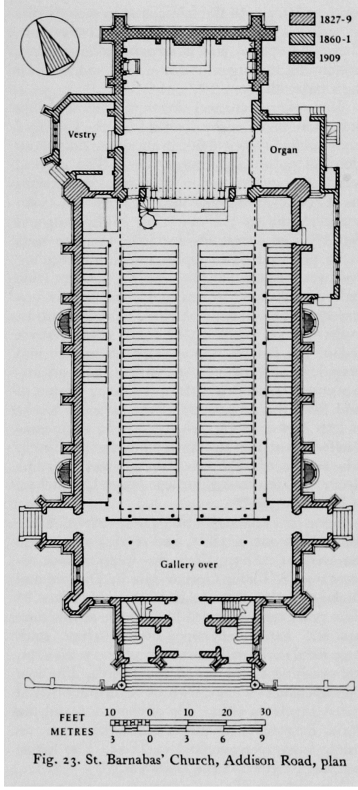
St. Barnabas' Church, Addison Road, plan
The original chancel was very shallow, being little more than a niche divided from the nave by a triple-arched screen flanked on either side by an identical pulpit and reading desk. The chancel was first reconstructed in 1860–1 to the designs of Thomas Johnson, the Lichfield diocesan architect, the contractors being McLennan and Bird. (fn. 55) The alterations enabled 125 more seats to be provided. The screen, pulpit and reading desk were removed at this time, for the very wide arch to Johnson's rearranged chancel was unscreened. The present chancel, dark in contrast to the nave, is essentially of 1909, when the east end of the church was entirely remodelled and extended eastwards by some fifteen feet, an improvement which was made possible by a grant of land from the proprietors of the adjacent blocks of flats known as Oakwood Court in compensation for loss of light and air sustained by the church. The architect for the reconstruction was J. Arthur Reeve, and the contractor was James Carmichael of Wandsworth. (fn. 56)
None of Vulliamy's fittings now survive. Some were taken out in 1861, and several more were removed in 1885, when the interior was redecorated in Tudor Gothic style by Dicksee and Dicksee under the architect Arthur Baker. (fn. 57) New pews were provided in the nave at this time and the handsome poppy-headed choir stalls were fixed in the still short chancel two years later. Refurnishing continued in the 1890's. The low marble chancel screen, with its beautifully carved seated angels on either side of the steps, and the florid Perpendicular pulpit raised high on an ornate base, were erected in 1895. The organ case was provided in the next year. (fn. 58)
The richness of these additions must have emphasized the inadequacy of the old chancel, and encouraged a desire to improve it. The opulently carved stone reredos, with its bold robed and crowned figure of Christ backed by an aureole upon a lush foliate ground and flanked in the lower wings by kneeling angels, was designed by Reeve as a memorial to the Reverend G. R. Thornton, vicar from 1882 to 1905, who, shortly before his death, had been much impressed by Reeve's reredos at St. Saviour's, Westgate, in Kent. The stone altar, which was based on fifteenth-century tomb designs, was removed at this time, being too small for the new chancel. Enrichment was completed with the erection of the stone canopy to the episcopal throne, while the finely executed piscina and triple sedilia testify to the wealth of the congregation. Messrs. Turner carried out the architectural features of the reredos, and J. E. Taylerson executed the figures. (fn. 56)
The glass of the east and west windows was transposed in 1895. The glass now in the east window is by Clayton and Bell, made in 1883. The window was cleaned, reconstructed and raised some feet when the chancel was extended in 1909. The present west window is by O'Connor, and dates from 1851. The canopies and diapered background are rich, but the colour is somewhat garish. Much bright and mostly midVictorian stained glass survives in the nave. The two-light window depicting Saints Cecilia and Margaret by the north-west door underneath the west gallery is an interesting Arts and Crafts design, remarkable for its strong drawing and rich gold and yellow colouring, by John Byam Shaw. Opposite the organ in the chancel is a two-light memorial window of 1922 by Geoffrey Webb, a pupil of Sir Ninian Comper. It commemorates parishioners killed in the war of 1914–18, their names being recorded on a stone tablet within a fifteenth-century-style frame in the south-east corner of the nave. (fn. 59)
Two mural monuments may be noted. That to George Shaw, the first cousin of John Byam Shaw, in the north-east corner of the nave, was designed in 1901 by Gerald Moira and Francis Derwent Wood (Plate 33d). The pretty monument of wood to John Byam Shaw on the north wall of the nave is a delightful composition in the late fifteenth-century manner, coloured red and dark green with rich gold detail. There is a small painting of Our Lady inset in late fifteenth-century Flemish style, probably by Gilbert Pownall (Plate 33f). (fn. 60)
The Church of St. John the Baptist, Holland Road
Plates 20, 21; fig. 24
In 1866 the Reverend E. J. May of Nottingham applied to the Ecclesiastical Commissioners for permission to build a church, the patronage of which would be vested in himself. The site which May proposed was on the west side of Holland Road almost exactly opposite the place where St. John's was eventually built. The principal reason which he advanced for the necessity of a new church was the extensive building operations then taking place on the Holland estate, and he added that, 'had not the monetary panic of last summer taken place, (fn. 5) from 300 to 400 more houses would have been erected by this time . . . beyond the large number already erected and mostly inhabited'. The letter implies that his proposal was meeting with the opposition of the incumbent of St. Barnabas', and, although the Ecclesiastical Commissioners were favourably disposed, the assent of the Bishop of London could not be obtained and May's application was rejected. There may well be a hidden story of disputes over doctrine, for within a very short time another clergyman, the Reverend George Booker, had succeeded where May had failed. The dedication to St. John the Baptist had been suggested by May. (fn. 61)
The site for Booker's church was made available through the failure of the builder, James Hall, to complete Addison Gardens. A piece of vacant ground lay to the west of the part of the communal garden which had already been laid out and on this a temporary iron church was erected at a cost of £1,700 which was defrayed by Booker; it was opened for divine service on 27 February 1869. The permanent acquisition of the site proved a complicated affair, however. In 1872 John Beattie and Harry Dowding, who undertook to complete James Hall's moribund development, obtained a conveyance of a large piece of land, including the plot on which the temporary church stood. (fn. 62) This conveyance made reference to a prior agreement with Booker, who was eventually able to purchase the freehold of the church site for upward of £1,100 in 1875. He conveyed it as a gift to the Ecclesiastical Commissioners in 1884. (fn. 63)
Plans for a permanent church to the designs of James Brooks were announced in 1872. The first designs show a tall western tower with a spire and, over the crossing, an octagonal lantern tower topped by a flèche. (fn. 64) No further progress beyond the laying of the foundation stone was made in that year, however, and a pastoral letter from Booker in 1873 contained a cri de coeur about the difficulties being encountered. 'Thus with no gift of a site', he wrote, 'hampered by the special conditions which the circumstances of the land imposed; with no help from Public Church Building Funds, and little from private individuals; having many acquaintances but few friends, and of those none who could call themselves wealthy; . . . a wilderness around us, and no decent path through; this church has had to contend with overwhelming difficulties which few others have known'. (fn. 65)
Building proper began with the apsidal section of the chancel in 1874; the contractor was Thomas Blake of Gravesend. The remainder of the east end as far as the crossing was not completed until 1885, the builders being Turtle and Appleton. A temporary brick nave was provided and the church was considered sufficiently far advanced to be consecrated on 30 March 1889. The contract for the construction of the nave was taken by Kilby and Gayford in 1890, and in 1892 the church was finished except for the west end. By this time both the lantern tower over the crossing and the western tower had been abandoned, and Brooks provided a new design for the west front in which the principal features were a large rose window and a grand central portal enriched with figure carving flanked by two smaller doorways; three deeply recessed porches were to project in front of these doorways. The rose window and part of the great doorway were completed and encased in rough brickwork, but the remainder of the façade had to await completion until 1909–11, when the work was carried out under the supervision of J. S. Adkins, who had taken over Brooks's practice after the latter's death. He made several alterations to Brooks's design, the most important of which were the substitution of a baptistry for the porch in front of the central doorway and the enclosing of the side porches. The work was carried out by E. A. Roome and Company and the stone carving, including the statue of St. John the Baptist, was by J. E. Tavlerson. When finished the façade drew a scathing comment from Maurice B. Adams: 'St. John's, Holland Road, one of Brooks' most noble buildings, has been spoiled by the dismal and incoherent west front. . .; this is to be deplored, as I think his original design, with the western tower, was perhaps the best that he ever conceived'. The total of the accounts submitted for completing the various parts of the church, including architect's fees, amounted to approximately £25,000. (fn. 66)
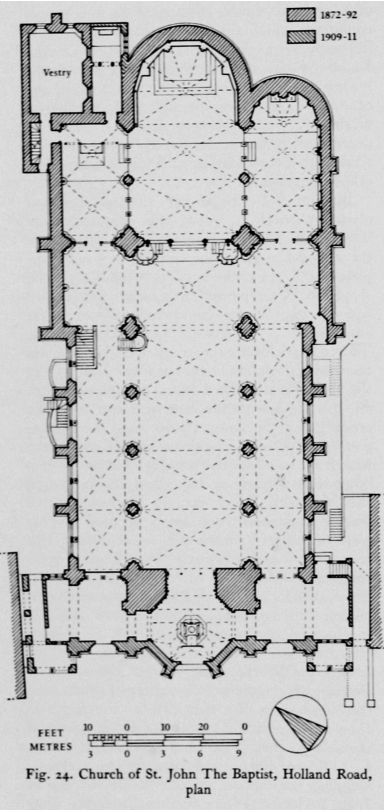
Church of St. John The Baptist, Holland Road, plan
Despite the cluster of fussy additions by Adkins, the west façade of St. John's (Plate 20a) is a composition of considerable character and emphasis in the context of Holland Road. Behind the porches, the west front proper is flanked by corner buttresses gabled in stages and rising to octagonal pinnacles. It is pierced by a huge rose window set within a semi-circular-headed arch surmounted by an open arcade of seven stepped cusped lancets that suggest a French ancestry. Its tall gable is pierced by an arcade of trefoil arches on colonnettes which is blind except for the central arch. Above, under the cross that crowns the apex, is a quatrefoil light.
The main door to the church from the baptistry porch is richly carved with figures representing the Wise and Foolish Virgins, added by J. E. Taylerson in 1909–11. This cathedralesque entrance, part of the design by Brooks, is French in manner, and the architectural origins are even more apparent in the interior of the church (Plate 21), except that the vaulting springs from corbelled brackets and is not continued in ribs down to the floor as would have been the case in a true French example.
The church is vaulted and huge, all in stone, and is dignified and solemn. It consists of a fourbay clerestoried have and aisles; short north and south transepts, so characteristic of Brooks's work, with a crossing broader than it is long; a polygonally apsed chancel; and north and south chapels, that to the south being the Lady Chapel.
The French flavour of the church is most marked in the chancel, the style being Burgundian, but the nave owes something to English Cistercian prototypes of the thirteenth century. The lighting is dim and mysterious, and the overall effect is suitably medieval. The excellent massing and control of spaces is typical of Brooks at his best, but the relationship between the spaces is obscured by the elaborately carved three-arched stone chancel screen, which he designed in 1895; (fn. 67) by the similar but modified stone screens in the arches between the chapels and the transepts; and by the parclose screens in the chancel arcades. The sculptured detail and figures tend to be out of character with the architecture of the church as a whole. In the nave itself, the praying angels, suspended at right angles to the walls at the apex of each arch of the arcade, are particularly unsatisfactory, and would only make sense as part of a timber roof.
There is a lavish stone pulpit, above which is a richly carved wooden canopy fixed to the northwest pier of the crossing. On either side of the chancel screen are ambones of white stone with coloured marble panels and colonnettes.
The Builder commented favourably on the solidity and massiveness of Brooks's design, and on the sparing use of ornament, which in 1885 consisted only of dog-tooth carving on the ribs and capitals. The Architectural Association visited the church in 1891 to view the vaulting of the nave, then in course of completion, a sight which was rare even then. (fn. 68)
The richly gilt polychrome reredos is partly the work of Brooks and partly that of Adkins. As first executed in 1892 it was relatively plain and it stood clear of the apse wall. Subsequently the statuary and painting were added and it was moved to the rear of the chancel. In 1909 Adkins gave it extra height by the addition of a blind arcade round the apse wall, and the three sides of the original reredos were separated by projecting piers. Adkins also designed the reredos in the Lady Chapel, the altar of which is brightly painted and has deep relief panels. (fn. 69) Other colour is provided by the stained glass, of which some good examples exist in the windows of the apse. Nearly all the glass is by Clayton and Bell, although there is a two-light lancet window of 1895 by C. E. Kempe in the second bay from the east in the south aisle.
No. 8 Addison Road
Plates 90, 91
This remarkable house was designed by Halsey Ricardo for (Sir) Ernest Debenham, who had previously lived in another house designed by Ricardo (No. 57 Melbury Road). No. 8 Addison Road occupies the sites of three previous houses (Nos. 8, 9 and 10) and was built under an agreement of March 1905, Debenham being granted a lease in July 1906 for seventy-eight and one half years at an annual rent of £430. By this the lessee was to be allowed at the end of the term of the lease 'to take down and remove all or any glazed tiles wood carving marble and mosaic fastened to or constituting part of the interior', provided that he made good with suitable materials. Among the buildings which Debenham was required to complete within twelve months of securing the lease was a 'Motor House'. (fn. 70) The only businesses for which the premises were originally allowed to be used were those of an artist, a physician or a surgeon, but in 1955 permission was given for the house to be used as a training college for teachers of dancing and drama, and in 1965 it was taken as the headquarters and college of the Richmond Fellowship for Mental Welfare and Rehabilitation. (fn. 71)
The house is an example of the structural polychromy advocated by Halsey Ricardo in lectures and papers given over several years. It represents an attempt to erect a building immune to the destructive effects of a city atmosphere, and is the expression of an architecture dependent on colour rather than on light and shadow.
The elevations consist of three elements: the basement, forming a podium on which the house rests; the ground and first floors embraced within a giant Florentine motif of pilasters carrying entablatures from which arches spring, and crowned by a richly modillioned cornice; and an attic storey over which is a smaller modillioned cornice. The tall chimneys are decorated with arches and cornices.
The basement is faced with blue-grey semivitrified bricks. The pilasters, arches, cornices and main elements of the house above are of Doulton glazed terra-cotta known as Carrara ware, the cream colour being relieved in the upper stages by bands of different colour. In the panels formed by this Carrara ware framework, the walls are faced with glazed Burmantofts bricks, the lower parts coloured green, and the upper a bright blue. The roof is covered with green tiles, semi-circular in section, and imported from Spain. The walls of the long entrance loggia and the corridor connecting the house with the breakfast-room in the garden are lined with De Morgan tiles.
The main feature of the plan is a central domed hall around which is a gallery at first-floor level connecting the upstairs rooms. The dome and pendentives over the hall are covered with mosaics depicting subjects from classical mythology and small portraits of the Debenham family against a background of sinuous plant patterns; the work was executed by Gaetano Meo from designs by Ricardo. The passages, hall and stairs are lined with De Morgan tiles, mostly in plain colour, but sometimes forming elaborate patterns in which the predominant motifs are peacocks and arabesques of Art Nouveau foliage. The colours, mainly turquoises, purples and blues, are rich and glowing. The marble work used in conjunction with the tiles was supplied and worked by Walton, Gooddy and Cripps Limited, and the carving was by W. Aumonier. Marble and tiles are also used in combination in the sumptuous fireplaces throughout the house. The main rooms have ornamental plaster ceilings executed by Messrs. Priestley from designs by Ernest Gimson. The library is elegantly fitted out in mahogany with delicate inlays of wood and mother-of-pearl in Art Nouveau designs. There is much enriched glass in the house, designed by E. S. Prior. The metalwork throughout, including the electric light switches, was principally designed and made by the Birmingham Guild of Handicraft. The builders were George Trollope and Sons with Colls and Sons. (fn. 72)
Nos. 10 and 10A (South House) Holland Park Road
These two houses, substantially dating from 1892–1893, were originally one house, which was known as No. 3 Holland Park Road until 1908 when it was renumbered 10.
The site was formerly occupied by the farm-house of Holland Farm. The laying out of Melbury Road in 1875 necessitated the removal of several of the farm buildings, but the farmhouse, which had been rebuilt in 1859, was not demolished. In 1892 the portrait painter (Sir) James Jebusa Shannon, entered into an agreement with the lessee, Ethel Tisdall, who was probably the daughter of Edmund Charles Tisdall (see page 127), to spend at least £3,500 in rebuilding or altering the farmhouse and erecting a studio adjoining. In return Ethel Tisdall was to grant him a lease for sixty years (the term remaining of a lease granted by Lord Holland in 1859) at an annual rent of £282. The plans, by the architects W. E. and F. Brown, were approved on behalf of the Earl of Ilchester, who had become the ground landlord, and work was begun by the builders, Thomas Gregory and Company, towards the end of 1892. (fn. 73)
The house and studio were joined together and remained one unit during Shannon's lifetime. From the plans, it appears that the structural core of the western, or residential, part of the building was provided by the existing farm house, but the exterior was completely altered to match the studio which was built to the east. An addition was made to the north-east of the studio in 1908. After Shannon's death in 1923 the two parts were divided, the eastern becoming No. 10 and the western No. 10A now called South House). (fn. 73)
Leighton House: No. 12 Holland Park Road
Plate 77; figs. 25–7
The factors which led Frederic (later Lord) Leighton to choose a site on the Holland estate when he decided to have a house built for himself are described on page 124. Leighton's letters indicate that he was negotiating for the site in the summer and autumn of 1864. In August he wrote to his father, 'As to the possible expense of the house, my dear Papa, you have taken I assure you false alarm. I shall indeed devote more to the architectural part of the building than you would care to do; but in the first place architecture and much ornament are not inseparable, and besides, whatever I do I shall undertake nothing without an estimate.' In September he complained about the 'preposterous charge' that Lady Holland's surveyor, John Henry Browne, was making for drawing up an agreement and added, 'My architect is Aitchison, an old friend.' (fn. 75)
A lease of the house was granted by Lady Holland in April 1866 for ninety-nine years from 1864, an unusual feature of it being a clause allowing Leighton to remove 'any Chimney piece in the nature of a Work of Art' and to substitute a plain marble chimneypiece to the value of £16, (fn. 76) presumably if he wished to move to another house. The builders were Messrs. Hack and Son, and the cost was about £4,500. (fn. 77) The house, which was ready for occupation by the end of 1866, (fn. 78) was originally known as No. 2 Holland Park Road until renumbered in 1908.
The extent to which Leighton influenced his architect, George Aitchison, in the design of the house has been the subject of much speculation. Aitchison had a considerable reputation in his day and was Professor of Architecture at the Royal Academy from 1887 to 1905 and President of the Royal Institute of British Architects from 1896 to 1899, but before receiving his commission from Leighton, whom he had first met in Italy in 1853, he was chiefly concerned with the design of commercial buildings. (fn. 79) Leighton himself received the R.I.B.A. gold medal for the knowledge of architecture which he displayed in the backgrounds to his paintings, and no doubt he had definite ideas about the kind of house he wanted, but several of the features of Leighton House reflect Aitchison's ideas about architecture. On more than one occasion Aitchison exhorted his fellow architects to break away from too rigid a dependence on historical styles, particularly in such matters as the type of mouldings used, and it is perhaps the care taken over both the design and execution of details that is the outstanding feature of the architecture of the house.
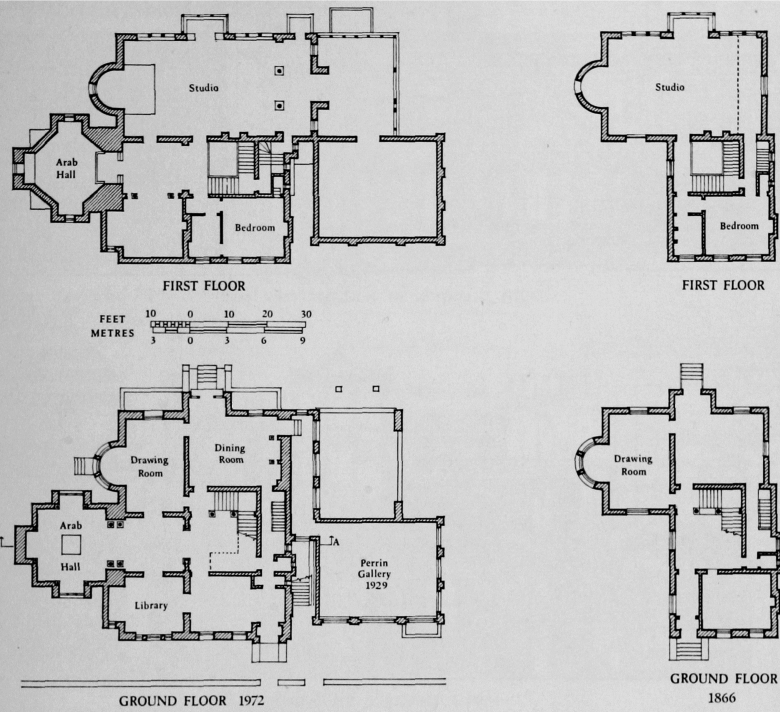
Leighton House, Holland Park Road, plans
The Building News in November 1866 described the newly built house with approval. It commented on the originality of detailing and remarked, 'It is the house of an artist, with a large and lofty studio on the first floor, and it expresses its purpose honestly to the casual passer-by, and no more'. (fn. 77) The restrained classical style of the exterior, executed in red Suffolk bricks with Caen stone dressings, did not meet with universal approbation, however, and a few weeks later in the same journal E. W. Godwin gave an altogether different verdict. 'Take Mr. Aitchison's house', he wrote, ' . . . and, allowing for its completion, what can be said of it, except that from one end to the other it is altogether unsatisfactory. . . . Mr. Webb's work, in Mr. Val Prinsep's house next door, comes into close comparison with it, and is chiefly admirable for the very things in which its neighbour is so utterly deficient—viz., in beauty of skyline and pleasing arrangement of gabled mass'. (fn. 80)
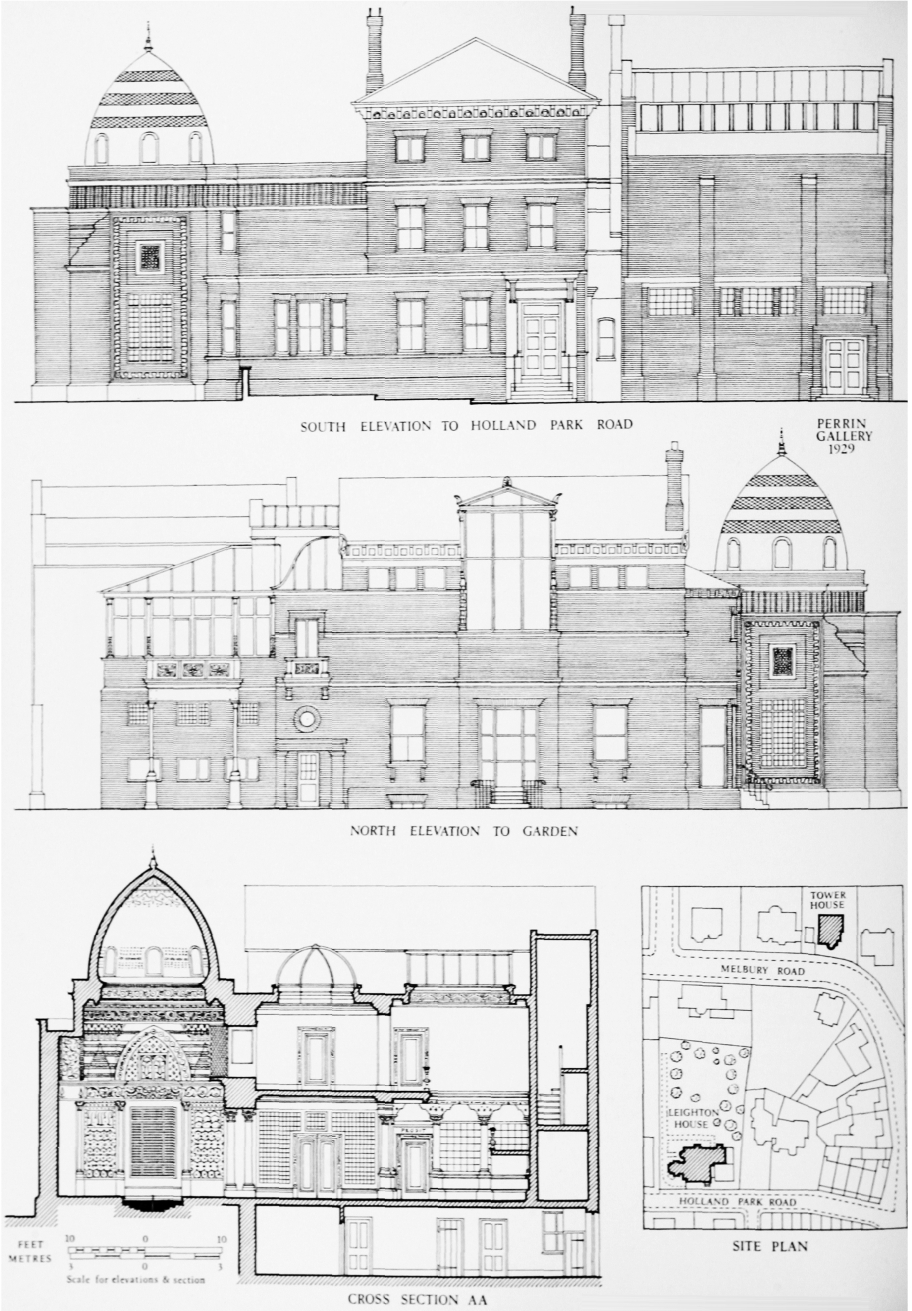
Leighton House, Holland Park Road, elevations and section
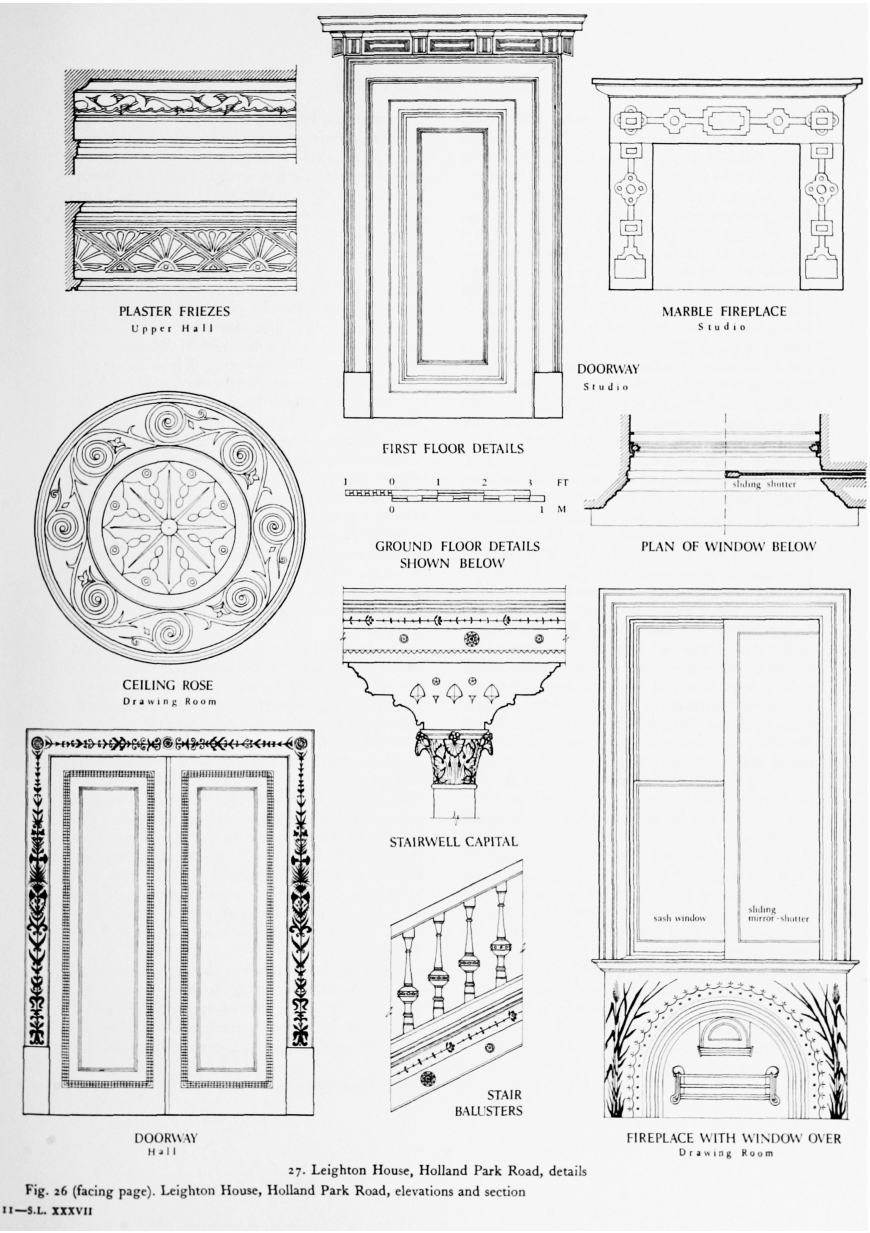
Leighton House, Holland Park Road, details
As first built the house was much smaller than it is now and the front was only three windows wide, although it was always intended to extend this to five bays. The plan was dominated by the studio on the first floor at the rear, facing north. It originally measured about forty-five by twenty-five feet and had a gallery at the east end. At first the great central window of the studio was stone-framed but this was soon replaced by an iron-framed window to let in more light. A stair led from the east end of the studio to a side entrance which was to be used by models, Leighton clearly having a more conventional Victorian sense of social propriety than his neighbour Val Prinsep, in whose house the models 'usually come up the main staircase'. (fn. 81) Apart from the studio the main room was a lofty hall (Plate 77a), lit principally by a large skylight in anticipation of later extensions which were to make it totally enclosed, Only one main bedroom was included in the plan, to discourage long-term guests who might interfere with Leighton's work, although servants' bedrooms were provided over his first-floor apartments and were reached by a back stair. The interior decorations were characterized by a bold use of colour. The woodwork was generally lacquered black with parts of the delicate incised leaf and flower mouldings of the door and window architraves picked out in gold. The beams supported by the stone columns of the entrance hall were painted blue and the sunk ornament above the capitals silvered. The colour of the studio walls was red. Among the surviving original fittings is the drawing-room fireplace, which was placed directly underneath a window. At night the window could be covered by sliding shutters to form a mirror (fig. 27). (fn. 6) Several items of furniture for the house were especially designed by Aitchison.
The first addition to the house was made in 1869–70 when the studio was lengthened to the east. A drawing made by Aitchison in 1870 for the coloured glass of two windows, which were inserted as part of this alteration, indicates that the Arab influence which was later to be so important was already present at this time. (fn. 82)
Outstanding among several additions made in 1877–9 was the Arab Hall (Plate 77b), built to house the collection of tiles Leighton had acquired during his visits to the East. According to Aitchison and Walter Crane, the design of the hall was based on the palace of La Zisa in Palermo. The numerous seventeenth-century tiles are complemented by the carved wooden Damascus lattice-work of the same period in the windows and gallery above. There are also several single tiles of Turkish origin dating from the previous century, and even earlier examples from Persia. The west wall contains a wooden alcove with inset tiles of the fourteenth century. On each side are brilliantly coloured plaques with floral patterns, and several tiles also depict birds. Apart from the eastern tiles the Arab Hall contains the work of several outstanding Victorian artists. The capitals of the smaller columns were modelled by (Sir) J. Edgar Boehm from Aitchison's designs, and the birds in the gilded caps of the large columns were by Randolph Caldecott. The mosaic frieze was designed by Walter Crane. Many of the tiles in the passage to the Arab Hall and elsewhere in the house are by William De Morgan. The builders were Messrs. Woodward of Finsbury, and among the specialist contractors were George P.White of Vauxhall Bridge Road for the marble work, Burke and Company for the mosaics, and Harland and Fisher for the painted decorations executed from Aitchison's designs. (fn. 83)
At the time the Arab Hall was built the ground storey at the front of the house was extended to the west, and the entrance was moved from the western of the original three bays to the eastern. The effect of all these additions was the abandonment of the five-bay symmetrical façade with a central entrance which had been originally envisaged, in favour of an asymmetrical grouping. The cut and moulded brickwork of the new parts reflects an Islamic inspiration. Aitchison also provided a winter studio to the east of the main studio in 1889. Originally it was raised on castiron columns, but the ground floor has now been bricked-in. In 1895 he also provided a top-lit picture gallery on the south side of the studio floor above the single-storey extension built in 1877–1879. (fn. 84)
After Leighton's death in 1896 several attempts were made to preserve the house for the nation. His two sisters, who were his executrices, assigned the house to representatives of the Leighton House Committee, which had been formed for this purpose, and in 1901 the leasehold interest was offered as a gift to the newly formed Kensington Borough Council, but negotiations broke down over the terms of the transfer. A further approach in 1925 was more successful, and the Council completed the acquisition of the house when it purchased the freehold in 1926 for £2,750. (fn. 85)
In 1927 Mrs. Henry Perrin of Holland Villas Road offered to provide additional exhibition galleries and chose Halsey Ricardo as the architect. After several alterations, including a considerable reduction in the amount of window space originally intended, Ricardo's designs were accepted. Approval had to be sought from the Holland estate under the usual provision that no alterations to the architectural character of, or additions to, houses which had been sold could be carried out without licence. It was suggested in favour of the extension that it would hide the cast-iron columns of the winter studio, and permission was secured. The Perrin Galleries were opened in 1929. (fn. 86) The interior of the ground-floor gallery was redesigned by Sir Hugh Casson in 1962 to provide a temporary home for the British Theatre Museum.
No. 14 Holland Park Road
Fig. 28
This house, which was known as No. 1 Holland Park Road until it was renumbered in 1908, was designed by Philip Webb for the painter, Valentine Cameron Prinsep. The associations of the Prinsep family with the Holland estate are described on page 125, and the site for Val Prinsep's new house was only a short distance from Little Holland House, where his father lived, and where he had spent much of his youth in the company of his mentor, George Frederic Watts. His choice of Webb as his architect was probably the result of his early association with William Morris and his circle.
Webb was working on plans for the house in 1864. (fn. 7) In January 1865 Prinsep entered into an agreement with Lady Holland to build a house to the value of at least £1,000, and the contract drawings were signed by the builders, Jackson and Shaw, in the same month. A lease for ninety-nine years from 1864 was granted by Lady Holland in March 1866 and the house was ready for occupation by the middle of that year. (fn. 88)
Originally consisting of two storeys and a basement, the house was built of red brick with a sparing use of brick dressings. In its apparent simplicity and absence of ornament, and with its mixture of segmental and pointed arches to the doorway and windows, the house reflected Webb's work at the Red House, Bexley Heath, for William Morris. The original front, or south, elevation, which was completely changed by subsequent alterations by Webb himself (fig. 28), consisted of three bays made up of two short gabled wings projecting on each side of a central recess, the bay to the west, which contained the doorway, being slightly wider. The rear elevation was dominated by two huge studio windows admitting north light, and at the west end of the studio there was a large oriel window making a conspicuous feature on the west side elevation. Several of the windows of the house anticipated the 'Queen Anne' style.
The studio, which measured forty feet by twenty-five feet, took up practically the whole of the first floor. The remaining space was hardly sufficient for domestic requirements, and the dining-room, Prinsep's bedroom and a spare bed-room were all situated on the ground floor. Prinsep was a bachelor at the time the house was built, but the original plan allowed for its extension to the east at a later date.
The first major alterations were made by Webb in 1877 (fn. 89) when the front was raised by an extra storey (because of the height of the studio the rear part of the house had formerly been higher than the front), and the studio was extended by arching over the central recess at first-floor level. This extension led to the construction of a draw-bridge, which could be raised for the passage of large canvases, in the gallery which Webb had originally provided for the studio. In 1892 Webb added the new wing to the east which had been anticipated both in the original planning and the alterations of 1877. This wing, which provided two more bays to the street elevation, extended beyond the line of the original garden front to give the house a reverse L-shape. (fn. 90)
During the twentieth century further considerable alterations were made, particularly to the fenestration, and in 1948 the house was converted into flats. (fn. 91)
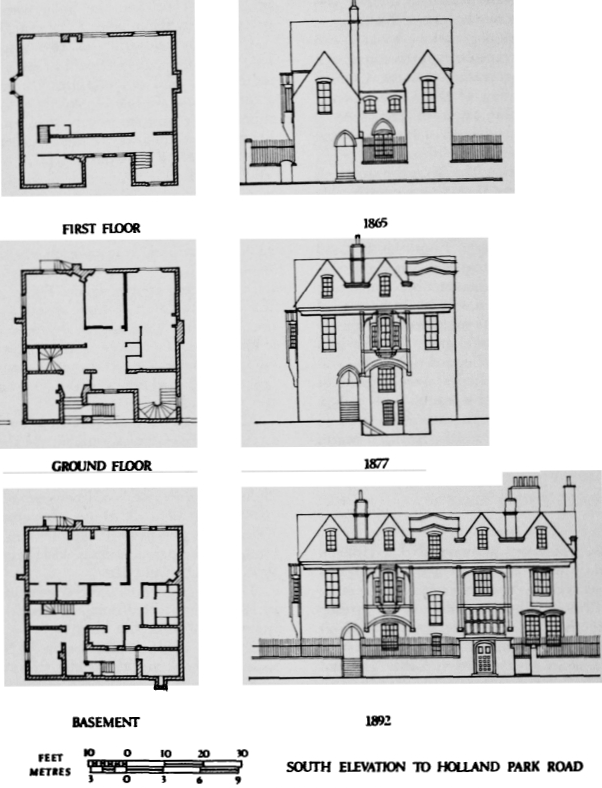
No. 14 Holland Park Road, plan (1865) and elevations
Nos. 2, 2A, 2B and 4 Melbury Road, Melbury Cottage, and No. 24B Holland Park Road
Plates 82, 84b
In March 1876 Messrs. Adamson and Son of Turnham Green, builders, gave notice to the district surveyor of their intention to build two houses and a studio for 'Mr. Thornicroft'. Although ninety-year leases of these two houses, originally Nos. 2 and 4 Melbury Road, were granted to Thomas Thornycroft, a sculptor, (fn. 92) they were built for, and in some measure to the designs of, his more famous sculptor son, (Sir) Hamo Thornycroft. They are of considerable interest in conception as a semi-detached pair, No. 2 being intended for the Thornycrofits' own residence with a wing containing several studios added to the south-west, while No. 4 was a speculation to let or sell in the normal way. How far Hamo Thornycroft was responsible for the design of these houses is difficult to estimate, but he had 'the advantage of suggestions and technical knowledge afforded by Mr. J. Belcher, architect'. (fn. 93) It is perhaps significant that when he wanted another studio built in 1891 he turned to Belcher, who was a lifelong friend, (fn. 94) to provide the designs. Certainly this pleasantly asymmetrical pair, with the huge projecting chimney stack accentuating the division between the two houses, shows a careful and sensitive handling.
No. 4 was occupied by Mr. and Mrs. Russell Barrington. Mrs. Barrington, who was the sister-in-law of Walter Bagehot, was a writer who also had some pretensions to being an artist. The house was brought to her attention by Watts and she persuaded her husband to take it. 'I felt this was indeed a delightful opportunity of entering into the highest precincts of art under the most helpful auspices', she wrote later. (fn. 95) After Leighton's death she became a leading figure in the movement to preserve Leighton House as a public memorial.
The working quarters of No. 2 were more distinctly separated from the living rooms than in most of the artists' houses of the late Victorian period. The south-west wing contained a large studio for sculpture and several smaller ones for other members of the Thornycroft family. The single-storey entrance porch to the west of the house was set in line with the studios and opened into a small vestibule which led either directly into the house or, via a gallery, into the studios. This plan has enabled the house to be converted into several separate units. In 1931 the present entrance porch was added, and the old entrance way and gallery were converted into a separate dwelling, now known as Melbury Cottage. The alterations were carried out by A. M. Cawthorne, architect. (fn. 96) The studios were already subdivided by this date and are now known as No. 2A Melbury Road and No. 24B Holland Park Road. In 1892 a new studio-house (now No. 2B Melbury Road) was built to the west of No. 2 to the designs of John Belcher (Plate 84b); the builders were again Adamson and Sons. (fn. 97) After completion of this building, Hamo Thornycroft lived there and No. 2 appears to have been let. (fn. 98)
No. 6 Melbury Road
Plate 76. Demolished
This house was built for George Frederic Watts, whose previous home for many years, Little Holland House, had to be demolished for the laying out of Melbury Road. Watts also called his new house Little Holland House.
Watts's architect was a friend, Frederick Pepys Cockerell, the son of Charles Robert Cockerell. Building began early in 1875 and Watts was able to take up residence in February 1876. The Earl of Ilchester granted a lease of the house to Val Prinsep, who gave up part of his garden in order to provide Watts's house with extensive grounds, for a term expiring in 1963 to correspond with that of Prinsep's own house, No. 14 Holland Park Road. Prinsep immediately sub-let No. 6 Melbury Road to Watts. (fn. 99)
The eclectic exterior reflected the complex planning of the interior (Plate 76). This included three studios on the ground floor, two of them for painting and sculpture—rising through the first floor, a small sitting-room on the ground floor and two bedrooms on the first floor. The shortage of living rooms was probably deliberately intended, as in the case of Leighton House, to enable Watts to pursue his work without interruption from too many guests. Several additions were made to the house after Cockerell's death by George Aitchison, including a picture gallery. (fn. 100) Watts lived in the house until shortly before his death in 1904. It was demolished c. 1965 and replaced by Kingfisher House, a block of flats.
No. 8 Melbury Road
Plate 78
This house was designed by Richard Norman Shaw for Marcus Stone. The Royal Academy possesses drawings for the house dated September 1875, and the builder, W. H. Lascelles, a contractor often used by Shaw, gave notice to the district surveyor of his intention to begin building in December of that year. Stone was granted a ninety-year lease from 1875 in December 1877 at an annual rent of £90. (fn. 101) The house was converted into flats c. 1950.
Built of red brick, with cut and moulded brick dressings characteristic of Norman Shaw's work, and with several of his tall, narrow sash windows, the house originally consisted of two tall storeys over a basement. On the Melbury Road elevation, which has been little altered, Shaw resolved the problem of reconciling a domestic front with the need for ample north light by providing three large oriel windows taking up most of the second storey. Originally these oriels were symmetrical, each one crowned by a tile-hung gable containing a small window, but the central window was extended upwards, no doubt to provide more light, probably shortly after the house was built, and almost certainly to Shaw's design. (fn. 8) The oriels were designed to be executed in wood but the district surveyor refused permission and concrete had to be used. The first floor was taken up with the studio and ancillary rooms, including a winter studio to the east, but the ground floor reflected a greater concern with domestic comfort than was required by some of Stone's fellow artists in the Melbury Road colony. The interior has been much altered but originally it was described as of a 'quiet and homely character', reflecting 'the spirit of an Old English Home'. A back stair was provided for models in a shallow extension which was built on to the south-western corner of the house and crowned with a Dutch gable. The studios were heated by hot-water pipes, but an angle fireplace was also provided 'for the company a cheering fire can afford'. (fn. 103)
No. 14 Melbury Road
Plates 81b, 83. Demolished
The last artist to take a plot in Melbury Road during the initial phase of house building there was Colin Hunter. He engaged the architect J. J. Stevenson to provide the designs, and tenders for building were received in August 1876. The lowest, for £4,594 by J. Tyerman of Walworth Road, was accepted and work began at once. (fn. 104) The exterior was of red brick with an abundant use of cut and moulded brick dressings. The dominant features of the street front were two large projecting bays crowned by elaborate gables containing the ground-floor dining-room and studio. Between them was a recessed entrance porch, and, to the west, another recessed part contained the kitchen. Above the kitchen was a day-nursery with a two-sided projecting bay supported by a large bracket. A drawing-room was also provided on the ground floor in another projecting bay to the rear, this combination of kitchen and ancillary rooms with living-rooms and studio on the ground floor being unique in the planning of houses in the Holland estate artists' colony. The first floor was given over to bed-rooms, dressing-rooms and nurseries, and there were more bedrooms in the attic. Another entrance, leading directly to the studio, was provided to the east, perhaps for models. The house was damaged during the war of 1939–45 and was demolished shortly afterwards.
Tower House: No. 29 Melbury Road
Plates 81b, 85, 86, 87, 88, 89; figs. 29–30
This house, numbered 9 until 1967, was designed by the architect William Burges for his own occupation. Burges began to make drawings for the house in July 1875, but his initial designs differed in some ways from those executed. In particular, the staircase turret, which is the dominant feature of the street front and gives the house its name, did not appear on the first plan. By the end of the year, however, Burges had decided on the present form of the house. No doubt with his designs for Castell Coch still fresh in mind, he placed the stairs in a circular tower crowned by a conical cap of slate. A building agreement was concluded with the Earl of Ilchester in December 1875 and building began in 1876. The contractors were Ashby Brothers of Kingsland Road and the basic cost was estimated to be £6,000. Burges was granted a lease in February 1877 for ninety years from 1875 at an annual ground rent of £50 for the first two years and £100 thereafter. (fn. 105)
The design stems from French domestic Gothic of the thirteenth century derived through the influence of Viollet-le-Duc. It makes use of themes explored and developed in Burges's work at Cardiff for the Marquess of Bute. The materials used are a hard red brick with stone dressings and grey slates in diminishing courses for the roof. There are two principal storeys over a basement and a commodious garret in the roof. The three main living-rooms on the ground floor form an L-shaped block with a square entrance hall in the angle, facing south and east. The circular staircase tower, flanked by a small gabled wing, is placed in front of the hall and approached from it through a pair of pointed arches. A double porch serves both the main entrance and the garden door behind it.
The street front (Plate 85a) is characterized by a striking association of the steep principal gable and the stair turret. The ground and first floors of the house are marked by storey-and sill-bands and in general there are moulded stone dressings to the eaves and gables of the roof, the chimney stacks being finished in moulded brick. The larger windows have stone mullions and transoms with square or cusped heads to the lights but some of the smaller openings are arched in brick or have plain stone lintels. The stone porch has square piers with carved capitals (the first pier was intended to be embellished with further carving) and a deep entablature with an arcaded cornice.
On the garden front (Plate 85b) the western part is again gabled, matching the gable to the street, the centre line of this element being emphasized by a stepped buttress which divides the pair of windows lighting the library. These have finely carved lintels and, like the dining-room windows on the front, emphatically modelled mullions to the side of the library is a larger enclosed by glazed screens, is incomplete in its decoration but has a mosaic floor depicting Pinkie, Burges's favourite dog. The entrance hall, to which access is gained through a heavy bronze-covered door with figure-subjects in relief panels, rises through two storeys to terminate in a painted ceiling based on the emblems of the constellations arranged according to their positions at the time of the first occupation of the house. The hall has a fine mosaic floor representing a labyrinth in the centre of which Theseus slays the Minotaur. Above plain dados the walls are painted as stone, with scarlet joints in simulation of ashlaring, and over the doorways to each of the major rooms are painted emblems appropriate to their use. Figures representing day and night appear in painted aedicules at gallery level on either side of the hall. The fire-hood opposite to the entrance door is more severely treated than those in other rooms, being simply lined out with scarlet jointing. The garden door into the porch is, like the front door, bronze covered, this time with a relief of the Madonna and Child.
According to Burges's brother-in-law, R. P. Pullan, the decorative scheme in the dining-room letters of the alphabet are incorporated—with the exception of H, which has been 'dropped' on to the onyx below the frieze. In the ceiling the founders of systems of theology and law are seen, and on the doors of the bookcases which surround the room is an illustrated alphabet of architecture and the visual arts with a scene of artists and craftsmen at their work on each lettered door. Pictures of birds by H. Stacy Marks are incorporated into the backs of the bookcase doors. Where visible the walls of the room are painted with a diaper pattern and above the bookcase runs a continuous deep modelled and gilded frieze of formalized foliage.
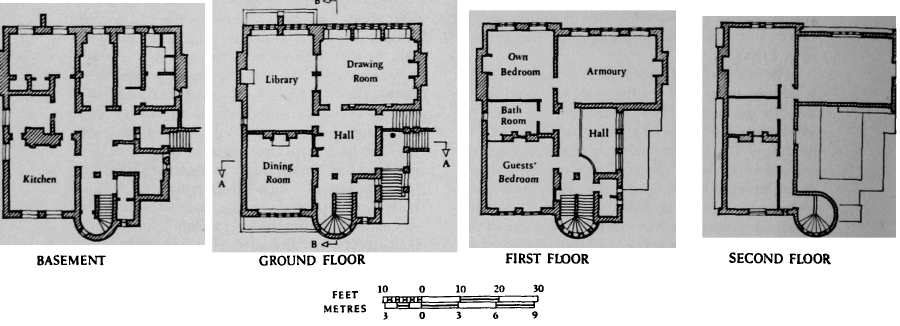
Tower House, Melbury Road, plans
A wide opening opposite the library fireplace, furnished with sliding doors and a central pair of marble columns, leads into one end of the drawing-room. The execution of the decorative scheme here seems to have been incomplete at the time of Burges's death although drawings had been prepared, and cartoons appear pinned to the walls and ceiling in the photographs taken to illustrate the description of the house by R. P. Pullan in 1885 (Plate 86a). The theme in the drawing-room is 'the tender passion of Love' and the chimney-piece, a fine counterpart to the one in the library, is carved with figures from Chaucer's Roman de la Rose. Recently the scheme originally designed for the walls and ceiling has been executed from Burges's drawings. The three windows with their original stained glass are set in deep reveals with marble linings and ornamented with ball-flower enrichments.
Back in the hall the stair is approached through the two pointed arches divided by a marble column with a carved capital and base. The stained glass in the windows of the stair turret represents 'the Storming of the Castle of Love' and the wall treatment of the entrance hall continues for the whole height of the stair.
Off the first-floor gallery with its turned wood balustrade the two main bedrooms and the armoury are approached. In the guest room on the street front the theme is 'the Earth and its productions' (Plate 87a). The ceiling here is painted with fleur-de-lis and butterfly designs and a convex mirror in a gilded surround is placed at the crossing of the main beams along which are painted frogs and mice. The frieze of flowers growing au natural within a Gothic arcade, once obliterated, has been repainted in the recent renovations.
Burges's own bedroom overlooking the garden is decorated with 'the Sea and its inhabitants' (Plate 87b). The elaborate ceiling (Plate 88b), divided into panels by painted and gilded beams and semi-shafts, is set with tiny convex mirrors within gilt stars. Below the level of the corbels is a deep frieze with fish and eels swimming amongst formalized waves. The frieze to the chimney-piece also depicts fish amongst waves, this time carved in relief, whilst above, on the fire-hood, a vigorously modelled mermaid gazes into a looking-glass (Plate 89b). Sea-shells, coral, seaweed and a mer-baby are also represented.
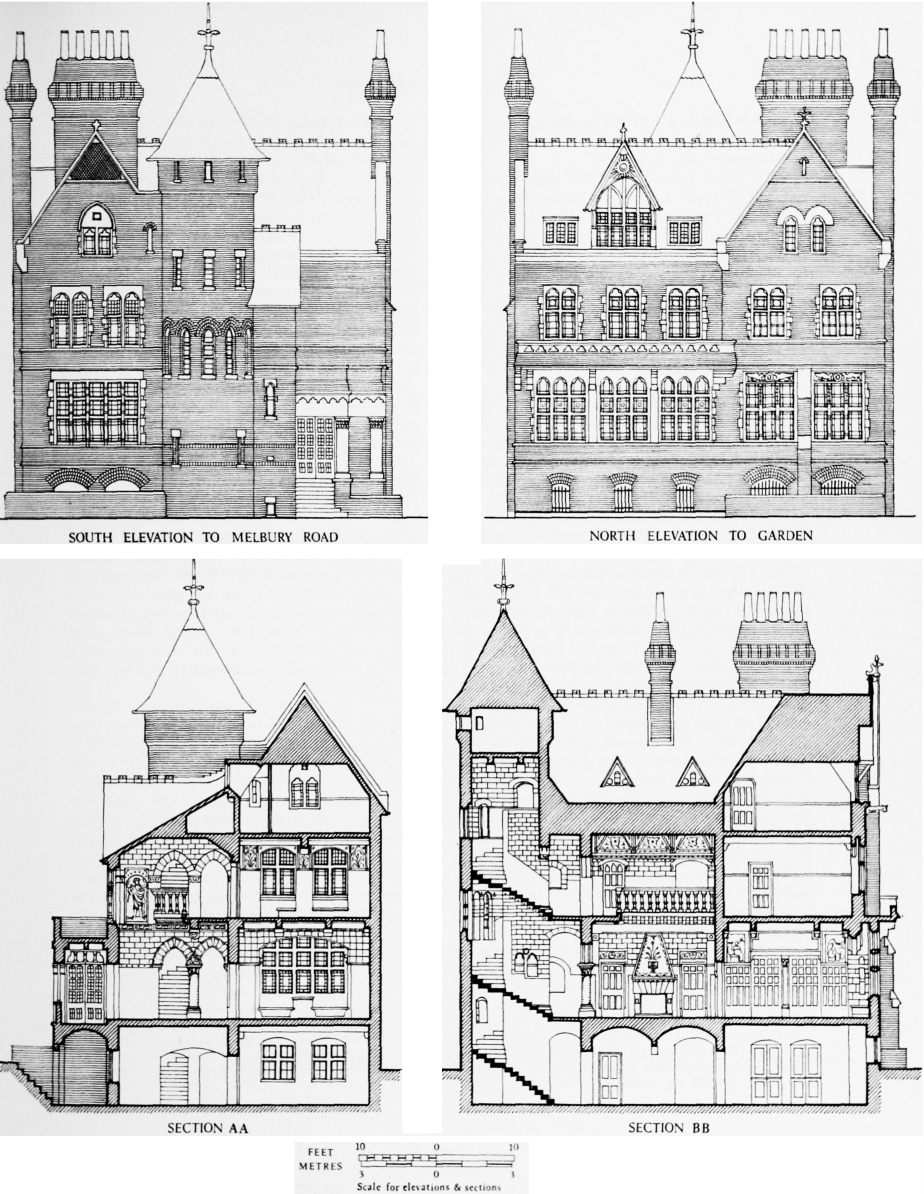
Tower House, Melbury Road, elevations and sections
The large room over the drawing-room originally housed Burges's collection of armour and was known in his time as the armoury. It now contains little of interest beyond the carved chimneypiece with a crocketed gable rising in front of the hood and three roundels carved with medieval versions of Venus, Juno and Minerva.
The storey in the roof, now somewhat altered, contained rooms known as the day and night nurseries although Burges had no family and remained a bachelor to the end of his life). Two interesting chimneypieces still survive, however. One represents 'Jack and the Beanstalk', with Jack supporting the mantelshelf whilst the giant's head and hands appear to tear through the stonework above. On the other are three monkeys at play.
The interior decorations were carried out by a small army of artists and craftsmen over several years and were still unfinished at Burges's death in 1881. The names of the specialist firms and individuals who executed the work can be found in the architect's own estimate book for the years 1875 to 1881, which contains over one hundred items relating to Tower House. (fn. 106) Burges appears only occasionally to have recorded alternative estimates for the same piece of work, and the craftsmen who worked at Tower House are in the main those who had worked, or were still working, for him on other projects, particularly Cardiff Castle. All of the stone carving, from the elaborate chimneypieces to capitals and corbels, was done by the sculptor Thomas Nicholls. Burke and Company of Regent Street were the principal contractors for the marble and mosaic work, and Simpson and Sons of the Strand supplied and fixed many of the decorative tiles. The bronze work for the great doors was undertaken by John Ayres Hatfield. The carpenter who was apparently responsible for all the woodwork in the house, from the joinery to the new items of furniture made to Burges's specifications, was John Walden of Maiden Lane, Covent Garden. The figure painting on the library bookcases and elsewhere was by Fred Weekes and Henry Stacy Marks, from whom Burges ordered seventy birds' heads at £1 apiece. Saunders and Company of Endell Street, Long Acre, made the stained glass, several of the cartoons for which were provided by H. W. Lonsdale. Most of the painted decorations were executed by Campbell and Smith of Southampton Row. By 1879, however, other estimates were being taken for decorative work, particularly in the guest room, including from 'Fisher', perhaps of the firm of Harland and Fisher, decorative specialists used by Burges in the past. (fn. 9)
Some of Burges's decorations were painted over in the years following his death, and from 1962 until 1966 the house remained unoccupied and was damaged by vandals. Restoration began in 1966 with the aid of grants from the Greater London Council and the Ministry of Housing and Local Government. In 1969 Mr. Richard Harris acquired the house and further extensively restored the internal decoration. The firm which had largely carried out the original painted decorations, now Campbell, Smith and Company Limited, was the principal specialist contractor employed. It proved possible to restore damaged and obliterated decorations and to finish parts of the scheme which had not been completed at the time of Burges's death from his own drawings.
No. 31 Melbury Road
Plates 80 81
Known as No. 11 until renumbered in 1967, this was the second of two houses in Melbury Road designed by Richard Norman Shaw. It was built for the artist, (Sir) Luke Fildes, and in May 1875 Shaw congratulated Fildes on acquiring 'such a delicious site'. Val Prinsep, who later acted as godfather to one of Fildes's children, had apparently informed him that the site was available, and the position was indeed a commanding one at the bend of Melbury Road, enjoying vistas to the south and west, with Holland Lane (now Ilchester Place) on the east. Shaw had prepared preliminary designs by August 1875, and building began early in 1876. The builder was W. H. Lascelles. Fildes had a friendly—or sometimes not so friendly—rivalry with Marcus Stone, with whom he had shared a studio in Paris in 1874. Each naturally regarded his own house as superior although they were designed by the same architect. In November 1876 Fildes wrote, 'The house is getting on famously and looks stunning . . . It is a long way the most superior house of the whole lot; I consider it knocks Stone's to fits, though of course he wouldn't have that by what I hear he says of his, but my opinion is the universal one.' Fildes took up residence in October 1877 and lived there until his death in 1927. (fn. 107)
Although the house has now been converted into flats, the red-brick exterior has been little altered and is one of Shaw's most assured compositions. Of the original interior, Maurice B. Adams commented, 'Taking it as a whole, Mr. Fildes' house is more of a residence or dwelling house than some we have illustrated, and although the studio is, perhaps, larger than many, yet it does not over-power the rest of the house'. (fn. 108) As the house faced south, the studio was at the rear and was lit by a skylight and six tall windows grouped in three pairs. As with No. 8 Melbury Road, however, these did not apparently provide sufficient light and the central pair were altered in 1881 to provide the present large four-light window rising to the roof parapet. (fn. 109) A winter studio was added in the north-east angle of the house in 1885 with a day-nursery underneath, (fn. 110) but this has since been completely altered and unsympathetic first-floor windows inserted. The studio was provided with central heating 'by means of hot-water pipe coils worked from a compact vertical boiler placed in a heating chamber in the basement'. (fn. 108) It was described by Edward VII, when he came to sit for a state portrait, as 'one of the finest rooms in London'. (fn. 111) The studio was approached by means of a grand staircase leading from an impressive entrance hall. The provision of generous light to the kitchen and other basement rooms necessitated the raising of most of the ground floor well above true ground level and resulted in a subtle change of level from the square entrance block, via the angle staircase, to the main rectangular north-west block containing the principal rooms underneath the great studio.
No. 47 Melbury Road
Plate 84a
This building, originally No. 13 Melbury Road until renumbered in 1967, was designed by Robert Dudley Oliver for Walford Graham Robertson, the artist and playwright. Oliver was a little-known architect who devoted most of his early years to painting and exhibited at the Royal Academy, but his obituary in The Times described him as 'an architect of skill, artistic feeling, and antiquarian knowledge'. The builder, W. J. Adcock of Dover, began work in 1892 and a ninety-year lease of the house was granted to Robertson in June 1893 at an annual ground rent of £125 for the first two years and £250 there-after. The lease allowed the premises to be used only as a private dwelling or studio. (fn. 112)
As first built the front of the house was only four bays wide and two storeys high, (fn. 113) but the lease made specific provision for the addition of another wing, not exceeding sixty feet in height. Graham Robertson appears, however, to have used the house as a studio with reception facilities for his clients, while he lived at No. 9 Argyll Road. (fn. 114) An extra storey was added, incorporating the existing wooden pediment and cornice, and a new north wing was built to match the existing south wing, to the designs of Basil Procter, in 1912, when Robertson was no longer the owner. (fn. 115) The result is a sensitive reproduction of a seventeenth-century façade, which does not give the impression of having been created at different times and by different architects, so excellently have the 1912 additions been matched to the original.
Before these additions the ground floor consisted of a grand hallway extending the depth of the house, a staircase, an ante-room, and a billiard-room, while on the first floor there were bedrooms and a large studio. The rear part of the house containing the studio was originally much higher than the front and must have presented a somewhat strange appearance before the alterations of 1912. It was also built in a contrasting style, and the dominating feature of the garden front is a large Elizabethan-style bay window which rises through the ground and lofty first floors and is flanked by buttresses. The house was converted into flats in 1948. (fn. 116)
For several years, from about 1896, Robertson shared his studio in Melbury Road with the brilliant young Scottish 'impressionist' painter, Arthur Melville, until the latter's death in 1904. (fn. 117)
Nos. 55 and 57 Melbury Road
Plate 84c
A piece of ground to the south of Graham Robertson's house was taken by Sir Alexander Meadows Rendel, the engineer, (fn. 118) who engaged Halsey Ricardo to design this pair of semi-detached houses, originally Nos. 15 and 17 Melbury Road. Plans were drawn up as early as January 1893, but difficulties were encountered in obtaining permission from the London County Council for the erection of covered ways in front of the entrances. Approval was not finally obtained until 1894. Ninety-year leases from 1893 were granted in October 1895 to James Meadows Rendel, a barrister, and presumably the son of Sir Alexander, for No. 55 and to Lady Eliza Rendel, Sir Alexander's wife, for No. 57. The builders were Walter Holt and Sons of Croydon. (fn. 119)
An illustration of the two houses appeared in The Builder in July 1894, and in a note for the same journal Halsey Ricardo set out his reasons for using the ox-blood-red glazed bricks with which the houses are faced. 'An endeavour has been made', he wrote, 'in building these houses, to recognize and accept the present conditions of house-building in London—more especially as regards the dirt and the impurities of the atmosphere. They are faced externally throughout with salt-glazed bricks, which, being of fire-clay vitrified at a high temperature, may be looked upon as proof against the disintegrating forces of the London air. These bricks, being virtually unchangeable, I have had to renounce the aid that time gives to a building by blunting its edges, softening and blending its colours; but as a per contra one has the satisfaction of knowing that the house is built of durable materials, wind-proof and rain-proof; and whatever effect one can manage to secure, that effect is indestructible. In the case of the usual brick house—whilst the brick and stone are ageing and weathering, the woodwork is periodically being renewed (in effect) by repainting—and the acquired harmony of the whole is constantly being dislocated by this renewal; but with these houses, every time the external woodwork is recoloured the bricks can be washed down and the original effect—for what it is worth—maintained.' (fn. 120)
An addition was made to the south-east corner of No. 57 in a Ricardo-esque manner by Symonds and Lutyens in 1930. In 1950 the two houses were joined together and converted into flats. (fn. 121)
James Meadows Rendel was the first occupant of No. 55, but No. 57 was taken by (Sir) Ernest Debenham (fn. 98) and so provided him with that introduction to Ricardo's architecture which was to have such a notable outcome in the building of No. 8 Addison Road.
Commonwealth Institute, Kensington High Street
The Commonwealth Institute is the successor to the Imperial Institute. An Act of 1958 provided for the name to be changed and a new building to be constructed. A site that had originally been part of the front park of Holland House was acquired from the Holland estate on a 999-year lease for £215,000, and Sir Robert Matthew, Johnson-Marshall and Partners were chosen as architects. The main contractors were the John Laing Construction Company, and among several contributions to the new building from Common-wealth countries were twenty-five tons of copper for the roof from the Northern Rhodesia Chamber of Mines. The new institute was opened by Her Majesty Queen Elizabeth II on 6 November 1962. (fn. 122)