Survey of London: Volume 37, Northern Kensington. Originally published by London County Council, London, 1973.
This free content was digitised by double rekeying. All rights reserved.
'The Ladbroke estate: The 1840s', in Survey of London: Volume 37, Northern Kensington, ed. F H W Sheppard (London, 1973), British History Online https://www.british-history.ac.uk/survey-london/vol37/pp200-220 [accessed 1 May 2025].
'The Ladbroke estate: The 1840s', in Survey of London: Volume 37, Northern Kensington. Edited by F H W Sheppard (London, 1973), British History Online, accessed May 1, 2025, https://www.british-history.ac.uk/survey-london/vol37/pp200-220.
"The Ladbroke estate: The 1840s". Survey of London: Volume 37, Northern Kensington. Ed. F H W Sheppard (London, 1973), British History Online. Web. 1 May 2025. https://www.british-history.ac.uk/survey-london/vol37/pp200-220.
In this section
- The resumption of building, 1841
- The Cheltenham Connexion
- The evolution of the layout plan
- Development by Roy and Reynolds west of Ladbroke Grove, 1842–6
- Development by Connop east of Ladbroke Grove, 1841–5
- Development by Chadwick in Ladbroke and Kensington Park Roads, 1840–52
- Development by Drew in Ladbroke Road, 1840–5
- Reorganisation east of Ladbroke Grove, and death of J. W. Ladbroke, 1846–7
The resumption of building, 1841
Yet despite this gratifying improvement in the social tone of the place, the Hippodrome evidently still did not pay, and in October 1840 Whyte assigned his twenty-one-year interest to his solicitor, Duncan, subject to a mortgage for £8,2000 to William Chadwick, the builder who had crected the fences and stables for Whyte. The heavy clay soil had proved unsuitable for racing, building in the environs of London was on the upsurge again, and speculators were beginning to look with interest at the land to the east of the Hippodrome, nearest to London. One of these was Jacob Connop, a bill broker in the City of London, who also acted as a commission agent, dealer and chapman, and to whom Duncan had at once assigned his twenty-one-year interest in the land on longer used as part of the racecourse. (fn. 7). In October 1840 Connop and James Weller Ladbroke signed an agreement whereby Ladbroke undertook, subject to various covenants, to grant Connop ninety-nine-year leases of the land between the Hippodrome and Portobello Lane, comprising some fifty-eight acres; and in February 1841 Ladbroke signed a similar agreement with Duncan, the solicitor, for the granting of long leases of the seventy-seven acres of his land which were then still occupied by the Hippodrome (fn. 8) (fig. 46).
Connop and Duncan were business associates, Connop as a bill broker having endorsed bills of exchange for the accommodation of Duncan, (fn. 9) and the whole project was probably a joint one, involving the risky combination of racing and building speculation. Connop was evidently to be the dominant partner, for in March 1841 he announced himself to a party of visiting journalists as the new proprietor of the Hippodrome. In the west he was assembling a stud of twenty racehorses to compete at the Hippodrome, which would vie with any course in the Kingdom; while to the east a new town 'or series of Italian villages, with an elegant church' was to arise. With twelve days' racing every year, he estimated that the annual revenue would be £15,000, half of which he would use 'to aid the sports of the succeeding year'. (fn. 10)
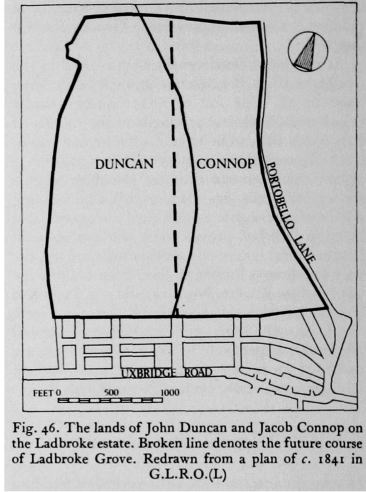
The lands of John Duncan and Jacob Connop on the Ladbroke estate. Broken line denotes The future course of Ladbroke Grove. Redrawn from a plan of c. 1841 in G.L.R.O.(L)
These dreams proved short-lived, for the last race at the Hippodrome took place only three months later, on 4 June 1841, (fn. 11) and it was during the ensuing six or seven hectic years that much of the Ladbroke estate assumed its modern aspect. By the two separate agreements signed with Connop and Duncan, Ladbroke had divided most of his undeveloped property into two parts, and the subsequent history of these two speculations demonstrates that the original undertakers of a large building project often failed, and that success depended largely upon the business capacity of each individual developer, and upon the financial resources which he could command. For both Connop and Duncan the results were disastrous. The successful development of Connop's lands was postponed for a decade or more, despite the fact that his lands were nearer to London and therefore more likely to prove 'ripe' for building, whereas on Duncan's more westerly lands, Duncan's partner, Richard Roy, was able to organize a dramatic surge of building whose momentum was only halted by the financial crisis of 1847.
In 1826 Connop had taken the benefit of the Insolvent Debtors' Act, and in 1830 he had been declared bandkrupt. In addition to 'discounting Bills of Exchange and receiving a commission on such transactions' he also dabbled in patent rights and searching for gold in Australia. (fn. 12) Despite these risky activities Ladbroke evidently considered him to be a suitable person to whom to entrust the development of a large part of the estate. By the agreement of 5 October 1840 Connop covernanted that by Christmas 1841 he would spend £2,000 on the building of such roads and sewers as Ladbroke's surveyor (Allason) might approve, and that by Michaelmas 1842 he would spend £5,000 on the building of two or more houses. During the first twenty years of the ninety-nine-year term he undertook to spend the enormous sum of £100,000 on the building of not less than 40 or more than 350 houses, half of which were to be of at least £1,000 in value, and none less than £500. The ground rent during the first year was to be £313, rising to £1,045 in the sixth and all succeeding years, this last figure being equivalent to £18 per acre.
Duncan's agreement contained very similar provisions. He covenanted to spend £80,000 within sixteen years on the building of between 32 and 250 houses, and to pay a ground rent of £405 in the first year, rising to £1,350 in the seventh and succeeding years (equivalent to £17 10s per acre). Either alone or in conjunction with Connop he was also to spend £2,000 on roads and sewers. (fn. 8)
Duncan's career as a speculator on the Ladbroke estate was even shorter than Connop's, and extended over little more than two years. He was a partner in the firm of Roy, Blunt, Duncan and Johnstone, solicitors, of Great George Street, Westminster, and Lothbury in the City, whose clients included several railway and insurance companies. He had been drawn into the Ladbroke estate through his client John Whyte, the original promoter of the Hippodrome, whose financial difficulties had prompted Duncan to take over Whyte's interest in the racecourse in October 1840, and (as has already been stated) on the very next day he had assigned his interest in the eastern half to Connop.
In order to raise capital for the fulfilment of his obligation to Ladbroke, Duncan borrowed £6,000 from the London and Westminster Bank (for which Roy, Blunt, Duncan and Johnstone acted as solicitors) upon the security of promissory notes repayable within six months. By an arrangement which he made with his partner, Richard Roy, repayment of these debts was guaranteed by Roy and Pearson Thompson of Cheltenham, esquire, to whom he conditionally assigened all his interest in the estate. (fn. 13) In the summer of 1841 his architect, Charles Stewart Duncan (probably a relative) was applying to the Commissioners of Sewers to lay sewers, (fn. 14) and he himself agreed to lease twenty building plots to a speculator, Mark Markwick of Worthing, esquire, who contracted with a builder from the City of London, John Jay, for the initial building of a range of ten houses in carcase at a cost of £1,000 each. (fn. 15)
Jay laid the foundations for these ten houses, but only completed five of them in carcase. These are Nos. 67–75 (odd) Ladbroke Grove, situated on the summit of the hill. They form a tall dull range of five houses, five storeys in height over basements, stucco-fronted at ground-floor level. Each house has a substantial enclosed projecting proch, also faced with stucco and furnished with sets of paired pilasters.
The whole project was to be financed by Duncan out of borrowed money, and in October 1841 he was obliged to provide Pearson Thompson with further security for his debts. In June 1842 he was able to stave off disaster for a short while by transferring the debt for £6,000 from the bank to Edmund Walker, a Master in the Court of Chancery. But in November 1842 Jay became bankrupt after Duncan and Markwick had failed to pay him the instalments due for his building work, and in December Duncan himself was also declared bankrupt. (fn. 16)
The parties possessing interests under Duncan's original agreement with Ladbroke were now the builder William Chadwick (to whom Duncan was liable for debts previously incurred by Whyte for building work at the Hippordrome), Walker, Pearson Thompson, Roy, and the latter's remaining partners, Duncan's own partnership having been dissolved shortly before his bankruptey, (fn. 17) when he owed his former partners over £45,000. In order to extricate the whole speculation from the financial difficulties created by Duncan's collapse, and to get it moving, all these parties agreed in November 1842 to appoint Pearson Thompson as their trustee and Roy as the recipient of all the building leases to be made by Ladbroke for Duncan's lands; and Roy was to hold all such leses upon trust for all parties according to their respective interests. (fn. 18) (fn. 1).
In the following year, 1843, Chadwick sold his interest in the westerly lands to Charles Henry Blanke, esquire, of Devonshire Place. (fn. 21) Blake was one of Roy's clients, and had recently arrived in England from Calcutta. (fn. 22) He had lent Roy's firm £10,000 (fn. 23) (probably in order to help the partners out of the difficulties caused by Duncan's debts to them of over £45,000), and was later to be the largest and most successful building speculator in the whole of North Kensington. At this stage, however, he took no active part in development. The interest which he acquired from Chadwick consisted of a claim for £4,100, or half the original debt of £8,200 incurred by Whyte to Chadwick, the other half having been apportioned to Connop's lands to the east. As the seventy-seven acres still nominally in Duncan's possession provided ample security for the recovery of this sum. Blake agreed to release the southern portion from this encumbranace. (fn. 24) This area (fig. 45) consisted of some sixteen acres to the west of Ladbroke Grove and to the south of the site of St. John's Church (later evidently extended to the line of Lansdowne Rise). Control of building development here was now vested in Roy and Pearson Thompson, acting on behalf of Edmund Walker and of Roy's partners as well as of themselves, and it was under their management that this part of the Ladbroke estate acquired its highly distinctive character.
The Cheltenham Connexion
At the time of his death in 1872 Pearson Thompson was described as the Marker of Cheltenham'. His father, Henry Thompson, after accumulating an ample fortune as a merchant and underwriter in the City of London, had retired to Cheltenham and bought the Montpellier estate, where medicinal springs were shortly afterwards discovered. His son, Pearson Thompson, had in early life practised as a solicitor in London, but after inheriting Henry Thompson's property in 1820 he removed to Cheltenham to develop the estate. From c. 1824 onwards the employed J. B. Papworth as his architect for both the layout of the Montpellier estate and the design of the Montepellier Purnp Room. Papworth also designed A number of large houses in Thompson's wealthy Lansdown district of Cheltenham, including one for Richard Roy. Both Pearson Thompson and Roy were members of the general committee for the provision of fashionable public amusements such as musical promenades and summer balls; in 1836 they were both founder-directors of a local joint-stock bank, and in the same year they were working together in the Controversies surrounding the promotion of railway lines to Cheltenham. They were, in fact, experienced and successful estate devlopers, willing, evidently, to extend their field of operations to the suburbs of London.
We have already seen that when Roy's partner, Duncan, had needed capital in 1841 for his operations on the Ladbroke estate, Roy and Pearson Thompson had acquired a share in the speculation by guaranteeing his promissory notes, and at the time of his bankruptey they had taken control. Pearson Thompson remained in Cheltenham, his principal role being probably the provision of capital, but Roy, whose residence in the town may always have been restricted to the fashionable 'season', gave up his house there in 1841–2. (fn. 25) From 1847 onwards he lived on the Ladbroke estate. He subsequently served as a Poor Law Guardian, as chairman of the commissioners under the Kensington Improvement Act of 1851, and as a vestryman.
The layout and general character of large parts of the Ladbroke estate clearly owe a great deal to the example of the Montpellier estate at Cheltenham. The scale of the layount and the size of most of the houses at Cheltenham are larger than on the Ladbroke estate, but the alternation of curving crescents with long straight roads, often lined with trees, the large gardens and open spaces, the mixture of house types and architectural styles, and the careful siting of churches and large houses at focal points all provide obvious similarities between the two estates. The use of Lansdowne (which Cheltenham had previously borrowed from Bath) and Montpelier (fn. 2) as street-names in Notting Hill even indicates an element of conscious and deliberate imitation. How the basis of these resemblances was created in the layout plan of the Ladbroke estate must now be described.
The evolution of the layout plan
It is first of all clear that after the failure of his 'great circus' plan of 1823 Ladbroke's own surveyor, Thomas Allason, ceased to be the sole author of later layout plans. His approval of these plans was, however, probably required, and he may well have greatly influenced their preparation; it is also likely that he provided designs for a number of houses. Three features of his abortive 'great circur' plan certainly survived all lter vicissitudes. These were, firstly, the large paddocks or private enclosures for the communal use of the residents of adjacent houses; secondly, his crescent, curving round the western slopes of the hill now surmounted by St. John's Church, an idea which in much amplified form provided a basic element in the executed layout of this part of the Ladbroke estate; and thirdly, the straight road (now Ladbroke Grove) which extended northward from the Uxbridge road, up over the hill and down the further side, and thus linked the ends of the crescents.
After Ladbroke's signature of the two building agreements with Connop and Duncan in 1840–1 Allason was, however, evidently no longer able to dictate the layout, and this caused additional complications. The straight course of Ladbroke Grove might with advantage have been taken as the dividing line between Connop's and Duncan's properties, but this was not in fact done, and the common border of their two leasehold properties had followed the gentle curve of the boundary of the Hippodrome (fig. 46). Thus when it was decided to extend Ladbroke Grove straight north in accordance with Allason's original plan, Duncan had a narrow sliver of land on the east side of the road and Connop an equally awkwardly shaped piece on the west side further north. Arrangements were eventually made to iron out this difficulty by a mutual exchange, in order to make Ladbroke Grove the boundary between Duncan's land on the west and Connop's on the east (fn. 26) (fn. 3) but the legal complications arising from this lack of overall control continued to reverberate until the early 1850's.
The next point to be noted about the layout of the Ladbroke estate is the influence of J. B. Papworth. We have already seen that after Duncan's failure in 1842, control of the land to the west of Ladbroke Grove passed to Pearson Thompson and Richard Roy, who had both previously employed Papworth at Cheltenham. There is no direct evidence that Papworth ever worked on the Ladbroke estate, but there are nevertheless indications, both visual and documentary, that his many-sided genius indirectly affected both the layout and even the design of some of the houses there. Bothe Allason and Robert Cantwell (whose work on the Ladbroke estate has been mentioned earlier) counted themselves among his admirers, for they were among the group of architects which presented Papworth with a silver inkstand at his retirement in 1847. (fn. 28). Allason and Papworth had both worked, either concurrently or consecutively, for the Earl of Shrewsbury in the adornment of the grounds at Alton Towers, (fn. 29) while the presence among the Papworth drawings in the library of the Royal Institute of British Architects of the design, referred to earlier and evidently by Cantwell, for a pair of houses in Ladbroke Terrace very similar to a pair in Cheltenham, suggests a professional association of some kind between Papworth and Cantwell.
Most important of all, the influence of Papworth is also revealed by the fact that after the abandonment of Allason's 'great circus' plan, the first revised scheme for the layout of the land to the west of Ladbroke Grove was the work of one of Papworth's pupils, James Thomson. Thomson had entered Papworth's employment in 1812, when he was only twelve years of age, and in a memoir written may years later he referred to his 'long residence' with Papworth. Whether his service extended to the years covered by Papworth's work at Cheltenham (c. 1824–32) is not clear, (fn. 30) for by 1826 he was acting as executant architect under Nash for Cumberland Terrace and Cumberland Place, Regent's Park. (fn. 31) But Thomson's sense of personal indebtedness to Papworth was certainly life-long, for he too was one of the architects responsible for the retirement presentation in 1847; (fn. 28) and the full extent of Papworth's influence on his work can be seen in Thomson's book, published in 1835 under the titile Retreats: A Seviers of Designs consisting of Plans and Elevations for Cottages, Villas and Ornamental Buildings.
Towards the end of 1842, when through Duncan's financial failure Pearson Thompson and Richard Roy were in need of an architect, Papworth was aged sixty-seven and within five years of retirement. After their brilliantly successful previous association with him at Cheltenham, to commission one of his former pupils (perhaps on his recommendation) for a fresh project in London was a natural step. However this may be, there can certainly be on doubt that it was Pearson Thomson and Roy who introduced James Thomson to the Ladbroke estate, for a posthumously published list of Thomson's works includes the laying out of Mr. Roy's estate at Notting hill'. (fn. 29)
In the autumn of 1842 Thomson was applying on Roy's behalf to the Westminster Commissioners of Sewers for permission to build sewers in Queen's Terrace (later Hanover Terrace, now Lansdowne Walk) and the west side of Ladbroke Grove, (fn. 32) and a printed plan, undated but not later than December 1842, is entitled 'Plan of Kensington Park, Notting Hill, as designed and laid out for building, with ornamental grounds, public drives etc. etc. James Thomson, Architect, Devonshire Street, Portland Place' (Plate 54a). Although subsequently much modified, this first plan does include the church (sited near its eventual position), two conscentric roads curving round the north-west slopes of the hill to join Ladbroke Grove, and perhaps at Allason's insistence, several of the 'paddocks' or communal gradens which were to form such important features of this area. All the houses on the southern portion of the estate were to be built in long terrace ranges, but further north there were to be detached and paired houses as well as terraces.
Thomson's plan for the lands to the west of Ladbroke Grove was evidently prepared in consultation with the architect for Jacob Connop's lands to the east, whose layout proposals were shown by Thomson in outline. This was Martin Joseph Stutely (d.1881), whose father Martin Stutely had worked as a builder on the Phillimore estate. (fn. 33) He was probably the author of a plan made at about this time for the erection of some 330 houses, almost all in long terraced ranges facing Ladbroke Grove and three streets leading eastward to Portobello Lane, on the west side of which there was to be a church. (fn. 34) This undistinguished scheme included a perfunctory attempt to provide a communal paddock, possibly again at Allason's insistence, but by January 1843 Connop was employing a new architect, John Stevens, (fn. 35), who was almost certainly the author of the unsigned plan for Connop's lands reproduced on Plate 54b.
Stevens had been a pupil of William Wilkins, and in 1843 he was elected district surveyor for the western part of the City. On the Ladbroke estate he and his partner George Alexander became architects in 1844 for St. John's Church, and he also designed many houses' there. (fn. 29) His plan for Connop's lands provided three large squares extending eastward from Ladbroke Grove to a new north-south line of communication, now known as Kensington Park Road. The houses in the two southerly squares, to be called Ladbroke Square and Beaufort Square, were to be separated in the traditional manner from the garden enclosure by the roadway, and at the west end of Beaufort Square there was to be a church fronting Ladbroke Grove. But in the northernmost square, to be called Lansdowne Square, the houses were to back directly on to a communal garden a feature evidently either insisted upon by Allason or borrowed from Thomson. On the northern slope of the hill there were to be fifteen detached houses each with a large private garden, and long ranges of terraced houses were to line the whole length of the east side of Kensington Park Road, one of whose functions appears to have been to shut off Portobello Lane from contact with the well-to-do inhabitants further west.
This plan must have been prepared in consultation with Thomson, and possibly with Allason also, for the positions of the openings into Ladbroke Grove correspond with those on Thomson's plan for the land to the west. But Stevens lacked the experience of landscape and layout which Thomson had acquired in Papworth's office and in Regent's Park, and his scheme seems mean and unimaginative in comparison. Fortunately, little of it ever materialized, the plan being abandoned after Connop's financial collapse in 1845 had resulted in the division of his lands among several speculators, who subsequently employed another architect, Thomas Allom, to prepare a new plan worthy of Thomson's example. Apart from the idea of Ladbroke Square, and the long range of houses along its south side (for the eastern half of which Stevens probably supplied designs), and the layout of Kensington Park Road, the northerly line of which was altered in 1849, (fn. 36) little of Stevens's work survives.
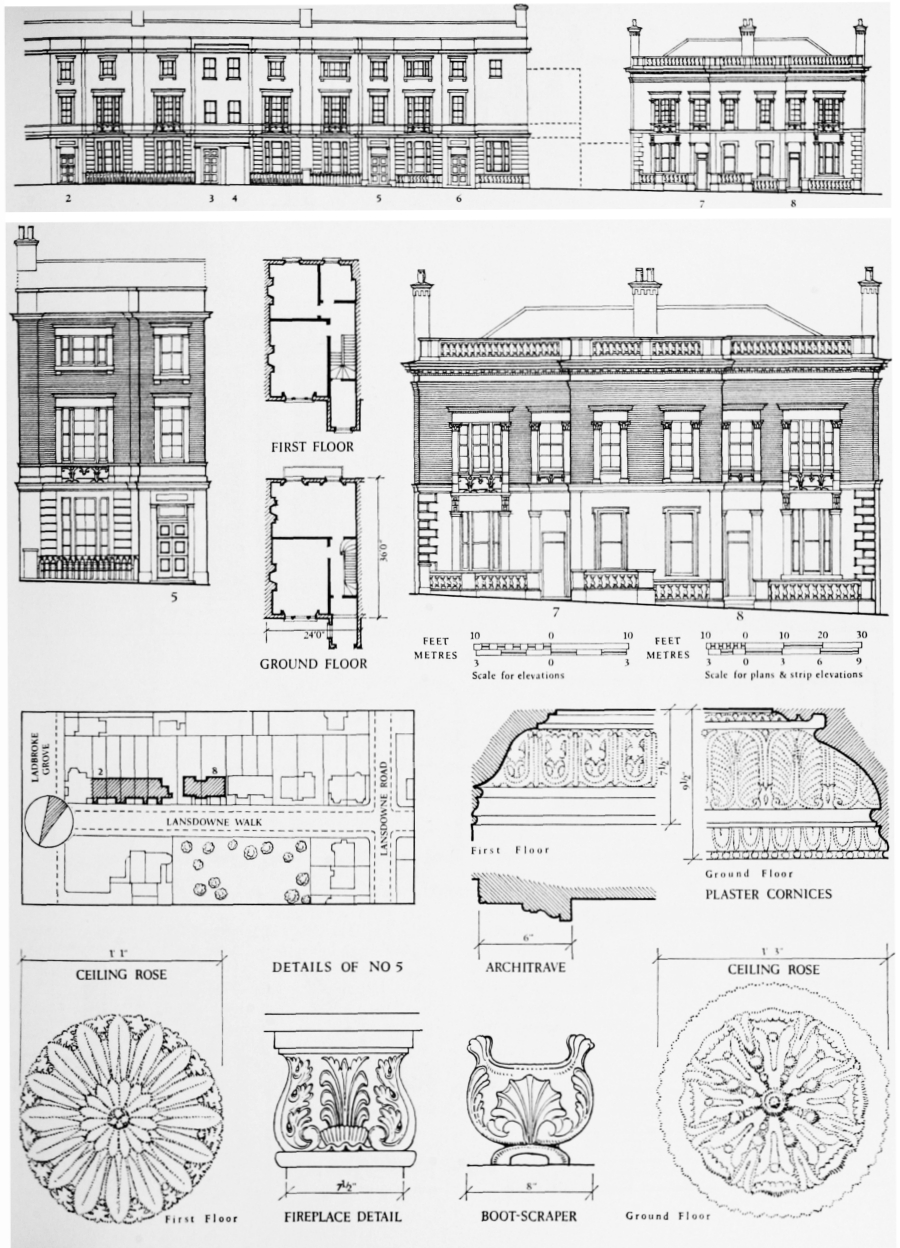
Nos.2–8 consec. Lansdowne Walk, plans, elevations and details
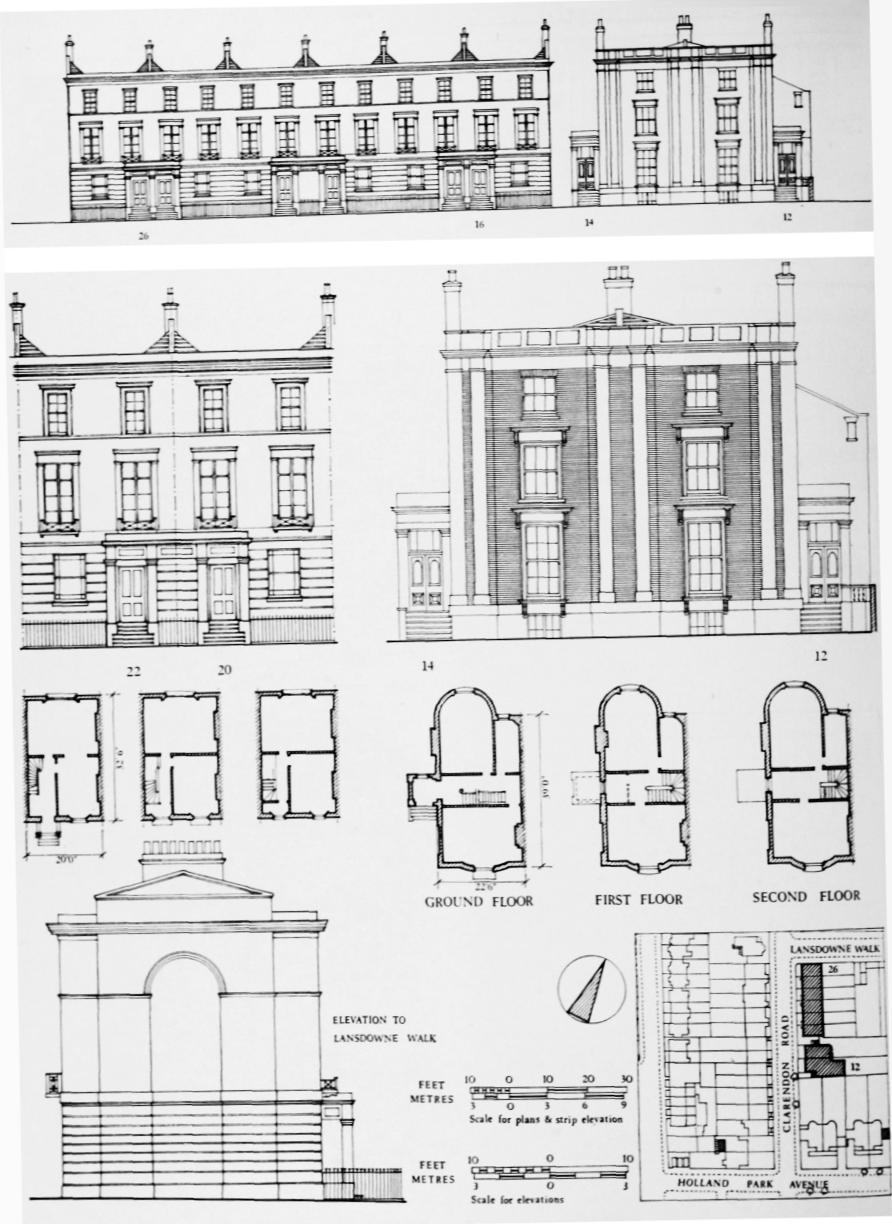
Nos. 12–26 even Clarendon Road, plans and elevations
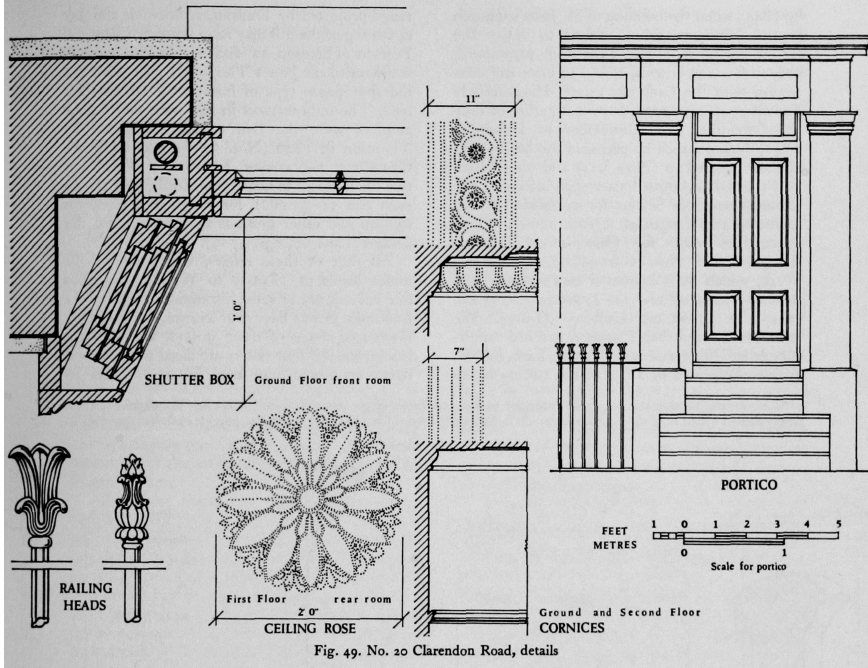
No. 20 Clarendon Road, details
His later commission to design St. John's Church was probably the result of a compromise. He and Thomson, presumably on the instructions of their respective clients, had both provided a church at focal points in their plans, the sites being almost opposite to one another on either side of Ladbroke Grove. But in the mid 1840's building development on the west side of Ladbroke Grove was advancing very rapidly under Richard Roy's auspices, whereas on the east side it was bedevilled by Connop's misfortunes (see below). It seems not improbable, therefore, that an agreement was reached whereby the church was built on the west side, on the condition that Stevens should be its architect.
This possibility is supported by the fact that by 1844, when the building of St. John's Church began, Thomson, whose claims to design the church might otherwise have been paramount, had, so far as is known, ceased to have any connexion with the Ladbroke estate. His definitely known connexion extends over a period of only three months, from September to December 1842, during which he prepared the layout plan already referred to (Plate 54a) and on Richard Roy's behalf submitted two applications to the Commissioners of Sewers for permission to lay drains to two ranges of terrace houses. These applications were for Queen's or Hanover Terrace (now Nos. 1–6 consec. Lansdowne Walk) which he is known from another source to have designed, (fn. 29) and for Lansdowne Terrace (now Nos. 37–61 odd Ladbroke Grove). (fn. 4) We have already seen that Thomson had had experience of building terraces in Regent's Park, but the failure at the end of 1842 of the twenty-house range projected by Duncan, Markwick and Jay at the top of the hilk may have prompted Roy and Pearson Thomson to decide that the terraces adumbrated on James Thomson's plan were not the appropriate type of house to build on their land. The only terraces in fact built under their auspices were the two certainly designed by Thomson in 1842 (Nos. 37–61 odd Ladbroke Grove and 1–6 consec. Lansdowne Walk) and two small ranges in Clarendon Road (Nos. 16–26 even and 31–39 odd), for which it is likely on stylistic and other grounds that he suplied the designs (Plate 60, figs. 47–9).
All four of these ranges, which were built under leases of 1842–5 to William Reynolds (see below), are of some distinction. Nos. 37–61 Ladbroke Grove have four storeys, but the other three ranges are of three storeys, and all have basements. All four ranges are faced with coursed stucco at ground-floor level, but at Not. 16–26 Clarendon Road the stucco extends to the full height. The upper windows of all four ranges have stuccoed architraves and a crowning cornice, also of stucco (now removed at Nos. 31–39 Clarendon Road). Nos. 37–61 Ladbroke Grove (of which Nos. 37, 39 and 51–57 have been rebuilt in recent years) are set back from the road behind their own shared private enclosure. They are stepped to match the steeply rising ground, and the end houses are set slightly forward to give added emphasis. At Nos. 1–6 Lansdowne Walk, the most sophisticated group in this quartet, the entrances are contained in projections which extend to second-floor level, and the balconies of the first-floor windows have simply detailed Grecian cast-ironwork. The treatment of the return fronts of the ranges in Ladbroke Grove and Clarendon Road must also be mentioned as notable features of Thomson's work. In Ladbroke Grove the central bays at both ends have a double range of plain pilasters surmounted by a pediment, all in stucco, while at the north end of both ranges in Clarendon Road the triumphal arch motif used to link the slightly projecting chimney-stacks recalls something of the scenic display of the terraces in Regent's Park.
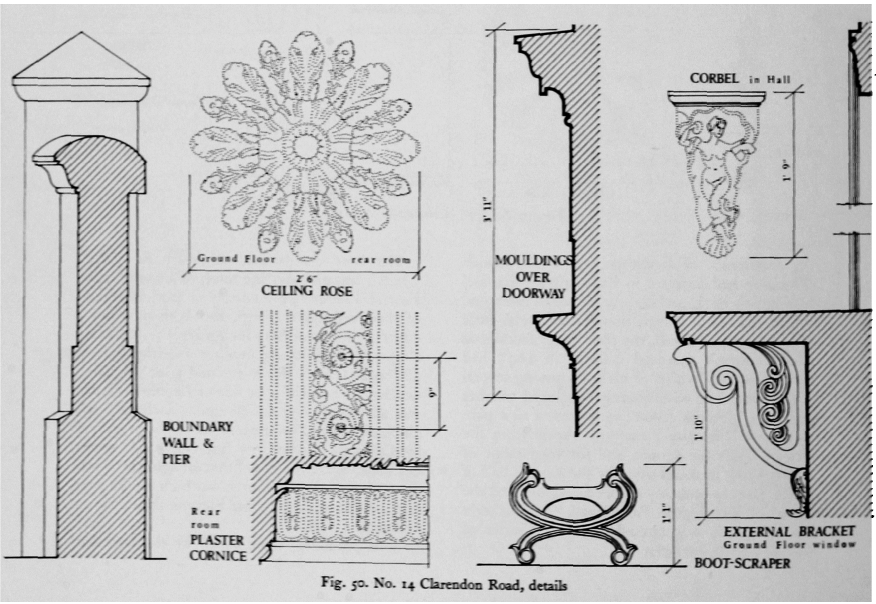
No. 14 Clarendon Road, details
Apart from these four ranges, all the other houses erected on Roy and Pearson Thompson's land to the south of Lansdowne Rise were built in pairs, with a few singles and trios. This change in policy required a substantial modification of Thomson's layout if the total number of houses to be built was not to be greatly decreased; and as it also corresponds in date with the end (so far as is known) of Thomson's connexion with the Ladbroke estate, and the appearance by March 1843 (fn. 38) of William Reynolds, builder or surveyor, regularly acting on Roy's behalf, (fn. 39) it seems likely that Reynolds, very probably in conjunction with Allason, was responsible for the substantial modifications which were now to be made to Thomson's original scheme.
The two plans reproduced on Plate 55 show successive strages in the evolution of these modifications. The first is dated 1843, and the second may probably be assigened to c. 1846; neither of them bears the name of its author, although Reynolds's name is mentioned on the second, and an incomplete manuscript version of the latter bears his signature and the date, 1846. (fn. 40) The main object of both plans was clearly to introduce more paired houses instead of the long terraced ranges which had predominated in Thomson's original design. This was achieved by the removal of the site for the church some two hundred feet southward in order to make room at the top of the hill for a new crescent (Lansdowne Crescent), and in the second version, by the introduction of two additional crescents on the lower, northern slopes of the hill. The provision of paddocks or communal gardens was also extended to most of the houses in the area, possibly at Allason's instigation.
The likelihood that Reynolds, in conjunction with Allason, was the author of the final executed layout plan for the Ladbroke estate to the west of Ladbroke Grove does not, however, reduce the significance of Thomson's earlier scheme. It was Thomson who first put Allason's original idea of shared private enclosures into practical form, and it was he who first propounded the idea of concentric crescents skirting round the north-west slopes of the hill. The success of these innovations was later to be attested in the work of other architects, notably Thomas Allom, to the east of Ladbroke Grove, where in the 1850's and 1860's the layout of Stanley Crescent and the formation of five more private enclosures are both derivatives of Thomson's work.
Development by Roy and Reynolds west of Ladbroke Grove, 1842–6
Extensive building development on the lands to the west of Ladbroke Grove began at the end of 1842, with Richard Roy in control as agent for the parties with claims against Duncan. From his office in Lothbury (where his firm also acted as solicitors to the London and Westminster Bank, a life insurance society and two railway companies) (fn. 41) Roy was able to command the financial resources needed for large-scale speculation. In November 1842 he signed a building agreement with Ladbroke for an additional three acres of land between Pottery Lane and Portland Road, (fn. 42) and within less than four years he had virtually completed the development of a substantial part of the area, extending as far north as Lansdowne Rise and Lansdowne Crescent (fig. 45). Between December 1842 and June 1846 he, as his clients' nomince, was granted 147 building leases by Ladbroke. These yielded a total annual income of £1,127 in ground rents payable to Ladbroke. (fn. 43) This revenue was considered to be enough to secure the rent reserved in the original agreement between Ladbroke and Duncan, and entitled Roy to leases from Ladbroke of the remaining lands to the north of Lansdowne Rise, which were granted to him at peppercorn rents on 8 June 1846. (fn. 44)
The mechanics of the development which took place to the south of Lansdowne Rise and Lansdowne Crescent between 1842 and 1846 were extremely complicated, and owing to the limitations of the evidence available, are not altogether clear now. The man on the spot was William Reynolds, a builder with a wharf on the Regent's Canal near City Road, (fn. 45) who occupied a house or office, first at No. 26 Ladbroke Grove and then at No. 16 Clarendon Road. In 1845 he was also acting in a supervisory capacity as a surveyor in the layout of an estate at Southall. (fn. 46) It was he who notified the district surveyor of impending works on Roy's estated and who from March 1843 onwards made application on Roy's behalf to the Commissioners of Sewers for permission to build new sewers in Clarendon Road, Lansdowne Road, Lansdowne Walk, Lansdowne Crescent and St. John's Gardens. Visual evidence suggests that he also supplied the designs for many of the houses which he built in these streets.
Reynolds's relations with Roy are obscure, but basically it was Reynolds's job to organize the building of the roads, sewers and houses, and Roy's to organize a continuous supply of large amounts of capital. The usual procedure was for Roy, as soon as he received a building lease from Ladbroke, to grant a sub-lease to Reynolds for the full extent of his own term less about ten days, but at about double the ground rent reserved to Ladbroke. (fn. 47) This was done in at least 112 of Roy's 147 leases from Ladbroke. Roy's profit or rather, that of his clients—was thus safeguarded, while Reynolds acquired a leasehold interest on the security of which he could raise capital for more building. This he did either by mortgaging his sub-leases (usually for between £500 and £800 per house) or by selling newly completed houses for a lump sum. Occasionally he granted twenty-one-year leases, at rents of about £75 or £90 per year. (fn. 48) Reynolds's principal mortgagee and purchaser was Joseph Blunt, one of Roy's partners, whose other clients' need for outlets for surplus capital probably kept him well supplied with resources available for investment in bricks and mortar. In all the deeds giving effect to these devices, Reynolds's signature was almost always witnessed by members of the staff of Messrs. Roy, Blunt and Johnstone, which indicates that it was through this firm that his financial requirements were met. In at least one case, indeed, that of G. H. Robins, auctioneer of Covent Garden, to whom Reynolds owed £3,500, the firm even undertook to guarantee repayment of the debt. (fn. 49)
Many of the houses built by Reynolds have a recognizable 'style' of their own, and may therefore (as previously mentioned) have been designed by him (Plate 63). Most of them are paired, with two or three storeys and a basement, each individual plot having a frontage of about 40 feet and a depth of between 90 and 130 feet. Most houses are faced with stucco at either ground-floor level or throughout their whole height, and all such features as doorways, balconies, windowarchitraves, cornices and pediments are liberally adorned with coarsely-detailed stucco dressings. A robust coarseness is, indeed, the distinguishing feature of Reynolds's work, as can be seen, for instance, in many of his houses in Lansdowne Road, where his Italianate detail (notably the shell motifs above the first-floor windows at Nos. 15 and 17 and elsewhere) is in marked contrast with the more restrained Grecian treatment practised by Thomson.
There was plenty of variety in Reynolds's work. In Lansdowne Walk, for instance, the pair numbered 7 and 8 (fig. 47) has first-floor windows framed by Corinthian pilasters and dentilled cornices, and a modillioned cornice crowned by a stucco balustrade, while Nos. 11 and 12 have semi-circular headed windows and a bold enriched cornice. All four of these houses, and many others, have suffered by the partial or complete removal of balconies, balustrades, cornices and other ornamentation, or by the insensitive insertion of extra windows, as, for instance, at Nos. 43 and 45 Clarendon Road. This unusual pair of villas has a giant Corinthian order of stucco pilasters carrying an entablature and pediment (now pierced by a window) with a modillioned cornice. Another nearby pair, Nos. 51 and 53 Clarendon Road, has triple-arched windows at first-floor level and ill-proportioned Ionic proches.
A few of the houses leased to Reynolds are, however, markedly different from those described above, and may have been designed by someone else. The quality of the ornamentation of the two pairs numbered 37–43 (odd) Lansdowne Road (Plate 63d), for instance, recalls Thomson's manner rather than that attributed above to Reynolds, while at Nos. 5–8 (consec.) and 13 and 14 Lansdowne Crescent squat Lombardic towers are introduced—an early example of this genre, which did not become generally fashionable until the 1850's. The fact previously noted that Reynolds was the lessee for the four ranges designed by Thomson shows that he did not always himself design the houses which he built, and one or two other architects besides Thomson may well therefore have been involved in his building work.
The only other builders to whom Roy granted sub-leases besides Reynolds were Joshua Higgs, senior and junior, of Davies Street, Mayfair, the builders of St. John's Church, for the adjoining Nos. 2–4 (consec.) Lansdowne Crescent and 63 Ladbroke Grove; (fn. 50) Frederick Woods and William Wheeler of Notting Hill, for Nos. 16–30 (even) Lansdowne Road; (fn. 51) Samuel Clothier of St. Pancras, marble mason, for Nos. 14 Lansdowne Road and 14 Lansdowne Walk; (fn. 52) and J. H. Nail, appraiser, for a number of small houses in the vicinity of Pottery Lane. (fn. 53) Nos. 2–4 Lansdowne Crescent and 63 Ladbroke Grove, two pairs, one in the Gothic manner appropriate to their situation beside the church, and the other having steeply pitched gables, do not resemble any other houses in the area under discussion, and were probably designed by the Higgs. Four of the eight houses leased to Woods and Wheeler in Lansdowne Road have the same stucco Corinthian pilasters at first-and second-floor level as Reynolds used opposite at No. 9 Lansdowne Road, and were probably designed by Reynolds, as also was the pair at the corner of Lansdowne Road and Walk (Plate 63e, 63f), where the lease to the marble mason Clothier may have been granted at Reynolds's request in settlement of a debt.
The census of 1851 provides detailed information about the people then living in the houses built under the auspices of Roy and Reynolds. The returns for the forty houses in Lansdowne Road now numbered 2–44 (even) and 9–43 (odd) show that two houses were empty and two others occupied by caretakers. In the remaining thirty-six houses there were 273 residents, of whom 90 were servants. The average number of residents in each house was thus c. 7–6, of whom 2–5 were servants. The householders included eleven fundholders or landed proprietors, five merchants, three lawyers, two army officers (both in the East India Company's service), two coach-builders, two civil engineers, and one surgeon (with four resident patients), one commercial clerk and one iron and tin manufacturer. Three houses were used as girls' schools, with a total resident staff of nine mistresses.
In Lansdowne Crescent twenty houses were occupied by 133 residents, of whom 53 were servants. The average number of residents in each house was thus 6–6, of whom 2–6 were servants. The householders included three fundholders (all women), three lawyers (one a magistrate), two army officers, two civil servants, and one clergyman, chemist, dealer in stocks and shares, parliamentary agent, wholesale bookseller, warehouseman, varnish maker and merchant.
The most remarkable feature of the development of this area was the creation of five communal gardens, four of them at the rear of the houses on either side of Lansdowne Road, and the fifth at the rear of the houses on the inner side of Lansdowne Crescent. Each house had a small private garden for its occupants' own exclusive use, and these gardens provided access at the rear to a much larger paddock, which was to be shared by all the inhabitants of the houses backing on to it. The five paddocks comprised over five acres of land, and only the houses on the west side of Clarendon Road and the south side of Lansdowne Walk, where the outer boundaries of Roy's land prevented such an extended layout, did not enjoy this precious amenity of suburban living.
Each paddock was leased by Ladbroke to Roy as part of the curtilage of one of the houses abutting on to it. The first to be so leased, in March 1844, was the garden behind the houses in Lansdowne Crescent, and here the paddock was included in the lease of No. 9. (fn. 54) When Roy granted sub-leases of the houses (usually to Reynolds), he covenanted to lay out the paddock 'for the convenience and recreation of the tenants and occupiers', and granted them the right to use the garden and 'to walk and demean in and upon the same premises in manner customary in enclosed pleasure or ornamental garden grounds in Squares and other like places in London', provided that 'none of the Livery or other servants . . . save and except the domestic servants in actual attendance on the Children or other members of the family' should be permitted to enter. (fn. 54) In his sub-leases Roy reserved to himself an annual garden rent ranging from one to three guineas on each house, (fn. 55) and in return he covenanted to maintain the garden at his own cost for the whole of his leasehold term. (fn. 54) In later years Roy bought the freehold of may of the houses from the Ladbroke family, and later still, sold many of these freeholds subject to the existing underleases. These sales included a right to use the appropriate paddock, but the soil itself was exculded. The purchasers, not wishing to undertake the maintenance of the five gardens, converyed the garden rents back to Roy, who thus retained his responsibility for maintenance for the remainder of the original leasehold term. In the case of the Lansdowne Crescent paddock, Roy's heirs in 1910 leased the garden rentcharges for one hundred years to trustees acting on behalf of a committee of the inhabitants. The rent-charges are still paid, supplemented by a voluntary additional payment to meet rising costs. (fn. 56)
The following table of leases granted by Ladbroke to Roy between December 1842 and June 1846 shows the gatering momentum of building. (fn. 43)
Besides the houses there were also the roads and sewers to be built, the total length of sewers for which Reynolds obtained building permission from the Commissioners amounting to some 8400 feet. The steeply sloping ground presented problems, and in the northern part of Lansdowne Crescent a great mass of clay twenty feet in depth which had been deposited on the turf to make the road slid down the hill, destroying vaults and sewers. (fn. 57) And finally there was the church itself (Plate 12), that important adjunct of a successful suburban building speculation, which was built on the summit of the hill on the west side of Ladbroke Grove, but where it could also form a total point for Connop's estate on the other side of the road. At the time of the consecration of the church, on 29 January 1845, The Builder commented that 'an entirely new neighbourhood has grown up in this quarter "like an exhalation". (fn. 58)
During the hectic three and a half years from December 1842 to June 1846 some £12,000 must have been invested in Roy's estate (fn. 5). Almost all, or perhaps all of this money was channelled to Reynolds through the firm of Roy, Blunt and Johnstone, either directly by Blunt or indirectly by one of the firm's clients with money available for investment. The case of one of these clients, Viscount Canning, was probably typical of a dozen others. In 1843 he had lent £2,000 to the trustees for building St. John's Church. (fn. 59) He had also lent to Reynolds, who in 1846 owed him £3,500 (later increased to £8,200) for monies lent and advanced or paid for his [Reynolds's] account by the hands of Messierus Roy, Blunt and Johnstone, the solicitors of the said Viscount Canning'. This loan was at first secured only by the deposit in the firm's custody of six of Roy's sub-leases to Reynolds, but by the end of 1846, when the boom in railway shares was rapidly mounting, money was becoming hard to find and Reynolds agreed that if Lord Canning should require him to do so, he would execute a mortgage which should include 'a power of sale'. (fn. 60)
By this time Roy himself had been compelled to make heavy mortgages of his leases from Ladbroke (subject of course to Reynolds's underleases) probably to his own clients, (fn. 61) and some of the existing mortgagees were calling in the money which they had advanced to Reynolds. In May 1846 Reynolds was able to transfer some of these mortgages to the Sovereign Life Assurance Company, (fn. 62) but by October he had to sell some of his under-leases to his mortgagees, (fn. 63) and even to resort to a loan of £7,000 limited to six months' duration from a group of City magnates. These were the two great bill dealers, Samuel Gurney, of Overend and Gurney, and James Alexander of Alexander and Company, plus Sir Moses Montefiore and Lionel Nathan de Rothschild. (fn. 64) In December this formidable quartet was willing to take over the mortgages made by the Sovereign Life, (fn. 65) but the repayment of the loan in April 1847 evidently exhausted Reynolds's resources and after the Sun Insurance Office had refused his request for a loan of £20,000 (fn. 66) a judgment for debt was entered against him in May. (fn. 67) Throughout the summer of 1847, when there were numerous mercantile failures in the City, he was still able to find purchasers for his under-leases through Roy, Blunt and Johnstone, (fn. 68) but in the autumn, when the Bank Charter Act was suspended, there were two more judgements for debt against him. (fn. 69) It was at about this time that his connexion with Roy, Blunt and Johnstone came to an end, and the firm itself split. Blunt, who had supplied so much of Reynolds's capital, appropriately became solicitor to the Royal Mint, Johnstone became clerk to the Patent Office, while Roy, who now lived at No. 59 Ladbroke Grove, remained in command in Lothbury. (fn. 41) Reynolds himself was not so fortunate, for in February 1848 he was declared bankrupt. (fn. 70) But this was not quite the end of him, for within less than eighteen months he was building houses again on the east side of Ladbroke Grove, and sewers in the northern part of Clarendon Road and in Blenheim Crescent. (fn. 71) He died intestate in 1850. (fn. 72)
For Pearson Thompson, from whom presumably had emanated the original idea of forming a 'little Cheltenham' at Notting Hill, the outcome was different. His investment on the Ladbroke estate had 'so involved his affairs as to compromise the whole of his property', and in 1849 he emigrated to Australia. After practising at the bar in Sydney for a while, he removed to Castlemaine, the centre of a large goldmining district, where he practised very successfully and later became a magistrate. He died there in 1872. (fn. 73)
Development by Connop east of Ladbroke Grove, 1841–5
To the east of Ladbroke Grove the progress of building had meanwhile been very much slower. There Connop was deeply involved in Duncan's financial difficulties; (fn. 74) like Duncan he was indebted to the builder William Chadwick for work done at the Hippodrome racecourse, (fn. 75) and through his activities in the City as a bill broker he also, in March 1842, owed nearly £12,000 on unpaid bills of exchange to William Sloane, (fn. 76) a gentleman who had made a fortune in Bengal as an indigo planter. (fn. 77) Connop urgently needed capital to get his building speculation moving, and in August 1841 C. H. Blake (see page 221), then still in Calcutta, agreed to purchase the improved ground rents of nine houses (where completed) for £6,750. (fn. 78) Blake seems, however, to have withdrawn from this risky project, and it was Connop's solicitor, William Parkin of Chancery Lane, (fn. 79) who persuaded a relative, Henry Parkin, a physician living in Torquay, to provide urgently needed backing. Henry Parkin agreed to buy at fifteen years' purchase the improved ground rents of eleven houses to be erected by Connop, and by February 1842 he had advanced £4,000 to Connop for this purpose, a debt which two years later had risen to £10,000. The security for all these and other debts was Connop's agreement with Ladbroke, but in July 1842 there were still no houses, Connop 'not being able to induce any person to undertake to build'. (fn. 80)
In the following month, however, he agreed to grant leases of five plots on the south side of Ladbroke Square (Nos. 23–27 consec.) to William Gribble, a St. Marylebone builder, and building began at last, Gribble's capital being supplied by C. H. Grove, another lawyer of Chancery Lane. (fn. 81) By October he had induced another builder, W. J. Wells of Islington, to take four more plots in Ladbroke Square (Nos. 28–31), (fn. 82) but misfortune was never far away, for in November he had to execute yet another mortgage of his lands, to his architect's father, Martin Stutely, for £7,400 due on unpaid bills of exchange; (fn. 84) and in January 1843 some 220 feet of the sewer which he was himself laying in Ladbroke Square collapsed. (fn. 84)
By June 1843 building was sufficiently advanced for Ladbroke to grant, at Connop's request, ninety-seven-year leases of twelve houses in Ladbroke Square (Nos. 23–27 and 31–37 consec.), two on the east side of Kensington Park Road (Nos. 44 and 46, now demolished) and five on the east side of Ladbroke Grove at the top of the hill (Nos. 42–50 even), all to William Parking. (fn. 85) John Stevens, who by this time had superseded Stuteley as Connop's architect, was a party in one of the transactions relating to Nos. 31–37 Ladbroke Square, (fn. 86) and he may therefore have been the designer of this range. The houses in Ladbroke Grove were certainly not yet finished, for seventeen months later they were still in carcase, (fn. 87) and in October 1845 they (Nos. 42–50) together with Nos. 52–58 Ladbroke Grove were re-leased by Ladbroke to John Brown of St. Marylebone, builder. (fn. 88) Soon afterwards Brown mortaged these houses to Ladbroke's solicitors, Bayley and Janson, (fn. 89) which suggests that Ladbroke or his agents were by the provision of capital trying to get development moving.
The houses in the range in Ladbroke Square between Ladbroke Terrace and Kensington Park Road (Plate 61e) are of the conventionally planned terrace type, but have spacious accommodation, being some twenty feet in width on average. Nos. 42–58 (even) Ladbroke Grove, by Brown, are large paired villas, with the exception of Nos. 50 which is detached, and are built of stock brick with stucco enrichments. The pair numbered 42 and 44 is an eclectic design, having a symmetrical façade of three storeys over a basement, with a small pedimented attic storey in the centre. The front is enlivened with stucco pilasters, architraves, balustrades, porch and large main cornice carried on console brackets.
The grant of leases in June 1843 (referred to above) had probably been an attempt by Connop to provide additional security for his creditors, for he was by then already being closely pressed, and by the end of 1843 two court judgments had been delivered against him for unpaid debts. (fn. 90) Soon afterwards Brown was granted leases of Nos. 20–22 (consec.) Ladbroke Square, (fn. 91) and William Parkin of three villas, Nos. 48–52 (even) Kensington Park Road (now demolished), (fn. 92) Parkin being also nominated as the intended lessee of Nos. 38–46 Ladbroke Square. (fn. 93) But the two Parkings were now in their turn in financial difficulty, and in June 1844 they mortgaged their interest in Connop's lands for £8,000. (fn. 94) Connop himself was evidently no longer credit-worthy, and in January 1845 a receiver was appointed to administer his estate. (fn. 95)
Development by Chadwick in Ladbroke and Kensington Park Roads, 1840–52
By this time doubts had again arisen, as in 1832, about the validity of the leasehold titles created by Ladbroke, and in 1844 a third Act of Parliament had been obtained. In addition to the two contracts of 1840–1 with Connop and Duncan, Ladbroke had also signed three other agreements—one with William Chadwick in 1840 for the development of land around the intersection of Ladbroke Road and Kensington Park Road, one already mentioned with Richard Roy in 1842 for some three acres between Pottery Lane and Portland Road, and one in 1844 with William Henry Jenkins, a civil engineer, for twenty-eight acres around Pembridge Villas (see Chapter X). All these agreements were now confirmed, and Ladbroke was also empowered to accept surrenders of existing leasehold interests, to grant new leases where necessary, to vary the existing agreements by mutual agreement, particularly as to the maximum numbers of houses to be built, and to sell land for the site of a church. (fn. 96) The fact that these and other amendments were needed suggests that Ladbroke and his advisers, Allason (surveyor) and Bayley and Janson (lawyers), had not been very efficient in their management of the estate.
William Chadwick had been active in building on the Trinity House estate in Southwark in the 1820's, (fn. 97) and was now in the City, where he described himself as an architect and/or builder. (fn. 98) Between 1832 and 1837 he had been the contractor at Kensal Green Cemetery for the building of the two chapels there and the boundary wall. He had been drawn into the Ladbroke estate through his employment by Whyte in the erection of fences and stables at the Hippodrome, and his unpaid account for this work, amounting to some £8,200, had been secured by a lien on the lands contracted by Ladbroke to Connop and Duncan in 1840–1. (fn. 99) He was evidently a man of caution and experience, for in his agreement with Ladbroke he only contracted for some seven acres (fig. 45), (fn. 100) at an initial rent of £104 rising in the fourth and all succeeding years to £113 (equivalent to £16 per acre), and he only undertook to spend £4,000 in building. (fn. 96)
Most of Chadwick's work on the Ladbroke estate consists of well-proportioned and regular terrace houses simply dressed with stucco, and provides a marked contrast with the loosely spreading Italianate façades of his contemporary, William Reynolds. He began, as speculators often did, by building a public house, the Prince Albert, at the junction of Kensington Park Road and Ladbroke Road, of which he was granted a lease by Ladbroke in 1841. (fn. 101) By 1848 he had built nine houses in Ladbroke Road—Nos. 1–11 (odd) on the south side (Nos. 9 and 11, Plate 61a, being a large pair of stucco-faced villas with pilasters and a grand cornice supported on huge brackets) and Nos. 14–18 (even) on the north, the latter adjoining Horbury Mews, which was formed many years later (in 1877) on the site of a nurseryman's grounds. (fn. 102) No. 14 is a large pedimented three-storey villa with two-storey wings, and has a frontage of seventy-five feet, while Nos. 16 and 18 form a pair of Italianate houses with pediments over the ground-floor windows, a bracketed cornice, and semi-circular headed windows above trabeated doorways (Plate 61b, 61d). On the east side of Kensington Park Road he had completed another six houses, of which Nos. 32–38 even (four-storey paired villas with stucco fronts) survive, (fn. 103) plus twelve small terrace houses on the west side of Pembridge Road (Nos. 13–33 odd Pembridge Road and 2 Kensington Park Road). (fn. 104)
The ground rents arising on these houses were enough to secure Ladbroke's interest, and in May 1848 Felix Ladbroke granted Chadwick a lease of most of the remaining land at a peppercorn rent, (fn. 105) the plot at the corner of Kensington Park Road and Ladbroke Road being reserved for a Congregational chapel. This was Horbury Chapel (now Kensington Temple, Plate 28b), designed by J. Tarring and built in 1848–9 by T. and W. Piper. (fn. 106)
Chadwick's business was large enough for him to employ his own clerk of works, (fn. 107) and in 1848 he began to grant leases to other builders, notably to George Stevenson for Nos. 13–19 (odd) Ladbroke Road, a group of houses which avoids the monotony of the terrace which it in fact is by having the entrances set in smaller and lower elements as in St. James's Gardens on the Norland estate and elsewhere. Chadwick's own later building included a range of small houses, models of simple stock-brick terraces, with stucco architraves, and some with shops on the ground floor, at the apex of Kensington Park Road (Nos. 2–30 even), and more similar development in Pembridge Road (Nos. 35–59 odd), the latter extending round into Portobello Lane (the Sun in Splendour public house and Nos. 9–13 odd), all of which was substantially complete by the time of his death in 1852. (fn. 108) The building of Horbury Crescent and Nos. 2–10 (even) Ladbroke Road was begun in 1855 by his heir, W. W. Chadwick, for whom a local builder, John D. Cowland, acted as contractor in the building of sewers. (fn. 109) The long three-storey range of Nos. 21–55 Ladbroke Road, notable for not having basements, was built by William Wheeler under leases granted by W. W. Chadwick in 1833–4 (Plate 61c).
Development by Drew in Ladbroke Road, 1840–5
One other portion of the Ladbroke estate developed before 1847 remains to be described the area to the north of Adams's speculation of 1826–31 along the Uxbridge road, extending westward from Ladbroke Grove to Portland Road, and bounded on the north by Roy's holding (fig. 45). The developer here was William John Drew, variously described as builder or architect and doubtless a relative of John Drew of Pimlico, builder, who together had built Nos. 11–19 (odd) Ladbroke Grove (fig.51), beginning in 1833. No agreement between Ladbroke and W. J. Drew has been found, but between 1839 and 1845 Drew or his nominees were granted leases of all the ground in this area. The fifty or more houses which were built here have a style of their own quite distinct from the work (previously discussed) of Cantwell, Adams, Thomson, Reynolds or Chadwick, and there is some reason to think that Ladbroke's surveyor, Allason, may have been responsible for their design (Plate 62).
After the completion of Nos. 11–19 Ladbroke Grove in about 1838 W. J. Drew had built a similar range of small two-storey stucco-fronted houses in the Grecian manner at Nos. 1–11 (odd) Clarendon Road (now demolished), under leases granted by Ladbroke in 1840–1 (fn. 110) (Plate 62a). Drew's mortgagee for part of this range was Allason, (fn. 111) and in 1843 Drew was mortgaging other houses in the area to Ladbroke's solicitor, R. R. Bayley. (fn. 112) It may therefore be that Ladbroke and his agents involved themselves more actively in the development of this part of the estate that was the case elsewhere.
The two characteristic features to be found in most of the houses with which Drew was connected, namely the use, firstly, of vertical strips of stucco, which appear as pilasters with the minimum of mouldings, and extending through two or sometimes even three storeys, and secondly, of semi-circular bowed projections, had both previously been used by Allason in 1827 for his own house. This was Linden Lodge in Linden Grove (now demolished, see page 269), a large twostorey stucco-fronted detached house having simplified pilasters extending through the full height of a central bowed projection (Plate 73a). On the main portion of the Ladbroke estate the first examples of the use of pilasters by Drew are to be seen at Not. 21 and 23 Ladbroke Grove, leased to him in 1839–40, (fn. 113) and at Nos. 25–35 Ladbroke Grovre, leased also in 1839–40 to Drew's nominee. Francis Read of Pimlico, builder. (fn. 114) This terrace (Plate 62b, fig. 52) is arranged as a series of linked pairs of houses, each of three storeys above a basement, their stucco façades being furnished with slender pilasters. These pilasters unite the ground and first floors beneath a continuous dentil entablature, whilst the upper storey is given an attic order, surmounted in turn by shallow eaves to the lowhipped slate roofs. The façades, each two windows wide in the main face, break back slightly in the linking parts where entrance doors are set within Roman Doric porches.
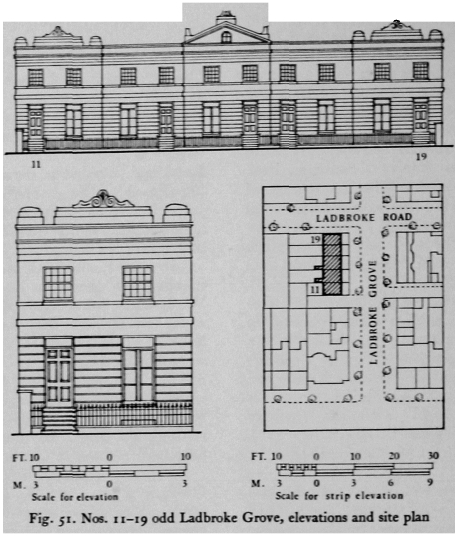
Not. 11–19 odd Ladbroke Grove, elevations and site plan
The houses (mostly paired) in the stretch of Ladbroke Road between Ladbroke Grove and Landsdowne Road, for which Drew was the lessee between 1841 and 1845, have characteristic vertical stucco strips, as well as bowed projections (now often obscured by later additions) at the side or rear. So, too, have Nos. 2–12 (even) Lansdowne Road, of which he was granted leases in 1843 (fn. 115) (Plate 62d, fig. 53). The latter form three pairs of two-storey houses with basements and attics. Here the giant stucco strips support large consoles which carry wide overhanging caves. Generally there are three rooms on the main floors, and the bowed projections of the large rear rooms overlook spacious gardens. These houses are faced by Nos. 1–5 (odd) Lansdowne Road, three large detached villas where, exceptionally, neither pilasters nor bows are used. These were leased in 1845 at Drew's direction to his nominee, William Liddard of Notting Hill, gentleman, and have stucon architraves, stringcourses and enriched cornices carried on ornate consoles. (fn. 116)
The possibility that Allason may have provided designs for Drew is further supported by the evidence of a group of houses further west. On the west side of Clarendon Road Drew was the lessee in 1840 for Nos. 13 and 15 (a stuccofronted pair with pilasters) (fn. 117) and in 1845 Nos. 17–29 (odd) were leased to his nominees, Liddard for Nos. 17–21 (a plain stuccoed range of three houses) and Allason himself for Nos. 23–29 (fn. 118) (Plate 62c). The latter form a short range of narrow terraced houses unique at this period in the development of the Ladbroke estate in having semi-circular projecting bows extending up through the full height of the fronts, three storeys over basements, much in the manner then fashionable at seaside resorts such as Brighton. (fn. 6) At the time of his death in 1852 Allason owned the freehold of all of these nine houses. (fn. 119)
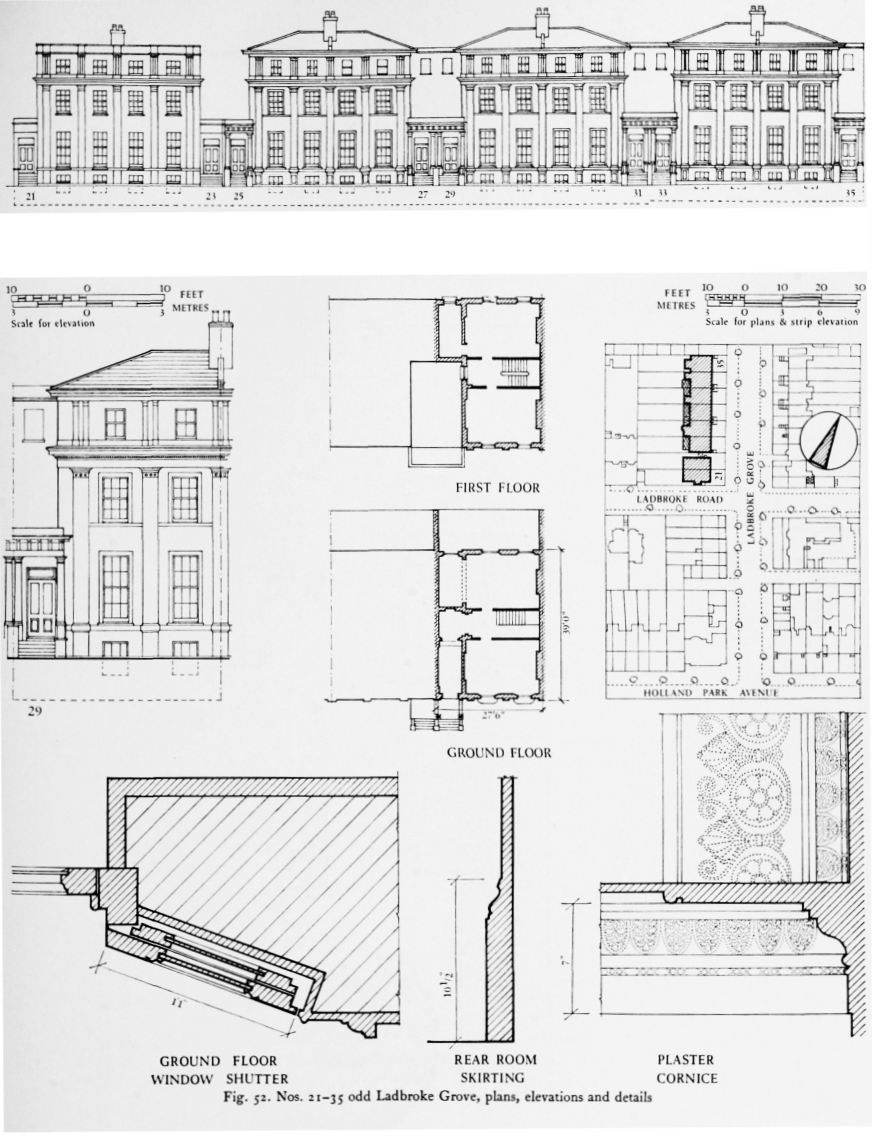
Nos. 21–35 odd Ladbroke Grove, plans, elevations and details
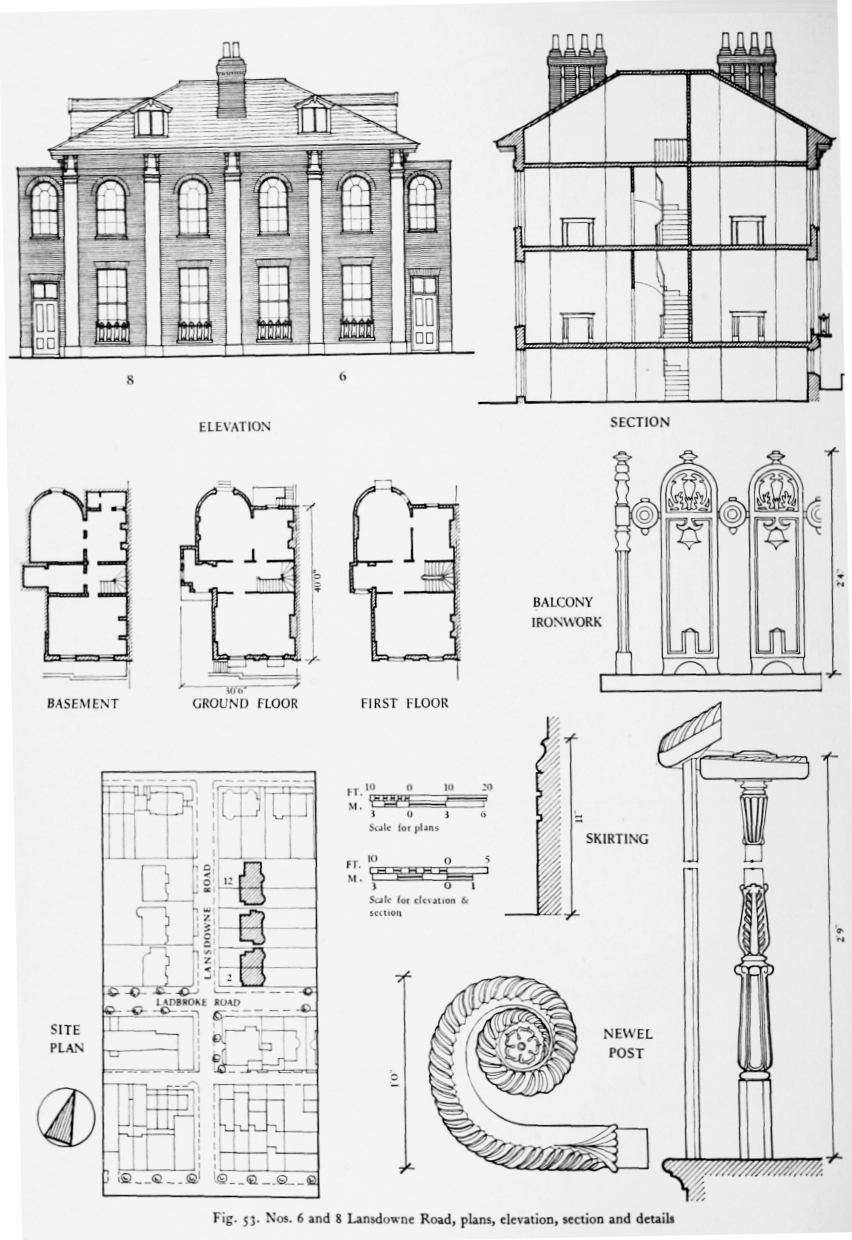
Nos. 6 and 8 Lansdowne Road, plans, elevation, section and details
Opposite, on the east side of Clarendon Road, Allason was also in 1845, at Drew's nomination, the lessee for Nos. 12 and 14 Clarendon Road (Plate 62e, fig. 50) and for the contiguous Nos. 80–86 (even) Ladbroke Road. (fn. 120) These six houses consist of three substantial pairs, all of three storeys over basements, and all with stucco strips rising from the ground floor to support an entablature surmounted by a panelled parapet. Nos. 12 and 14 Clarendon Road have shallow bowed fronts, and the doorways are set back on the flanks. Unmistakably related to this pair is the much larger and slightly later group at Nos. 1–3 (consec.) Kensington Park Gardens, where Allason and Drew were also both involved (fn. 121) (Plate 62f). At Nos. 80–86 Ladbroke Road there are paired porches projecting from the centres of the symmetrical fronts. All six houses have bowed projections at the rear. At his death Allason owned the freehold of these six houses, (fn. 119) and it may very well be that he had been their architect.
Drew occupied a house at the south-east corner of Ladbroke Grove and Ladbroke Road, where Notting Hill Police Station now stands. (fn. 122) Although he lived until 1878, he is not known to have built any houses in Kensington after 1851 (the year before Allason died). After his death his personal estate was valued at around £12,000. (fn. 123) His son, George Drew, was an architect, who was responsible for Nos. 95–109 (odd) Ladbroke Grove in 1864, but he had been still a child at the time of the building of the houses discussed above.
Reorganisation east of Ladbroke Grove, and death of J. W. Ladbroke, 1846–7
After Connop's bankruptcy in 1845 it was clear that the development of his lands to the east of Ladbroke Grove would not get under way without the intervention of the ground landlord. In April 1846, therefore, all the parties having claims on Connop's lands surrendered their various interests to Ladbroke to enable him to enter into new building agreements. (fn. 124) Within a week Ladbroke signed new contracts with four of the claimants for some fifty of Connop's original fifty-eight acres, and undertook to grant ninety-four-year leases from Michaelmas 1845. The whole area was divided up substantially in accordance with the plan (probably) prepared for Connop by Stevens (Plate 54b), now modified to harmonize with more recent alterations to the ground plan of the lands west of Ladbroke Grove. Connop's previous architect's Martin Stutely (now also described as a trustee of the Norwich Union Reversionary Interest Company), took twelve acres now the site of Ladbroke Square, at a rent of c. £24. per acre; (fn. 125) William Sloane took nine acres of the best land at the top of the hill, now the site of Kensington Park Gardens and Stanley Gardens, at a rent of c. £30 per acre; (fn. 126) James Whitchurch, a speculator already heavily engaged outside the Ladbroke estate in the vicinity of Walmer Road, took three acres of the least eligible land at the northern extremity of Ladbroke's estate at a rent of c. £3 per acre; (fn. 127) and George Penson, a cheesemonger of NewgateStreet, took the remaining twenty-six acres at a rent of c. £10 per acre. (fn. 128) The thin sliver of what had originally been Duncan's land on the east side of Ladbroke Grove was excluded from this new division.
The onset of the financial crisis of 1847 prevented these new developers from making any rapid progress in building, and on 16 March 1847 James Weller Ladbroke died at his house at Petworth, Sussex. (fn. 77) At the time of his death the Notting Hill estate (excluding the Pembridge Villas portion) yielded an annual revenue of some £3,000 in ground rents. (fn. 130) His heir, a distant cousin, Felix Ladbroke of Headley, Surrey, now possessed an absolute title to the estate, and was therefore able to sell the freehold if he so desired. He had been planning against the day of his cousin's death, for he at once transferred the administration of the estate from Bayley and Janson to his own solicitors, Western and Sons, (fn. 77) and within a fortnight of James Weller Ladbroke's death, he sold the freehold of ten houses on the south side of Ladbroke Square (Nos. 38–47 consec.), (fn. 131) and the twenty-nine acres of land which J. W. Ladbroke had agreed in 1846 to lease to Whitchurch and Penson. The purchaser of the houses and three acres of the land was Thomas Pocock, an attorney of Bartholomew Close in the City; the other twenty-six acres of land were bought by Brooke Edward Bridges, a Bedfordshire clergyman, for whom Pocock acted as solicitor. (fn. 132)
The next phase in the development of the Ladbroke estate, from 1846–7 onwards, was thus conducted under very different auspices from the earlier phase. With a ground landlord now in possession who was able and often willing to sell in fee simple, the break-up of the estate had begun, and a new generation of developers appeared, the solicitor Roy being the only significant active survivor from the earlier years.