
Survey of London: Volume 27, Spitalfields and Mile End New Town. Originally published by London County Council, London, 1957.
This free content was digitised by double rekeying. All rights reserved.
'The St. John and Tillard estate: Elder Street', in Survey of London: Volume 27, Spitalfields and Mile End New Town, (London, 1957) pp. 81-87. British History Online https://www.british-history.ac.uk/survey-london/vol27/pp81-87 [accessed 25 April 2024]
In this section
Elder Street
The building of Elder Street probably began in 1722. It was constructed on an entirely undeveloped line: in the ’New Church’ plans of 1711–12 buildings are shown on the north side of Folgate Street occupying the site of the future southern end of Elder Street. It was described in May 1724 as a street ’intended to be called Elder Street’. (fn. 155) Part of the northern end of the street was demolished for the formation of Commercial Street.
Most of the early eighteenth-century houses in Elder Street are single-fronted and paired, the fronts showing straight joints and, occasionally, surface breaks where the pairs adjoin. The accommodation is generally contained in a basement, three storeys, and a roof garret, and most of the houses were originally only one room deep. The plan generally adopted is very simple, that of No. 17 being fairly typical of the rest. The front door opens to a small staircase hall, separated from the ground-floor room by a slightly canted post-and-panel partition. The stair begins with a straight flight and continues with winders round a central newel. Each upper floor has one L-shaped room with windows front and back. Thus the maximum floor space was provided for living or working accommodation. While the fronts are well designed and often embellished with handsome doorcases, the interiors are seldom interesting.
The inhabitants were probably less wealthy than those of Spital Square. In the 1740's and 1750's a number of the residents were presented before the manorial court for keeping hogs. (fn. 128)
No. 16 Elder Street
Formerly No. 11 Elder Street
The site of Nos. 14–22 (even) was leased for sixty-one years, together with the south side of Fleur-de-lis Street, in May 1724 by Sir Isaac Tillard to Thomas Bunce of Spitalfields, plasterer, who was concerned in the building of houses on the east side of the street. In July the lease was assigned by Bunce, as a mortgage, to a Spitalfields weaver, the site being then described as waste ground. (fn. 156) The date of erection of the original five houses is not known. Only No. 16 (Plate 73a) survives in anything like its original condition. It is a four-storeyed weavers' house, one room deep, with living accommodation on the ground and first floors, and two large workrooms over. The front is of simple utilitarian character, faced with stock brick, now stained red, with bandcourses marking the first- and second-floor levels, and finishing with a narrow stone coping. The stucco-faced ground storey contains the doorway, framed by a simple doorcase and placed on the left of two windows. The second storey has three windows which, like those below, are of normal proportions with segmental-arched heads. The third and fourth storeys each have two segmental-headed weavers' windows, that on the left having five lights and that on the right having four.
No. 18 has a narrow front originally continuing that of No. 16 but now entirely faced with stucco and of no interest.
In 1812 and 1836 No. 16 was occupied by John Sholl, silk manufacturer. (fn. 103)
Nos. 24–36 (even) Elder Street
Formerly Nos. 7–1 (consec.) Elder Street
Nos. 24 and 26 were built under a sixty-one-year building lease granted in July 1722 by Sir Isaac Tillard to Edward Osborne and John Burges. Osborne and Burges were described as citizens and joiners of London, but Burges, who occupied No. 26, was in fact a calender. In 1744 he was a trustee for the Norton Folgate court house. The site was surrounded by a wall ’built by the said Sir Isaac Tillard for that purpose’ and abutted north, south and east on vacant ground of Tillard's. In February 1722/3 the lease and two houses were assigned by Osborne and Burges as a mortgage to John Ham, a dyer. (fn. 157) They con tain a basement, three storeys, and a mansard garret, and share a simply designed front. The ground storey of No. 24 is largely taken up by a carriage entry, on the left of which is the house doorway. This storey is stucco-faced and finished with a simple cornice. The upper part of the front is of plum-coloured stocks, finished with a narrow stone coping. Each storey has three evenly spaced windows, with stone sills and segmental arches of red brick. The exposed flush frames and top sashes are also segmental-headed. The narrow front of No. 26 (Plate 62c) has only two windows in each upper storey, and in the ground storey one window and a doorway against the left party wall. The tall and narrow doorcase of wood consists of a straight-headed architrave flanked by plain narrow jambs with shaped brackets supporting a corniced hood.
No. 26 was occupied in 1763 by Miles Burkitt, worsted stuff weaver, and a trustee under the Local Act of 1759. (fn. 158)
Nos. 28 and 30 (Plate 62b, 62c) were built by November 1724 and were granted in February 1724/5 by a sixty-one-year building lease from Sir Isaac Tillard to Isaac Dupree of Bethnal Green, weaver. The site was then described as abutting north on the house in Burges's occupation and south on vacant ground let to William Goswell and as having two newly built messuages lately erected on it. (fn. 159) In April 1725 Dupree assigned the lease and houses to a Shoreditch silk thrower as a mortgage to secure £210 and also assigned him two insurance policies for £250 which he had taken out on the two empty houses in November 1724. (fn. 160) An Isaac Dupree of Spitalfields undertook in 1745 to raise a body of twelve of his workmen to resist the Young Pretender. (fn. 64) The similarity of the doorcase of No. 30 to those formerly at Nos. 30–32 Spital Square suggests that William Goswell may have been associated with the construction of these two houses.

Nos. 28 and 30 Elder Street, 1724, ground-floor plan
Nos. 28 and 30 are tall and narrow-fronted houses, originally only one room deep although No. 30 has an old weather-boarded extension at the back (figs. 22, 23). Each house contains a basement and four storeys. The shared front has a stuccoed ground storey, the face above being of plum-coloured stocks with red brick jambs and segmental arches to the window openings of the three upper storeys. These openings, containing exposed flush frames and top sashes with segmental heads, form two evenly spaced groups, two to No. 28 and three to No. 30. The top-storey face has been rebuilt with the window frames recessed. The wooden doorcase of No. 28 is a smaller and simpler version of those at Nos. 9 and 13 opposite, but No. 30 has perhaps the finest doorcase in this street (Plate 80a, 80b). It consists of a rusticated arch with moulded imposts and a male mask keyblock, flanked by Ionic three-quarter columns supporting an entablature and triangular pediment. The doorcases at Nos. 30–32 Spital Square, now demolished, were of similar design but here the arch-headed door has eight panels, and the steps are bounded by good wrought iron railings surmounted by scrolls.
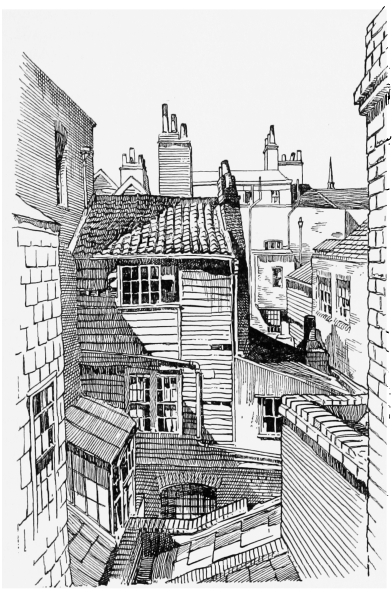
Elder Street, backs of houses an the west side
The interior of No. 30 is cramped and awkwardly planned, with rooms of irregular shape and an insignificant staircase winding round central newels. It was, however, finished in fine style, the ground-floor room having fielded panels in cyma-moulded framing, with a box-cornice enriched with carving. This room once contained a remarkable chimneypiece of marble (Plate 102b), the lower part being of conventional early eighteenth-century pattern with wide flat jambs, narrow imposts, and a Baroque shaped lintel with a fluted keystone. Above were two fielded oblong panels, separated by three reeded consoles supporting a broken triangular pediment and, above the middle console, a shaped pedestal bearing a Baroque cartouche of arms surmounted by a casque. This was flanked by acanthus flourishes with pendants of fruits and flowers falling along the inclined cornices of the pediment. The dexter half of the arms appears to be that of the Tizard family, but the reason for its presence at No. 30 is not known.
The site of Nos. 32–36 (even) and of Nos. 23–27 (odd) Folgate Street, forming the western corner of the two streets, was granted, together with the six houses lately built on it, by a sixty-one-year building lease from Sir Isaac Tillard to William Goswell in May 1725. (fn. 161) But the site of at least No. 32 had been leased to Goswell as early as November 1724. (fn. 162) In July Goswell assigned the lease and premises, as a mortgage to secure £1,000, to Oakey, Fuller and Sudbury and in December this mortgage was assigned to Alexander Garrett. (fn. 163) In November 1726 Goswell surrendered his lease of May 1725 and received in return a lease for fifty-nine and a half years of Nos. 32 and 34 Elder Street and also a similar lease of No. 36 Elder Street and No. 27 Folgate Street. In December he assigned these leases also, as a mortgage for £400 each, to Oakey, Fuller and Sudbury. In March 1736 both these mortgages were assigned to a White chapel printer. (fn. 164) The lease of May 1725 had been witnessed by Francis Goswell, bricklayer, of Blossom Street, where William Goswell had his carpenter's yard.
Nos. 32, 34 and 36 (Plate 62a, 62c) have uniform fronts but differ in width and depth, the first two being single-fronted and two rooms deep, whereas No. 36 is double-fronted and one room deep. Each house contains a basement and three storeys, No. 36 having the later addition of a garret storey. The front of No. 32 has three windows in each upper storey; No. 34 has four, but those over the doorway are blind; and No. 36 has five evenly spaced and a sixth that might, at one time, have belonged to No. 34. The segmental arches and jambs of the window openings are of red brick, which continues down the front to form apron panels of the plum-coloured stocks with which the fronts are generally faced. The exposed flush frames have segmental heads and the top sashes generally follow this form. The front finishes with a narrow stone coping and the original roofs are of tile. The arch-headed door-way of No. 32 has a simple stucco surround, probably early nineteenth century, with moulded imposts, keyblock, and a cornice-head. No. 34 has a late eighteenth-century doorcase of wood, with plain pilasters and entablature, and a cornice surmounted by a flat triangular pediment. More interesting is the charming late eighteenth-century doorcase of No. 36, also of wood (Plate 81d). The six-panelled door is recessed in an arched opening, the reveals and soffit being panelled to match the door. The moulded archivolt rises from fluted imposts, continued as a transom below the radial fanlight of iron with lead enrichments. Flanking the arched opening are engaged three-quarter columns, standing on square pedestals and having plain shafts and modified Tower-of-the-Winds capitals. They support entablature blocks, each adorned with a triglyph, and a dentilled cornice that is returned to form an open pediment.
No. 36 was occupied in 1812 and 1821 by George Woolrich, silk manufacturer and a trustee under the Local Act of 1810. (fn. 165) (fn. c1)
Nos. 1 and 3 Elder Street
No. 3 was formerly No. 13 Elder Street
Demolished
The building of the east side south of Fleur-de-lis Street proceeded southward after the completion of Nos. 24–36 (even) on the west side.
In July 1725 Sir Isaac Tillard granted to Thomas Bunce, plasterer, elsewhere described as of Thrall Street, Spitalfields, a lease of a piece of waste ground forming the site of Nos. 1 and 3 and of the two houses adjacent eastward on the south side of Fleur-de-lis Street. (fn. 166) In September 1726 the lease and property, still described as waste ground, were assigned by Bunce as a mortgage for £400 for the Spitalfields weaver to whom Bunce had in July 1724 made a mortgage assignment of his ground on the south-west corner of Elder Street and Fleur-de-lis Street (see above). In July 1731, when another mortgage assignment of the lease was made, five messuages were said to have been built on the site by Bunce.
Nos. 5–23 (odd) Elder Street
Formerly Nos. 14–22 (consec.) Elder Street
Nos. 5 and 7 (Plate 63a) were built under a sixty-one-year lease granted in July 1725 by Sir Isaac Tillard to Thomas Bunce. (fn. 167) Bunce made two mortgage assignments of this lease to a Spitalfields weaver in February 1725/6 for £250 and in February 1727/8 for £337 10s. (fn. 168) The houses had been built by March 1726/7. (fn. 169)
They are paired houses, containing a basement, three storeys and a roof garret. The shared front is of simple design, built of brown stocks with red brick dressings to the jambs and flat arches of the windows in the first two storeys. These have double-hung sashes in exposed flush frames and are grouped two to each house on either side of the paired doorways, which are now devoid of ornament, and the one blind window over. The top storey of each house is differently treated, No. 7 having three normal windows, one being blind, whereas No. 5 has a wide segmental-arched weavers' window alongside a rectangular blind window.
Nos. 9, 11 and 13 (Plate 63a) were originally built as two houses which were divided into three probably in the early nineteenth century, the centre house, now No. 11, including part of each of the former pair of houses with a doorway in the more southerly house of the pair. (fn. n1) In July 1725 the site was described as waste ground. (fn. 167) Two brick messuages were said to have been built on the site by Thomas Brown (or Browne), citizen and pavior of London, when he was leased the site by William Tillard on 10 March 1726/7. (fn. 169) Brown made a mortgage assignment of the lease and houses for £200 to a Hoxton cooper in the same year. (fn. 170) Thomas Bunce was a witness of this assignment and was probably associated with the building of the houses.
The two original large houses each had a basement, three storeys, and a roof garret. The shared front is of plum-coloured stocks, simply finished with a stone coping. Red brick is used for the jambs and segmental arches of the window openings, which contain double-hung sashes in exposed flush frames, those of the northern house having segmental heads. The northern house has five windows evenly spaced in each upper storey, and the southern has four. Nos. 9 and 13 have wooden doorcases of Doric design, with rusticated pilasters and triglyphed entablatures, very similar to those in Spital Square and Folgate Street. The ground storey, between the two Doric doorcases, is faced with stucco and contains the simple arch-headed doorway to No. 11.
No. 13 was occupied in 1812–13 by John Wallen (see page 58), and in 1836 and 1851 was used as a girls' school. (fn. 165)
Nos. 15 and 17 were built as a pair, obviously by the same builder, and were erected under sixty-one-year building leases of the same date (28 June 1727) from William Tillard. The lease of No. 15 was, however, granted to Thomas Brown and that of No. 17 to Thomas Bunce who was probably chiefly responsible for the erection of the two houses and thus may well have been responsible also for the actual erection of the other two houses, now Nos. 9–13 (odd), leased to Brown. (fn. 171)
Each house contains a basement and four storeys, the heights of which are rather less than those of Nos. 9, 11 and 13, with its doorway on the left of the two ground-storey windows. In each upper storey there are three evenly spaced windows, those above the doorways being blind except that in the top storey of No. 15. The frontage is of plum-coloured brick, with red brick segmental arches to the window openings, which contain double-hung sashes in exposed flush frames. No. 15 has a very fine Doric doorcase of wood (Plate 79c, 79d), the pilasters having plain shafts (originally fluted) and enriched capitals, and the entablature having an enriched frieze of floral metopes between the triglyphs. Above the six-panelled door is a later fanlight of iron with lead enrichments. No. 17 has an early nineteenth-century doorcase of simple design in wood, with narrow pilasters supporting an entablature, its frieze ornamented with plain lozenges.
No. 17 was occupied in 1741 and 1763 by John Payton, shag weaver, a trustee for the Norton Folgate court house in 1744, who undertook in 1745 to raise a body of forty-seven of his workmen to resist the Young Pretender. (fn. 172)
Nos. 19 and 21 (Plate 63b) were built under a sixty-one-year building lease granted on the same day as those of Nos. 15–17 (28 June 1727) by William Tillard to Jonathan Beaumont, citizen and mason, who had received the building lease of the houses on the eastern corner of Folgate Street and Spital Square. Beaumont covenanted to build two houses which were erected by July 1730. By March 1735/6 they had been assigned to the same Whitechapel printer who received an assignment of Nos. 32–36 (even) in March 1736/7. (fn. 173)
They are paired houses, with a basement, three storeys, and a roof garret. The plans are mirrored so that the houses share chimney-stacks, and the doorways are placed left and right of the two ground-storey windows. Each upper storey has three evenly spaced windows, those centred over the doorways being blind, except for that in the third storey of No. 21. The front is faced with plum-coloured stocks and bounded by slightly projecting pilaster-strips. The window openings have stone sills resting on plain consoles, and segmental arches of red brick with fluted keystones. The exposed flush frames and top sashes are also segmental-headed. The arch-headed doorway of No. 19 has a plain stucco surround finished with a simple cornice, but No. 21 has a wooden doorcase consisting of an architrave, frieze with tablet, and cornice.
No. 23 (Plate 63b) was built, together with the corner house, No. 29 Folgate Street and No. 31 in that street, under a sixty-one-year building lease granted by William Tillard to William Goswell on the same day as the building leases of Nos. 15–21 (fn. 174) (28 June 1727). In June 1728 Goswell made a mortgage assignment of the lease and houses to a Shoreditch gingerbread maker. (fn. 175)
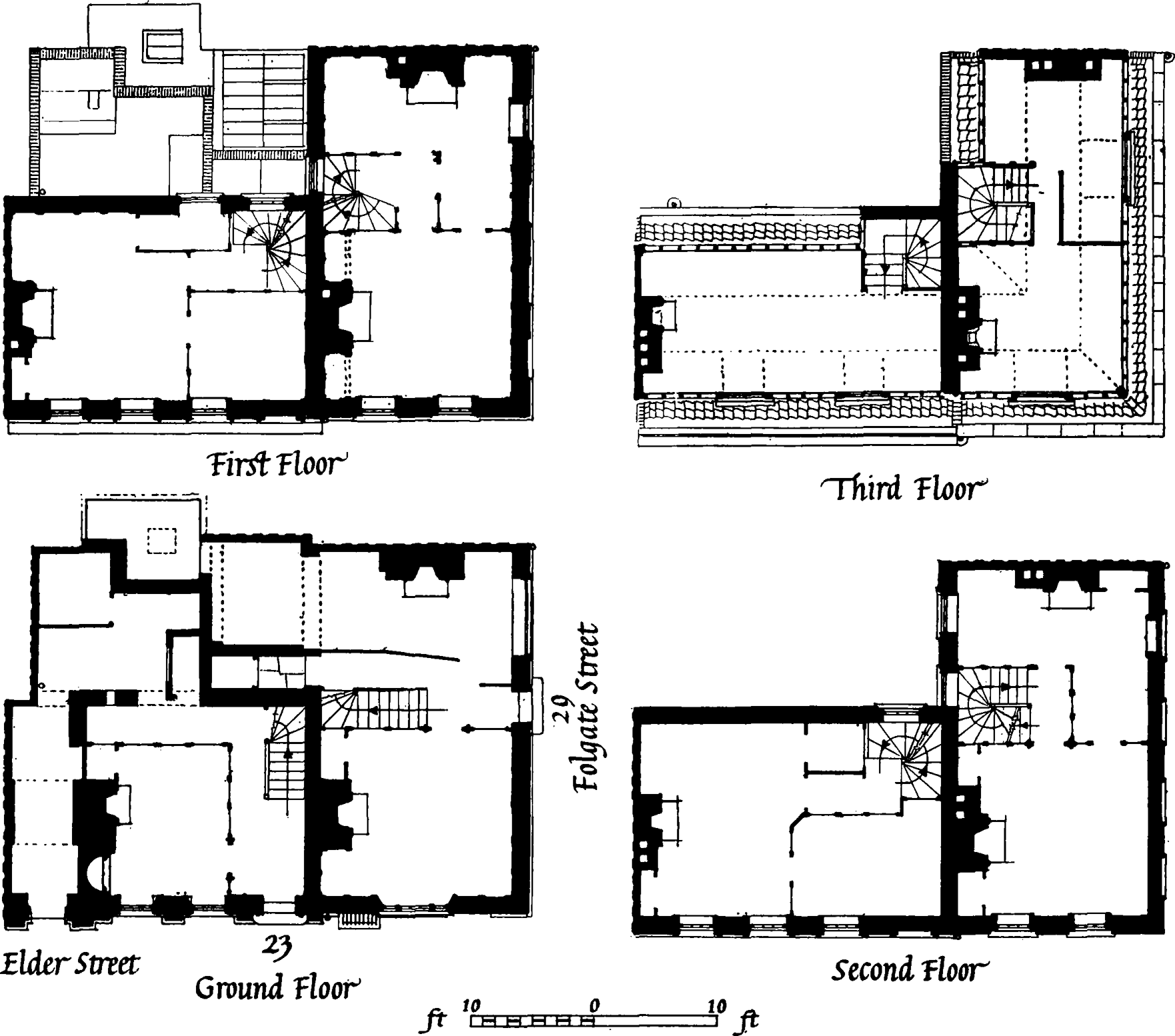
No. 23 Elder Street and No. 29 Folgate Street, 1727, plans
No. 23 is a wide-fronted house, only one room deep, with a basement, three storeys, and a roof garret (fig. 24). The front was originally uniform with that of No. 29 Folgate Street, but now has an elaborate face of early nineteenth-century stucco. The ground storey is divided into four bays, three being framed by pilasters with plain shafts and palmette capitals, supporting a simple entablature. The right-hand bay contains the house doorway, and each of the others a window, all with seg mental-headed architraves. Beneath each window sill is a fret-ornamented panel. The entablature breaks slightly forward over the rusticated pilasters that frame the left-hand bay, containing a secondary doorway with a moulded panel over. The second-storey face is channelled into courses, and the third storey is plain. Each contains four evenly spaced windows, the right-hand one being blind, uniformly framed by segmental-headed architraves which rise, in the second storey from a blocking-course, and in the third storey from a moulded stringcourse. The front finishes with a cornice and plain parapet. The house retains its early eighteenth-century character inside. The ground- and first-floor rooms are lined with plain panelling, and the ground-floor room contains a shelved and semi-domed china cupboard.