
Survey of London: Volume 27, Spitalfields and Mile End New Town. Originally published by London County Council, London, 1957.
This free content was digitised by double rekeying. All rights reserved.
'Commercial Street', in Survey of London: Volume 27, Spitalfields and Mile End New Town, (London, 1957) pp. 256-264. British History Online https://www.british-history.ac.uk/survey-london/vol27/pp256-264 [accessed 26 April 2024]
In this section
CHAPTER XIX - Commercial Street
This street (fig. 65) was built in two sections. The southern part, from Whitechapel High Street to Spitalfields church, was built in 1843–5 by the Commissioners of Woods and Forests, under Acts of August 1839 and August 1840. (fn. 1) The northern section, from the church to Shoreditch High Street, was laid out between 1849 and 1857 by the Commissioners of Woods and, after 1851, by the Commissioners of Works, under an Act of July 1846 and others of August 1850 and August 1853. (fn. 2) The frontages were not quickly built upon and some sites remained undeveloped in 1870.
These Acts also provided for the construction of New Oxford Street, Cranbourn Street and Endell Street. These streets, together with Commercial Street, represented modified parts of the scheme of James Pennethorne for ’Metropolitan Improvements’, while Commercial Street in particular formed a link in his scheme for a line of communication from the docks to the northern and western parts of London.
The first governmental consideration of a new street in Spitalfields and Whitechapel was made by a Select Committee on Metropolitan Improvements in August 1836. This Committee recommended the construction of a street ’from Finsbury Square to Whitechapel Church and the Commercial Road’, (fn. 3) running in a straight line from the Bishopsgate Street end of Middlesex Street to near the southern end of Osborn Street. (fn. 4) This was approximately the line that the City favoured, to relieve the congestion in Aldgate and Leaden hall Street. The cost was estimated at £300,000. (fn. 4) An alternative scheme put to the Committee by the chairman of the Tower Hamlets Commissioners of Sewers was, however, closer to the line finally chosen. This was for a street from the London Docks through Leman Street to Spitalfields church and thence to the western end of Church Street, Bethnal Green. This more northerly projection of the street was urged because of the proposed construction of the Eastern Counties railway terminus on the site of Webb's Square, Shoreditch, a factor which ultimately determined the line of the northern end of the street. (fn. 5)
In August 1838 another Select Committee again suggested a line from Whitechapel to Bishopsgate Street, but carried to the western end of Union (Brushfield) Street, where Sun Street would continue the line to Finsbury Square. (fn. n1) They suggested also the southern continuation of the line to the London Docks. (fn. 6) They had, however, heard representatives of Spitalfields and Bethnal Green parishes, whose views resembled those of the Tower Hamlets Commissioners of Sewers, and favoured a line from the southern end of Rose Lane to the northern end of Wheler Street. Thence it might run into Shoreditch High Street or behind Shoreditch church. (fn. 7) The more northerly direction of the line had the advantages of communicating with Spitalfields Market (fn. 8) and the new railway terminus, and of making some use of the lines of existing streets. It also performed more extensively than the line first suggested a function which was agreed to be of the greatest importance, that of opening up the congested warren of seventeenth-century streets and eighteenth- and nineteenth-century courts on the line of the street. Quite apart from its merits as a communication route a new street was advocated to facilitate the draining and policing of the area. It would achieve ’the destruction of a neighbourhood inhabited by persons addicted to vices and immorality of the worst description’, (fn. 9) and permit the better surveillance of ’a low population’, which was hitherto ’without any respectable persons to keep them at all in check and under control’. (fn. 4) The Committee thought it an area ’presenting serious obstacles to the efficient action even of the best constituted police’, (fn. 6) while the rector of Spitalfields cordially agreed that the route through his parish was ’inhabited by an exceedingly immoral population’ and desired that a new street should ’open it to public observation’. (fn. 7) The rector was equally convinced that a new street would assist the drainage of a fever-ridden district that was mainly dependent on an open ditch across Mile End New Town. (fn. 10) The improvement of sanita- tion was later acknowledged to be ’one of the principal objects for the formation of the new street’. (fn. 11)
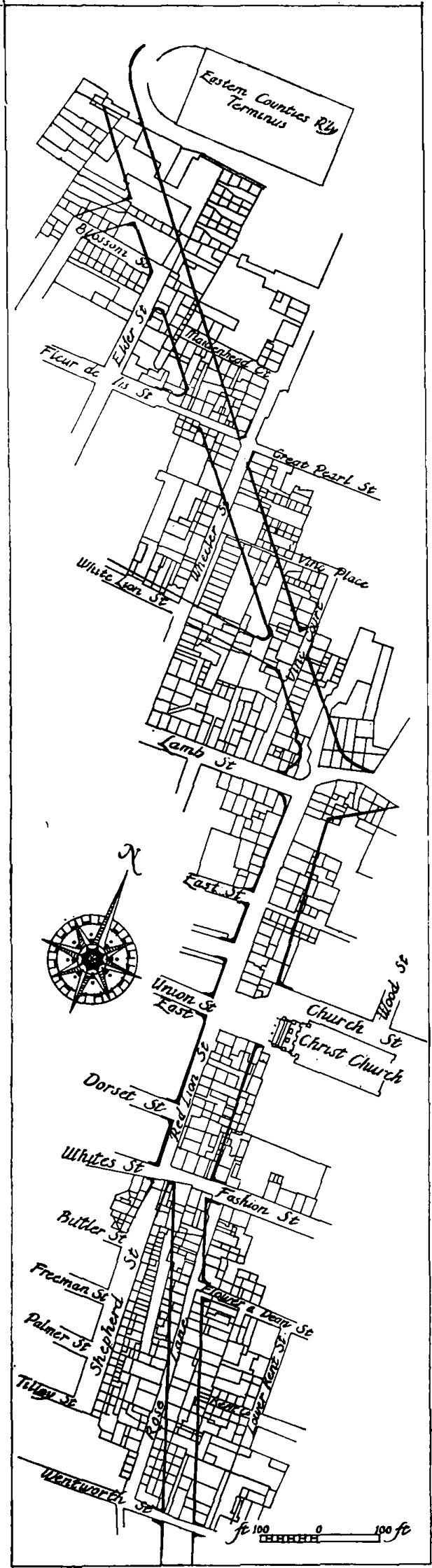
Commercial Street, lay-out plan. Previous lay-out based on a plan in the Public Record Office
In March 1839 another Select Committee recommended that New Oxford Street, Cranbourn Street, Endell Street and a ’spacious thoroughfare’ from London Docks to Spital fields should be built by the Commissioners of Woods and Forests. The Committee thought that £200,000 ’employed in aid of the capital which individual or associated enterprise may reasonably be expected to bring to the execution of such works’ would be sufficient. (fn. 12)
Following the recommendations of the Select Committee James Pennethorne prepared plans for the new streets on behalf of the Commissioners of Woods, (fn. 13) in consultation with Thomas Chawner, the Commissioners’ architect and surveyor. (fn. 14) These plans were submitted to the Treasury in May 1839 (fn. 14) for the preparation of the necessary Bill, which received the royal assent in August. (fn. 15) This Act empowered the Commissioners to raise £200,000 out of certain funds derived from the duties on coal and wine, including the ’Orphans Fund’ and the ’London Bridge Approaches Fund’, in order to construct the four streets. The Commissioners were also empowered to make surveys but not as yet to undertake actual construction.
It was, however, discovered by the Commissioners that the cost would be £638,000, and a further Committee was appointed which heard evidence in the spring of 1840. A renewed suggestion for a street from Whitechapel to Bishopsgate Street was made by Messrs. J. W. Higgins and R. L. Jones, (fn. 16) the latter being described in a later account as ’a person of great influence in the City, and one who was alive to the chance of diverting money to his quarter of the metropolis’. (fn. 17) In reply Pennethorne and Chawner stressed the greater value for London's communications of their more northerly direction of the line. The other line would bring traffic into the City whereas their plan was intended ’to form a great communication from the port of London to all the railways that come to the north of London, and also to the north and north-western parts of London, without going into the city’. (fn. 18) Pennethorne's ultimate object at this time was to take the street as far north as Shoreditch, for which plans had already been prepared, and then to link it with the City Road. (fn. 19) Pennethorne and Chaw- ner had, however, reduced the estimated net outlay on the Whitechapel-Spitalfields street from some £141,000 to some £91,000, partly by terminating it at Spitalfields church instead of at the market, and by reducing its proposed width south of the church to fifty feet. (fn. 20) The latter economy was abandoned in execution but otherwise the plan accompanying the Committee's report in June 1840 was that carried out. The Committee recommended other economies, including the abandonment of the Cranbourn Street scheme, to reduce the estimated total outlay to £279,000. (fn. 21)
The Act of August 1840 authorized the Commissioners of Woods to proceed with the work, and to raise a further £100,000 from the funds and purchase the necessary property. (fn. 22)
The curtailment of the ’improvements’ was criticized in The Westminster Review of July-October 1841, which prophesied that the economies would ’one day be universally lamented’. It regretted the failure to attempt the fulfilment of Pennethorne's original idea of a road ringing the City on the line of Hart Street, Theobalds Road and Old Street, to join the road from the docks at Shoreditch. The termination of the street at Spitalfields church was particularly ridiculed ’as if the only object of the line was to enable the sailors of our merchantmen to attend divine service on Sunday’. (fn. 23)
The financing of the Commissioners’ work was dependent on the gradual accumulation of funds, and want of ready money postponed the clearing of the line until early in 1843, (fn. 24) most of the property being purchased in that and the preceding year. (fn. 25)
In March 1843 the Government's intention was to continue the street past the Shoreditch railway terminus to the junction of Old Street and the City Road. (fn. 26)
The work of clearing so closely built an area was not always easy: men worked at night to empty and fill in the dangerous ’privy-pits’ in the congested courts on the line of the street. (fn. 27) The old properties were sold privately for demolition, the Commissioners’ architects finding that ’by selling by Private Tender … in low neighbourhoods many difficulties are avoided and a better price realized’ than by public auctions. (fn. 28) In August 1844 the tender of J. and C. I'Anson of Fitzroy Square to construct the vaults along the street for £3,098 was accepted. (fn. 29) In November the gas-pipes were laid. (fn. 30) By December the line was completely marked out, (fn. 31) and in January of the following year tenders were invited for paving the street. (fn. 32) The name Commercial Street was decided on by September 1845 after the name Spital Street had been abandoned because it duplicated an existing local street-name. (fn. 33) In October 1845 the Commissioners issued notices for the erection of houses along the line of the street, which was divided into thirty-two lots to be leased for eighty years from Christmas 1845. (fn. 34) Many of the plots were not disposed of at this sale. In June 1849 Whitechapel parish complained that some sites were still unbuilt and that too high prices were being asked by the Commissioners, who replied that these would be obtainable when the extension to Shoreditch was completed. (fn. 35) As late as 1861, however, building sites constituting most of both sides of the street south of Fashion Street were still being sold by auction. (fn. 36)
The completion of the line northward from Christ Church to Old Street was strongly urged on the Commissioners in June 1844 by a memorial from the inhabitants of the locality. (fn. 37) Pennethorne informed the Commissioners that the extension of the street to the terminus of the Eastern Counties railway at Shoreditch would cost some £40,000 and its continuance thence to the junction of Old Street and the City Road a further £112,000. The insanitary and disreputable nature of the property between the church and station was again stressed. (fn. 38) In April 1845 the Commissioners recommended the extension of the street as far as the Shoreditch terminus. In May 1846 they were seeking to adjust the plans of the Eastern Counties Railway Company for the proposed extension of their terminus to fit the plans for the new street. (fn. 39)
An Act of July 1846 (fn. 40) authorized the Commissioners to make the extension to Shoreditch and to raise £120,000 out of ’The Metropolis Improvement Fund’. For some two years, however, little or nothing was done. In May 1848 Viscount Morpeth told the Commons that ’the proceedings in regard to these metropolitan improvements must be reported as almost wholly stationary, not in consequence of any want of confidence in the Commission, but solely owing to the conclusive reason of want of money. The money required to carry the recommendations into effect must be raised in the first instance by mortgage of the land revenues; and all that could be fairly relied upon from this source had been anticipated for the four main lines from the Docks to Spitalfield, Coventry Street [i.e. Cranbourn Street], Oxford Street East and Endell Street.’ (fn. 41) According to The Builder, ’Some detail was then entered into respecting … the proposed improvements between Spitalfields Church and Shoreditch, but unfortunately the noise of the House, not unusual when art or improvement are talked of, drowned the statement’, (fn. 42) which is not reported in Hansard. Between December of that year and the end of 1851 most of the property on the line of the extension was purchased. (fn. 43) In August 1850 a further Act (fn. 44) prolonged the Commissioners’ powers of purchase and authorized them to raise a further £60,000, although it was not anticipated that the final cost would be more than £120,000. In July 1851 Messrs. J. and C. I'Anson's tender for the construction of the vaults as far north as the line of Fleur-de-lis Street was accepted (fn. 45) and the first 1,000 feet of the extension was ready for the laying of the sewers. (fn. 46) The Spitalfields and Shoreditch New Street Act of August 1853 (fn. 47) granted the Commissioners of Works, in succession to the Commissioners of Woods, a further extension of time for the purchase of property and the line of street in relation to the Eastern Counties railway terminus was authorized. By January 1856 the street was complete and paved as far as Fleur-de-lis Street, (fn. 48) and was open to Shoreditch High Street by January 1858. (fn. 49)
The expense of the extension had been the subject of inquiries addressed in 1857 by the Office of Works to Pennethorne, who had some difficulty in framing an adequate reply. It appears from his statement of May 1857 that in 1847 the Eastern Counties Railway Company had been expected to make the northern extremity of the street, and its eventual construction by the Commissioners had increased the estimate of some £160,000 made in 1847 to some £183,000 estimated in 1850. Pennethorne thought that the total sum which would have been needed by the time the new street was completed would be about £231,000. Against this sum had to be set the receipts from ground and building rents. (fn. 50) In July 1857 Pennethorne pointed out that the cost of the street had been increased by the small instalments in which the funds were made available. Money had been raised by mortgaging property already purchased, including ground mortgaged to the Commissioners of Greenwich Hospital to secure £20,000, (fn. 51) and he thought this means would provide the funds necessary to complete the street. (fn. 52) It was perhaps with conscious reference to the disagreements between Pennethorne and the Commissioners over costs that William (later Sir William) Tite praised Pennethorne's ’proper application of the large sums necessary for the purchase of property for great improvements’, when presenting the Sir William Chambers gold medal of the Royal Institute of British Architects to him at this time. In the management of the improvements ’the money had been applied usefully, economically, gracefully, and elegantly’. (fn. 53)
The first public auction of land in the new extension took place in August 1858; a site adjoining the Eastern Counties terminus was then described as ’extremely well adapted for the erection of a first-class hotel, manufacturing premises, capital shops or dwelling houses’. (fn. 54) The following year the rector of Christ Church, wishing to reduce the price asked for a site for St. Stephen's Church, claimed that the result of the auction ’went to prove that the value of the ground had been over estimated’. (fn. 55) It was 1869 before all the sites were sold. (fn. 56)
The Builder (fn. 57) announced the commencement of building operations in the new street in January 1862. (fn. n2) Architects in the new extension included Mr. H. H. Collins (also the architect of the Jewish and East London Model Lodgings), Mr. Reddall and Mr. N. S. Joseph. (fn. 59) Most of the buildings in this part of the street were built in the 1860's but the police station site was not occupied until 1874–5.
The line of which Commercial Street was intended to form part was further developed by the construction in 1872–6 of Great Eastern Street, joining Commercial Street to Old Street, by the Metropolitan Board of Works. (fn. 60)
Associated with the completion of the new street was the extension of Quaker Street westward to join it north of St. Stephen's Church. The Act of July 1846 for the enlargement of the Shoreditch railway terminus (fn. 61) required the Eastern Counties Railway Company to make the street. It was not, however, constructed until 1858–9, (fn. 62) the paving and macadamizing being completed for the Commissioners by George G. Rutty of Elder Street in 1861–2. (fn. 63)
The degree of control over the architectural character of the buildings on the street was apparently slight, although the granting of leases was subject to the Commissioners’ approval of the proposed plans and elevations. The Commissioners’ records suggest that such control as was exercised was directed to securing a use of sites that would enhance the market value of the street-frontage rather than to any close architectural control of the elevations. In 1846 the (Metropolitan) Association for Improving the Dwellings of the Industrious Classes sought to obtain the lease of a site in the southern part of the new street and submitted a plan and elevation for buildings forming a paved court open to the street. The Commissioners refused to grant a lease, fearing that the court would ’be almost constantly filled with Loiterers and Women’. They were further ’of the opinion that the allowing a building of the proposed description in any part of the New Street would be prejudicial to the letting of the remainder of the building ground there’. (fn. 64). In 1849 the Commissioners were concerned at the ’very unsightly appearance’ of a public house on the northern corner of Fashion Street and Commercial Street, which was ’likely to be detrimental to the property acquired by us’, and sold to the owner a strip of land bordering the street on condition that he pulled down the public house and adjoining house and on their site built five houses according to designs approved by the Commissioners, which was done (see fig. 66). (fn. 65) It was perhaps this desire to preserve the dignity of the street that caused the Commissioners to make a condition in their lease of the Jews’ Infant School site that no entrance for the children should be made on the Commercial Street front. (fn. 66) The request by the rector of Christ Church in 1858 for a site for a new church, built as St. Stephen's, was supported by Pennethorne who considered that ’the erection of a Church on the site proposed would be a great benefit to, and increase the respectability of, the whole of this District which is now in a very low condition’. Pennethorne made suggestions for the siting and orientation of the church in the early stages of the project. (fn. 67)
The difficulty of disposing of sites in such a ’low neighbourhood’ militated against the enforcement of a high standard of design. When a site between Commercial Street and Shepherd Street (now Toynbee Street), which had been offered unavailingly in 1845, was finally granted on a cheap building lease in 1858 Pennethorne thought it more advisable to accept the low rent to ’secure the covering of the ground than to allow it to remain vacant’, and recommended the approval of the designs for houses and shops although ’the character of the houses … as shewn by the drawings is not altogether so good as I could have desired’. (fn. 68)
The supposed value of the street as a means of enforcing law and order was asserted in the opening of Keate Court (now the western end of Thrawl Street) into the new street in 1859. The Whitechapel District Board of Works informed the Office of Works that this court was ’about the worst spot in a notoriously bad neighbourhood and it is positively unsafe for respectable persons to visit it’. This they attributed to the lack of outlet into the new street. Pennethorne told the Commissioners that he understood the police thought the locality safer with the court shut than open. In fact, however, the police were willing for the court to be connected with the street and a footpath to be kept open all night between Brick Lane and Commercial Street. This was therefore done. (fn. 69) It remained, however, a notoriously lawless part of Spitalfields.

Commercial Street, elevations of typical buildings
Commercial Street has always presented a strange assortment of styles, materials and scales, in strong contrast to the uniformity originally prevailing in the Italianate stucco of the contemporaneous new streets in the West End (fig. 66). Commercial Street has little enough of stucco but plenty of brick, yellow, red, and ’white’, often with polychrome dressings, and the most favoured style was a ’Warehouse Gothic’ of a particularly brutal kind, with window arches of cut brick and stone displaying originality of a most perverse order. Perhaps the most startling example of this style is No. 43, at the south end of the street, but the most generous display of curious window arches is to be seen at Nos. 81–85 (odd) just south of the market.
In the north part of the street, beyond Christ Church and the market, much of the original east side has gone. On the west side, however, are three striking examples of Victorian eclecticism. The Peabody Buildings (Plate 77a), after four storeys of sober dark red brick, break into a flamboyant skyline with curvilinear gables spaced between closely ranked windows. The police station (Plate 49a), a sombre palazzo, has an arcaded ground storey of stone and three welldefined storeys of red brick with widely spaced windows. Lastly, there is No. 157, a warehouse with a front of curiously Vanbrughian flavour, its windows grouped into interesting patterns and its parapet terminated by two great urns.
St. Stephen's Church and Parsonage, Commercial Street
Church demolished
St. Stephen's Church (Plate 43c, fig. 67) was built through the efforts of the Rev. John Patteson, rector of Christ Church, and a group of parishioners including Robert Hanbury and Thomas Fowell Buxton, who thought that the population of Christ Church parish had become too great to be served by a single church. (fn. 70) Its district was formed by an Order in Council in 1858, out of the north-western portion of Christ Church parish. (fn. 71) A freehold site on the east side of Commercial Street was conveyed to the Ecclesiastical Commissioners by the Commissioners of Works in 1860 (fn. 72) for £2,320. The architect of the church and parsonage was Ewan Christian, (fn. 74) whose plans were approved by the Ecclesiastical Commissioners on 16 August 1860. (fn. 73) The builders were Messrs. Brown and Robinson of Worship Street, Bishopsgate. (fn. 74) The church was consecrated by the Bishop of London on 6 December 1861. (fn. 74)

St. Stephen's Church, Commercial Street, 1861, plan. Based on the Ordnance Survey 1873–5
In 1863 the district was enlarged by the inclusion of small portions of the parishes of St. Leonard, Shoreditch, and St. Philip, Bethnal Green. (fn. 75) The church was closed and its parish re-united to that of Christ Church on 27 February 1930. (fn. 73) The church was demolished, but the parsonage still stands, and is now used for commercial purposes.
The church was described in 1863 by James Thorne, writing in The British Almanac, (fn. 76) as follows: ’The church is of yellow brick, with red and black bricks sparingly introduced. Its distinctive feature is the apse … which, instead of serving as the chancel, as is usual, is placed at the west end of the nave— a fashion borrowed, with some other features, from Germany. The windows, as will be noticed, are small, and in two ranges, the lowest being placed at a considerable height from the ground. To our thinking, nothing can well surpass the ugliness of the exterior, but it has been well studied and laboriously attained. Beside it is a parsonage, quite as quaint as the church, and infinitely meaner. Both church and parsonage are placed at an awkward angle to each other and to the street, but this was probably done with the object of turning the ground to as much account as possible. The interior of the church is almost as peculiar as the outside. In form it is an exact square (of 61 feet), without the apse. The eastern wall is pierced with three small star-lights in the gable. The nave is equal in width to the two aisles (28 feet), but the north aisle is three and a half feet wider than the south. The walls are plastered, but the piers and arches are faced with red and white bricks. Altogether, there is no doubt that novelty of effect is obtained; the beautiful or the pleasing must be sought elsewhere. As regards convenience, something may be said in its favour. There are only two pillars on each side, and, practically, the view is almost unobstructed. The church is said to be also well adapted for hearing, but to us there seemed an unpleasant reverberation, during both the reading of the service and the sermon. This may have arisen, however, from sitting near the apse, during an afternoon service; it would perhaps be less noticeable if the church were full.’ To this description it is necessary to add that the church was entered through porches, one on each side of the western apse, that on the south side forming the base of the tower, which had a saddle-back roof.
No. 43A Commercial Street
Formerly Jews' Infant School
In 1841 a school for 200 Jewish children was opened in Houndsditch, (fn. 77) the first honorary president being Francis Henry Goldsmid. In December 1858 Goldsmid and Nathaniel Monte-fiore took a building lease for eighty years of a site for a new school in Commercial Street from the Commissioners of Works, (fn. 77) the carcass of the building having already been erected (fn. 66) (Plate 46c). The architects were Messrs. Tillot and Chamberlain. The lowest tender, for £3,719, was submitted by George Myers, of Guildford Street and Ordnance Wharf, Belvedere Road, Lambeth. (fn. 78). The final cost of the building was about £5,000. (fn. 79)
In 1861 there were 560 pupils registered in the school, with a regular attendance of 348, (fn. 79) most of the children making a small payment towards their tuition. During the winter, dinners were provided twice weekly. (fn. 80) The school was highly praised by The Builder, both for its building and for the standard of its work. (fn. 79)
The freehold of the school site was purchased in 1865 from the Commissioners of Works for £2,300, (fn. 81) and in 1883–4 the site was enlarged by the acquisition of property in Rose Lane and Ann's Place, part of which was used for further buildings (fn. c1) (fn. 77) The school was closed in 1939 and damaged during the war of 1939–45. The buildings were sold in 1951 and reconstructed for commercial use. A new school will be built in Hampstead.
The well composed front of the building has a wide central feature of five bays projecting slightly from narrow wings. The ground storey is of painted stucco and the five windows of the central feature are recessed between wide pilasters or piers with moulded caps carrying an unbroken entablature. The south wing has been altered, but the north wing retains a doorway, flanked by narrow windows. The lofty upper storey of the central feature is of yellow brick, with five round-arched windows having moulded archivolts and keystones of stucco. The moulded imposts to the piers, the long-and-short quoins defining the angles, and the bold main cornice are also of stucco. Each wing has two windows, the north wing alone retaining the original treatment with a pedimented window below one with a framing architrave. The parapet originally had balustrades centred over the windows.
Nos. 135–153 (odd) Commercial Street
Peabody Buildings
George Peabody was born in 1795 in Massachusetts. He became a banker and merchant and in 1837 settled in London, where he died in 1869. Although he had enormous wealth he lived modestly, devoting his fortune to philanthropic ventures in the United States and England. He is known chiefly for his creation of the Peabody Trust in 1862, which originally consisted of a sum of £150,000 (later considerably augmented), ’to ameliorate the condition of the poor and needy of this great metropolis, and to promote their comfort and happiness’. The Trustees were free to apply the fund as they thought fit but were forbidden to allow religious or political bias to influence them. Peabody himself suggested ’the construction of such improved dwellings for the poor as may combine in the utmost possible degree the essentials of healthfulness, comfort, social enjoyment and economy’. (fn. 82)
In 1863 the Peabody Trustees purchased a site in Commercial Street from the Commissioners of Works for £3,300, (fn. 83) and opened their first block of family dwellings there on 29 February 1864 (fn. 84) (Plate 77a). The architect was H. A. Darbishire, (fn. 83) who had previously designed Columbia Square, Bethnal Green, for Miss Burdett Coutts. (fn. 85)
The arrangement of these first Peabody Buildings is noteworthy, the planning being on similar lines to that of Columbia Square, and setting a pattern which was to be followed in many subsequent Peabody estates. This sombre red brick building takes the form of two five-storeyed ranges merging together at the acute-angled corner of Commercial Street and Folgate Street. The longer range fronts Commercial Street and has shops on the ground storey, each with ample storage in the basement, and a five-room maisonette arranged behind and above the shop. In the original plan, four storeys of the Folgate Street range and the third and fourth storeys of the Commercial Street range contained flats of two and three rooms, arranged on each side of a central corridor. The living-rooms, entered directly from the corridor, measured on average thirteen feet by ten feet, and the bedrooms thirteen feet by eight feet, all the rooms having a clear height of eight feet. The lavatories were separated from the flats, being grouped in pairs on each side of the staircases, the allotment of water-closets being one for two families. The top storey was given over to communal laundries, drying-rooms, and bathrooms.
The shops and maisonettes were let at economic rentals to provide income offsetting the loss on the low-rented flats. Of these there were seven with three rooms, letting at 5s. per week; forty-one with two rooms, letting at 4s. per week; six with two rooms, letting at 3s. 6d. per week; and three single rooms letting at 2s. 6d. The porter was allotted a five-room maisonette in the middle of the Commercial Street range, with easy control of the two main staircases of that range. (fn. 86)
The unplastered walls of the rooms, the direct access without lobbies from the corridors, the absence of fireplaces in all but the living-rooms, and the rents, were adversely criticized in The Builder. (fn. 87) Despite these faults, however, there is no doubt that this first block of Peabody Buildings was an important step towards the proper housing of the poor of East London.
Nos. 45–55 (odd) Commercial Street
Formerly the Jewish and East London Model Lodgings
In August 1863 the Chief Rabbi opened this block of family dwellings in Commercial Street for the Jewish and East London Model Lodging House Association. (fn. 88) The site had been purchased in 1862 from the Commissioners of Works for £1,600. (fn. 89) The architect was Hyman Henry Collins, of 61 Torrington Square, whose design was chosen in competition by Professor Donaldson. The contractor was R. Stap, (fn. 90) and the cost of the building was £6,000; accommodation was provided for thirty families with six shops on the ground floor. (fn. 88)
By 1893 the block was known as the Alexandra Buildings. It is no longer used for residential purposes, and the centre portion has been rebuilt.
Police Station, Commercial Street
This building (Plate 49a) was erected in 1874–1875 by Messrs. Lathey Brothers to the design of Frederick H. Caiger, Surveyor for the Metropolitan Police; it then had a three-storey frontage, to Commercial Street only. The top storey and Elder Street wing were added in 1906.
The site had been sold by the Commissioners of Works in 1862, and after passing through two intermediate ownerships had been acquired by the Receiver for the Metropolitan Police District in May 1874. (fn. 91)
No. 136 Commercial Street
Royal Cambridge Music Hall
Demolished
The first music hall on this site was in existence in the autumn of 1869 when it was probably newly built. (fn. 92) Of this building it was written in 1884, ’Many of the characteristics of the old Canterbury are visible here. There are the pictures, copies of gallery works of importance, and no little merit, hanging in the noble staircase… The interior of the hall is severely classic in form, with a remarkably broad stage… [The] edifice itself is mainly characterized by unusual breadth.’ A bill-head of 1885 claimed that it ’is acknowledged to be the handsomest hall in England’’. (fn. 93) The theatre was rebuilt in 1898 by H. Percival with a pleasant Moresque front (Plate 49b). (fn. 94) In 1930 it was taken over by Messrs. Godfrey Phillips and de- molished in 1936 for the extension of their tobacco factory. (fn. 95)
No. 142 Commercial Street
The Commercial Tavern
This was built by Abraham Keymer, of the Norfolk Arms, Bethnal Green, licensed victualler. The site was leased to him in February 1865 by the Commissioners of Works, for eighty years from Michaelmas 1863 at a peppercorn lease for the first year and then at £50 per annum. (fn. 96)