Survey of London: Volume 42, Kensington Square To Earl's Court. Originally published by London County Council, London, 1986.
This free content was digitised by double rekeying. All rights reserved.
'De Vere Gardens area', in Survey of London: Volume 42, Kensington Square To Earl's Court, ed. Hermione Hobhouse (London, 1986), British History Online https://www.british-history.ac.uk/survey-london/vol42/pp121-129 [accessed 30 April 2025].
'De Vere Gardens area', in Survey of London: Volume 42, Kensington Square To Earl's Court. Edited by Hermione Hobhouse (London, 1986), British History Online, accessed April 30, 2025, https://www.british-history.ac.uk/survey-london/vol42/pp121-129.
"De Vere Gardens area". Survey of London: Volume 42, Kensington Square To Earl's Court. Ed. Hermione Hobhouse (London, 1986), British History Online. Web. 30 April 2025. https://www.british-history.ac.uk/survey-london/vol42/pp121-129.
CHAPTER VII - De Vere Gardens Area
De Vere Gardens, despite its good situation, respectable width, well-built houses and upper-class name, is not now very striking or grand-looking. Circumstances made it one of the last parts of the neighbourhood to be laid out for residence, between 1875 and 1884, and although in construction and appearance its sponsors seem to have aspired to something better than ordinary Italianate brick and stucco its street-fronts missed the new taste for red-brick vivacity, and the early decline of its big houses into use as flats and hotels (even if for the comparatively rich) has dulled its surface.
In the eighteenth century the site was, like the land westward, in the freehold of the Edwards, later Noel, family, who were also owners of the adjacent site eastward where Noel House was built and Palace Gate now stands. (fn. 1) In 1710 a nurseryman, Robert Furber, came on the scene as occupant, and established here what became well known as the Kensington Nursery. (fn. 2) His assistant, John Williamson, took over on Furber's death in 1756, (fn. 3) and in 1783 the widow of Barnard Williamson transferred the ground to another nurseryman, Nathaniel Grimwood. Daniel Grimwood, (fn. 4) successively father and son, thereafter appears as occupant and in 1801 the son bought the freehold from Gerard Noel Noel, (fn. 5) who was then disposing of much of his property hereabouts (see pages 56, 58). Three or four years later William Malcolm took over as Grimwood's tenant, and Malcolm's Nursery continued here until 1837. (fn. 6) In 1824 Malcolm paid the seemingly rather moderate sum of £300 for a 21-year lease, at £180 per annum, of the well-established nursery on what was called a five-acre site. (fn. 7)
The lessor was John Desse Grimwood, the younger Daniel's son, who, marrying a Chilean lady, had emigrated to South America. (fn. 8)
The nursery at about the time of this lease is shown on Starling's map (Plate 2a), with the smaller cultivated plots at the north end and a building on the west side abutting on Love Lane (now Canning Passage). This survived until the rear part of No. 28 De Vere Gardens was built on the site. It was probably here that the artist Samuel Palmer lived (in half the building) in 1848–51. (fn. 7) (fn. n1) Other buildings on the nursery site included a ‘counting house’ and a shop with ‘a double bowed front glazed with folding doors glazed, fan light over ditto’. This ‘retail outlet’ facing the Kensington Road had been an adjunct of the nursery since at least the 1770s (fn. 10) and is shown on Plate 46d with the pineapple sign that the Grimwoods had also used at their shop in Arlington Street. (fn. 11)
In 1837, on William Malcolm's death, the nursery was carried on by Richard Forrest, landscape gardener and garden architect. (fn. 12) He perhaps adopted a building at the north-east corner of the site as his residence, as it was later known as Forrest House.
Forrest's tenure ended in 1847 (fn. 10) and a mixed development ensued, nothing of which survived more than about thirty years (fig. 42). In 1848 John Inderwick, a tobaccopipe importer of Wardour Street who had just developed the Kensington New Town area immediately to the south, took a lease from representatives of J. D. Grimwood, who had died in 1843, and some buildings were quickly erected. Strangely, the lease was for only 21 years (fn. 13) —a much shorter period than was usually accepted for a building lease. In Kensington Road eastward from the corner of Love Lane (Victoria Road) Inderwick had Robert James of Brewer Street build him in 1848 a terrace of nine houses over shops called Craven Place that was to be swept away within a generation. (fn. 14) The houses had deep closet wings and long back gardens and were not lowly assessed for rates at £45 each. (fn. 15) They were successful, being occupied in 1849–50. (fn. 16) In 1850 two more houses, called Canning Cottage and Melville Cottage, were built under Inderwick's auspices at the southern end of the site, each detached in generously sized gardens on the north side of Canning Place (the south side of which Inderwick had himself developed some twelve years before). (fn. 17) They seem to have reflected Inderwick's limited tenure, worrying the District Surveyor during their construction by ‘being built in a slight and hardly safe manner.’ (fn. 18) Presumably this was at least partly remedied, as they were quickly and respectably occupied until De Vere Cottages and Mews were built over their site. (fn. 16)
The transformation wrought in the major, vacant, part of the old nursery ground was closely related to the advent of the Great Exhibition just eastward. This was its use to accommodate the Grand National Hippodrome established by William Batty, the proprietor of Astley's Amphitheatre in Westminster Bridge Road, and put up quickly in the spring of 1851 to attract visitors to the Exhibition. Batty had tried for a site within that of the Exhibition itself and then for another (rather distant) in the Abingdon-Scarsdale area. (fn. 19) But the then obtained this better site on lease from Inderwick, went to the architect George Ledwell Taylor for a design, and, after submitting a model to the Metropolitan Buildings Office, had the Lambeth builders Haward and Nixon execute it. (fn. 20) The cost was reported as likely to approach £6,000. (fn. 21) Designed to accommodate equestrian displays in which races between female charioteers from Paris played a stimulating part, the Hippodrome was an oval open to the sky surrounded by some eight rows of seats rising within a slatefaced circumference-wall of timber under a slated timber roof (fig. 44). (Taylor briefly contemplated iron construction, and a corrugated iron roof over the seats.) Externally it measured 360 by 260 feet. Periodicals reported that it held 14,000 spectators, although the true figure cannot have been much more than a third of that. Decorations were in blue and white. The slated exterior was, The Builder thought, ‘not prepossessing’, but Taylor was quite capable of providing some Roman pomp in the tripartite entrance from the Kensington Road and an answering entrance for the performers from the stables on the south side of the Hippodrome. The Builder thought this latter structure well arranged—a rectangle of stalls surrounding an arena for a riding school at the centre, all under one roof. Also of timber construction, it measured 150 feet by 57 feet. (fn. 22)
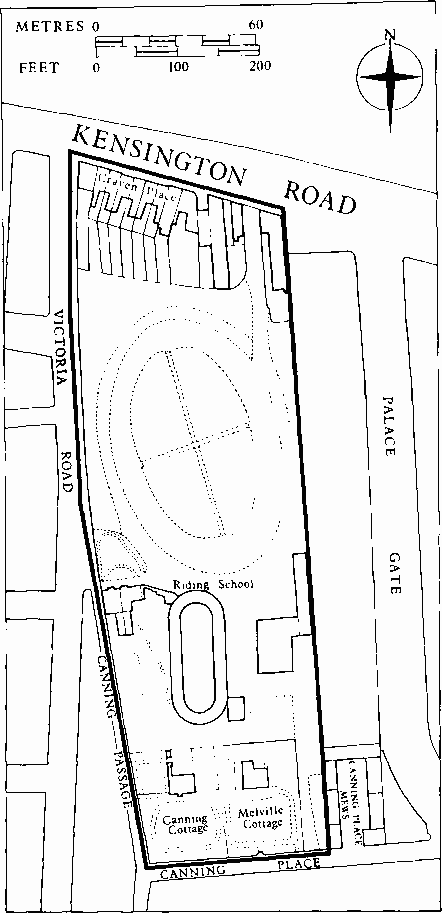
(above). De Vere Gardens area. Based on the Ordnance Survey of 1862–72
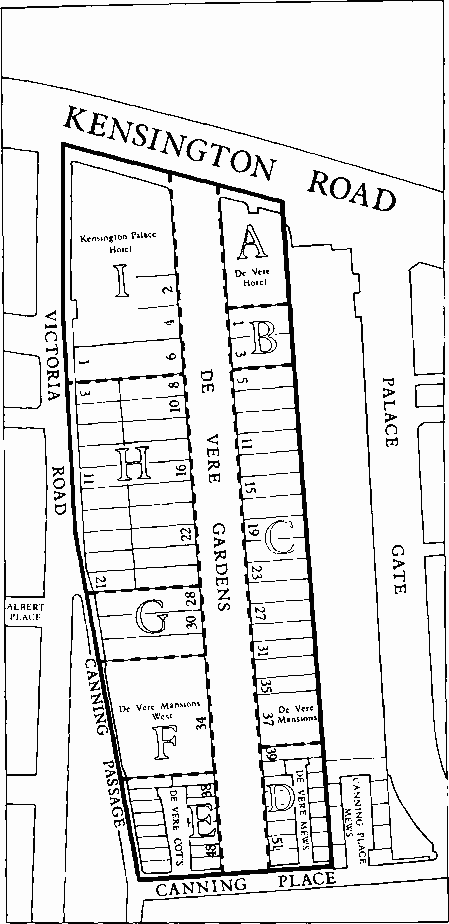
(right). De Vere Gardens area. Based on the Ordnance Survey of 1949–68. The letters denote builders' plots as follows: A, W. Elsdon, 1881; B, W. H. Willis, 1876; C, C. A. Daw, 1875 (Nos. 5–11)–1880 (No. 37); D, same, 1877–8; E, Taylor and Cumming, 1877–8; F, C. A. Daw, 1884–5; G, same, 1878; H, Taylor and Cumming, 1875–8; I, G. B. Hart, 1876-c. 1879. The enumeration and divisions of sites does not necessarily observe all subsequent amalgamations of tenure
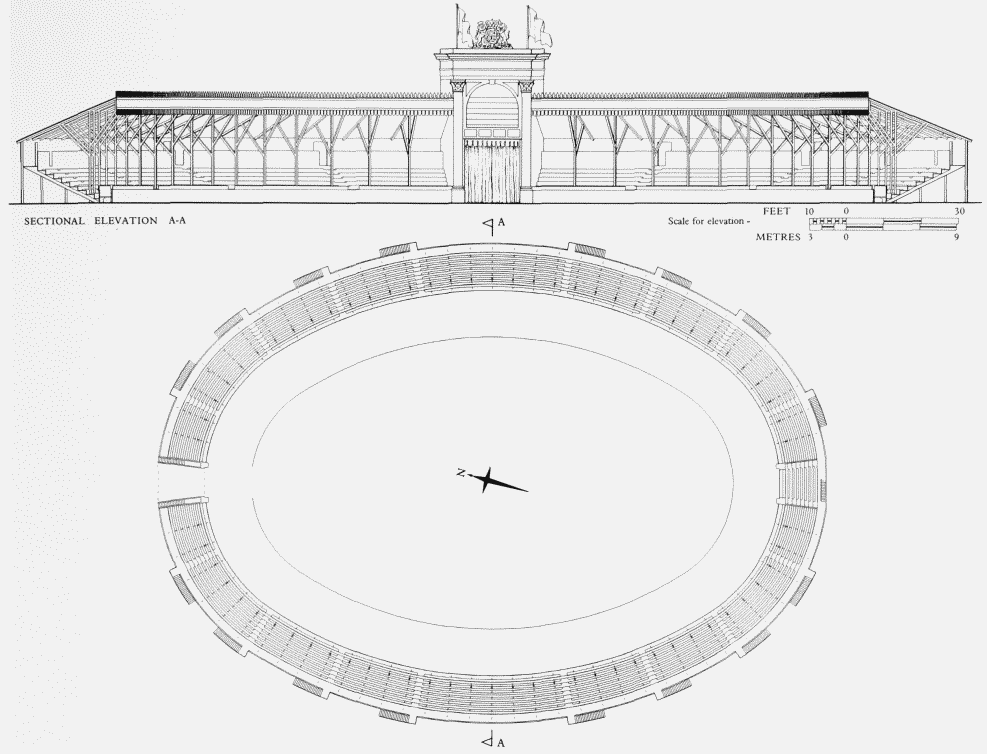
Batty's Hippodrome, plan and sectional elevation. G. L. Taylor, architect, 1851
The Hippodrome had one more season, in 1852, (fn. 23) and thereafter stood disused except in connection with the riding school and ‘hunting ground’ managed in 1853–74 by Messrs. W. H. Blackman from Batty's old stables. (fn. 24) The Ordnance Survey map of 1862–72 shows the riding school within an evidently rebuilt arena of straight-sided oval form and the site (only) of the abandoned amphitheatre. Batty said he deliberately had the Hippodrome buildings lightly constructed to prevent their becoming landlord's fixtures, and perhaps carried the materials off to serve him elsewhere. (fn. 18)
It was about 1870 before preparations were made for the total recasting of the area as a street of houses and 1875 before it was begun. This comparative tardiness in conforming to the local norm of bricks and mortar was doubtless due principally to the existence and, at the same time, the shortness of Inderwick's lease expiring at Michaelmas 1868. Behind this again lies the fact of J. D. Grimwood's emigration to raise a family in Chile. The freeholders were thus expatriate and, it seems, Hispanicized, and on Grimwood's death at Valparaiso in 1843 his Kensington property passed to his Chilean sons-in-law in trust equally for his seven children. (fn. 25) One of these, Juan, was of weak intellect, and this probably put some check on quick decisive handling of the site on normal lines. (fn. 26) Juan was represented by his brother Ramon, who seems to have come to London in 1868—perhaps with a view to the falling-in of the lease—and to have acted in some sense for his brothers and sisters. (fn. 27) Important developments on each side of the property at Palace Gate and Prince of Wales Terrace must have made more intensive use of the site seem worthwhile but seven more years passed before this was achieved. In 1870 the Grimwood children sought a sale or partition of the Kensington estate, but it was not until summer 1873 that a sale was ordered in accordance with a provisional contract that had been concluded in March of that year. For some reason it was two years more before the sale was made, in compliance with another Order of Court, and the site passed, in August 1875, to the contractual purchasers, who were responsible for the buildings that can be seen today. (fn. 28)
These were a surveyor, Charles Edward Barlow, who in 1875 had an office in Queen Victoria Street (fn. 16) and a builder, William Bennett Daw, who briefly described himself as of the same address (fn. 29) before returning to his native Devonshire. They soon mortgaged the five acres for £60,000. (fn. 30)
The party conveying the property was not an immediate representative of the Grimwood family but Neve Lewis Hart of Ealing as the recipient of a deed of transfer from the Grimwoods in 1873 and seemingly also as representative of a solicitor and locally active property speculator, T. H. Scarborough, who was probably a mortgagee from the Grimwoods. (fn. 31) Hart—called ‘esquire’ in title deeds but ‘Revere[n]d’ in the 1881 census and father of a builder son (fn. 32) —shared in 1875 the same office as Barlow, (fn. 16) and although he does not thereafter figure in the history of De Vere Gardens he must have been a very close relation—perhaps father—of Barlow's and Daw's supervising architect. He was George Barlow Hart, whose private address at Ealing in 1877 was the same as N. L. Hart's (fn. 33) and whose second name, in turn, may hint that the Harts were related to Barlow.
Ealing was also where, until at least 1887, the principal builder on the Kensington estate had his private address. This was not W. B. Daw but his younger brother Charles Adams Daw, (fn. 34) who had been brought into the enterprise by the elder brother, initially under leases from him and Barlow.
There thus seems to have been a connection between the Harts, Daws and Barlow which perhaps makes the formal documents less revealing even than usual of the reality behind them. Fortunately the picture is filled out by letters between the brothers W. B. Daw and C. A. Daw (the latter usually writing through his son W. A. Daw). These date, however, from a time when the chequered fortunes of De Vere Gardens gave some bias to what was written. (fn. 35)
Already just before the conveyance to them of August 1875 Barlow and W. B. Daw had initiated the scheme by an application made to the Metropolitan Board of Works in July, through their architect G. B. Hart, to lay out the new street of houses that they wanted to call Avondale Road but the Board named De Vere Gardens. Victoria Road (the former Love Lane) was to be widened at its north end. (fn. 36) In October the Board consented and in the following month, November 1875, the building of the houses began. (fn. 37)
This was at Nos. 5–11 (odd) De Vere Gardens, by C. A. Daw, acting in accordance with the terms of a building agreement with Barlow and W. B. Daw dated 29 September 1875 although not actually concluded until the following April. (fn. 38) His ‘take’, as shown on fig. 43, included all the east side of De Vere Gardens south of No. 3, and the west side between No. 26 and De Vere Cottages: here he built, instead of the 28 houses and a mews intended, 19 houses and a mews between 1875 and 1879 and two blocks of flats in 1880 and 1884–5. (fn. 39) C. A. Daw and his son W. A. Daw went on to build quite extensively in South Kensington, and in particular established themselves in Palace Gate in a block of flats built by them, where the firm still exists, mainly as a property company.
A month later than C. A. Daw's first building, in December 1875, the other main builders followed suit on the west side, at Nos. 8–12 (even) De Vere Gardens. They were A. F. Taylor and S. A. Cumming of Fopstone Road (now Nevern Place), Earl's Court. (fn. 40) They soon made De Vere Gardens their headquarters, and also had before them an active career of building elsewhere in South Kensington, where one of their backers was a solicitor cousin of the Daws (see page 106). Their ‘take’ on this estate comprised ten houses on the west side, from No. 8 to No. 26 (even) De Vere Gardens, and the ten houses behind them, facing the east side of Victoria Road at Nos. 3–21 odd (originally Nos. 1–10 Edinburgh Terrace). These they built in 1875–8. (fn. 41)
The building agreement with Barlow and W. B. Daw, under which C. A. Daw, at least, worked, contained the usual provisions for the builder to erect his houses within a specified time—from sixteen months to four years after the nominal date of the agreement at Michaelmas 1875. (fn. 42) All the houses and stables were to be completed within six months of the building of the carcase. The plans and elevations had to be approved by Barlow's and W. B. Daw's unnamed architect—evidently G. B. Hart. Disputes about them were to be referred to the architects T. Hayter Lewis and P. C. Hardwick. Use of the best white Suffolk bricks was prescribed, and Portland stone (as C. A. Daw subsequently made a selling-point) for the sober architectural ‘frontispieces’ of each of his houses. The use of granite columns (in the porticoes) was optional, but in fact adopted, like the Portland stone, by both C. A. Daw and by Taylor and Cumming, and is still (as the use of Portland stone perhaps is not) noticeable to the eye. As C. A. Daw later claimed, it was understood the enterprise was to be ‘of a superior and expensive character’. (fn. 43) A surveyor reporting on two of Daw's houses as security for a loan in 1879 thought well of them—‘handsome’, ‘spacious’ and of ‘substantial and good’ workmanship. The staircases were of stone to the second floor. (fn. 44)
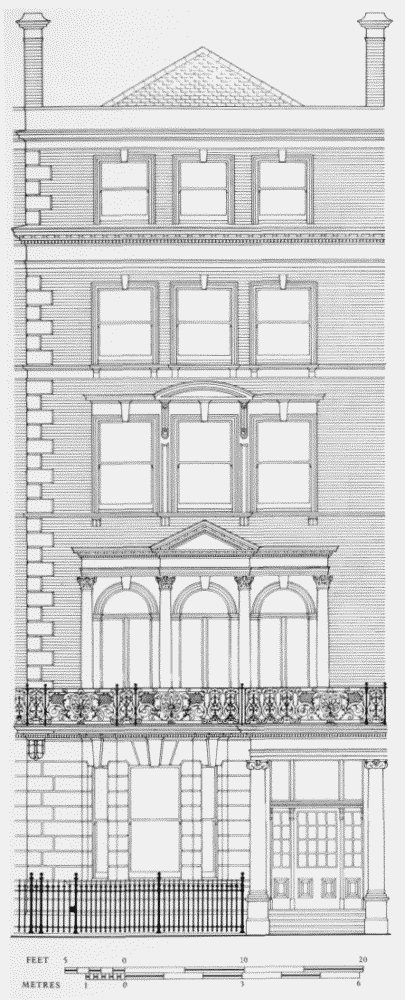
No. 30 De Vere Gardens, elevation. C. A. Daw, builder, 1878
Despite this high-quality execution, at most of Daw's and Taylor and Cumming's houses an elevational design was thought appropriate (Plate 47c, fig. 45) that closely followed the work of the builder Charles Aldin ten years earlier in Queen's Gate Place, which itself derived from houses built in the 1850s by William Jackson in Queen's Gate Terrace.
The leases granted by Barlow and W. B. Daw were all for 99 years from 29 September 1875. (fn. 45) Under the agreement they were to include an option to buy the freehold.
So far as C. A. Daw's ‘take’ was concerned his agreement specified a total of £2,618 per annum to be paid by him to Barlow and W. B. Daw in ground rents in stated amounts for each plot. (fn. 42) The ground rents actually paid by Taylor and Cumming probably amounted to about £1,695, giving a total of some £4,313 plus those for Taylor and Cumming's mews and for the sites at the north end of De Vere Gardens. (These last, as it happens, were eventually developed not under building leases.) In a few instances, however, C. A. Daw's actual ground rents were not those specified (but larger), so the total is uncertain. (fn. 43)
The layout was inevitably, within the narrow limits of choice afforded by the site, a straightforward one. (It was reported that at first it was intended to make an opening from De Vere Gardens into Victoria Road opposite Albert Place. (fn. 46) but if so the idea was soon dropped.) The breadth of land available made it virtually certain that the houses on the east side should be back-to-back with those already built on the west side of Palace Gate: no sacrifice was made in the extent of the houses to give back yards or gardens. Rather similarly, on the west side of De Vere Gardens, where Taylor and Cumming's ‘take’ abutted on Victoria Road, the houses of ‘Edinburgh Terrace’ were built fronting that road back-to-back with Nos. 8–26 De Vere Gardens.
Limitations of space obliged Barlow and W. B. Daw to place the two mews with their flank walls fronting De Vere Gardens.
Immediately north of Taylor and Cumming's area (northward, that is, of No. 8 De Vere Gardens) the site was treated differently. It was evidently retained in hand by Barlow and W. B. Daw. Possibly this (like the management of the northern end of the east side) was meant to achieve a good entrance to the street from the Kensington Road, although this was not quite what happened. In 1876–7 four houses were built, nominally by G. B. Hart (who called himself builder as well as architect (fn. 16) )—Nos. 2, 4 and 6 De Vere Gardens and a house at the north-west corner of De Vere Gardens, In 1879 Hart began flats adjacent westward, at the north-east corner of Victoria Road, where building dragged on into the difficult years that soon followed. (fn. 47)
On the other side, north of C. A. Daw's ‘take’ (that is, northward of No. 5) two houses, Nos. 1 and 3 De Vere Gardens, were erected by a Kensington builder, W. H. Willis, in 1876 under lease from Barlow and W. B. Daw. (fn. 48) Northward again the old Forrest House was retained for a time, and its site (now part of that of the De Vere Hotel) not redeveloped until 1881, when Barlow had houses built that caused great trouble.
At the southern end two mews were built in 1877–8 opening onto Canning Place. Taylor and Cumming built and bought the freehold of Laconia Mews (now De Vere Cottages) at the western corner with De Vere Gardens and C. A. Daw De Vere Mews at the eastern. (fn. 49) For Laconia Mews G. B. Hart signed the plans as ‘architect’ and doubtless had the same role at the similarly arranged De Vere Mews. At each the ground floor was appropriated to coach-houses, the first floor to stables opening to a wide gallery approached by a tightly turned ramp, and the second floor to living quarters off a gallery approached by a stair rising from within the well of the horse-ramp (Plates 48–9). The construction (on the evidence of the Laconia Mews plans) incorporated iron girders supporting concrete and tile floors. (fn. 50) This compact arrangement provided residents with about thirty stables—more, in fact, than the falling demand for private stables justified.
How far the appearance of all this is to be attributed to G. B. Hart is uncertain. Apart from presenting the whole scheme to the local authority in 1875 he put his signature to lease-plans for houses in Edinburgh Terrace in Victoria Road, (fn. 51) the plans and elevations of Laconia Mews, (fn. 50) and some at least of the lease-plans for C. A. Daw's houses in De Vere Gardens: (fn. 52) the District Surveyor also names him as ‘builder’ of No. 6 De Vere Gardens and its neighbours northward as well as of Kensington Palace Mansions (now rebuilt) at the north-east corner of Victoria Road. (fn. 47) The flats at Nos. 34 and 37 De Vere Gardens (De Vere Mansions and De Vere Mansions West) are not known to be directly linked to him but only at the houses now forming the carcase of the De Vere Hotel is another architect known to have been involved.
Hart's name is thus associated in some way with different styles of house- or mews-front on the estate—the heavy almost industrial-looking treatment of the two mews exteriors (as they were before alteration), the staidly pompous fronts (‘borrowed’ from builders' work elsewhere) of most of De Vere Gardens on both C. A. Daw's and Taylor and Cumming's takes (Plate 47c, fig. 45), the more ordinary fronts in Victoria Road (Plate 47d) and the showy and exotic façades of the big houses exemplified by No. 6 De Vere Gardens (Plate 47a) or the rather similar but ashlar-faced No. 3 opposite. None of this architecture is so finely honed as to preclude one authorship for all of it, particularly as C. A. Daw himself said that despite the building agreement he was allowed great liberty in the detail of the buildings. (fn. 43)
One or two houses were specially planned—No. 6, for example (fig. 46), which had its own stables at the back facing Victoria Road—but the great majority conformed to one of three or four slightly variant species of a single genus. Generally the plans are mirrored, with entrances adjoining under double porticoes. All houses had bay windows on the ground-floor front, all (more or less inevitably) had the usual side placing of the entrance-hall, and all had the main stairs rising at the back of that hall, although the second staircase, where it existed, varied in its position. All had three (or in one or two instances four) rooms on the ground floor. Two of the bigger houses, Nos. 28 and 30, had four ground-floor rooms, including a library and billiard-room, a drawing-room and boudoir on the first floor and eighteen bedrooms or dressing-rooms and two bathrooms above. (fn. 53)
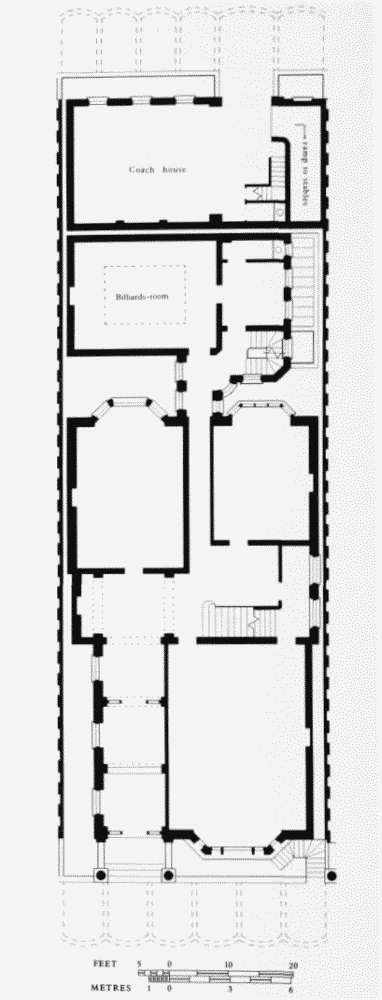
No. 6 De Vere Gardens, 1877, ground-floor plan on lease
No. 6 De Vere Gardens was particularly laid out with an eye to effect. (fn. 33) The first occupant (and the first in the street), Sir Daniel Cooper, had it fitted out with stained glass by Walter Hensman that attracted some publicity in 1881. (fn. 54)
An asking price for the freehold of a moderate-sized house was (in 1879) £6,500, and £9,000 or £11,000 for larger houses. (fn. 55) One of the latter was let for £700 per annum by 1883. (fn. 56)
The households that first moved into these big, conservative, houses were correspondingly extensive. In 1881 No. 6 had eighteen occupants, and the average number in De Vere Gardens was fourteen. The occupants were, moreover, of a kind to please a developer, being rich enough to employ, on average, eight or nine servants, of whom one or two were male. (At one house, No. 10, eight servants attended a single lady of 30.) (fn. 57)
Some of the early residents in De Vere Gardens were people of note, and in 1888–9 included Robert Browning at No. 29, Henry James in a ‘chaste and secluded’ flat on the fourth floor of De Vere Mansions West, (fn. 58) Sir James Fitzjames Stephen at No. 32, the Marquess of Carmarthen (later tenth Duke of Leeds but then a junior minister at the Colonial Office) at No. 20, Sir Daniel Cooper, Australian merchant and a former member of the Council of New South Wales, at No. 6, and Sir Francis Dillon Bell, a member of the first New Zealand government, in a flat at Kensington Palace Mansions. With John Henniker Heaton, M.P. and Commissioner for New South Wales at the Indian and Colonial Exhibition, Browning's predecessor at No. 29 in 1886 De Vere Gardens's residents had a distinctly ‘Colonial’ flavouring in the eighties. (fn. 16)
A few architects' names occur in records of work in these houses—Halsey Ricardo at No. 6 in 1879 and No. 32 in 1882, (fn. 59) J. Hatchard Smith at an unspecified house in 1886 (fn. 60) and Walter Stokes at No. 25 in 1888. (fn. 61) (Later, in about 1905, J. Leonard Williams equipped No. 10 for Captain C. A. Osborne with a rich early-eighteenth-century-type interior carried out by Oswald Craske with the aid of a good array of Edwardian specialist craftsmen. (fn. n2) (fn. 63) )
Yet the success of De Vere Gardens in attracting some eminent and wealthy residents was in strange contrast to its general failure with house-hunters. The early occupants were very slow in arriving. By 1879, when the 34 houses in De Vere Gardens north of Nos. 34 and 37 were substantially complete, only four were in occupation and two years later only another six. It was apparent the development was not succeeding in the way intended. On the west side of De Vere Gardens Taylor and Cumming's ten houses at Nos. 8–26 fared as badly as C. A. Daw's (very similar) houses and only one was occupied by 1884. Edinburgh Terrace at Nos. 3–21 Victoria Road was for some reason more successful, nine of the ten houses being then in occupation. (fn. 16) In 1879 C. A. Daw's brother W. B. Daw withdrew from the enterprise, selling his share of the freehold to Barlow in May for £65,667. (fn. 64) This occasioned long-enduring resentment on the part of his brother and the latter's son W. A. Daw. C. A. Daw regarded himself as having been brought into the speculation as building lessee by his brother's over-optimism (evidently arising from a mistaken idea of Cubitts' success next door at Palace Gate), and he was unhappy to be left with the obligations of his building agreement towards Barlow alone or, as he put it, at Barlow's ‘tender mercies’. (fn. 65) By 1881 C. A. Daw was anxious to escape his undertaking to build more houses on the vacant site south of No. 32 De Vere Gardens—in fact, ‘to be quit of the whole thing’. (fn. 66)
Just at that time Barlow made matters worse, in Daw's view, by his handling of what is now the De Vere Hotel site (Plate 47b). Here instead of the one fine house set back from the road to enhance De Vere Gardens that (Daw claimed) had originally been intended Barlow had three houses (or ‘barns’ as Daw called them) built in 1881 facing Kensington Road and two facing De Vere Gardens. The builder was William Elsdon of Clapham, to whom Barlow sold the freehold in 1881, but Elsdon later mortgaged it back to Barlow, and Daw, who asserted what Elsdon denied—that he was Barlow's foreman—regarded it all as a ‘Barlow’ enterprise. (fn. 67) That this was so is made likelier by the identity of the architect signing the plans. He was a J. C. Boys, who had shared Barlow's office address for some years. (fn. 16) What made the act ‘disastrous’ in Daw's view was that Elsdon built the corner house facing Kensington Road with its flank wall rising from the inner edge of the pavement of De Vere Gardens and thus protruding forward from the main building line in that street. It was thus in some degree an obstruction to the view of Kensington Gardens from the balconies of the houses south of it. The Kensington Vestry was also concerned and in 1882 obtained a magistrate's order to Elsdon to set back his flank wall. He did not do so and in 1883 became bankrupt. (fn. 68) Barlow died in 1882 or 1883 but his representatives (and heirs to his mortgage interest) carried to the House of Lords a dispute which raised difficult questions regarding the section of the Metropolis Local Management Act dealing with building lines. In 1886 the Lords' judgement went in Elsdon's favour and the flank wall remains where it was. (fn. 69) It does not now seem so blighting as it did to Daw, entangled in the failure of De Vere Gardens to ‘take off’.
In the end Daw and Taylor and Cumming alike survived, and De Vere Gardens achieved a stable place in the Kensington housing market. This was largely as a street of unobtrusive but respectable hotels and wellinhabited mansion flats. Doubtless an underlying fact was its good position. But the builders were able to benefit from this only because they evidently had the resources and judgement to make the necessary conversion to meet the suddenly apparent demand by some of the rich for a less labour-intensive kind of life in London. C. A. Daw bought freeholds in De Vere Gardens from 1878 onwards, including the site south of No. 32 he wanted to be rid of in 1881. This was in 1883, when he paid £13,999 to Barlow's representatives for the plot with its 141-foot frontage. The sale was arranged to be made not to him but to his son, William A. Daw, and his brother, Nicholas Fabyan Daw. (C. A. Daw himself supplied the bricks for building on the site at 28s. a thousand.) (fn. 70) The emergence of C. A. Daw's capable son W. A. Daw was an important if purely personal factor in surmounting the problems of De Vere Gardens. In 1886 Daw entered into formal partnership with his son. (fn. 71) Daw undertook in 1882 flats of more up-to-date appearance in Palace Gate, and in 1886 the firm went on to steady and extensive building in the red-brick land of Cranley and Evelyn Gardens. Taylor and Cumming had ventured boldly in Cheniston Gardens from 1879 onwards (see page 106).
Barlow himself showed the necessary flexibility, converting the houses built northward of No. 6 De Vere Gardens in 1877 to flats, which began to appear occupied, as Kensington Palace Mansions, in the Post Office Directory in 1881–2. But it was C. A. Daw who so early as 1880 put up purpose-built flats at No. 37 De Vere Gardens, named De Vere Mansions, which also began to come into occupation in 1881–2. (fn. 72) In 1893 they yielded a net income of £1,430 per annum. (fn. 73) At No. 34, as has been noticed, the Daws demonstrated their faith in flats even more extensively. In May 1885 they were finishing the block which in name—De Vere Mansions West—and in appearance reflected the block opposite at No. 34 and they had (they thought) already let six flats. (fn. 74)
The conversion of already-built houses to flats was seemingly not necessarily inordinately expensive—Daw and Son united and converted Nos. 15, 17 and 19 De Vere Gardens in 1889 for something over £1,000. (fn. 75) And as C. A. Daw said, of fifty flats in De Vere Gardens and Palace Gate only one was then unoccupied, whereas houses could not be disposed of. (fn. 76) Conversion to hotel-use was sometimes more costly. Making the two big houses at Nos. 28–30 into a hotel of residential suites called the Maisonettes Hotel (although each suite seems to have been on a single floor) with electric lift, electric light, steam heating and room-telephones to the service quarters, took nearly £6,000 in 1892–3. (fn. 73)
By 1895 there were six hotels and five blocks of flats in De Vere Gardens. (fn. 16) The important matter of management was not left to chance and the lessee of the Maisonettes Hotel, at £1,600 a year, was a T. Tucker, formerly of Queen Anne's Mansions, who was said to be tenant of six other houses in De Vere Gardens ‘which are doing exceedingly well’. (fn. 73) (Mrs. Tucker was at that time manageress of the De Vere House hotel. (fn. 16) ) By 1906 even the first house to be occupied, No. 6, was a hotel. (fn. 77)
The only hotel now externally of visual interest is the De Vere Hotel (numbered 60 Hyde Park Gate), where an almost ‘Art Nouveau’ treatment unites the carcases of Boys's (heightened) houses (Plate 47b). Possibly this dates from 1897–8, when the De Vere House hotel was remodelled and extended with ‘considerable architectural pretensions’ as the De Vere Hotel. (fn. 78) No confident attribution to an architect can be made although the local practitioner Walter Graves added an iron and glass porch at that time. (fn. 79) The winged lions in terracotta at the corners are by the sculptor Alfred Drury and probably date from the same period (being certainly not later than 1902). (fn. 80)
At what is now the Kensington Palace Hotel the eastern side, of 1877, at the corner of De Vere Gardens, was augmented by G. B. Hart in 1879 by a seven-storey block of flats, run in conjunction with the hotel, at the corner of Victoria Road. (fn. 81) In 1927–8 another tall block, in a ‘neoGeorgian’ style, containing flats similarly managed with the hotel, was built at No. 1 Victoria Road on the site of the stables behind No. 6 De Vere Gardens by Ward and Paterson to designs by M. H. Baillie Scott and E. Beresford. This unlikely authorship is explained by the ownership of the Kensington Palace Hotel at that time by the family of Baillie Scott, who was a director of the hotel and had his London address there. After rocket-damage in the 1939–45 war the north-western portion of the hotel was rebuilt in 1950–1 (Duke and Simpson, architects) and a new block in Victoria Road added in 1957–9 (Laurence Gotch and Partners, architects). (fn. 82)
The stables in the mews of 1877, now De Vere Cottages and De Vere Mews, were always in excess of the residents' needs. In 1897 C. A. Daw complained to his brother that De Vere Mews was more than half empty and fetched only £50 or £60 a stable instead of the £90 his brother and Barlow had promised when urging him to build them. (fn. 83)
At Laconia Mews a transformation was wrought over the years 1918–25 for the freeholders, London Reconstruction Limited, by which the mews became bijou residences called De Vere Cottages, equipped with latticed oriel windows and village-y door-hoods (of concrete). On the east side they were turned to face De Vere Gardens as Nos. 38–48 (Plates 48b, 49c). The builder, at least latterly, was F. Roe of Croydon and the architects were Stanley-Barrett and Driver. (fn. 84) This is one of the most conspicuous examples of the revulsion expressed in mews-conversions against the style of the big ‘South Kensington’ house, in which those architects were prominent. On the Canning Place front vent-pipes tolerated by the local authorities in the 1920s (fn. 85) and a plethora of drain-pipes are a disfigurement.
Some of De Vere Mews was in the hands of a jobmaster until about 1912, a garage company appears there from 1915, and riding-masters from 1923. (fn. 86) The use of the mews to accommodate horses was reinforced in 1947 when it became the home, under a 25-year lease from the Daw family, of the Civil Service Riding Club, founded in 1937 (Plates 48c, 49a, b). On the ground floor, however, the mews was partly in light industrial use. As the club's lease was coming to an end in 1972 a scheme was produced by the architects Triad for Barlow Cannon Estates to reconstruct the mews and the adjacent Canning Place Mews, which had been built in the 1860s by Cubitts to serve Palace Gate. Houses, flats and offices would have been provided and the horses of the Civil Service Riding Club rehoused in the basement of Canning Place Mews. The scheme was hailed in the Sunday Times as ‘a harbinger of the new age of urban renewal—the age of discretion. Developers and planners have thought big for too long.’ Instead, the scheme would produce ‘a cobble-stoned village’. (fn. 87) The authorities concerned with the planning and historic-building aspects of the scheme were reluctant to see the horses moved, and in 1973 the same architects produced an elaborate scheme to have horse-boxes on the ground and first floors of De Vere Mews, approached from Canning Place Mews and affording the purchasers of the reconstructed dwellings a view of horsy activities through ‘sealed glass inspection panels’. This scheme was delayed until 1974 by difficulties over the amount of office accommodation to be permitted, and was succeeded in 1974–5 by another scheme, by Covell Matthews Partnership, in which ‘Victorian detailing’ would have featured. This again came to nothing and in 1977 Roger Carpenter and Associates submitted on behalf of CPK Construction Limited a scheme for the conversion of De Vere Mews for offices, maisonettes and houses. Opinion among some residents in the neighbourhood and local government officers was sympathetic to the retention of working stables, but the Civil Service Riding Club had moved in 1974—briefly to Canning Place Mews and then to its present home at the Royal Mews. In 1978–80 Roger Carpenter and Associates carried out the refurbishment of De Vere Mews for wholly residential and office use but retaining its essential form, in conjunction with the rebuilding of the west side of Canning Place Mews and the conversion of the remainder of that mews to offices and residences. At De Vere Mews the builders were K. and R. C. Thompson of Swaffham, Norfolk, and at Canning Place Mews Focus 4 Construction Limited. (fn. 88) The houses made out of the west side of De Vere Mews were given the numbers 39–51 (odd) De Vere Gardens in 1979 (Plates 48d, 49d). (fn. 89)
De Vere Cottages were included in the Kensington New Town Conservation Area designated in 1969, De Vere Mews added in 1972 (the Area being by then called the De Vere Conservation Area) and De Vere Gardens itself and the adjacent part of Victoria Road added in 1982–3.