Survey of London: Volume 42, Kensington Square To Earl's Court. Originally published by London County Council, London, 1986.
This free content was digitised by double rekeying. All rights reserved.
'Hereford Square area: The Day estate', in Survey of London: Volume 42, Kensington Square To Earl's Court, ed. Hermione Hobhouse (London, 1986), British History Online https://www.british-history.ac.uk/survey-london/vol42/pp158-167 [accessed 30 April 2025].
'Hereford Square area: The Day estate', in Survey of London: Volume 42, Kensington Square To Earl's Court. Edited by Hermione Hobhouse (London, 1986), British History Online, accessed April 30, 2025, https://www.british-history.ac.uk/survey-london/vol42/pp158-167.
"Hereford Square area: The Day estate". Survey of London: Volume 42, Kensington Square To Earl's Court. Ed. Hermione Hobhouse (London, 1986), British History Online. Web. 30 April 2025. https://www.british-history.ac.uk/survey-london/vol42/pp158-167.
In this section
CHAPTER X - Hereford Square Area: The Day Estate
The streets and houses described in this chapter (fig. 65) were laid out and built, mostly between 1845 and 1885, on land belonging to the Day family. Situated at the west corner of Old Brompton Road and Gloucester Road, this portion of the Day estate in Old Brompton was traditionally known as the ‘six acres’, though in actual area it was closer to ten. The rest of the estate consisted of a three-acre field on the south side of Old Brompton Road formerly called Rosehall. This is now occupied by the northern end of Drayton Gardens whose development is described in volume XLI of the Survey of London.
Both parts of the Day estate were formerly copyhold lands of the manor of Earl's Court. They had been held in common since at least 1661, when they were in the ownership of James Dyson, from whom Rosehall and the ‘six acres’ descended in the Dyson family until the early years of the eighteenth century. (fn. 1)
The estate came into the possession of the Day family through the marriage, in 1743, of Benjamin Day of Tavistock Street, Covent Garden, the son of a worsted weaver in Norwich, to the heiress Ann Dodemead. Ann's father, Walter Dodemead, had acquired the land in 1735, by foreclosing on a mortgage, and when he died in 1744 it was inherited by his three daughters, each of whom received a one-third share. But in 1753 Ann Day and her sister Susanna Vincent surrendered their two-thirds interest to their sister, Elizabeth Brent, under whose will the whole estate eventually passed, in 1772, to Benjamin and Ann Day's second son, James Frapwell Day. He never married and when he died in 1819 he left it to his nephew James Day of Horsford near Norwich. (fn. 1) The subsequent owners have all been the direct descendants of James Day, two of whom still retain an interest in parts of the estate. (fn. n1)
Villa Building in the Eighteenth Century
The first houses to be built on the estate were a group of five villas erected near the Old Brompton Road over a period of some twenty years starting in the mid 1760s (fig. 64). The oldest was a largeish detached house, later called Hereford Lodge, whose site is now covered by the roadway of Brechin Place (between Nos. 19 and 20). The evidence of the ratebooks suggests that it was built in the mid 1760s, and that its first inhabitant, from c. 1766 until 1772, was Benjamin Day himself. (fn. 2) In the early leases it is usually described as being ‘behind or at the bottom of a walk or grove of chestnut trees from Hogmore Lane [Gloucester Road]’. (fn. 3) The grounds, which extended to more than five acres, comprised a large paddock to the north of the house, where Hereford Square was laid out in the 1840s, a walled kitchen garden to the west, and pleasure gardens to the east and south. No illustration of the house is known.
Apart from Benjamin Day the inhabitants of Hereford Lodge included Gertrud Elisabeth Mara, the diva, 1797–8; Lady Essex Ker, eldest daughter of the second Duke of Roxburghe, 1809–19, and her sister Lady Mary Ker (died 1818); and the Rev. George Stokes, a former chaplain to the British residents in Rouen and later minister at the Thurloe Chapel in South Kensington, who used the stable and coach-house for a schoolroom, 1849–58. (fn. 4) The Dowager Duchess of Argyll succeeded Stokes as ratepayer here in 1858, for ‘the Choral Sunday School’. (fn. 2)
In 1869 Walter Woodbury, the inventor of the Woodbury type process of reproducing photographs, set up a studio for his Photo-relief Printing Company in the grounds of Hereford Lodge. Later numbered 9A Hereford Square, the studio survived until 1876, the firm by then being known as the Woodbury Permanent Photographic Printing Company. (fn. 5)
The building of Hereford Lodge was soon followed by the erection in about 1770 of another large detached house further to the west on a site now covered by the roadway of Rosary Gardens (between Nos. 2 and 11). Later known as Brompton Villa, this stood in just over two acres of ground. It had no frontage to Old Brompton Road, and the entrance was in Love Lane, the long-established pathway connecting Old Brompton Road and Kensington Road whose southern end is now represented by Dove Mews. A nineteenth-century illustration of the house (Plate 65d) shows it to have been a neat four-bay Georgian brick box, three storeys high, flanked by lower wings, each one bay wide, with a single-storey extension in front of the main block. In 1820 the house contained nine bedrooms, two dressing-rooms, a ‘handsome’ drawing-room, breakfast-room and dining-room, a ‘good’ kitchen, larders, store room, wash-house and cellaring; and the outbuildings comprised a double coach-house, six-stall stable, cowhouse and piggeries. The premises were then said to be ‘peculiarly adapted for the residence of a Family who wish for retirement and yet near town’. (fn. 6) By 1859 the house and stables had become, in the opinion of the estate surveyor, ‘very old and dilapidated’, although the garden was still ‘nice and pleasant’. (fn. 7)
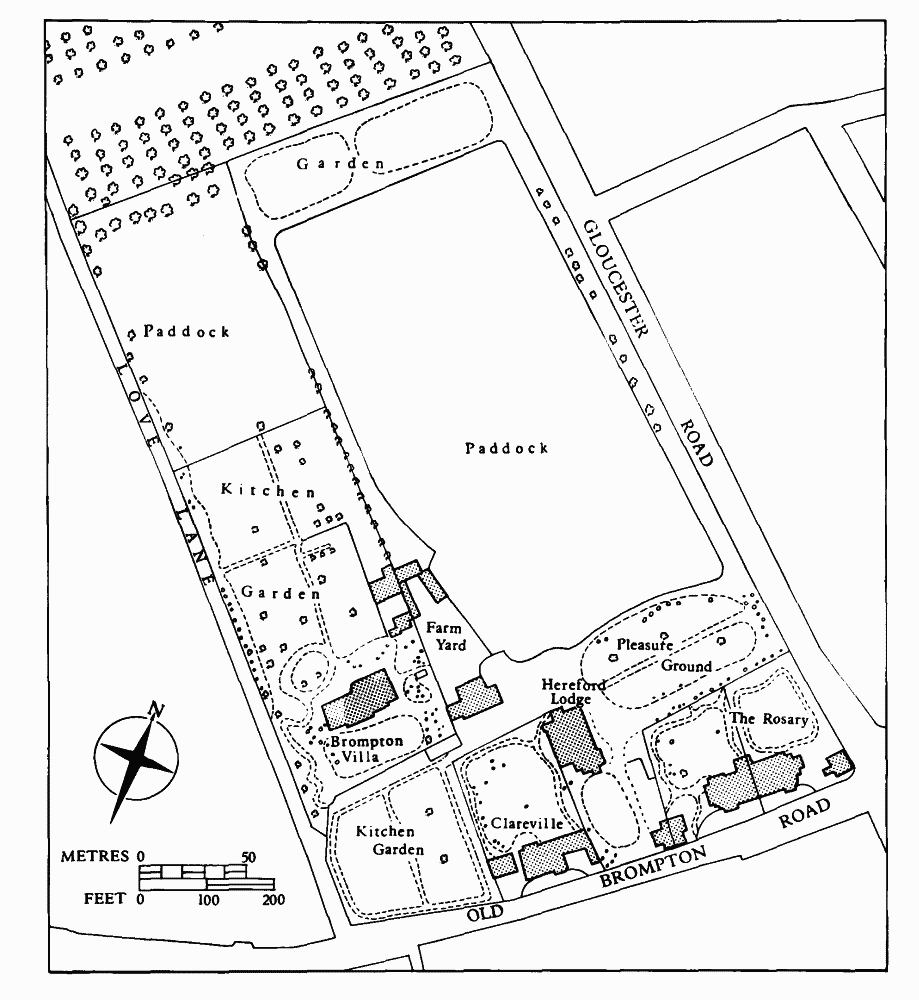
Villas on the Day estate in c. 1835
The best-known occupant of Brompton Villa was the poet Laetitia Elizabeth Landon, who lived here from 1817 to 1820, the house being let to her father, John Landon, a partner in a firm of army agents in Pall Mall. (fn. 8) A later inhabitant, from 1837 to 1859, was the tenth Baron Cranstoun. (fn. 9)
Shortly after James Frapwell Day inherited the estate in 1772, a pair of villas was erected in the grounds of Hereford Lodge close to the corner of Gloucester Road and Old Brompton Road, which provides an early instance of the semi-detached arrangement of two villas. As ‘Day's 2 new houses’ they were entered in the ratebook in 1774, although not inhabited until the following year. (fn. 2) The eastern house, later known as The Rosary, is shown in a picturesque view of about 1845 (Plate 65b) which, however, omits altogether the adjoining house to the west. The single-storey wing with Gothic windows on the east side of the house was probably added in the 1840s for Samuel Carter Hall, the author, editor and critic, and his wife Anna Maria Hall (née Fielding), the novelist and miscellaneous writer, who lived here from 1839 to 1849. (fn. 10) The Halls had their library in this wing, which was decorated internally in the baronial style (Plate 65c). S. C. Hall may perhaps have been his own architect here. He was the author of The Baronial Halls and Picturesque Edifices of England, and is reputed to have been the model for Mr. Pecksniff. (fn. 11)
The adjoining house was inhabited from 1784 until 1788 by a Henry Holland, possibly the architect. (fn. 2)
The last of the five villas to be erected on the estate in the eighteenth century was Clareville, which is designated a ‘New House’ in the ratebooks of 1784. (fn. 2) This too was built in the grounds of Hereford Lodge, squeezed in between the kitchen garden, on the west, and the front garden abutting on Old Brompton Road, to the east. A drawing by T. H. Shepherd of 1852 shows a plain but nicely proportioned house of two storeys and three bays with what appears to be a stuccoed front (Plate 65a). The Swedish soprano Jenny Lind stayed at Clareville during her visits to London in 1848 and 1849. (fn. 12)
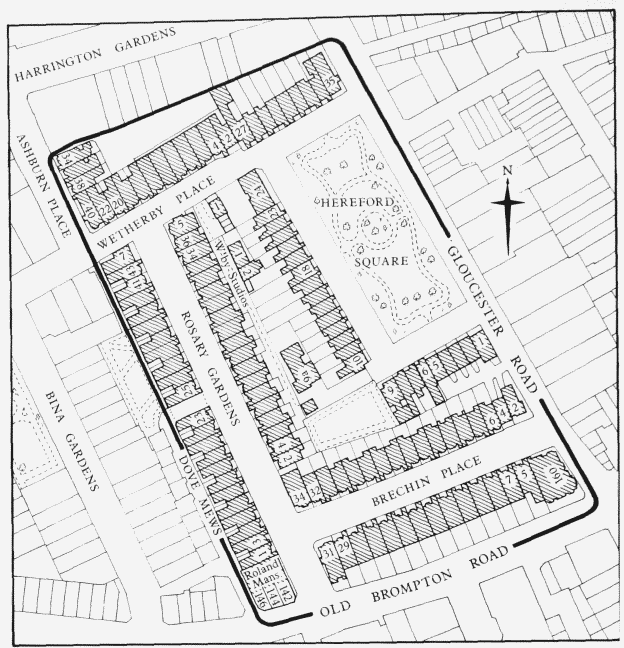
Hereford Square area: the Day estate. Based on the Ordnance Survey of 1976–7
All five villas were pulled down in the early 1880s, but three of them are commemorated in local street names: Hereford Square and Rosary Gardens, on the Day estate, and Clareville Grove (and Street) on the nearby Lee estate.
The Building of Hereford Square
The nineteenth-century development of the Day estate was begun in the 1840s by James Day, who inherited the property from his uncle in 1819. One of the earliest developments in this part of Old Brompton had been on the Lee estate, a similar property to Day's on the opposite side of Gloucester Road, which was laid out for building in 1820. (fn. 13) But the slow rate of progress there was not encouraging for other landowners in the vicinity and Day waited until 1845 before agreeing to let any of his land for building. He may, however, have had it in mind since 1835, when he purchased the enfranchisement of the copyhold. (fn. 14)
In January 1845 Day concluded an agreement with two speculators to let the whole of Rosehall for building; (fn. 15) and six months later he made another agreement to let part of the grounds of Hereford Lodge to a builder. (fn. 16) The area in question was a piece of pasture of about four acres known as the ‘paddock’ which had a frontage to Gloucester Road of over 550 feet.
The builder who agreed to take this piece was Thomas Holmes of Lower Belgrave Street. Still only in his early twenties, Holmes was already a seasoned speculative builder who had gained most of his experience in the Brompton area, particularly on the Alexander estate, where he built parts of Thurloe Square, Thurloe Place and Thurloe Street. (fn. 17)
On the Day estate Holmes contracted to lay out and build Hereford Square which he undertook to complete, with all the houses ‘ready for occupation’, by Christmas 1849. Originally there were to have been forty-three houses, for in addition to thirty-five in the square proper Holmes agreed to build four semi-detached pairs in the so-called ‘angle plots’ at the west end of the north and south ranges. Under the terms of the agreement Holmes was to make the roads and sewers and lay out the ornamental garden in Hereford Square. The latter was to be enclosed with iron railings on dwarf brick walls, and to have entrances on the north, south and west sides. The agreement also allowed for the erection of up to nineteen stables and coach-houses behind the west range of the square. These were never built, but an access road was laid out, and survives as the pathway leading out of Wetherby Place behind the gardens on the west side of the square. (fn. 16)
As soon as the houses were finished they were to be leased by Day to Holmes or his nominees on ninety-nine-year terms, from Christmas 1844. The sum total of the individual ground rents was to be £130 a year, equivalent to over £32 per acre. (fn. 16) This was £50 a year more than Day was getting for the undeveloped site in 1843. (fn. 18)
The architect of Hereford Square was John Blore, the estate surveyor, whose authorship was formerly attested by a notice on the wall of the now-demolished No. 1. (fn. 19) (fn. n2) Blore's houses have fully stuccoed fronts—the ‘best description of Roman Portland or other approved cement’ being specified—richly composed in what the architect himself described as the ‘Italian Style of Architecture’ (Plate 66, fig. 66). (fn. 20)
The ‘square’ comprises three ranges of houses: a long north-south range of seventeen houses on the west, and two shorter east-west ranges each of nine houses to north and south. Only the north range has survived intact (Plate 66a). Most of the houses have three full storeys, a basement and garrets, but in the centre of the ranges are one or more houses with a full attic storey. The roofs and dormer windows of the three-storey houses were originally hidden behind balustrading, which nowhere survives. The houses are two windows wide except for the corner houses which have three windows at the front.
In the west range the five central houses (Nos. 16–20) project slightly to form a quasi-palatial frontispiece decorated with an applied order of giant Corinthian pilasters and engaged columns (Plate 66b). In the northern range (and originally also in the southern) the central house (No. 31) rises to a full attic finished with a pediment. This house has a Venetian window at first-floor level flanked by pairs of giant Corinthian pilasters. Throughout the ranges the first-floor windows open on to balconies which have cement parapets pierced with a pattern of intersecting circles. The entrances have arched porches with lesser round-headed openings at the sides. Except at the corners, the plans follow the conventional arrangement for two-bay houses with the entrance hall and staircase on one side (fig. 66).
The specifications required that the houses be built of good hard well-burnt stock bricks bonded with ‘stout iron hoops’, and roofed with slates. All the timber-work, except where English oak was used, was to be of Baltic fir or red pine. For supervising the construction Blore was to be paid a fee of £3 per house by the builder. (fn. 16)
Holmes started building in Hereford Square in August 1845 and by the end of the year he had six houses (Nos. 1–3 and 33–35) under construction. Another fifteen houses (Nos. 4–9, 21–26 and 30–32) were started during 1846 and a further three (Nos. 10–12) in March 1847. (fn. 21) But in June 1847 Holmes was declared bankrupt and all building work in the square came to a halt. Except for Nos. 10–12, the houses already under construction were sufficiently well advanced for the leases to have been granted, though none was yet occupied. Some had been leased to Holmes himself (Nos. 1, 9, 30 and 31), but most of the leases were, at his request, granted to his financial backers, principally George Pinckney Whitfield. (fn. 22)
Holmes's bankruptcy was doubtless precipitated by a sharp financial crisis in the spring of 1847 which disrupted building operations and brought many builders to bankruptcy. (fn. n3) But he was already under pressure from his creditors as a result of a building accident in Thurloe Street which he himself described as ‘one of the principal causes of his misfortunes’. This was in November 1846, when some of his houses collapsed while under construction, killing a workman. Although the inquest cleared Holmes of any blame some of his creditors ‘pressed upon him immediately after’, forcing Holmes ‘to seek refuge in the Gazette’. (fn. 23)
Far and away the biggest of his creditors was George Pinckney Whitfield, who had lent £5,000 for the development of Hereford Square, of which nearly £4,000 was still owing. Whitfield was a Yorkshireman in his early sixties, who in the census of 1841 described himself as an ‘independent’, and ten years later as ‘proprietor of houses’. He had been Holmes's principal financial backer from the outset of the latter's career in the early 1840s, and had previously lent money to Holmes's builder father. On the Alexander estate he provided much of the finance for the development of Thurloe Square (where from 1847 to 1854 he occupied No. 27), as well as for Holmes's houses in Thurloe Place and Thurloe Street. (fn. 24) When, in the wake of Holmes's bankruptcy, Whitfield was faced with the prospect of being unable to recover any more of his loan he decided to foreclose, take over the building agreement and complete the development himself. But by then the agreement was in the hands of assignees appointed to administer Holmes's affairs, and it was not until July 1848, when they released it to Whitfield, that he was able to proceed.
His first priority was to complete the central garden, which under the terms of the agreement should have already been finished. In July 1848 he placed contracts for laying out and planting the garden and for erecting the iron railings around it, and the work was completed by the end of the year, at a cost of between £1,200 and £1,300. (fn. 25)
Meanwhile Whitfield had instructed his solicitors to try and secure some relaxation in the terms of the agreement since the development was by now well behind schedule. In the course of these discussions changes to the layout were considered, among them a suggestion from Day himself that an opening should be left in the middle of the western range of the square ‘so that a street might thereafter be formed’. Whitfield was asked by Day's solicitors to consider ‘the advantage the property would derive’ from the inclusion of a church in the development. ‘It has struck us’, they wrote, ‘that a good scite might be obtained about the Midway point between the north east and south east ends of the square adjoining the Road’. He replied that he thought it would be ‘hardly practicable’ to build a church in the square, though he recognised the value of having one in the immediate vicinity and promised ‘to join in furthering such a desirable object’. (fn. 25) But in the end the only significant change to come out of these discussions was the abandonment of the eight semi-detached houses in the two ‘angle plots’. (fn. 26)
Though protracted, the negotiations appeared to be progressing smoothly and Whitfield was surprised when in October 1848 Day served a Declaration in Ejectment on him for breach of contract, on the grounds that Whitfield had failed to complete the square garden within the stipulated time. Whitfield responded by filing a bill in Chancery in which he argued that it had been informally agreed that Day would not press this point, and on this understanding he had gone ahead with the contracts for the square garden which, moreover, was being laid out under the supervision of Day's own surveyor. (fn. 25) All seemed set for a legal battle when the two principals, ‘for the purpose of avoiding all future litigation’, decided to settle the matter out of court. Whitfield surrendered Holmes's original building agreement, and in May 1849 he and Day signed a new one by which Whitfield undertook to finish the development of Hereford Square by Christmas 1851. (fn. 26)
Fourteen of the thirty-five houses in the square still remained to be built (eleven in the western range) and these were completed between 1849 and 1851. Thomas Holmes, back in business after his bankruptcy, but without responsibility for the development, was recalled to complete the three houses (Nos. 10–12) he had abandoned in 1847, and went on to build three more (Nos. 27–29) in 1850. (fn. 27) The other eight houses (Nos. 13–20) were built by William Wells of Vauxhall in 1850–1. (fn. 28) All the leases were granted to Whitfield, who in 1854 left his house in Thurloe Square and took up residence at No. 27 Hereford Square, where in March 1857 he died. (fn. 29) In his will he bequeathed his freehold and leasehold property to two trustees to be sold at public auction or by private contract. (fn. 30)
A few houses on the north and south sides of the square were inhabited by the summer of 1847. (fn. 2) These included the now-demolished No. 3 where the ratepayer was Thomas Holmes, who had probably been using the house as a site office while the square was in building. After his bankruptcy Holmes removed to No. 33, where he continued as ratepayer until 1851. Most of the houses in the square were inhabited within a year or two of being leased. (fn. 2) They were intended to be occupied only as private residences and were not to be used for any trade, sale, exhibition, manufactory, asylum, school (except a young ladies' school) or any business likely to cause a nuisance. As well as having their own back gardens, the occupants of the square enjoyed a right of access to the central garden. This was maintained out of an additional annual rent charge of £3 per house, part of which was also used to pay for lighting the square. (fn. 31)
The cost of buying one of the new houses in Hereford Square is not generally known, but in 1853 Whitfield sold the now-demolished No. 26 to the first occupant for £900. (fn. 32) This was probably on the high side, for No. 26 was one of the bigger corner houses with a uniquely large L-shaped back garden which extended behind some of the other gardens. The new owner added a conservatory, and in 1865 No. 26 changed hands for £1,500. (fn. 33) In the previous year the corresponding house at the south end of the range, No. 10, had been sold for £1,100. (fn. 34)
Despite the presence in the 1851 census of a baronet at No. 12, the early inhabitants of Hereford Square were mostly drawn from the professional middle classes. At the time of the census twenty-two of the houses were in more or less permanent occupation, sixteen by their original inhabitants. Another three houses still in building or not yet sold were temporarily occupied by workmen. (fn. n4) The callings best represented among the householders were the law, medicine and commerce. There was also the usual sprinkling of annuitants (mostly female) and ‘clerks’. At No. 4 the householder was an artist, F. W. Hulme, and at No. 9 an engineer, John W. Corpe, who although aged only 44 was described as ‘retired’. Every household in 1851 had either one or two servants, except at No. 35 (a barrister's), where there were three. (fn. 35)
Twenty years later the census of 1871 shows that half the householders in the square were then either retired or were living off private incomes (including the income from property and annuities). (fn. 36) Two of the houses, Nos. 9 and 33, were occupied as high-class preparatory boarding schools for boys.
The back garden of No. 9 is now occupied by a single-storey building erected some time between about 1872 and 1894. It was probably built either as a schoolroom, or as a surgery for the ‘specialist in American dentistry’ who took over No. 9 in 1890. (fn. 37) Another house to have its back garden similarly built over is No. 27, where in 1883 the occupant was allowed to erect a large room connected by a corridor to the house. (fn. 38)
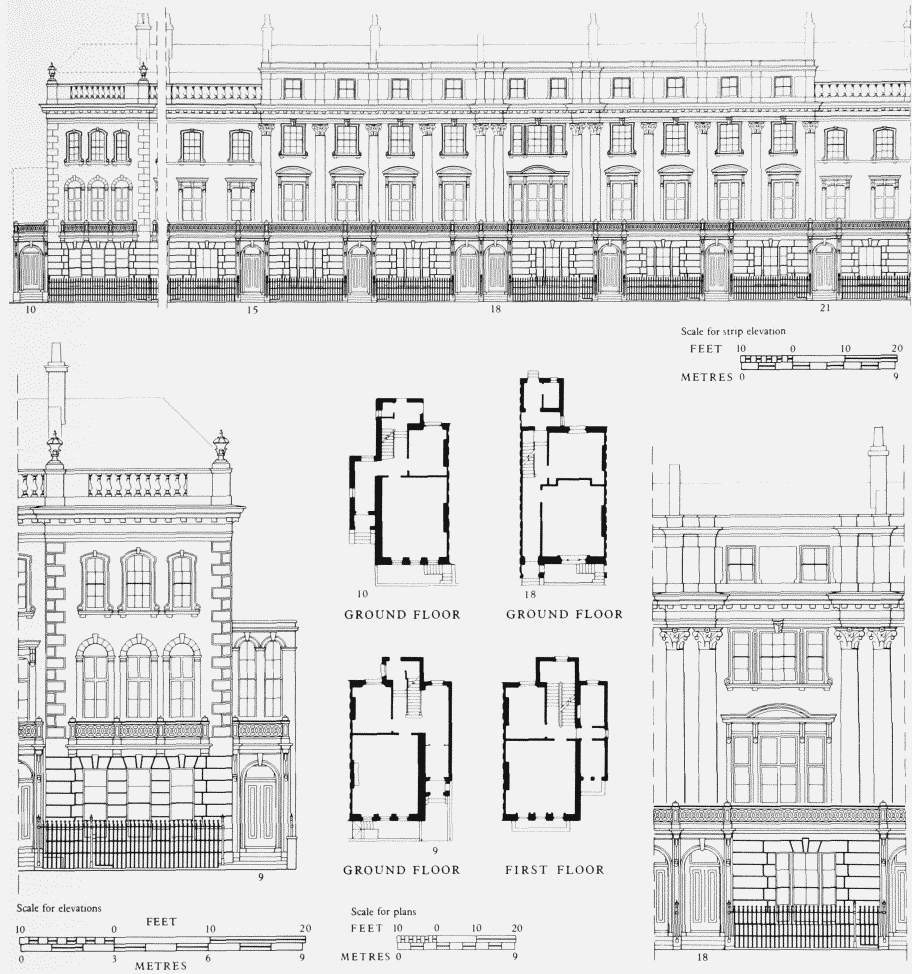
Hereford Square, plans and elevations. John Blore, architect, 1845–51
Some residents of Hereford Square: No. 4. Frederick W. Hulme, landscape painter and art teacher, 1851–63; No. 6. Charles Alban Buckler, architect and Surrey Herald Extraordinary, 1865–1905; No. 16. Rev. William H. Brookfield, literary divine, 1874; No. 20. Robert Collinson, genre-painter, and his wife, Eliza Collinson, flower-painter, 1857–93; No. 22. George Borrow, author, 1860–72. The L.C.C. Blue Plaque commemorating Borrow's residence was put up in 1911; No. 26. Frances Power Cobbe, philanthropist and religious writer, lived at No. 26 with her friend Mary Charlotte Lloyd, 1864–84; Fanny Kemble, actress, 1884–90; No. 27. Acton Smee Ayrton, Liberal M.P. and First Commissioner of Works, 1874–6; No. 35. John Arrowsmith, geographer and cartographer, 1861–73.
Brechin Place, Rosary Gardens and Wetherby Place
After the completion of Hereford Square in 1854 and of the northern end of Drayton Gardens in 1863 the only part of the Day estate that remained to be developed was the L-shaped area to the south and west of Hereford Square still occupied by the five eighteenth-century villas. Although some development here may have been in prospect in 1859 (fn. 39) this did not go forward, and the old houses were still standing when James Day died in 1875. By his will the estate was placed in the hands of trustees who were to administer the property until all the children of his son, Gerard, should come of age. (This happened in 1899.) The whole estate was then to pass to James Day's eldest grandson, Herbert Allen Day (1860–1940). (fn. 40)
Development of the L-shaped area just referred to was apparently being contemplated by the trustees as early as 1876, (fn. 41) but they did not go ahead until 1881, the work being completed in 1885. The preliminary stages of the development were undertaken by William H. Roberts of Cromwell Road, a builder already active on the adjoining Alexander estate, who in November 1881 secured the necessary approval of the Metropolitan Board of Works for his proposed layout of three new roads (now Brechin Place, Rosary Gardens and Wetherby Place). (fn. 42) Once having obtained this consent Roberts ceased to play an active role and the ground was parcelled out among three experienced builders of good standing. The firm of Taylor and Cumming took the north side of Wetherby Place, and the short return frontage at Nos. 34–40 (even) Ashburn Place; William Willett was responsible for Rosary Gardens; and George E. Mineard built Brechin Place. (fn. n5)
Both Mineard and Willett began building houses in their respective streets in May 1882, Brechin Place being completed in 1884 and Rosary Gardens in 1885. (fn. n6) Taylor and Cumming's houses in Ashburn Place and Wetherby Place were erected between 1883 and 1885. (fn. 45)
The new houses numbered 88, of which 40 were built by Willett, 31 by Mineard, and 15 by Taylor and Cumming; and two were erected under contract by other builders (see below). The estate trustees leased them to the builders or their nominees for ninety-nine years from Midsummer 1881. When completed the development, which also included two blocks of flats mentioned below, yielded £1,800 a year in ground rents. (fn. 46)
Architecturally the houses fall within a run-of-the-mill range of up-to-date red-brick styles (Plate 67). The estate surveyor when they were begun was Charles Moreing, an elderly man whose career stretched back to the 1830s and who (unlike his predecessor) figures in the estate records doing only routine work. He was active until his death in 1885 (fn. 47) but is perhaps an unlikely candidate as designer of the houses. These differ, moreover, from street to street, corresponding with the identity of the builder, which rather suggests it was the builders, not the estate surveyor, who brought architects on to the scene. Willett certainly is known to have employed architects, but of these J. T. Smith would seem to be precluded from Rosary Gardens on stylistic grounds, while his successor, Harry Measures, mentions no work for Willett here in a curriculum vitae, although he does not omit other work for Willett in this neighbourhood. (fn. 48) The locally-active architect William H. Collbran similarly produced a list of his work that makes no mention of any designs for houses in Rosary Gardens. (fn. 49) Otherwise he would seem the likely architect there: he had had a connexion with Willett (over an abortive scheme in Hereford Square) in 1881, succeeded Moreing as estate surveyor, and made additions to the houses in Rosary Gardens in 1892 in their existing style. (fn. 50)
Only in Brechin Place (and at Nos. 2 and 4 Rosary Gardens) do the houses have private gardens. In Ashburn Place and Wetherby Place, Taylor and Cumming's houses are provided with a communal garden at the rear, and the occupants of Willett's houses at Nos. 25–43 Rosary Gardens had the use of a similar garden laid out by Willett on the adjoining Gunter estate. (fn. 51) The development did not in the end include any stabling, although in 1882 Willett had planned to erect a small mews in the south-west corner of Hereford Square, the intended site being subsequently used for a communal garden. (fn. 52)
The builders disposed of their houses either by selling them, on long leases, or by letting them for short terms (7, 14 or 21 years) at high rents, this latter method being perhaps more generally preferred. Known rents ranged from £145 a year for No. 36 Rosary Gardens, to £225 a year for some of the houses in Brechin Place. To buy, prices ranged from £2,300 for No. 30 Brechin Place to £3,600 for No. 13, the average price for a house on this development being about £2,700. (fn. 53)
An impression of the character of these houses is provided by sale particulars of No. 17 Brechin Place in 1889. (fn. 54)
Built by Mineard in 1883, this is a five-storey house over a basement, with its own small private garden backing on to Old Brompton Road. In 1889 it was described as a ‘Residence of pleasing elevation … fitted with all modern improvements and conveniences’. The sanitary arrangements, a particular interest of Mineard's (see page 318), were singled out as having received ‘special attention’. Both hot and cold water were laid on from the basement to the top of the house.
On the top floor there were two servants' bedrooms, one of them fitted with a lavatory and housemaid's sink, and a full-sized top-lit billiard-room. Below, on the third floor, were four bedrooms and another two on the second floor, where the ‘large’ back bedroom had an adjoining dressing-room. Also on the second floor was a bathroom, fitted with bath and lavatory, and a water closet. The first floor was occupied by an L-shaped double drawing-room, with bay windows at both front and back, and a French casement opening on to a balcony at the front. The walls here were finished with a coved cornice and ‘frieze rail’, and the entire floor laid with ‘Parqueterie’. On the ground floor there was an inner and an outer hall, both laid with tessellated flooring, a lobby fitted with a lavatory and a water closet, a ‘capital library’ at the front of the house, and a ‘noble dining-room’ at the back with a panelled ceiling and a ‘Japanese embossed dado’. ‘Lincrusta Walton’, by contrast, was used for the dado in the library, on the staircase up to second-floor level, and in the billiard-room. In the basement there was a kitchen with a range and dressers, a larder and scullery, a housekeeper's room, a butler's pantry, a large box-room, wine and coal cellars, and a servants' water closet.
A group of photographs taken in 1890 illustrates the interior of an unidentified house in Rosary Gardens. (fn. 55) In the dining-room, which is dominated by a heavy carved wooden chimneypiece and overmantel, the upper part of the walls is hung with a Morris-like paper having an overall pattern of naturalistic leaves. This contrasts with the geometrically patterned dado and ceiling. In the drawing-room the decorations are overpowered by the heavy Victorian furnishings (Plate 68b). The walls are papered from skirting to cornice, but the pattern is subdued, suggesting damask or watered silk. The ceiling is quite plain and the main decorative feature is the cornice, which has pretty neo-Adam urns and swags. In the one bedroom shown the walls are hung from skirting to simple cornice with a very attractive paper closely patterned with butterflies (Plate 68a).
At No. 31 Rosary Gardens (where from 1886 to 1888 the occupant had been Beerbohm Tree) decorative work of a doubtless rather different character was carried out in 1890 to the designs of Mackmurdo and Horne, although, as it cost only £220, it was probably not extensive. The client was Charles Robertson, a stock-jobber and benefactor of the Servite Church in Fulham Road. (fn. 56)
The two houses built under contract are both at the north end of Rosary Gardens, where Willett sold the corner sites to individuals who wished to erect houses for their own occupation employing architects and builders of their choice. They were both originally numbered in Rosary Gardens but have been renumbered in Wetherby Place.
At the west corner (No. 7 Wetherby Place) the building owner was Captain William de Wiveleslie Abney of the Royal Engineers, who gave £924 10s. for the site. (fn. 57) Designed by W. H. Collbran, No. 7 was erected in 1882–3 by H. Toten and Sons of Richmond Road, Kensington, builders; their tender price was £2,825. (fn. 58) In 1883, when Abney moved in, his taste in ‘aesthetic’ window blinds was gently mocked by the building owners at the opposite corner. (fn. 59)
There, at No. 5 Wetherby Place, the site had been acquired, for £756, by Richmond Ritchie, an official in the India Office, and his wife Anne, Thackeray's eldest daughter. (fn. 60) The Ritchies wanted a house planned to their own specifications, and although they evidently employed an architect his identity remains unknown. One of their special requirements was the provision of a speaking tube from the drawing-room to the nursery. (fn. 61) The house was erected in 1883–4 by Stimpson and Company of Brompton Road. (fn. 62) Built of red brick, with gables on the west and north sides and a bay window at the north-east corner, it is in a plain, even severe, architectural style which eschews all ‘aesthetic’ ornament (Plate 67a). The Ritchies did, however, allow themselves a double monogram of their own initials (RR and AT) on the porch. They moved into their ‘beautiful new house’ in August 1884. But the upkeep was greater than they could afford and in March 1886 they left to live with Richmond's mother in Wimbledon, having let No. 5 at £200 a year. (fn. 63)
Although large single-family houses predominated, the development of the estate in the 1880s also included two blocks of residential flats, for which there was a growing demand. The earlier of the two is Roland Mansions at the southern end of Rosary Gardens (Plate 69c). Built in 1882–3, it includes three shops at Nos. 142–146 (even) Old Brompton Road. The developers, who bought the site from Willett for £1,806, were two local shopkeepers, William Glover, a dairyman, and Robert King, a wine merchant. Their architect was W. H. Collbran, and the contractors were Perry and Company of Bow, whose several tenders amounted to £15,187. (fn. 64) The developers were granted separate leases of the block, Glover taking the western third, including No. 146 Old Brompton Road, and King the rest. (fn. 65) Thus Glover's initials, with the date 1883, appear on the return front in Dove Mews, while King's initials, with the same date, are on the return front in Rosary Gardens.
A second block of flats called Cranley Mansions (and numbered 160 Gloucester Road) was erected in 1883–4 at the eastern end of Brechin Place (Plate 69d). Collbran was again the architect, but here he was also the developer and lessee. (fn. 66)
By the time of the 1914–18 war the demand for large single-family houses of the type built in southern Kensington in the 1880s had greatly weakened and many estate owners adjusted to this change by allowing their houses to be converted into flats. On the Day estate this tendency was resisted, and in 1919 a successful action for breach of covenant was brought against a tenant who had converted a house into three maisonettes. (fn. 67) By 1929, however, if not before, the estate had accepted the situation and was licensing conversions. (fn. 68)
Wetherby Studios
These two Victorian studios at the back of Nos. 20–22 Hereford Square face the pathway leading out of Wetherby Place (Plate 69b). The earlier, now No. 2 Wetherby Studios, was built in 1867 for the painter Robert Collinson in the back garden of his house at No. 20 Hereford Square. It is a two-storey brick building, stuccoed on the west side, with a slated mansard roof. Collinson's studio was on the first floor, which was originally lit by a large, centrally positioned, north-facing window-cum-skylight (removed in 1946–7). The approved drawings for the studio in 1867 also show an unexecuted scheme for an adjoining single-storey top-lit picture-gallery and reception-room. (fn. 69) Later occupants of No. 2 (or Wetherby Cottage, as it was sometimes called) have included Baron Jean Cassell, and the portrait and figure painters Beatrice Malcolm and William H. Robinson.
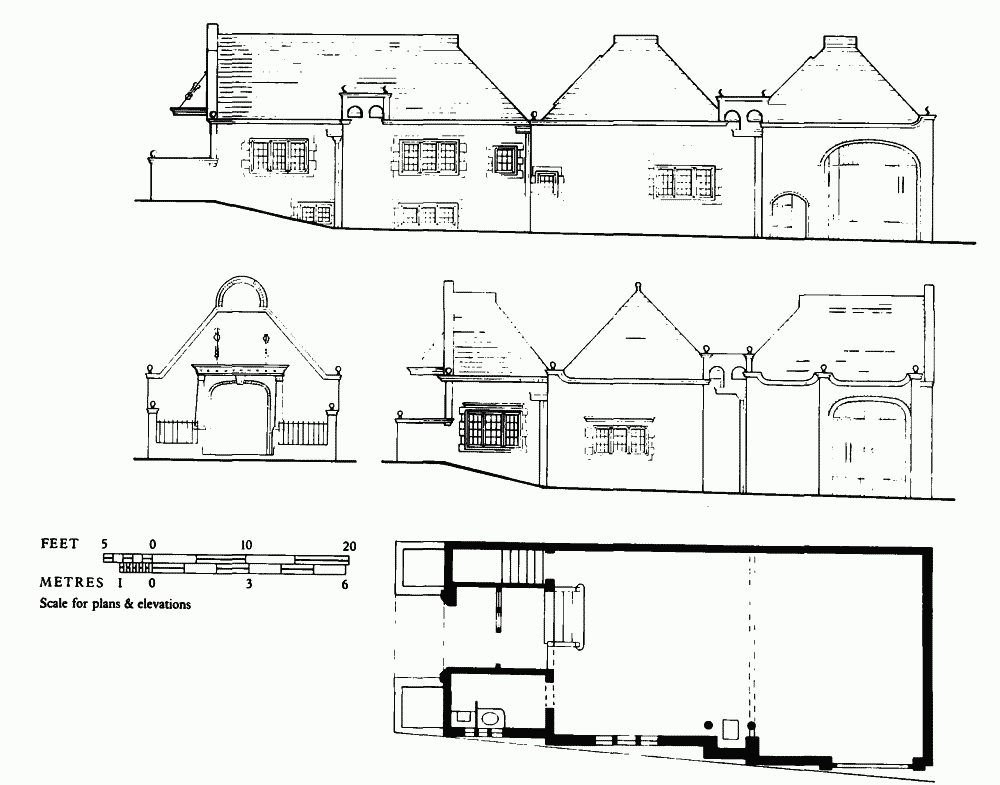
Elevations and plan of a proposed studio in Wetherby Place. E. L. Lutyens, architect, 1891. Unexecuted
No. 1 Wetherby Studios was erected, probably in the 1870s, for the occupant of the now-demolished No. 26 Hereford Square, Mary Charlotte Lloyd, an amateur sculptor and Welsh landowner. It is a single-storey brick building, top-lit in factory style. The site was part of Miss Lloyd's back garden, which then extended behind the gardens of Nos. 21–25 Hereford Square. (fn. 70) Also known as Hereford Square Studios, No. 1 was later occupied by the sculptors William H. Tyler, Charles J. Pibworth and Septimus A. Bennett, and by the portrait painters Thomas M. Ronaldson and Reginald H. Campbell. Since 1945 it has been modernized and extended to make ‘a good studio dwelling’. (fn. 71)
In 1892 the lease of No. 26 Hereford Square was bought by a house agent in Gloucester Road, Charles Saunders, who obtained a licence from the estate trustees to erect a large studio of superior character on the back part of the garden, which, had it gone ahead, would have involved the demolition of the existing No. 1 Wetherby Studios. Probably intended as a speculation, it appears to have been designed by the young Edwin Lutyens, who at the time was still living in his father's house in nearby Onslow Square, and would have been the earliest example in London of Lutyens's work. Two versions of the scheme were approved, the final choice being left to Saunders. One was for a building nearly eighty feet in length, and the other a reduced version just over fifty feet long (fig. 67). In both, however, the elevation of the north-facing entrance front is the same, and is all but identical with Lutyens's surviving sketch for a studio in Wetherby Place dated 27 February 1891 (Plate 69a). (fn. 72)
A third studio, ‘of a somewhat temporary character’, erected on the site of the present No. 1 Wetherby Place, probably in the early 1920s, was destroyed by bombing in 1940. Known as No. 1A Wetherby Studios it had been occupied in the early 1930s by a portrait painter, Mrs. Henrietta Thorburn. (fn. 73)
The Day Estate since 1945
As a result of enemy action during the second World War eight houses in Hereford Square and two in Brechin Place were either completely destroyed by bombing or damaged beyond repair. (fn. 74) At the less severely damaged Nos. 22 and 23 Hereford Square the reinstatement of the building in 1949 preserved the original façades (shorn of their crowning balustrade), behind which the houses were reconstructed as four flats and two maisonettes, the two biggest flats, on the first and second floors, being carried horizontally across both houses. They were designed by Arcon, with Marshall Andrews and Company as the principal contractors. (fn. 75)
Replacement of the demolished houses began in 1953–4 with the rebuilding of Nos. 1–5 Hereford Square and Nos. 2 and 4 Brechin Place. These very plain predominantly brick houses were designed by Alexander Flinder. (fn. 76) At Nos. 24–26 Hereford Square a proposal in 1954 to erect three houses on the site, one of them in Wetherby Place, was turned down by the planning authorities as ‘detrimental to the appearance of the square as a whole’. Another scheme by the same architects, Chesterton and Sons, for three neo-Georgian-style houses facing the square and a ‘studio dwelling’ in Wetherby Place was, however, approved but did not go ahead. In 1956 it was superseded by a proposal from Planning and Development of Knightsbridge for a block of flats and maisonettes on the site of Nos. 24–26 and a little flat-roofed house behind in Wetherby Place (the present No. 1). Designed by Colin Wilson and Arthur Baker, these were in an uncompromisingly modern style, the architects' only concession to the original buildings in the square being to line up the top of their block with the main cornice of Blore's houses. Official approval for the scheme was, nevertheless, quickly forthcoming and building was completed in 1958. (fn. 77)
The main block (Plate 66c) has external walls of deep-buff flint facing bricks with eaves and exposed beams of wire-brushed granite aggregate. (fn. 78)
Wilson and Baker's work here was particularly admired by Ian Nairn, who in 1966 wrote that it was worth a special visit ‘to see how a modern building can fit into one corner of a stucco Kensington square without forced compromise or forced individuality either, just by being itself’. (fn. 79) But an earlier comment of his that ‘four flats and two maisonettes [are] indicated with such ease in the elevations that you wonder why it can't be done every time’ misapprehends the distribution between flats and maisonettes, which is, moreover, actually contradicted by the elevations. (fn. 80) There are in fact four maisonettes and only two flats, the latter being on the top floor.
In 1961–2 an additional house was built on land previously used for a tennis court, behind Nos. 10–15 Hereford Square. A proposal to develop this site was made in 1955, when Chesterton and Sons, on behalf of the estate's owner, J. A. Day, sought permission to build two studios here. But these plans, though acceptable in principle to the local authority, did not go forward, and in 1957 the L.C.C. approved a scheme by the architect J. J. de Segrais for a single-family dwelling-house here, which in a slightly modified form was carried out in 1961–2. Known as White Lodge or No. 9A Hereford Square, it is a single-storey house, neo-Georgian in style with white-painted rendered walls and a shallow pitched slate roof. (fn. 71) The house and its garage were extended in 1983–4.
In recent years there has been a considerable erosion of the Day family's freehold interest in the estate. This has been due in part to the operation of the Leasehold Reform Act (1967) under which some residents, particularly in Hereford Square, have been able to acquire the freeholds of their houses. At the time of writing (1985) only ten houses in the square remain in the possession of the Day family. (fn. 81) Other parts of the estate not affected by this Act have also been sold, most notably in 1972, when twenty-eight properties in Brechin Place, Rosary Gardens and Wetherby Place, and the communal garden at the back of Wetherby Place, were sold on the orders of Mr. Simon Day. (fn. 82)