Survey of London: Volume 42, Kensington Square To Earl's Court. Originally published by London County Council, London, 1986.
This free content was digitised by double rekeying. All rights reserved.
'The Edwardes estate: South of West Cromwell Road', in Survey of London: Volume 42, Kensington Square To Earl's Court, ed. Hermione Hobhouse (London, 1986), British History Online https://www.british-history.ac.uk/survey-london/vol42/pp300-321 [accessed 6 May 2025].
'The Edwardes estate: South of West Cromwell Road', in Survey of London: Volume 42, Kensington Square To Earl's Court. Edited by Hermione Hobhouse (London, 1986), British History Online, accessed May 6, 2025, https://www.british-history.ac.uk/survey-london/vol42/pp300-321.
"The Edwardes estate: South of West Cromwell Road". Survey of London: Volume 42, Kensington Square To Earl's Court. Ed. Hermione Hobhouse (London, 1986), British History Online. Web. 6 May 2025. https://www.british-history.ac.uk/survey-london/vol42/pp300-321.
In this section
CHAPTER XIX - The Edwardes Estate: South of West Cromwell Road
The part of the Edwardes estate which lay to the south of West Cromwell Road (fig. 121) was developed almost entirely after the construction of the Metropolitan District Railway had been authorized by Act of Parliament in 1864. Before that year the only residential buildings standing in this vast area were two short terraces (Rich Terrace and Rich Terrace West) on the north side of Richmond Road (now the western part of Old Brompton Road) which were built in the 1830s and 1850s respectively, a detached house behind Rich Terrace (Rich Lodge), three houses behind, and essentially in continuation of, Rich Terrace West, and the Manor House and farmhouse on the west side of Earl's Court Road (see page 239) at the heart of the market gardens of Earl's Court Farm which spread over the remaining land.
In early 1864 a public house, the Lord Ranelagh (now Chaps and Bromptons), was built at the south-west corner of Warwick Road and Richmond Road, but concerted development began in 1867, when a fan-shaped area some six acres in extent radiating from this public house as far as the southern curve of the District railway line and enclosed by Richmond Road and Warwick Road was let under a building agreement. The timing of this speculative venture may, however, have been less directly related to the transportation opportunities offered by the new railways than to the demarcation of a compact and clearly defined plot of land on which house-building could take place.
Development of the more easterly portion of the area began with building along the frontage to Earl's Court Road near its southern end (at Nos. 292–302) early in 1872, very shortly after the opening of Earl's Court Station in the preceding year (see page 329). Thereafter housebuilding quickly spread northwards along Earl's Court Road and westwards behind this frontage, with the first starts in Earl's Court Square and Penywern Road being made in 1873. In the meantime Lord Kensington's surveyor, Martin Stutely, had applied in October 1872 to the Metropolitan Board of Works for permission to form a grid of roads between West Cromwell Road and the railway tracks which now crossed the estate. (fn. 1) Although not carried out exactly as envisaged, this scheme quickly formed the basis for letting building land, and construction began on the northern part of the frontage to Earl's Court Road and in Longridge Road (the most northerly of the new roads) in 1873. Nevern Place (formerly Fopstone Road) was begun in 1874 and Trebovir Road in 1876.
From the late 1860s, building had also been progressing slowly northwards along Warwick Road, where St. Matthias's Church was begun in 1869. An application to form the roadway of Philbeach Gardens was first made in 1875, and building began there in 1876. In the following year plans were made for the formation of Nevern Square in the last area of the estate of any considerable size to be developed, but building did not begin there until 1880. The completion of building around the square and in Philbeach Gardens and the contiguous part of Warwick Road during the 1880s marked the climax of housebuilding on the estate, apart from the erection of the distinctive terrace on the south side of Earl's Court Square (Nos. 30–52 even) in 1888–90. From the late 1880s onwards the predominant building type on the few remaining plots still available was the block of mansion flats — Kensington Mansions and Nevern Mansions in Trebovir Road and Warwick Road near Nevern Square, and Herbert Court Mansions, Langham Mansions, Wetherby Mansions, The Mansions and Richmond Mansions in the vicinity of Earl's Court Square and Richmond Road.
In the more detailed account of these developments which follows, a topographical rather than a chronological sequence has been adopted, beginning with Longridge Road and progressing in an approximately clockwise direction to end up with the Philbeach Gardens area.
Longridge Road, Nevern Road and Nos. 150–168 (even) Earl's Court Road
Longridge Road was part of the network of streets for which Lord Kensington's surveyor, Martin Stutely, had submitted a plan in October 1872, and was named after a place in the Edwardes family's home county of Pembrokeshire. In January 1873 Lord Kensington agreed to let the whole length of the projected road to Charles Hunt of Orchard Street, Kensington, builder, together with the adjacent frontages of Earl's Court Road and Warwick Road at its eastern and western ends respectively and of two cross streets (now named Nevern Road and Templeton Place). The area involved was six and a quarter acres and the total ground rent payable (after six years) for leasehold terms equivalent to ninety-nine years from 25 December 1872 was £1,045 (or about £165 per acre). The building agreement, which was of a standard kind, required Hunt to construct the roads and sewers at his own cost and to build at least one hundred houses with rack-rental values ranging from £80 at the eastern end of the site (in Earl's Court Road) to £50 at the western end. The elevations, plans and specifications of the houses were to be submitted to Lord Kensington or his surveyor for approval, and the whole scheme was to be completed to their satisfaction by the end of 1878. (fn. 2) The development, which, in the usual way, slightly overran its allotted time, resulted in the building of Nos. 2–76 (even) and 1–75 (odd) Longridge Road, Nos. 150–168 (even) Earl's Court Road, and Nos. 2–18 (even) and 1–17 (odd) Nevern Road, a total of 104 houses, all of which survive.
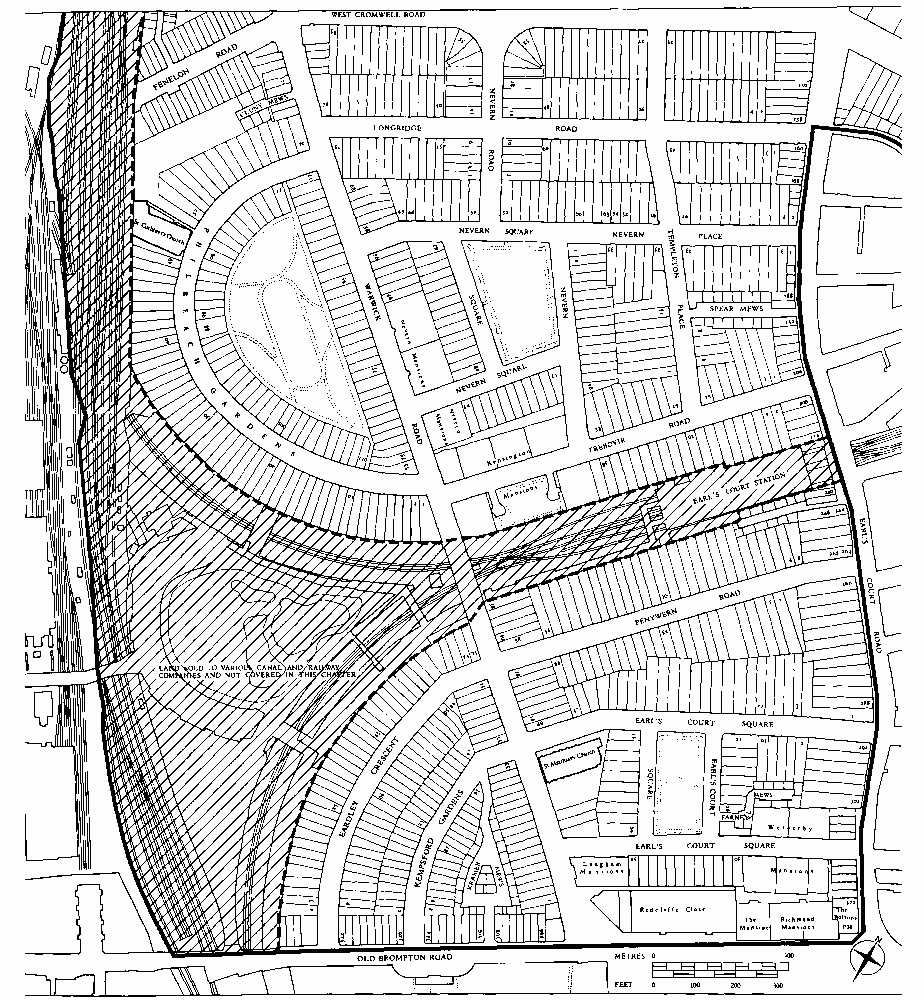
The Edwardes estate, southern part. Based on the Ordnance Survey of 1894–6 with later additions
Building work began on the frontage to Earl's Court Road, where in 1873 Hunt himself erected two short terraces, Nos. 150–158 (even) to the north of Longridge Road and Nos. 160–168 (even) to the south. (fn. 3) The former consists of five substantial houses which have four storeys including a semi-basement and are faced with stock bricks and standard Italianate stucco dressings, but the latter group, which have shops on the ground floor and two main storeys and garrets above, are much plainer in ornamentation.
In Longridge Road itself building began towards the end of 1873 at the eastern end, but here Hunt initially left the actual construction work to others. Nos. 2–24 (even) on the north side, up to Templeton Place, were built by George Edward Mineard, who by then had a local address in Earl's Court Road, and in 1873–4 he was granted leases of all of these houses with the exception of No. 24, which was leased to the first occupant by his direction. (fn. 4) Nos. 3–25 (odd) on the south side, also as far as Templeton Place, were built by, and leased to, William Hopping of Kilburn in 1873–5. (fn. 5) No. I was slotted in at the eastern end of the terrace in 1874–5. It was leased to, and occupied by, Charles Hunt himself, but the district surveyor in his monthly returns entered the builder's name as W. Hunt of Longridge Road. (fn. 6) These two facing terraces between Earl's Court Road and Templeton Place are alike in appearance. Both have three main storeys and attics above semi-basements (except at Nos. 23 and 25 which have four full storeys above basements), paired Doric porches and bay windows up to the first floor, but there are minor variations in the treatment of the stucco dressings, and on the north side Mineard appears to have used gaults for his facing bricks while on the south side stocks were used.
The two terraces between Templeton Place and Nevern Road, Nos. 26–48 (even) on the north side and 27–49 (odd) on the south, were built in 1874–7. Charles Hunt was the lessee of all of these houses, (fn. 7) but, according to the district surveyor, Hopping was the builder of No. 27 and W. Hunt was responsible for five or six houses in each terrace, while Charles Hunt built the remainder. (fn. 8) These terraces are very similar to the ones east of Templeton Place, but have four main storeys above semi-basements.
In 1876–7 Hunt erected Nos. 1–17 (odd) and 2–18 (even) Nevern Road in the short stretch of that road (named also after a place in Pembrokeshire) for which he was responsible. These are larger and more imposing houses than those in Longridge Road and have four full storeys above semi-basements, individual Doric porticoes, and well-executed stucco dressings including pilastered window architraves and balustrades, both at roof level and above the porticoes. A particular distinguishing feature is the robust ornamental ironwork of the sides of the porticoes and the area railings. W. Hunt was the nominal builder of four of these houses and Charles Hunt of the rest, but all the leases were granted to Charles. (fn. 9)
To the west of Nevern Road, Hunt completed the development of Longridge Road with a different type of house from those he had erected previously. Nos. 50–76 (even) and 51–75 (odd) Longridge Road, which were built in 1877–81 with Hunt as both the declared builder and the lessee, (fn. 10) have the same paired Doric porticoes and bay windows as the earlier houses and are of full four-storey height, but instead of having brick façades they are faced with cement which was carefully scored to resemble stone jointing (Plate 121b). Consequently they have much plainer window openings but are given prominent stringcourses. Further variety is provided by delicate and attractive ironwork above the porticoes and bay windows.
In 1888 the architect William Hunt of York Buildings, Adelphi, applied unsuccessfully to add a bay window to the side of No. 76, overlooking Warwick Road. (fn. 11) Whether he was related to Charles Hunt or to the W. Hunt who apparently assisted in the building of these houses is unknown.
The census of 1881, which was taken when the westernmost houses were still under construction, shows that Longridge Road was very respectably tenanted. The occupants were the mixture of middle and upper middle class residents common to many parts of South Kensington. They included a number of professional men — music teachers, private tutors, lecturers, clergymen, solicitors and barristers (no less than six of the last category) — civil servants, of the Home or formerly of the Indian Civil Service, merchants, clerks, company secretaries or agents, the business manager of the Haymarket Theatre, several army officers, and at least ten widows who lived on incomes from property, the Funds or annuities. Most households had three servants and some four: none was servantless. Perhaps as a sign of changes to come, however, two houses were already sub-divided, while two more were boardinghouses, and other families also took in boarders. In Nevern Road one house was sub-divided and at another a Professor of Mathematics and his wife took in six boarders but had three servants to look after them. On the other hand three households in this street had five servants each, including a woolbroker from Huddersfield at No. 11 who not only had four domestic servants, but also housed a coachman, his wife and their three children, an unusual solution to the problem posed by the omission of mews accommodation from the development. (fn. 12)
Among the inhabitants of Longridge Road at the time of the census was the actress Ellen Terry at No. 33. She lived there from 1878, shortly after her marriage to Charles Wardell, until 1889, when she moved to Barkston Gardens, and it was to Longridge Road that Henry Irving came in 1878 to invite her to join his company at the Lyceum Theatre and thus established a famous twentyyear partnership. (fn. 13) The Reverend Dugald MacColl, Minister of the Kensington Presbyterian Church (later St. John's Presbyterian Church), and his son, D. S. MacColl, who was to become a noted art critic and Keeper of the Tate Gallery, lived at No. 36. (fn. 14) The architect Mervyn E. Macartney, then aged twenty-seven, was living with his widowed mother at No. 21, and the builder Charles Hunt lived at No. 1 with his wife, a grand-daughter, and one general servant. He was then aged fifty-four and described himself as a builder employing sixty to one hundred men. Later occupants of Longridge Road included the poet and journalist Charles Mackay and his daughter, the novelist Marie Corelli. They lived at No. 47 from c. 1885, he until his death in December 1889 and she until 1901. (fn. 15)
In his memoirs D. S. MacColl remarked on the contrast in the 1880s between the dullness of the street with its houses 'of sad-coloured brick, with columned porticos and window-surrounds in gritty stucco' and the liveliness of its inhabitants. He recalled especially the impact made by Ellen Terry each morning as she went to rehearsals. 'She appeared upon the steps like April morning, lifting wide eloquent lips, hooded eyes and breathless face to the light. She raised and kissed two little tots who were to be known as Edith and Gordon Craig. She greeted the next-door neighbours, family of a Rabbinical scholar, who had promptly become slaves of her apparition, and stood ready on the pavement. Her cushions were brought out, placed and patted in the open carriage; herself installed; the air became tender and gay with wavings and blown kisses; the wheels revolved, and greyness descended once more on Longridge Road.' He added that 'the climacteric day of the street must have been when Mrs. Gladstone was left in her carriage outside No. 47 "to enjoy the fresh air" for two solid hours and more, while her wonderful spouse and the younger leader of religious thought [Marie Corelli] conferred … Surely a tablet should mark the spot.' (fn. 16)
Nevern Place, Nos. 188–214 (even) Earl's Court Road and Spear Mews
In early 1874 Lord Kensington apparently made an agreement with the builder Thomas Grange to develop the frontage of Earl's Court Road between Hunt's ground in Longridge Road and the Metropolitan District Railway tracks, together with a substantial part of the hinterland of the estate stretching westwards from Earl's Court Road. The exact terms of the agreement are not known, but from the evidence of other documents the depth of ground involved amounted to about 450 feet and included the whole extent of Nevern Place, Templeton Place and much of Trebovir Road, or approximately seven acres in all. The total ground rent eventually received for this area amounted to some £1,350, or about £200 per acre, for leases of ninety-nine years from 1874 or equivalent terms. (fn. 17)
Grange was then living at No. 39 Warwick Road, a newly built house near to the north corner of Kempsford Gardens, and he may have been involved in the development of the south-western corner of the estate, though he was not a direct lessee of any of the houses there. From the start he involved other builders in house-building in the Nevern Place area and quickly disposed of some of his ground to them.
Grange himself was, however, the first to begin building operations in May 1874 on the south side of Nevern Place (formerly called Fopstone Road, another Welsh placename, until it was renamed in 1907), where he eventually built Nos. 1–15 (odd) in 1874–5. (fn. 18) These houses set the stylistic tone for at least the eastern end of the street as far as Templeton Place. They are large houses, with four full storeys above a semi-basement, and are predominantly brick-faced with stucco bays up to the first floor, simple stucco architraves to most of the windows, a linking stringcourse at second-floor level, and a crowning cornice — all perfectly decent Italianate ornamentation. But their most remarkable features are the porticoes which have bizarre barley-sugar columns with capitals which are basically Corinthian but which vary in detail from house to house (fig. 122). The last four houses in the terrace, Nos. 17–23 (odd), were built in 1876 by William Hopping of Kilburn, and Nos. 17 and 19 were leased to him by Grange's direction. (fn. 19) They have essentially the same elevations as Grange's houses, though built as mirrored pairs and differing slightly on plan.
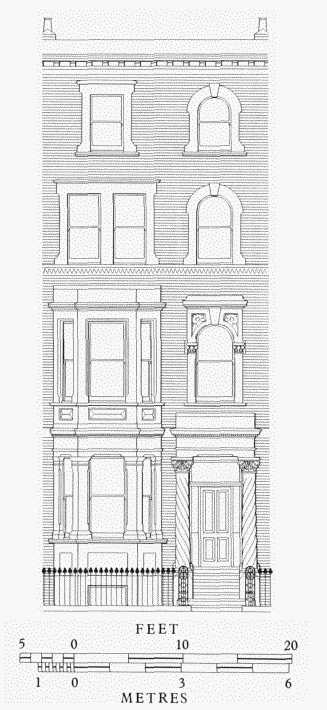
Nos. 1–15 (odd) Nevern Place, typical elevation. Thomas Grange, builder, 1874–5
On the north side of the road building began almost immediately after Grange had begun work on the south side. Here the builders were Arthur Furneaux Taylor and Stephen Abbott Cumming of Lancaster Road, Notting Hill, who erected the complete terrace as far as Templeton Place, namely Nos. 2–24 (even) Nevern Place, in 1874–5. All of these houses were leased to Taylor and Cumming jointly with Grange as a consenting party. (fn. 20) In appearance they are virtually identical to Grange's houses on the opposite side, though with more correct Doric porticoes instead of the idiosyncratic ones on the north-facing range.
To the west of Templeton Place yet another builder was involved at an early stage. He was Robert Whitaker of Appleford Road, North Kensington, who erected both Nos. 26–34 (even) on the north side and the facing range of Nos. 25–35 (odd) in 1874–6. (fn. 21) All of these houses were leased directly to Whitaker by Lord Kensington without mention of Grange, but it is clear from the abuttals recited in the leases that this land had formerly been part of Grange's 'take'. (fn. 22) Whitaker's houses are also four-storeyed above a basement but otherwise differ from the ranges to the east of Templeton Place. They have sturdy Doric porticoes and bay windows on the ground floor only supporting a continuous balustraded balcony. Above, the brickand-stucco façades are orthodox Italianate apart from unusual heads to the wide first-floor windows above the bays. Nos. 33 and 35 have been demolished and replaced by the Kensington Court Hotel (1969–70, Inskip and Wilczynski, architects (fn. 23) ).
Grange also built the group of four-storey houses with ground-floor shops at Nos. 188–214 (even) Earl's Court Road in 1875–6. (fn. 24) Above the shops these have brick façades with Italianate cement dressings which have remained in remarkably good condition for such a busy commercial street frontage, including a crowning cornice which has surprisingly survived intact on several houses. Grange also laid out Spear Mews in 1875–6. (fn. 25)
A surviving series of documents relating to No. 17 Nevern Place provides further details of the building and leasing history of a typical house. No. 17 was leased by Lord Kensington in May 1876 to William Hopping at Thomas Grange's direction for ninety-seven years at a ground rent of £14 per annum, in consideration of Hopping's expense in building the house and of £66 11s. 3d. paid by him to Grange. In June Hopping mortgaged his lease to two solicitors, Underwood and Colman, of Holles Street, St. Marylebone, for £1,088. He later borrowed a further £500 from them, of which he repaid £288, leaving £1,300 still due on the mortgage, which was transferred in January 1877 to a spinster of Brighton. In August of that year Hopping raised a further £600 by a second mortgage to Colman, and in February 1878 he let the house on a fourteen-year lease to two spinster sisters at an annual rent of £135 for the first three years and £150 thereafter. Six weeks later he sold the head lease to another spinster with an address in Cromwell Crescent for £2,150, giving him a surplus of £250 above the money he still owed on mortgage. (fn. 26)
An inventory of fixtures attached to the fourteen-year lease shows that the house had extensive service quarters with a servants' hall in the basement, a dining-room, sitting-room and library on the ground floor, and front and back drawing-rooms on the first floor. All the main rooms had marble chimneypieces and the dining-room had gilt mouldings. There were at least thirteen register stoves, and gas was laid on throughout. (fn. 27)
Nevern Square
In July 1877 Lord Kensington's surveyors, Martin Stutely and Daniel Cubitt Nichols, applied to the Metropolitan Board of Works for permission to vary the simple grid of streets which had been approved in 1872 by the formation of a garden square. The plan which they submitted with the application shows the layout of Nevern Square as it was eventually formed. (fn. 28) It was not, however, until three years later that arrangements were made with the builder Robert Whitaker to carry out their proposals. The building agreement has not survived, but from other evidence Whitaker was given a ninety-nine-year term from March 1880 at a total ground rent of £1,618. (fn. 29) How this was calculated is not known, but the total area of ground occupied by the square and the house plots around it is some six acres. Whitaker was thus paying over £250 per acre, and as so much of the area was taken up with the communal garden each house had to bear a relatively high average ground rent of over £25.
In 1874–6 Whitaker had built the westernmost houses in Nevern Place, the continuation of which would form the northern side of the square. His houses there were basically of the standard grey-brick-and-stucco Classical variety that had predominated on the estate for decades. By 1880, however, the elderly Stutely (who died in 1881) was probably being supplanted as Lord Kensington's adviser by his son-in-law Cubitt Nichols, who clearly favoured the new Domestic Revival style pioneered in the previous decade by architects like J. J. Stevenson, E. R. Robson and Norman Shaw. So it was to this style that Whitaker turned when building Nevern Square despite the sharp stylistic differences between his two adjoining ranges on the north sides of Nevern Place and Nevern Square. Cubitt Nichols himself did not supply the designs for the houses in the square. These were provided, presumably at Whitaker's behest, by Walter Graves, an architect in his early thirties who had recently resumed practice in London after spending some time in New Zealand. (fn. 30)
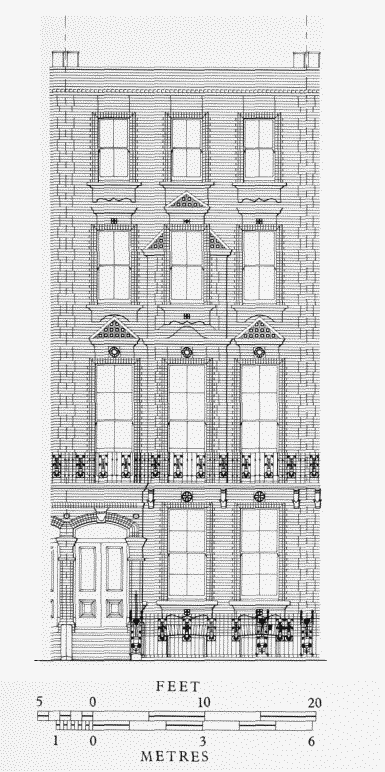
No.5 Nevern Square, elevation. Walter Graves, architect, Robert Whitaker, builder, 1880
Graves's designs have survived in the form of a perspective of the square looking westwards which was later used on a poster advertising the development (Plate 122a). (fn. 31) This depicts houses with basements, four main storeys and attics, and with the ends and centre of each terrace accentuated by pavilion-like roofs and ornate gabled surrounds to the dormer windows. On part of the north side of the square the houses are shown with oriel windows at secondfloor level of a kind which are rarely found on speculatively built London houses. In execution the attics (and the oriels) were omitted and only the end houses of some of the sides were given an extra storey with gabled windows. Otherwise the design was relatively faithfully carried out on the north, east and south sides (Plate 121c, figs. 123–4). It is an attenuated, reticent form of the Domestic Revival executed in yellow and red bricks, in which the ornamental features barely project from the wall surface, though there is the usual variety in the patterning of moulded brickwork. The main, though perhaps not immediately obvious, feature of each house is a wide centrepiece at first- and second-floor level, pierced by window openings and capped by a vestigial pediment at the sides of the second-floor central window, which itself carries a secondary raised pediment. One result of the rather unemphatic treatment of the upper storeys is to throw into prominence the projecting paired porches with arched openings and the continuous balcony at first-floor level with its delicately patterned iron railings.
Whitaker began building on the east side in 1880 and was granted building leases of the first five houses in December of that year. (fn. 32) Shortly afterwards he mortgaged these to the Land Securities Company for £4,000 at six per cent interest. (fn. 33) As further leases were granted for the east, north (begun in 1881) and south (begun in 1883) sides, many of them were mortgaged to the same company for additional sums amounting to at least £15,000. (fn. 34) Six per cent was a high rate of interest to pay, however, and Whitaker also turned to a firm of solicitors, Bircham and Company of Parliament Street. Some of the partners of this firm and their families lent money themselves, and other private individuals, including several members of the aristocracy, who were presumably clients, also provided mortgages. (fn. 35) With the help of these, the loans from the Land Securities Company were repaid relatively promptly. (fn. 36)
In July 1881 a contract was concluded for the sale of No. 1 Nevern Square for £3,500, (fn. 37) but this was a large corner house, and when in about 1882 Whitaker issued the prospectus previously mentioned he advertised houses for sale at £2,200 or to let at £150 per annum. (fn. 31) Several houses were inhabited by 1882 and others seem to have attracted occupants as soon as they were completed. (fn. 38) A number of the early residents of the square were army officers, a point made by Cubitt Nichols when he gave evidence in 1894 before the Select Committee on the London Streets and Buildings Bill. Remarking that the houses were 'perfectly satisfactory' despite a limited amount of open space at the rear, he commented that 'they were occupied principally by a large number of retired army men, and they are not very easy to satisfy as a rule'. (fn. 39) Whitaker's expectations about rental values appear initially to have been fulfilled. The rents ranged from £150 to £180 for houses in the middle of terraces to as high as £250 to £275 for corner houses, usually for twenty-one-year terms.
The square garden was formed at an early stage of building, and in January 1882 tenders were invited for the erec tion of the surrounding iron railings and gateways to Graves's design. The lowest, of £525, by Wells and Company, was accepted. (fn. 40) The occupants of the houses paid an annual rental of two guineas for the maintenance of the garden.
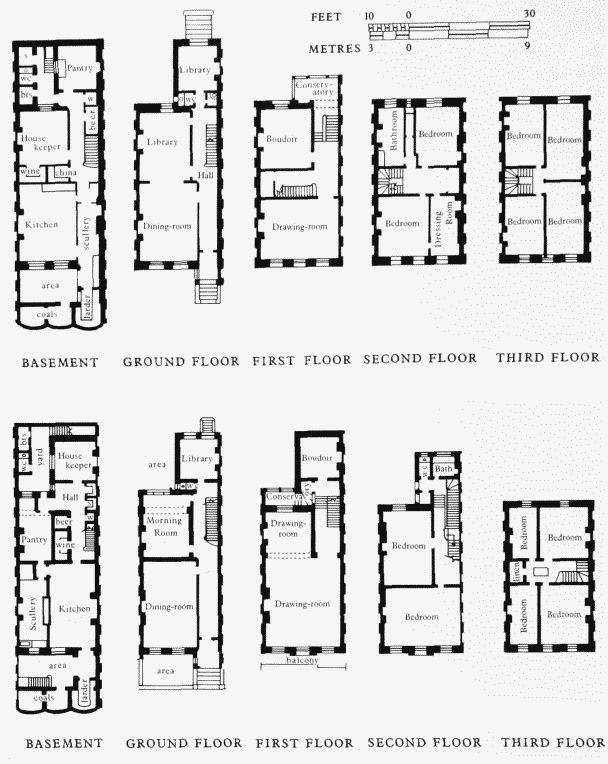
Nevern Square, proposed house plans redrawn from a poster advertising the
development
bts - bottles; s - store; w - wood
On 12 January 1885, shortly after he had commenced building the west side of the square, Whitaker died. (fn. 41) He left no will, and administration of his personal estate, which was valued at £30,309, was granted to his widow, Elizabeth Ann. He had lived at No. 3 Nevern Square since 1881, (fn. 42) and Mrs. Whitaker continued to live there. She took over the direction of his building concerns and invited tenders for the completion of unfinished houses. (fn. 43) On the west side of the square, where work had barely begun, however, she handed over operations to George Whitaker of Hammersmith, presumably a relative, who built the houses there in 1885–6. (fn. 44)
George Whitaker is described in the deeds of the houses on the west side as a surveyor, (fn. 45) but he is listed in directories as an architect and surveyor, and, in 1888–9, as a builder with an address in Nevern Square. (fn. 38) The appearance of the west side of the square as built by him differs significantly both from the other sides and from the perspective by Walter Graves which shows the proposed elevation of this side, and it seems likely that Whitaker 'improved' on Graves's design. He added square openings above the arches of the porches, thus making these appear even bulkier, and larger brackets beneath the balconies, while in the upper storeys thin pilaster strips divide the elevation of each house into regular bays and the windows have small stone or cement keystones. The effect is to produce a more conventional speculator's version of the Domestic Revival style than that adopted on the other sides of the square. Six of George Whitaker's houses were sold in 1887 for £9,875, or an average of £1,646 each. (fn. 46)
Elizabeth Whitaker soon ran into difficulties over the management of the houses on the other sides of the square. From about 1888 rents began to fall drastically, and by 1890 No. 51, which had let at £250 per annum in 1885, would only fetch £135. (fn. 47) Some existing rents were renegotiated downwards, and new lessees were paying as little as £110 per annum by the end of the 1890s. (fn. 48) No. 23, for instance, was let on a twenty-one-year lease in 1886 at £150 per annum, which was to rise to £170 after fourteen years, but in 1890 the occupant secured a reduction to £135, and in 1899 a new twenty-one-year lease was granted at an annual rent of £110. (fn. 49) In 1898 Mrs. Whitaker still owed over £32,000 on mortgages of twenty houses, mostly to members of the Bircham family and their clients. (fn. 35) The payment of the interest on this amount, together with the ground rents due on the houses, meant that there was little left over from the low rack rents paid by their occupants, and in 1898 she had to take out a second mortgage from Bircham and Company to pay their charges 'in connection with the management of the estate' and the cost of repairs to some of the houses. Rents continued at a low level, one house in 1902 letting for only £100 per annum, (fn. 50) and by 1906 Elizabeth Whitaker had defaulted on her payments. Bircham and Company thereupon took possession of the houses. (fn. 51)
The Edwardian period was a time of severe depression in the metropolitan property market, but the 1890s were generally a buoyant period for house prices and rents in London. The phenomenon of falling rents at that time in this part of Kensington appears to have been localized, perhaps brought on by the overbuilding of large houses over the past two decades, but it no doubt helps to explain why the builders and developers of the area generally eschewed houses in favour of blocks of flats in the 1890s.
In 1909 Birchams gave permission for No. 51 to be used as a 'high class Boarding House', but imposed stringent provisions about the conduct of the establishment and a ban on advertising. (fn. 52) By the following year there were three boarding-houses so described in the Post Office Directory, and there may well have been others of a more discreet kind. The sub-division of houses becomes particularly noticeable after the war of 1914–18 and continued apace during the 1920s and 1930s. (fn. 53) A rise in rental values also took place after the war, however, while the prices of between £1,750 and £2,200 which Birchams were able to obtain for houses which they sold are, in view of the shortened leasehold terms, additional evidence of a recovery in values. (fn. 54)
The author Compton Mackenzie and his sister, the actress Fay Compton, lived at No. 1 in the early part of the present century. Their father, Edward Compton, bought the house in 1901 for £2,000, £1,500 less than the price paid for it twenty years earlier (see above), having himself made a loss in selling the family's previous home in Avonmore Road, Fulham. When he died in 1918 his widow sold the house for £2,500. (fn. 55)
The northern part of Nevern Square was badly damaged by bombing during the war of 1939–45. Nos. 1, 51 and 52–55 have been rebuilt, while Nos. 56 and 57 have been so substantially reconstructed as to have been in effect rebuilt. Proposals to rebuild Nos. 1 and 51 were first made early in 1948, but the officers of the L.C.C. who had special responsibilities for historic buildings thought that the drawings submitted showed a lack of harmony with the existing buildings in the square. As a result a local firm of architects, Llewellyn Smith and Waters, was brought in to revise the scheme and these two corner buildings were erected to their designs in 1948–50. (fn. 56) They have perfectly plain but decent elevations in brickwork (yellow stocks with red-brick dressings) which matches that of the remainder of the square without in any way attempting to reproduce the original ornamental features.
Much the same happened in the case of Rupert House at Nos. 52–57, though the building history here is more complicated. A proposal to rebuild on this site was first made in 1947 by Gollins, Melvin and Partners, but was rejected, principally on the grounds of excessive density, but also because the architectural treatment did not harmonize with the rest of the square. Accordingly, after discussion with L.C.C. officers, the architects completely revised their plans and elevations, and these were approved in 1948. Building initially only took place at Nos. 56 and 57, where a licence to repair had been granted, however, and consisted of a wholesale reconstruction with new facades of these war-damaged buildings in 1949. The remainder of Rupert House was not erected until 1958–9, but the builders, Styles (Contractors) Limited, and the developers, who were their associate company, Rawlings Brothers Limited, adhered faithfully to the design already carried out at Nos. 56–57. (fn. 57) The result is an unassertive, well-mannered building in yellow and red brickwork which is in keeping with the general character of the square.
Trebovir Road and Templeton Place
Most of the houses in Trebovir Road and all of those in Templeton Place were built on ground which the builder Thomas Grange had contracted to develop by his agreement of 1874 with Lord Kensington mentioned on page 303. In the event the houses were erected, in 1876–9, not by Grange but by other builders, presumably in arrangement with him. They were the Van Camps, a Belgian-born family of builders who had become naturalized British subjects and had settled in Kilburn. (fn. 58) The principal member of the family operating in southern Kensington was Jean Francois Van Camp, to whom nearly all of the building leases were granted, but notices of the commencement of building to the district surveyor were frequently issued in the names of J. F. and E. Van Camp, the latter being probably Edouard Van Camp (fn. 58). They were currently building houses in Hogarth Road and Knaresborough Place (see page 220) and it was thus a simple matter for them to extend building operations to the other side of Earl's Court Road. Their houses on the Edwardes estate are very similar to those in Hogarth Road, the main differences being the adoption of hipped roofs with a balustrade in front, the use of more ornate ironwork for the balconies and the sides of the porticoes, and, most surprisingly, the use of casement windows in the upper storeys rather than the double-hung sashes normally found at second-and third-floor level. What is common to both groups of houses is florid stucco ornament of a kind found in French eighteenth-century architecture, bringing a Continental flavour to their façade-design which is enhanced in Trebovir Road and Templeton Place by the French-style casements in the upper floors and the patterns of the ironwork (Plate 126a, fig. 125).
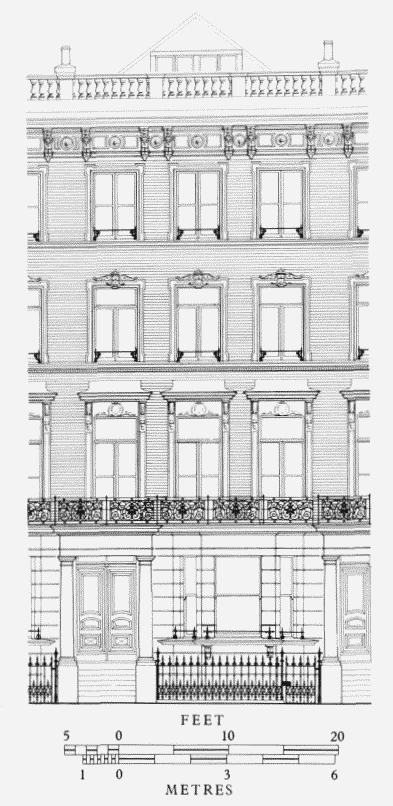
Trebovir Road, typical elevation. J.F. Van Camp, builder, 1876–9
The Van Camps began building here in the autumn of 1876, and leases of the first houses to be completed in carcase, Nos. 1–15 (odd) Trebovir Road, were granted to Jean François in December of that year. (fn. 59) These were quickly followed by leases to him of Nos. 2–18 (even) in February 1877. (fn. 60) Most of these leases were mortgaged to private creditors through the auspices of two solicitors, William M. Sherring of Lincoln's Inn Fields and Thomas Lyon of Newman and Lyon of Clement's Inn. (fn. 61) Both solicitors were themselves mortgagees, (fn. 62) and Lyon, who came from Yeovil, persuaded a number of people in the West Country to invest in the Van Camps' speculations. (fn. 63) At Nos. 10–18 (even) a third firm of solicitors, R. and A. Russell of Coleman Street, were involved, and these houses were mortgaged to the National Permanent Mutual Benefit Building Society, commonly known as the National Freehold Land Society. (fn. 64)
Nos. 17–27 (odd) Trebovir Road were begun early in 1877 and leased to J. F. Van Camp in May of that year. (fn. 65) Five of these six houses were mortgaged to Thomas Lyon and the other jointly to Lyon and a man from Leicester. (fn. 66) All eleven houses in Templeton Place (formerly called Haroldstone Road before being renamed in 1886, both names having Pembrokeshire associations) were begun in 1877 and also leased to Van Camp in the same year. (fn. 67) These leases were mortgaged to a number of private individuals, including four to a banker from Langport in Somerset and one to a resident of 'Shanghai in the Empire of China'. (fn. 68)
Most of the remaining houses in Trebovir Road were begun in 1877, but the building of Nos. 20–24 (even) did not apparently start until February 1879. (fn. 69) After 1877, though the Van Camps were apparently the builders of all of the houses, Lord Kensington granted the building leases to third parties, especially to Rush Marten Cripps, esquire, of Westmeston in Sussex, who was the lessee of Nos. 20–24 and 28–38 (even) and who may well have had a considerable financial stake in the whole enterprise. (fn. 70)
The evidence of the census of 1881 is that the houses in Trebovir Road did not always immediately attract the kind of occupants for whom they were no doubt intended. Twelve were then unoccupied or unfinished, and two more were in the hands of caretakers. Most of the inhabitants of the remainder were of the solid Victorian middle class, including three barristers with fourteen servants between them, but there were also widows who took in boarders and one lodging-house-keeper with eight paying guests. (fn. 71)
In Templeton Place, of the eight occupied houses, one was in use as a private school, and the remainder were well inhabited, including two by merchants who had five servants each. (fn. 72) Three of the householders were authors, including the poet and journalist (Sir) Edwin Arnold, who lived at No. 2 from c. 1880 to 1884. (fn. 15)
In 1887 two houses on the south side of Trebovir Road sold for £1,150 and £1,275 respectively, prices which seem decidedly on the low side for houses of such size and ostentation. (fn. 73)
Most of the Van Camps' houses have undergone extensive internal alteration, many of them having been adapted for use as hotels, while attic storeys have been added at several houses and alterations made to the windows of others. The best surviving groups are Nos. 25–31 (odd) Trebovir Road and 2–8 (even) Templeton Place (Plate 126a), which for the most part retain the original features of their elevations including impressive double entrance doors (fig. 125). No. 13 Trebovir Road, which has now been converted into several flats, had a particularly lavishly decorated drawing-room with an ornately plastered and stencilled ceiling, a deep figurative frieze and lacquered woodwork. In 1971 a number of photographs were taken of this scheme, which was probably done for an early occupant. (fn. 74)
Nos. 10–14 (even) Trebovir Road were demolished following damage by bombing in the war of 1939–45 and were replaced in 1952–3 by Orpen House, a plain, low, four-storey block of flats which was erected by R. Mansell Limited for the Royal Borough of Kensington. The building was named after Sir William Orpen, the painter who lived in South Bolton Gardens, but it shows scant regard for aesthetics in its uncomfortable relationship to its tall Victorian neighbours. (fn. 75)
Kensington Mansions at the west end of Trebovir Road consists of six blocks of flats, four adjoining on the north side of the road, and two on the south side separated by a wide communal garden. They are of identical design, six red-brick storeys high, with long iron-railed balconies and gabled bays, and were built in 1888–90 by William Cooke of Upper Phillimore Place. Cooke, who was at this time in partnership with another builder by the name of Battson, (fn. 76) had just previously built two very similar blocks of flats, called York Mansions, at the south corner of Earl's Court Road and Barkston Gardens. The same design (or a very close variant of it) was, however, also used for other blocks of flats in the same streets, where Cooke was not the builder (see page 210), and later for Nevern Mansions to the north of Kensington Mansions (Plate 122b), where again he was not involved. The architect Charles Henry Thomas of Pall Mall was a party to the leases of the blocks on the north side of Trebovir Road, which were granted by Lord Kensington to Cooke in 1888–9. (fn. 77) He had been on the staff of the speculative builder Sir Charles James Freake for many years before establishing an independent architectural practice. (fn. 78) While there are some similarities between the design of these blocks of flats and that of a group of houses in Cranley Gardens known to be by Thomas, (fn. 79) the stylistic vocabulary employed is so common that there is no certainty that they were by the same hand. Thomas may merely have had an interest in the ground on the north side of Trebovir Road in a speculative capacity; he was not a party to the leases to Cooke of the flats on the south side of the road, (fn. 80) nor does his name appear in connection with any of the other blocks which have a seemingly common authorship.
Between the Van Camps' houses and the eastern block of flats on the south side of Trebovir Road Cooke built an attractive single-storeyed lodge in a Jacobean style with a stepped gable. (fn. 81)
About 1905 a small extension of Kensington Mansions in the same style was built on the west side of Warwick Road, immediately south of No. 1 Philbeach Gardens. (fn. 38)
Penywern Road Area
The area described in this section includes, besides Penywern Road, Nos. 240–278 (even) Earl's Court Road, Old Manor Yard, Nos. 16–38 (even) Warwick Road and No. 49 Earl's Court Square, which, despite its numbering, is part of a terrace of houses in Warwick Road.
The formation of an east-west road between Earl's Court Road and Warwick Road in continuation of Eardley Crescent to the west of Warwick Road was projected in 1868, and when building began in the new road in 1873 it was simply regarded as an extension of Eardley Crescent. The Welsh name Penywern was adopted shortly afterwards at Lord Kensington's request. (fn. 82)
Once the position of the new road had been determined, building took place initially on the frontage to Earl's Court Road immediately to its south, when the range of houses now numbered 266–278 (even) Earl's Court Road was erected in 1872–3 by William John Taylor of Chelsea. (fn. 83) These houses are very similar to ones which had been begun slightly earlier by the builder Edward Francis a short distance to the south in Earl's Court Road (see below) and are principally in the form of linked pairs with three storeys over a basement and an additional attic storey in the roof lit by a single dormer window on the street elevation. They have Doric porticoes and bay windows on the ground floor (except at Nos. 266 and 268 where the ground floor has been converted into a shop) and are faced in stock brick with stucco dressings. Taylor's houses, though, have a simpler arrangement of window openings and plainer architraves than Francis's.
Taylor did not build any more houses on the estate, and by the time the corresponding group of houses to the north of Penywern Road was begun in August 1873 Lord Kensington had agreed terms with another builder, Henry Harris, for the development not only of this short stretch of frontage to Earl's Court Road but also the whole length of Penywern Road and the frontage of Warwick Road at its western end. Harris at this time had an address in Pimlico, but he soon moved into the area, firstly to No. 39 Warwick Road and then to No. 44 (now 22) Warwick Road, a house built by himself. At both addresses he succeeded Thomas Grange, another builder who was involved in the development of the estate (see page 303). Harris or his nominees were granted leases of all the houses in the area (with the exception of those already leased to Taylor) for terms equivalent to ninety-nine years from June 1873 at ground rents totalling slightly under £1,000. (fn. 84)
When he began building in Earl's Court Road in 1873 Harris sought the co-operation of another builder, Matthew Scott of Earl's Court Gardens, and the four houses now numbered 250–264 (even) Earl's Court Road (double numbering having been adopted in 1907 after the ground floors had been converted into shops) were erected jointly by them, two being leased to Harris and two to Scott. (fn. 85) The two centre houses (Nos. 254–256 and 258–260) were joined together in 1913 to provide offices, showrooms and a restaurant for the Brompton and Knightsbridge Electric Supply Company. The façades were refaced with white terracotta and a new central entrance was formed on the ground floor with windows to each side. The restaurant, which was intended to publicize the advantages of cooking by electricity, was fitted out in a characteristically Edwardian manner with oak panelling and a coved plaster ceiling having naturalistic carving in low relief above a frieze of Classical figures (Plate 126b). The architect for the whole scheme was Frederick Herbert Mansford. (fn. 86) At the same time two American bronze 'white way' lampstandards in the form of an Ionic column carrying a cluster of globes were placed outside the premises. They have recently been restored by the Royal Borough of Kensington and Chelsea. (fn. 87)
Further north in Earl's Court Road, another house (Nos. 246–248) and two flat-fronted four-storey buildings with shops on the ground floor (Nos. 240 and 242) were erected by Harris in 1879 on the site of the farmhouse of Earl's Court Farm, the last remnants of which were not removed until October 1878. (fn. 88) The southernmost bay of No. 242 is built over the entrance way to Old Manor Yard, (fn. n1) a private gated mews which had been laid out by Harris with stables and workshops in 1874–8 and leased to him in 1879. (fn. 90) The mews buildings were 'extensively rebuilt' when they were converted into houses in 1960–1 to the designs of W. Paton Orr and Partners. (fn. 91)
When building began in Penywern Road late in 1873 Harris, initially assisted once again by Scott, used essentially the same house-type he had employed in Earl's Court Road, that is houses of three main storeys above a basement with Doric porticoes and bay windows up to the first floor. Their facades are of stock brick with plain stucco window-surrounds and have a cornice and balustrade at roof level. An attic storey within the roof has roundheaded dormer windows set flush with the balustrade. The only slightly unusual features of these very ordinary Italianate houses is that the porches are enclosed and that stone or cement balustrading is used to protect the areas rather than iron railings.
In 1873–5 nine houses of this type, Nos. 2–18 (even), were built on the north side of the road, and four, Nos. 1–7 (odd), on the south side. (fn. 92) All were leased to Harris with the exception of Nos. 4 and 6, which were leased to Scott by Harris's direction. (fn. 93) At that point, in about September 1875, Harris changed from this type of house to one with a full fourth storey crowned by a secondary cornice and balustrade instead of attics, the rest of the elevation remaining unaltered. The succeeding houses in Penywern Road are of this type and were built over some four years. (fn. 94) All were leased to Harris with the exception of No. 36, where a clergyman was the lessee. (fn. 95) The houses at the western end of the road are significantly smaller on plan than those nearer Earl's Court Road, the transitional point on the north side being marked by a change of level between Nos. 36 and 38.
At the time of the census of 1881 fifteen houses in the street were still unoccupied and there was a mixed pattern of occupancy in the remainder with two already being used as boarding-houses. Nevertheless, besides the annuitants, lawyers, clerks, and military men who formed the core of the population of Earl's Court, several merchants, a stockbroker, a shipowner and a railway contractor lived in the street. (fn. 96) Sir Norman Lockyer, the director of the Solar Physics Observatory at South Kensington, (fn. 97) had purchased No. 16 in 1876 for the remarkably high price of £2,700, (fn. 98) and continued to live there until his death in 1920. The archaeologist and anthropologist, Augustus Henry Lane Fox Pitt-Rivers, lived in the street for a much shorter time, between c. 1879 and 1881, (fn. 38) but he occupied both Nos. 19 and 21 and had eleven servants.
Lockyer's was one of the larger houses in the street, but even taking that into account there appears to have been a very substantial fall in house values in Penywern Road over the next three decades. In 1892 No. 40, a smaller house, which had been mortgaged for £1,500 in 1879, was sold for £1,300, and in 1919 the same house changed hands for only £450 (with fifty-three years of its lease still to run). Likewise No. 38, which had also been mortgaged for £1,500 in 1880, was sold in 1907 for £550. (fn. 99)
In Warwick Road the two ranges on either side of the entrance to Penywern Road, consisting of No. 49 Earl's Court Square and Nos. 16–28 (even) Warwick Road to the south and No. 58 Penywern Road and Nos. 30–38 (even) Warwick Road to the north, were built by Harris in 1875–6. (fn. 100) They are basically similar to the terraces in Penywern Road but have only three storeys above a basement.
Earl's Court Square Area
The land in the angle of Earl's Court Road and Richmond Road (as the part of Old Brompton Road to the west of Earl's Court Road was called until 1939) was the only part of the southern half of the estate where any speculative house-building took place before the advent of the railways. No trace now remains of these early developments, however.
The very modest beginnings of speculative development here occurred in the 1830s when John Turner, builder, erected a terrace of ten houses on the north side of Richmond Road immediately to the west of the junction with Earl's Court Road. These houses, which were completed in carcase by 1833, (fn. 101) were named Rich Terrace, no doubt after the Rich family, Earls of Warwick and Holland, which had once owned the estate, but the fact that they fronted on to Richmond Road probably helped to suggest the choice of name. Behind the terrace was a detached house called Rich Lodge. This was apparently in origin merely a small cottage which had been enlarged in 1854. (fn. 102) It had extensive grounds with an entrance from Earl's Court Road. (fn. 103)
A short distance to the west of Rich Terrace a further eighteen houses were built in 1850–3 by the builder Stephen Bird in partnership with his son Henry. (fn. 104) This range was initially called Richmond Terrace, then Rich Terrace West until 1866, when both terraces were renumbered as Nos. 2–56 (even) Rich Terrace. Nothing is known of the appearance of the earlier group of houses, but Bird's were simple stuccoed three-storeyed houses. (fn. 105) Bird also built three small houses behind the main terrace. These were called Portland Cottages and faced on to a narrow track (which was at one time called Earl's Court Lane like many another lane hereabouts) that crossed the market gardens towards Earl's Court village.
Godfrey Sykes, the decorative artist, lived at No. 2 Rich Terrace (old numbering) from 1860 (probably shortly after his arrival in London from Sheffield) until his death there in February 1866. (fn. 106) He was employed by the Department of Science and Art from 1859 to 1866 and had a major influence on the design of the many buildings in South Kensington for which the Department was responsible. (fn. 107) Another artist, Samuel John Carter, lived at No. 10 (new numbering) from 1869 until 1891. His son, Howard, who was born in 1874, was the famous archaeologist who discovered the tomb of Tutankhamun. (fn. 15)
The third and most comprehensive stage of building development began in the early 1870s on the frontage of Earl's Court Road to the north of the garden of Rich Lodge. Here in 1872–3 the builder Edward Francis erected two groups of six houses separated by a roadway which was intended to form a continuation of Kempsford Gardens to the west of Warwick Road. (fn. 108) Francis had an address in Fulham when he began building here, although he had already erected a group of houses in Warwick Road (see page 317), and he quickly moved into the area. He lived firstly in Rich Terrace and from late 1875 at No. 37 Warwick Road, which he had himself built some four years previously. (No. 39, next door, was occupied firstly by Thomas Grange and then by Henry Harris, two builders who were operating contemporaneously with Francis in the Earl's Court area.)
Francis's houses in Earl's Court Road, now Nos. 280–288 (even) with No. 1 Earl's Court Square and Nos. 292– 302 (even), are in the form of semi-detached or linked pairs and have three storeys, plus basements and attics (Plate 126c). They all have Doric porticoes and bay windows on the ground floor with stock-brick facades above (except for No. 280 which is rendered), but there are differences in the treatment of the upper-storey window-architraves between the southern and northern group of houses. In September 1873 the architect Frederick Nesbitt Kemp applied to the Metropolitan Board of Works for permission to vary the frontage line of the northernmost house, perhaps to link up better with Nos. 266–278 (even) Earl's Court Road, which were then being built immediately to the north. (fn. 109) Kemp, who submitted a ground plan of the house in question and of the next one to the south, wrote from the Redcliffe Estate Office at No. 2A Redcliffe Gardens on the Gunter estate, where he was acting in a professional capacity for the builders Corbett and McClymont, but probably only as site architect. (fn. 110) He later also acted for Francis in negotiations about the layout of Earl's Court Square (see below) and may have been more involved here in the actual design of houses for Francis than on Corbett and McClymont's 'estate', where the dominant architectural influence was that of George and Henry Godwin. (fn. 110) An obituary of Kemp, written some sixty years later, did not mention these houses or any in Earl's Court Square, and said merely that he was responsible for 'the layout of large areas of Kensington', (fn. 111) but the treatment of the upper storeys of Nos. 280–288 Earl's Court Road and No. 1 Earl's Court Square suggests that here his role may have been more than simply providing the layout. In particular the architraves of the triple windows of the second floor are exactly identical to those on several houses in Redcliffe Gardens to the south of Old Brompton Road which had been built a short while previously. Francis's houses in Warwick Road were adjacent to an identical group which had been completed by Corbett and McClymont (see page 317), and when he later built some houses and shops in Earl's Court Gardens on the Gunter estate (see page 224) he mortgaged two of them to George Godwin. (fn. 112) Other connections with people who were active on Corbett and McClymont's Redcliffe Estate will be described later.
Francis's houses in Earl's Court Road were quickly occupied. The first resident of No. 1 Earl's Court Square (which was originally named Earl's Court Lodge), an imposing double-fronted house (Plate 126c), was the ordnance inventor Sir William Palliser, (fn. 14) who was to play a major role in the development of Earl's Court Square and who may already have been providing Francis with financial backing. The builder Thomas Guy Welchman, of Welchman and Gale, was the first occupant of No. 288. (fn. 38)
When, in December 1873, Francis extended building activity behind the frontage to Earl's Court Road along the road then still called Kempsford Gardens, there was no plan to lay out a square. Instead Francis proposed to build a new north-south street (which was to be called Farnell Road) about 250 feet to the west of Earl's Court Road and to erect a terrace of houses on each side of the short stretch of Kempsford Gardens between the two roads. These two ranges, now Nos. 3–11 (odd) and 2–10 (even) Earl's Court Square, were built in 1873–4, together with stabling in Farnell Mews, which was intended to lead out of Farnell Road. (fn. 113)
The terrace on the north side, Nos. 3–11 (odd), is of a stylistic type not found elsewhere on the Edwardes estate, in which the formula of Classicism is combined with the naturalistic ornament, straight lines and sharp angles of Ruskinian Gothic (Plate 124a). The nearest equivalent, at least in this part of Kensington, is some of the more muscular architecture of George and Henry Godwin on the Gunter estate, to which a link was provided by F. Nesbitt Kemp. Nos. 2–10 (even), on the south side, however, while similar to their counterparts on the north side in the upper storeys, besport a full-dress Italianate style (quite unlike the architecture of the Gunter estate) for the lower parts of the facades with Composite capitals to the porticoes and an elaborate composition at first-floor level with half-columns and pilasters carrying a vestigial balcony at second-floor level (Plate 124c). It was this more conventional, though highly elaborated, Italianate manner that Francis was to adopt, with variations, for the remaining houses he was subsequently to build in Earl's Court Square.
The decision to abandon the proposed north-south road and form a square further to the west was taken by December 1874, when Kemp, on behalf of Francis, submitted a plan for the square to the Metropolitan Board of Works. This was approved, despite the fact, as the surveyor to the Kensington Vestry pointed out, that a sewer had already been built along the course of the projected road and would, therefore, run under the back gardens of the houses on the east side of the square. (fn. 114)
Once permission had been given for the formation of the square, Francis began building in April 1875 on the north side in continuation of his already existing range at Nos. 3–11 (odd). (fn. 115) The houses he now erected, however, were of an entirely different type and scale from the earlier ones, the visual break between Nos. 11 and 13 being particularly noticeable (Plate 124a). Initially both here and on the east side of the square, which was also begun in 1875, (fn. 116) he built a similar kind of house to Nos. 2–10 (even), faced in stock brick with stucco dressings, but added a full fourth storey instead of attics and a balcony beneath the central window on the second floor, and used stone or cement balustrading instead of iron railings on the first-floor balcony (Plate 124d).
In 1876, when he began to build on the west side of the square, he used basically the same house-type but with fully stuccoed facades, and followed this practice on the north side with Nos. 25–47 (odd). The first four houses of this group, Nos. 25–31, have an additional storey which, if original, may have been intended to provide a visual centrepiece (though slightly off-centre) to the north side of the square (Plate 124a,124b).
Building proceeded slowly but by the end of 1878 Francis appears to have made at least a start on all the house plots on the north and west sides of the square and on the east side as far south as Farnell Mews. (fn. 117) Up to this date Lord Kensington granted all of the building leases directly to Francis with the exception of those of Nos. 13 and 25–31 (odd) which were granted to Sir William Palliser and of No. 69 which was granted, by Francis's direction, to Lee and Chapman, timber merchants, of King William Street in the City. (fn. 118)
The houses Francis was building were large and expensive, even by the standards of the day, and he financed his operations in a variety of ways. He obtained first mortgages through the auspices of several solicitors including Thomas Lyon of Newman and Lyon, who was much involved in the financing of building speculation hereabouts and who himself lent substantial sums to Francis on the security of the leases of three houses on the north side of the square, Benjamin Hardwick of Hardwick and Jones, who was the first occupant of No. 296 Earl's Court Road, and John Leonard Tomlin, the Gunters' solicitor, who was the freeholder of ground in Earl's Court Gardens on which Francis was also building. Francis soon mortgaged some of his leases for a second time, an accountant of Clapham, for instance, providing further loans on the security of the houses already mortgaged to Lyon. He also sold improved ground rents, Lee and Chapman, the timber merchants who were lessees of No. 69, purchasing several of these. Finally, in December 1878, he mortgaged several houses, most if not all of them already subject to other incumbrances, to the Midland Land and Investment Corporation Limited 'for large sums of money'. (fn. 119)
By March 1879 Francis had exhausted his credit and petitioned the Court of Bankruptcty for liquidation of his affairs by arrangement with his creditors. At a subsequent meeting, his creditors agreed by a majority decision to accede to this request and not to press for a formal declaration of bankruptcy. Henry Smith, a builder who lived in Tregunter Road and had formerly done jobbing work for Corbett and McClymont, was appointed trustee in liquidation. (In subsequent deeds apportioning some of Francis's leasehold interests between Lee and Chapman and the Midland Land and Investment Corporation, who were among his principal creditors, the signatures of Francis and Smith were witnessed by T. E. Lewin, a member of the family firm of solicitors employed by Corbett and McClymont.) Leases of three house plots which had not yet been accounted for, those of Nos. 39 and 24–26, were granted in 1881 by Lord Kensington to the Midland Land and Investment Corporation. (fn. 120)
The late 1870s were particularly difficult years for builders in South Kensington (Corbett and McClymont, by far the largest operators in the area, having themselves gone bankrupt in 1878 (fn. 121) ) and Francis appears to have completely misjudged his market in building such large and ambitious houses. The evidence suggests that their rate of occupancy was even slower than their rate of building. At the time of the census of 1881 twenty-six out of a total of forty-eight houses were unoccupied or unfinished, and three others had only temporary caretakers in charge. (Those inhabitants who had taken up residence in the square, however, included army officers, members of the professions, higher civil servants, merchants, rentiers and the like, and on average there were over four servants to each household.) (fn. 122) As late as 1885 twenty-two houses were apparently still unoccupied, and a few remained so into the 1890s. (fn. 38)
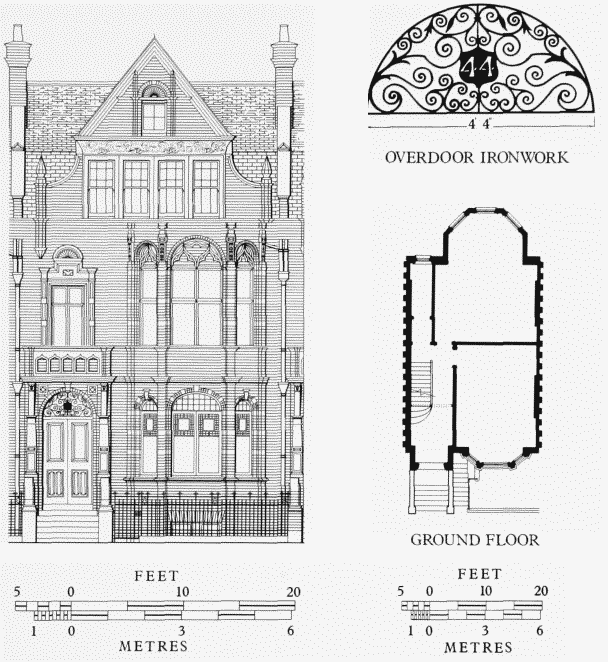
No. 44.Earl's Court Square, plan, elevation and detail of ironwork. John Douglas, builder, 1888–90
By this time building was also taking place on the south side of the square, which had remained untouched while the other sides were being developed. Francis must have disposed of his interest in the land here to Sir William Palliser, who as early as 1877 had submitted proposals for the layout of the south side. (fn. 123) Palliser had lived firstly at No. 1 in the square from 1874, but in 1877 the Post Office Directory gave his address, perhaps wrongly, as No. 23, and in November of the same year he signed a plan from No. 19. By 1878, however, he was definitely in residence at No. 21 and he continued to live there until his death on 4 February 1882, when he left a personal estate worth £89,689. (fn. 124)
It was not, however, until six years after Palliser's death that any building began on the south side. By then the land was in the hands of John Halley of Peckham, who described himself as an architect but who was probably basically a speculator. In February 1888 The Builder published the tenders which had been received for the erection of three 'mansions', that is blocks of flats, in Earl's Court Square for Halley. (fn. 125) The architect of the blocks was stated to be John Maclaren of No. 21 King William Street but this must have been a mistake for James MacLaren who practised from that address. He was an architect of considerable promise who died young in 1890.
By May 1888 there had been a change of plan, and the builder W. J. Parker of Battersea Park Road (who did not tender for the flats) gave notice to the district surveyor that he was about to build three houses, Nos. 34–38 (even) Earl's Court Square, for Halley. (fn. 126) In July, however, there was a change of builder and fresh notices were issued for the erection of twelve houses including the three perhaps begun by Parker. (fn. 127) The new builder was John Douglas, who was also entered in the district surveyor's returns as the owner of the houses about to be built. He was the son of the noted South Kensington builder, William Douglas, who had been declared bankrupt in this same year, and these houses appear to have been John Douglas's first independent speculative venture. (fn. 128) The most likely explanation is that he had bought up Halley's interest in the site when building works were at an early stage.
The houses which are the subject of this complex building history are Nos. 30–52 (even) Earl's Court Square, an attractive red-brick, gabled range. All of the houses were leased to Douglas in 1888–90, with Halley as a consenting party, (fn. 129) the first leases to be granted being of Nos. 34–38, which are set apart slightly from the remaining houses in having square bays on the ground floor instead of canted bays on the ground and first floors. Basically, however, the houses fall into two groups, Nos. 30–38, which have three storeys above a basement, the topmost storey being within a mansard roof, and Nos. 40–52, which have an additional attic storey within the gable. The overall effect is of a small-scale version of George and Peto's houses in Harrington and Collingham Gardens with echoes of Norman Shaw's Lowther Lodge (Plate 125b, 125c, fig. 126). Unfortunately, the name of the architect is not known, nor whether Douglas took over existing designs, or provided new ones.
These very much smaller houses were far more successful than Francis's had been. They seem to have attracted occupants as soon as they were finished and had all been taken by 1895. (fn. 38) The first person to move into a house in the range was Frank Gielgud, the father of Sir John and Val Gielgud. He lived at No. 36 from 1890 to 1904. (fn. 130)
In 1891–2 Douglas built a block of flats, Herbert Court Mansions, on the vacant site in the south-eastern corner of the square, to the south of the entrance to Farnell Mews. (fn. 131) This small block, five storeys tall above a basement and containing originally only one flat per floor, was designed by R. A. Briggs and attracted some favourable critical attention. (fn. 132) It has a facade of red brick with stone and cement dressings, including some fine decorative carving in the segmental pediment above the entrance and in the responding pediment at roof level.
Slightly later, in 1894–6, Douglas built a larger sevenstorey block of flats, Langham Mansions, on the south side of the square between No. 52 and Warwick Road. (fn. 133) His architect here was J. A. J. Keynes, and although the design is not as cohesive as that of Herbert Court Mansions it is a lively composition in red brick and terracotta with an iron-crested pavilion roof in the centre and a turret at the corner (Plate 123c). The flats were of various sizes and originally a billiard-room and reading-room were provided in the basement, though these were soon adapted to other uses. (fn. 134) In the course of building the flats the last part of the old lane to Earl's Court disappeared and Portland Cottages were demolished.
In the meantime the sites of Rich Lodge and the earliest part of Rich Terrace were being redeveloped. The land here had come into the hands of George Whitaker, the speculating builder-architect who had been responsible for the west side of Nevern Square (see page 306) among other ventures in this part of Kensington. He began with the frontage to Earl's Court Road, where, in 1889, he submitted an application to the L.C.C. to rebuild or enlarge The Bolton tavern at the south corner (which had been a beerhouse since at least 1866 and had been called The Bolton since 1870 (fn. 38) ) and build shops and flats to its north. (fn. 135) For some reason this particular application was refused, but Nos. 304–322 (even) Earl's Court Road and The Bolton were erected in 1890–2. Nos. 304–310 were built by Sage and Company of Hammersmith (and leased to Edgar Sage, who was also described in one deed as an architect) and Nos. 312–322 by Turner and Company, later Turner and Withers, of Earl's Court Road (and leased to Whitaker), but they are all in Whitaker's humdrum red-brick manner. The public house (now called The Boltons, Plate 127a) was also built by Turner and Withers and leased to Hoare and Company, brewers. It was almost certainly designed by Whitaker, with a little more flair than his residential buildings, the present sharp contrast between them being largely due to the excessive white-painting of parts of the facade of the public house. (fn. 136)
In 1891–2 Sage and Company also built a six-storey block of flats, simply called The Mansions, in Richmond (now Old Brompton) Road to Whitaker's designs. (fn. 137) Four similar blocks were built in 1892–4 on either side of the eastwards continuation of the south side of Earl's Court Square, which was initially called Wetherby Road West. These blocks, containing Nos. 2–48 (even), A-L, and 37– 59 (odd) Wetherby Mansions, were built by Sage and Company and Foley and Company. (fn. 138) Shortly afterwards Whitaker died and two further blocks which were built in 1895–7 in Richmond Road (Richmond Mansions) and one in Earl's Court Square (Nos. 13–35 (odd) Wetherby Mansions) were erected to the designs of Cubitt Nichols, Sons and Chuter, the firm of Daniel Cubitt Nichols, Lord Kensington's surveyor, who himself died in 1895. The builders and developers were H. and A. Harris of Brompton Road. The principal partners in this firm appear to have been Henry Harris and Joseph William Moy, and their main backer a barrister of Lincoln's Inn, Archibald Edward Dobbs, who was the actual lessee from Lord Kensington of all of these blocks. (fn. 139) The design of the buildings is very similar to Whitaker's, the main difference being the introduction of bands of stonework into parts of the facades to produce the striped effect which was then fashionable. The easternmost block of Richmond Mansions was damaged by bombing during the war of 1939–45 and has been much simplified in the course of reconstruction.
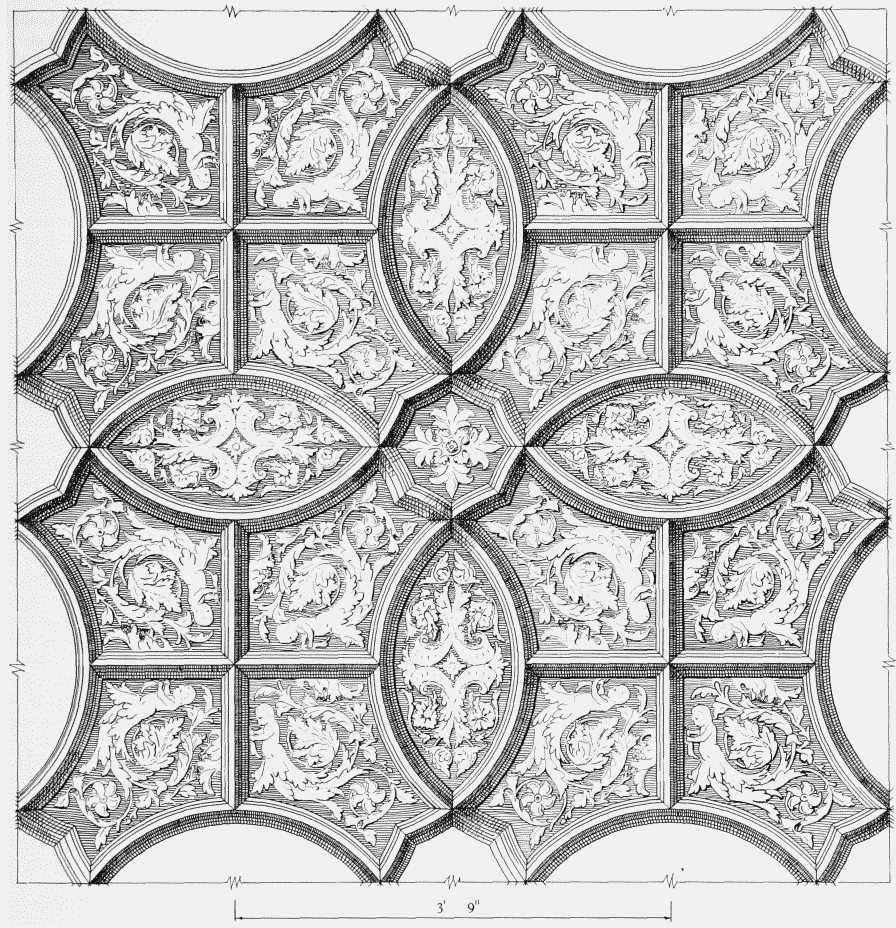
No. 44 Earl's Court Square, detail of ceiling of ground-floor back room. John Douglas, builder, 1888–90
Most of the remaining houses of Rich Terrace were demolished for the erection in 1936–7 of Redcliffe Close, a six-storey block of flats in red brick and stone with shops on the ground floor, which was designed by Murrell and Pigott and built by Humphreys Limited. (fn. 140) It was originally intended to extend the building as far as Warwick Road, but war intervened and five houses were left at the western end. These were damaged during the war of 1939– 45 and demolished afterwards for the widening of the junction between Old Brompton Road and Warwick Road. (fn. 141) The extension to Redcliffe Close at No. 284 Old Brompton Road was built in 1956 to the designs of J. J. de Segrais. (fn. 142)
The frontage of Warwick Road to the west of Earl's Court Square was largely occupied by St. Matthias's Church and Schools (see page 378). A group of three houses were built to the south of the schools in 1873–4 by Alfred Brickell of Fulham, (fn. 143) but were also damaged during the war and have since been demolished.
Most of the houses in Earl's Court Square have remained relatively little altered externally, and the only new building is the unobtrusive five-storey block of flats called Northgate House, which was erected between Nos. 1 and 3 in 1965 to the designs of Higgins and Ney and Partners, architects, in association with Masefield Partners, surveyors and valuers. (fn. 144) The partial demolition of houses towards the western end of the north side in 1974, however, alerted the occupants of the square to the danger of extensive change, and a quickly formed residents' association succeeded in having the demolition work halted. (fn. 145) In the resulting reinstatement of the houses, however, extra storeys were formed in Nos. 33 and 43–47 (odd) with detrimental effects on the fenestration of the façades. In 1975 the square was declared a Conservation Area.
Despite the slow rate of occupancy of houses in the square, and the use of some of them virtually from the beginning as boarding-houses (of which there were eight, plus two private hotels, an army tutor and a dancing school, listed in directories by 1910 (fn. 38) ), a few houses attracted occupants of sufficient wealth and social position to undertake major decorative embellishments of the interiors. Some of these schemes still survive and one or two others have been covered up, but not destroyed, in the course of the conversion of houses into flats. The fine plasterwork in the former ballroom of No. 16, perhaps added during the occupancy of the house in about 1885– 90 by Le Chevalier de Almeida de Portugal, (fn. 38) is illustrated in Plate 125a. Also remarkable is the Adamesque treatment of the interior of No. 23 with painted panels on the ceiling and pilasters to the walls. The scheme was largely the conception of Mrs. Elizabeth Stannus, who lived at the house c. 1910–32, and undertook much of the work herself. (fn. 3) She was the mother of Dame Ninette de Valois, who was living here at the start of her professional career. (fn. 146) More typical, no doubt, of the original finish of most houses is No. 21, first occupied by Sir William Palliser and now housing the Poetry Society, which has some good marble chimneypieces, modest plasterwork, and a stone staircase with cast-iron balustrading and a carved mahogany handrail. On the south side of the square the house interiors reflect the changes in taste of their slightly later period, with extensive areas of panelling, 'Jacobethan' plasterwork and beams to the ceilings, and wooden or metal chimneypieces (fig. 127).
Eardley Crescent and Kempsford Gardens Area
This area, which includes, besides Eardley Crescent and Kempsford Gardens, Nos. 294–350 (even) Old Brompton Road, Nos. 1–51 (odd) Warwick Road, and Kramer Mews, was largely built up between 1867 and 1873 as one speculative development. But the very first building here, a public house, was erected in 1864 at the corner of Richmond Road (as this part of Old Brompton Road was then called) and Warwick Road (which was laid out across the market gardens of Earl's Court Farm at the latest by 1862, (fn. 147) well in advance of building plans for the southern half of the Edwardes estate). The public house, originally named the Lord Ranelagh, was built by Robert George Sharpin of Foxley Road (now Scarsdale Villas), builder, (fn. 148) and should probably be seen principally as an extension of development westwards along Richmond Road, although it doubtless enjoyed much custom later during the construction of the Metropolitan District Railway a little way to the north. Further house-building in the area did not take place until after that railway had been begun and West Brompton Station on the West London Extension Railway had opened (see page 326), but this rather humdrum development may have been motivated as much by the need to utilize the segment of land left between the railway lines and the main roads in as economical a way as possible as by the transport opportunities offered by the railways.
The developer, whose agreement with Lord Kensington to take the land was dated 1 August 1867, was Leonard Couling of Markham Street, Chelsea, builder. (fn. 149) The precise terms are not known, but some six acres of land were involved, on which Couling created ground rents of over £1,200 under leases which ran for ninety-nine years from June 1867. (fn. 150) The rent of over £200 per acre was a high figure for such an isolated location, but Couling managed to pack over 160 houses and a group of stables on to the ground. As very little house-building had yet taken place on the former market gardens of Earl's Court, and the situation was not a particularly favourable one, both landlord and developer were no doubt content that nothing too ambitious should be attempted.
Apart from Old Brompton Road (Plate 127b), which had uniform ranges of three-storey dwellings with shops on the ground floor (in parts now rebuilt), all of the houses in the area have three main storeys faced with white brick and cement dressings over basements (Plate 127c). Most have Doric porticoes but are otherwise flat fronted, only Nos. 25–51 (odd) Warwick Road having the bay windows which were often regarded as the hallmark of a better type of house at that period. At the south end of Eardley Crescent, where building began in 1867, some houses have three windows in the upper storeys perched uncomfortably over one on the ground floor and desperately unhappy proportions overall, but the worst excesses in facadedesign were corrected in later houses, perhaps on the intervention of the estate surveyor.
The most satisfactory group is Nos. 37–51 (odd) Warwick Road, which have high semi-basements, recessed entrances, bay windows up to the first floor, and a deep, bracketed cornice. Some interest attaches to the building of these houses. Nos. 45–51 were begun by John Beale, the licensee of the Coleherne Arms on the south side of Old Brompton Road, who had been a prominent builder under Corbett and McClymont on the Gunter estate. On Couling's nomination, Beale was granted leases of the stilluncompleted houses in August 1869, but was shortly afterwards declared bankrupt, and building work stopped. In 1871 the builder Edward Francis began to erect Nos. 37– 43, and shortly afterwards work was resumed at Nos. 45– 51 by Corbett and McClymont themselves. (fn. 151) In view of their involvement it is perhaps not surprising that the façade-treatment of the complete range contains muted hints of the architecture of George and Henry Godwin on their Redcliffe Estate, and this association with Corbett and McClymont is perhaps significant for some of Edward Francis's later work in the Earl's Court Square area (see page 311).
Most of the building leases of houses in the area were granted by Lord Kensington to Leonard Couling, including all of Eardley Crescent, namely Nos. 1–75 (odd) and 2–58 (even), in 1867–72, Nos. 344–350 (even) Old Brompton Road (No. 344 being the Richmond Arms public house, Plate 127b) in 1868, and Nos. 25–47 (odd) and 18–34 (even) Kempsford Gardens in 1871–3. (fn. 152) Other builders who took leases were Thomas and John Bissett of St. Marylebone (Nos. 17–23 (odd) Kempsford Gardens in 1870), Edward Francis (Nos. 37–43 (odd) Warwick Road, as described above), Thomas and Henry Furnass of Chelsea (Nos. 1–3, 9–11 and 17–23 (odd) Warwick Road in 1867–8), and George Parkin of Chelsea (Nos. 5–7 and 13–15 (odd) Warwick Road in 1867–8). (fn. 153) Three licensed victuallers were also granted leases, but at least two of them, R. G. Sharpin, the builder of the Lord Ranelagh, and John Beale, were builders who also managed public houses — a not unusual combination of trades in the nineteenth century. Sharpin was the lessee of Nos. 1–15 (odd) and 2–16 (even) Kempsford Gardens and of Nos. 318–324 (even) Old Brompton Road in 1868–9, (fn. 154) while Beale was the lessee of Nos. 326–342 (even) Old Brompton Road as well as Nos. 45–51 (odd) Warwick Road in 1868–9. (fn. 155) The third publican, John Philip Lowther of the Lillie Arms, Lillie Road, Fulham, was the lessee of Nos. 296–316 (even) Old Brompton Road and Nos. 25–35 (odd) Warwick Road in 1870–1. (fn. 156)
A plan for the formation of Kramer Mews was submitted to the Metropolitan Board of Works in 1869 by John Beale, (fn. 157) but after his departure from the building scene the plan was modified and Alfred Brickell of Fulham erected the stables in 1873. (fn. 158) The leases were, however, granted to Couling. (fn. 159)
The enumerators' books for the census of 1881 indicate that the pattern of occupancy in the area was very mixed. Most of the houses in Eardley Crescent were lived in by single families, only five (all on the east side) having more than one household, although several families took in boarders and there were a number of lodging-houses. A few of the householders were artisans, but there were also solicitors, a civil engineer, artists, clerks, a very large number of rentiers (mostly widows, no doubt with modest incomes) and officers of the armed services, including a Colonel in the Madras Staff Corps and a Rear-Admiral, both with three servants. Most of the houses in Warwick Road were also single-family homes, although there were two boarding-houses. In contrast, in Kempsford Gardens, where the house plots are smaller, twenty-four of the thirty-eight inhabited houses were multi-occupied. Two more were lodging-houses and there were a large number of boarders elsewhere. Only nine households could afford a servant. The occupants included several building workers, railway workers and other artisans, but also clerks, salesmen and annuitants. Two adjoining houses were each divided between four households and had twelve and fourteen occupants respectively. Of the fifteen 'householders' who lived in Kramer Mews, nine were cabmen. (fn. 160)
One family of very considerable subsequent fame lived in the area. In 1887 the painter John Butler Yeats, searching for a house to rent in London after recently returning from Sligo, settled on No. 58 Eardley Crescent. His family came over from Ireland in stages to join him, including his eldest son, the poet W. B. Yeats, a younger son, Jack B. Yeats, the painter, and their black cat named Daniel O'Connell. Jack Yeats enjoyed frequent visits to Buffalo Bill's Wild West Show at the Earl's Court Exhibition, using the tickets given to nearby residents to compensate them for the noise, but the rest of the family found life in the house almost intolerable. The Fenian John O'Leary, who visited them there, called the house 'old and dirty and dark and noisy', and Lily Yeats described it as 'a horrible house' and its garden as 'a bit of cat-haunted sooty gravel'. In March 1888 they moved to Bedford Park. (fn. 161)
The southern part of the area suffered severe damage during the war of 1939–45, and much of the frontage to Old Brompton Road has been either rebuilt or substantially altered with the consequent simplification of external detailing. No. 296, however, though not in good condition, has retained its architectural features and its original surrounds to the shop front. Further west, Nos. 326–342 (even) have been replaced by Hunter House, a fourstoreyed red-brick block of flats with balconies, erected in 1952–3 by H. Fairweather and Company Limited for the Royal Borough of Kensington. (fn. 162) The Richmond Arms public house and the adjoining No. 346 Old Brompton Road were demolished and replaced in 1964 by a single red-brick public house called The Tournament, designed by J. T. Terrel, Staff Architect of Whitbread and Company. (fn. 163) The Lord Ranelagh, too, has been extensively remodelled into two establishments called Chaps and Bromptons.
Kramer Mews was also extensively damaged during the war and its site used for temporary prefabricated housing afterwards. In 1973 this was replaced by Sybil Thorndike Casson House, a development of sheltered housing for the elderly by the Anchor Housing Association. The architects of this attractive complex of two-and three-storey blocks faced with pink stock bricks and coloured concrete bands, and arranged around a small courtyard, were Hubbard Ford and Partners. (fn. 164)
Philbeach Gardens Area
The development of this area, which consists of Philbeach Gardens, Cluny Mews, and the contiguous part of Warwick Road with Nos. 53–121 (odd) on the east side and Nevern Mansions and Nos. 46–68 (even) on the west side, was almost entirely the work of the Mineard family of builders and took place over some fifteen years between 1876 and 1891.
Philbeach Gardens (Plate 123a,123b) was named after a property of the Edwardes family in Pembrokeshire. An initial layout plan for the street (which was originally intended to be called Philbeach Crescent) was submitted to the Metropolitan Board of Works by Lord Kensington's surveyor, Martin Joseph Stutely, as early as January 1875. This shows the crescent in approximately its present position, but the area now occupied by the communal garden was to be given over to an extensive mews. Although approved, the scheme was not implemented, and some eighteen months later an amended application was submitted showing the layout as built with the mews relegated to the north of the crescent. (fn. 165)
The builder chosen to carry out the revised plan was George Edward Mineard, who was then engaged in building in Lexham Gardens, and whose origins and early career are described on page 294. He took the ground now occupied by the whole of Philbeach Gardens and Cluny Mews and the west side of Warwick Road, for which Lord Kensington undertook to grant leases for terms equivalent to ninety-nine years from September 1876. (fn. 166) A precise layout was devised with house plots and numbers demarcated, before building began at the southern end of Philbeach Gardens in December 1876. (fn. 167)
Shortly afterwards the terrace on the west side of Warwick Road was begun, (fn. 168) and building proceeded steadily northwards. In both streets Mineard erected houses which were very similar to those he had been building in Lexham Gardens, of the full-blooded Italianate variety in white brick with stucco dressings and containing four full storeys above basements, with Doric porticoes and bay windows up to the first floor. The façades, while not having the crispness of detailing of the houses in Lexham Gardens, are nevertheless well articulated, with segmental pediments to the second-floor windows, a bracketed cornice and prominent strings and bandcourses. The earliest houses are arranged in mirrored pairs, but Mineard abandoned this practice in about 1879. At about the same time, in the more northerly houses in Warwick Road he replanned the interior so that the staircase would rise towards the front of the house, no doubt to provide large rooms at the rear which would face south-westwards over the communal garden. One unfortunate by-product, however, is that on the house front a landing coincides with the first-floor window above the portico, a problem which was eventually resolved, not entirely satisfactorily, by lengthening this window and dividing it horizontally into two, with each half opening separately as casements. Nos. 71–73 (consec.) Philbeach Gardens also have this feature (fig. 128b).
By the time the census was taken in 1881 fifty-one houses in the two streets were occupied and a further ten were probably substantially finished but not yet occupied. The evidence of the returns suggests that the speculation was proceeding successfully and that the houses proved attractive to the typical South Kensington resident. The inhabitants included army and naval officers, barristers and other professional men, a stockbroker, a shipowner, several merchants (perhaps a higher proportion than was usual elsewhere in this district), and the usual large number of occupants whose income came from rents or dividends but was here substantial enough to support two or three servants. (fn. 169) Mineard, himself, lived at No. 57 Warwick Road with his wife, six children and two servants. He was then forty-two years old and described himself as a builder employing ninety-six men and six boys. (fn. 170)
One of the occupants of Philbeach Gardens was Sir Henry Cole at No. 106. Then retired from his posts as Secretary of the Science and Art Department and Superintendent of the South Kensington Museum, he described himself as a 'Civil Servant Superannuated'. His diary entries record how, in the early summer of 1880, he had searched in Kensington for a house which 'must have a guarantee against escape of sewer gas'. He looked over some twenty houses before settling on No. 106 Philbeach Gardens, where the system of drainage 'appeared good'. He rented the house from Mineard for £120 per annum, and moved in at the end of June 1880. Though disturbed by the evidence of shrinkage, he thought the house well planned and convenient. The amenity of the communal garden was important to him, and, with Mineard, he established a 'Fifth of November Club' to provide an annual display of fireworks in the garden.
Soon, however, he was discussing improvements in sanitation with Mineard, and allowed his house to be used by the builder for further experiments with a system he had already introduced in houses in Warwick Road. This was designed to prevent any escape of sewer gas into the house — a matter with which Cole was somewhat obsessed at this time — and involved the building of an intercepting chamber between the house drains and the sewer and the provision of an extraction shaft with a small heating chamber at roof level through which fresh air was drawn via the soil pipe and the house drains. Cole subsequently purchased a newer house, No. 96, from Mineard, and moved there in May 1881. He encouraged the builder to patent and publicize his system, and secured for him the job of overhauling the sanitary arrangements at Sandringham for the Royal Family. In October 1881 Cole also wrote a long letter to The Builder entitled 'A Victory over Sewer Gas' in which he explained Mineard's system at length with the help of plans, and an extensive correspondence ensued in the journal. (fn. 171)
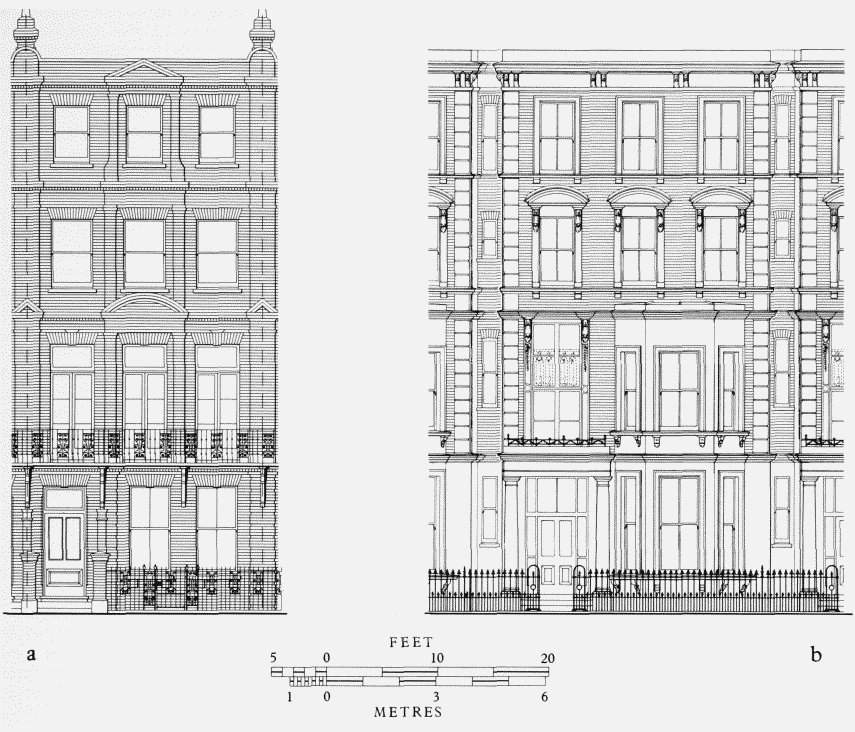
Nos. 48 and 72 Philbeach Gardens, elevations. No. 48, Edwin Mineard, builder, 1884–5; No. 72, George Edward Mineard, builder, 1882
Mineard consulted Cole over tree-planting in the garden and the street, and the provision of electric lighting in the garden, and in December 1881 the two men went together to a sanitary conference in Brighton. Cole also encouraged the builder William Lascelles to experiment with a new type of conservatory porch at his house, and his fertile mind returned to one of its former concerns — the use of convict labour to carry out mosaic work, this time to provide street names and house numbers — shortly before his death on 18 April 1882. (fn. 172)
By the end of 1882 Mineard had built or was in the process of building 103 houses, namely Nos. 1–31, 64–73 and 89–110 (consec.) Philbeach Gardens, and Nos. 53–129 (odd) Warwick Road, Nos. 119–129 being a group of houses with ground-floor shops on either side of the entrance to Cluny Mews, of which Nos. 123–129 have since been demolished for the widening of West Cromwell Road. All of these houses are similar in appearance, but Nos. 64–70 Philbeach Gardens, which are only threestoreyed above a basement, have triple windows at secondfloor level and a crowning balustrade. By this time Mineard had also built five stables in Cluny Mews, and as this was the sum total which was eventually provided for the whole development, it is a striking indication of the decline in the demand for mews accommodation by that date. He had also surrendered, for £600, his leasehold interest in the site of St. Cuthbert's Church (see page 371). Up to this stage of the development all the notices to the district surveyor of the commencement of building operations had come from Mineard himself, and he was the sole recipient of every lease which Lord Kensington had granted. (fn. 173)
At this point there was a lull in building in Philbeach Gardens while Mineard concentrated his efforts on another speculative enterprise in Brechin Place on the Day estate. He had acquired the land there with the help of a reference from Sir Henry Cole and had begun building in May 1882 (see page 164), but the houses he erected in Brechin Place, though similar in size to those in Philbeach Gardens, are in the red-brick Domestic Revival manner.
In the meantime, only one new house was started in Philbeach Gardens between August 1882 and July 1884. This was No. 88, the only double-fronted house in the whole development, which was begun in May 1883 and leased in July of the same year, not to Mineard but to the first occupant, Lewis Hall Bliss, a merchant, on Mineard's nomination. (fn. 174) It appears to have been completed in the following year, (fn. 38) and, instead of adhering to the Italianate style of its neighbours to the south, was in the idiom of Brechin Place. And when building resumed in earnest in Philbeach Gardens in July 1884 it was this style which prevailed (Plate 123a, 123b, fig. 128a).
The reasons for this dramatic change of style in the middle of a development, and, indeed, in the middle of a street, are not immediately apparent. There is every indication that the Italianate houses in Philbeach Gardens were successful and that few houses remained empty for more than a short period, (fn. 38) and the new houses were indeed basically identical to the old in plan and proportions, merely clothed in a different dress. The Domestic Revival style had been introduced on the estate in nearby Nevern Square some three years earlier and was undoubtedly favoured by Daniel Cubitt Nichols, who, after the death of his father-in-law and former partner, Martin Joseph Stutely, in 1881, was in sole charge as estate surveyor, but it seems unlikely that he would have insisted on such a change. Lewis Hall Bliss, for whom No. 88 was built, may have preferred red brick and thus precipitated a stylistic break, or Mineard, suppressing any doubts about the aesthetic propriety of his actions, may have simply decided to continue building to the same designs and with the same materials as Brechin Place.
All of the houses which were built in Philbeach Gardens after 1882 have two-tone brick work with cut-and-moulded red-brick dressings. Some have continuous balconies carried on large brackets but are otherwise flat fronted, some have porches and bay windows on the ground floor, and others have bays up to the first floor. They display similar façade motifs, in a pleasing variety of arrangements, to the houses in Brechin Place and are clearly by the same (unknown) architect's hand.
George Edward Mineard was the builder and lessee, in 1884–6, of Nos. 74–86 (consec.) Philbeach Gardens, which closed the gap on the inside of the crescent, and of Nos. 60–63 in the outer crescent, (fn. 175) but the building lessee of Nos. 32–49, in 1884–5, was Edwin Mineard, who was a year younger than George Edward and probably his brother. He had doubtless already been assisting with the development, for in 1881 he was one of the occupants of the upper floors of No. 119 Warwick Road and described himself as a builder and decorator, but these were the first houses for which he had full responsibility. (fn. 176) Edwin Mineard also began to build Nos. 57–59 (consec.), to the north of St. Cuthbert's Church, in 1885, but apparently ran into difficulties, and these three houses were finished by, and leased to, a local builder, Walter Nash. (fn. 177) (fn. n3)
When he had completed building in Philbeach Gardens, G. E. Mineard took the vacant strip of land on the east side of Warwick Road, to the west of Nevern Square, for ninety-nine years from March 1887. (fn. 178) On the northern part of this ground two terraces of six houses each, now Nos. 46–56 and 58–68 (even) Warwick Road, were erected in 1888–9 on either side of the opening into Nevern Square. Their building lessee was Harry Mineard, G. E. Mineard's son, then in his early twenties. (fn. 179) With their flat ornamentation and red and yellow brickwork, these houses recall more those of Nevern Square than the later houses of Philbeach Gardens.
The southern half of the plot was used, not for building more houses, but for the erection of the three blocks of flats called Nevern Mansions (Plate 122b). In order to build these G. E. Mineard formed a limited company in partnership with Stephen Abbott Cumming called Mineard and Cumming Limited. Cumming had previously been in partnership with Arthur Furneaux Taylor, and as such had built houses in Nevern Place in 1874–5 before moving on to large developments in De Vere Gardens, Cheniston Gardens and Wetherby Place, the last being on the same estate as Mineard's speculation in Brechin Place. The new company was incorporated in 1889 with a nominal capital of £25,000 divided into 2,500 £10 shares. Initially 232 shares were taken up, 100 each by Mineard and Cumming, 10 each by the builder William Henry Willis, a Congregational minister from Rotherham and a bookseller from Lavender Hill, and one each by a solicitor and another builder (Thomas Carter of Cheniston Gardens). G. E. Mineard was appointed Senior Managing Director and Chairman. (fn. 180) Construction began in 1889 and leases of the two southern blocks were granted to the company in 1889 and 1890. (fn. 181) At this point the company was wound up voluntarily. Of the £6,430 which had been subscribed by the time of its dissolution, over £6,000 had been provided by members of the Mineard and Cumming families. The lease of the northernmost block was granted to Mineard alone in 1891, (fn. 182) and in the same year he built the small estate office on its north side. (fn. 183) These six-storey blocks of flats are similar in design to Kensington Mansions immediately to the south, which were built a short while previously, and they are likely to be by the same architect (see page 309).
In about 1880 a poster was issued showing a perspective of the houses in Philbeach Gardens and on the west side of Warwick Road and stating that they were available to let at about £120–160 per annum and to buy at from £1,600 to £2,200. (fn. 184) There is, however, very little evidence of the actual sums paid by tenants or purchasers. Cole gave £120 per annum for a short lease of No. 106 in 1880, and No. 96 was valued for him variously at £1,500 and £3,000, to which latter figure he added an exclamation mark in his diary. (fn. 185) Edwin Mineard let No. 43 in 1895 on a twenty-one-year lease for £105 per annum, and in the same year No. 7 fetched only £650 in what was probably a forced sale. (fn. 186) No. 58 Warwick Road, which had been sold by its mortgagee in 1890 for £1,100, changed hands in 1908 for only £550, and again nine years later for £600. (fn. 187)
Most of the houses in the area have been converted into flats and several in Philbeach Gardens have been altered externally or rebuilt, largely as a result of damage sustained during the war of 1939–45. In 1936 Nos. 33 and 34 were altered to provide a means of access to the rear of the Earl's Court Exhibition, which involved removing most of their ground floors to make way for two passageways, and they have since been further altered and their brickwork painted white. (fn. 188) Nos. 77–83 were damaged by bombing and have been replaced — at Nos. 77–82 by Beach House, a block of flats erected in 1954 for the Metropolitan Police to the designs of their architect, J. Innes Elliott, (fn. 189) predominantly in red brick but with some contrasting areas of blue tiles, and at No. 83 by a decent neo-Georgian rebuild of 1950–1 by Richardson and McLaughlan, architects. (fn. 190) Nos. 95–97 were destroyed by a VI flying bomb, and while No. 96 (Cole's old house) was faithfully reconstructed in 1947 to the designs of T. Mortimer Burrows and Partners, (fn. 191) Nos. 95 and 97 were not replaced until the mid 1950s, and then by two pedestrian blocks of flats to the designs of Leslie Ling and Rand, surveyors and auctioneers. (fn. 192)