
Survey of London: Volume 42, Kensington Square To Earl's Court. Originally published by London County Council, London, 1986.
This free content was digitised by double rekeying. All rights reserved.
'The Kensington Canal, railways and related developments', in Survey of London: Volume 42, Kensington Square To Earl's Court, (London, 1986) pp. 322-338. British History Online https://www.british-history.ac.uk/survey-london/vol42/pp322-338 [accessed 26 April 2024]
In this section
CHAPTER XX - The Kensington Canal, Railways and Related Developments
Arteries of transport have had a powerful effect upon the portion of Kensington discussed in this volume. This chapter therefore enters into the history of those transport developments which have made the strongest physical impact upon the area, namely the Kensington Canal, the West London and West London Extension Railway, the Metropolitan and Metropolitan District Railways (now part of the Circle and District Lines), and the Great Northern, Piccadilly and Brompton Railway (now the Piccadilly Line). Appended to this follow accounts of important developments built upon railway land, notably the Earl's Court Exhibition, the West London Air Terminal and a number of post-war hotels. Emperor's Gate and Nos. 116–156 (even) Cromwell Road, built on railway land shortly after the completion of the Metropolitan and District Railways, are considered separately in the next chapter, while a discussion of the effect of the railways upon the area as a whole appears in the general conclusion to the volume.
The Kensington Canal and the West London Railway
The common sewer known as Counter's Creek, a tidal tributary of the Thames, formed the boundary of the parishes of Kensington and Fulham, and for much of its length also formed the western boundary of the vast estate belonging to the Edwardes family (see page 239). In 1820 the Regent's Canal had been opened from near the Grand Junction Canal basin at Paddington to the Thames at Limehouse, and was soon carrying a large and rapidly increasing traffic. (fn. 1) Stimulated no doubt by this example, William Edwardes, the second Lord Kensington, hoped that if the Counter's Creek sewer were made navigable, the improved communication would assist the development of his property, and also provide him with a useful income from the tolls. Accordingly in 1822 his surveyor, William Cutbush, prepared a plan for this purpose. (fn. 2)
This first scheme related only to that part of the creek which bordered on Lord Kensington's own lands, between Fulham Road at Stamford Bridge (below which no improvements were then thought necessary) and the Hammersmith Road (now Kensington High Street) at Counter's Bridge. (fn. n1) Here the proposed canal terminated abruptly without any basin, suggesting perhaps an intention to continue it later to join the canal junction at Paddington. This plan was superseded by another (signed by John Holland) in 1823, which provided for a small basin to the south of Counter's Bridge, approached through a single lock, and for improvement works between Stamford Bridge and the Thames. (fn. 4)
This second plan formed the basis of the Parliamentary proceedings which led in 1824 to the establishment of the Kensington Canal Company. This consisted of eighteen gentlemen, headed by Lord Kensington and Sir John Scott Lillie (an owner of land on the Fulham side of the creek), who were empowered by the Act to widen, deepen and enlarge Counter's Creek from Counter's Bridge to the Thames 'so as to form or make a Canal for the Navigation of Boats, Barges and other Vessels'. They were also authorized to raise among themselves a capital sum of £10,000 by the issue of one hundred shares of £100 each, and an additional £5,000 if necessary. The canal was to be completed within three years. (fn. 5) Among the initial shareholders were Joseph and Thomas Brindley, who were then building Warwick Square (now the northern end of Warwick Gardens) on Lord Kensington's estate (see page 263). (fn. 6) Joseph Brindley was also one of the proprietors of the company mentioned in the Act.
Most of the evidence about the construction of the canal comes from the records of the bankruptcy of the original contractors, and there are inevitably some gaps. (fn. 7) Bids for the contract to build the canal were invited in August 1824. (fn. 8) The successful tenderer appears to have been Robert Tuck, a carpenter. Tuck was then engaged in the development of Pembroke Square in partnership with John Dowley (see page 268), and there is no doubt that Dowley was also involved in the canal works. His name may, however, have been discreetly left off the tender because he was surveyor to the Westminster Commissioners of Sewers, whose jurisdiction extended to Counter's Creek. The principal sub-contractor under Dowley and Tuck was apparently William Hoof of Brook Green, Hammersmith, 'excavator', then in partnership with Daniel Pritchard. (fn. 9)
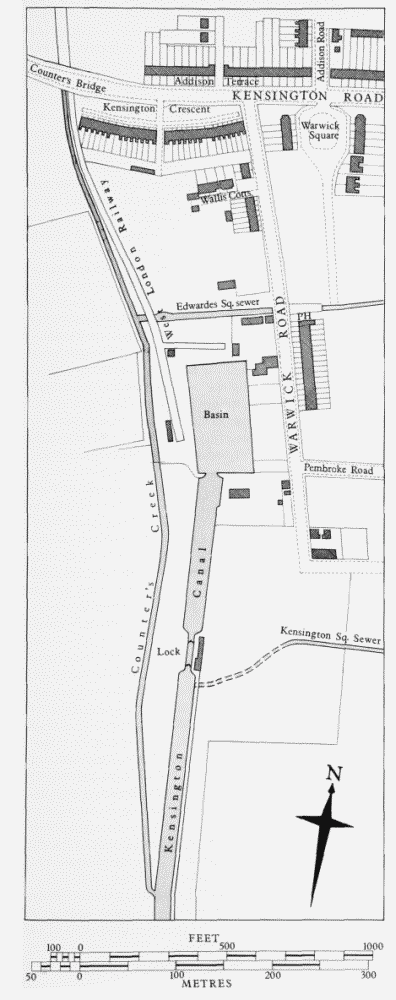
Kensington Canal, plan of basin and lock near Warwick Road in c. 1850
The cost of construction had been estimated by John Holland at £7,969, (fn. 6) but this very soon proved to be a gross under-estimate. Early in 1826 the engineer (Sir) John Rennie was called in and estimated that over £34,000 would be needed to complete the work with certain modifications, the main items being the widening of the canal, excavations needed to slope the banks, the construction of long stretches of wall, and the rebuilding of Stamford Bridge. (fn. 10) Holland was superseded by Rennie's 'Surveyor of the Works', Thomas Hollinsworth, as surveyor to the Canal Company. (fn. 11) Rennie did not mention his role in the construction of the canal in his later autobiography, but his involvement was substantial enough to include the supervision of the building of a bridge for the Commissioners of Woods and Forests, presumably the King's Road bridgein Chelsea. (fn. 12)
In May 1826 the company therefore had to obtain powers by another Act to raise a further £30,000. (fn. 13) Yet despite even this great increase in costs the idea of extending the canal northward to connect with the Grand Junction Canal at Paddington was still under consideration, for in November 1826 Hollinsworth produced plans (never executed) for this purpose, the proposed meeting point (reached through eleven locks) being at Westbourne Green. (fn. 14)
Meanwhile in July 1826 Dowley and Tuck had been declared bankrupt, largely it seems through difficulties encountered in their development of Pembroke Square (see page 270), though they were owed money for work on the canal and this may have been a contributory factor. During the bankruptcy proceedings £2,476 was stated to be due to them from the Canal Company, of which £1,323 was in turn owed by them to Hoof, but the company claimed £2,000 for the non-fulfilment of Tuck's contract. (fn. 15) The assignees in bankruptcy commenced an action against the company, but the matter was compromised when they agreed to take some promissory notes and shares from the company. These eventually realized only £320 when sold at auction after the canal had been opened. (fn. 16)
Hoof, who may have agreed to adopt some of the Company's debts in lieu of the money owed him, took over as principal contractor and was later described as the man 'who formed the Canal'. (fn. 17) He remained a creditor of the company for some time, and in 1839 was castigated as a 'troublesome person' when he insisted on the settlement of his claim for £2,695 from the Canal Company before allowing preliminary works to take place on garden ground he held as a tenant-at-will, for the construction of the Birmingham, Bristol and Thames Junction (later West London) Railway to the canal basin (see below). (fn. 18) Troublesome or not, he became a very successful builder and railway contractor and was elected a director of the West London Railway. (fn. 19) By 1840 he was able to buy a large detached villa on the site now occupied by Prince of Wales Terrace (see page 117), and at his death in 1855 he left an estate worth over £148,000. (fn. 20)
During the later stages of construction of the canal, from about August 1827, John Fawcett of New Ormond Street (now Great Ormond Street), surveyor, took over from Thomas Hollinsworth as surveyor or 'engineer' to the Canal Company. (fn. 21)
The Kensington Canal was finally opened on 12 August 1828. Witnessed by an immense number of persons (The Times recorded), 'the Right Hon. Lord Kensington and a number of friends to the undertaking, embarked in a stately barge at Battersea-bridge and proceeded up the canal … The whole party entered the basin amidst the cheers of the multitudes assembled, the band on board playing "God Save the King".' This was followed in the evening by a 'sumptuous dinner' with Lord Kensington in the chair and 'By his Lordship's command, and chiefly at his expense, a substantial dinner with a butt of porter was also given to about 200 of the workpeople'. (fn. 22)
The canal, about one and three-quarter miles long, was one hundred feet broad and provided passage for barges of a hundred tons' burden. The basin, some 300 yards south of the Hammersmith Road, was four hundred feet long and two hundred wide, and was approached through a single lock about 180 yards further south (fig. 129). The total cost of all the works had amounted to about £40,000, and the income was estimated at £2,500 per annum. (fn. 23)
Traffic soon proved, however, to be 'very limited', (fn. 24) and in the mid 1830s Lord Holland, whose estate to the north of Counter's Bridge would be affected by any schemes for the continuation of the canal to Paddington, described it as 'a total failure'. (fn. 25) In 1840 the canal was said to be 'totally unfit as a Channel of communication with the River Thames' owing to the extremely short and constantly changing period of time during each tide when it was navigable. (fn. 26)
Lord Kensington must have been severely affected by this fiasco. As the principal progenitor of the canal, he had in 1824 subscribed £5,000 of the capital sum of £10,000 or £15,000 then envisaged (five times as much as the next largest shareholder, Sir John Scott Lillie), and he may well have invested more after 1826. He also appears to have sold the eleven acres of his land needed for the canal at well below its full value of £400 per acre. (fn. 27) In about 1833 he and his co-proprietors were still hoping to extricate themselves by continuing the canal northward to Paddington — a scheme which Lord Holland (against whom Lord Kensington had recently been conducting a prolonged law suit (fn. 28) ) had happily described as having been 'found so objectionable and afforded so small a prospect of benefit to the publick' that it had soon been abandoned. (fn. 29)
The West London Railway
By this time, however, the impending establishment of the London and Birmingham Railway (in 1833) and of the Great Western Railway (in 1835) was causing uncertainty about the future development of communications throughout west London. Neither company had yet decided upon the site for its permanent London terminus. But even before their incorporation as a company the directors of the Great Western Railway had in 1834 considered acquiring a site for a goods terminus beside the Kensington Canal basin, by which they would have obtained access by water to the London docks. (fn. 30) The anxiety of the two main-line railway companies to obtain access to the Port of London had, in fact, suddenly conferred a short-lived importance upon the Kensington Canal, and in February 1836 its proprietors were no doubt delighted to accept a very good offer from the provisional committee of a new railway company then in course of formation to buy their semi-moribund property. This new company was the Birmingham, Bristol and Thames Junction Railway, incorporated by an Act of Parliament of June 1836 with power to buy the canal and to build a railway northward from the Kensington basin to link up with the Great Western and London and Birmingham railways in the vicinity of Willesden. The price to be paid for the canal was £36,000, of which £10,000 was to be paid in cash and the remainder in shares in the new company. (fn. 31)
The directors of the company, who included the local landowners Sir John Scott Lillie and Robert Gunter as well as the Hon. Captain William Edwardes (Lord Kensington's son and heir), had wildly optimistic hopes for the future of their project. In December 1836 they announced that 'almost the whole of the merchandise and produce traffic' of the Great Western Railway and 'a great proportion' of that of the London and Birmingham would use their railway and canal 'as the easiest, the most direct, and by far the most economical means of conveyance to and from the Thames'. Nor was this all. At least one-fifth of the passenger traffic to and from London of the two mainline railways would use the new station to be built at Kensington, and this traffic could be greatly increased if, as the directors now proposed, their line were extended from the Kensington basin to a terminus 'near Hyde Park Corner', which formed 'the recognized portal' of the 'west-end of the town', comprising 'almost all the rank and wealth of London'. The 'London West-End Railway', as this proposed extension was to be called, was to curve through Brompton to Knightsbridge, 'A very important and favourable consideration' being that for over half its length it would 'pass over the property of Lord Kensington, who is a warm supporter of the undertaking'. (fn. 32)
More realistically, Lord Holland thought that (even with the extension to Knightsbridge, for which an abortive application to Parliament was made soon afterwards (fn. 33) ) the railway would 'answer no purpose even if successful but that of indemnifying the proprietors of the canal for the sums they have lost in that improvident undertaking'; and that in fact it would prove 'as signal a failure as the Canal'. (fn. 34)
The Act of 1836 had authorized the company to raise a capital sum of £150,000, (fn. 31) and construction of the railway from Willesden to the basin soon started, with William Hosking as engineer. (fn. 35) But some of the shareholders began to refuse to pay their share calls, arrears quickly amounted to £28,000, and the directors were unable to pay current bills. In 1840 statutory power to raise a further £75,000 was obtained, the opportunity provided by this second application to Parliament being used to change the name to the more manageable one of the West London Railway Company. (fn. 36) Purchasers for the new shares were, however, slow to come forward. Not until the winter of 1842–3 was the company able to pay its debts and make new contracts, the principal contractor being Thomas Earle. (fn. 37)
Purchasing the canal company proved troublesome too, for there were numerous creditors to be paid, and possession was not obtained until 1 July 1839. (fn. 38) There were also complex drainage problems to be sorted out with the Westminster Commissioners of Sewers, (fn. 39) and in 1840 Robert Stephenson was appointed as engineer to the company. His opinion was that 'the present line is but of little value unless extended to the Thames and to Knightsbridge'. (fn. 40) Under his auspices several plans for both these purposes were prepared between 1840 and 1845; (fn. 41) and in 1840 the directors also considered a scheme for extending the canal northward. (fn. 42)
The West London Railway was finally opened on Whit Monday, 27 May 1844, and for regular services on 10 June. From its junction with the London and Birmingham at Willesden it traversed the Great Western line by a level crossing (there being no station) and continued to Kensington Station, (fn. n2) a little to the north of Counter's Bridge. Thence it passed under the Hammersmith Road to a goods yard at the canal basin. Traffic proved negligible; in August and September passenger receipts averaged only £15 10s. per month, and the unfortunate line became the butt of so many jokes in the pages of Punch that it soon became known as 'Punch's Railway'. This sobriquet was due largely to the journalistic efforts of Gilbert Abbott a Beckett, who lived close to the Kensington station and did everything he could to fight the line, alleging that 'there was so little traffic that the station-master was wont to grow cabbages between the sleepers, and train vegetable marrows along the rails'. (fn. 44) The directors attributed their misfortunes to the failure of both the London and Birmingham and the Great Western to stop their longdistance trains at the respective junctions with the West London line; but with losses amounting to £50 a week and an execution placed upon the company for nonpayment of a debt, they felt compelled to close the line on 30 November 1844, less than six months after it had opened. (fn. 45)
Soon afterwards several members of the Board resigned. After some difficulty in financing replacements six directors were appointed, of whom three were resident in Manchester and three in London, the latter being Stephen Bird, the Kensington builder and contractor, William Cubitt (the civil engineer, not the brother of Thomas Cubitt) and William Hosking, formerly the company's engineer. They 'found the affairs of the company in a state of far greater embarrassment and difficulty than they had anticipated'. Debts amounted to £60,000, the contractor had filed a bill in Chancery for non-payment of a debt, and the line had been seized and actually advertised for sale. (fn. 46)
By 1844 both the London and Birmingham and the Great Western companies had settled upon the sites for their respective termini and they were much less interested in the Kensington Canal and the little railway leading to it than they had been in the mid 1830s. The new directors of the West London Railway Company were therefore fortunate to find that the London and Birmingham Company was willing to pay £60,000, in discharging the West London's debts and to take a 999-year lease of the line at the rent of one-quarter of its gross proceeds. But the canal remained the property of the West London Railway Company, which thus achieved the unusual situation of having charge of a canal but no railway. (fn. 47) These arrangements were agreed in March 1845 and confirmed later in the same year by an Act of Parliament which also authorized the Great Western Railway to use the line. (fn. 48)
No passenger service was re-introduced, however, and the line was only used for the conveyance of coal. (fn. 49) The rent payable by the London and North Western (as the London and Birmingham was now known) must therefore have been very small, and traffic on the canal (which in 1857–8 yielded about £800 per annum) was falling. (fn. 50) In 1849 the West London Railway Company's misfortunes were compounded when its secretary, after defalcating with some £1,000 of company funds, had escaped to New York; and even though the numerous disputes which had soon arisen with the London and North Western Railway Company had been referred to arbitration by yet another Act of Parliament, the future of the line remained as uncertain and unprofitable as ever. (fn. 51)
The West London Extension Railway
This unsatisfactory state of affairs continued until 1858, when the directors of the West London Railway decided to convert their canal into a railway which would provide a connecting link with the rapidly developing railway system on the south side of the Thames. The West London's own shareholders refused to subscribe the necessary funds, (fn. 52) but in the end the capital of £300,000 was jointly found by the London and North Western, the Great Western, the London and South Western and the London, Brighton and South Coast companies, which together promoted a Bill for the establishment of the West London Extension Railway Company. This Act, passed in 1859, authorized the new company to fill in the Kensington Canal from its terminus at the Kensington basin as far southward as the King's Road bridge, Chelsea, and to use the site for a railway which, commencing at the south end of the West London Railway, was to cross the Thames by a bridge and, by four different branches, join the lines of the various companies then active in the vicinity of Clapham Junction. The line was opened on 2 March 1863, with a new Kensington station replacing the old one of 1844 on almost the same site. (fn. 53)

Lock-keeper's cottage, Kensington Canal, elevation. West London Railway boardroom on right
Soon half a dozen companies were running services along the extended line, to which a number of important connections were made. The first of these was with the Hammersmith and City line near Latimer Road in North Kensington, opened in 1864, by means of which passenger trains were run from the West London's Kensington (Addison Road) Station via Paddington to Farringdon Street on the new underground. (fn. 54) The building of the Metropolitan District Railway and its spurs to join the West London Extension Railway, described below, offered further opportunities. To meet these, a new station named West Brompton was opened in 1866 on a lonely spot at Lillie Bridge (Plate 133c). (fn. 55) A simple brick building with subdued touches of Gothicism, set back from Richmond (now Old Brompton) Road, it was to be on its own only until 1869, when it was joined by the District Railway's station of the same name (see page 329). Although no physical connection was ever made between the two railways at West Brompton, the land beside the West London Extension Railway for about a quarter of a mile was later used by the District for its route to Putney (1880) and Wimbledon (1889). In addition, from 1872 the London and North Western ran a service from Broad Street in the City to Mansion House via Willesden and Kensington (Addison Road) Station. (fn. 56) Meanwhile in 1869 the London and South Western used its financial stake in the West London Extension line to build a feeder from a point on the latter a little to the north of Kensington Station to Hammersmith Broadway and thence on to Richmond. (fn. 57)
The heyday of the West London and West London Extension line lasted from the 1860s for some forty years. In 1903 it was claimed to pay 'a dividend of enormous proportions on the original stock'. (fn. 58) But after 1914 the building of deep-level electric tube railways and the advent of the motor bus and the motor car all provided quicker and more direct travel than the often circuitous routes on which the line had largely depended for its passenger traffic. The service from Broad Street to Earl's Court via Willesden (where passengers had to change) was, however, only discontinued in 1940, and when exhibitions are held at Olympia the District Line still runs trains to Kensington (Olympia) Station from High Street Kensington. Changing conditions of living have also resulted in the closure of the coal yards, but the line is nevertheless still an important freight route, (fn. 59) and Kensington (Olympia) Station is now used as a motorail terminus. The line's West Brompton Station was closed in 1940 and demolished some years later. (fn. 60)
The only significant survival from the Kensington Canal in the area covered by this volume is the lockkeeper's cottage (Plate 115c, fig. 130) which presumably dates from the canal's construction in 1824–8 (provision for a 'lock house' having been included in the original estimates). (fn. 6) It now stands boarded-up in forlorn isolation a short distance to the north of the bridge which carries the West Cromwell Road extension over the railway tracks. The single-storey addition to the south of the cottage is the boardroom built by the impecunious West London Railway Company in 1845. (fn. 49)
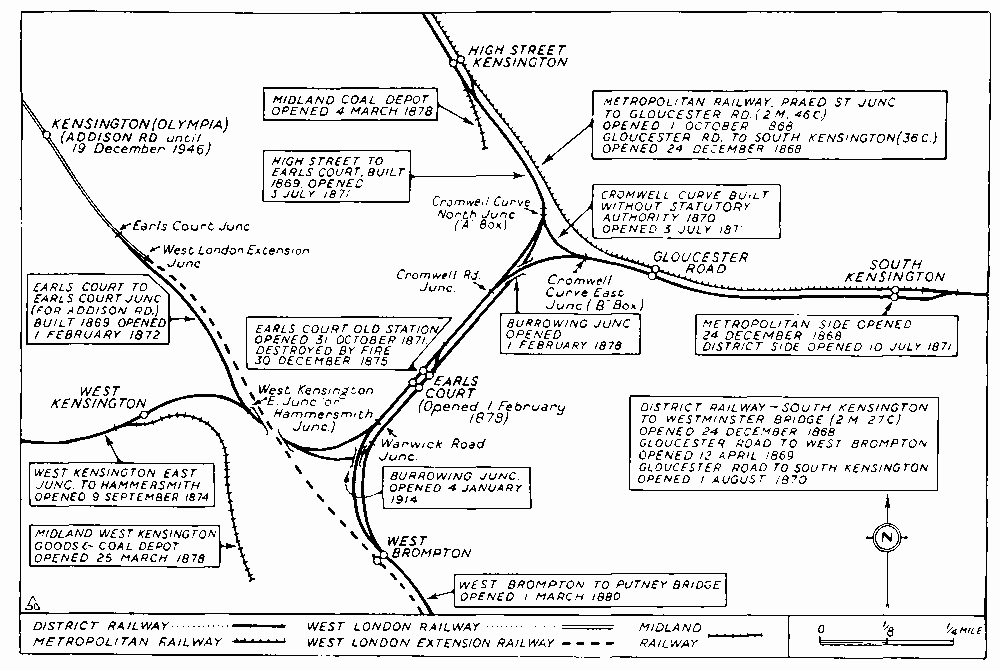
Railways in the Earl's Court area
The Metropolitan and Metropolitan District Railways
The history of the Metropolitan Railway and its companion, the Metropolitan District Railway, is well known and documented and need only be recited in so far as it affected Kensington's development. The Metropolitan Railway having prosperously opened its pioneering line from Paddington to Farringdon Street in 1863, a plethora of railway schemes for London followed. Few survived the test of scrutiny by Select Committee in Parliament during the first half of 1864, but among these was the scheme for completing an 'Inner Circle' put forward by John Fowler, acting as engineer for the Metropolitan. Under Acts of 29 July 1864, the Metropolitan company was permitted to extend its line southwards from Paddington to a new station at South Kensington as well as to continue on at its eastern end from Moorgate to Tower Hill. But the completion of the circle between Tower Hill and South Kensington was allotted to a second company, the Metropolitan District Railway, which also undertook to build two short spurs through Kensington: one starting westwards from South Kensington, running parallel at first with the Metropolitan and then diverging through Earl's Court to join the new West London Extension Railway (opened in 1863) at West Brompton; the other beginning at High Street Kensington, turning westwards through Earl's Court alongside its sister spur and then veering northwards to meet the West London Railway at a junction just south of Addison Road (fig. 131). (fn. 61)
In due course the two companies intended to amalgamate and operate as one — a hope that was to be dashed until the creation of the London Passenger Transport Board in 1933. For the time being, separate companies spread the risk and helped to ensure speedier completion. Fowler acted as engineer to both companies and the same contractors, Peto and Betts (succeeded after their failure in 1866 by Lucas Brothers), Kelk, and Waring Brothers, undertook the task of construction. Three of the local stations, at High Street Kensington, Gloucester Road and South Kensington, were for the joint use of the companies.
The compulsory purchases authorized under the Acts included only a modicum of developed property in southern Kensington. Major demolitions occurred only at two of the station sites, on the south side of Kensington High Street and on the Alexander estate south and west of Thurloe Square. Indeed H. B. Alexander and the residents of Thurloe Square and Onslow Square were the only vociferous objectors to Fowler's plans along this part of the line. In the hope of shifting the position of South Kensington Station, an influential procession of witnesses from Onslow Square, comprising Sir James DairympleHorn-Elphinstone, Sir Robert Anstruther, Theodore Martin and Baron Marochetti averred before the Commons Select Committee that the expected traffic traversing the east side of their square on its way to and from the station would wreck their amenities. (fn. 62) 'My probable conduct is that my first step would be to leave the house', stated Theodore Martin (who continued to inhabit Onslow Square till his death in 1909), '… which I went to with a view to getting great quiet.' (fn. 63)
Such, however, were relations between the railway companies and the other landed interests in the area, principally the Commissioners for the 1851 Exhibition and Charles Freake, that these protests fell on stony ground: the South Kensington Station was confirmed in its original position. Other large Kensington proprietors affected were more complaisant, anticipating no doubt the benefits which good transport would one day confer on their as yet undeveloped land. They included Robert and James Gunter, the Harrington, Broadwood and Vallotton families, and above all the third Lord Kensington, through whose fields in particular the lines west of Gloucester Road were scheduled to be driven. Lord Kensington's readiness to part with some thirty acres of his estate (for some £10,000) may have followed from his hapless father's involvement with the West London Railway, in which the family had had large shareholdings. The District Railway's scheme promised both to open up his estate for development and to link the West London Railway with the projected Inner Circle and thus restore its profitability. (fn. 64)
Yet the peculiar curving configuration of lines in South Kensington and Earl's Court, coupled with the fact that in many places four tracks ran together, meant that the new railways ate up or sterilized much valuable land. As the companies requisitioned more land than they ultimately needed, awkward areas were left over which later proved hard to use. The largest were the sites of the 'Cromwell Road triangle' and of the future Earl's Court Exhibition (fig. 131), at which the contractors dug up swathes of land to take out clay and bake some fifty million bricks in massive kilns specially built for the purpose. (fn. 65) Stations and sidings also took up much space. The more practicable remnants such as the site of Emperor's Gate were sold after the railways' completion, but the two large triangles remained in the companies' hands.
Construction (Plates 130, 131a, 134) began in 1865, continued intensively until 1868, and dribbled on thereafter as successive sections of the District line were opened. The methods of layout used were orthodox, with covered sections in the eastern, more developed, areas giving way to open stretches further west. 'Cut-and-cover', noted William Humber in 1866, was largely adopted 'by reason of the value of the land … By far the greater portion of the line is simply opened out, the arch turned, and the surface of the ground above made good as may be required.' (fn. 66) One feature of outstanding technical interest was a short-lived bridge, claimed by the railway historian the late Charles Lee as the first concrete arch bridge in the world. (fn. 67) This was thrown across the southern section of the 'Cromwell Curve', beneath the present British Airways building, in 1867–9. A large triangular site here was completely cut off by the radiating lines. To reach it, Fowler in 1867 had a thin bridge, twelve feet wide and seventy-five feet in span, built across the District lines next to Cromwell Road in mass concrete, 'with a view to determine the fitness of that material for arches' (Plate 134). (fn. 68) It was constructed/plt with the help of centering, entirely lacked reinforcement, and weighed some 200 tons. Early in 1869 the bridge was broadened by similar methods, probably to forty-two feet, and finished off with voussoirs simulating stonework. It had gone by the time the railways were plotted by the Ordnance Survey in 1872, more probably because the access was no longer needed than for any deficiencies. The Cromwell Curve triangle remained under-used for many years, though from the inter-war period it was increasingly taken up with sidings.
The first portion of the railways to be finished was the Metropolitan from Paddington through High Street Kensington to Gloucester Road, opened on 1 October 1868. Its continuation on to South Kensington and the District line on from South Kensington to Westminster came into service on 24 December 1868, but District trains westward from Gloucester Road to West Brompton did not run until 12 April 1869. The District's operations were established in very piecemeal fashion. Their tracks between Gloucester Road and South Kensington were not ready until 1 August 1870, their service from High Street Kensington to Earl's Court not until 1871, and its extension to Addison Road not until 1872, though the lines had been laid before then (fig. 131). (fn. 69)
Up until 1871 the inconvenience of these fragmented services was limited by the operating agreement between the companies, whereby the Metropolitan worked and maintained the District lines with their own stock in exchange for a proportion of the receipts. But in 1870 the companies fell out. James Staats Forbes of the London, Chatham and Dover Railway became the dominating force on the board of the District, soon to be opposed by Sir Edward Watkin of the South Eastern Railway, from 1872 the chairman of the Metropolitan. A long era of friction ensued between the companies. The agreement was abrogated. In haste the District had to buy rolling stock, lay out a depot at Lillie Bridge, insert an unauthorised short stretch of line at the Cromwell Curve to link High Street Kensington and Gloucester Road, and add its own section to South Kensington Station, all in time to run its own services from July 1871. Under these circumstances the companies co-existed uneasily for many years. (fn. 70)
The Kensington Stations
The original stations built by the railway companies in southern Kensington in 1865–9 were four in number: South Kensington (at first to be called Brompton Exchange), Gloucester Road (originally Brompton: Gloucester Road), High Street Kensington (originally to be simply Kensington), and West Brompton. Like other Metropolitan and District stations, they were designed by Fowler and his staff in a light-brick Italianate manner, with balustrading, urns and chimneys of a sufficiently 'ornamental description' to satisfy local proprietors. They varied slightly: South Kensington, West Brompton and High Street Kensington were single-storey buildings, but Gloucester Road (Plate 131a) boasted an upper storey and wings, and here a separate two-storey office building was added on the District side shortly after completion. From a concourse behind the booking office, passengers took staircases down to the platforms. At High Street Kensington (Plate 130b, 131b, fig. 132) and Gloucester Road, these were wholly covered by elliptical iron roofs of some breadth and elegance, spanning the whole width and buttressed by high retaining walls. This type of arrangement also obtained at South Kensington, but here the original span (1867–8) covered only the Metropolitan tracks, coming to rest on columns in the centre; from here a second and broader arch accompanied by a lean-to roof was added to shelter the separate District tracks (1871). At West Brompton, where the District station abutted that of the West London Extension Railway (Plate 133c), only the northern end of the long platforms was covered in, and in a plainer idiom. (fn. 71)
Earl's Court Station was an afterthought. It was at first a temporary affair, built in wood for some £1,600 on the east side of Earl's Court Road in 1871. (fn. 72) It burned in 1875 and was then reconstructed in 1876–8 at a cost of £60– 65,000 on a bigger site on the west side of Earl's Court Road, to designs by the independent District's engineer, John Wolfe Barry. By then the District had extended its operations westwards from Earl's Court through Hammersmith to Richmond (1874–7) and was well forward with plans for its branch to Putney Bridge (opened 1880). So the enlarged station (Plate 132b) spanned a hundred feet and accommodated four sets of lines, to allow both for the District's traffic and for 'the trains hereafter expected from the Midland and South-Western systems' by way of the West London Railway. Barry put a pitched roof over the platforms using a simpler, lighter style of ironwork than Fowler's, but the station offices and front (Plate 132a) were no better than a bald parody of their predecessors. (fn. 73)
The last piece of important surface railway construction in the area took place in 1877–8, when R. M. Ordish on behalf of the Midland Railway laid out a big coal depot off Scarsdale Place next to High Street Kensington Station, on the site of the present London Tara Hotel (see page 108). This and a larger depot at West Kensington came into being after the Midland Railway had acquired an interest in the District's Richmond extension in 1875, thus securing a route for its coal trains into the heart of London.
The Advent of the Piccadilly Line
In 1897 the District Railway acquired an Act to electrify its line and build a tube beneath it for non-stop trains from Earl's Court to Mansion House. In the same year a separate company, the Brompton and Piccadilly Circus Railway, also obtained sanction for a tube which would meet the former at South Kensington. The companies were united under the District's control in 1899. But shortly afterwards the District fell into the hands of the celebrated tycoon Charles Yerkes and became a central plank of his combine, formalized in 1902 as the Underground Electric Railways Company of London. The District's plan for a high-speed line now vanished. Instead, the Piccadilly to Brompton line, extended westwards to Earl's Court and Hammersmith, went ahead in 1902–7, with stations in Kensington at Knightsbridge, Brompton Road (closed in 1934), South Kensington, Gloucester Road and Earl's Court. The line, officially part of the Great Northern, Piccadilly and Brompton Railway, was opened on 15 December 1906. (fn. 74)
By and large, the Edwardian deep-level tubes made a small physical impact on the metropolitan environment. Though this was certainly the case in Kensington, the Piccadilly line's coming did lead to major reconstruction at all the previously existing stations along its route. At South Kensington and Gloucester Road, where the stations were still split between the Metropolitan and the District, the impending arrival of the tube and the electrification of their own lines spurred the companies to make major adjustments. At both stations, space for the surface buildings of the Piccadilly line had to be found on the southern or District side. The Metropolitan took this opportunity to reorganize the stations to George Sherrin's designs. Sherrin had first been asked by the Metropolitan to rebuild High Street Kensington Station, where no deep-level tube was anticipated but where the old station took up space of increasing commercial value. Here, by a scheme devised in 1903–4 and carried through in 1906–8, Sherrin took down Fowler's elliptical iron roof, substituted a wnings of wood on the platforms, and at street level created a shopping arcade leading to the booking hall, with a commercial superstructure above. The same principles operated at South Kensington, where in 1905–6 his arcade was simpler and without upper storeys. At Gloucester Road, a less profitable site, the original buildings facing the road were left intact but the iron roof was again removed and separate roofs erected on each platform. (fn. 75)
As for the Piccadilly line stations themselves, all except Earl's Court were designed by Leslie W. Green in the distinctive house-style of the Yerkes tubes, with round arched fronts clad in ox-blood faience. Earl's Court Station was rebuilt in 1915, when the U.E.R.L.'s architect, H. W. Ford, replaced the District Railway's unworthy frontage of 1876–8 facing Earl's Court Road with a new elevation in Green's manner but in a paler colour of faience (Plate 132c). (fn. 76)
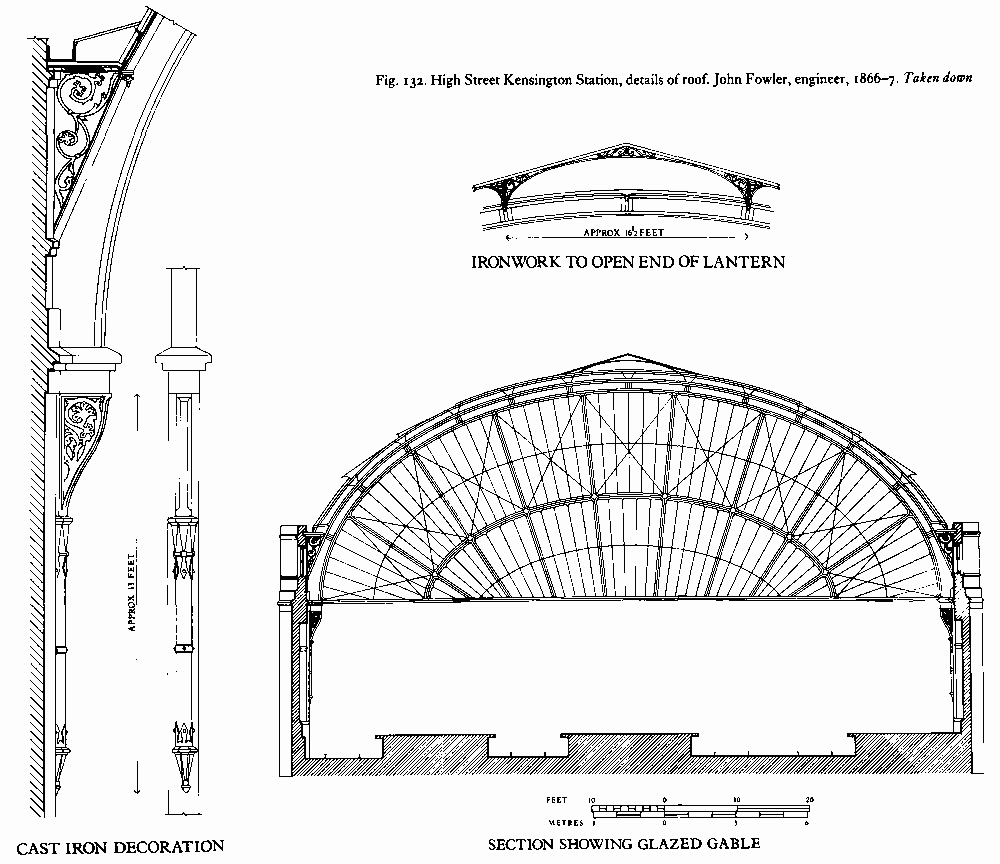
High Street Kensington Station, details of roof. John Fowler, engineer, 1866–7. Taken down
Among later changes made at these stations, the most important were the making of a new booking hall at High Street Kensington in 1937–8, and of an improved western approach to Earl's Court Station from Warwick Road in 1936–7, to serve the new Earl's Court Exhibition building (Plate 133a, 133b). (fn. 71) This latter work, which included a new circular entrance feature next to Warwick Road, was carried out with some style, in the best tradition of the London Passenger Transport Board's architecture during the Frank Pick era. At West Brompton, London Transport also planned for a time in 1935 to form a ticket hall north of Lillie Bridge for the benefit of visitors to the exhibition, but neither this nor schemes of 1937 for rebuilding or uniting the two adjacent West Brompton stations were carried through. The West Brompton Station of the West London Extension Railway closed in 1940 and was later demolished, leaving the old District station in less than splendid isolation. (fn. 60)
Earl's Court Exhibition
Much the most ambitious development upon 'railway land' in Kensington, that is to say upon land bought by the railway companies in the 1860s and then found surplus to their requirements, was the Earl's Court Exhibition. This enterprise has a complex history dating back to the 1880s.
The present Earl's Court Exhibition building, designed by C. Howard Crane and built in 1936–7, lies entirely in Kensington, just west of Warwick Road. Previous exhibitions here, however, spread also on to land immediately to the west, beyond the West London Extension Railway and in the parish, later the borough, of Fulham. For the purposes of understanding the exhibitions, the sites are treated as a whole in what follows. But neither the early history of the land in Fulham before the coming of the railways, nor buildings raised there since 1930 (principally the Empress State Building), are considered in this account.
Early History: The Kensington Catholic Public School
The present Earl's Court Exhibition and the concrete raft on which it stands together cover some eleven acres. These were part of the main sale of land from the Edwardes estate to the Metropolitan District Railway Company in 1866 for the layout of the District line. (fn. 77) The divergence of tracks here beyond Warwick Road north and south to meet the West London Extension Railway left an empty triangle, similar to the area further east within the 'Cromwell Curve' but larger. Westwards, beyond the West London Extension Railway, the District in 1871 built their Lillie Bridge Works and the Midland Railway in 1878 opened their West Kensington Goods and Coal Depot. (fn. 78) The resulting tangle of tracks, sidings and workshops made the area awkward to develop. Between them patches of land were still cultivated, for the first exhibition grounds were said to be 'won out of a cabbage-field and a sea-kale swamp'. (fn. 79)
The triangle, which amounted only to about six acres once the lines had been built, was not wholly without potential, small bridges having been built over the District tracks from north and south to allow future access. For a few years it seemed destined to achieve respectability. In 1873 Monsignor T. J. Capel opened his 'Kensington Catholic Public School' with an address in Warwick Road. (fn. 80) This was an early step in Capel's scheme, explained on page 105, to build up a system of middle-class Catholic education in Kensington, including a 'university college' at Abingdon House in Wright's Lane. At first his foundations, supported by Catholics of high family, flourished. In October 1875 Capel began raising a singlestorey (perhaps temporary) school-building, described as in Warwick Road but probably on the triangle; (fn. 81) and in the ensuing March he borrowed £9,500 on mortgage, enough to complete the purchase of the whole site and draw up a scheme of new school buildings. (fn. 82) George Goldie, architect of the Pro-Cathedral in Kensington High Street (to which Capel was attached) provided a design. This comprised a main block with a hall and short wings at right-angles, and a hundred-foot-long chapel (probably separate). An internal perspective of the chapel, a selfconsciously collegiate affair with a broad ante-chapel, was published in November 1877, when benefactors were said to be forthcoming and excavations progressing. (fn. 83)
It is doubtful if building went much further. In June 1878 Capel was disgraced and resigned, in circumstances described on page 106. Debt on the Earl's Court site played its part in his further downfall. Early in 1879 he desperately remortgaged the property, raising his obligations here to some £15,500. (fn. 84) In December he appealed to the Duke of Norfolk, a trustee of the Catholic University College, to buy him out. The Duke's solicitor, after commissioning a surveyor's report, advised emphatically against. The surveyors, Farebrother Ellis and Company, reported that the only approach was by way of the southern bridge from a private road behind Eardley Crescent, as the northern bridge had been blocked when building started in Philbeach Gardens. This, they argued, would make any development 'exceedingly dull, as there is no traffic over the Roads except that actually appertaining to the Houses'. They also apprehended noise from the trains, opined that 'the property generally on the borders of the Railway is not of a desirable character', and hazarded the suggestion that the triangle might be best suited for 'Model Lodging Houses or Artizans Dwellings'. This crushing advice, together with Cardinal Manning's aloofness in the face of Capel's difficulties, persuaded the Duke not to buy. (fn. 85) After further attempts to sell the site, Capel succumbed to foreclosure and bankruptcy in 1880. (fn. 86)
In 1881 a certain T. Ingram of Beckenham toyed with developing the triangle, naming it the 'Wrexford Building Estate'. (fn. 87) But this venture failed to materialize, doubtless for the reasons adumbrated by Farebrother Ellis and Company. Meanwhile the District Railway seems to have taken back the freehold from Capel's mortgagees. For the time being, the prospects of the land again looked uninviting.
The first Earl's Court Exhibition
The idea of using the surplus railway lands west of Earl's Court for exhibitions originated with John Robinson Whitley (1843–1922). Whitley gained experience of such ventures as manager of a Leeds engineering business which displayed goods at the large European exhibitions of the 1860s and 1870s. Later he had been a partner in promoting the wall-covering 'Lincrusta-Walton'. While visiting the United States in 1884, he found that a consortium of businessmen proposed to hold an 'American Exhibition' in London. Whitley teamed up with this group and was soon in effective control. Late in that year, he opened negotiations with the District Railway and its canny chairman, James Staats Forbes, for use of a variety of sites in their ownership, including the triangle in Kensington and some land in Fulham beyond the West London Extension Railway. For an exhibition, the land had the attraction of being within easy walking distance of four stations: Earl's Court, West Brompton, West Kensington and Addison Road (now Kensington Olympia). (fn. 88)
Whitley intended the first Earl's Court Exhibition to open in 1886. But because a British Colonial and Indian Exhibition under royal patronage was already scheduled for South Kensington, he decided to postpone his opening for a year. During this interval the tenor of the exhibition changed, as several American manufacturers proved fairweather friends and backed out. Visiting Washington in 1886 to enlist President Grover Cleveland's support, Whitley saw Colonel William Cody's 'Buffalo Bill Roughriders and Redskin Show' arriving in town. Forthwith he booked them for Earl's Court. This chance proved the outstanding success of Earl's Court's first season, turned its nature into one of spectacle as much as of serious exhibition, and introduced Englishmen for the first time to the cult of the Wild West. (fn. 89)
The land leased by Whitley fell into three parts (Plate 135a, fig. 133). In the triangle occupied by the present exhibition building he made an open arena and covered stand, accessible from an entrance in Warwick Road; here Buffalo Bill and his troupe gave their performances. The stand itself was built at three weeks' notice by Peto Brothers on Cody's verbal instructions, and 'reaped a rich harvest' for Basil Peto's brother-in-law Penruddock Wyndham, who sold a large quantity of timber from his estate to meet this sudden need. (fn. 90) Between the West London Extension Railway's tracks and the sidings of the Midland Railway, sandwiched next to the Lillie Bridge Depot, was squeezed a long single-storey building, 1,140 by 120 feet, with annexes for refreshment and the fine arts. This was the main exhibition building, entered from Richmond Gardens, a short cul-de-sac off Richmond (later Lillie) Road (just in Fulham). It was cheaply constructed, consisting merely of columns each of two steel rails bolted together, with simple covering walls and roof of glass and corrugated iron; the front was covered with Portland cement. (fn. 91) North of this, on a slightly broader site between the Midland's sidings and North End Road were pleasure gardens. These included a switchback railway, a toboggan slide, the largest bandstand in London and various buildings including the 'Welcome Club'. These awkward sites were linked by seven bridges over the various railway lines and landscaped to give a superficial air of rural isolation.
Two gangs of a thousand men each, working alternative shifts by day and by night, constructed the buildings and grounds under the supervision of Whitley's staff over the first four months of 1887. The buildings were apparently designed by O'Driscoll, an engineer, and the grounds landscaped by William Goldring, gardener. (Nominally John Gibson was architect and Alfred Pickard engineer, but their contribution is not apparent.) (fn. 92) As is the way with exhibitions, all was by no means ready on the opening day (9 May 1887). The entrance fee was high, and from some quarters came criticism of the exhibition's slight nature. Nevertheless its success was great, thanks mainly to Buffalo Bill. Nearly 15,000 visitors came daily during the five-month season, including on one occasion the whole of Harrow School. Among early guests were Gladstone and the Prince and Princess of Wales, who watched the first performance of the Wild West Show ('The sensation … was instantaneous and electric'); the Queen was shown a shortened version a few days later. All were intrigued by Cody's hapless Sioux warriors, particularly by the chief Ogila-Sa ('Red Shirt'). Gladstone and the Prince of Wales conversed with him about the weather in London and the Dakotas, and the latter gave him the contents of his cigarette case. In addition Queen Victoria 'expressed a desire to see the Indian babies or papooses. Two of these were presented … and she was pleased to shake their hands and pat their painted cheeks.' (fn. 93)
Whitley capitalized on his success with further 'national exhibitions': the Italian Exhibition in 1888, the French Exhibition in 1890 and the German Exhibition in 1891 (in the intervening year, 1889, 'several Spanish gentlemen' took on the grounds for the season). Each year the main building was redecorated and filled with commercial products from the country concerned, the arena and flimsier erections were redressed in fitting garb and some new buildings were added. In 1888, for instance, 'two large new annexes' were built in the western gardens and in the northern sector T. W. Cutler, architect, added a theatre and concert hall to hold 1,200, disguised as the Palazzo dei Signori at Perugia. Attractions like the switchback railway operated as before, 'but the crags and peaks hardly soar high enough to shut out the disillusioning effect of stray chimney-pots belonging to the houses in the rear', carped The Builder. (fn. 94) In the arena Buffalo Bill proved hard to follow. In 1888 'Rome under the Caesars' was given in the 'Flavian amphitheatre'; in 1890 came the 'Wild East' show, presented by a troupe of 'French Africans', and in 1891 a tableau of Germania. This last was less sedate than it sounds, for the 'bombardment and blowing-up of German castles' every afternoon and evening proved a source of distress to nearby residents in Philbeach Gardens and Eardley Crescent. (fn. 95)
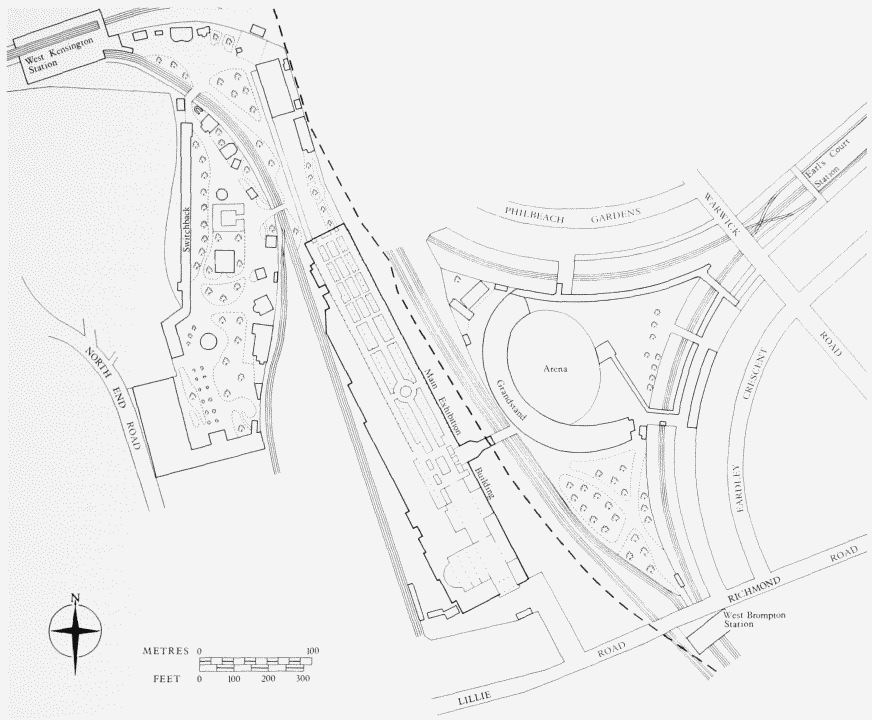
Earl's Court Exhibition, ptan at the time of the American Exhibition, 1887. The broken line marks the western boundary of Kensington
Whitley retired after the 1891 season, having lost rather than gained from his four exhibitions as a whole; no doubt the momentum of 1887 had not been kept up and attendances had dropped. Late in life he founded an 'Anglo-French pleasure resort' at Le Touquet, but he had no further connection with Earl's Court. (fn. 96)
There followed a period of uncertainty. The District Railway threatened to put a coal depot on the site of the arena but eventually relented and decided to promote improvements instead. Exhibitions (managed by H. E. Milner and H. P. Dodson) were held on horticulture and forestry in 1892 and 1893 respectively, supplemented by new entertainments erected under licence by a variety of concerns. In 1893 the arena was turned into a shallow lake with small islands and a chute for Captain Paul Boyton's 'World Water Show', Britain's first water-toboggan. (fn. 97)
The Exhibition Expanded
Late in 1893 a new figure appeared in the saga of Earl's Court. This was Imre Kiralfy (d. 1919), a Hungarian showman who had made his mark in the United States from the 1870s as a producer of 'spectacles'. Several had featured in the programmes of Barnum and Bailey, and the most celebrated, 'Nero or the Destruction of Rome', having been staged in New York in 1888, was brought to London's Olympia for a show put on there by P. T. Barnum in the following year. In 1890 Kiralfy with the backing of Harold Hartley and Joseph Lyons produced a further spectacle at Olympia. Then at the Chicago World's Fair of 1893 he staged 'America', a 'Grand Historical Spectacle'. The effect of the 'Great White City' (as the World's Fair came to be known) shaped his conceptions when he began negotiating for Earl's Court late in that year. His plan was to replace all the old buildings. On the site of the arena he proposed a 'reproduction of a part of the Chicago Exhibition'; further north was to rise a great 'Graydon Wheel' similar to the gigantic Ferris Wheel built in Chicago. In place of the old exhibition hall there was to be a new enclosed building for 'spectacles' seating 6,000. (fn. 98)
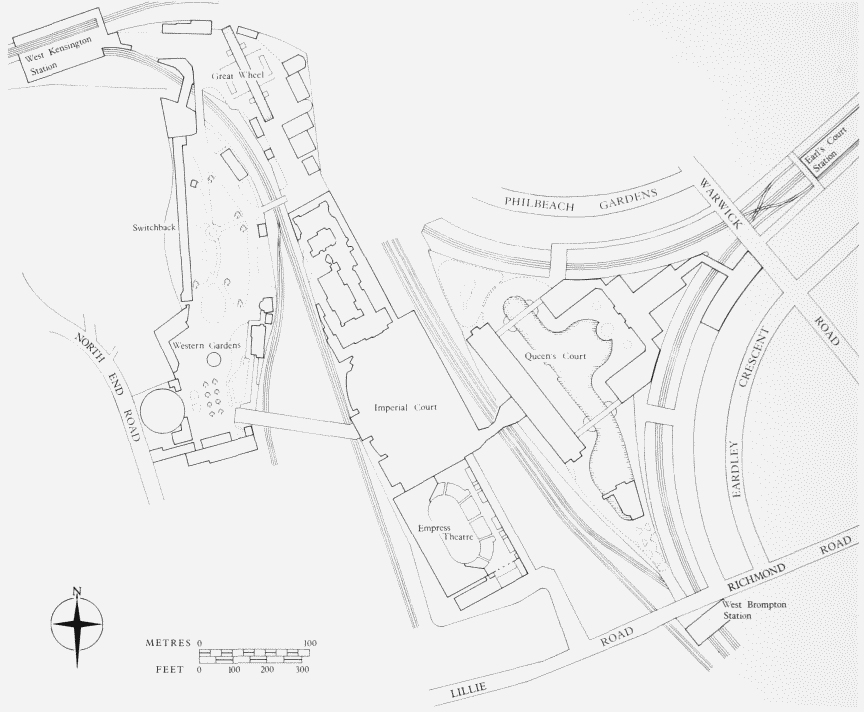
Earl's Court Exhibition, plan in 1899
None of this could be achieved for the season 1894. So Milner and Dodson were recalled to put on an Industrial Exhibition in that year, while construction commenced on the Great Wheel (for which Kiralfy was not responsible). To finance his scheme Kiralfy approached Harold Hartley, who helped set up London Exhibitions Limited under the chairmanship of Paul Crémieu-Javal (of Spiers and Pond, the catering firm). The new company agreed to a twentyone-year lease of the site (later extended to forty-two years) from the end of 1894, by which time work was well under way. Progress proved not uneventful and in the early days the company was close to ruin. To save money the directors purchased from Battersea Park the old Albert Palace building, originally designed for the 1865 Dublin Exhibition. This was meant to occupy the western part of the 'arena' site and to be the main exhibition building. But the ironwork proved too heavy for the made-up ground and had to be sold at a loss. A similar purchase of the 'Paris Hippodrome' was also disastrous, for it blew down whilst incomplete in February 1895. After this mishap Harold Hartley took control of all the works except the new theatre, in order to finish them in time. This he did successfully. The 'Empire of India Exhibition' duly opened in May 1895; the Great Wheel was inaugurated in July and the theatre in August. (fn. 99)
As renewed by Kiralfy and his partners, the exhibition site (fig. 134) was too complex and many of its features too ephemeral to describe fully. Three items in particular may be singled out: the Queen's Court, the Empress Theatre and the Great Wheel.
The Queen's Court occupied the arena site. Here Kiralfy fulfilled his intention and used the lake to achieve some particle of the effect of the great court at Chicago. On the west side stood the Queen's Palace, the main exhibition building, which annually took on a new external dress geared to the character of the year's theme. With it was associated the Ducal Hall on the east side of the lake, next to the approach from Warwick Road. (fn. 100)
The Empress Theatre (Plate 135b) was Kiralfy's personal venture. It was intended for his 'spectacles' and differed much from orthodox theatres. It measured 370 by 220 feet with unobstructed sight-lines. The seating, in a single tier accommodating 5,000, was arranged lengthwise and faced a broad proscenium arch. The stage itself, with a frontage of 315 feet, possessed platforms of varying height, and the front platforms could be rolled back to reveal an expanse of water. The orchestra was elevated and hidden from spectators behind the proscenium arch; all scenery was suspended. The theatre was constructed of an iron frame covered inside and out with concrete slabs, upon base walls of concrete. The roof was in a single span and consisted of bowstring girders covered with corrugated iron. The architect of the Empress Theatre, Allan O. Collard, supervised other of Kiralfy's new buildings, probably including the Queen's Palace and Ducal Hall. The chief contractor was D. Charteris; the ironwork was supplied by Handyside and Company; and the internal plasterwork was by one Verstappen, a Belgian. (fn. 101)
The Great Wheel of Earl's Court (Plates 136a, 152) was based upon the celebrated Ferris Wheel that had been the most arresting feature of the Chicago Exhibition of 1893. The patentee of the Chicago Wheel, a United States naval engineer called James Weir Graydon, had signed over his European rights to Walter B. Basset, a retired British naval officer. Basset was therefore the contractor for the project, but not apparently being himself an engineer he was assisted by others in its preparation and execution, notably the engineers J. J. Webster and C. F. Hitchens and the firm of Maudslay, Sons and Field, of which Basset was a director. (Basset later built further wheels at Paris, Blackpool and Vienna, of which the last alone survives.) Maudslays made the axle and bearings but other firms were also involved. The steel girderwork was supplied by the Arrol Bridge and Roof Company and the forty carriages around the circumference by Brown, Marshall and Company. To promote and run the enterprise, the Gigantic Wheel and Recreation Towers Company Limited was formed. The Chicago Wheel had paid handsome dividends and the Earl's Court one was thought likely to follow suit. Several newspapers compared it with the Watkin Tower at Wembley, then being promoted by the District Railway's more affluent rival, the Metropolitan. Commented Vanity Fair: 'A revolution of the Graydon wheel will exalt the passengers in its forty cars by 300 feet above the groundlings ... it can hardly be doubted that we shall all do the circular trip at Earl's Court — rising as if in a baloon, in a comfortable carriage, without risk and "without exertion".' (fn. 102)
The Earl's Court wheel was commenced in March 1894, when massive concrete footings were put in. Effectively completed in April 1895, it was not opened to the public until July. Its 300–foot diameter made it slightly larger than its predecessor. It weighed altogether 1,100 tons, of which the wheel itself accounted for 500 and the eight inclined columns supporting the axle 600. Originally there were to be 'recreation towers' on either side with lifts carrying visitors up to the axle, through which it would have been possible to walk, but this was not carried through. The wheel rotated by means of two 50 h. p. steam engines; a complete revolution, with interruptions so that passengers could admire the view, took twenty minutes. Each of the forty cars could accommodate forty persons, so that up to 1,600 could ride on the wheel together. In its life it conveyed two and a half million passengers. Despite an embarrassment when the wheel stuck for four and a half hours in May 1896 (the passengers were handsomely compensated for their ordeal and the episode spawned a music-hall song 'I've Got The Five-Pound Note'), its operations were uneventful and innocent. Few who travelled on it would have endorsed this pontifical verdict from The Builder: 'We have as little sympathy with this foolish kind of sensational toy as we have with Eiffel towers … It is only a pity that all the ability and cost expended in its construction should not be devoted to some more useful end than carrying coach-loads of fools round a vertical circle.' The wheel survived until 1906–7, when it had ceased to be profitable and Basset supervised its demolition (Plate 152b, 152c). (fn. 103)
Kiralfy's reign at Earl's Court lasted from 1895 to 1903. These years were the heyday of the grounds. Kiralfy's own chauvinist spectacles in the Empress Theatre were a notable part of the proceedings and included 'India' (1895–6), 'Our Naval Victories' (1898 — in this year loss of life was narrowly averted when sodium destined for explosions blew up in a store) and 'China, or the Relief of the Legations' (1901). After 1903 Kiralfy was less involved, and from 1906 he withdrew completely from Earl's Court to devote himself to a new venue for international exhibitions at White City, where he operated between 1908 and 1914. After the Hungarian Exhibition of 1908, Earl's Court was in perceptible decline, hardly arrested after London Exhibitions Limited assigned their leases and agreements in 1910 to a new company, Earl's Court Limited. The grounds continued in operation up to the war of 1914–18, but were then used for five years as a Belgian refugee camp. (fn. 104) They became 'the largest clearing house in England for dealing with the refugee problem'. (fn. 105)
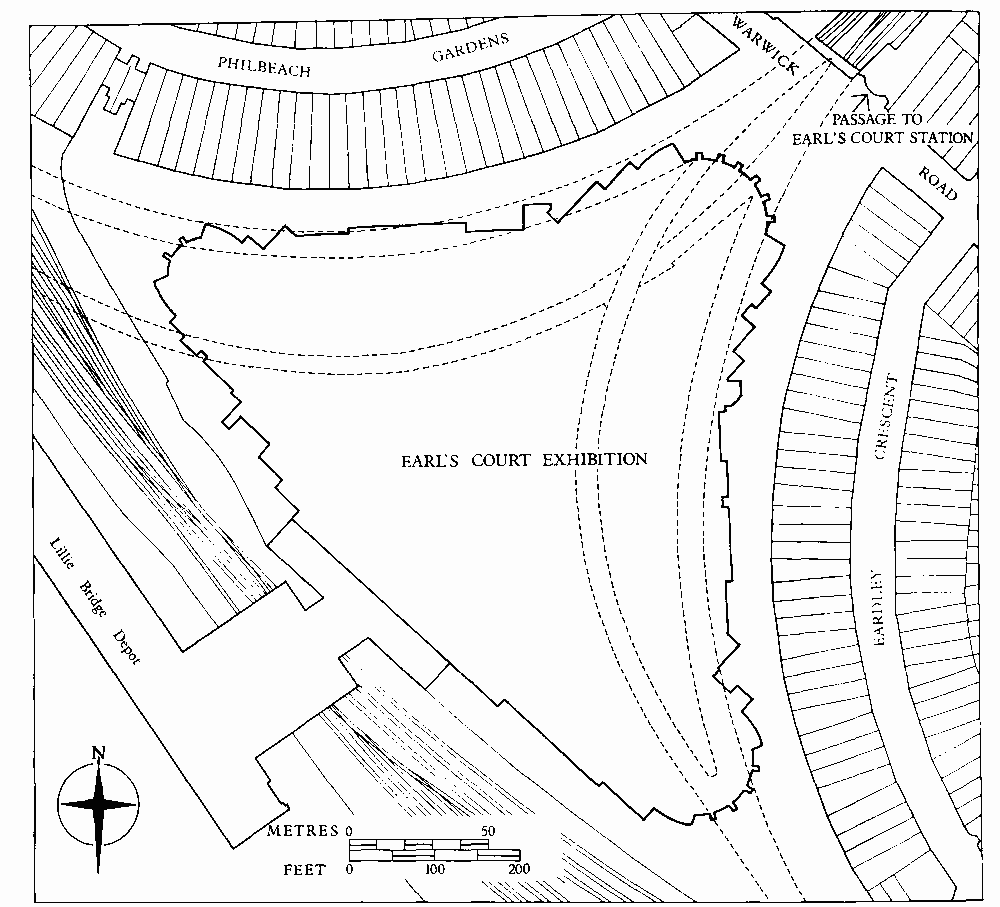
Earl's Court Exhibition, site plan of present building. Based on the Ordnance Survey of 1973–6
The immediate post-war history of the grounds is not inspiring. By now the site had reverted to the Underground Electric Railways Company of London, as successors to the Metropolitan District Railway Company. Some parts were used as a bus depot, in others a circus was held sporadically, others again lay derelict. The Empress Hall, as the theatre was by now known, was put to sundry uses for storage and for the assembling of experimental 'mock-ups' for stations. In 1929 the U.E.R.L. tried to promote a new exhibition building, but this came to naught. Nor for the moment did a less ambitious proposal of 1932 to turn the Empress Hall into an ice-hockey rink prosper. (fn. 106)
The present Earl's Court Exhibition
In 1935, with the end of the old lease in sight, a new scheme appeared—seemingly the brainchild of Frank Reginald Lewis. The London Passenger Transport Board, by now the freeholders, promised a new ninety-nine-year lease of some eighteen and a half acres to a resuscitated Earl's Court Limited, in which American interests became prominent. The company started its programme by renovating the Empress Hall, which reopened as an iceskating rink seating 7,000 in November 1935. On the eastern triangle the company proceeded to build the present exhibition hall. C. Howard Crane of Chicago was the architect, with Gordon Jeeves as his English representative and Robert J. Siddall as chief consulting engineer. The main contract was managed by Hegeman-Harris of New York, who had organized construction of the Rockefeller Center; their role was essentially one of coordinating a long list of sub-contractors. (fn. 107)
The building was constructed at speed between January 1936 and July 1937. It cost £1.5 million and was one of the largest reinforced concrete structures then existing. All the foundations and reinforcement were designed by the English subsidiary of the French firm L. G. Mouchel and Partners. One feature of the work was the covering-over of the two curves of the District Line to form roadways. This contract was executed by Sir Robert McAlpine and Sons Limited directly for the London Passenger Transport Board. The Board stipulated that no loads from the superstructure should fall directly over tracks or tunnels. Therefore the reinforced concrete beams had to be of great strength and size, the largest amounting to ninety-seven feet in length and 1,200 tons in weight. Mouchels were just then beginning to adopt Freyssinet's method of prestressing beams and considered using it here to lighten the mass of concrete, but the delays that would have been necessary to perfect the new technique narrowly prevented the Earl's Court Exhibition from becoming Britain's first pre-stressed building. (fn. 108)
By the nature of the site the building itself was triangular, with entrances at the three corners (fig. 135). In style it was up-to-date and striking but not distinguished. The main front (Plate 136b) bore a strong resemblance to the unbuilt design for an 'International Music Hall and Opera House' designed just previously for Hyde Park Corner by the consortium of American architects involved in the building of Rockefeller Center, together with Crane. (fn. 109) Nearly 450,000 square feet of exhibition space were provided, without any columns impeding the view. The upper floor was divisible into three sections, so that four exhibitions could be shown simultaneously. A large swimming pool was included, built in three sections which could be lowered or raised with hydraulic jacks. Concealed artificial lighting in various colours was installed, and hot-air heating supplied from seven large thermal storage tanks via the same system of filters and ducts as the cool-air ventilation.
The Earl's Court Exhibition Building continues in use today and is substantially the same as when first built, despite much modernization. After various changes of ownership it is now controlled by Earl's Court and Olympia Limited, a company itself controlled at the time of writing by Sterling Guarantee Trust Limited. The freehold of the site now belongs to London Regional Transport, the latest body in succession to the Metropolitan District Railway.
Developments stemming from Transport since 1945
The opening in 1941 of the road bridge linking West Cromwell Road with Talgarth Road set the scene for the transformation of Cromwell Road into a major arterial road. It offered a new and faster route from central London to Hammersmith and the Great West Road beyond. Above all, with the post-war emergence of Heathrow Airport, which lacked the benefit of rail connection until 1977, Cromwell Road became the natural thoroughfare for international travellers coming in and out of the capital. This had far-reaching effects on South Kensington and Earl's Court. Physically it made its direct impact in two ways, through the building of the West London Air Terminal in 1957–63 and the springing-up of a rash of international hotels on the face of the area.
The West London Air Terminal
While Croydon remained London's chief airport, the main airline terminal in central London was by Victoria Station. But when Croydon was gradually supplanted by Heathrow from 1946 onwards, this location became less logical. A joint committee of the airlines, British Railways and London Transport therefore investigated the problem and decided that as money for a rail link with Heathrow was unlikely to be quickly forthcoming, it was best to build a large terminal in west London, at the edge of the more congested area of London's traffic. The best site which the committee was able to identify in its report of 1954 was the 'Cromwell Curve', which was already in the ownership of London Transport, easily accessible by road from Heathrow, and close to Gloucester Road Station. (fn. 110)
In order to use the site effectively, it was first necessary for London Transport to cover most of the tracks and the central area of the triangle with a concrete raft, as had been done at the Earl's Court Exhibition twenty years previously. Only the west end of this raft was at first constructed; it was begun in 1955 and finished only in April 1957. As British European Airways needed to have its terminal ready by September 1957, their in-house architects together with Air Terminals Limited (the company officially in charge of the project) engaged Richard Costain Limited to erect a modest, short-life building which could be put up quickly. This was done by using a modified version of a standard prefabricated system, with structural members of hot-rolled steel, welded box stanchions and mahogany panels for cladding. It was finished seven weeks ahead of schedule. This original two-storey West London Air Terminal remained in use for some years. (fn. 111)
By 1960 a permanent building had been planned to house B.E.A.'s main London offices and a much enlarged terminal handling up to 25,000 passengers per day. The architects for this scheme were Sir John Burnet, Tait and Partners, and the builders Holland and Hannen and Cubitts. Work on extending the raft and raising this commanding but not wholly coherent building took place mainly in 1962–3. (fn. 112) It functioned as B.E.A.'s main London terminal until the end of 1973, when facilities for checking-in there were suspended following a reduction in use. In 1983 J. Sainsbury Limited opened a large supermarket in the western half of the building, taking advantage of the ample spare car parking created by the vacation of the terminal. British Airways, of which B.E.A. became part in 1974, occupied the upper parts of the building until July 1985. (fn. 113)
Hotels
Before the First World War hotels were few in number in southern Kensington. The notable example in the environs of Cromwell Road was Bailey's Hotel, opened close to Gloucester Road in 1876 (see page 181). As the district declined socially in the inter-war period, residential hotels and boarding-houses proliferated in old premises.
The opening of the air terminal, combined with the boom in tourism which London experienced in the 1960s, gave many of these existing hotels a fresh lease of life and brought a new set of larger ones into being. The neighbourhood of the West London Air Terminal was particularly touched by the Development of Tourism Act of 1969, whereby hoteliers building over the next four years could earn a subsidy of £1,000 per bedroom. (fn. 114) The London Tara Hotel in Scarsdale Place (page 108), the London Penta (now the Forum) in Ashburn Place (page 182), the Gloucester in Harrington Gardens (page 182), the London International in Cromwell Road and the Elizabetta, also in Cromwell Road (page 299), were all built in these years. None reached a high architectural standard; the whole crop of subsidized hotels was comprehensively indicted by Lance Wright in the Architectural Review. 'The most offensive single thing about the new flight of hotels,' wrote Wright in 1972, 'is the way in which they arrogate a civic importance which they do not deserve.' (fn. 115) These heavy buildings, intensively used for business events as well as for accommodating tourists, have altered the social as well as the physical character of this portion of Kensington.
Like the West London Air Terminal, two of the hotels were built upon railway land, the London Tara (Plate 44a) on the old Midland Railway's goods yard, and the London International on the south side of Cromwell Road, over the tracks leading out of the Cromwell Curve towards Earl's Court Station. Other hotels of this vintage are discussed elsewhere (see above); by way of example, the London International Hotel is considered here. Plans for this project, then backed by Transworld Hotels Limited, were made in 1967. As at the air terminal, a reinforced concrete raft had to be laid over a steel bridge by London Transport all the way from Cromwell Road to Knaresborough Place, with no support at all between the tracks, before the hotel could be built. The engineers for this complicated work were Brandt and O'Dell. The London International Hotel itself, designed by George Beech, was first conceived as a tower block, but after objection the height was reduced to a hundred feet. Built in stages between 1968 and 1972 at a cost of some £4,730,000 to accommodate 850 guests, it is in four blocks of which the most south-westerly stands on the west side of Knaresborough Place, connected to the others by a bridge. The structural frame is of steel, with pre-stressed concrete beams for the floors and aluminium curtain walling. The contractors were Trollope and Colls, whose parent company, Trafalgar House Investments, bought the hotel from the original clients during the process of construction. The revolving stainless steel globe in front of the main entrance was designed by John Hardman Studios of Birmingham. Beech designed much of the internal finishings, including the 'Cavalier Restaurant' and 'Stuart Bar' where according to Building Specification the walls were 'covered in brown velour hung with Laughing Cavalier period pictures'. (fn. 116) At the time of writing these attractions have given way to the Aviary Coffee House, the Earl's Dining Room and the Heritage Bar.