Magna Britannia: Volume 6, Devonshire. Originally published by T Cadell and W Davies, London, 1822.
This free content was digitised by double rekeying. Public Domain.
Daniel Lysons, Samuel Lysons, 'Antiquities: Ancient church architecture', in Magna Britannia: Volume 6, Devonshire(London, 1822), British History Online https://www.british-history.ac.uk/magna-britannia/vol6/cccxxiii-cccxlv [accessed 10 May 2025].
Daniel Lysons, Samuel Lysons, 'Antiquities: Ancient church architecture', in Magna Britannia: Volume 6, Devonshire(London, 1822), British History Online, accessed May 10, 2025, https://www.british-history.ac.uk/magna-britannia/vol6/cccxxiii-cccxlv.
Daniel Lysons, Samuel Lysons. "Antiquities: Ancient church architecture". Magna Britannia: Volume 6, Devonshire. (London, 1822), British History Online. Web. 10 May 2025. https://www.british-history.ac.uk/magna-britannia/vol6/cccxxiii-cccxlv.
In this section
Ancient Church Architecture.
Saxon. — The remains of Saxon architecture in the Devonshire churches are neither numerous nor particularly interesting. The most considerable are the two square towers of the cathedral built by Bishop Warlewast, and the churches at Bishop's Teignton and East Teignmouth, both of which appear to have been built about the same time. The tower at Bishop's Teignton, which stands between the nave and the chancel, is square, of very massive construction, with a circular turret at one of the angles. The west door exhibits the richest specimen of Saxon architecture in Devonshire, with grotesque heads, chevron, and other mouldings: the south door has a plain circular arch, on the transom stone of which are some kneeling figures, rudely carved, much defaced and obscured by white-wash. (fn. n1) The tower of East Teignmouth church is similar, and in the same situation as that of Bishop's Teignton; it has roundheaded windows, which occur also on the north side of the church. One of the doorways, which has a circular head, is enriched with Saxon mouldings.
In the churches of Bundleigh, Farway, Holsworthy, and North Petherwin, are some remains of Saxon pillars and capitals. In the chapel at Ford abbey is an arch slightly pointed, with chevron mouldings at each end of a groined stone roof.
In the churches of Axminster, Buckland Brewer, Tiverton, Loxbeare, Parkham, Paignton, Woolfardisworthy, in the hundred of Hartland, Beaworthy, Holcombe Burnell, Meeth, Stockleigh Pomeroy, and East Worlington, are doorways having circular arched heads, with chevron and other mouldings characteristic of the Saxon style. There are also arched doorways without enrichments, but evidently of this æra, in the churches of Bickleigh (near Tiverton), Bradford, Bradstone, Dunsford, High Hampton, High Bray, Holsworthy, Knowestone, Sutcombe, and Thornbury. At South Milton are two pillars of a Saxon doorway. At Downe St. Mary, over the doorway, are some rude Saxon carvings.
Thirteenth and fourteenth Centuries. — The chapel of St. Mary in Exeter cathedral is supposed to have been built by Bishop Simon de Apulia, in the early part of the thirteenth century; and the style of architecture appears to be of that period. The remains of the priory church at Frithelstock, founded in the beginning of the reign of Henry III., has three lancet-shaped windows at the west end. The chancel of Bishop's Teignton church has windows of a similar form; and there are some remains of the architecture of this date in the church of Aveton Giffard. The remains of the cloisters at Hartland exhibit the arches and columns in use during the reign of Henry III. The choir and nave of Exeter cathedral, designed by Bishop Quivil, who was promoted to the see in 1280, were begun by him, but the greater part was built by Bishop Grandisson, who was promoted to the see in 1327. The lower part of the chapter-house, from the style of its architecture, appears to have been built after Bishop Quivil's design. It is attributed to Bishop Lacy, who was not promoted to the see till 1420. The upper part of the building is of that age. The very rich façade at the west front, adorned with numerous statues of patriarchs, prophets, apostles, kings, bishops, &c. under enriched niches, was built by Bishop Brantingham towards the latter end of the fourteenth century.
The church of Ottery St. Mary, dedicated by Bishop Bronscombe in the year 1260, is a large structure, built in the form of a cathedral, with nave, choir, and lady's chapel, of a plain, and, for the most part, uniform style of architecture. The roof appears to have been finished by Bishop Grandisson, who made it collegiate. The bosses at the intersection of the groins are ornamented with foliage, and have his arms frequently repeated. The north aisle is of later date.
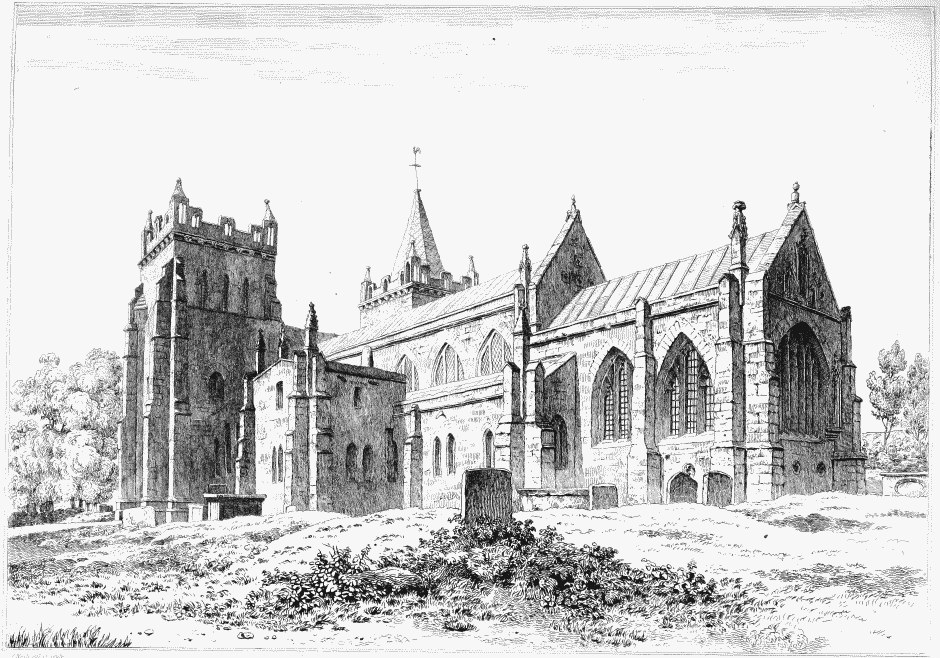
S. E. view of the church of Ottery St. Mary
Fifteenth Century. — Most of the parish churches in Devonshire appear to have been rebuilt in this century: they are distinguished by clustered columns, more or less ornamented with foliage, and by arches of a pointed form. Among the most handsome of these churches may be reckoned Ashburton, Broad Clist, Chittlehampton, Colyton, Collumpton, Crediton, Heavitree, Kenton, South Molton, Silverton, Swimbridge, and Tiverton.
The church of Crediton is a handsome structure, and exhibits several rich specimens of the style prevailing during this æra: it appears to have been erected towards the end of the fifteenth century; for Leland, who was at Crediton in the reign of Henry VIII., speaks of the parish church as of no antiquity, and William of Worcester, who was there in 1478, does not mention it. Honiton church appears also to have been built about the end of this century. The window of the south transept at Awlescombe is a rich specimen of the florid style prevailing about this period.
Sixteenth Century. — The principal specimens of the florid Gothic, which was in use in the reign of Henry VIII., are the chapel of Bishop Oldham, and Speke's chapel in Exeter cathedral; the north aisle of Ottery St. Mary, built when Voysey was Bishop of Exeter, much enriched with tracery and pendant ornaments on the ceiling; the chapel at Collumpton, built by John Lane, wool merchant, in 1528, richly ornamented in the same style, with figures of angels holding emblems of the crucifixion; the cloisters and hall at Ford abbey, built by Abbot Thomas Chard, in 1508; and Greenwaye's chapel at Tiverton, built in 1517. The latter is separated from the south aisle of the church by a rich stone screen. The roof is coved and enriched with tracery and pendant ornaments. The cornice has angels holding shields, with the founder's mercantile mark, and with anchors and woolpacks; the arms of the Drapers' company, and those of the Merchant Adventurers. The arms of Greenwaye are on the wainscot of the chapel. (fn. n2) The outside of the chapel is richly ornamented with tracery in stone, with shields and anchors. The cornice is carved with various subjects from the history of our Saviour. On a wide frieze are waves, with ships and boats; on another, immediately under the battlements, the arms of Greenwaye, &c., as in the chapel, and a shield with three roses and several quarterings, probably the arms of the founder's wife; the whole rather coarsely executed. On another frieze is this inscription:
Have grace, ye men, and ever pray
For the souls of John and Jone Greenwaye.
The Umberleigh aisle at Atherington, fitted up in the reign of Queen
Elizabeth, has the following inscription:
"God save the church, our Queen Elizabeth, and realme,
And grant us peace and truth in Christ. Amen."
Ancient painted Glass. — The painted glass of the cathedral was nearly all destroyed during the civil war. Some figures remain in the great east window; among these are the Virgin Mary, St. Catharine, St. Helen, St. Sidwell, King Edmund the Martyr, Edward the Confessor, St. Martin, with some of the prophets and patriarchs. In St. Gabriel's chapel is a figure of that archangel; in St. Mary Magdalen's is a portrait of Bishop of Stafford, in an attitude of devotion before that saint. The great west window, of painted glass, by Peckitt, of York, was fitted up in 1766.
There are few remains of painted glass in the Devonshire parochial churches, and those, for the most part, much mutilated; as at Abbot's Bickington, Bampton, Coleridge, Lamerton, and Lustleigh, consisting chiefly of figures of saints. At Clist St. George, the east window appears to have been ornamented with painted glass, at the expence of one of the rectors, whose figure is introduced in a kneeling attitude. On a scroll is the following imperfect inscription: "Ora pro Johi A. . . . . .lar rectori hujus ecclesie." In the central light is the crucifixion; on one side the virgin and child, on the other St. George, on foot, armed. In the church at Doddescombleigh are some remains of painted glass, representing the seven sacraments, with figures of saints, &c.
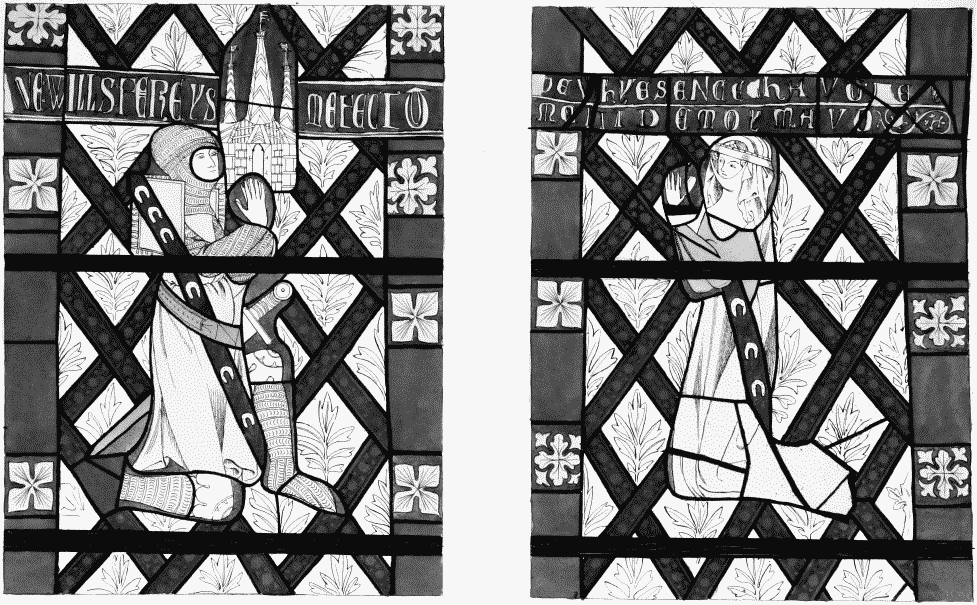
Painted glass in the east window of Beer Ferrers church
In the east window of the church at Beer Ferrers are some curious remains of painted glass, particularly the figures of the founder and his lady, as represented in the annexed plate, with an imperfect inscription, which denotes him to have been Sir William Ferrers. There are also the figures of St. Catherine and other saints, much mutilated. The different compartments of the window have borders formed of the arms of Ferrers and plain coloured glass placed alternately.
Rood-lofts, Screens, &c. — This county abounds in very rich remains of antiquities of the kinds here mentioned. Almost the whole of them appear to have been the work of the fifteenth century. The greater part of them are of wood, but there are also several of stone. At Totnes is a very elegant stone screen, represented in the annexed plate, with tabernacle work painted and gilt. It extends to one half of the chancel: the gallery of the rood-loft remains, the staircase to it being on the north side. At Culmstock is a stone screen, between the nave and chancel; it has a rich doorway, ornamented with foliage, and a tufted finial; on each side the doorway are three arches, with Gothic tracery: above the arches are scrolls, on which is inscribed, "Whan God woll better may hit be." At Colyton is an elegant open stone screen across the south transept. At Marldon is a rich screen of stone, and another at the end of the north aisle, with the cornices much enriched. At Luppit is a stone screen. At Awlescombe is the stone screen of a rood-loft, in the style of the fifteenth century, with angels holding scrolls in the springings of the arches. At Bideford is a stone screen between the chancel and the south aisle, with several shields of Grenville, connected with the monument of Sir Thomas Grenville (1513). At Paignton, in the south aisle, is a rich stone screen, with shields similar to those in use in the reign of Edward IV., connected with monuments of the Kirkham family.
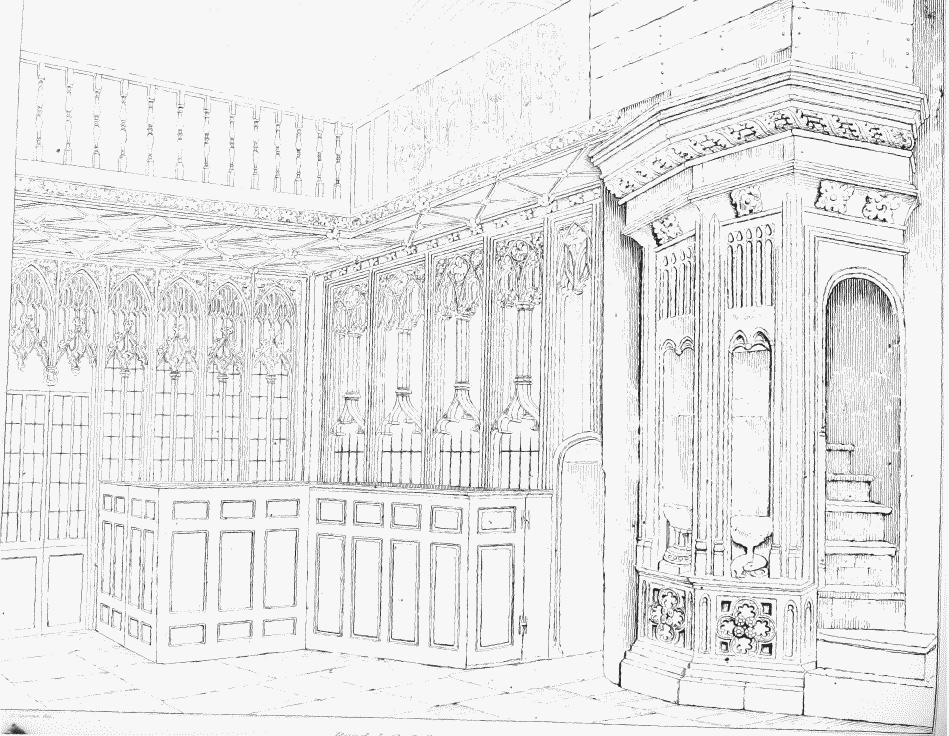
Rood-loft and screen in Totnes church
The costly stone screen at the east end of the choir of Exeter cathedral, erected by Bishop Stapeldon, is supposed to have been demolished about the beginning of Elizabeth's reign (fn. n3); its place was long supplied by a plain freestone wall, for which has been lately substituted a screen of enriched Gothic sculpture by Mr. Kendall; but it is to be regretted that this ingenious artist had not adopted the lighter style of architecture, which, no doubt, characterized the Bishop's screen, and which is seen in the remarkably beautiful adjoining stalls.
Among the most rich and curious of the wooden screens which have the rood-loft remaining, are those at Ashton, Berry Pomeroy, Bradninch, (extending across the nave and aisles, with the date 1528,) West Buckland, with heads and arabesque ornaments, the projecting part of it particularly well carved; Clist St. Lawrence; Collumpton, with cornice of vineleaves, &c.; Dartmouth (uncommonly rich); Feniton (very rich and complete); Halberton; Harburton, and Honiton (both very rich and entire); Kentisbere; Kenton, with scrolls, on which is the Belief in Latin; Marwood (inscribed Sir John Beapul, persone of Merewode); King's Nympton; Peahembury; Pinhoe, with rich mouldings of vineleaves, bunches of grapes, &c.; Plymtree; Poltimore; Sampford Peverell, Swimbridge, richly ornamented with vine-leaves, &c.; Tallaton, very rich and complete; Tiverton, richly ornamented, and with side screens; Tor Bryan, Trusham, and Uffculme, with foliage, richly gilt and painted, as are several of those above mentioned. Most of them have figures of saints, &c., painted on the lower compartments. At Tor Mohun is a screen with the joists of the rood-loft remaining over the Ridgway chapel. At Atherington is a very rich screen across the north aisle, with the gallery of the rood-loft remaining: it originally extended across the whole church. At Dawlish part of the rood-loft and screen remain. At Malborough the projection of the rood-loft remains across the north aisle.
In numerous churches, the screen of the rood-loft only remains; in the following they are particularly rich, and most of them are painted and gilt: Bridford, Bovey Tracey, Burlescombe, Chivelstone, Clayhanger, Clist St. Lawrence, Dartington, Dowland, Little Hempston, Holne, Lapford, Manaton, West Ogwell, Pilton, Plymstock, Portlemouth, Shipstor, and Staverton. Those at South Brent, Christow, Rattery, and Wolborough, extend across the nave and aisles.
There are screens of a less ornamented description at East Allington, Alphington, Ashcombe, Blackauton, (ornamented with pomegranates,) North Bovey, High Bray, Burrington, Broadwood Wiger, Buckland-in-theMoor, Chawley, Chulmleigh, Cockington, Coleridge, Churston Ferrers, Comb in Teignhead, Dodbrook, East Downe, Dittisham, Ermington, (with ornaments in the Holbein style,) Broad Hempston, Hennock, Heanton Punchardon, South Huish, Ilsington, Ipplepen, Kenn, Abbot's Kerswell, Littleham, Lustleigh, St. Mary Church, South Milton, North Molton, Monkleigh, Moreton Hampstead, North Petherwin, South Pool, Powderham, Sherford, Slapton, Stoke Gabriel, Stoke Rivers, Stoke in Teignhead, Stokenham, East Teignmouth, and Ugborough.
At Heavitree only the lower part of the screen remains, formed into pews, with paintings of saints. At Romansleigh and Sampford Courtenay are remains of screens. At Throwley is the base of the screen, painted with Scripture subjects (1544). At Ashprington is part of a screen, which has been much cut away. At North Huish, Whimple, and Widdecombe-in-theMoor, are remains of screens. The screen at Holbeton, which was at the end of the nave, has been cut down, but it remains in the north and south aisles, ornamented with roses, portcullises, pomegranates, and fleurs-de-lis. The screens have been removed, within a few years, from the churches of Coffinswell, Langtree, North Lew, and Uplowman. There was an elegant screen in the old church of St. Sidwell, with rich mouldings of vine-leaves, &c., which was taken down a few years ago, when that church was rebuilt. The screen at Langtree was rich and entire, ornamented with scrolls of vine-leaves, flowers, heads, &c., on the projecting fans, and shields of the age of Edward IV. That at North Lew is said to have been very rich.
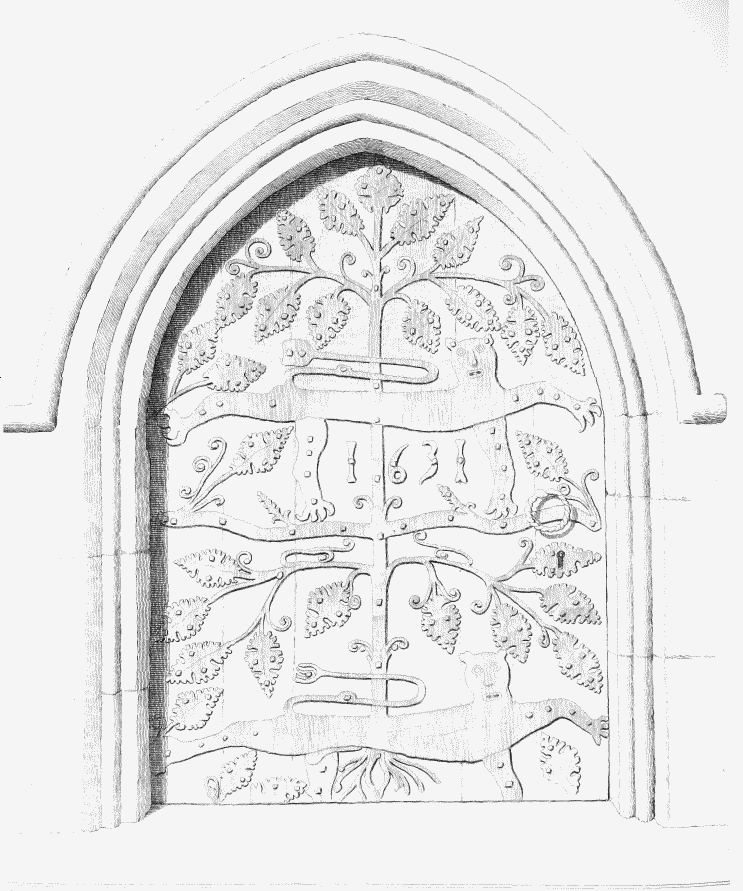
Door of Dartmouth church
In several of the churches the pews appear to be coeval with the roodlofts, which they resemble in their ornaments, as at Peahembury, &c. The pews in others are ornamented with grotesque figures carved in wood, as at Lew Trenchard, Pancras Week, &c. &c. The door at St. Saviour's at Dartmouth, or at least its iron ornaments, appear to be coeval with the building of the church in the reign of Edward III. The date of 1639 must have referred to some repairs.
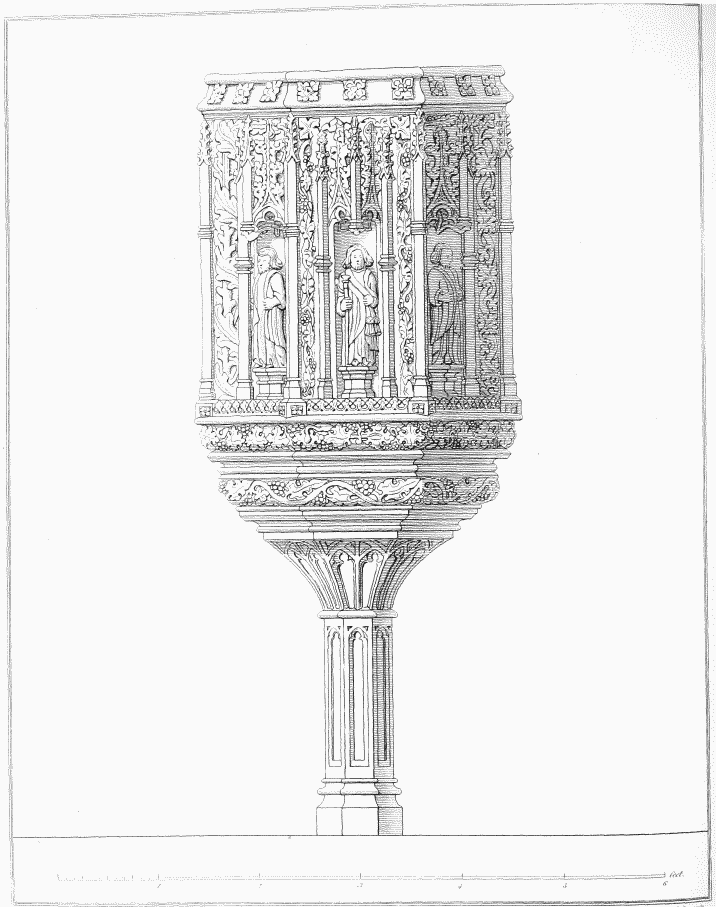
Stone pulpit at South Molton
Ancient Pulpits.— There are several richly ornamented ancient pulpits, both of stone and wood, in the Devonshire churches. At Bovey Tracey the pulpit is ornamented with foliage and tabernacle work, gilt; at Chittlehampton it is ornamented with scrolls of vine-leaves and figures of saints; at Dartmouth several enrichments, carved in wood, have been added to the stone pulpit, and are evidently of later date. The pulpit at Dittisham has figures under niches, rudely executed, with alternate scrolls of vine-leaves and other foliage; that at Harberton is richly ornamented with scrolls of vine-leaves and grapes, and the figures of the evangelists and other apostles, in niches; the pulpit at North Molton is enriched with tabernacle work and tracery; that of South Molton, of the same description, which is particularly rich, is represented in the annexed plate. The stone pulpit at Paignton is ornamented with vine-leaves and other foliage; that at Pilton with Gothic tracery; that at Swimbridge with figures of saints; that at Witheridge with sculpture of saints, crucifixes, &c. The stone pulpit at Totnes is on a pedestal, with Gothic tracery and shields.
Among ancient enriched wooden pulpits, those of East Allington, Bridford, Halberton, Holne, Ipplepen, Kenton, Malborough, Pinhoe, and Tor Bryan, may be particularized. Some of these are painted and gilt, and are evidently of the same date as the rood-lofts, by the resemblance in their enrichments.
Stone Stalls.— In Axminster church are three stone stalls of unequal height, with trefoil arched heads, and an elegant piscina; at Bigbury, three with plain pointed arches, and a piscina; at Broad Clist, three of equal height, connected with a monument (fn. n4); at Cornwood, three of unequal height, with plain trefoil-arched heads and a piscina; at Crediton, the remains of three, with arched heads of remarkably rich tracery.
In the Lady's chapel in Exeter cathedral, are three stone stalls, with highly pointed arches and a double piscina. On the south side of the choir, are three of great beauty. The seats are of unequal height; the backs, which are semi-octagon, are richly ornamented with mosaic work; the canopies, which are octagonal, are surmounted by lofty pinnacles, with finials; the whole richly ornamented with foliage.
At Harberton, are three stone stalls, very much enriched, and a piscina; at Lustleigh, three of equal height, with plain trefoil-arched heads and a double piscina; at Maristow, two similar ones of equal height; at Newton Ferrers, three with very pointed arches and a double piscina; at West Ogwell, three of equal height, with trefoil arches upon detached columns; at Plympton St. Mary, three and a piscina; and at Yealmton, two with plain pointed arches upon detached pillars.
At Dartmouth, the communion-table is surrounded with seats, the upper parts of which are enriched with arabesque ornaments and arms. The table is supported by grotesque figures, and the four Evangelists with their symbols.
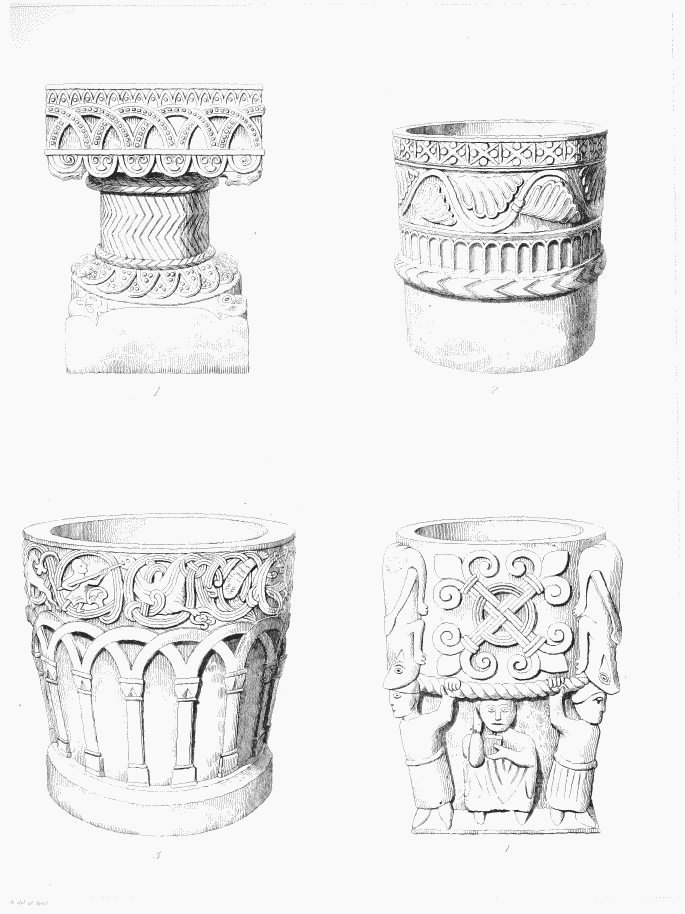
Fonts
1 - Hartland; 2 - St Mary Steps, Exeter; 3 - Alphington; 4 - Stoke Canon
Fonts.— Few of the fonts in this county claim particular notice. Among many of circular form and an early age, enriched with various carved mouldings, wreaths, scrolls, or foliage, may be enumerated those of Ashcombe, Bideford, Blackauton, South Brent, Dean Prior, Dittisham, St. Petrock in Dartmouth, St. Mary Steps in Exeter, Farrington, Harberton, Huxham, Loddiswell, Nymet Rowland, South Pool, Rattery, Stoke Fleming, Bishop's Teignton, Drew's Teignton, Twitchen, and Ugborough. At South Milton and Topsham, the fonts are also circular, with figures of animals rudely carved; that at Alphington is surrounded with pillars and interlaced arches in low relief, with an ornament of grotesque figures over them. The font at Stoke Canon has figures and animals of very coarse workmanship.
There are ancient square fonts, for the most part supported by four pillars and a large pedestal in the centre, at Bundleigh, Dodbrook, Holne, Honeychurch, Honiton Clist, Kenne, North Lew, Lifton, Mariansleigh, Maristow, Petrockstow, Sherwell, Washfield, Wembury, Woodleigh, and Woolfardisworthy. (fn. n5) At Ashwater, Holbeton, and Luppit, are square fonts with rude figures of animals; that at Ashwater has grotesque heads at the angles. The fonts at Christow, Hittesleigh, Loxbeare, Newton Tracey, Roseash, Bishop's Tawton, and Thelbridge, have square Saxon fonts on circular pillars, or pedestals. Those at Bishop's Nympton, Woolfardisworthy (fn. n6), and Dolton, are square, on a square base; the latter is highly enriched, but the ornaments are much worn.
The fonts at Broad Hembury and North Molton are octagonal, very richly ornamented with quatrefoils, foliage, and the figures of saints under niches. The fonts at Cockington and Dunsford are octagonal, ornamented with coats of arms; at Plymtree, with quatrefoils and tracery; at Tor Mohun, with foliage, and winged figures at the angles as supporters. The fonts at Challocombe, Linton, and East Teignmouth, are octagonal, on pillars; the latter enriched with quatrefoils, &c. in pannels, and foliage. At Bigbury, the font is octagonal, with carved pannels and shields on the sides, and supported upon a base fancifully ornamented with tracery and small pillars. At Shipwash, the font is square upon the top, curved below, and connected with a plain octagonal base, upon which it stands. Three sides of the font are plain; the fourth, enriched with foliage slightly carved upon its surface. The font at Beer Ferrers consists of a truncated polygonal shaft, resting upon four foliated ornaments, encircled by a band of rather coarse execution.
Ancient Sepulchral Monuments. — Few instances occur in this county of ancient monuments of ecclesiastics without inscriptions, distinguished by crosses flory, &c. There are such in the ruins of Canonleigh priory, at Coleridge, Hittesleigh, and Offwell. At Chittlehampton is a slab with a cross flory fitcheé, having a tall shaft resting on a base, on which are the following arms: — A bend engrailed, cottised; on the slab is inscribed in text characters, the letters being on each side of the shaft, "Orate pro a[nim]a Joh. Doble."
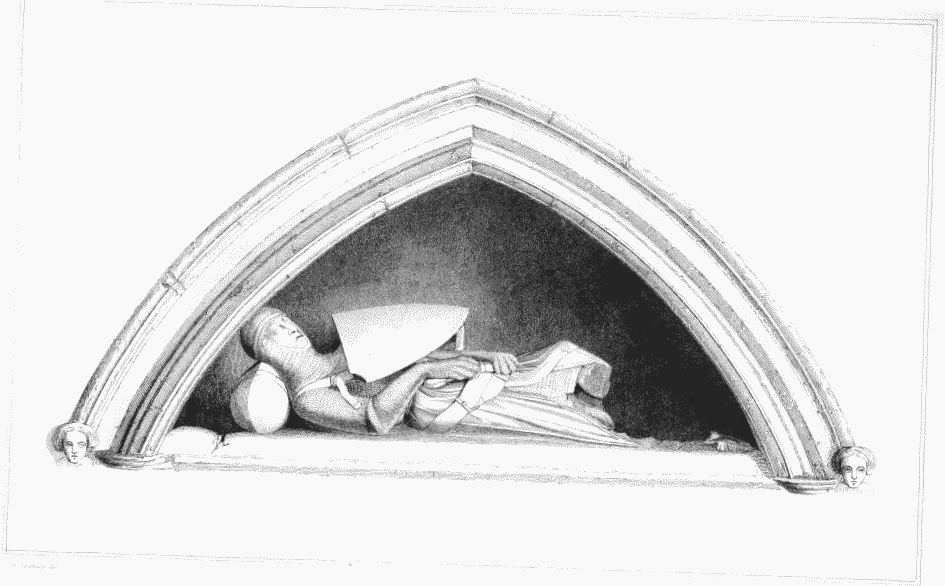
In Axminster church is a mutilated effigies of an ecclesiastic, with a maniple suspended from the left wrist. Under the south tower of the cathedral is an altar-tomb, ornamented with quatrefoils, supposed to be that of John, Bishop of Exeter, who died in 1191: that of Bishop Leofric, under the same tower, was constructed in the reign of Queen Elizabeth. Two ancient monuments, supposed to be those of Bartholomew Iscanus and Simon de Apulia, Bishops of Exeter, have been lately discovered on removing the library in the Lady's chapel. The latter, which belongs to the thirteenth century (fn. n7), is represented in the annexed plate; the former is of ruder sculpture, and not so much raised.
Monument of a Crusader at Beer Ferrers
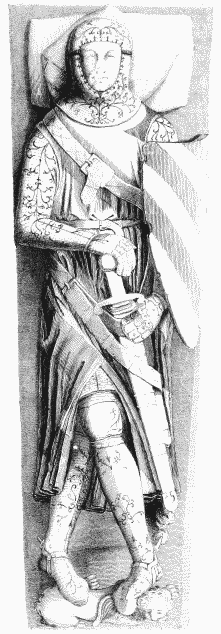
Effigy of a Crusader in Haccombe Church
Thirteenth and Fourteenth Centuries. — At Atherington is the effigies of a crusader, brought from Umberleigh chapel in 1818. At Beer Ferrers, on the north side of the chancel, is the monument of a crusader and his lady. He is habited in mail and surcoat; she in a veil and whimple. In the north transept is the mutilated effigies of a crusader in the act of drawing his sword, the shield angular; both doubtless of the Ferrers family, who possessed Beer Ferrers from a very early period. At Georgeham is the effigies of a crusader, rudely executed; with a plain shield, two angels at his head, and a lion at his feet (said to be Sir Mauger St. Albyn, who died 22 Edw. I.). At Haccombe is the effigies of a crusader in armour, richly inlaid with ornament, as shown in the annexed plate; on his shield the arms of Haccombe (either Sir Stephen or Sir Jordan de Haccombe).
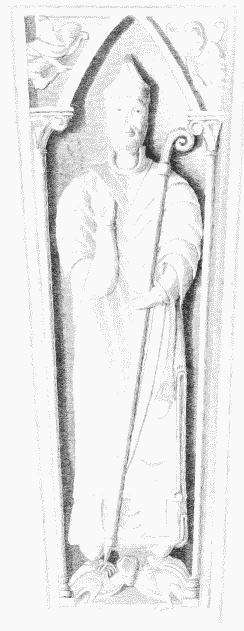
Monument of a Bishop at Exeter
In Exeter cathedral, in the south aisle of the choir, are the effigies of two crusaders. One of these, which is under an ogee arch, is in mail and surcoat, with a helmet under his head, and a dog at his feet; he has a long sword, which he is in the act of drawing: the other, which is under a plain arch, and has a round helmet, is in the act also of drawing his sword; at his feet is a lion. These monuments are said to be for one of the Chichester family, and Humphrey Bohun, Earl of Hereford. (fn. n8) At Iddesleigh, under a flat arch, is the effigies of a crusader, with a plain shield, said to have been intended for Sir John Sully. At Little Hempston is the effigies of a crusader, much mutilated and defaced; a lion at his feet; probably Sir John Arundell. At Weare Giffard, under a plain arch, is the effigies of a crusader, with that of his lady, in stone, much obscured by white-wash; he is represented in mail and surcoat, in the act of drawing his sword; she in a veil and whimple, with a coronet on her head, her hands joined in prayer. A mutilated effigies of a crusader, doubtless one of the Peverell family, has recently been discovered in the church of Sampford Peverell.
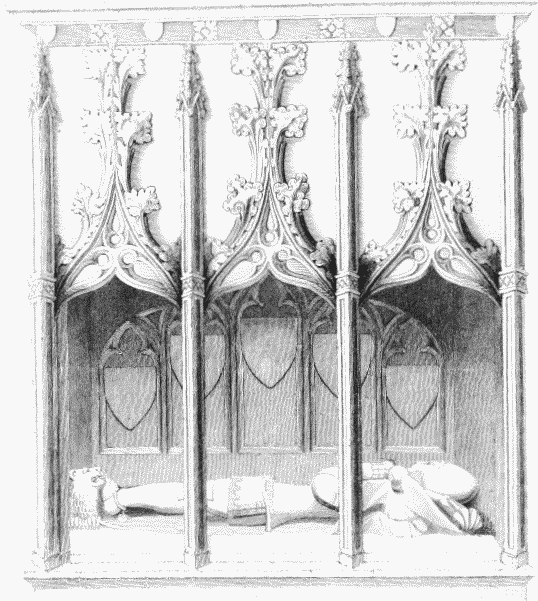
Stone seats and Monument at Broad Clist
At Arlington, in a little chapel on the south side of the church, is
the effigies of a lady, in a very good style, with a coronet, which may probably be attributed to the latter part of this period. At Atherington, under
a plain arch, on the north side of the chancel, is an altar-tomb, ornamented with shields: on the slab are the effigies of a knight and his lady;
the former in armour, with a pointed helmet, a lion at his feet, and on his
breast the arms of Champernowne (fn. n9); the lady is in a long loose gown,
with a mantle, and has a dog at her feet. At Broad Clist is a monument
connected with three stone stalls, as is shown in the annexed plate.
Behind the columns which support the arches, is the effigies of a knight,
in plate armour, with mail gorget, and a pointed helmet; under which
is the crest; a hand, with the fist clenched, rising out of a ducal coronet.
On the surcoat are lions rampant. At Dartington, under a trefoil-headed
arch, is an effigy, two feet in length, with curled hair and a long gown.
At West Downe, in the north transept, under an arch, is the effigies of
a female, in a loose dress with large collar; the whole much defaced. In
Exeter cathedral are monuments of Bishop Marshall, who died in 1206;
Simon de Apulia, before mentioned, who died in 1223, Walter Bronscombe, who died in 1280; and Walter Stapeldon, who was murdered by
the mob in 1326. That of Bishop Marshall is an altar-tomb of purbeck
marble, enriched with foliage on both sides. The effigies of the Bishop
is under a canopy, with a trefoil-shaped head; a dragon at his feet; his
right hand raised in the attitude of benediction, his crosier on the left.
The monument of Bishop Bronscombe, on the south side of the Lady's
chapel, consists of an altar-tomb, under a rich canopy, the cornice of
which is ornamented with angels playing on musical instruments; the two
in the centre holding shields, with the arms of Bronscombe. The monument is much enriched with quatrefoils, trefoils, &c., painted and gilt.
It has the following inscription:
"Olim sincerus pater omni dignus amore
Primus Walterus magno jacet hic in honore
Edidit hic plura dignissima laude statuta
Quœ tanquam jura servant hic omnia tuta
Atque collegium quod Glasney plebs vocat ois
Condidit egregium pro voce data sibi somnis
Quot loca construxit, pietatis quot bona fecit,
Quam sanctam duxit vitam, vox dicere quœ scit?
Laudibus immensis jubilet gens Exoniensis
Et chorus et turbœ, quia natus in hac fuit urbe.
Plus si scire velis, festum statuit Gabrielis.
Gaudeat in coelis igitur pater iste fidelis.
The monument of Bishop Stapeldon, on the north side of the choir, has the effigies of the Bishop in his pontificals, lying on an altar-tomb, under a depressed arch. It appears by the inscription that this monument was repaired at the expense of the rector and fellows of Exeter college, in 1733. Underneath is a long Latin epitaph, written in 1554, by John Hoker. (fn. n10)
Opposite to the monument of Bishop Stapeldon, is the effigies of a crusader in armour, said to be that of Sir Richard Stapeldon, the Bishop's brother, who lost his life at the same time; but there seems to be no particular reason for the supposition, nor any evidence to show for whom it was intended.
Under an arch, on the south side of the nave, is a lofty altar-tomb, enriched at the ends and sides with niches, shields, and quatrefoils, in memory of Hugh, Earl of Devon, who died in 1377, and Margaret, daughter of Humphrey Bohun, Earl of Hereford. On a slab of black marble are the effigies of the Earl and his Countess, much mutilated; at the feet of the former is a lion, at the lady's feet the remains of two birds.
At Little Hempston, in the south aisle, is the effigies of a knight in plate armour, with an oval helmet; a lion at his feet, the hands joined in prayer: on another tomb is the effigies of his lady, both much obscured by white-wash. At Haccombe, in the north aisle, under an obtuse arch, is the effigies, in free-stone, of a lady of the Haccombe family, as appears by the arms; probably the heiress, who married L'Ercedekne. She is habited in a veil and whimple, has angels at her pillow, and a dog at her feet; with her left hand she holds up her loose robe, which is tucked under her right. Under another arch is the effigies of a lady in a veil and whimple, her right hand holding the string of her mantle, her left a book; a dog at her feet. At Clay Hidon, under a trefoil-shaped arch, is the effigies of a knight, much mutilated.
At Lustleigh, in the north aisle, under two obtuse arches, are the effigies of a knight in armour, and his lady; he has his right hand on his shield; she is habited in a long gown. At the south end of the transept is the effigies, in stone, of a knight in a surcoat, with his right hand on his shield, the left on his sword; this figure is much mutilated. At Modbury is the monument of a knight and his lady, of the Champernowne family, much mutilated, under an open trefoil-shaped arch, with crockets and finials.
At Morthoe is an altar-tomb, the sides of which are rudely ornamented with tracery; the arms of Tracey, the crucifixion, &c. On the slab are cut the lines of the figure of an ecclesiastic in his robes, holding a chalice with both hands. It has the following mutilated inscription: .........ame de Traci ...l' ame eut merci. This monument commemorates William de Tracey, rector of Morthoe, who in 1308 founded a chantry in that church, and died in 1322. It has been erroneously ascribed to Sir William Tracey, one of the assassins of Thomas à Becket.
At Poltimore is a slab for John Bampfylde, at whose expense the church was erected, with the following inscription: MCCCXC. John Baunfeld et Agnes uxor ejus patr. et matr. Willi[am] Baunfeld qui hanc ecclesiā et magnā campanā fieri fecerunt." At Stoke Fleming is a slab with the effigies (cut on a brass plate) of a man with flowing hair, forked beard, a large dagger on his left side, long pointed shoes, his hands joined in prayer; his lady standing on a pedestal, with reticulated head-dress and a veil flowing on one side. Underneath is the following inscription: "Amys q[ui] passes ycy p Joh Corp et Elyenour....... ancy pies dieux pur charite q[ui] di lo almes aīe merce. Amen.
| Obiit in die Sci Georg. | Obiit in die Sci Joh[anni]. |
| An[n]o D[omi]ni Millo CCCLXXX primo. | Evangeliste Ao D[omi]ni. |
| Millo CCCLXImo. | |
At Widworthy, in the transept, under a flat arch, ornamented with quatrefoils, is the effigies of a knight in armour, with whiskers, habited in mail gorget, and pointed helmet; on his shield are the arms of Wootton. It must have been intended for William Wootton, who purchased Widworthy in the reign of Edward III.
I am not certain whether to refer the following to the fourteenth, or the early part of the fifteenth century.
At Broadwood Wiger, an altar-tomb, ornamented with niches, on which is the effigies of a knight, much mutilated and covered with whitewash; — at Bundleigh, an elegant monument, ornamented with quatrefoils, &c., with the effigies of a female in a loose robe; — at Feniton, on the south side of the chancel, an altar-tomb, ornamented with quatrefoils, on which is an emaciated figure in a winding sheet, larger than life; — at Horwood, in a window on the left of the altar, the effigies, in marble, of a lady, about four feet in length, habited in a loose dress, with a mantle; the head-dress reticulated in the form of a mitre; at the feet a plain shield; — at Haccombe between the nave and aisle, on a tomb, three sides of which are embattled, an effigy two feet two inches in length, of a person in armour, without a helmet; angels supporting the pillow; a dog at the feet; — at King's Carswell, a rich monument, much mutilated, having on an altar-tomb the effigies of a man with a pointed helmet, mail gorget, and surcoat, on which are the arms of Dynham (fn. n11), and that of a lady with a coronet, habited in a gown with a rich stomacher. In the north aisle of the same church, on an altar-tomb, the effigies of a lady, with a reticulated head-dress; two angels at her head, a wyvern at her feet; — at Luppit, an altar-tomb under an open arch of trefoils, much enriched with foliage, and having angels holding shields; the tomb ornamented with tabernacle work; the brass plates removed from the slab, except the arms of Carew, impaling three crescents; — at Membury, under a low circular arch, the effigies of a lady, habited in a long gown, with a veil and whimple; — at Plympton St. Mary, in the south aisle, under a rich canopy with an obtuse arch, an altar-tomb much enriched with tabernacle work, on which is the effigies of a knight in plate armour, much mutilated and obscured by white-wash; — in the north aisle of the same church, the remains of a rich monument, much mutilated, under a rich canopy of three arches, highly ornamented with crockets and pendents; the soffit enriched with tracery, as well as the back part of the arch: on the altar-tomb the effigies of a knight in plate armour, with a helmet under his head, and a wyvern at his feet; — at Shebbeare the effigies of a lady in a loose robe and veil, in the attitude of prayer; an angel at her head; — at Sherwell, on an altar-tomb with quatrefoils, that of a lady in a similar habit; a dog at her feet; — at Stoke Fleming, on an altar-tomb, the effigies of a lady with a turban head-dress, a book in her left hand, a dog at her feet; — and at Tamerton Foliot, in the chancel, an altar-tomb, bearing the effigies of a knight in plate armour; a lion at his feet: and that of his lady, with a dog at her feet, much covered with white-wash.
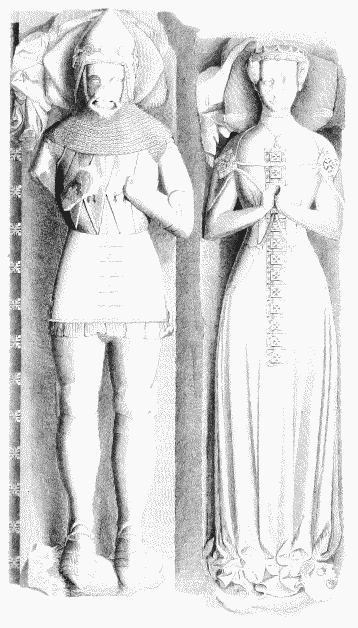
Monument of the Dinham family at King's Carswell
Fifteenth Century. — At Alwington, in the north transept, is a very small effigies of a lady, in a veiled head-dress, similar to those worn in the reign of Edward IV. In the south aisle at Ashwater, is the monument of Sir Thomas Carew, who married the heiress of Carminow. Under a Gothic arch, richly ornamented, are the effigies of Sir Thomas and his lady, recumbent; their hands joined in prayer. At Atherington is an altartomb, ornamented with quatrefoils, on the slab of which are the figures of a knight and his two ladies, on brass plates, with the arms of Basset impaling Grenville and Dennis: the ladies have angular head-dresses; the knight is in plate armour, with a long sword.
At Berry Pomeroy, is an altar-tomb ornamented with quatrefoils, under an obtuse arch, much enriched; the brass plates have been removed, but the arms of Pomeroy remain impaling Ashton. At Bigbury, is a monument to the memory of William Bigbury, the last of the family of that name, and his wife Elizabeth, who afterwards married Sir Thomas Arundell. The figure (on a brass plate) of William Bigbury, has been removed: that of his wife is represented in a veiled head-dress, gown, and mantle; two little dogs at her feet. There is only this fragment of an inscription: ". . . . . . . . . et domina Elizabeth uxor ejus, nuper uxor Thomæ Arundell de Com . . . . . . ." At Burlescombe is an altar-tomb, on the sides of which are angels under canopies, holding shields, in memory of Nicholas Ayshford, and Margaret and Isabella, his wives (the date obliterated). At Chittlehampton, on a grave-stone are the figures, on brass plates, of a man between his two wives, who are in veiled head-dresses, such as were worn in the reign of Edward IV. Underneath is the following inscription: — "Hic jacent Joh[ann]es Coblegh et Isabella uxor ejus que quidem Isabella obiit XXI. die Octob. Ao. Domi. MCCCCLXVI. nuper uxor Robert Cornew armigeri et Johanne uxor pdi. Johis Coblegh que quidem Johanne obiit ult. die Septemb. Ao. D[omi]ni. MCCCCLXXXo."
At Colyton, is a monument much enriched with tabernacle work and tracery; with an altar-tomb, bearing the effigies of a young lady in a gown, with a coronet on her head, her pillow supported by angels, a dog at her feet. This monument, which has the royal arms and those of Courtenay, was put up in memory of a daughter of William Courtenay, Earl of Devonshire, by his wife Catherine, daughter of King Edward IV. A vague tradition, that this young lady was choaked with a fish-bone, has occasioned it to be called the monument of "little choak a bone."
At Dartmouth, on a slab, are the figures, on brass plates under rich Gothic canopies, of a knight in plate armour, with mail gorget, between his two wives, taking hold of the hand of one with his right hand, and having the left on his belt; a lion at his feet, and two dogs at the feet of each of the ladies. Underneath is the following inscription: — "Hic jacet venerabilis vir Johannes Hawley istius cancelle fundator qui obt. XXI. Octob. M . . . . . . . . dicta jacet uxor ejus. . . . . . . . . noie Johna que obiit XII. die Julii ao. d[omi]ni MCCC. nonagento q[ua]rto. In par . . . . . . . . . que obiit VII. die Januarii anno d[omi]ni . . . . . . . . CCCCo tercio quor animar. propicietur Deus."
In the nave of Exeter Cathedral, near the monument of his father, (before mentioned), is the tomb of Peter Courtenay, Earl of Devon, a distinguished military character, in the reign of Henry IV., who died in 1409.
On a marble slab is his figure, under a Gothic canopy, on a brass plate, in
plate armour, with pointed helmet, a long sword, and dagger; a helmet,
lamberquin, and the crest of Courtenay, (a plume of feathers issuing out
of a ducal coronet), a dog at his feet. Underneath is the following inscription: —
"Devoniæ natus comes Petrusque vocatus
Regis cognatus, camerarius intitulatus,
Calesie gratus, capitaneus ense probatus,
- - - - - - - - - - - - - (fn. n12)
Cælo firmatus maneat sine fine beatus."
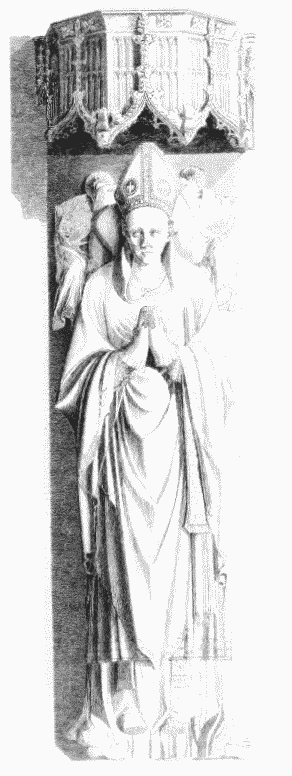
Monumental effigies of Bishop Stafford at Exeter
The monument of Edmund Stafford, Bishop of Exeter, and some time
Lord Chancellor, who died in 1419, is in the chapel of St. Gabriel, on the
south side of the Lady's chapel. It is a very handsome monument of alabaster, with the effigies of the bishop in pontificalibus under a canopy, with
his arms: (Or, a chevron, G. a border Az., charged with mitres of the
field). Round the tomb is the following epitaph: —"
Hic jacet Edmundus de Stafford intumulatus,
Quondam profundus Legum Doctor reputatus,
Verbis facundus, Comitum de stirpe creatus;
Fælix et mundus, Pater hujus pontificatus."
In the chapel is a grave-stone, with the effigies, engraved on a brass plate, of Walter Langton, cousin of Bishop Stafford, who was Canon of Exeter cathedral, and died in 1413. In the vestry chapel, under the north tower, is the tomb of William Pylton, secretary to King Henry IV. On the north side of the choir, is the monument of Edmund Lacy, Bishop of Exeter, who died in 1475; it consists of a plain altar-tomb; on the screen above are the arms of Lacy; 3 swans' heads erased. (fn. n13)
In St. Giles's church, near Torrington, is a slab, with the figure on a brass plate, of a lady in a veiled head-dress and long gown; with the following inscription: — "Hic jacet Alyanora Pollard que fuit uxor Joh[ann]is Pollard et filia Joh[ann]is Copleston qui obiit xxi die mensis Septembris Anno D[omi]ni Millmo. CCCCXXXo. cujus anime propicietur D[ominu]s Amen."
At Haccombe, between the chancel and north aisle, is the monument of Sir Hugh Courtenay, who married the heiress of L'Ercedekne; consisting of a large altar-tomb, which bears the effigies of the deceased and his lady, in freestone. He is represented in plate armour, with a pointed helmet; under his head the crest of Courtenay; a lion at his feet. The lady has a reticulated head-dress covered with a veil, a dog at her feet. At Marldon, is a monument of one of the Gilbert family, with his effigies, smaller than life, much mutilated; the shield of the form which was in use in the reign of Edward IV. At Monkleigh, is an altar-tomb, with tabernacle work, under a flat Gothic arch, much enriched, said to be the monument of Sir William Hankford, Chief Justice of the King's Bench, who died in or about 1424. At Bishop's Nympton, is a monument consisting of an altar-tomb, enriched with a double row of quatrefoils under a flat Gothic arch, without inscription, said to be one of the Pollard family.
Monumental screen in Paignton church
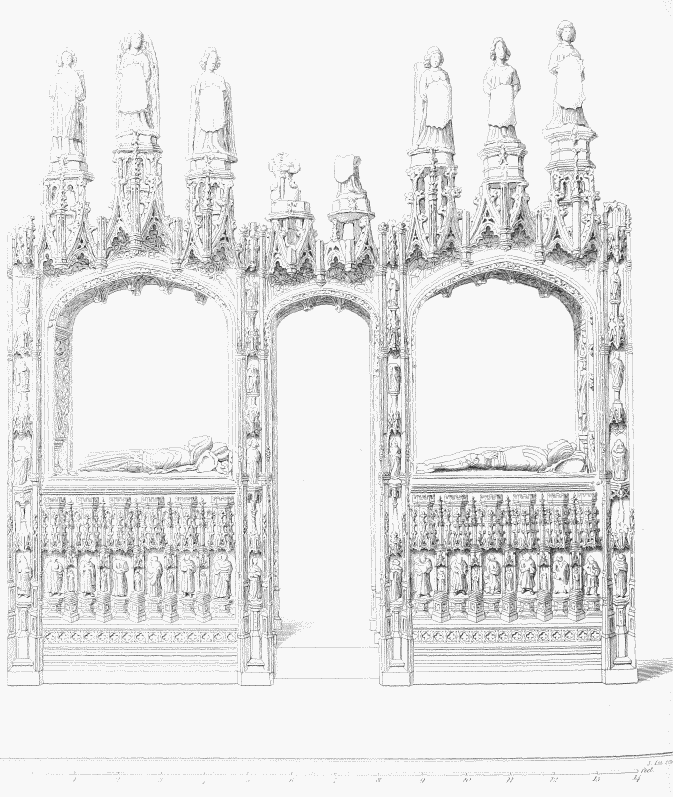
At Paignton, in the south aisle, is a very rich monumental screen of three open arches, with the figure of a knight and his lady, supposed to be of the Kirkham family, lying under the two side arches, upon bases ornamented with small statues in canopied niches. A similar enrichment is introduced on the piers of the arches, and the whole is surmounted with figures of angels, holding shields of a form similar to those used in the reign of Edward IV.
At Powderham, in the window of the north aisle, is the effigies of a female in freestone, in a close-bodied gown and mantle, with a square head-dress, the hands in the attitude of prayer, a dog at her feet: supposed to be one of the Courtenay family. At Thornbury, on a slab, are the figures on brass plates, of Sir Thomas Brooke and his lady. He is represented in a gown with short hair; she is in a gown with a mantle, her head-dress reticulated, with a veil; at his feet is a greyhound, at her's a lap-dog. The inscription is imperfect and wants the date: — ". . . . . . . . Thomas Brooke, Knyght, the which dyed . . . . . . ."
At Upton Pyne, in the south aisle, are two flat arches, under one of which is the effigies of a man in plate armour, a helmet under his head; on his shield are the arms of Larder. (fn. n14)
At Shillingford, is an altar-tomb under an obtuse arch, with the figure
on a brass plate, of a knight in armour, with surcoat, and his lady in a
mantle, with the arms of Courtenay. It has the following inscription: —
"Conditor et redemptor corporis et animæ,
Sit mihi medicus et custos utriusque."
"Dame Kateryn ye wife of Sir William H...field, and daughter of Sir W. Courtenay, Knight." Sir William Huddesfield, was Attorney-General to King Henry VII. This monument belongs, probably, to the beginning of the following century.
At Yarnscombe is a flat arch, ornamented with quatrefoils and tracery, under which is a stone inscribed to the memory of John Cockworthy, Esq., who died in 14...
The emaciated figure, in a winding sheet, under an obtuse arch in the north aisle of Exeter cathedral, which has been erroneously called the tomb of one of the bishops, is probably to be referred to this century; and a similar figure in the north aisle of Paignton church.
Sixteenth Century. — At Berry Pomeroy, is a handsome monument for Lord Edward Seymour, (son of Edward Duke of Somerset), who died in 1593, Sir Edward Seymour, Bart., his son, and others of the family, with their effigies. At Bideford, on the south side of the chancel, under a screen of stone-work, is an altar-tomb, ornamented with quatrefoils and tracery: on the tomb is the effigies of a knight in plate armour, with straight hair, having his helmet, with the crest and lamberquin, under his head. Over the arch, on both sides, is this inscription: "Hic jacet Thomas Graunfyld miles patron isti eccle q. obiit viii die mensis Marcii A. D. MCCCCCXIII. cuju. . . . . . (the latter part of the inscription hidden by a pew).
In Branscombe church is the monument of the father and mother of Nicholas Wadham, the founder of Wadham College in Oxford. She was widow of John Kelloway, and the monument has the arms of Kelloway and Wadham. There are kneeling figures in alto relievo, of the two husbands and their children. At Broad Clist is the monument of Sergeant Drewe, who died about the year 1600, with recumbent effigies of himself and his lady. This monument may probably belong to the following century. At Cadleigh is the monument of Sir Simon Leach, who died in the reign of Queen Elizabeth, with kneeling figures under a handsome canopy, and the following inscription: "Here lye the bodies of Sir Symon Leach, Knight, son of Symon Leach, of Crediton, blackesmith; and of Lady Katherine Leach, his wife, daughter of Nicholas Turberville, of Crediton, Esq., whose true affection in religious wedlock caused their desire to make there bed together in the dust."
In the chancel at Chagford is a very rich monument with an altar-tomb, and two arches, all much enriched with arabesque ornaments in bas relief, for Sir John Whiddon, Knight, one of the justices of the King's Bench, who died in 1575. At Dartington is a monument of the Champernowne family, with kneeling figures of a man in armour (a helmet before him) with four sons and five daughters. At Dunsford are slabs in memory of Sir John Fulford, the builder of Fulford House, who died in 1580: and another of the family about the same period. At Ermington is a monument of purbeck marble, with the figures on brass plates of an old man in a gown kneeling, with his wife and daughter, with this inscription: "Here lyeth buried the body of Willia Strachleigh, of Strachleigh, Esquire, who dyed the xxi day of July in the yeare of our Lorde God 1583, and Anne his wife, the daughter and heyre of John Gould, of Dore, Esq., and Christian, their only daughter and heyre, who married with Christopher Chudleigh, Knight, by whom she had issue, John Strachleigh, John, Robert, Elizabeth, Marye, and Anne." Against the north wall is a monument of the Chudleigh family; an altar-tomb under an arch; the canopy is much enriched by arabesque ornaments.
In the north transept of Exeter cathedral, in the chapel of Dr. William
Sylke, precentor of the church, who died in 1508 (fn. n15), is an obtuse arch,
under which is the figure of a skeleton. In the north aisle, in the chapel
founded by Sir John Speke, in 1518, is the recumbent effigies of the
founder in armour. At the end of the south aisle is the enriched chapel
of Bishop Oldam, in which, under a flat ogee arch, is an altar-tomb ornamented with tracery and shields bearing the effigies of the Bishop. It has
the following inscription: "Hic jacet Hugo Oldam Ep[iscopu]s q. obiit xxv die
Junii An° D[omin]i Mill° CCCCC° XIX° cujs a...... In St. Gabriel's chapel,
on the south side the library, is the monument of Sir John Gilbert, who
was sheriff of the county in 1574, and his lady, with their effigies; in
the north aisle is an altar-tomb in memory of Anthony Harvey, Esq., who
died in 1564: on the north side of the choir is a plain altar-tomb for
Bishop Bradbridge, who died in 1578: under the south tower is the monument of Sir Peter Carew, with his effigies in a kneeling attitude, 1574,
removed from the north aisle; the monument of Sir Gawen Carew and his
lady, with their effigies, the dates (which were 1581 and 1589) gone; the
altar-tomb of Bishop Wolton, who died in 1594, remains on the south side
of the choir, but his monument, with the following inscription, has been
removed to the south tower:
"Hic jacet, haud jacet hic tumulo quem credis in esse
Terra nequit tantum contumulare virum:
Ingenium, genium, mores, pietatis honores
Eloquimur que pium busta perusta tegent
Falleris Ultonus tonus est, sic spiritus unde
Hoc nostri? tonus est cœlicus orbe tonans."
At Filleigh is a brass plate having the figure of a knight in armour kneeling, with a helmet and gauntlet at his feet, and the following inscription:
"Forget who can yf that he lyst to see
Fortescue of Fyllegh, the seventh of that degree,
Remembrance of a frynde, his brother Drake doth showe
Presenting this unto the eyes of moo
Hurtfull to none and fryndlye to the moste,
The earthe his bones, the heavens possess his goste.
Richard Fortescue died at Fyllegh yc last day of June, 1570."
At Harford, under an obtuse arch, ornamented with foliage, is an altartomb with quatrefoils, on which is the figure, on a brass plate, of a knight
in plate armour, with long sword, his helmet under his head: it has the
following inscription:
"Here lyeth the corps of Thomas Williams, Esquire.
Twice reader he in court appointed was,
Whose sacred mind to virtue did aspire;
Of parlement he speaker hence did passe;
The common peace he studied to preserve,
And trew religion ever to mayntayne,
In place of justice whereas he did serve,
And now in heaven with mighty Jove doth reigne.
Obiit primo die mensis Julii An° Dno, Mo. CCCCCLXVI. ætatis suæ anno quinquagesimo
secundo."
At Heanton Punchardon, in the chancel, is an altar-tomb in the style of Henry VIII.'s reign, with the initials R. C. on the spandrils; the upper part is richly ornamented with vine-leaves and grapes; in the middle are angels with shields bearing the arms of Coffin. The altar part has shields and roses, with a double row of quatrefoils. At Holcombe Burnell is an altar-tomb with shields under a flat arch, apparently of the time of Henry VIII., the spandrils and cornice enriched; at the back, in rude sculpture, is a bas relief of the resurrection. (fn. n16)
At Kentisbeare is an altar-tomb in memory of John Whiting, who died in 1529, and Anne his wife; and in the same church, on the east wall, the figure, on a brass plate, of Mary, daughter of Sir Robert Wotton, wife, first of Sir Henry Guldeford, and afterwards of Sir Gawen Carew; she died in 1558.
At Monkleigh is an altar-tomb, under a low flat arch, with ornaments in the mixed style which prevailed at this period, in memory of John Coffin, Esq., who died in 1566. At Pilton is a large handsome monument of stone for Sir John Chichester, who died in 1569. In the chancel at South Pool is the monument of Thomas Briant, rector; an altar-tomb under an obtuse arch, with the figure of an ecclesiastic under a Gothic canopy. The arch is much enriched with Gothic tracery, and at the back of it, in rude sculpture highly relieved, is a representation of the resurrection. (fn. n16)
At Tavistock is the monument of Sir John Glanville, one of the justices of the Common Pleas, who died in 1600, with his effigies in his judge's robes. In the south aisle of the chancel is a large monument of stone, with the effigies of a knight in armour and his lady, in memory of Sir John Fitz, of Fitzford (about the latter end of Elizabeth's reign: no inscription). In the burial-place of the Bourchiers, on the south of the chancel, among other monuments of later date, is that of Frances, Lady Fitzwarren, daughter of Sir Thomas Kitson, who died in 1586; it is under a rich canopy, of several arches.
At Thornbury is a monument of the Edgecumbe family, apparently of this century, with the effigies of a knight and his lady: he is in armour, with his left hand on his breast, his right on his sword: she is in a long robe, with ruff and collar. There are also three small figures, kneeling; two in armour, the other a female. At Woodleigh, in the chancel, is the monument of Thomas Smyth, rector, resembling that of Thomas Briant, at South Pool. At Yealmton is a slab with the figure, on a brass plate, of a knight in plate armour, with a long sword. It has the following inscription: "Hic jacet. Johan Crokker quonda[m] ciphorarius ac signifer illustrissimi viri regis Edwardi quarti qui obiit xiii die Marcii Anno D[omi]ni Milleso. quingentesimo octavo."
There are many handsome monuments of the seventeenth century, which are more particularly spoken of under the several parishes in which they occur; as of the Rolles at Bicton; the Leaches at Cadleigh; the Giffards at Chittlehampton; the Fulfords at Dunsford; the Chichesters at Eggesford; Sir John Doderidge, &c. in Exeter cathedral; Otho Peter at Exminster; the Bluetts at Holcombe Rogus; the Aclands at Broad Clist, and Landkey; the Tremaynes at Lamerton; the Harrises at Lifton; Sir Thomas Wise at Maristow; the Bampfyldes at North Molton, Poltimore, and Tamerton Foliot; the Drakes at Musbury; the Strodes at Plympton; the Northcotes at Newton St. Cyres; Sir R. Reynell at Woolborough, &c. &c. &c.
Monastic Remains.
The remains of monastic buildings in this county are inconsiderable. There is a wall of Canonleigh priory, about 45 paces in length, and the remains of an entrance-porch, which has been converted into a coachhouse. There are some remains of the priory church at Frithelstock, the west end of which has three lancet-shaped windows. The chapel of Ford abbey, built apparently in the early part of the twelfth century, has its groined stone roof remaining, with an arch at each end slightly pointed, and having chevron mouldings. The hall, cloisters, and entrance-tower, are of the reign of Henry VIII., built by Thomas Chard, the last abbot. Below the battlement of the tower is the following inscription: "Ano D[omi]ni millesimo quingesimo vic.mo. octao. A. D[omi]no factum est Thoma Chard Abb." Over the hall, below the battlements, are the unicorn, rose, and crown, within the garter, with the dragon and dog as supporters. The bay window over the door is much enriched with the arms of the abbey, the initials T. C., and a mitre frequently repeated. Over the cloisters in the quatrefoils are shields with a stag's head and crosier, the initials T. C., &c.
The refectory and abbot's hall of Tavistock abbey remain, but in an altered state, as mentioned in p. 474. The gate-house also remains, and a building with turrets and pinnacles, now converted into a mill. In the court, before the present abbey-house, is an arch, about nine feet high, and nearly 13 in width, supported by short slender pillars with rich foliated capitals, and within it several small trefoil-headed arches, in the style of the early Gothic of the thirteenth century.
The only remains of Hartland abbey are some parts of the cloisters with trefoil-shaped arches, now placed in the front of Mrs. Orchard's house, and the following inscription in Lombardic capitals: "Istud: quadratum: claustrum: . . . . . ci: edificatum: marmoreo: lapide: perfect: sumptibus: ac: annis A... Abbatis: et: arte: Joh[ann]is: Exonie (fn. n17) : sit: ei: gr:
There are some small remains of Polsloe nunnery in a farm-house built on the site. The crypt of St. Nicholas's priory at Exeter, with massive Saxon arches, remains in Mint lane, having been converted into a kitchen. The walls of the priory may be traced to a considerable extent. The steeple of the college at Slapton remains near the parish church. There are considerable remains of the conventual church of Tor abbey, in the garden of George Cary, Esq., particularly a fallen tower, in which is a doorway with a semicircular arch; there are fragments also of foliated capitals. The refectory has been fitted up as a chapel. A large gateway, not far from the dwelling-house, has two groined entrances. The four great arches of the tower of the conventual church at Buckland, are preserved in an upper room of the old mansion built on the abbey site.