Magna Britannia: Volume 4, Cumberland. Originally published by T Cadell and W Davies, London, 1816.
This free content was digitised by double rekeying. Public Domain.
Daniel Lysons, Samuel Lysons, 'Parishes: Edenhall - Grinsdale', in Magna Britannia: Volume 4, Cumberland(London, 1816), British History Online https://www.british-history.ac.uk/magna-britannia/vol4/pp100-109 [accessed 1 May 2025].
Daniel Lysons, Samuel Lysons, 'Parishes: Edenhall - Grinsdale', in Magna Britannia: Volume 4, Cumberland(London, 1816), British History Online, accessed May 1, 2025, https://www.british-history.ac.uk/magna-britannia/vol4/pp100-109.
Daniel Lysons, Samuel Lysons. "Parishes: Edenhall - Grinsdale". Magna Britannia: Volume 4, Cumberland. (London, 1816), British History Online. Web. 1 May 2025. https://www.british-history.ac.uk/magna-britannia/vol4/pp100-109.
In this section
Edenhall
EDENHALL, in Leath ward, lies four miles from Penrith. The first proprietor of the manor upon record is Henry Fitz-Swein; in the reign of Henry III. it belonged to Robert Turp; a co-heiress of that family, after three descents, brought it to the Stapletons, in whom it continued five descents, and then passed with a co-heiress to the Musgraves in the reign of Henry VI. Sir Richard Musgrave, who had been made Knight of the Bath at the coronation of James I. was made a baronet in the month of June 1611, being one of the second list after the institution of the order. Sir Philip Musgrave, the second baronet, distinguished himself in the civil wars on the side of King Charles I. and is said to have been one of the last who despaired of the royal cause; he took Carlisle from the parliament in 1648, and was made governor of that city. The present baronet is Sir Philip Musgrave, as yet under age; Eden-hall is in the possession of his mother Lady Musgrave, relict of the late Sir John Chardin Musgrave, Bart. The singularly curious glass vessel, called the Luck of Eden-hall, has been already spoken of.
On the west side of the tower and in the south window of the parish church are the arms of Stapleton, Vipont, Musgrave, and Hilton. In the church is the grave-stone of William Stapleton, Esq. who married the heiress of Vipont, and died in 1457. There are several monuments of the Musgrave family. (fn. n1)
The church of Eden-hall was given by King Edward I. to the priory of Carlisle, and was soon afterwards appropriated to that monastery. The dean and chapter of Carlisle are now appropriators and patrons; the vicarage is united to that of Langwathby.
It appears by the parish register that forty-two persons, supposed to have been a fourth part of the inhabitants, died of the plague at Eden-hall in 1598.
There is a school at Eden-hall, endowed with 4l. per annum, by one of the Musgrave family.
The commons of this parish were inclosed by the act of 1803, for inclosing the honor of Penrith and forest of Inglewood.
Egremont
EGREMONT in the ward of Allerdale above Derwent, is an ancient market town, five miles from Whitehaven, and 302 from London.
The barony of Egremont was given by Ranulph de Meschines, (who possessed the county of Cumberland by the grant of William the Conqueror,) to his brother William; this William seated himself at Egremont, and built the castle (fn. n2) near the town, of which there are still some remains; his only daughter and heir married Robert de Romeley, Lord of Skipton, whose daughter and heir Alice married William Fitz-Duncan, Earl of Murray, nephew of David King of Scots. Ciceley, one of the three coheiresses of Fitz-Duncan and Alice, married William de Gros, Earl of Albemarle, and inherited the barony of Skipton; Alice was twice married but had no issue; Amabel married Reginald de Lucy, and had two daughters, co-heiresses, married to two brothers of the Multon family. In the year 1300 (fn. n3) the barony of Egremont was in moieties between Thomas de Multon and Thomas de Lucy, the latter having taken the name of Lucy from his maternal grandfather.
The whole of this barony appears afterwards to have been in the Multons till it became divided among the sisters and co-heiresses of John de Multon, the last heir male of that family, who died in 1335; one of these married Thomas Lord Lucy, grandson of Thomas Multon, who took the name of Lucy as above-mentioned. Henry Percy, the first Earl of Northumberland, having married Maud, the only sister and heir of Anthony, the last Lord Lucy, who died in 1369, the Earls of Northumberland, by gift or purchase, eventually became possessed of the whole barony, and it continued in that noble family till Elizabeth, daughter and sole heir of Josceline, the last Earl of Northumberland, brought it in the year 1682, to Charles Duke of Somerset, whose son Algernon, the succeeding Duke, was in 1749 created Baron Cockermouth and Earl of Egremont, with remainder to Sir Charles Wyndham, son of his sister Catherine, by Sir William Wyndham, Bart. On the death of Duke Algernon in 1750, Sir Charles Wyndham succeeded to these titles and the Egremont estate, and on his death in 1763, was succeeded in both by George, now Earl of Egremont.
In the Appendix to Nicolson and Burn's History of Cumberland, is printed a charter of Richard de Lucy, in or about the reign of King John, containing rules and orders, with the grant of certain privileges to his burgesses of Egremont. It appears that the burgesses were bound in time of war to defend Egremont Castle at their own cost with twelve armed men, and to clothe and maintain them upon credit during that time; to grant an aid for knighting one of the Lord's sons and marrying one of his daughters, or for redeeming him or his heirs if taken prisoners. A burgess accused of robbing had a right to his trial by thirty-six men three times; but on a fourth accusation was to be expelled the borough, and his goods and chattels to be seised to the use of the lord: the fines for assaults, &c. are defined: a burgess was not to pay the customary fine for fornication with the daughter of a countryman unless he had promised her marriage: exemption from toll, and some other privileges, are granted to the burgesses.
The borough of Egremont sent members to parliament in the 23d year of Edward I.; but this ancient privilege has never been restored.
In the year 1300, Thomas de Multon and Thomas de Lucy claimed to have assize of bread, &c. and the chattels of felons condemned and beheaded throughout the whole land of Copeland; a gallows at Egremont; a market at that town on Wednesday, and a fair for two (fn. n4) days at Lady-day, which market and fair had been granted in 1266. The market, which is now held on Saturday, is a large corn-market, and well supplied with butchers' meat and other provisions. The fair is now held on the 18th of September for cattle, &c. There is another fair on the third Friday in May. There are also certain great markets or cattle-fairs held on the market-days in the summer months.
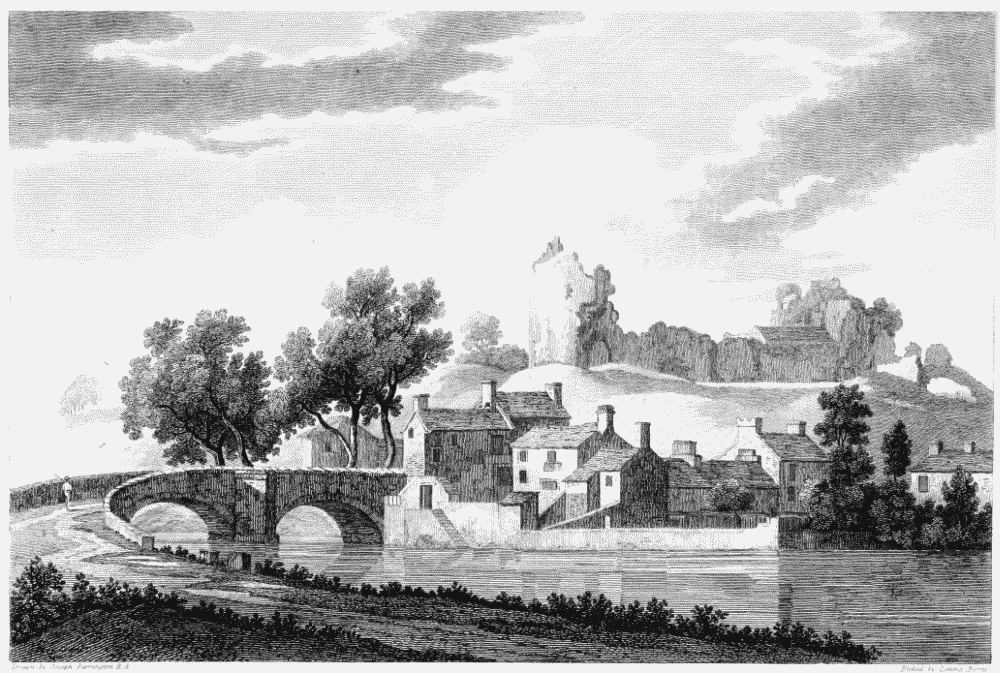
Egremont Castle
The church of Egremont was given by William de Meschines to the cell of St. Bees belonging to the abbey of St. Mary in York. The church is a rectory, in the diocese of Chester, the archdeaconry of Richmond, and the deanery of Copeland. The Earl of Egremont is patron.
The school has no other endowment than the interest of 7 or 8l. There are two paper-mills at Egremont, two manufactories of sail-cloth and checks, and four tan-yards. According to the returns of 1811, there were then 329 inhabited houses in the parish of Egremont, and 1,556 inhabitants. Mr. T. Denton computed the inhabitants at 1,410 in 1688.
Farlam
FARLAM, in Eskdale ward, lies about three miles from Brampton. It is divided into two townships, East-Farlam and West-Farlam, containing together, in 1811, 115 houses and 672 inhabitants. The manor was granted by Hubert de Vaux, lord of Gilsland, to Walter de Windsor, whose posterity took the name of Farlam. John de Farlam having no children, devised it in the reign of Edward III. to Ralph de Dacre and Margaret Multon, lady of Gilsland, his wife, and their heirs. It has ever since passed with the barony of Gilsland, now vested in the Earl of Carlisle.
The church of Farlam was given by Robert de Vallibus to the priory of Lanercost, to which monastery the tithes were appropriated. Lord Carlisle is now impropriator and patron of the perpetual curacy, which has been augmented by Queen Anne's bounty, aided by a benefaction of 200l. given by the Countess-dowager Gower.
Gilcrux, or Gilcruce
GILCRUX, or GILCRUCE, in the ward of Allerdale below Derwent, lies six miles from Cockermouth, which is the post-office town. The manor was given by Waldieve, lord of Allerdale, to Adam, son of Lyulph, whose daughter brought it to the family of Bonekill. It was given by this family to Calder Abbey. After the Reformation it was in the family of Armstrong, who were succeeded by that of Dykes. It is now the property of Joseph Dykes Ballantine Dykes, Esq. in right of his wife, who was daughter and heir of the late Frecheville Dykes, Esq.
Ellenhall, in this parish, now a farm-house, was some time a seat of the Dykes family. The church was appropriated to Calder Abbey. The present impropriator is Mr. Dykes, by purchase from Sir Frederic Fletcher Vane, Bart. The Bishop of Carlisle is patron of the vicarage.
Gosforth
GOSFORTH, in the ward of Allerdale above Derwent, lies eleven miles and a half from Whitehaven and six and a half from Egremont. There is a post-office at Calder Bridge, two miles and a half from Gosforth. This parish is divided into the townships of High and Low-Bolton, Boonwood, Seascales, and Gosforth; containing together, in 1811, 132 houses and 685 inhabitants. An ancient family, who took their name from Gosforth, appears to have been possessed of the chief estate in that township, which was divided in severalties between the five daughters and coheiresses of the last of that family. In 1688 it was divided between the families of Pennington, Kirkby, and Senhouse of Seascales. (fn. n5)
The manor of Bolton belonged at an early period to the Wabergthwaites. William Kirkby was possessed of it in the reign of Henry VIII. It was afterwards in a younger branch of the Senhouses of Seascales. The late Charles Lutwidge, Esq. and his younger brothers Henry and Sheffington (the late Admiral (fn. n6) ), were successively proprietors of this manor. It now belongs to Major Sheffington Lutwidge, the Admiral's nephew.
Seascales, in this parish, was the ancient seat of the Senhouse family, who possessed it for several generations (fn. n7). It was afterwards successively in the families of Blacklock, Earl, and Lutwidge. After the death of the late Charles Lutwidge, Esq. the manor of Newton and Seascales was purchased by Sampson Senhouse, Esq. of London, (nephew of the late Humphrey Senhouse, Esq. of Netherhall,) who is the present proprietor. Seascales is now a farm-house.
The church of Gosforth is a rectory, in the diocese of Chester, archdeaconry of Richmond, and deanery of Copeland. The present patron is Sampson Senhouse, Esq. In the church-yard is a very curious ancient cross, which has been already noticed. This parish has been inclosed under an act of parliament passed in 1810, by which lands were allotted to the rector in lieu of tithes. There are two fairs held annually at Boonwood in this parish, April 25. and Oct. 18; the former for horned cattle, the latter for foals and cattle: two acres of land were allotted for the purpose of holding these fairs by the act of 1810.
Greystock
GREYSTOCK, in Leath ward, lies five miles from Penrith. It is divided into the townships of Berrier and Murrah, Little-Blencow, Greystock, Hutton-John, Hutton-Roof, Hutton-Soil, Johnby, Matterdale, Motherby and Gill, Mungrisdale, Threlkeld, and Water-Melock; containing collectively, according to the returns of 1811, 459 houses and 2,132 inhabitants. Mr. T. Denton computed the inhabitants of this parish to be 2,510 in 1688.
The barony of Greystock was given by Ranulph de Meschines to Lyulph, and confirmed by Henry I. to his son Phorne, whose posterity took the name of Greystock.
Thomas de Greystock in 1244, had a charter for a weekly market on Saturday, in his manor of Greystock (fn. n8), and a fair for three days at the festival of the translation of St. Edward, both long ago disused. (fn. n9)
John de Greystock, who was summoned to parliament as a baron in the reign of Edward I. died without issue, and left his estates to Ralph de Grimsthorpe, son of Joan, aunt to the said John; Ralph, Lord of Grimsthorpe and Greystock, was summoned to parliament in the reign of Edward II. Ralph, grandson of the last mentioned Ralph, assumed the name of Greystock. William de Greystock, his son, in 1353, had the King's licence for castellating his manor-house of Greystock (fn. n10). Ralph, the last Lord Greystock of this family, died in the year 1486; his only son, who died before him, left one daughter, Elizabeth, who became heiress to the barony, and married Thomas Lord Dacre of Gilsland. George, Lord Dacre, died without issue in 1568, and his sisters and co-heiresses married the two sons of Thomas, Duke of Norfolk, Philip, Earl of Arundel, and Lord William Howard. On the partition of the property, Lord Arundel had the Greystock estate (fn. n11), which, after a long chancery suit, was adjudged to Charles, fourth son of Henry Lord Mowbray, (grandson of Philip, Earl of Arundel, above-mentioned,) pursuant to a settlement made by his father.
Upon the death of Edward, Duke of Norfolk, in 1773, the dukedom devolved on Charles Howard, Esq. of Greystock, grandson of Charles above-mentioned, and father of the present duke, who, among his numerous titles, bears the ancient title of Baron of Greystock.
Greystock Castle, which had been garrisoned for the King in 1648, was taken by a detachment of General Lambert's army in the month of June. Mr. T. Denton says, that it was burnt down by order of Major Cholmley, who commanded the detachment (fn. n12). The castle, which stands at the south end of the park, on a steep bank above a small stream, which runs into the Petrell; it was almost wholly rebuilt by H. C. Howard, Esq. grandfather of the present duke. The lower part of a large square tower of the original edifice remains, which has been lately repaired and raised by his grace, who is making considerable additions to the other parts of the buildings in the castellated style. There are several valuable portraits at the castle, among which are Archbishop Warham and Erasmus, by Holbein; John, Duke of Norfolk, who fell at the battle of Bosworth; Thomas, Duke of Norfolk, Lord High Treasurer in the reign of Henry VIII. with his treasurer's rod and marshal's staff; Anne Dacre, Countess of Arundel, who brought Greystock to the Howards; Elizabeth, daughter of the last Duke of Lennox, and wife of Henry Frederick Earl of Arundel; Henry Earl of Arundel, and his Countess, and several others of the Howard family. In one of the rooms is the Crucifixion in needle-work, by Mary Queen of Scots. (fn. n13)
The park at Greystock now contains upwards of 3000 acres, surrounded by a wall nine feet in height; more than a thousand acres have been added to it since the year 1800, in consequence of the inclosure of the adjacent wastes. The plantations made in the park by the present duke, occupy about 375 acres. From one to two thousand head of deer, were generally kept in this park till within these few years; they are now reduced to a small number. Gobarrow-park, on the Duke of Norfolk's estate, in this parish, extended three miles in length and one in breadth, on the north side of Ulswater, but the present duke has taken off two thirds, and converted the land into farms, leaving the central part for red and fallow deer; of the latter there are about 300: the red deer, of which there are about a hundred, have a free communication across the water with MartindaleChase, in Westmorland; hunts on both sides the water, are occasionally held in the months of August and September, the deer being frequently pursued across the lake.
The manors of Motherby, Matterdale, Grisdale, Water-millock, and Berrier and Murrey, are spoken of in a record of the reign of Queen Elizabeth as appendages of the manor (fn. n14) of Greystock.
In the parish church are monuments of some of the barons of Greystock, and a gravestone of Dr. John Whelpdale, master of the college, 1526.
The church of Greystock was made collegiate in 1382, by Alexander Nevil, Archbishop of York. The college consisted of a master and six chantry priests: it continued collegiate till the abolition of colleges and chantries, when a dispute arose whether the crown was intitled to the rectory and profits as having been vested in the college. The cause was tried, and judgment given against the crown, on the ground, that the college had no common seal, and that the church had been made collegiate on the Pope's authority alone. In consequence of this decision it remains rectorial. The advowson was long attached to the manor of Greystock. The late duke, when Charles Howard, Esq. sold it to Adam Askew, Esq.; the Rev. H. Askew is now both patron and incumbent.
Dr. Richard Gilpin, who was ejected from this rectory by the act of uniformity, in the reign of Charles II. practised afterwards as a physician at Newcastle. He was author of a Discourse on Satan's Temptations, and several Treatises on Divinity.
There is a Presbyterian meeting-house at Penruddock, in this parish, endowed with a field, let for 11l. per annum.
The manor of Hutton-John, or Penruddock, in this parish, belonged for many generations to the family of Hutton. One of the sisters and coheiresses of Thomas Hutton, who died in the reign of Queen Elizabeth without issue, brought Hutton-John to a younger branch of the Huddlestons of Millom. The Huddlestons suffered much for their loyalty during the civil wars; John Huddleston, second son of Andrew Huddleston, of Hutton-John, was instrumental in saving King Charles II. after the battle of Worcester; he afterwards became his private confessor, and is said to have administered the sacrament to him on his death bed, according to the rites of the church of Rome. Andrew Huddleston, of Hutton-John, the first protestant of the family, was an active promoter of the Revolution. Hutton-John is now the property and residence of Andrew Huddleston, Esq. great grandson of Andrew last-mentioned. The manor of HuttonJohn, alias Hutton-Soil, was purchased in 1787 by the Duke of Norfolk, of Mr. Huddleston, who retained the demesne. An act of parliament for inclosing lands within this manor, was passed in 1813.
The manor of Johnby belonged formerly to the Musgraves of Hayton; an heiress of a younger branch of this family brought it to the Wyvills, by whom it was sold to William Williams, Gent.; one of Mr. Williams's co-heiresses brought it to Sir Edward Hasell, of whose descendant, William Hasell, Esq. this manor was purchased by the Duke of Norfolk in 1783. The manor of Low-end and Thwaite-hall, belonged to the Huttons, and passed by marriage to the Dalstons, who sold this estate about the year 1680, to Mr. Williams of Johnby (fn. n15); having passed with Johnby to the Hasells, it was purchased in 1785 of William Hasell, Esq. by the Duke of Norfolk.
The manor of Greenthwaite and Greenthwaite-hall, which had long been the property and residence of the Halton family, was purchased by the Duke of Norfolk, of Wingfield Halton, Esq. in 1795.
Little-Blencow, in this parish, gave name to an ancient family, by whom it was long possessed. In the year 1358 King Edward III. granted to Adam de Blencowe all the lands in Greystocke, Blencowe, and Newbigging, which had belonged to John Riddall (fn. n16). The manor of Blencowe and Blencow-hall, the old seat of the family, were purchased of the immediate descendant of the family, Henry Prescot Blencowe (fn. n17), Esq. in 1802, by the Duke of Norfolk.
There are four chapelries in the parish of Greystock, Water-Millock, Matterdale, Grisdale, and Threlkeld.
There was a chapel at Water-millock, as early as the reign of Edward III. This appears to have been rebuilt about 1558, and then called Newkirk; from this time the chaplain had licence from the bishop to baptize and bury at Water-millock. The chapel has been augmented by Queen Anne's bounty. Dr. Joseph Brown, born at Water-millock in 1700, published in 1726 a fine edition of Cardinal Barbarini's Latin poems, with a life of the author.
The school at Water-millock has an ancient endowment of 5l. per annum, given by some person or persons now unknown.
The chapelry of Matterdale was endowed with parochial rights by Bishop Meye in 1580; the present chapel was erected in 1685; the rector of Greystock nominates the curate: the chapel has been augmented by Queen Anne's bounty, aided by 200l. given by Countess Dowager Gower. The Rev. Robert Grisdale built a school-house at Matterdale, and endowed it in 1722, with the interest of 200l. In 1723 Mrs. Elizabeth Grisdale gave a small library, chiefly books of divinity, for the use of the chapelry.
The village of Threlkeld lies on the road between Penrith and Keswick, at the foot of the mountain of Saddleback, which is in the chapelry. The manor belonged at an early period to a family who took their name from the place. Sir Lancelot Threlkeld, the last heir male, left three daughters, one of whom brought Threlkeld to the Pickerings. It was sold to the Lowther family before the year 1632, and now belongs to the Earl of Lonsdale. Threlkeld-hall and the demesne lands passed from the Pickerings by marriage to the Irtons, and from the latter in like manner to the Speddings. This estate now belongs to the Duke of Norfolk by purchase from the last-mentioned family; the duke also claims manerial rights here. A fair for sheep is held at Threlkeld on the first Thursday in September.
There was a chapel at Threlkeld as early as the year 1431: this chapel which has right of sepulture and baptism, has been augmented by Queen Anne's bounty.
The chapel at Grisdale, or Mungrisdale, has also been augmented by Queen Anne's bounty, aided by 200l. given by the inhabitants, and 200l. by the Countess Dowager Gower; it has a house belonging to it with a small close. The rector presents to the chapels of Matterdale, Grisdale, and Water-millock. The Earl of Lonsdale is the patron of Threlkeld.
Grinsdale
GRINSDALE, in Cumberland ward, lies two miles and a half from Carlisle. This place gave name to an ancient family who held Grinsdale under the barony of Burgh. The elder line failed about King John's time, when the co-heiresses married Newton and Le-Sor (fn. n18). Newton's lands passed by successive marriages to Martindale and Dacre, and having been forfeited to the crown, were granted to Whitmore, and passed by sale to Dacre of Kirklinton. This estate is now the property of Joseph Dacre, Esq. who is at present in the East Indies. A younger brother continued the male line of the family of Grinsdale, and some of his posterity represented the city and the county in parliament. This branch became extinct about the reign of Henry IV. when the co-heiresses sold their lands in Grinsdale to the Dentons, of whom they were purchased by the Lowthers about the year 1686. This estate now belongs to the Earl of Lonsdale, who is Lord Paramount of the manor, as parcel of his barony of Burgh.
The church of Grinsdale was given by Hugh de Morville to the priory of Lanercost, and became appropriated to that monastery. King Edward VI. granted the rectory of Grinsdale to Sir Thomas Dacre; the great tithes. were sold by the Dacre family in 1751, to the respective landholders. Joseph Dacre, Esq. is patron of the perpetual curacy, which has been augmented by Queen Anne's bounty. The church, which had been many years totally in ruins, was rebuilt about the year 1743 by Joseph Dacre, Esq. at his own expence.