Magna Britannia: Volume 4, Cumberland. Originally published by T Cadell and W Davies, London, 1816.
This free content was digitised by double rekeying. Public Domain.
Daniel Lysons, Samuel Lysons, 'Parishes: Thursby - Workington', in Magna Britannia: Volume 4, Cumberland(London, 1816), British History Online https://www.british-history.ac.uk/magna-britannia/vol4/pp159-175 [accessed 1 May 2025].
Daniel Lysons, Samuel Lysons, 'Parishes: Thursby - Workington', in Magna Britannia: Volume 4, Cumberland(London, 1816), British History Online, accessed May 1, 2025, https://www.british-history.ac.uk/magna-britannia/vol4/pp159-175.
Daniel Lysons, Samuel Lysons. "Parishes: Thursby - Workington". Magna Britannia: Volume 4, Cumberland. (London, 1816), British History Online. Web. 1 May 2025. https://www.british-history.ac.uk/magna-britannia/vol4/pp159-175.
In this section
Thursby
THURSBY, in Cumberland ward, on the road from Carlisle to Wigton, lies six miles from the former, and five from the latter. The parish is divided into the townships of Parton, High-Thursby, Low-Thursby, and Whinow, or Crofton-Quarter, containing collectively, in 1811, 94 houses, and 340 inhabitants. The manor of Thursby was given by Alan, second Lord of Allerdale, to Herbert de Bruce, who took the name of Thursby; from his family it passed by an heir female to a younger branch of the Boyvills, who held it in the reign of Edward I. Soon after it was in the Ogles, who continued to possess it in the reign of Edward IV. afterwards it came to the Dacres, and having been united to the barony of Burgh, is now the property of the Earl of Lonsdale.
The manor of Crofton belonged in King John's reign to Gilbert de Dundraw, one of whose coheiresses brought it to Stephen de Crofton. The heiress of Crofton brought the manors of Crofton and Whinow, about the year 1390, to the Briscoes, of Briscoe, near Carlisle. Sir John Briscoe, the immediate descendant of this ancient family, was created a baronet in 1782. Crofton is now the property and seat of his son Sir Wastell, who succeeded to the title and estate in 1805. There is a deer park at this place.
The manor of Parton belonged anciently to a family, who took their name from the place of their residence; their heiress brought it to the Mansels; afterwards it passed successively to the families of Mulcaster, Grinsdale, Roose, Carliel, and Denton (fn. n1). It was purchased of the latter in 1686, by Sir John Lowther, Bart. ancestor of the Earl of Lonsdale, who is the present proprietor.
In the Briscoe chapel of Thursby church are monuments of the Briscoe family, and of a daughter, married to Holme of Holme-hill. A tombstone in the church-yard records a remarkable length of widowhood: William Read, of Micklethwaite, died in 1715, aged 33, his widow in 1761, aged 105.
The church of Thursby, which is in the deanery of Carlisle, was granted before 1469, by Sir Robert Ogle, to the priory of Carlisle; to which monastery the great tithes were appropriated. The dean and chapter are now appropriators of the great tithes and patrons of the vicarage. There is a school at Thursby, which has been endowed with the sum of 384l. under the will of Mr. Thomas Thomlinson, who died in North-Carolina in 1802; he gave also 160l. to the poor of Thursby.
Torpenhow
TORPENHOW, in the ward of Allerdale below Derwent, lies about ten miles from Cockermouth, and about seven from Wigton, which is the post-office town. The parish is divided into the townships of Bowaldeth and Snittlegarth, Blennerhasset and Kirkland, Bothel and Threapland, and Torpenhow with Whiterigg, containing collectively, in 1811, 192 houses, and 724 inhabitants. The manor of Torpenhow was given by Alan, son of Waldieve, to his brother-in-law Ughtred. Philip de Valoniis held it in the reign of Henry II. in right of his wife; we afterwards find it successively in the families of Estoteville, Ulfly, Mulcastre, Tilliol, Moresby, and Pickering (fn. n2). It was purchased of the heiress of the latter by Thomas Salkeld and John Appleby, about the middle of the sixteenth century. This estate has passed with Whitehall, in Allhallows, and is now the property of William John Charlton, Esq. The paramount manor of Whiterigg, was in 1804 or 1805, adjudged to belong to Mr. Charlton, who, at the time of the inclosure, had a composition for his manerial rights. A subordinate manor of the same name, which passed with one of the coheiresses of Tilliol to Colvill, and was afterwards in the Skeltons of Armathwaite, is said to have been purchased of the latter by Sir Gilfred Lawson, in 1712 (fn. n3), and has since passed with the Isel estate.
The manor of Bewaldeth, or Bowaldeth, was given by Waldieve, Lord of Allerdale, to Gilmin. Having again reverted to the Lord Paramount, it was granted by Alice de Romely to John de Utterfield; after this the Mulcasters had it for several descents: in or about the year 1400, Robert de Mulcastre conveyed it to Robert de Highmore, whose descendant, Mr. Benson Highmore, sold it to James Spedding, Esq. grandfather of John Spedding, Esq. now of Mirehouse, of whom it was purchased by Sir Frederick Fletcher Vane, Bart. the present proprietor. This manor was holden of the honor of Cockermouth, by the service of maintaining one of the King's servants once, for three weeks. (fn. n4)
The manor of Blennerhasset was given by Alan, Lord of Allerdale, to his brother-in-law Ranulph de Lindsey, from whom it passed by inheritance through the families of Mulcaster, Tilliol, Moresby, and Pickering. The heiress of the latter sold it in the reign of Henry VIII. to the Salkelds. It has since passed with Whitehall, and is now the property of William John Charlton, Esq.: he is proprietor also of the manor of Kirkland, which belonged to the priory of Rossdale, and after the reformation was granted to the Salkelds of Whitehall.
The manor of Bothill, otherwise Boald, was given by Waldieve, Lord of Allerdale, to Gamel, son of Brun. The Bruns were Lords of Bothill till the reign of Edward III. when the coheiresses married Harrington, Culwen, and Bowet. The descendants of Harrington sold their share, with the parks and demesne, to Thomas Lord Dacre, who conveyed it in exchange to the Dentons. In 1670 Thomas Denton, Esq. sold the park, &c. to Sir Francis Salkeld, and the manor to Captain Anthony Wilkes. Sir Henry Curwen, sold the third part of Bothill, which belonged to his family, to the Barwises of Ilekirk, whose heiress brought it to the Dentons, and the Dentons sold it to the Salkelds. Bowet's share is said to have been conveyed by Sir Nicholas Bowet to William Ellis, whose grandson sold it piecemeal to the tenants, but in 1807 William John Carlton, Esq. representative of the Salkelds, claimed to be sole lord of this manor, and his claim was allowed by the commissioners. Mr. Charlton has since sold the demesne lands, called Bothill Parks, to John Raney, Esq. of Whitehaven. Bothill-hall, and certain lands adjoining, are the property of Mr. Gibson, by devise of the late Thomas Storey, Esq. of Mirehouse.
The manor of Threapland was given by Alan, Lord of Allerdale, to his steward Ketel, from whose descendants it passed to the family of Herela, Michael de Hercla, in the reign of Edward II. conveyed it to William de Mulcastre, from whom it passed by fine to Sir Henry Multon, and Margaret, his wife (fn. n5); their daughter and heir brought it to a younger branch of the Skeltons. It passed by sale from the Skeltons to the Salkelds, and from the latter to the Greggs of Mirehouse; a coheiress of Gregg married the Rev. John Story, who was instituted to the vicarage of Dalston in 1731, and Mr. Roger Williamson. The manor of Threapland is now the property of Roger Williamson, Esq.
The church of Torpenhow was given by Sibella de Valoniis and Eustachius D'Estoteville, to the prior and convent of Rossdale, in Yorkshire, to whom it was appropriated; but by an award made in the year 1290, by Bishop Irton, the glebe, &c. of Torpenhow, and the great tithes of Torpenhow, Threapland, Aldersceugh, Applewray, Snittlegarth, Bellasis, and Bowaldeth, were assigned to the vicar, for the maintenance of three priests and one sub-deacon: some of these tithes were granted by Queen Elizabeth in 1562, to Cicely Pickrell, and the remainder, in 1574, to John Sonky and Percival Gunson. These tithes belonged to the vicar till the late inclosure act, under which lands were given in lieu of them. The tithes of Bothill and Blennerhasset, which were reserved to the priory of Rossdale, were granted to the Salkelds, and were held till lately with the Whitehall estate. Under the inclosure act an allotment was given in lieu of the tithes of Bothill. Mr. Charlton has sold the great tithes of Blennerhasset to Mr. Hodgson, of that place; the small tithes belong to the vicar of Torpenhow. The great tithes of the manor of Kirkland belong to the land owners. In 1807 an act of parliament passed for inclosing lands in the manors of Torpenhow and Bothill; in 1811 an act for inclosing those in the township of Threapland (Threapland-town Green excepted); and in 1814 an act for inclosing lands in the manor of Bowaldeth. The Bishop of Carlisle is patron of the vicarage, which is in the deanery of Allerdale.
There is an endowed school at Bothill, which has had a small endowment in land from time immemorial. One of the Salkeld family gave a rentcharge of 2l. 10s. Robert Smithson, of Bothill, about the year 1701, gave an acre of land; it was made a free school in 1686, when the amount of a subscription (about 55l.) was laid out in land. The present income of this school is 49l. 10s. per annum. The nomination of the master is in the vicar and a select vestry of sixteen.
Uldale
ULDALE, in the ward of Allerdale below Derwent, lies one mile from the small market town of Ireby, nine miles from Wigton, ten from Cockermouth, eleven from Keswick, and eighteen from Carlisle. The manor of Uldale was given by Waldieve, Lord of Allerdale, to Adam, son of Lyolf, ancestor to the Bonekills, whose heiress married John Stewart kinsman of the King of Scots, and afterwards Sir David Brigham. On the attainder of Alexander Senescall, this manor was granted to Anthony Lord Lucy in 1337 (fn. n6). From this time it continued attached to the barony of Allerdale, till Henry Earl of Northumberland gave it to King Henry VIII. That monarch in 1543 granted it to Thomas Dalston, Esq. ancestor of the late Sir William Dalston, Knight, of Acron-bank, in Westmorland; after whose death it was sold to John Gaff, Esq. and by his son to the Earl of Egremont, the present proprietor.
Orthwaite-hall was successively in the families of Simpson, Richmond and Browne. It is now the property of William Browne, Esq. of Tallantire, and in the tenure of Mr. — Cape.
The advowson of the rectory, which is in the deanery of Allerdale, is attached to the manor.
There is a large sheep fair at Uldale on the 29th of August, which was first established in 1791.
The school at Uldale was founded in 1726, when Matthew Caldbeck gave 100l. on condition that the inhabitants would raise the same sum, which was accordingly done, and the whole was laid out in land. Mr. Thomas Thomlinson, who died in 1802, in North-Carolina, gave by will (1798) the sum of 354l. to this school. Its income is now 31l. 17s. 6d. per annum.
Waberthwaite, Waybergthwaite, or Wyberthwaite
WABERTHWAITE, WAYBERGTHWAITE, or WYBERTHWAITE, in the ward of Allerdale above Derwent, lies two miles from Ravenglass, which is the post-office town. The manor belonged to an ancient family, who took their name from this the place of their residence; their heiress brought it to an ancestor of Lord Muncaster, who is the present proprietor, and is patron of the rectory, which has been augmented by Queen Anne's bounty.
Walton
WALTON, in Eskdale ward, lies three miles from Brampton, and about ten from Carlisle. The parish is divided into the townships of High and Low-Walton, containing together, in 1811, 74 houses, and 417 inhabitants. The manor was given by Robert de Vaux to the priory of Lanercost, and after the dissolution of that house to Sir Thomas Dacre. It passed with the priory estate, till sold in 1789, by William Dacre, Esq. to the late John Johnson, Esq. father of William Johnson, Esq. of Walton house (fn. n7), the present proprietor. The church of Walton, which is in the deanery of Carlisle, was appropriated to the priory of Lanercost. Mrs. Dacre, of Carlisle, is the present impropriator and patron of the perpetual curacy, which was augmented with Queen Anne's bounty in 1767.
Warwick
WARWICK, in the wards of Cumberland and Eskdale, lies four miles from Carlisle. It comprises the townships of Aglionby and Warwick, in Cumberland ward; and Little-Corby, in Eskdale ward, containing altogether, in 1811, 88 houses, and 401 inhabitants.
The manor of Warwick was given by Hubert de Vaux and Robert his son, to Odard, first Lord of Corkby, whose posterity assumed the name of Warwick. It continued in this family for many generations: Francis Warwick, Esq. the last heir male, died in 1772 without issue; he bequeathed this manor, after the death of his sisters, to Ralph Maddison, Esq. grandson of his father's sister; after him his brother John possessed it, but both died without issue, when it devolved to the next heir of the testator, Robert Bonner, Esq. son of Sarah Maddison, (sister of Ralph and John abovementioned,) by Thomas Bonner, Esq. This Robert took the name of Warwick in 1792, and is the present proprietor. He resides at Warwick-hall.
The manor of Aglionby was the ancient inheritance of the family of that name, who are said to have been settled there from the time of the Conquest. The last heir male of this family, Christopher Aglionby, Esq. died in 1785: this manor is now the property of Mrs. Bamber, one of his sisters and coheiresses.
The antiquity of the parish church has been already spoken of. (fn. n8)
The church of Warwick, which is in the deanery of Carlisle, was appropriated to the abbey of St. Mary at York. The dean and chapter are now the appropriators and patrons of the perpetual curacy.
Westward
WESTWARD, in the ward of Allerdale below Derwent, lies three quarters of a mile from Wigton. It is divided into the townships of Brocklebank and Stoneraise, and Roseley or Rosley, with Woodside, containing together, in 1811, 189 houses and 1,002 inhabitants. Westward was conveyed by Alan, second lord of Allerdale, to King Henry II. and was attached to the forest of Inglewood. The forest of Westward was granted by King Edward III. to Thomas de Lucy and Agnes his wife. This estate was given, with others, to Henry VIII. by the Earl of Northumberland. Queen Mary granted it to Thomas Percy, but it reverted to the Crown, during the reign of Elizabeth, by his attainder. It appears, nevertheless, to have been again restored; the Earl of Egremont being now by inheritance proprietor of the manor, forest, and lordship of Westward.
Ilekirk, in this parish, had its name from the hermitage of Saint Hilda, which having before belonged to Roger the hermit, was given by King John to the abbey of Holme-Cultram. King Henry VIII. in 1543, granted the hermitage of Hildkirke or Ilekirk, with all the lands thereto belonging, to Thomas Dalston, Esq. who the next year conveyed it to Anthony Barwis, Gent. The last of this family, about the latter end of the seventeenth century, left two daughters coheiresses, married to Fetherstonhaugh and Emerson. Ilekirk is now the property of Raisbeck Lucock Bragg, Esq., whose family have possessed it many years. It is now occupied as a farm.
In the division of Brocklebank is Clea-hall, the seat of Sir Henry Fletcher, Bart. It had formerly belonged to a younger branch of the Musgraves of Crookdake, whose heiress married Fletcher of Dearham. In Woodside is a manor, the joint property of Wilfred Lawson (as heir of the late Sir Wilfred Lawson, Bart.) and Sir Wastell Briscoe, Bart.
At Rosley is a great fair for horses, cattle, sheep, cloth, &c. held on Monday in Whitsun-week and every Monday fortnight from that time till the festival of All-Saints (fn. n9). Mr. T. Denton, writing in 1688, says, that Rosley fair was then the best in all the North for Irish and Scotch horses, cattle, and sheep. It is computed that 2,000 head of cattle and 500 horses are now exhibited for sale at this fair. The fair held once a fortnight was established before 1688.
In the division of Stoneraise are the ruins of Old-Carlisle. (fn. n10)
In the parish church of Westward, supposed to have taken its origin from the hermitage of St. Hilda, are monuments of the Barwis family, particularly that of Richard Barwis, Esq. (commonly called the Great Barwis, from his gigantic stature), who died in 1648. In the church-yard are several memorials of the Fletcher family, particularly Philip Fletcher, Esq. who had been in all the considerable actions under the great and victorious Duke of Marlborough: he died in 1744, aged 93. An act of parliament passed in 1811 for inclosing the parish of Westward, by which lands were given to the dean and chapter of Carlisle, as appropriators, or their lessees, and to the perpetual curate, for a portion of tithes. The Musgraves of Edenhall are lessees of the rectory under the dean and chapter, who are patrons of the curacy.
There are two schools, in this parish, called Cragg's School and ChurchSchool, endowed by Mr. Jefferson: the revenue is now 4l. per annum. Half an acre of land adjoining was allotted to each school by the act of 1811.
Wetheral
WETHERAL, in the wards of Cumberland and Eskdale, lies four miles and three quarters from Carlisle. It comprises the townships of Wetheral, Cumwhinton, and Scotby, in Cumberland ward, and Great-Corby and Warwick-Bridge (fn. n11) in Eskdale ward; containing collectively, in 1811, 333 houses and 1601 inhabitants. Ranulph de Meschines, in the year 1088, founded at Wetheral a priory of Benedictine monks, as a cell to the abbey of St. Mary at York. This priory was surrendered in the year 1539, when its revenues were valued at 117l. 11s. 10¾d. clear yearly income. In the year 1541, King Henry VIII. granted the site of the priory and the manor of Wetheral, with several other manors and lands, to the dean and chapter of Carlisle, and by a subsequent grant he gave them the rectory and advowson. Not far from the site of the monastery, are three cells, communicating with each other by means of a gallery in front; cut out of a rock at the height of above forty feet from the summer level of the river Eden (fn. n12). The remains of the priory, except a gate-house, which is still standing, were pulled down in the last century by the dean and chapter, and the materials used to rebuild a prebendal house.
The manor of Corby, on the east side of the Eden, was granted by King Henry II. to Hubert de Vaux, and given by him to Odard, whose posterity assumed the name of De Corkby or Corby. In the reign of Edward I. it was in the family of Richmond, who conveyed it to Andrew de Hercla, Earl of Carlisle. After his attainder it was granted (in 1335) to Richard Salkeld (fn. n13) : his descendant of the same name, who died in the reign of Henry VII. left two daughters coheiresses, married to Salkeld of Whitehall and Blenkinsop. The immediate descendants of these families sold their moieties of Corby to Lord William Howard; Blenkinsop in 1606, Salkeld in 1624. Lord William gave Corby to his second son Sir Francis, the immediate ancestor of Henry Howard, Esq. the present possessor. There is a full length portrait at Corby Castle of Lord William Howard. The pleasure grounds on the banks of the Eden are much enriched with wood, and present a great variety of beautiful scenery.
The manor of Scotby was one of those granted to the King of Scots. After the resumption of the grant it continued in the Crown, and was annexed to the honour of Penrith, granted in the reign of King William to the Earl of Portland, and now belonging to the Duke of Devonshire.
The manors of Cumwhinton or Combwhinton, and Cotehill belonged, soon after the Conquest, to Hildred de Carliell, in whose posterity they continued many generations: having been divided between two brothers of this family, they have ever since been in moieties, one of which has long been attached to the Armathwaite-Castle, the other to the Aglionby estate. The former is now the property of Robert Sanderson Milbourn, Esq.; the other, of the Rev. S. Bateman of Newbiggin-hall, in right of his wife, one of the sisters and coheiresses of the late Christopher Aglionby, Esq.
In Wetheral church is the monument of Sir Richard Salkeld, who died in the reign of Henry VII. and his lady. In the Howard chapel, which was rebuilt by Henry Howard, Esq. in 1791, is the monument of Francis Howard, Esq. who died in 1702, and that of the Honourable Maria, daughter of the late Lord Archer, and wife of Henry Howard, Esq. who died in 1789. The latter is by Nollekens.
The dean and chapter are appropriators of the tithes, which formerly belonged to the priory of Wetheral, and patrons of the perpetual curacy. The benefice is consolidated with that of Warwick. The present lessee of the tithes under the dean and chapter is Peregrine Towneley, Esq. The commons in this parish have been inclosed under the act of 1803, for inclosing the forest of Inglewood.
There is a Quakers' meeting at Scotby, and a Roman catholic chapel (endowed partly by the Warwick family) at Warwick-bridge.
At Great-Corby is a school endowed with land, now let at 21l. per annum. The land was allotted for this purpose when Corby common was inclosed: in consequence of an advantageous exchange made to accommodate Mr. Howard, the charity was benefited 7l. per annum. There is also a house and garden belonging to the school.
The school at Scotby is endowed with land allotted by the inhabitants at different periods, and now let at 14l. 5s. per annum. Thomas Graham, Esq. who died in 1790, gave the sum of 60l. for the education of poor children of Wetheral quarter.
There is a considerable cotton-mill at Warwick-bridge.
Whicham
WHICHAM, in the ward of Allerdale above Derwent, lies about five miles from Bootle, and about twenty-seven from Whitehaven.
The manor of Whichamshall or Whichall belonged at an early period to the family of Bethom; it was afterwards divided into severalties. Sir James Lowther purchased this estate, a considerable portion of which had belonged to Mr. Henry Fearon: it is now the property of the Earl of Lonsdale. The manor of Whicham and Silcroft now Mr. John Muncaster's, has belonged for a considerable time to his ancestors the Mulcasters or Muncasters of Cockermouth. The advowson of the rectory, which belonged formerly to the abbey of St. Mary at York, is now vested in Lord Lonsdale, by purchase from the late Lord Muncaster. This parish is in the diocese of Chester, the archdeaconry of Richmond, and the deanery of Copeland. There is a free school at this place, formerly called "the Gramer Schole of Whicham and Milham," it being free for both parishes. It has an ancient endowment of 16l. per annum, payable out of the exchequer, as recognised by a warrant of Queen Elizabeth, dated October 13, 1581.
Whitbeck
WHITBECK, in the ward of Allerdale above Derwent, lies about three miles from Bootle, and about twenty-five from Whitehaven.
The manor was given by Sir William Morthing to the priory of Conishead, to which monastery the church also was given by Gamel de Pennington. The manor, rectory, and advowson, were granted in 1687 to Mr. Lawrence Parke, in whose descendants they continued till the year 1807, when they were sold by Charles Parke, Esq. to the Earl of Lonsdale, who is the present proprietor. The Parkes resided at an old mansion at Whitbeck, now occupied as a farm-house. Lord Lonsdale is proprietor of half the tithes and patron of the perpetual curacy, which is in the diocese of Chester, the archdeaconry of Richmond, and deanery of Copeland. The benefice was augmented in 1747 with 200l. by the governors of Queen Anne's bounty, and 250l. given by the patron and impropriator, being the produce of the sale of a portion of tithes; a further sum of 200l. was given by the governors about the year 1760: with these benefactions an estate was bought near Dalton, in Furness. In 1785 the benefice received a further augmentation of 200l. in addition to 200l. from Queen Anne's bounty, with which were purchased a house and lands in Whitbeck, now the minister's residence.
Mr. Henry Parke, of Kendall, mercer, gave the sum of 400l. for the maintenance of six poor persons in the almshouse at Whitbeck; a rentcharge of 24l. per annum was purchased with this benefaction.
The manor of Scoggerbar, which has been always held with Bootle, is in this parish. Munkforce, in this parish, some time belonging to the Gibsons, passed from them to the Lewthwaites, and is now the property of Miss Lewthwaite. Barfield is the property and residence of Robert Gibson, Esq.
Wigton
WIGTON, a considerable market-town in Cumberland ward, is situated 10¾ miles from Carlisle, and 305½ from London. The parish is divided into the townships of Oulton, Waverton High and Low, Wigton, and Woodside. Quarter; containing altogether, in 1811, 862 houses and 4,051 inhabitants.
This town is said to have been burned by the Scots when they plundered the abbey of Holme-Cultram, in 1322 (fn. n14). The van of the Duke of Hamilton's army was quartered in and about Wigton in 1648. (fn. n15)
The barony of Wigton was given by Waldieve lord of Allerdale to Odard, whose posterity assumed the name of De Wigton. This family became extinct in the reign of Edward III. when the heiress married Gernon. Soon after her death, Thomas Lucy, lord of Allerdale, became possessed of the barony of Wigton, which passed with that of Allerdale to the Earl of Egremont, the present proprietor.
The manor of Oulton, which belonged for many descents to the Dalstons, was sold, after the extinction of that family, to — Watson, and is now the property of William Taylor, Esq. of Greenwich, in Kent. Lesson or Lassonhall, originally called Lassell's-hall, from one of its remote proprietors, is described as having been formerly an independent manor, in the successive possession of the Waverton, Multon, and Mulcaster or Pennington families. It was purchased of the latter by the Dalstons: having from that time been esteemed parcel of the manor of Oulton, which was enfranchised by Sir George Dalston, Bart. in 1747.
The market at Wigton is by prescription, and appears to have been always held as now on Tuesday. John de Wigton proved his right to it in the reign of Edward I. (fn. n16) and to a fair for three days at Lady-day. The market is a very considerable one for corn (fn. n17), butchers' meat, and other provisions. On St. Thomas's Day there is a very large market for butchers' meat, apples, and honey. On Martinmas Tuesday a large quantity of beef is brought to the market, and bought by the country-people, to be salted for winter consumption. The old charter fair is now held on the 5th of April, and is a great mart for black cattle, stallions (fn. n18), Yorkshire cloth, hardware, &c. There is a large and noted horse-fair on the 20th of February. The town has been much improved by the removal of the butchers' shambles.
The principal manufactures at Wigton are checks, muslins, and ginghams, made in large quantities; a few calicoes also are manufactured, and the calico-printing branch is carried on to a great extent; there is also a considerable dying concern. The population of the town, from the influx of weavers from Ireland and Scotland, has been for many years progressively increasing. In Hutchinson's History, published in 1794, Wigton is said to have increased greatly within the twenty years then preceding; and it is added, that it was then supposed to contain 1,700 souls. In 1801 the number of persons in the township of Wigton appears to have been 2,166. In 1811, according to the return made to parliament, the parish of Wigton contained 2,977 persons. The present number of inhabitants in the town alone is supposed to be nearly 2,700.
In the parish church, which was rebuilt in 1788, there are the monuments of Colonel Thomas Barwis, who died in 1648; the Rev. John Brown (fn. n19), vicar of Wigton, 1763; and the Rev. Lowther Yates, D.D. Master of Catherine Hall, Cambridge, who died in 1798. Margaret de Wigton gave the church to the abbey of Holme-Cultram, to which it was soon after appropriated. The tithes of the greater part of the parish had been long vested in the Fletcher family, and were the property of Sir Frederick Fletcher Vane, Bart. when the inclosure act took place; the tithes of eggs, geese, &c. had long been in the Briscoe family. The impropriators have now land in lieu of tithes, except for those in Oulton Quarter; an allotment was made also to the vicar in lieu of the hay-tithes of a small district, the tithes of pigs, &c. (fn. n20)
There was a free chapel at or near Wigton attached to the hospital of St. Leonard, the lands belonging to which were granted by King Edw. VI. to Thomas Dalston and William Denton. This hospital is supposed to have been at a place now called Spital, nearly a mile east of the town, now the property of Sir Wastell Briscoe, Bart. About three quarters of a mile from the Spital, in the village of Kirkland, is the site of a chapel, which, according to tradition, belonged to the Hospital. The land on which this chapel stood, paid, till commuted for of late years in common land, a fine at the death or alienation of the tenant, to the vicar of Wigton. There has been no trace either of the hospital or chapel within the memory of any person now living. Mr. Denton describes Spital as the demesne of a manor called Dockwray, which passed from the Dalstons by marriage to the Brathwaites, and was sold by them in 1671 to — Chambers, who sold to Simpson.
There is a Quakers meeting in Wigton, built in 1707 (fn. n21), and a Methodists meeting; at Oulton is a Baptists meeting and cemetery. In the year 1723 an hospital for six widows of Protestant beneficed clergymen of the county of Cumberland (fn. n22), or such as have served two years as curates, was founded by the executors of the Rev. John Thomlinson, rector of Rothbury. The widows are incorporated by the name of the Governess and Sisters of the College of Matrons or Hospital of Christ, in Wigton. The widows must be forty-six years of age. The bishop is visitor. This hospital is endowed with a rent-charge of 45l. 12s. issuing out of the Haughton-Castle estate; 6l. per annum out of lands in Gateshead, a similar rent-charge on lands at Blencogo (fn. n23), and 1l. 1s. 0d. for a small portion of common allotted to the hospital.
A free grammar school was founded at Wigton by the Rev. John Thomlinson, rector of Rothbury, who, having received 200l. collected by the inhabitants, gave a rent-charge of 19l. 6s. 4d. per annum, out of his lands at Haughton; of this the master receives two-thirds, the usher the remainder. Dr. Thomlinson built the school house in 1730. John Allison, who died in 1792, bequeathed the interest of 1000l. three per cents reduced, to be divided equally between the two masters, on condition that they continued to teach four poor children of the town (not free to the school) gratis. At the first institution of the school, the tenements of such of the inhabitants as furnished a horse and cart for the use of the buildings, or contributed a sum equivalent, were made free to the school. This raised a small stock, the interest of which is 3l. 9s. 8d. Mr. Thomas Thomlinson, by his will, bearing date 1798, left the sum of 354l. to this school; 60l. to the poor of Wigton, and 100l. to a book club in this town. The master has now a salary of 32l. 2s. the under master 20l. 14s.
Workington
WORKINGTON, a considerable market town on the western coast, in the ward of Allerdale above Derwent, is situated about 8 miles from Whitehaven, 34½ from Carlisle, and 311 from London. The parish is divided into the townships of Great-Clifton, Little-Clifton, Stainburn, Winscales, and Workington, containing collectively, in 1811, 1220 houses, and 6533 inhabitants.
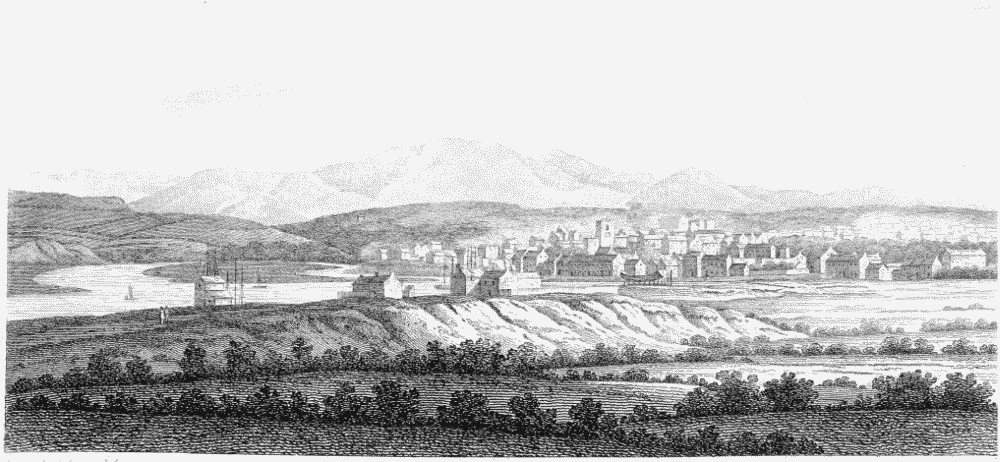
Workington
The manors of Workington and Lamplugh were given by William de Lancaster, in exchange for Middleton in Westmorland, to Gospatric, son of Orme, brother-in-law of Waldieve, Lord of Allerdale. Thomas, son of Gospatric, having had a grant of the great lordship of Culwen, in Galloway, his posterity assumed the name of de Culwen. They became a family of great consequence in the county, and eight out of ten in successive descent, were knights of the shire. Sir Christopher, in the reign of Henry VI. first wrote his name Curwen, and that spelling has been ever since retained. This ancient family became extinct in the male line by the death of the late Henry Curwen, Esq. in 1778; his only surviving child Isabella, married her cousin John Christian, Esq. of Unerigg-hall, who took the name of Curwen in addition to his own, and in right of his wife, is the present proprietor of the manor of Workington. Workington-hall, the seat of Mr. Curwen, stands on a finely wooded eminence overlooking the river Derwent; the old mansion, of which there are scarcely any traces, was castellated pursuant to the royal licence granted by King Richard II. to Sir Gilbert de Culwen in 1379. (fn. n24)
Mr. Denton, speaking of Workington-hall says, "I do not know any one seat in all Britain so commodiously situated for beauty, plenty, and pleasure, as this is. The demesne breeds the largest cattle and sheep in all the country. The famous salmon fishing here (mentioned in Camden,) is worth 300l. per annum, three hundred of those great fishes having been frequently taken at a draught. They are likewise plentifully stored here with very good sea fish and fowl, and here is a large rabbit-warren, worth 20l. a year, besides what serves the house, and a great dove-cote, stored with a huge flight of pigeons; a salt pan and colliery, worth 20l. per annum, within the demesne." Workington-hall has been nearly rebuilt by its present owner, from the designs of Mr. Carr of York, and the grounds greatly extended and improved.
When the unfortunate Mary Queen of Scots fled to this country as an asylum, she landed at Workington from a fishing boat, on the 16th of May 1568; the next day she addressed a letter from this place to the Queen. Mary attempted at first to conceal her rank, but certain gentlemen of the county understanding who she was, waited upon her and conducted her to Cockermouth (fn. n25). There is a tradition that she was lodged at Workington-hall during her short abode on the coast.
The manor of Clifton was given by William de Meschines to Waldieve, son of Gospatric, and passed by successive female heirs to the families of Lucy, Eglesfield, Berdsey, and Salkeld. By the latter it was sold to Sir James Lowther, Bart. and is now the property of the Earl of Lonsdale.
There are two large weekly markets at Workington, Wednesday and Saturday, for butchers' meat and other provisions. Corn is sold only on the Wednesday, which is the principal market day. It does not appear that the markets are of ancient origin. There are two cattle fairs, but not of much note, May 18th and October 18th.
The increase of population at Workington has been very great, but we have no means of ascertaining its progress. In Hutchinson's history the supposed number of houses in 1794 is stated to have been between 1100 and 1200: the population returns of 1801, state the number of houses in the township at 1160, the families at 1375, and that of inhabitants at 5716: the returns of 1811, state the number of houses in the township of Workington at 1059, of families at 1489, and that of inhabitants at 5807. Hutchinson's statement must have been erroneous (for houses it is probable was meant families): the population appears to have been gradually increasing. The average of baptisms for ten years, ending with 1800, was about 170; for the ten years ending with 1810, 191.
The chief trade of the place consists in the exportation of coals, which are sent in considerable quantities from Mr. Curwen's coal pits to Ireland. The chief manufactures are those of sail cloth and cordage, and every thing connected with the shipping. There is a considerable salmon fishery in the Derwent, in which the Earl of Lonsdale and Mr. Curwen have an interest.
The ship-building trade is very prosperous; vessels of from four to six hundred tons, copper bottomed, are built here, and sold to the merchants of Liverpool, Cork, &c. &c.
This town has an assembly room, built by Mr. Curwen, a theatre, &c. In the parish church is the monument of Sir Patrick Curwen, Bart. who died without issue in 1661. In the church-yard is the tomb of the Rev. William Thompson, who raised and formed a society of Protestant dissenters (Presbyterians) in Workington, and collected funds for building a meetinghouse, of which he was pastor for 40 years: he died in 1782, aged 73.
The advowson of the rectory was given by Ketel, son of Eldred, to the abbey of St. Mary at York. In the year 1544 the grantees from the crown sold it to Thomas Dalston, of whose family it was purchased in 1563 by the Curwens, and it has ever since been held with the manor. The townships of Workington and Winscales have been inclosed by virtue of an act of parliament passed in 1809. Allotments of lands were made to the rector, to Mr. Curwen as lord of the manor, and to the latter and Thomas Harrison, Esq. for a certain portion of tithes in Winscales. There appears to have been a chapel also at Workington, granted, with certain lands attached to it by Queen Elizabeth in 1574, to Percival Gunson and John Sonkey. There was formerly a chapel at Stainburn, belonging to the prior and convent of St. Bees, who had a manor-house there, which was burnt by the Scots in 1315 (fn. n26). At Clifton is a chapel in the patronage of the rector, which has been augmented by Queen Anne's bounty. In 1812 an act passed to inclose the township of Stainburn and in 1814 for inclosing those of Great and Little-Clifton. Under both these acts allotments of land were given in lieu of tithes. There is a Catholic chapel at Workington, and meeting-houses for the Presbyterians and Methodists.
The school at Workington was founded by Sir Patrick Curwen, and endowed by his brother, with a rent-charge of 8l. per annum. Mr. Curwen has lately succeeded in a chancery suit, by which he has recovered this endowment, his ancestors having had no right to alienate or charge the lands so disposed of, they having been strictly entailed. There is a large school for boys, and another for girls, on Mr. Lancaster's plan, patronized by Mr. Curwen; a Sunday school belonging to the establishment, and another to the Methodists.
Workington bridge was rebuilt by the county in 1650 (fn. n27). The present structure was erected in the year 1763.