A Topographical Dictionary of England. Originally published by S Lewis, London, 1848.
This free content was digitised by double rekeying. All rights reserved.
'Anthony, St - Appledram', in A Topographical Dictionary of England, ed. Samuel Lewis (London, 1848), British History Online https://www.british-history.ac.uk/topographical-dict/england/pp62-66 [accessed 30 April 2025].
'Anthony, St - Appledram', in A Topographical Dictionary of England. Edited by Samuel Lewis (London, 1848), British History Online, accessed April 30, 2025, https://www.british-history.ac.uk/topographical-dict/england/pp62-66.
"Anthony, St - Appledram". A Topographical Dictionary of England. Ed. Samuel Lewis (London, 1848), British History Online. Web. 30 April 2025. https://www.british-history.ac.uk/topographical-dict/england/pp62-66.
In this section
Anthony (St.) in Meneage
ANTHONY (ST.) in Meneage, a parish, in the union of Helston, W. division of the hundred of Kerrier and of the county of Cornwall, 7 miles (S. by W.) from Falmouth; containing 313 inhabitants. During the civil war of the seventeenth century, a small intrenchment here, called Little Dinas, was occupied by the royalists, for the defence of Helford harbour, but was captured by the parliamentarian forces under Sir Thomas Fairfax, in 1646. The parish is situated on the estuary of the river Helford, and divided by a creek that runs into it from the Nase Point to Gillan. It comprises by measurement 1510 acres; the high grounds command fine views. The living is a discharged vicarage, valued in the king's books at £4. 15. 10., and in the patronage of the Crown; impropriators, the family of Gregor: the tithes have been commuted for £210 for the impropriate, and £140 for the vicarial; and the glebe comprises 62½ acres. The church, situated at the foot of the promontory of Little Dinas, within fifty yards of the sea, is an ancient and elegant structure, with a tower built of a very fine granite said to have been brought from Normandy. There is a place of worship for Bryanites. At Conderra, in 1735, was found a very large number of Roman brass coins, chiefly of the Emperor Constantine and his family. The parish had a cell to the priory of Tywardreth.
Anthony (St.) in Roseland
ANTHONY (St.) in Roseland, a parish, in the union of Truro, W. division of the hundred of Powder and of the county of Cornwall, 9¼ miles (S. W. by S.) from Tregoney; containing 144 inhabitants. It lies at the extreme point of Roseland, a verdant and bold promontory, connected on the north by a narrow isthmus with the parish of Gerrans. The living is a donative, in the patronage of the family of Spry: the tithes have been commuted for £118. The church, beautifully situated on the border of a navigable lake separating this parish from St. Mawes, contains some handsome monuments to the Spry family, of which one, by Westmacott, is to the memory of Sir Richard Spry, Rear-Admiral of the White. An Augustine priory, subordinate to that of Plympton in the county of Devon, existed here till the general Dissolution; its remains have been converted into a private residence called Place House.
Anthony, West (St. Anthony and St. John the Baptist)
ANTHONY, WEST (St. Anthony and St. John the Baptist), a parish, in the union of St. Germans, S. division of the hundred of East, E. division of Cornwall, 5½ miles (S. E.) from St. Germans; containing, with the chapelry of Torpoint, 2894 inhabitants. The living is a discharged vicarage, valued in the king's books at £12. 17. 8½., and in the gift of the family of Carew, the impropriators: the incumbent's tithes have been commuted for £307. 3. 6., with a glebe of 6 acres, and the great tithes for £284. 13. The incumbency of Torpoint is in the gift of the Vicar. There is a place of worship for Wesleyans. A small endowed school was founded in 1766, by Sir Coventry Carew, Bart.
Anthorn
ANTHORN, a township, in the parish of Bowness, union of Wigton, Cumberland ward, and E. division of Cumberland, 8 miles (N. W. by N.) from Wigton; containing 207 inhabitants. Here is a school with a small endowment.
Antingham
ANTINGHAM, a parish, in the union of Erpingham, hundred of North Erpingham, E. division of Norfolk, 2½ miles (N. W.) from North Walsham; containing 271 inhabitants. It is intersected by the road from North Walsham to Cromer, and comprises 1509a. 3r. 36p., of which 1356 acres are arable, 33 pasture and meadow, 56 woodland, and 13 water, consisting of two lakes forming the principal source of the river Ant, which was made navigable to the eastern boundary of the parish in 1806. The living of Antingham St. Mary is a discharged rectory, valued in the king's books at £6. 3. 1½.; patron, Lord Suffield. Antingham St. Margaret's is also a discharged rectory, consolidated with the living of North Walsham, and valued at £5. 6. 8. The tithes of St. Mary's have been commuted for £340, with nearly 16 acres of glebe; and those of St. Margaret's for £28. 10. The church of St. Mary is chiefly in the decorated style, with an embattled tower: in the churchyard are the remains of the church of St. Margaret, consisting of its tower and some of its side walls. Neat schoolrooms were erected by the late Lord Suffield, at a cost exceeding £2000.
Antrobus
ANTROBUS, a township, in the parish of Great Budworth, union of Runcorn, hundred of Bucklow, N. division of the county of Chester, 5 miles (N. N. W.) from Northwich; containing 489 inhabitants. Antrobus Hall and demesne belonged to the family of Antrobus from an early period till the reign of Henry IV., when it was sold to the Venables family, who resided here for many generations. The estate was purchased in 1808 of Edward Townshend, Esq., of Chester, by Edmond Antrobus, Esq., a descendant of the former proprietors, and is now the property of Sir Edmund W. Antrobus, Bart. The township comprises 1947 acres, of which 308 are common or waste land; the soil is clay and moss.
Anwick (St. Edith)
ANWICK (St. Edith), a parish, in the union of Sleaford, wapentake of Flaxwell, parts of Kesteven, county of Lincoln, 4¾ miles (N. E.) from Sleaford; containing 314 inhabitants. The living is a discharged vicarage, united, with the rectory of Dunsby, to the rectory of Brauncewell, and valued in the king's books at £5. 3. 11½.; impropriator, S. Hazelwood, Esq. The tithes were commuted for land and corn-rents, under an inclosure act, in 1791.
Apesthorpe.—See Applesthorpe.
APESTHORPE.—See Applesthorpe.
Apethorpe (St. Leonard)
APETHORPE (St. Leonard), a parish, in the union of Oundle, hundred of Willybrook, N. division of the county of Northampton, 4¼ miles (S. W. by W.) from Wansford; containing 269 inhabitants. The parish is situated on the road from King's Cliff to Oundle, and on the Willybrook, at the border of Rockingham forest; and comprises 1669a. 15p., a portion of which is occupied by Apethorpe Hall, the seat of the Earl of Westmoreland. The living is a perpetual curacy; net income, £80; patron, the Bishop of Peterborough. The church contains a sumptuous monument to the memory of Sir Anthony Mildmay, Bart., and his lady; and another with the recumbent figure of an infant, the eldest son of Lord Burghersh, beautifully sculptured by a Florentine artist. The Earl of Westmoreland, by indenture in 1684, charged a farm with the payment of £36 annually in lieu of certain rent-charges assigned by his ancestors, for apprenticing boys and girls of Apethorpe, Wood-Newton, Nassington, and Yarwell.
Apeton
APETON, a township, in the parishes of Bradley and Gnosall, union of Newport, W. division of the hundred of Cuttlestone, S. division of the county of Stafford. It lies about two miles west-by-north from the village of Bradley, and two and a half south-east from that of Gnosall. A tributary to the Penk flows in the vicinity.
Apley (St. Andrew)
APLEY (St. Andrew), a parish, in the W. division of the wapentake of Wraggoe, parts of Lindsey, union and county of Lincoln, 3 miles (S. W.) from Wragby; containing 162 inhabitants. It comprises 1660 acres, of which 250 are woodland; the surface is flat, and the soil a cold clay, subject to inundation from a stream that divides Apley from the parish of Stainfield. The living is a perpetual curacy, valued in the king's books at £6; net income, £20; patron and impropriator, T. Tyrwhitt Drake, Esq. Formerly a church existed; but at present there is only a small building erected on its site, in which the minister reads the funeral service, and the parishioners hold their vestries.
Apperley
APPERLEY, a township, in the parish of Bywell St. Peter, union of Hexham, E. division of Tindale ward, S. division of Northumberland, 2½ miles (S. by E.) from Bywell; containing 34 inhabitants. It is situated at a short distance from the border of the county of Durham, and comprises 316 acres of land. The Roman Watling-street passes on the south-west; and a stream, tributary to the Tyne, flows in nearly the same direction.
Apperly, with Whitefield
APPERLY, with Whitefield, a hamlet, in the parish of Deerhurst, Lower division of the hundred of Westminster, union of Tewkesbury, E. division of the county of Gloucester, 4½ miles (S. W. by S.) from Tewkesbury; containing 420 inhabitants. There is a place of worship for Wesleyans.
Appleby (St. Michael)
APPLEBY (St. Michael), a parish, in the union of Ashby-de-la-Zouch, partly in the hundred of Repton and Gresley, S. division of the county of Derby, but chiefly in the hundred of Sparkenhoe, S. division of Leicester, 5¾ miles (S. W. by S.) from Ashby; comprising 2803a. 3r., and containing 1075 inhabitants. The living is a rectory, valued in the king's books at £20. 9. 4½.; net income, £750, with a house; patron, George Moore, Esq. The tithes were commuted for land and a money payment, under an inclosure act, in 1771. The church, which is in Leicestershire, was repaired and repewed in 1830, when some windows of painted glass were added by private donation; it contains a curious monument to Sir Stephen and Lady Appleby. A free grammar school was founded in 1699 by Sir John Moore, Knt., lord mayor of London in 1682, who endowed it with an estate at Upton, consisting of 228 acres of land, producing about £315 per annum; the buildings, forming a spacious structure, were erected by Sir Christopher Wren.
Appleby (St. Bartholomew)
APPLEBY (St. Bartholomew), a parish, in the union of Glandford-Brigg, N. division of the wapentake of Manley, parts of Lindsey, county of Lincoln, 7 miles (N. W. by N.) from Glandford-Brigg; containing, with the hamlet of Raventhorpe, 505 inhabitants. The living is a discharged vicarage, valued in the king's books at £10. 4.; net income, £150; patron, C. Winn, Esq.
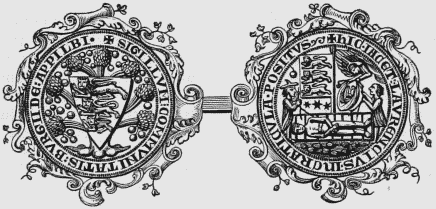
Seal and Arms.
Obverse.
Reverse.
Appleby
APPLEBY, an incorporated market-town, having separate jurisdiction, and formerly a representative borough, locally in East ward, union of East ward, county of Westmorland, of which it is the chief town, 274 miles (N. N. W.) from London; containing 1075 inhabitants. This place is thought, but on uncertain grounds, to have been a Roman station: Camden, from a similarity of name, erroneously calls it Aballaba; while Horsley considers it to have been the Roman Galacum. A Roman road passed near it from Langton, on the east, to Redland's Bank on the north-west; and some antiquities of the Romans have been discovered in the vicinity. It has long been the head of a barony, sometimes called the barony of Westmorland; the rest of the county, which forms the barony of Kendal, having been anciently included in Lancashire and Yorkshire. The barony was granted by the Conqueror to Ranulph de Meschines, whose son Ranulph, having in his mother's right succeeded to the earldom of Chester, gave it to his sister, the wife of Robert d'Estrivers. It afterwards came into the possession of the Engains and Morvilles, and was seized by the crown, in consequence of the participation of a member of the latter family in the murder of Thomas à Becket. King John bestowed it, together with the "Sheriffwick and rent of the county of Westmorland," upon Robert de Veteripont, Lord of Curvaville, in Normandy, whose grandson, Robert, joining the confederated barons, in the reign of Henry III., it escheated to the crown; it was restored, however, to the two younger daughters of Robert, and subsequently, by marriage, came into the possession of the illustrious family of Clifford, whose descendants, the Tuftons, earls of Thanet, have ever since enjoyed it, with all its rights and dignities.
Appleby was anciently of much greater magnitude than it is at present, as is evident from the situation of a township called Burrals (Borough Walls), a mile distant, and from the discovery of old foundations at the distance of more than two miles, to which the suburbs formerly extended. An ancient record, about the period of the reign of Edward I., makes mention of a sheriff of Applebyshire; from which it appears that the town gave name to one of those districts into which Edward the Confessor divided the earldom of Northumberland. It retained its importance from the time of the Romans until the year 1176, when William, King of Scotland, surprised the castle, and destroyed the town; from which calamity, however, it had so far recovered in the reign of Henry III., that a court of exchequer was established here. A Carmelite monastery was founded at Battleborough, in the parish of St. Michael, in 1281, by the Lords Vesey, Clifford, and Percy; the site of which is now occupied by a neat modern mansion, called the Friary. In the year 1388 the town was again totally laid waste by the Scots, from the effects of which it never afterwards recovered; so that, in the reign of Philip and Mary, it was found necessary to reduce the ancient fee-farm rent, due to the crown, from twenty marks to two. In 1598 it was nearly depopulated by the plague, and its market was consequently removed to Gilshaughlin, a village five miles distant. At the commencement of the parliamentary war, the castle was garrisoned for the king by the Lady Anne Clifford, Countess of Pembroke and Montgomery, and it continued in his interest until after the battle of MarstonMoor, when all the northern fortresses fell into the possession of the parliament.
The town is pleasantly situated on the river Eden, by which it is almost surrounded. It is well paved, and amply supplied with water, and consists of one spacious street, intersected at right angles by three smaller streets, and terminated at one extremity by the castle, and at the other by the church of St. Lawrence; at each end also is a handsome stone obelisk, or cross. An ancient stone bridge of two arches, over the Eden, connects the suburb of Bongate with the borough. The castle stands on a steep and richly-wooded eminence rising from the river. It suffered much in the wars with Scotland, especially in the reigns of Richard II. and Henry IV.; and of the original structure, said to be of Roman foundation, only a detached portion called Cæsar's tower, and a small part of the south-east end, remain: the greater part was rebuilt by Lord Clifford, in the reign of Henry VI., and again by Thomas, Earl of Thanet, in 1686. The castle is of square form, and contains several apartments of noble dimensions, adorned with a large and valuable collection of ancient family portraits; the magnificent suit of gold and steel armour worn by George Clifford in the tilt-yard, when he acted as champion to his royal mistress Queen Elizabeth, is also preserved here, as too is the famous genealogical picture of the Veteriponts, Cliffords, and Tuftons. The shrievalty of the county of Westmorland is hereditary, and has descended lineally through the male and female line from the year 1066 to the present time. The castle has been from time immemorial the temporary residence of the judges travelling the northern circuit, who are entertained here at the expense of the Earl of Thanet. In the vicinity of the town are lead-mines worked by the London Mining Company; also quarries of red freestone used for building; and at Coupland-Beck is a carding and spinning mill, where yarn is spun for coarse woollen cloth, stockings, and carpets. The market is on Saturday: fairs are held on the Saturday before Whit-Sunday, for cattle; on Whit-Monday for linen-cloth, and the hiring of servants; and the second Wednesday in June (commonly called Brampton Fair), and the 21st of August, for horses, cattle, sheep, woollen cloth, cheese, and other articles. The market-house, or the Cloisters, is a handsome structure near the church, rebuilt by the corporation in 1811, in the early style of English architecture, after a design by Mr. Smirke.
This is a borough by prescription, and received a charter of incorporation from Henry I., with privileges equal to those of York, which were confirmed by Henry II., King John, Henry III., Edward I., and Edward III.; the last monarch's charter reciting that the borough had been seized by Edward II. for an arrear of rent, and was then in the possession of the crown; and granting the town again to the burgesses, on the same terms as before. The present officers of the corporation are a mayor, deputy-mayor, twelve aldermen, and sixteen common-councilmen, assisted by a recorder, town-clerk, two coroners, two chamberlains, a sword-bearer, macebearer, two serjeants-at-mace, and two bailiffs; the mayor is a justice of the peace, but exercises only a limited jurisdiction. Petty-sessions are held here by the county magistrates every Saturday; the assizes for the county also take place here, and the general quartersessions are held alternately at Appleby and Kendal, the Easter and Michaelmas at the former, and the Epiphany and Midsummer at the latter. The powers of the county debt-court of Appleby, established in 1847, extend over the registration-district of East Ward. The town-hall is a large ancient edifice in the principal street. The county gaol and house of correction has been adapted to the radiating plan: adjoining it is the shire-hall, built in 1771. The borough sent members to parliament from the 23rd of Edward I., but was disfranchised by the act of the 2nd of William IV. cap. 45: the right of election was vested in the holders of burgage tenements, in number about 200; and the mayor was the returning officer. It is the place of election of knights of the shire, for which also it has been constituted a pollingplace.
The town is situated in the parishes of St. Lawrence and St. Michael, that portion of it which is in the latter being named Bongate: St. Lawrence's contains a population of 1354, and St. Michael's one of 1165. The livings of both are vicarages. That of St. Lawrence is valued in the king's books at £9. 5. 2½., and has a net income of £306; it is in the patronage of the Dean and Chapter of Carlisle, and attached to it are 51 acres of ancient glebe, and 252 allotted in lieu of tithes. That of St. Michael is valued at £20. 13. 9.; net income, £175; patron, the Bishop of Carlisle. The tithes of the manor of Appleby were commuted for land, under an inclosure act, in 1772: the Dean and Chapter are appropriators of both parishes. The church of St. Lawrence is partly in the decorated, and partly in the later, style of English architecture; it contains the remains of Anne, the celebrated Countess of Pembroke, Dorset, and Montgomery, who died in 1675, and of her mother, the Countess of Cumberland, to the memory of each of whom there is a splendid marble monument. The church of St. Michael is situated about three-quarters of a mile south-east of the town; and about three miles and a half from it, between the villages of Hilton and Murton, is a place of worship for Wesleyans.
The free grammar school, founded by the burghers, existed long before the dissolution of religious houses, but was established on its present foundation in the 16th of Elizabeth, when the management was vested in ten governors, who are a corporate body: the endowment, arising from different sources, is about £200 per annum. It has five exhibitions, of £8 per annum each, to Queen's College, Oxford, founded by Thomas, Earl of Thanet, in 1720, and is entitled to send candidates for one of Lady Elizabeth Hastings' exhibitions to the same college. Dr. Bedel, Bishop of Kilmore; Dr. Barlow, Bishop of Lincoln; Drs. Smith and Waugh, Bishops of Carlisle; and Dr. Langhorne, the translator of Plutarch, were educated in the school. St. Ann's hospital, for 13 aged widows, was founded and endowed in 1653, by the Countess of Pembroke; the revenue arising from land is about £490, and it has a considerable funded property. The building, which is quadrangular, comprises 13 distinct habitations and a neat chapel; the chaplain and sisters are appointed by the Earl of Thanet, as heir of the countess, who left also various lands at Temple-Sowerby for repairing the church of St. Lawrence, the school-house, town-hall, and bridge. In the neighbourhood were two ancient hospitals for lepers, dedicated respectively to St. Leonard and Nicholas; the estate of the latter was applied by the countess towards the endowment of her almshouse. There was also a chapel at the western end of the stone bridge of St. Lawrence; and the ruins of another have been found at Chapel hill. About a mile north of the village of Crackenthorpe, on the ancient Roman way, was a Roman encampment; and a little further to the north was discovered, on sinking the foundation of a new bridge, in 1838, between the parish of St. Michael and KirkbyThore, a variety of Roman coins and other antiquities. At Machill bank, near the Roman way, urns have been found in circular pits of clay, apparently dug for their reception. Thomas de Appleby, Bishop of Carlisle, and Roger de Appleby, Bishop of Ossory, were natives of the town.
Appledore
APPLEDORE, a small sea-port town, in the parish of Northam, union of Bideford, hundred of Shebbear, Great Torrington and N. divisions of Devon, 3 miles (N.) from Bideford; containing 2174 inhabitants. This spot is celebrated in history for the many battles between the Saxons and the Danes which took place in the immediate vicinity, more especially for the decisive and important victory obtained by Earl Odun and the men of Devon, over a large army of Danes under the command of Hubba, who, in the reign of Alfred, landed here with thirty-three ships. The invaders were repulsed with great slaughter and the loss of their leader, who, being taken prisoner, was beheaded on a hill in the neighbourhood, on which a stone has been erected to mark the spot, and which still retains the name of Hubberstone hill. The town is pleasantly situated on the shore of Barnstaple bay, and, from its facilities for sea-bathing, the mildness of its climate, and the romantic beauty and variety of the surrounding scenery, has been gradually growing into importance as a favourite watering-place. The beach, which is from two to three miles in length, is a firm level sand, affording an excellent promenade; and there are other agreeable walks and rides in the vicinity. The streets are for the greater part narrow and inconvenient, but leading down to the beach, they are ventilated by a current of pure air; and the atmosphere, impregnated with saline particles from the sea, and softened by the adjacent hills, is considered very favourable for invalids. There is a market well supplied with fish, and with every other kind of provisions. The Burrows, a fine tract of land, on which every inhabitant householder has the right of common, is defended from the sea by an embankment called Pebbleridge, which is nearly two miles in length, 150 feet broad at the base, and considerably higher than high-water mark. The parish church at Northam being about a mile and a half distant, a district church has been lately erected here by subscription, containing 550 sittings, of which 275 are free: the living is a perpetual curacy in the gift of the Vicar, with a net income of £150. There is a place of worship for Independents.
Appledore (St. Peter and St. Paul)
APPLEDORE (St. Peter and St. Paul), a parish, in the union of Tenterden, partly in the liberties of Romney Marsh, but chiefly in the hundred of Blackbourne, lathe of Scray, W. division of Kent, 6 miles (S. E. by S.) from Tenterden; containing 561 inhabitants. The parish comprises 2963 acres, of which 63 are common or waste, and 60 in wood. Some trade is carried on in coal, timber, and other merchandise, by means of the Royal Military canal, which passes close to the village. The living is a vicarage, with the living of Ebony annexed, valued in the king's books at £21; net income, £185; patron and appropriator, the Archbishop of Canterbury. The church is a spacious edifice in various styles, with a Norman tower which appears to have formed part of the ancient castle on whose site the church is built. There is a place of worship for Wesleyans.
Appledram (St. Mary)
APPLEDRAM (St. Mary), a parish, in the union of West Hampnett, hundred of Box and Stockbridge, rape of Chichester, W. division of Sussex, 1¾ mile (S. W.) from Chichester; containing 156 inhabitants. It is bounded on the west by the harbour of Chichester, and is of very small extent. Considerable business is done in the timber and coal trade at Dell Quay. The manor-house, crowned with turrets, and surrounded by a moat, is a good specimen of the style of domestic architecture of the reign of Henry VIII.: near it are the remains of another ancient house, now occupied by a farmer. The living is a perpetual curacy, valued in the king's books at £14; net income, £34; patrons and appropriators, the Dean and Chapter of Chichester. The church is in the early English style.