
A Topographical Dictionary of England. Originally published by S Lewis, London, 1848.
This free content was digitised by double rekeying. All rights reserved.
'Boston - Botwell', in A Topographical Dictionary of England, (London, 1848) pp. 309-314. British History Online https://www.british-history.ac.uk/topographical-dict/england/pp309-314 [accessed 26 April 2024]
In this section
Boston (St. Botolph)
BOSTON (St. Botolph), a borough, port, markettown, and parish, and the head of a union, in the wapentake of Skirbeck, parts of Holland, county of Lincoln, 34 miles (S. E.) from Lincoln, and 116 (N.) from London; containing 12,942, and, with certain extra-parochial grounds, 13,507 inhabitants. This place derived its name from St. Botolph, a Saxon, who founded a monastery here about the year 650; from which circumstance it was called Botolph's Town, since contracted to Boston. The monastery, which was erected on the north side of the present church, was destroyed by the Danes in 870, and its remains have been converted into a dwellinghouse, styled Botolph's Priory. From the discovery of the foundations of several buildings, urns, and other relics of antiquity, in 1716, the place is supposed to have been of Roman origin; and according to Dr. Stukeley, the Romans built a fort at the entrance of the river Witham, over which they had a ferry, at a short distance to the south of the town. In the reign of Edward I., Robert Chamberlayne, having assembled some associates disguised as ecclesiastics, secretly set fire to the town, and, while the inhabitants were endeavouring to extinguish the flames, plundered the booths of the rich merchandise exposed for sale at the fair, and burnt such goods as they were not able to carry away. So rich is the town represented to have been at the time of this fire, that veins of melted gold and silver are said to have run in one common current, down the streets. In 1285, Boston suffered greatly from an inundation of the river; and the mercantile ardour of the inhabitants having been checked by the plunder of the fair and the conflagration of the town, its prosperity began to decline. In the early part of the reign of Edward II., however, it was made a staple port for wool, leather, tin, lead, and other commodities, which soon gave a new impulse to the spirit of commercial enterprise; and the settlement in England of the Hanseatic merchants, who established a guild here, tended so powerfully to revive the former prosperity of the town, that, in the reign of Edward III., it sent deputies to three grand councils held at Westminster, and contributed 17 ships and 261 men towards the armament for the invasion of Brittany.
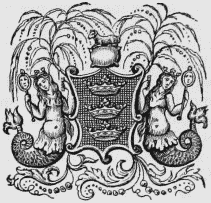
Arms.
The town is situated on the banks of the river Witham, which divides it into two wards, east and west, connected by a handsome iron bridge of one arch, erected by the corporation in 1807, at an expense of £22,000, under the superintendence of Mr. Rennie. The streets are well paved, and lighted with gas, under acts passed in the 16th and 46th of George III. for the general improvement of the town; and many handsome buildings have been erected. The inhabitants were till recently scantily supplied with water, which the more opulent collected from rain, in cisterns attached to their houses, and the poorer brought from the river, or from pits in the neighbourhood. Frequent attempts to procure a better supply, by boring, failed; and in Feb. 1829, after expending £1800, the last undertaking was relinquished. An act, however, was passed in 1846, by which this inconvenience has been remedied. There are two subscription libraries; a handsome suite of assembly rooms, built by the corporation in 1820; a commodious theatre, erected in 1806; and a theatre of arts, exhibiting views of various cities, with appropriate moving figures, which is open every Wednesday evening. About half a mile from the town are Vauxhall Gardens, which, during the season, are brilliantly illuminated, and numerously attended; they were designed by Mr. Charles Cave in 1813, and comprise about two acres of ground: in the centre is an elegant saloon sixty-two feet wide.
The trade of the port, from an accumulation of silt in the river, which impeded its navigation, had begun to decline about the middle of the last century, but was revived by forming a canal, deepening the river, and enlarging the harbour. The exports consist chiefly of the agricultural produce of the county; the imports include timber, hemp, tar, and iron from the Baltic: a considerable coasting-trade is carried on, which of late years has rapidly increased. Since the fens adjoining the town have been drained and cultivated, a tract of rich land, of nearly 70,000 acres, has been obtained, which, besides producing grain, feeds a number of sheep and oxen, remarkable for their size and fatness: oats in great quantity are shipped to various parts of the coast, and wool to the manufacturing districts in Yorkshire, whence coal and other articles are brought in return. The quay, which is conveniently adapted to the loading of vessels, is accessible to ships of 100 tons' burthen. The custom-house, a commodious building, was erected at the public expense: the pilot-office was built in 1811; the establishment consists of a master, twelve pilots, and a few supernumeraries. The Witham is navigable to Lincoln, from which place, by means of canals communicating with the Trent, there is an inland navigation to almost every part of the kingdom. A loop or diverging line of the London and York railway will pass by the town: an act was passed in 1846 for a railway to Grantham, Nottingham, and Ambergate; and another act, also passed in 1846, authorises the formation of a railway to Louth and Grimsby. About 40 boats are employed in the fishery, and shrimps of superior quality, soles, smelts, and herrings are taken in profusion: in 1772, the corporation erected a fish-market, which was taken down, and a new one upon a larger scale erected, in 1816. The market is on Wednesday and Saturday, and is abundantly supplied with poultry, a large quantity of which is sent to London every week; also with vegetables and fruit. The fairs are on May 4th for sheep, and the day following for cattle; Aug. 11th, which is called the Town fair; Nov. 30th and the three following days, for horses and horned-cattle; and Dec. 11th, for horned-cattle only.
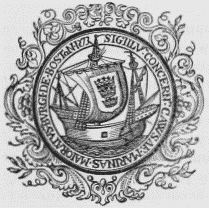
Seal of the ancient Admiralty Jurisdiction, now abolished.
Boston is a borough by prescription. According to a charter bestowed by Henry VIII., and confirmed and extended by Elizabeth and other sovereigns, the government was vested in a mayor (who was also clerk of the market and admiral of the port), a recorder, deputy-recorder, 12 aldermen, 18 common-councilmen, a judge and marshal of the admiralty court, and other officers. The court of admiralty granted by Elizabeth, and which had a jurisdiction extending over the whole of the adjacent coast, was abolished by the act of the 5th and 6th of William IV., c. 76; and under this act the corporation now consists of a mayor, six aldermen, and eighteen councillors. There are nine borough magistrates, but the magistrates for the division exercise a concurrent jurisdiction. A court of record, for the recovery of debts to any amount, is held before the mayor, the alderman who is a magistrate, and the town-clerk, who is likewise registrar of the court. The petty-sessions for the wapentakes of Skirbeck and Kirton are held weekly at the public office in Bridge-street; the general quarter-sessions for the parts of Holland are held here and at Spalding. The powers of the county debt-court of Boston, established in 1847, extend over the registration-district of Boston. The elective franchise was conferred in the reign of Edward VI., since which time the borough has returned two representatives to parliament. The right of election was formerly vested in the members of the corporation, the sons of aldermen, and eldest sons of common-councilmen, residing as householders within the borough, and in the resident freemen generally; but by the act of the 2nd of William IV., cap. 45, it was extended to the £10 householders of the borough, the limits of which, comprising 4574a. 2r. 8p., were enlarged by the act of the 2nd and 3rd of the same reign, cap. 64, and now include 4614 acres. The mayor is returning officer. The guildhall is an ancient building, in the council-chamber of which is a fine portrait of Sir Joseph Bankes, presented by him when recorder. The gaol is a handsome building, at the south end of the town, erected in 1811.
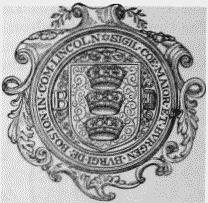
Corporation Seal.
The living is a vicarage, valued in the king's books at £33. 6. 8., and in the gift of the Corporation: the net income is £360, the greater part of which is paid out of the proceeds of certain lands granted by Philip and Mary; and out of the same fund £200 are received by a lecturer, the vicar and lecturer standing in the place of two presbyters named in that grant. The tithes for the eastern division of the parish were commuted for land and a money payment in 1810. The church is a magnificent structure in the decorated English style, erected in 1309, with a lofty square tower surmounted by an octagonal lantern turret, in the later English style; the tower, which is 300 feet high, and was formerly illuminated during the night, forms a conspicuous landmark for mariners traversing the North Sea. An additional church was erected some years since, by subscription: the living is a perpetual curacy, endowed with £100 per annum by the Corporation, who are the patrons. There are places of worship for General and Particular Baptists, the Society of Friends, Independents, Methodists, Unitarians, and Roman Catholics. The free grammar school, founded and endowed in 1554, under the above grant of Philip and Mary, is subject to the control of the trustees for charitable purposes appointed under the act of the 5th and 6th of William IV.: the schoolroom was built in 1567, and a convenient house for the master in 1826. A school was founded in 1707, by Mr. Laughton, who endowed it with lands in Skirbeck, producing about £50 per annum, since augmented by other benefactors; and a Blue-coat school, founded in 1713, for clothing and instructing boys and girls, and two national and Lancasterian schools, established in 1815, are supported by subscription. A general dispensary was instituted in 1795. The poor law union of Boston comprises 27 parishes or places, and contains a population of 34,680. Of the numerous monastic establishments which formerly existed in the town and its vicinity, there remain only some slight vestiges of the Black or Dominican friary, established in the year 1288. The ancient church of St. John, formerly the parish church, has been totally removed, but the cemetery is still used as a burying-ground. Fox, the martyrologist, was a native of the town. Boston confers the title of Viscount on the Irby family.
Boston
BOSTON, a village, forming with Clifford a township, in the parish of Bramham, Upper division of the wapentake of Barkstone-Ash, W. riding of York, 3 miles (S. S. E.) from Wetherby; containing 1566 inhabitants, of whom 1014 are in Boston. This large and commanding village is of recent growth. It arose in consequence of the discovery, in 1744, of a mineral spring here, which was called Thorp-Arch Spa on account of Thorp-Arch, in the vicinity, affording the nearest accommodation for visiters, before the building of the village of Boston, where the first house was erected in 1753. The water is of a saline taste, of a slightly sulphureous smell, and possessed of purgative and diuretic qualities: it is taken in larger quantities than the Harrogate water, and is efficacious in cases of general relaxation, bilious and dyspeptic complaints, and glandular obstructions. For the accommodation of the visiters to this place of fashionable resort, there is a pump-room, with hot and cold baths, the conveniences of which, together with the salubrity of the air, and the situation of the spot, in a valley, on the southern side of the river Wharfe (the village communicating with Thorp Arch by a good stone bridge), contribute greatly to increase the sanative effect of the spa water. The powers of the county debt-court of Boston, established in 1847, extend over the registration-district of Tadcaster, and the townships of Linton and Wetherby. A chapel, a neat plain building, erected on land given by Mr. Samuel Tate, was consecrated in 1815: the living is a perpetual curacy; net income, £146; patron, the Vicar of Bramham. There is a place of worship for Wesleyans.—See Clifford.
Bosworth, Husband's (All Saints)
BOSWORTH, HUSBAND'S (All Saints), a parish, in the union of Market-Harborough, hundred of Gartree, S. division of the county of Leicester, 6 miles (W. S. W.) from Harborough; containing 953 inhabitants. The river Welland bounds the parish on the south and south-east, and the Avon on the northwest; the Grand Union canal crosses the western part of it, being conducted through a tunnel, 1170 yards in length, to the northern side of the village. The living is a rectory, valued in the king's books at £24. 15. 7½.; net income, £929; patron, the Rev. J. T. Mayne. The church had its spire greatly damaged through a storm of thunder and lightning, in July, 1755. There are places of worship for Particular Baptists, Wesleyans, and Roman Catholics. A school for boys is partly supported by a bequest of £15 per annum; and a school for boys and girls, partly by Miss Turvile.
Bosworth, Market (St. Peter)
BOSWORTH, MARKET (St. Peter), a parish, and the head of a union, in the hundred of Sparkenhoe, S. division of the county of Leicester; comprising the chapelries of Barleston, Carlton, Shenton, and SuttonCheney, and part of the townships of Barton-in-theBeans and Osbaston; and containing 2539 inhabitants, of whom 1135 are in the town of Market-Bosworth, 7 miles (N. by W.) from Hinckley, and 13 (W. by S.) from Leicester. This place, in Domesday book called Bosworde, takes the prefix to its name from a market granted to the inhabitants in the reign of Edward I. The neighbourhood is celebrated as the scene of a decisive battle fought on the 22nd of Aug. 1485, between Richard III. and the Earl of Richmond, afterwards Henry VII. This battle, the last of the sanguinary conflicts between the houses of York and Lancaster, took place on Redmoor Plain, in the lordship of SuttonCheney, a long tract of uneven ground extending in the direction of Atherstone from about a mile below Bosworth, now inclosed, and since that event better known as Bosworth-Field. On a hill about two miles southwest of the town, is a small spring, inclosed with rough stones in the form of a pyramid or obelisk, and which bears the name of "King Richard's Well:" according to tradition, the king quenched his thirst here during the action; and this circumstance has been commemorated by Dr. Parr, who visited the spot in 1813, in a short Latin inscription placed immediately above the spring. Numerous swords, shields, spurs, and other military relics, have been dug up in the neighbourhood.
The town, which is pleasantly situated on an eminence, contains some respectable houses, and is well supplied with water. The manufacture of worstedstockings is carried on here, and in the adjacent villages, to a considerable extent; and great facility has been given to trade by the Ashby and Coventry canal, which, passing within a mile of the town, affords a medium for supplying it with coal and other articles. The soil is good, but often clayey; it rests on gravel, with a substratum of sand, and it is remarkable that the best land is on the hills. There is a market on Wednesday; and fairs are held on May 8th, for horses, horned-cattle, and sheep, and July 10th, which is called the Cherry fair: there are also statute-fairs on Oct. 2nd and about a fortnight before Martinmas. The powers of the county debt-court of Market-Bosworth, established in 1847, extend over the registration-district of Market-Bosworth.
The living is a rectory, valued in the king's books at £55. 18. 4.; net income, £903; patron, Sir W. W. Dixie, Bart., of Bosworth Hall: the tithes were commuted for land and money payments in 1794. The church is a spacious ancient structure, with a beautiful spire, and contains many interesting monuments, among the finest of which is one to some members of the Dixie family. There are chapels of ease at Barleston, Carlton, Shenton, and Sutton-Cheney; also places of worship in the parish for Baptists and Independents. The free grammar school, which is open to all boys of the parishes of Bosworth and Cadeby, was founded in 1593, by Sir Wolstan Dixie, Knt., who endowed it with lands, and with two fellowships of £30 and four scholarships of £10 per annum each, at Emmanuel College, Cambridge. In consequence of some abuses, the affairs were in chancery for nearly 50 years, during the greater part of which time the establishment was discontinued; but in 1827 new premises were begun, which were opened on the 1st of Feb. 1830, and form a very handsome pile. The Rev. Anthony Blackwall, an eminent classical scholar, was master, and the celebrated Dr. Johnson, for a short time, usher; Richard Dawes, the learned critic, was educated here under the former. The poor law union of Bosworth comprises 28 parishes or places, and contains a population of 13,600. This is the birthplace of Thomas Simpson, the eminent mathematician, who died here in 1761, and was interred at SuttonCheney, where a tablet has lately been erected to his memory.
Botcherby
BOTCHERBY, a township, in the parish of St. Cuthbert, Carlisle, Cumberland ward, union of Carlisle, E. division of Cumberland; containing 125 inhabitants. It lies east of Carlisle.
Botchergate
BOTCHERGATE, a township, in the parish of St. Cuthbert, Carlisle, Cumberland ward, union of Carlisle, E. division of Cumberland; containing 5460 inhabitants.—See Carlisle.
Botcheston
BOTCHESTON, a hamlet, in the parish of Ratby, union of Market-Bosworth, hundred of Sparkenhoe, S. division of the county of Leicester, 6 miles (E. N. E.) from Market-Bosworth; containing 37 inhabitants.
Botesdale
BOTESDALE, a chapelry and post town, and formerly a market-town, in the parish of Redgrave, union and hundred of Hartismere, W. division of Suffolk, 25 miles (N. N. W.) from Ipswich, and 86 (N. E. by N.) from London, on the road to Norwich; containing 633 inhabitants. The name, a contraction of Botolph's Dale, is derived from Botolph, the tutelar saint of the chapel, and from the dale in which the place is situated. The town consists principally of one long street, which extends into the parishes of Rickinghall Superior and Inferior; the houses are indifferently built: the inhabitants are amply supplied with water from wells. A small fair for cattle and pedlery is held on Holy-Thursday; and there are courts leet and baron held at Whitsuntide; at the former of which constables and other officers are appointed. The chapel is a small and rather mean building, of some antiquity. A free grammar school for six boys was founded and endowed in 1561, by Sir Nicholas Bacon.
Bothal (St. Andrew)
BOTHAL (St. Andrew), a parish, in the union of Morpeth, E. division of Morpeth ward, N. division of Northumberland; containing the townships of Ashington with Sheepwash, Bothal-Demesne, Longhirst, Oldmoor, and Pegsworth; and comprising 800 inhabitants, of whom 249 are in Bothal-Demesne, 3 miles (E.) from Morpeth. The parish is bounded on the south by the river Wansbeck, and comprises, with Hebburn chapelry or parish, 15,290 acres, of which 12,050 are arable, 2720 pasture and meadow, and 520 woodland: the soil is in general of poor quality, being a stiff clay; but the country abounds in beautiful wood and rock scenery. Coal is abundant in the south-eastern part of the parish; there is an extensive quarry of freestone on the bank of the Wansbeck, and one of whinstone near Causey Park. The village is romantically situated in a small vale on the north of the river Wansbeck, and is sheltered on all sides by a range of hills, which surround it in the form of an amphitheatre. The living is a rectory, with the rectory of Sheepwash and the parochial chapelry of Hebburn annexed, valued in the king's books at £25, and in the gift of the Duke of Portland: the tithes have been commuted for £1377. 15., and there are 105 acres of glebe, with a house. The church, of which the foundation is very ancient, contains an altartomb of alabaster, with the recumbent effigies of a member of the Ogle family and his lady. There is a chaple at Hebburn, rebuilt in 1793; but the church of Sheepwash no longer exists. On the north bank of the Wansbeck, between Bothal and Morpeth, in the middle of a rich hanging wood, and surrounded by the wildest and most romantic scenery, are the remains of an oratory dedicated to the Virgin Mary. A considerable portion of the ancient baronial castle of Bothal is now in ruins; but the gateway, built in the reign of Edward III., was, a few years since, repaired and fitted up as an occasional residence for the steward.
Bothamsall (St. Mary)
BOTHAMSALL (St. Mary), a parish, in the union of East Retford, Hatfield division of the wapentake of Bassetlaw, N. division of the county of Nottingham, 4½ miles (W. N. W.) from Tuxford; containing 325 inhabitants. It comprises 2267 acres, and is intersected by the river Meden. The living is a perpetual curacy; net income, £52; patron and impropriator, the Duke of Newcastle. There is a tumulus, called Castle Hill, a little westward from the village of Bothamsall.
Bothel, with Threapland
BOTHEL, with Threapland, a township, in the parish of Torpenhow, union of Cockermouth, Allerdale ward below Derwent, W. division of Cumberland, 4 miles (W.) from Ireby; containing 455 inhabitants. This is a long straggling village; the vicinity abounds with limestone, and there are kilns for burning it. The tithes were commuted for land in 1811. A school is endowed with 27 acres of land, yielding £42 per annum.
Bothenhampton (Holy Trinity)
BOTHENHAMPTON (Holy Trinity), a parish, in the union of Bridport, liberty of Loders and Bothenhampton, Bridport division of Dorset, 1¼ mile (S. E. by S.) from Bridport; containing 533 inhabitants. It is situated within a quarter of a mile of the great western road, and about the same distance from Bridport harbour, on the southern coast: there are some quarries of excellent building-stone. The living is a perpetual curacy; net income, £46; patron, Sir M. H. Nepean, Bart.
Botley
BOTLEY, a hamlet, in the parish of Chesham, union of Amersham, hundred of Burnham, county of Buckingham; containing 499 inhabitants.
Botley
BOTLEY, a tything, in the parishes of Cumner and North Hinksey, union of Abingdon, hundred of Hormer, county of Berks, 1½ mile (W.) from Oxford; containing 155 inhabitants.
Botley (All Saints)
BOTLEY (All Saints), a parish, in the union of South Stoneham, hundred of Mansbridge, Southampton and S. divisions of the county of Southampton, 6 miles (S.) from Southampton; containing 904 inhabitants, of whom 436 are in the North portion, and 468 in the South. This parish, originally called Botleigh, comprises 1790a. 1r. 2p., of which 982 acres are arable, 198 pasture, 84 common, and 474 woodland and coppice; it is situated on the river Hamble, which is navigable for boats up to the village and turns several corn-mills in the parish. The Botley station of the Gosport branch of the South-Western railway is 10½ miles from Gosport, and 5½ from the main line at Bishop's-Stoke. A considerable trade in flour, timber, hoops, and coal, is carried on; and a paper-mill affords employment to about forty persons. A market for corn is held on Wednesday, and a cattle-market every alternate Monday: fairs, chiefly for toys and pedlery, are held on Shrove-Tuesday, Whit-Tuesday, and the Tuesday before St. Bartholomew's day; for cheese, on Feb. 20th, and May 28th; and for cattle, on July 23rd, Aug. 20th, and Nov. 13th. The living is a rectory, valued in the king's books at £5. 10. 2½., and in the patronage of the Duke of Rutland: the tithes have been commuted for £391. 17. 8., and there are about 21 acres of glebe. The present church, erected at an expense of £2400, was consecrated in August, 1836; it contains 550 sittings, of which half are free, and has a handsome steeple. A strong chalybeate spring here was formerly in great repute, but is now disused.
Botolph-Bridge.—See Orton-Longville.
BOTOLPH-BRIDGE.—See Orton-Longville.
Bottesford (St. Mary)
BOTTESFORD (St. Mary), a parish, in the union of Grantham, hundred of Framland, N. division of the county of Leicester, 7 miles (W. N. W.) from Grantham; containing, with the hamlets of Easthorpe and Normanton, 1375 inhabitants. From the discovery of various relics of antiquity, this place is supposed to have been occupied by the Romans. The Grantham canal passes through the parish. The living is a rectory, valued in the king's books at £51. 5.; net income, £993; patron, the Duke of Rutland: the tithes were commuted for land in 1770. The church is a spacious cruciform structure, with a tower supporting a spire at the western end; it has been the burial-place of the noble family of Manners since the dissolution of monasteries, at which period several monuments to the memory of deceased members of that family were removed hither from the conventual church at Belvoir. There is a place of worship for Particular Baptists. In 1711, the Rev. Abel Ligonier and Anthony Ravell bequeathed 32 acres of land, for teaching 28 boys; the schoolmaster receives from the charity £31. 10. per annum, and instructs other children.
Bottesford (St. Peter)
BOTTESFORD (St. Peter), a parish, in the union of Glandford-Brigg, partly in the W., but chiefly in the E., division of the wapentake of Manley, parts of Lindsey, county of Lincoln, 7 miles (W.) from Glandford-Brigg; containing, with the townships of Ashby, Bottesford, Burringham, Holme, Yaddlethorpe, and part of East Butterwick, 1586 inhabitants, of whom 153 are in Bottesford township. The parish is of considerable size; much of the land is fertile, and of various qualities of soil, but a great extent is sterile and swampy moor, some portions of which, however, have been lately improved by draining, and by warpage from the Trent. The living is a discharged vicarage, united in 1727 to the vicarage of Messingham, and valued in the king's books at £10: the tithes of Ashby, Bottesford, and Yaddlethorpe, were commuted for land and cornrents, under an inclosure act, in 1794; and those of Burringham, Holme, and East Butterwick, have been commuted for a rent-charge. The church is an ancient structure of a mixed character of architecture, with a square tower, and Norman porch. There are places of worship at Ashby and Burringham for Wesleyans, and one at Yaddlethorpe for Primitive Methodists.
Botteslaw
BOTTESLAW, a township, in the parish and union of Stoke-upon-Trent, N. division of the hundred of Pirehill and of the county of Stafford; containing 65 inhabitants. This is a township of scattered farms, lying north of the town of Stoke; it belongs to several proprietors.
Bottisham (Holy Trinity)
BOTTISHAM (Holy Trinity), a parish, in the union of Newmarket, hundred of Staine, county of Cambridge, 6 miles (W. S. W.) from Newmarket; containing 1484 inhabitants. The parish comprises about 5000 acres, of which 400 are pasture, and the rest arable, with the exception of a few acres of woodland. A considerable part of the village was destroyed by fire in 1712. The petty-sessions are held here. The living is a discharged vicarage, valued in the king's books at £16; net income, £258; patrons and impropriators, the Master and Fellows of Trinity College, Cambridge. The tithes were commuted for land and a money payment in 1801. The church contains the tomb of Elias de Beckingham, justiciary of England in the reign of Edward I. At Bottisham Lode is a place of worship for Particular Baptists. Sir Roger Jenyns, Knt., founded a school in 1730, and endowed it with £20 per annum. The poor also derive benefit from a bequest of £118 per annum by the Rev. W. Pugh, late vicar, who died in 1825; one of £25 per annum, by Henry Sheppard; and £5 per annum, by another benefactor. A small priory of Augustine canons, dedicated to the Blessed Virgin and St. Nicholas, was founded at Anglesey, in the parish, by Henry I.; the revenue, in the 26th of Henry VIII., was £149. 18. 6.: the site is now occupied by a farmhouse, in the walls of which a portion of the conventual buildings is visible. Soame Jenyns, author of the Evidences of Christianity and a volume of poems, was a native of the parish.
Bottoms
BOTTOMS, a hamlet, in the parish of Blidworth, union of Mansfield, Southwell division of the wapentake of Thurgarton, S. division of the county of Nottingham; containing 250 inhabitants.
Botus-Fleming
BOTUS-FLEMING, a parish, in the union of St. Germans, S. division of the hundred of East, E. division of Cornwall, 3 miles (N. W.) from Saltash; containing 250 inhabitants. The parish comprises 937 acres, of which 21 are common or waste. The living is a rectory, valued in the king's books at £16. 15. 7½.; net income, £190; patrons, the family of Spry. In the centre of a field, on the northern side of the village, stands a pyramidal monument erected to the memory of Dr. William Martin, of Plymouth, who died in 1762.
Botwell
BOTWELL, a hamlet, in the parish of Hayes, union of Uxbridge, hundred of Elthorne, county of Middlesex; containing 373 inhabitants. It lies to the south of the village of Hayes, and near the Grand Junction canal.