
A Topographical Dictionary of England. Originally published by S Lewis, London, 1848.
This free content was digitised by double rekeying. All rights reserved.
'Bridport - Brighton, New', in A Topographical Dictionary of England, (London, 1848) pp. 369-375. British History Online https://www.british-history.ac.uk/topographical-dict/england/pp369-375 [accessed 26 April 2024]
In this section
Bridport (St. Mary)
BRIDPORT (St. Mary), a sea-port, borough, markettown, and parish, having separate jurisdiction, and the head of a union, in the Bridport division of Dorset, 14¾ miles (W.) from Dorchester, and 134 (W. S. W.) from London, on the high road to Exeter; containing 4787 inhabitants. This was a town of some importance in the time of Edward the Confessor, and is mentioned in Domesday book as having a mint and an ecclesiastical establishment. During the civil war in the reign of Charles I. it was garrisoned by the parliament; but, not being a place of much strength, was alternately in the possession of each party. In 1685 it was surprised by some troops in the interest of the Duke of Monmouth, under Lord Grey; these were defeated by the king's forces, and twelve of the principal insurgents were afterwards executed. The town is situated in a fertile vale surrounded by hills, having on the west the river Bride or Brit, from which it takes its name, and on the east the Asher, over which are several bridges: these rivers unite a little below the town, and fall into the sea at the harbour, about a mile and a half to the south. It is chiefly formed by three spacious streets, containing many handsome modern houses; and is partially paved, amply supplied with water, and well lighted with gas. A mechanics' institution, containing a reading-room, and lecture and class rooms, has been built at the expense of H. Warburton, Esq., a late member for the borough.
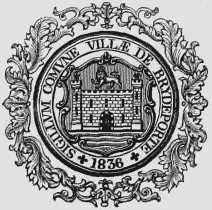
Seal of the New Corporation.
The trade of the port consists principally in the importation of hemp, flax, and timber, from Russia and the Baltic, and timber from America and Norway: there is also a considerable coasting-trade, by which the adjacent towns are supplied with coal from the north of England, with culm from Wales, and with other articles of general consumption. Many coastingvessels, particularly smacks, for the trading companies of Scotland, are built at this port; they are considered remarkable for strength, beauty, and fast sailing. The harbour is situated at the bottom of the bay formed by Portland Point, on the east, and the headlands near Torbay on the west. An act for restoring and rebuilding it was obtained in the 8th of George I., the preamble to which recites that, by reason of a great sickness that had swept away the greater part of the wealthy inhabitants, and other accidents, the haven was choked with sand, and the piers had fallen into ruins: the work was begun in 1742, and, by the expenditure of large sums, great improvement was made. Another act was obtained in 1823, since which more than £20,000, raised on the security of the rates and duties, have been expended, so that the harbour is now perfectly safe and commodious. This is a bonding port for wines, spirits, hemp, iron in bars, timber, tallow, hides, and other articles; the amount of import duties is somewhat more than £6200 per annum. An act was passed in 1845, for the construction of the Wilts, Somerset, and Weymouth railway, with a branch of 11¾ miles to this town. The principal articles of manufacture are nets, lines, small twine, shoe-thread, girthwebbing, cordage, and sail-cloth, for the use of the home and colonial fisheries, particularly those of Newfoundland and Nova Scotia: 10,000 persons are generally thus employed in the town and neighbourhood. In the reign of Henry VIII., the cordage for the whole of the English navy was ordered to be made at Bridport, or within five miles of it, exclusively. The markets are on Wednesday and Saturday; fairs are held on April 6th and Oct. 11th, for horses, horned-cattle, and cheese, and there is a smaller fair on Holy-Thursday.
The government, until recently, was regulated by charter of incorporation, originally granted by Henry III., confirmed by Richard II., Henry VII., Edward VI., and Elizabeth, and renewed and extended by James I. and Charles II. By the act of the 5th and 6th of William IV., cap. 76, the corporation now consists of a mayor, six aldermen, and eighteen councillors; and the borough has been divided into the north and south wards, the municipal and parliamentary boundaries being the same: the number of magistrates is eight. The elective franchise was conferred in the 23rd of Edward I., since which time the borough has regularly returned two members to parliament. The right of election was formerly vested in the inhabitants of the borough (which comprised 92 acres), paying scot and lot, in number about 250; but the act of the 2nd of William IV., cap. 45, extended it to the £10 householders of an enlarged district, containing by computation 388 acres. The mayor is returning officer. The powers of the county debt-court of Bridport, established in 1847, extend over the greater part of the registration-districts of Bridport and Beaminster. The town-hall is a handsome building of brick and Portland stone, containing, in the upper story, a large room for judicial and other purposes, a council chamber, town-clerk's offices, &c.: it was erected in 1786 on the site of the ancient chapel of St. Andrew, in the centre of the town, by an act of parliament. There is also a lock-up house for the confinement of prisoners before committal.
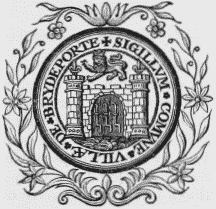
Old Corporation Seal.
The living is a discharged rectory, valued in the king's books at £10. 12. 3½.; net income, £166; patron, the Earl of Ilchester. The church, which appears to have been erected in the reign of Henry VII., about 1485, is a handsome and spacious cruciform structure, chiefly in the later English style, with a square embattled tower seventy-two feet high, rising from the centre, and crowned with pinnacles: it contains many interesting monuments; among them is an altar-tomb of William, son of Sir Eustace Dabrigecourt, of Hainault, related to Queen Philippa. There are places of worship for the Society of Friends, Independents, Wesleyans, and Unitarians. A free school was founded and endowed in 1708, by Daniel Taylor, one of the Society of Friends; and there are almshouses and other charities, under the management of trustees appointed in 1837, by the court of chancery. A handsome stone building for the poor law union of Bridport, and a register and other offices, have been lately erected; the union comprises nineteen parishes and places, and contains a population of 16,695. Turtle stone and cornua ammonis are found in the neighbouring quarries; and copperas stones on the beach, about four miles west of the harbour. There were formerly several religious houses here, among which were the priory of St. John, and the chapels of St. Leonard, St. Michael, and St. Andrew; but no remains exist. Bridport confers the titles of Baron and Viscount on the family of Hood.
Bridstow (St. Bridget)
BRIDSTOW (St. Bridget), a parish, in the union of Ross, Lower division of the hundred of Wormelow, county of Hereford, 1¼ mile (W. N. W.) from Ross; containing 625 inhabitants. Wilton Castle, the ruins of which constitute an interesting object on the western bank of the Wye, in the neighbourhood, was the baronial residence of the noble family of Grey, who assumed their title from this place: it was burnt by order of the royalist governor of Hereford, during the parliamentary war, and the walls are now overspread with ivy. The parish is bounded on the east by the river, which is here crossed by a bridge leading to Ross; and consists of 2196 acres, exclusively of 2 acres, extraparochial, on which stand the ruins of the castle. The living is a vicarage, valued in the king's books at £9. 3. 11½., and in the patronage of the Bishop of Hereford. The tithes here payable to the Bishop of Gloucester and Bristol have been commuted for £118. 6. 8.; those to the Bishop of Hereford, for £236. 16. 4.; and the vicarial for £230. 12. The glebe consists of 52 acres.
Briercliffe, with Extwistle
BRIERCLIFFE, with Extwistle, a township, in the parochial chapelry and poor law union of Burnley, parish of Whalley, Higher division of the hundred of Blackburn, N. division of the county of Lancaster, 2½ miles (N. E.) from Burnley; containing 1498 inhabitants. This place belonged to the De Lacys, one of whom obtained from Henry III. a charter for free warren in "Brerecleve;" and in this king's reign, the canons of Neubo held land in "Extwysell." Monk Hall, in the township, is supposed to take its name from a family, sometimes called Le Moin and sometimes De Monkys, who resided here as early as the time of Edward III. After the Dissolution, the Bradhills, and subsequently the Parkers, were proprietors. The township comprises 2577 acres of inclosed land, exclusive of commons: the surface is uneven, bordering upon the mountainous, with a wet soil; the prospects are very extensive. There are coal-mines, at present not wrought; and stone is obtained in abundance. The Cockden water passes through the township. The population is employed in hand-loom weaving, chiefly at their own homes. The greater part of the township belongs to Robert Townley Parker, Esq., of Cuerden Hall, near Preston. A district church, dedicated to St. James, was built in 1840, at a cost of £1500; it is a neat edifice in the early English style, and is a conspicuous object for many miles round. The living is a perpetual curacy, in the patronage of Hulme's Trustees; net income, £150, with a parsonage-house built in 1847. There are places of worship for dissenters. The remains of Extwistle Hall, the old family seat of the Parkers, still exist; and vestiges may be traced of a Roman camp.
Brierdean, or Burradon
BRIERDEAN, or Burradon, a township, in the parish of Earsdon, union of Tynemouth, E. division of Castle ward, S. division of Northumberland, 6¾ miles (N. N. E.) from Newcastle-upon-Tyne; containing 97 inhabitants. It comprises an area of 515 acres, and contains quarries of excellent freestone, and an extensive colliery opened some years ago by Lord Ravensworth and partners: the whole township belongs to the Ogle family, of Causey Park, near Morpeth. Here are the ruins of an ancient castle, of great interest to antiquaries, and very similar in appearance to Loch Leven Castle in Scotland, where Queen Mary was confined.
Brierley
BRIERLEY, a township, in the parish and union of Leominster, hundred of Wolphy, county of Hereford; containing 89 inhabitants.
Brierley
BRIERLEY, a township, in the parish of Felkirk, wapentake of Staincross, W. riding of York, 6½ miles (N. E. by E.) from Barnsley; containing 491 inhabitants. This township, which includes the hamlet of Grimethorpe, is situated on the road from Barnsley to Pontefract, and comprises about 2490 acres: a coal-pit is in operation. Grimethorpe Hall, an ancient mansion, had formerly a small Roman Catholic chapel, and extensive pleasure-grounds. The tithes of this place, with those of South Hiendly and Shafton, have been commuted for £716. 19. payable to the Archbishop of York, and £114. 8. to the vicar of the parish; there is a glebe of 1¼ acre. The Wesleyans have a place of worship. On the lofty hill of Ringstead is a venerable oak measuring thirteen yards in circumference, the hollow of which is sufficient to admit of six men sitting round a table.
Brierley-Hill
BRIERLEY-HILL, a district chapelry, in the parish of King's Swinford, union of Stourbridge, N. division of the hundred of Seisdon, S. division of the county of Stafford, 2¼ miles (N. N. E.) from Stourbridge. This is a populous village and chapelry, consisting of several streets, and having in its vicinity numerous collieries, and iron-works on a large scale; steam-boilers and various other heavy articles in iron being manufactured here. There are also glass-works, and some potteries. It appears by an old deed, that coal and ironstone were obtained at this place as early as the 46th of Edward III. The living is a perpetual curacy, with a net income of £210; patron, the Rector of King's Swinford; impropriator, Lord Ward. The chapel was erected in 1767, was enlarged in 1823 and again in 1837, and will now accommodate nearly 2000 persons: a magnificent organ has lately been erected at an expense of 400 guineas. In 1834, a national school was built for 500 children, at a cost of £700, whereof £270 were given by the Lords of the Treasury; and in 1846, a handsome infant school was added, the expense of which was £400. The first minister here, was the Rev. Thomas Moss, author of the elegant little poem called The Beggar's Petition; he afterwards removed to Trentham, as domestic chaplain to the Marquess of Stafford.
Briers, county of York.—See Owram, South.
BRIERS, county of York.—See Owram, South.
Brierton
BRIERTON, a township, in the parish of Stranton, union of Stockton-upon-Tees, N. E. division of Stockton ward, S. division of the county of Durham, 8¼ miles (E. N. E.) from Stockton; containing 27 inhabitants. The manor belonged from the earliest date of the records to the family of Graystock. It afterwards passed to the Dacres; and Lord William Howard, who married Elizabeth, younger sister and coheiress of George, Lord Dacre, seems to have had the Durham estates on partition with his brother, the Earl of Arundel, husband of Anne, the elder sister. The place was subsequently the property of the Blacketts.
Briery-Cottages and Greta-Mills
BRIERY-COTTAGES and Greta-Mills, an extraparochial district, connected with the chapelry of St. John Castlerigg, parish of Crosthwaite, union of Cockermouth, Allerdale ward below Derwent, W. division of the county of Cumberland; containing 100 inhabitants.
Brieryhurst, or Brerehurst
BRIERYHURST, or Brerehurst, a hamlet, in the parish of Wolstanton, union of Wolstanton and Burslem, N. division of the hundred of Pirehill and of the county of Stafford, 5½ miles (N.) from Newcastle; containing 1518 inhabitants. It comprises an area of 922 acres, and includes the eastern portion of Merocop, a rugged and lofty hill dividing the counties of Stafford and Chester: the district is rich in mineral produce, and the hamlet contains mines of coal and ironstone, which are extensively worked at Kidsgrove and in the immediate vicinity. Several blast furnaces for smelting iron-ore have been erected by Thomas Kinnersly, Esq. A handsome church has been built and endowed at Kidsgrove by Mr. Kinnersly, capable of accommodating 400 persons: it has a tower, in which are six bells and a clock; and nearly adjoining are a parsonage and school-house, erected by the same gentleman. They are all situated in a secluded spot, embosomed in woods, and have a very picturesque appearance. There is a place of worship for Wesleyans.
Brigg.—See Glandford-Brigg.
BRIGG.—See Glandford-Brigg.
Brigham (St. Bridget)
BRIGHAM (St. Bridget), a parish, comprising the borough and market-town of Cockermouth, and the townships of Blindbothel, Brigham, Buttermere, Eaglesfield, Embleton, Gray-Southan, Mosser, Setmurthy, and Whinfell, in the union of Cockermouth, Allerdale ward above Derwent, W. division of Cumberland; the whole containing 7397 inhabitants, of whom 490 are in the township of Brigham, 2 miles (W.) from Cockermouth. This parish is situated among the lakes Bassenthwaite, Buttermere, Crummock, and Loweswater, which, with the rivers Derwent and Maron, form its boundaries; and is intersected by the Cocker, which falls into the Derwent at Cockermouth. The surface is hilly, but since the inclosure of the waste land, the high grounds have been chiefly brought into cultivation: there are quarries of limestone, freestone, and blue slate, and a mine of coal has been opened. The village, which contains some respectable dwellinghouses, is built upon an eminence on the south bank of the Derwent, commanding a richly diversified prospect. The living is a discharged vicarage, valued in the king's books at £20. 16. 0½ net income, £190; patrons and impropriators, the family of Lowther, to whom, in 1813, land was assigned in lieu of all tithes for the township of Brigham. The church, situated at the distance of half a mile from the village, has a handsome window of five lights in the decorated style, at the east end of the south aisle; a curious circular window of the same date; and a monumental arch richly canopied. A chapel of ease was erected by the Rev. Dr. Thomas, in 1840; and there are separate incumbencies at Buttermere, Cockermouth, Embleton, Lorton, Mosser, Setmurthy, and Wythrop. The dissenters have several places of worship.
Brigham
BRIGHAM, a township, in the parish of Fostonupon-Wolds, union of Driffield, wapentake of Dickering, E. riding of York, about 5½ miles (S. E.) from Driffield; containing 147 inhabitants. It is situated on the navigable river Hull, near Frodingham Bridge, and comprises by computation 1470 acres. Land and money payments were assigned in lieu of tithes, in 1766. There is a place of worship for Wesleyans.
Brighouse
BRIGHOUSE, an ecclesiastical district, in the township of Hipperholme-cum-Brighouse, parish and union of Halifax, Upper division of the wapentake of Morley, W. riding of York, 4 miles (E. by N.) from Halifax; containing 3200 inhabitants. This flourishing and rapidly increasing place, which has grown into some importance within a comparatively recent period, is beautifully situated on the road from Bradford to Huddersfield, and in the fertile valley of the Calder; the village is spacious and well built, and contains many handsome houses. An act for lighting and otherwise improving the place, was passed in 1843. In the immediate vicinity are pleasing villas and detached ranges of building, forming a considerable appendage to the village, and adding much to the appearance of the surrounding scenery. The manufacture of worsted and cotton goods is carried on, several large mills being in full operation; the manufacture of cards used in the woollen, flax, and cotton trades, is also carried on to a great extent, and there are some flour-mills, and tanneries. In the neighbourhood are the valuable quarries called Cromwell Bottom, from which large quantities of building and flag stone are sent to various parts of the kingdom, by the Calder and Hebble navigation. The river Calder forms the southern boundary of the township, and at the village is a station on the old Leeds and Manchester railway, with a spacious depôt for merchandise. A fair for cattle and pigs is held on the day after the festival of St. Martin. The church, dedicated to St. Martin, was erected at an expense of £3200, principally a grant from Her Majesty's Commissioners, and was consecrated in 1830; it is a good edifice in the later English style, with a square embattled tower crowned by pinnacles, and contains 1150 sittings, of which 500 are free. The living is a perpetual curacy, at present in the patronage of the Vicar of Halifax, with an income of £150, and a handsome parsonage-house erected at a cost of £1600.— See Hipperholme.
Brighthampton
BRIGHTHAMPTON, a hamlet, in the parish of Bampton, union of Witney, hundred of Bampton, county of Oxford, 4¾ miles (S. E. by S.) from Witney; containing 120 inhabitants.
Brightling (St. Thomas à Becket)
BRIGHTLING (St. Thomas à Becket), a parish, in the union of Battle, partly in the hundred of Henhurst, but chiefly in that of Netherfield, rape of Hastings, E. division of Sussex, 4 miles (N. W.) from Battle; containing 692 inhabitants. The parish comprises about 4000 acres, of which 1020 are arable, 850 meadow and pasture, 350 common, 120 acres hopgrounds, and 1630 wood. It is diversified with gentle undulations, rising in some places to a considerable eminence; the highest parts of Rose Hill have an elevation of more than 600 feet above the level of the sea. Limestone and sandstone are found in abundance, and great quantities of the latter are quarried for building; ironstone was formerly wrought, and there were furnaces for the smelting of iron-ore. The living is a rectory, valued in the king's books at £11; patron and incumbent, the Rev. J. B. Hayley, whose tithes have been commuted for £642. The church is a handsome edifice, chiefly in the later English style, with a low embattled tower, and contains several neat monuments, among which is one to John Fuller, Esq., whose bust is finely sculptured by Chantrey. The Rev. William Hayley, who collected ample materials for a History of Sussex, and whose manuscripts are in the British Museum, was rector of the parish, and was interred here. At Rose Hill is a chalybeate spring.
Brightlingsea (All Saints)
BRIGHTLINGSEA (All Saints), a parish, in the union of Lexden and Winstree, hundred of Tendring, N. division of Essex, 9 miles (S. E.) from Colchester; containing 2005 inhabitants. It constitutes a peninsula, formed by the estuary of the river Colne on the west, and that of a smaller river on the east; and comprises 3090 acres, of which 128 are common or waste. The living is a discharged vicarage, valued in the king's books at £17. 0. 5.; patron, the Bishop of London; impropriator, M. D. Magens, Esq.: the great tithes have been commuted for £240, and the vicarial for £150. The church is situated about a mile and a half from the village. There is a place of worship for Wesleyans.
Brighton (St. Nicholas)
BRIGHTON (St. Nicholas), a sea-port, borough, market-town, and parish, in the hundred of Whalesbone, rape of Lewes, E. division of Sussex, 30 miles (E.) from Chichester, and 52 (S.) from London; containing 46,661 inhabitants. This place, in the Saxon Brighthelmstun, in Domesday book Bristlemeston, and now, by contraction, generally Brighton, is supposed to have taken its name from the Saxon bishop, Brighthelme, who resided in the vicinity. It was anciently a fortified town of considerable importance, and by some antiquaries is thought to have been the place where Cæsar landed on his invasion of Britain; an opinion probably suggested by the quantity of Roman coins found in the town, the vast number of human bones, of extraordinary size, which have been discovered for nearly a mile along the coast westward, and the traces of lines and intrenchments in the immediate vicinity, bearing strong marks of Roman construction. From a fortified town, it was, by successive encroachments of the sea, reduced to a comparatively inconsiderable village; and soon after the Conquest the place was inhabited principally by fishermen. It was frequently assaulted by the French, by whom, in the reign of Henry VIII., it was plundered and burnt; and as a protection against their future attacks, fortifications were erected, which were repaired and enlarged by Queen Elizabeth, who built a wall, with four lofty gates of freestone, for its better defence. After the fatal battle of Worcester, Charles II. arrived here on the 13th of October, 1651, and on the following morning embarked for France, in a small vessel belonging to the port, which landed him safely at Feschamp in Normandy, and which, after the Restoration, was taken into the royal navy as a fifth-rate, and named the "Royal Escape." In the years 1665 and 1669, an irruption of the sea destroyed a considerable part of the town, and inundated a large tract of land adjoining; and in 1703, 1705, and 1706, the fortifications were undermined, and many houses destroyed by tremendous storms and inundations that threatened its annihilation.
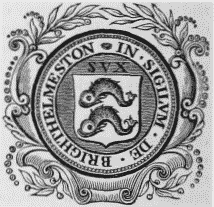
Town Seal.
In the reign of George II., Brighton began to rise into consideration as a bathing-place, from the writings of Dr. Russell, a resident physician, who recommended the sea-water here, as containing a greater proportion of salt than that of other places, and being therefore more efficacious in the cure of scrofulous and glandular complaints. Its progress was accelerated in 1760 by the discovery of a chalybeate spring, the water of which being successfully administered as a tonic, in cases of infirm or debilitated constitutions, the town became the resort of invalids from all parts of the country; and it ultimately obtained the very high rank which it now enjoys as a fashionable watering-place, under the auspices of George IV., who, in 1784, when Prince of Wales, commenced the erection of a palace here.
The town is pleasantly situated on elevated ground rising gently on the east and west from a level called the Steyne, supposed to have been the line of the ancient Stayne-street, or Roman road from Arundel to Dorking. It adjoins a bay of the English Channel, formed by the promontories of Beachy Head and Worthing Point; extends nearly three miles from east to west; and is sheltered by a range of hills on the north and north-east, and by the South Downs. Its form, including the more recent additions, is quadrangular; and the streets, which are spacious, and intersect each other at right angles, are well paved, and lighted with gas: an act was obtained in 1834, for more plentifully supplying the town with water; in 1839 and 1843 acts were procured for the better lighting of the town, and in 1839 one for the establishment of a general cemetery. The houses in the older part are irregularly built, but the more modern part consists of handsome ranges of uniform buildings, many of which are strikingly elegant, and situated on the cliffs. Kemp Town, in the extreme east, contains some splendid mansions: there are also fine ranges of building, with a square, in the extreme west, towards Hove; and in other parts are agreeable squares. The Pavilion, begun in 1784, and completed in 1827, by George IV., is in the oriental style of architecture, on the model of the Kremlin at Moscow. It has a handsome stone front, 200 feet in length, with a circular building in the centre, surrounded by an arcade of elliptic form, with intercolumniations carried up to the parapet, and crowned with a splendid oriental dome, terminating in a slender and richly-embellished finial, and encircled with four minarets of nearly equal elevation. The central range is connected, by corridors of circular buildings, crowned with domes of similar character, but of smaller dimensions, with two quadrangular and boldly-projecting wings, round which are carried arcades similar to that of the centre, with lofty pagoda roofs, and minarets rising from the angles. The interior contains a splendid vestibule and grand hall, a Chinese gallery of costly magnificence, a music-room, banqueting-room, rotunda, and numerous stately apartments, all decorated in the most sumptuous style of oriental splendour. Connected with the palace on the west, is the private royal chapel, consecrated in 1822; and behind it are the royal stables, a circular structure, appropriately designed in the Arabian style, and surmounted by a dome of glass: on the east side of the quadrangle in which they are situated, is a racquet-court, and on the west a ridinghouse.
Hot and cold sea-water, vapour, and shower baths have been constructed in the town, with every regard to the convenience of the invalid: those at the New Steyne hotel are supplied with water raised from the sea, to the height of 600 feet, by an engine, and conveyed through a tunnel excavated in the rock. The chalybeate spring, about half a mile west of the old church, is inclosed within a neat building; and the water, which deposits an ochreous sediment, has been found very beneficial as a restorative, and is in high repute: the German spa, also, near the Park, affords every variety of mineral water, artificially prepared. There are several public libraries: assemblies are held at the Ship hotel, in which are spacious rooms superbly fitted up; and a concert and ball room, in Cannon-place, lately erected, is said to be one of the best adapted to its purpose in the kingdom. The theatre, erected in 1807, is externally an unadorned building, with a plain portico, but is elegantly fitted up within. The races, which continue for three days, are held on the Downs, in the first week in August. The Royal Gardens, to the north of the town, including a spacious cricket-ground, are appropriated to various amusements; and the Downs afford pleasant and extensive rides. The Old Steyne is adorned with a bronze statue of George IV. by Chantrey, erected in 1828, at an expense of £3000, raised by subscription; and comprises the North and South Parades, and several other agreeable walks: the inclosures have been much improved of late, and are ornamented with a fountain, which was completed in 1846. The splendid suspension chain pier, constructed in 1821, at an expense of £30,000, under the superintendence of Capt. Sir S. Brown, R.N., forms a favourite promenade, 1130 feet in length: during a violent storm on the 15th of October, 1833, it sustained considerable injury, but it was effectually repaired by subscription, under the direction of Capt. Brown. The Esplanade, 1200 feet long and 40 feet wide, connects the pier with the Steyne. Among the more recent improvements is the construction of a sea-wall, on the beach in front of the town, extending from Middle-street to Kemp Town, a distance of a mile and a half; it forms one compact and solid mass, presenting a formidable barrier to further encroachments of the sea: a beautiful carriage drive was formed, and the total expense of the undertaking exceeded £100,000. There are barracks for infantry in the town, and for cavalry at the distance of a mile, on the road to Lewes. The artillery barracks on the western cliff, where there is a battery of heavy ordnance for the defence of the beach, are now used as dwelling-houses.
Steam-vessels sail from this place or Shoreham to Dieppe and Havre; but few vessels discharge their cargoes on the beach, the great quantity of articles for the supply of the town being landed at Shoreham harbour, and thence conveyed hither by land carriage or railway. The principal branch of trade is the fishery, in which about 100 boats are employed: the mackerel season commences in April, and the herring season in October; and soles, turbot, skate, and other flat fish, are also taken in great quantities, and sent to the London market. The making of nets and tackle for the fishermen, the materials of which are brought from Bridport, affords employment to a portion of the inhab tants. The London and Brighton railway was constructed by a company, incorporated by act of parliament passed in July 1837, by which they were empowered to raise a joint-stock capital of £1,800,000, and by loan £600,000. The line was opened Sept. 21st, 1841. It diverges from the London and Croydon railway, about 9¼ miles from London, and reaches its termination at Church-street, Brighton, whence there is a branch of 5½ miles to Shoreham, opened in May, 1840: the Shoreham branch has been since extended to Worthing, Arundel, Chichester, and Portsmouth; and a line has been completed from Brighton to Lewes and Hastings. The Brighton station is an elegant structure in the Grecian style, surrounded by a colonnade, above which is a handsome balustrade. The market was established by act of parliament, in 1773: the principal day is Thursday, but there are daily markets for the supply of the inhabitants. The fairs are on Holy-Thursday and Sept. 4th. A new and commodious market-house was built on the site of the old workhouse, in 1829. By the act of the 2nd of William IV., cap. 45, the town was constituted a borough, consisting of the parishes of Brighton and Hove, with the privilege of sending two members to parliament; the returning officer is annually appointed by the sheriff of the county. The town is within the jurisdiction of the county magistrates, who hold meetings every Monday and Thursday. A constable, eight headboroughs, and other officers are chosen annually at the court leet for the hundred; and the direction of police and parochial affairs is entrusted, under an act of parliament, to a corporate body of 112 commissioners elected by the inhabitants, who appoint a town-clerk, surveyor, collectors of tolls and duties, police officers, &c. The powers of the county debt-court of Brighton, established in 1847, extend over the registration-district of Brighton, and part of that of Steyning. A new town-hall has been erected on the site of the old market-house, near the centre of the town, at an expense of £30,000; it is a very large edifice, ornamented with three stately porticoes, and contains offices for the magistrates, commissioners, directors of the poor, &c., the lower part being used as a market-place.
The living is a vicarage, with the rectory of West Blatchington consolidated, valued in the king's books at £20. 2. 1½.; net income, £1041; patron, the Bishop of Chichester; impropriator, T. R. Kemp, Esq. The parish church is a spacious ancient structure, partly in the decorated, and partly in the later, English style, with a square embattled tower, which, from the situation of the church on the summit of a hill, 150 feet above the level of the sea, serves as a landmark to mariners. It contains a fine screen of richly carved oak, and an antique font, said to have been brought from Normandy in the reign of William the Conqueror, which is embellished with sculptured representations of the Last Supper, and of the miracles of our Saviour. St. Peter's church is an elegant structure at the north end of the town, in the later English style, with a square embattled tower crowned with pinnacles, erected in 1827, at an expense of £18,000, partly by the Parliamentary Commissioners, and containing 1840 sittings, of which 940 are free. The living is a perpetual curacy; net income, £350; patron, the Vicar. The Chapel Royal, in Prince's-place, erected in 1793, is a neat plain edifice, containing 900 sittings, of which 200 are free: the living is a perpetual curacy; net income, £180; patron, the Vicar. The church of St. James, in St. James's street, contains 1000 sittings, of which 300 are free: the living is a perpetual curacy; net income, £181; patrons, the Trustees of the late N. Kemp, Esq. The church of St. Mary, in the same street, is a handsome structure in the Grecian style, with a portico of the Doric order, and contains 1100 sittings, of which 240 are free: the living is a perpetual curacy; net income, £100; patron and incumbent, the Rev. H. V. Elliott. The church of St. George, in Kemp Town, is a well-built edifice in the Grecian style, containing 1450 sittings, of which 390 are free: the living is a perpetual curacy; net income, £150; patrons, L. Peel, Esq., and the Rev. J. S. M. Anderson, the incumbent. The church of the Holy Trinity, Ship-street, contains 900 sittings, of which 200 are free: the living is a perpetual curacy; net income, £150; patron and incumbent, the Rev. C. E. Kennaway. St. Margaret's, Cannon-place, was built in 1827, is in the Grecian style, and contains 1000 sittings, of which 200 are free: the living is a perpetual curacy, in the gift and incumbency of the Rev. F. Reade, with a net income of £150. The church of All Souls, Upper Edward-street, erected in 1833, contains 1100 sittings, nearly all free: the living is a perpetual curacy; net income, £100; patron, the Vicar. Christ-Church, in the Montpelier-road, was consecrated April, 1838, and contains 1076 sittings, of which 624 are free: the living is a perpetual curacy, in the gift of the Vicar; net income, £420. The church of St. John the Evangelist, Carlton-Hill, contains 1225 sittings, of which 625 are free: the living is a perpetual curacy, in the patronage of the Vicar; net income, £90. The foundation-stone of All Saints' church, West-street, was laid in April, 1846; the building is in the early decorated style, and was erected partly by the Church Commissioners, partly by the Wagner family, and partly by general subscription. A neat church, with a spire, has also been just completed at Kemp Town; and besides these is St. Andrew's, Waterloo-street, in Hove parish. There are places of worship for Baptists, Independents, the Society of Friends, the Connexion of the Countess of Huntingdon, Huntingtonians, Scottish Seceders, Wesleyans, and others; also Bethel chapel, belonging to the Mariners' Friend Society; a Roman Catholic chapel, and a synagogue.
Brighton College, opened January 26th, 1847, provides for the sons of noblemen and gentlemen a course of education of the highest order, in conformity with Church principles. It was established by a proprietary, who appoint a patron, four vice-patrons, and a council consisting of a president, four vice-presidents, and twelve other members: there are a principal, a vice-principal and theological tutor, a head-master, and seven assistant-masters. The pupils are divided into two departments, the senior and the junior; and those in the former wear an academical dress: three scholarships of £30 a year each have been founded. The building occupies an elevated site at Kemp Town, near the new church, and is in the Elizabethan style; it is of compact form, and the grounds around it are inclosed by a substantial wall, in some parts very lofty. Of the numerous Free Schools the principal are, the school in Gardenerstreet, for girls, endowed in 1811, by Swan Downer, Esq., with £7100, subsequently invested in the purchase of £10,106. 15. three per cent. consols., producing a yearly income of £303; the Blue-coat school, in Ship-street, for boys, to which William Grimmit, Esq., in 1749, bequeathed property, afterwards invested in Old South Sea annuities, amounting at present to £2330. 11., producing a dividend of £69. 18.; the school near Russel-street, for the children of fishermen; and the Orphan Asylum, for girls, on the western road. The St. Mary's Hall institution, for the education of the daughters of poor clergy, was established in 1838. There are also several schools on the National system, connected with the Established Church, in which more than 1300 children receive daily instruction, and also infant and Sunday schools; appropriate buildings have been completed at an expense of nearly £7000.
The County Hospital and General Sea-Bathing Infirmary, with a detached house of recovery for persons labouring under contagious fever, is a very neat edifice of pale brick, with ornaments of stone, occupying an elevated site near Kemp Town, which, with a donation of £1000, was given by T. R. Kemp, Esq. The Earl of Egremont contributed £2000 towards its erection, and £4000 towards its endowment. At the western extremity of the main building, a wing called "Victoria" was added in 1839, towards the erection of which Lawrence Peel, Esq., contributed £500; the balance of a fund raised for the celebration of the Queen's first visit to Brighton, amounting to £400, was also appropriated, and £1600 raised by subscription. Six almshouses for poor widows are endowed with £96 per annum, under the wills of Philadelphia and Dorothy Percy, daughters of a late Duke of Northumberland: 20 poor men and 24 women are annually clothed from the interest of £5000, left by Swan Downer, Esq.; and there are a lying-in institution, Dorcas, and other societies for the benefit of the poor; for whose advantage, also, Col. Ollney recently bequeathed £500, the interest to be distributed in coal and blankets at Christmas. On White Hawke Hill, near the race-course, on which a signal-house has been erected, are the remains of an encampment, having a narrow entrance on the north, where it is defended by a double intrenchment; and on Hollingsbury Hill, a second station for signals, about two miles north of the town, are vestiges of a large circular encampment, in which are several tumuli. In 1750, an urn containing 1000 silver denarii, of the emperors from Antoninus Pius to Philip, was found near the town; and in the immediate vicinity are numerous remains of altars and other Druidical monuments.
Brighton, New
BRIGHTON, NEW, a bathing-place, in the parish of Wallasey, union, and Lower division of the hundred, of Wirrall, S. division of the county of Chester, 3 miles (N. W. by N.) from Liverpool. It forms the north-east corner of the peninsula of Wirrall, being bounded by the river Mersey on the east, and on the north by the Irish Sea; and comprises 180 acres, of undulated surface, and hilly in some parts, the whole laid out in roads, and studded with mansions, many of them of much architectural beauty. The striking features of the locality have been taken advantage of in constructing a series of marine villas, which, rising one above another, have a most picturesque effect as seen from a distance. Spacious streets, fifteen yards wide, have been formed: several excellent hotels and boarding-houses have been built; and the accommodation which the place affords, the salubrity of its air, and the convenience of bathing, have made it the residence of eminent merchants, and the resort of visiters generally of the wealthy classes. The sandy beach is very smooth, dry, and firm; and the water on the shore, beautifully pellucid. From the higher grounds are extensive views of the Welsh mountains, the opposite port of Liverpool, and the shipping on the Mersey. A reservoir has been constructed for supplying the inhabitants with water, and on the shore is a spring of fine fresh water, which, though covered over by the tide, is perfectly pure when the sea retires. Upon the Black rock, where the Mersey enters the Irish Channel, is a very strong fort, mounting fifteen large guns, and approached from the main land by a drawbridge; and further off the shore is a small lighthouse, on the plan of the Eddystone, built of Anglesey marble at a cost of £34,500, defrayed by the corporation of Liverpool: it rises ninety feet, and is completely surrounded at high tides, like the fort, by the water. Steamers run to and from Liverpool every hour. A site and £500 have been offered for building a church, and plans are in progress for its erection. The masses of sandstone near the Black rock, called the Red and Yellow Noses, well merit the attention of the naturalist, being worn by the action of the sea into a variety of caverns of the most romantic forms; a tunnel has been cut through one of them from the beach, forming a private entrance up to Cliffe Villa.