A Topographical Dictionary of England. Originally published by S Lewis, London, 1848.
This free content was digitised by double rekeying. All rights reserved.
'Cheshunt - Chetwood', in A Topographical Dictionary of England, ed. Samuel Lewis (London, 1848), British History Online https://www.british-history.ac.uk/topographical-dict/england/pp576-586 [accessed 30 April 2025].
'Cheshunt - Chetwood', in A Topographical Dictionary of England. Edited by Samuel Lewis (London, 1848), British History Online, accessed April 30, 2025, https://www.british-history.ac.uk/topographical-dict/england/pp576-586.
"Cheshunt - Chetwood". A Topographical Dictionary of England. Ed. Samuel Lewis (London, 1848), British History Online. Web. 30 April 2025. https://www.british-history.ac.uk/topographical-dict/england/pp576-586.
In this section
Cheshunt (St. Mary)
CHESHUNT (St. Mary), a parish, and formerly a market-town, in the union of Edmonton, hundred and county of Hertford, 8 miles (S. by E.) from Hertford; containing, with Cheshunt-street, Waltham-Cross, and Woodside wards, 5402 inhabitants. In this parish was formerly a bank separating the kingdoms of Mercia and East Anglia during the heptarchy, the lands on one side of which the elder brother still inherits, and the younger those on the other side. Cardinal Wolsey possessed the united manors of Andrews and Le Mote, in the parish, and received from the crown the appointment of bailiff of the honour, and keeper of the park, of Cheshunt. Here stood the palace called Theobalds, the favourite residence of Lord Burleigh, and afterwards of James I., who died in it in 1625; it was also the occasional resort of Charles I., who here received the petition from both houses of parliament in 1642, a short time before he placed himself at the head of the army. The greater part of the palace, the park attached to which was ten miles in circuit, and surrounded by a wall, was taken down by the Parliamentary Commissioners for selling the crown lands, in 1650. Near the church is a house in which Richard Cromwell, after resigning the protectorate, lived in retirement, under the assumed name of Clark, till his death in 1712. The parish comprises about 8450 acres, the soil of which is rich and fertile, consisting of the several varieties of gravel, clay, and loam; the surface is undulated, and the scenery enlivened by the picturesque windings of the New River, and the expansive stream of the Lea. The Cheshunt station of the Cambridge railway is 16¼ miles from the London terminus. The village is supposed to occupy the site of a Roman station on the Ermin-street: the petty-sessions for the division are held here.
The living is a vicarage, valued in the king's books at £26; net income, £401; patron, the Marquess of Salisbury; impropriator, J. J. Martin, Esq.: there is a good glebe-house, with nearly 200 acres of land allotted at the inclosure, in 1800, in lieu of tithes. A new church, in the later English style, with a campanile turret, was erected in 1832, at an expense of £3282, under an act of the 58th of George III. At Waltham-Cross, is Trinity chapel, in the gift of the Vicar. Cheshunt College, for the preparation of young men for the ministry, was originally established in 1768, at Talgarth, in the county of Brecon, South Wales, by the Countess of Huntingdon, who continued to support the college until her death in 1791, when it was removed by the trustees to this place; a chapel was built in 1806, and in 1821 a new building was annexed for the accommodation of 20 additional students. The institution is supported by the interest on about £8000 stock, a portion of an estate called Cobham, and subscriptions, the whole producing about £1200 per annum. A free school was founded about 1642, and endowed with land by Robert Dewhurst, who built the school-house, and also assigned 20 nobles each for apprenticing six boys. Almshouses for ten widows, at Turner's Hill, are endowed with a donation of £500 from James I., and the income has been augmented by various benefactions. To the north were lately some remains of a nunnery founded in the reign of Stephen, by Peter de Belengey, in honour of the Blessed Virgin, for nuns of the Sempringham order, whom Henry III. afterwards displaced for others of the Benedictine order: its revenue, in the 26th of Henry VIII., was estimated at £27. 6. 8. Roman coins of the reigns of Adrian, Claudius Gothicus, and Constantine, were found in 1724.
Cheslyn-Hay
CHESLYN-HAY, an extra-parochial liberty, locally in the parish of Cannock, union of Penkridge, E. division of the hundred of Cuttlestone, S. division of the county of Stafford, 7 miles (S. E. by S.) from Penkridge; containing 774 inhabitants, and comprising by computation 790 acres. It includes the large and irregularly-built village of Wyrley-Bank, which extends from one mile south of Cannock to the township of Great Wyrley: an eminence here, planted with firs, may be seen at a considerable distance. The opening of the neighbouring coal-mines has much improved the place, which now has a meeting-house for Methodists, and a Sunday school.
Chessington
CHESSINGTON, a parish, in the union of Epsom, Second division of the hundred of Copthorne and Effingham, W. division of Surrey, 3 miles (S.) from Kingston; containing 226 inhabitants. The parish comprises by admeasurement 1223 acres, of which 970 are arable, and about 200 pasture; the soil is chiefly clay. It is annexed to the vicarage of Malden, and the Warden and Fellows of Merton College, Oxford, are impropriators: the tithes have been commuted for £305, and the glebe contains 25 acres. The church is in the early English style. There is a strong chalybeate spring, called Jessop's Well.
Chester
CHESTER, a city, port, and county of itself, locally in the hundred of Broxton, S. division of the county of Chester, of which it is the capital, 17 miles (S.) from Liverpool, 36 (S. W.) from Manchester, and 197 (N. W.) from London; containing 23,115 inhabitants, and, including those portions of the parishes of St. Mary on the Hill, St. Oswald, and the Holy Trinity, which are without the limits of the city, 25,613. The origin of this ancient city has been ascribed to the Cornavii, a British tribe who, at the time of the Roman invasion, inhabited that part of the island which now includes the counties of Chester, Salop, Stafford, Warwick, and Worcester; and its British name Caer Leon Vawr, "city of Leon the Great," has been referred to Leon, son of Brût Darian Là, eighth king of Britain. But there is no authentic account of Chester prior to the period when it was made the station of the twentieth Roman legion, after the defeat of Caractacus; and the more respectable historians deduce its names, Caer Leon Vawr, "city" or "camp of the great legion," and Caer Leon ar Dwfyr dwy, "the city of the legion on the Dee," from its connexion with the Roman people. It was also called Deunana and Deva, from the same river. The Romans occupied it from the year 46 till their departure from the island in 446, when it reverted to the Britons, from whom it was taken by Ethelfrith, king of Northumbria, who in 607 defeated them with the king of Powysland, with great slaughter. Having regained the place, the Britons continued to hold it till 828, when Egbert, as sole monarch of England, annexed it to his other possessions. By the Saxons the city was called Legancester and Legecester. It suffered greatly from the Danes in the ninth century: on their retreat, the walls were repaired by Ethelfreda, Countess of Mercia: and after her death the Britons once more became its masters, but were again driven out by Edward the Elder. In 971–3, Edgar assembled a naval force on the Dee, on which occasion that king, as mentioned by some writers, was rowed from his palace on the southern bank of the river to the conventual church of St. John, by eight tributary kings, he himself taking the helm, to denote his supremacy.
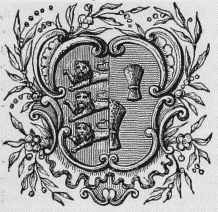
Arms.
On the division of England between Canute and Edmund Ironside, in 1016, Canute retained possession of Mercia and Northumbria; and Chester, which was included in Mercia, continued to form part of it till the Norman Conquest, when William bestowed it, with the earldom, on his kinsman, Hugh Lupus. At this time, according to Domesday book, the city contained 431 rateable houses. For more than two centuries after the Conquest, it was the head-quarters of the troops employed to defend the English border against the incursive attacks of the Welsh, and, on account of its importance as a military station, was more or less favoured by the reigning monarchs. In the war between Henry III. and the barons, Chester was captured by the Earl of Derby, in the year 1264, and held for the crown till the battle of Evesham, in which the barons were defeated with the loss of their leader, and an end put to the contest. On the subjugation of Wales, in 1300, by Edward I., several of the Welsh chieftains did homage to his son, Edward of Carnarvon, then an infant, in Chester Castle. Richard II., by an act of parliament which was rescinded by his successor, erected the earldom of Chester into a principality, to be held only by the king's eldest son.
The city, in common with the whole county, suffered considerably from the sanguinary conflicts between the houses of York and Lancaster, during which it was visited by Margaret of Anjou. In 1554, the inhabitants experienced the severity of the persecution by which the reign of Mary was distinguished; and the martyrdom of George Marsh, a clergyman who was burnt for preaching the tenets of Protestantism, was rendered memorable by an attempt of one of the sheriffs to rescue him, which was defeated by the other. In 1634, the city suffered dreadfully from the plague; during its continuance the court of exchequer was removed to Tarvin, and the court of assize to Nantwich, and the fairs were suspended. In the memorable siege of the city by Sir William Brereton, in 1645, when the garrison was commanded by Lord Byron, the inhabitants experienced great privations for their adherence to the cause of Charles I., who had the mortification to witness, from the Phœnix tower and the great tower of the cathedral, the entire defeat of his army under Sir Marmaduke Langdale, and its pursuit by the enemy even to the very walls. The noble commander, after a gallant resistance, surrendered on honourable terms, February 3rd, 1646. In 1659, Sir George Booth surprised and took possession of the city, but it was soon given up to the parliamentary forces under General Lambert. In 1688, the Roman Catholic lords, Molyneux and Aston, raised a force, and made themselves masters of Chester, for James II.; but his abdication rendered further efforts useless. Under William III. it was chosen one of the six cities for the residence of an assay-master, and allowed to issue silver coinage. In the rebellion of 1745, it was fortified against the Pretender, the last military event of importance recorded of a place celebrated as the rendezvous of troops from the earliest times.
Situated on a rocky elevation, on the northern bank of the Dee, and half encircled by a fine sweep of the river, the appearance of Chester is remarkable and picturesque. The city is entirely surrounded by a wall, and comprises four principal streets, diverging at right angles from a common centre, and extending towards the cardinal points; at the extremities of the streets are gates, after three of which are respectively named Eastgate-street, Northgate-street, and Watergate-street. This plan, strictly conformable to the Roman style of building, affords strong presumptive evidence of a Roman origin. Within the liberty of the city is an extensive southern suburb, called Hanbridge, which in feudal times generally fell a prey to the predatory incursions of the Welsh, and thence obtained, in their language, the appellation of Treboeth, "the burnt town." The streets of Chester, being cut out of the rock, are several feet below the general surface, a circumstance that has led to a singular construction of the houses. Level with the streets are low shops, or warehouses, over which is an open balustraded gallery, with steps at convenient distances into the streets; and along the galleries, or, as they are called by the inhabitants, "rows," are houses with shops: the upper stories are erected over the row, which, consequently, appears to be formed through the first floor of each house; and at the intersection of the streets are additional flights of steps. The rows in Bridge and Eastgate streets, running through the principal part of the city, are much frequented as promenades. Pennant considered these curious galleries to be remnants of the vestibules of Roman houses; but other writers are of opinion that they were originally constructed for defence, especially against the sudden inroads of the Welsh. The fronts of such of them as have not been modernised are bounded by a heavy wooden railing; and immense pillars of oak, supporting transverse beams, sustain the weight of the upper stories. Many of the houses in Bridge and Eastgate streets, having been rebuilt, are considerably improved and enlarged, and their appearance rendered light by iron-railing. The streets are well lighted with gas; they are indifferently paved, but the inconvenience to foot passengers, to whom the rows afford a sheltered walk, is little felt: the inhabitants are plentifully supplied with water, and the city, both within and without the walls, has been much improved of late by the addition of well-built houses. The new bridge, consisting of one arch of 200 feet in the span, is constructed of Peckforton stone, with quoins of granite, at an expense of £50,000, from a design by Mr. Thomas Harrison: the old bridge, consisting of seven arches, has, within the last few years, been considerably widened. In 1845 an act was passed for further improving the city, and for establishing new market-places. Fine views of the peninsula of Wirrall, the Welsh hills, and the estuary of the Dee, are obtained from the walls, which afford a delightful and favourite promenade. There are two public libraries: the theatre, a small neat edifice, is open during the races, and generally throughout the summer; and grand musical meetings are held at distant periods. The races, which attract much company from Wales and the neighbouring counties, commence on the first Monday in May, and terminate on the Friday following; they take place on the Rood-eye, a fine level beneath the city walls, well adapted to the purpose.
The port is not of much importance, owing to the shallowness of the water; but, by the exertions of the River Dee Company, the channel has been deepened, the navigation improved, and a tract of ground, formerly sands, but now arable land, has been gained by altering the course of the river, and making embankments, the last of which was completed in 1824. The commerce, both domestic and foreign, was once somewhat extensive, but is now chiefly confined to Ireland, though a few ships trade with the Baltic, Spain, Portugal, and the Mediterranean shores. The articles imported are, linen, butter, provisions, timber, hides, tallow, feathers, iron, hemp, flax, kid and lamb skins, fruit, oil, barilla, and wine; those shipped, chiefly coastwise, are cheese (in large quantities), coal, lead, copper, calamine, and lead, copper, and iron ores. About 1736, Chester became a great mart for Irish linen, the trade in which increased so much, that the fairs were principally distinguished by the quantity sold annually at them, estimated at 4,000,000 yards. The manufactures are inconsiderable; the principal articles are tobacco, snuff, whitelead, shot, tobacco-pipes, and leather. The skin trade was formerly extensive, but is now extinct; and the manufacture of gloves, in which several hundred persons were employed, has much declined. The city mills, standing on the western side of the old bridge, are complete and extensive; they were erected a few years since, in consequence of the destruction by fire of the former mills, which were a source of considerable profit to the earls of Chester, the inhabitants not being permitted to grind their corn elsewhere.
Chester is connected with Liverpool by the Ellesmere canal, which commences at Ellesmere Port, on the Mersey, and here joins the Dee and the Chester canal. The Chester and Crewe railway diverges from the Liverpool and Birmingham railway a little to the north of Crewe, and proceeds in a west-north-west direction towards Chester, on reaching which, it is connected with the Chester and Birkenhead line at its terminal station in Brook-street; it was opened in October, 1840. The Birkenhead line commences at the station in Brookstreet, and runs north-north-west to Birkenhead; it was opened for passengers and general traffic in September, 1840, and is 16 miles long. A railway to Holyhead has been carried straight through the walls of the city, so as to cut them in two places; the walls are here of considerable height, and the railway reaches them from a bridge that has been thrown over a canal, and leaves them by an embankment that is carried onwards to the Dee. Two strong bridges of iron and wood continue the walk upon the walls, on which a person can stand and see a train passing immediately under his feet. In 1845 an act was passed for making a railway to Shrewsbury; and in 1846 another act authorizing the formation of a railway from Chester, to join the proposed line between Hooton and Stockport. In 1847 a central station was projected for all the lines meeting at Chester.
The market-days are Wednesday and Saturday: the market-place comprising five distinct buildings, was erected at the expense of the corporation, in 1828. Fairs are held on the last Thursday in February, for horses and cattle; and July 5th and October 10th, for articles in general, of which Irish linen, Manchester goods, Welsh flannel, and Birmingham and Sheffield wares, are the principal. The two latter fairs were granted by Norman earls; and their antiquity is proved by the recorded jurisdiction of the Dutton family over the Cheshire minstrels, which is said to have originated in the deliverance of Earl Ranulph de Blundeville from a body of Welsh invaders, by a band of minstrels and buffoons, under the command of Hugh Dutton, who had assembled at Chester fair; for which service Dutton was afterwards allowed to license minstrels, and other itinerants, without their being accounted vagabonds. Fourteen days before the commencement of each general fair, a wooden hand, as the emblem of traffic and bargain, used to be suspended from the Pentice, adjoining St. Peter's church, where it remained during the fair, a period of twenty-nine days, when non-freemen were allowed to trade in the city. Besides these fairs, are others for the sale of live-stock, held on the last Thursday in April, the first Thursday in September, and the last Thursday in November; and for the sale of cheese and other agricultural produce, on the days preceding all the fairs. The Linen Hall, built about the year 1780, is a spacious pile of building, forming an oblong, and comprises more than one hundred shops.
The city is one of the most ancient corporate towns in England. At the Conquest, it ranked as a Guilda Mercatoris, a constitution somewhat similar to that of modern municipal corporations; it was chartered by its Norman earls, and additional immunities were conferred on the inhabitants by charter of King John. Edward III. granted to the corporation all the vacant lands within the liberty of the city; and Richard II. authorized the mayor, sheriffs, and commonalty, to hold courts of common law and other courts, which privileges were confirmed and extended by Henry IV. and VI. Henry VII., besides granting a more extensive charter, remitted four-fifths of the fee-farm rent of £100 per annum, which Henry III. and Edward I. had claimed from the citizens in consideration of continuing their privileges; and constituted the city a county of itself, under the style of the "City and County of the City of Chester." Charles II. disfranchised it in 1684–5; but its liberties were afterwards restored, with a discretionary power in the crown to displace the officers of the corporation. James II., availing himself of this prerogative, displaced the mayor, recorder, and other functionaries, but was induced, at the approach of the Revolution, to restore them to office. By the act of the 5th and 6th of William IV., cap. 76, the government is vested in a mayor, 10 aldermen, and 30 councillors; the council appoint a sheriff; and the city, formerly in 12 wards, is by that act divided into 5 only: the number of magistrates is 15. No fewer than 24 guilds or trade companies, headed by aldermen or wardens, hold charters of incorporation under the city seal. The freedom of the city is inherited by all the sons of freemen, and acquired by servitude. On the abridgment of the privileges of the county palatine, in 1541, an act was passed, empowering the county to return two knights, and the city two burgesses, to parliament. The election for the city was vested in the mayor, aldermen, and common-councilmen, whether resident or not, and freemen resident in the city a year preceding, in number about 1300; but by the act of the 2nd of William IV., cap. 45, the right of voting was extended to the £10 householders; and the limits of the borough, which anciently comprised 3000 acres, were enlarged, so as, for electoral purposes, to include part of the township of Great Boughton, and comprehend 3080 acres. The sheriff is returning officer. By ancient usage, confirmed by the several charters, the mayor, assisted by the recorder, held crown-mote and port-mote courts: the recorder has been sole judge since the passing of the act of the 5th and 6th William IV. The earliest rolls in these courts are of the date 1277: the jurisdiction of the crown-mote extends to all crimes except that of high treason, the mayor having had power to pass sentence of death, and order execution, independently of the crown; and in the portmote, pleas to any amount are cognizable. There are two other ancient courts; one called the "Pentice court," which has cognizance of personal actions to any amount; and the other the "Port-mote court," held before the mayor, to which records are removable from the Pentice court, by command of the mayor, without writ. The courts of quarter-sessions are held in the exchange, where the town officers and the members for the city are elected; and the assizes for the county are held in the castle. The powers of the county debtcourt of Chester, established in 1847, extend over the registration-district of Great Boughton. The exchange is a handsome brick building, finished in 1698; it is fronted with stone, supported by columns, and surmounted by a glazed cupola. On the ground-floor are the record-room and shops; and on the first floor the council and assembly rooms, which are decorated with a picture of George III. by Reynolds, and portraits of members of the Grosvenor, Cholmondeley, Bunbury, and Egerton families, and of several charitable individuals. The city gaol contains twelve wards, day-rooms, and airing-yards, and eight work-rooms.
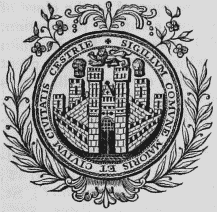
Corporation Seal.
Of the ancient castle, built by the Conqueror, there remains only a large square tower, called "Julius Agricola's Tower," now used as a magazine for gunpowder. Though of modern appearance, having been newly fronted, it is undoubtedly of great antiquity, and interesting as the probable place of confinement of the Earl of Derby, and the place in which Richard II., and Margaret, Countess of Richmond, were imprisoned. In the second chamber James II. heard mass, on his tour through this part of the kingdom, a short time previously to the Revolution. This apartment, when opened after many years of disuse as a chapel, exhibited, from the richness of its decorations, a splendid appearance, the walls being completely covered with paintings in fresco, as vivid and beautiful as when executed; and the roof, from the fine effect produced by the ribs of the groined arches, springing elegantly from slender pillars with capitals in a chaste and curious style, was equally striking. The remainder of the original structure, which was pulled down in 1790, contained a room termed Hugh Lupus' Hall, that was regarded as a superb specimen of baronial grandeur. The new edifice, which has excited general admiration, was erected from a design by Mr. Harrison, and under his inspection: the principal entrance is of the Doric order, resembling the Propylæa at Athens. Opposite to the great gate is the shire-hall, a magnificent structure: on the right of the hall is the entrance to the gaol, which is appropriated to debtors and felons of the county. At the eastern side of the yard are barracks for 120 men, fronted with white freestone, and ornamented with Ionic pillars; on the western side is a corresponding building, used as an armoury, which will contain 30,000 stand of arms. The castle is a royal fortress: the establishment consists of a governor, lieutenant-governor, ordnance-keeper, and barrack-master. The constableship of the tower is held by patent, and is free from municipal control.
Chester, with part of the kingdom of Mercia, at an early period gave name to a diocese, which afterwards was incorporated with that of Lichfield. In 1075, Peter, Bishop of Lichfield, restored the episcopal chair to Chester, whence it was a second time removed to Lichfield, by his successor, Robert de Lindsey. Chester again became a distinct diocese under Henry VIII., who named it one of the six new sees created in 1541, and endowed it with a portion of the possessions of the abbey of St. Werburgh, the revenue of which, at the Dissolution, was £1073. 17. 7. The first bishop was John Bird, previously a provincial of the Carmelites, and Bishop of Bangor, who, in 1547, granted the manors and demesnes of the bishopric to the king, accepting impropriations of little value in exchange, and thus rendered it one of the least valuable of the English sees. Its temporalities in Chester consist only of the palace, which was rebuilt in 1752, by Bishop Keene, and its appendages, and two houses near St. John's church. The act of the 10th and 11th Victoria, cap. 108, provides that the diocese of Chester shall consist of the county of Chester, and of the rural deanery of Warrington, in Lancashire. The bishop has the patronage of the canonries, of the honorary canonries, and the archdeaconries and chancellorship. The Dean and Chapter have the patronage of the minor canonries. The cathedral, originally the conventual church of St. Werburgh, was at first dedicated to St. Peter and St. Paul, but subsequently placed by Ethelfreda under the patronage of the Saxon saint Walmgha, daughter of Wulphere, King of Mercia: that princess, and Leofric, Earl of Mercia, were great benefactors to the church, as well as Hugh Lupus, who substituted Benedictine monks for Secular canons. On the suppression of the abbey, a dean, six canons or prebendaries, and six minor canons, were appointed in lieu of the abbot and monks, the last abbot being made dean: there are now a dean, four canons, four honorary canons, four minor canons, two archdeacons, a chancellor of the diocese, registrar, sacrist, and precentor. At the Dissolution the cathedral was dedicated to Christ and the Blessed Virgin. It stands on the eastern side of Northgatestreet, and exclusively of some interesting remains of the abbey, the present building was erected in the reigns of Henry VII. and Henry VIII. With the exception of the western end, it is externally a heavy irregular pile: the tower in the centre, originally intended to sustain a spire, is supported by massive piers, and is in the later style of English architecture. The interior is elegant and impressive, and exhibits portions in the Norman and the early and decorated English styles. The piers of the nave are in the decorated style, with flowered capitals; and the clerestory, which is in the later style, has a fine range of windows. To the east of the north transept are traces of some chapels in the early English style; the south transept, which is larger than the north, and consists of a centre and two aisles, is in the decorated style, and, being separated from the cathedral by a screen, forms the parish church of St. Oswald. The choir has a chequered floor of black and white marble, and the stalls are adorned with light tabernacle-work skilfully executed; the bishop's throne, usually deemed Werburgh's shrine, is a beautiful specimen of workmanship, in the style of the early part of the fourteenth century. The chapter-house, an admirable relic of antiquity, in the early English style, stands in the eastern walk of the cloister; it was built by Earl Randulph the first, and became the burial-place of the earls of the original Norman line, except Richard, who perished by shipwreck. The cathedral was re-opened at the close of 1845, having undergone an almost complete restoration. Beneath part of the prebendal houses is a fine Norman crypt, in good preservation, which supported the great hall of the monastery, and had lain concealed till it was cleared out and rendered accessible by order of Dr. Blomfield, the present Bishop of London, who then presided over this see.
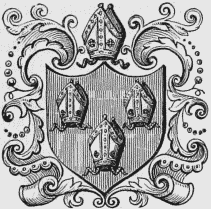
Arms of the Bishopric.
The city comprises the parishes of St. Bridget, containining 675 inhabitants; St. John the Baptist, 6752; Little St. John, extra-parochial; St. Martin, 532; St. Michael, 649; St. Olave, 430; and St. Peter, 847; part of the parishes of St. Mary on the Hill, 2975, St. Oswald, 5959, and the Holy Trinity, 3340; and the precinct of the Cathedral Close, 329. The living of St. Bridget's is a rectory not in charge, with that of St. Martin's; net income, £150; patron, the Bishop. The church, lately rebuilt, is a chaste and elegant structure of the Doric order; towards its erection the Bridge Committee gave £4000, and the parishioners £500. The living of St. John the Baptist's is a vicarage not in charge; net income, £237; patron and impropriator, the Marquess of Westminster. The church, formerly collegiate, and, on the removal of the see of Lichfield to Chester by Bishop Peter, used as the cathedral, consists of the nave and portions of the transepts of the ancient cruciform structure, of which the eastern part has been long destroyed. The nave has massive Norman piers, with a triforium and clerestory of early English character; the north porch, in the same style, is very beautiful: the tower, a fine composition though greatly mutilated, is detached from the church by the shortening of the western part of the nave. Little St. John's is a perpetual curacy; net income, £164; patrons, the Mayor and Corporation, who, by the Municipal Corporations' act, were directed to dispose of the advowson. The living of St. Michael's is a perpectual curacy, with that of St. Olave's; net income, £173; patron, the Bishop. St. Peter's is a discharged perpetual curacy, valued in the king's books at £6. 13. 4.; net income, £120; patron, the Bishop. The living of the parish of St. Mary on the Hill is a rectory, valued in the king's books at £52, and in the gift of the Marquess of Westminster: the tithes have been commuted for £400. The church is a venerable building, in the later style of English architecture. St. Oswald's is a discharged vicarage, with the chapelry of Churton-Heath annexed, valued in the king's books at £8. 18. 4.; net income, £245; patrons, the Dean and Chapter. The church is formed of the south transept of the cathedral. The living of the parish of the Holy Trinity is a discharged rectory, valued in the king's books at £8. 15. 6.; net income, £290; patron, the Earl of Derby: the tithes have been commuted for £245. An additional church, dedicated to St. Paul, has been erected at Boughton, of which the living is a perpetual curacy; net income, £60; patron, the Vicar of St. John's. In New Town, likewise, is a church, dedicated to Christ, built in 1835: the living is a perpetual curacy in the gift of the Bishop, with a net income of £150. There are places of worship for Baptists, the Society of Friends, the Connexion of the Countess of Huntingdon, Independents, Welsh and Wesleyan Methodists, New Connexion of Methodists, Sandemanians, Unitarians, and Roman Catholics.
The Free Grammar school was founded by Henry VIII., who, in the 36th year of his reign, endowed it with a rent-charge of £108. 16., for two masters and twentyfour boys, from amongst whom the choristers of the cathedral are chosen: it has an exhibition for a scholar at one of the Universities. The schoolroom, originally the refectory of the monastery, is a fine specimen of the early English style, but retaining little of the ancient edifice, except a stone pulpit, and a staircase in good preservation. The Blue-coat school was founded in 1700, on the recommendation of Bishop Stratford, and endowed for the maintenance of thirty boys: it is supported by the interest of money arising from benefactions, legacies, surpluses of musical festivals, rent of land, and annual subscriptions. In 1781, the revenue being augmented, a plan was adopted for educating 90 day scholars in addition; hence the origin of the Green-cap school. A similar school for girls was established in 1718, to which in 1793 Mary Tilley bequeathed £400, paid in 1815. In 1811, the late Marquess of Westminster founded a school for boys, and the marchioness a school for girls; the rooms are situated near St. John's church. There are two diocesan schools, one of which, the Diocesan Central school, was instituted in 1812, under the patronage of Bishop Law; also a day school supported by endowment; a training college, with a commercial, agricultural, and mechanical school under the same roof; and various infants' and Sunday schools which are maintained by subscription.
St. John's Hospital, a very ancient institution, founded probably before the reign of Henry III., was demolished during the siege of Chester, but was rebuilt in the reign of Charles II., and its revenues conferred by charter on the corporation, in trust for the poor in the hospital; the charter also included the revenues of St. Giles's Hospital in Spital Broughton. In consequence of extreme neglect and misapplication, the property belonging to this charity has been greatly reduced. The buildings which now occupy the site of St. John's Hospital form, towards the front, three sides of a quadrangle, separated from North-street by iron-railings; the south wing is used for the church of Little St. John's, the Blue-coat school occupies the centre, and the remaining wing contains the master's house, at the back of which is an inclosed yard, whereof one side contains six dwellings for poor women, who represent the sisterhood of the hospital. Six almshouses founded by Sir Thomas Smith in the reign of Henry VII., are inhabited by widows of freemen; four were founded by Robert Fletcher, in 1674, for widows; and almshouses containing 16 rooms, in St. John's lane, are tenanted by as many poor women. In 1658, William Jones, of the Middle Temple, granted buildings containing 10 rooms, and endowed them for six poor women and four men above 55 years of age; the houses are situated in Pepperstreet, and the income amounts to £67. 16. per annum. There are various endowments and bequests belonging to dissenters of the Presbyterian denomination, among which are almshouses for four women, in Trinity-lane, erected and endowed with property bequeathed by Mrs. Jane Dean, in 1729. The house of industry, built in 1751, is pleasantly situated near the Rood-eye. The general infirmary, a well-built commodious structure, on the western side of the city, originated in 1756, from a bequest of £300 by Dr. John Stratford, and its expenditure is now nearly £3000 per annum: the establishment of fever wards was proposed in 1774, and a few years afterwards carried into execution, chiefly through the exertions of Dr. Haygarth. There is also a lying-in institution, supported by subscription; and a county asylum for lunatics, capable of accommodating 96 patients, has been erected on the Liverpool road, from a design by Mr. William Cole, jun., at a cost of £25,125.
The Walls of Chester rank amongst its principal Antiquities, and are the only specimen of this species of ancient fortification in Britain remaining entire; they comprise a circuit of nearly two miles, and, in the narrowest parts, are sufficiently wide for two persons to walk abreast. Of the small towers, or turrets, erected within bow-shot of each other, only the Phœnix and Water towers exist. To keep the walls in repair, a small murage duty was granted by Edward I. on all merchandise brought to the town by sea, but this revenue is not now very productive, in consequence of the principal articles of commerce being landed at Liverpool, and conveyed hither by canal; the corporation, however, continue the repairs. Besides the city gates before enumerated, which, in comparison with the walls, are modern erections, is a fifth, or postern, between East gate and Bridge gate, called New gate. The military importance of the city rendered the custody of four of the gates, for centuries, an honourable and lucrative office; it was held successively by the Earls of Shrewsbury, Oxford, and Derby, and Lord Crewe, and that of the fifth by one of the magistrates for the city. The custody of Water gate, connected with the office of issuing process for offences committed on the Dee, was sold in 1778, by the Earl of Derby, to the corporation. Among the ancient Religious Establishments may be noticed the monastery, or abbey, of St. John the Baptist, founded in 906 by Ethelred, Earl of Mercia, the revenue of which, at the Dissolution, was £88. 16. 8., and the remains of which constitute the parish church of St. John; the monastery of St. Mary, of uncertain foundation, for Benedictine nuns, mentioned in Domesday book, and the revenue of which was £99. 16. 2.; the monastery of St. Michael, of which mention occurs in the charter of Roger, constable of Chester, and also in the reign of Henry II.; a house of Grey friars, in the parish of the Holy Trinity, probably founded by Henry III.; a house of Carmelites, and another of Black friars, in the parish of St. Martin; and, without the North gate, the hospital of St. John, which had a sanctuary and extensive privileges, and the revenue of which was £28. 10. In the neighbourhood of the castle were formerly numerous Roman antiquities, particularly at Nunsfield, where remains of a tessellated pavement have been discovered. The esplanade, when cleared of the ancient parts of the castle, was given by government to the county, for the erection of the splendid public buildings which now ornament the site; but the right of establishing a fortification, whenever necessary, was reserved for the crown. The eastern wall is built over part of a Roman wall; but a segment of the wall is left outside the esplanade, for the purpose of clearing it. In a cellar belonging to the Feathers hotel is a Roman hypocaust, in a remarkably perfect state; and in a close at the southern end of the bridge, termed Edgar's field, the supposed site of Edgar's palace, and adjoining a cavity in a rock, is a stone figure of the goddess Pallas, a relic alluded to by ancient writers. Remains of Roman altars, with figures and inscriptions, have also at different times been discovered. Randle Higden, Roger of Chester, and Bradshaw, mention subterraneous passages under the city; one of these was discovered about the commencement of the present century, extending in a southeastern direction from the ruins of the abbey, but it was soon closed up, On taking down an old house lately in Eastgate-street, a silver coin of Titus was found among the rubbish, and while digging for the foundation of the new building, a pavement was discovered about eight feet below the present road, giving authority to the prevalent opinion that the level of the city was formerly the same as that of the cathedral, the descent to which is now made by several steps.
This ancient city has been the birthplace of several eminent men, the most distinguished of whom were, four antiquaries of the same family, all named Randle Holme; Dr. William Cowper, who made collections for a History of Chester; and the celebrated mathematicians, Edward Brerewood and Samuel Molyneux, the latter a friend and correspondent of Locke. In the church of the Holy Trinity were interred, Matthew Henry, the commentator on the Bible, and a pastor in the city from 1687 to 1713, to whose memory a brass tablet has been placed over the communion-table; and Parnell, the poet. Chester gives the title of Earl to the Prince of Wales, eldest son of the sovereign.
Chester-Le-Street (St. Mary and St. Cuthbert)
CHESTER-LE-STREET (St. Mary and St. Cuthbert), a parish, and the head of a union (though a portion of the parish is in the union of Lanchester), partly in the N. division of Easington ward, but chiefly in the Middle division of Chester ward, N. division of the county of Durham; comprising the chapelries of Birtley, Lamesley, Pelton, and Tanfield, and the townships of Chester, Edmondsley, Harraton, Hedley, Kibblesworth, Lambton, Great and Little Lumley, Ouston, Plawsworth, Ravensworth, Urpeth, and Waldridge; the whole containing 16,359 inhabitants, of whom 2599 are in the township of Chester, 6 miles (N.) from Durham. This place occupies the site of the Roman station Condercum, and was called by the Saxons Coneceaster, from which its present appellation is derived, as is its adjunct from its position on the line of the Roman military way to Newcastle: several Roman coins (especially a Gordian in gold, in the possession of the family of the late Mr. Surtees, of Mainsforth), and an altar much defaced, have been found; and specimens of antiquity are still frequently turned up. It was made the head of the ancient see of Lindisfarne by Eardulph, eighteenth prelate, who in 882 removed hither the relics of St. Cuthbert, and founded a church which continued under a succession of eight bishops to be the cathedral of the diocese, till the removal of the see, in 995, to the city of Durham. At this period the church became parochial, and in 1286, Bishop Anthony Beck founded in it a collegiate establishment, consisting of a dean, seven prebendaries, three deacons, and other members, who remained till the Dissolution, when the dean's portion of the revenue was estimated at £77. 11. 8.
The parish comprises by measurement 23,852 acres, of which 2619 are in the township, where the soil is light and variable, and the scenery rich and beautiful; the neighbourhood abounds with coal, and there are some freestone-quarries. The town, which extends nearly a mile in length, is situated in a valley, on the western side of the Wear, and on the road to Newcastle; a more irregular line of buildings runs east and west, at right angles with the former. In 1771 it suffered from an inundation of the river, which greatly damaged many of the houses and destroyed considerable property. A bridge was built over the Cone or Cong, also called Chester brook, a branch of the Wear, in 1821; a mechanics' institute was established in 1825. Here are a large brewery, a tannery, a foundry and engine-building works employing about 125 hands, and manufactories for ropes, nails, and tiles; cannon were formerly cast in a foundry commenced about the close of the last century. A market which was held weekly has been discontinued. A court leet is holden twice in the year by the Bishop of Durham, as lord of the manor, at which small debts are recoverable; and the petty-sessions for Chester ward, for which a coroner is specially appointed, are held every alternate Thursday. The town is a polling-place for the northern division of the county. The Living is a perpetual curacy, in the gift, alternately, of Lady Byron and the Joliffe family, with a net income of £377: the patrons are also the impropriators. The church is partly in the early and partly in the later English style, with an enriched tower, square at the base and octangular in the second stage, and surmounted by a finely-proportioned spire 156 feet high, considered to be the handsomest in the north of England. In the north aisle is an interesting series of fourteen altar-tombs, with recumbent effigies of the family of Lumley, of Lumley Castle, from the time of the Conquest to the sixteenth century, the greater part of them set up by John, Lord Lumley, in the reign of Elizabeth. There are churches at Lamesley, Tanfield, and Pelton; and places of worship in the parish for Independents, Primitive Methodists, and Wesleyans. The poor law union of which this place is the head, comprises 20 parishes or places, and contains a population of 18,357.
Chester, Little
CHESTER, LITTLE, a township, in the parish of St. Alkmund, union of Derby, but without the limits of that borough, in the hundred of Morleston and Litchurch, S. division of the county of Derby; containing 364 inhabitants It is situated on the eastern bank of the Derwent, about one mile north-north-east from the town; and occupies the site of the Roman station Derventio, the most important in the county, which was of an oblong form, and comprised nearly six acres. The wall that surrounded it was traced by Dr. Stukeley, in the year 1721; but subsequent cultivation has removed every vestige. It stood on the line of the Ikeneld-street, which here crossed the river; and is noticed in Domesday book under the name of Cestre, being therein described as parcel of the ancient demesne of the crown. Numerous foundations, coins of gold, silver, and copper, and other remains of Roman antiquity, have been discovered.
Chesterblade
CHESTERBLADE, a chapelry, in the parish of Evercreech, hundred of Wells-Forum, E. division of Somerset, 4¼ miles (E. S. E.) from Shepton-Mallet; containing 57 inhabitants. The chapel is dedicated to St. Mary. There are vestiges of a Roman encampment on a small hill in the vicinity.
Chesterfield (All Saints)
CHESTERFIELD (All Saints), a parish, and the head of a union, in the hundred of Scarsdale, N. division of the county of Derby; comprising the incorporated market-town of Chesterfield, which has a separate jurisdiction, and the townships of Calow, Hasland,Newbold with Dunstan, Tapton, Temple-Normanton, and Walton; the whole containing 10,451 inhabitants, of whom 6212 are in the town, 24 miles (N. by E.) from Derby, and 151 (N. N. W.) from London, on the road to Leeds. This place, from its Saxon name Ceaster, appears to have been a Roman station; its Roman name is said to have been Lutudarum; and there is reason to suppose that in Roman times it was an emporium of the mining districts of Derbyshire. At the period of the Norman survey it was called Cestrefeld, and was only a bailiwick to Newbold, the latter being now a small hamlet in the parish; but within a century from the Conquest, it seems to have risen into such importance as to have obtained from King John, who conferred it upon William de Briwere, a charter of incorporation, with the privilege of two markets and a fair. In the reign of Henry III., a decisive battle was fought here between Henry, nephew of that monarch, and the barons: it terminated in the defeat of the latter, several of whom were slain; and Robert de Ferrers, Earl of Derby, who had espoused their cause, being taken prisoner, was sent in chains to Windsor, and afterwards, by act of parliament, degraded from his honours and deprived of his estates. During the parliamentary war, another conflict took place, between the royalists, under the command of the Earl of Newcastle, and the parliamentarians, in which the former obtained a signal victory.
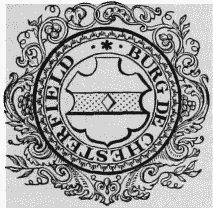
Seal and Arms.
The Town is situated on an eminence, and the borough is bounded on the south and south-west by the Hipper, and on the east by the Rother, which are here inconsiderable streams: the houses are of brick, roofed with stone; the streets are indifferently paved, but well lighted with gas, by an act of parliament obtained in 1825, and the inhabitants are plentifully supplied with water. There are a subscription library, a mechanics' institute, and a theatre; and races take place in autumn. An agricultural society was established in 1819, the members of which hold their meetings alternately at Chesterfield and Bakewell, generally in October. Some of the inhabitants are engaged in tambour-work, and the manufacture of bobbin-net lace and hosiery; there is a silk-mill in the town, and in the neighbouring village of Little Brampton a cotton-wick mill, called the bump-mill, and a small-ware manufactory. In the vicinity are productive mines of ironstone and coal, and some foundries; also several potteries, chiefly for coarse brown and yellow stone ware, which afford employment to upwards of 200 men. The Chesterfield canal, communicating with the Trent and the Humber, was completed in 1777, at an expense of £160,000: the Midland railway passes by the town, a little to the east of which is a station. The market is on Saturday: fairs, principally for cattle, are held on Jan. 27th, Feb. 28th, the first Saturday in April, May 4th, July 4th, Sept. 25th, and Nov. 25th, the last being toll-free; those in May and September, at the latter of which a great quantity of cheese is sold, are attended by clothiers from Yorkshire.
The government, by charter of incorporation, granted by King John, ratified by succeeding monarchs, enlarged by Queen Elizabeth, and confirmed by Charles II., was vested in a mayor, six aldermen, six brothers, and twelve capital burgesses, assisted by a town-clerk, chamberlain, two meat inspectors, and a serjeant-at-mace. The corporation now consists of a mayor, four aldermen, and twelve councillors, under the act of the 5th and 6th of William IV., cap. 76: the limits of the borough are coextensive with the township of Chesterfield. The mayor for the time being, and for the previous year, are justices of the peace ex officio; and there are two others. The petty-sessions for the division are held here; and a court of record, for the recovery of debts not exceeding £20, is held under the lord of the manor, by letterspatent granted by King John to William de Briwere, and confirmed by Charles I., in the seventh year of his reign, to William, Earl of Newcastle, and Sir Charles Cavendish, then lords of the manor: the jurisdiction extends over the hundred of Scarsdale, eight miles round Chesterfield. The powers of the county debt-court of Chesterfield, established in 1847, extend over the greater part of the registration-district of Chesterfield. The town-hall, standing in the market-place, was built in 1790; on the ground-floor is a prison for debtors. There is also a house of correction, under the superintendence of the county magistrates.
The living is a vicarage, valued in the king's books at £15. 0. 2½.; net income, £204; patron, the Bishop of Lichfield. The church is a spacious cruciform structure, principally in the decorated, but partly in the early, and partly in the later, style of English architecture, with a tower rising from the intersection, and surmounted by a grooved or channelled spire of wood covered with lead. The clerestory windows of the nave, and the east window of the chancel, are fine compositions in the later style; and in the south transept are a beautiful screen and rood-loft: there are two very antique monuments in the nave, and three in the chancel, to members of the family of Foljambe. The interior of the edifice was renovated in 1842, at a cost of £4000; and it now gives accommodation to 1800 persons. Portions of the hamlets of Walton and Newbold, and the contiguous parts of the parish of Brampton, have been consolidated as a district to the new church of St. Thomas, Brampton. In 1838, a church was built and dedicated to the Holy Trinity; it is in the early English style, with a tower, and cost £3700. To this church a district has been assigned, having a population of 3000: the living is a perpetual curacy, in the patronage of certain Trustees: net income, £90, with a glebe-house. There are places of worship for Baptists, the Society of Friends, Independents, Wesleyans, and Unitarians. The free grammar school, for the endowment of which Godfrey Foljambe, in 1594, appropriated £13. 6. 8. annually, was founded in the reign of Elizabeth, and placed under the management of the corporation; the endowment, augmented by benefactions, produces annually £109. 10. 9.: the master is chosen by the trustees of charities, subject to approval by the Archbishop of York. The schoolhouse was rebuilt by subscription in 1710, and was again rebuilt only a very few years since. The school, in common with the schools of Ashbourn and Wirksworth, has the preference, after the founder's relatives, to two fellowships and two scholarships, founded by the Rev. James Beresford, in St. John's College, Cambridge. A school intended originally as preparatory to the grammar school, was founded in 1690, and endowed by Cornelius Clarke; the endowment was subsequently augmented by John Bright, senior, and John Bright, junior, Esqrs., and the income is now £74. A national school was built in 1814, and a Lancasterian school in 1819. The Victoria school, just erected, is intended for the children of the district annexed to the parish church; of these children 50 boys and 50 girls are now clothed and educated at the expense of the vicar, the Rev. Thomas Hill. Judith Heathcote, and other members of the family, in the year 1619 appropriated estates, producing an income of about £114 per annum, to the apprenticing of children.
Thomas Large, in 1664, gave lands and tenements, now worth about £45 per annum, for the foundation and endowment of three almshouses, to which two more were added in 1751, by Mrs. Sarah Rose, who left £200 for their endowment. Almshouses for six aged persons were founded in 1668, by George Taylor, who endowed them with property at present yielding £22 per annum. The dispensary, erected in 1800, is liberally supported by subscription. Godfrey Foljambe, in 1594, bequeathed the rectory of Attenborough, and an estate at Ashover, producing together about £640 a year, which sum, after paying £40 per annum to the minister, £13. 6. 8. to the master of the grammar school, £20 to Jesus College, and £13. 6. 8. to Magdalen College, Cambridge, is appropriated to the relief of the poor. Godfrey Wolstenholme, in 1682, gave a house, let for £38. 5. per annum, which sum is distributed in coats and gowns; and Sir Godfrey Webster, in 1720, bequeathed £1100 South Sea stock. Mrs. Hannah Hooper, in 1755, gave £2000 three per cent. consols., and Mrs. Elizabeth Bagshaw, in 1802, £2000 three per cent. consols.; the dividends on which are distributed to the poor. The union of Chesterfield comprises 34 parishes or places, and contains a population of 39,379. An hospital for lepers, founded prior to the 10th of Richard I., and dedicated to St. Leonard, existed here till the reign of Henry VIII.; and there was a guild or fraternity, dedicated to St. Mary and the Holy Cross, founded in the reign of Richard II., the revenue of which, at the Dissolution, was £19. The chantry of St. Michael, founded by Roger de Chesterfield in 1357, and the chantry of the Holy Cross, founded in the reign of Edward III., were also among the ancient religious establishments of this place. There were besides, prior to the Reformation, three free chapels, dedicated respectively to St. James, St. Thomas, and St. Helen: on the site of the last, the grammar school was built. Chesterfield gives the title of Earl to the family of Stanhope; a title conferred Aug. 4th, 1628, on Sir Philip, Baron Stanhope, a firm supporter of the royal cause during the civil war.
Chesterford, Great (All Saints)
CHESTERFORD, GREAT (All Saints), a parish, and formerly a market-town, in the union of SaffronWalden, hundred of Uttlesford, N. division of Essex, 4 miles (N. W. by N.) from Saffron-Walden; containing 917 inhabitants. It is by most antiquaries identified with the Camboricum of Antoninus, and the foundation of walls inclosing a quadrangular area of 50 acres, was, till lately, plainly discernible. That it was a Roman station is evident, not only from its name, but from its contiguity to several Roman roads, of which the Ikeneld and Ermin streets intersect each other in the immediate vicinity; and Roman bricks, coins of the earlier and later emperors, and other relics have been found, in great quantities. Besides the large camp, are several smaller camps, including one near the church, in the grounds between which and the river Granta are traces of an amphitheatre: at the distance of half a mile from the larger camp is another, called Hingeston Barrows, and on the opposite side of the river a third. On an eminence, near the Roman road from Inckleton towards Newmarket, is Fleamsdyke, where is a small square fort, probably the castra exploratorum, in the centre of which are vestiges of a building; and the Roman road to Grantchester may be plainly discovered, forming a ridge of 200 yards, in a direction towards the river above Cambridge. The parish comprises by admeasurement 2811 acres, of which 200 are woodland: the soil, in the more elevated parts, is a dry thin loam resting on chalk, and in the valleys a rich loam on a gravelly bottom. The village is pleasantly situated, and commands an uninterrupted prospect extending into the county of Cambridge. Here is a station of the railway from London to Cambridge, ten miles distant from Cambridge. The market has been discontinued; but a fair for horses is held on July 5th. The living is a discharged vicarage, with the rectory of Little Chesterford annexed, valued in the king's books at £10; net income, £427; patron and impropriator, the Marquess of Bristol. The tithes of both parishes were commuted for land and a money payment in 1801. The church is an ancient and spacious structure, and formerly contained a chantry, founded in the reign of Henry VIII., by William Howden, and the revenue of which, at the Dissolution, was £9. 9. 7. John Hart, of Saffron-Walden, in 1592 founded what he intended to be a grammar school, and endowed it with upwards of 30 acres of land, under the management of the Master and Fellows of Magdalen College, Cambridge, who appoint the master; but a considerable part of the endowment having been lost, the charity has been incorporated with a national school.
Chesterford, Little (St. Mary)
CHESTERFORD, LITTLE (St. Mary), a parish, in the union of Saffron-Walden, hundred of Uttlesford, N. division of Essex, 3 miles (N. W. by N.) from Saffron-Walden; containing 229 inhabitants. It is separated from the parish of Littlebury by the river Granta, and comprises 1166a. 3r. 9p., of which about 65 acres are pasture, 107 woodland, and the rest arable. The living is a rectory, annexed to the vicarage of Great Chesterford, and valued in the king's books at £11. The church is a small edifice, partly in the early and partly in the decorated English style; the chancel is separated from the nave by a screen of wood, and contains an ancient tomb of marble, with a recumbent figure of a member of the Walsingham family. There are places of worship for Baptists and Wesleyans.
Chesterhope
CHESTERHOPE, a hamlet, in the parish of Corsenside, N. E. division of Tindale ward, S. division of Northumberland, 5 miles (E. N. E.) from Bellingham. This place, which derives its name from the Roman castra, Habitancum, or Risingham, being situated at the foot of it, is of considerable antiquity. The church of Hexham had some property here at an early period: in 1294 the prior of the hospital of St. John of Jerusalem claimed extensive privileges over lands he possessed in Chesterhope; and the Halls, Forsters, and others have subsequently been owners of estates in the district. At Park Head are the remains of the celebrated figure called Robin of Risingham, cut in bas-relief in a rock, and which may certainly be assigned to the Roman era in Britain; and stones bearing Latin inscriptions have been found, which are supposed to be relics of the station at the adjoining village of Risingham.
Chesterton (St. Andrew)
CHESTERTON (St. Andrew), a parish, and the head of a union, in the hundred of Chesterton, county of Cambridge, 1¼ mile (N. E.) from Cambridge; containing 1617 inhabitants. The name of this place is derived from a castrum, or fortification, called Arbury Camp, at a small distance from the village, three parts of the vallum of which are still remaining, inclosing a square area of nearly six acres, where many Roman coins have been found. It appears that every one who kept a fire here, in 1154, was bound to pay an Ely farthing, as it was called, to St. Peter's altar, in the cathedral of Ely; and the fourth farthing arising from this town and that of Grantchester used to be paid to the castle of Norwich, by the name of Ely ward penny, because that place received it before. The parish is watered by the river Cam, and comprises 2729 acres, of which 169 are common or waste; the soil is in general a gravelly earth, with a subsoil of clay. In 1837, an act was passed for inclosing waste lands. The living is a vicarage, valued in the king's books at £10. 12. 3½.; net income, £206; patrons and impropriators, the Master and Fellows of Trinity College, Cambridge. The great tithes have been commuted for £500, and the vicarial for £180; the impropriate glebe consists of 90½ acres, and the vicarial contains 27½ acres, with a glebe-house. The church is principally in the decorated and later English styles. The poor law union of Chesterton comprises 38 parishes or places, and contains a population of 21,608. The remains of Cambridge Castle are in the parish.
Chesterton (St. Michael)
CHESTERTON (St. Michael), a parish, in the union of Peterborough, hundred of Norman-Cross, county of Huntingdon, 4½ miles (N. N. W.) from Stilton; containing 129 inhabitants. The parish is situated on the great north road, which is here crossed by the road from Lynn to Northampton. It comprises by admeasurement 1330 acres, consisting of arable and pasture land in nearly equal portions; the soil is in some parts a rich clay, mixed with red sand, and in others chalk of fertile quality. The living is a rectory, valued in the king's books at £17. 3. 4., and in the gift of the Marquess of Huntly: the tithes have been commuted for £417. 11., and the glebe comprises 4¼ acres, with a glebe-house. The church is principally in the early English style. Midway between this and Castor is the site of the ancient city of Durobrivœ, the fort of which was placed on the Huntingdonshire side of the river Nene; and at Castle Field is a large tract inclosed by a ditch and rampart, with the Roman Ermin-street running through it obliquely. On making a road across the site of Durobrivœ, several stone coffins, urns, and coins were dug up; and by the side of the high road near this place, in 1754, was found a coffin of yellowish stone, six feet two inches long, within which were a skeleton, three glass lachrymatories, some coins, and scraps of white wood inscribed with Greek and Roman letters.
Chesterton (St. Mary)
CHESTERTON (St. Mary), a parish, in the union of Bicester, hundred of Ploughley, county of Oxford, 2 miles (W. by S.) from Bicester; containing 393 inhabitants. The living is a discharged vicarage, valued in the king's books at £7. 8. 9.; net income, £210; patrons and appropriators, the Warden and Fellows of New College, Oxford. The tithes were commuted for land in 1767. The church was consecrated in 1238. The Roman Akeman-street crosses the parish.
Chesterton
CHESTERTON, an ecclesiastical district, partly in the parish of Audley, union of Newcastle-underLyme, but chiefly in the parish of Wolstanton, union of Wolstanton and Burslem, N. division of the hundred of Pirehill and of the county of Stafford; containing upwards of 2000 inhabitants, of whom 1207 are in the township of Chesterton, 2 miles (N. by W.) from Newcastle. The name of Chesterton evidently has reference to the ancient Roman fortress situated here, the Mediolanum of Antonine; the site is still clearly marked out, and a large fosse exists along the north side of the station. Camden calls the place Chesterton-under-Lyme. The district comprises 2700 acres, whereof 843 are in Audley parish, and 1857 in the parish of Wolstanton; the township of Chesterton, which is wholly in Wolstanton, contains about 1100 acres, lying on the north side of that parish. The surface is hilly, and consists of such land as is usual above iron and coal mines; parts are wooded, and the views are extensive. The road from Newcastle to Liverpool passes on the east; and Sir Nigel Gresley's canal (now belonging to R. E. Heathcote, Esq.) runs through. Considerable quantities of blue bricks, tiles, and pipes for drains and conduits, of superior hardness, are manufactured here; and potteries have been established at Red-street, in the northern part of Chesterton township, for a long period. There are iron and coal mines, several blast-furnaces for smelting the ironstone, and extensive iron-works belonging to Mr. Heathcote. The district was constituted in July, 1846, under the act 6th and 7th Victoria, cap. 37: the living is in the gift of the Crown and the Bishop of Lichfield, alternately. At Chesterton are places of worship for Wesleyans and Independents; at Alsager's Bank, about two miles and a half west of that village, is another place of worship for dissenters, and at Red-street a small Unitarian meeting-house. The site of an ancient castle of John of Gaunt's, is to be seen behind an old mansion in Chesterton, called the Old Hall: the castle was removed to Newcastle, from which circumstance that place derived its name.
Chesterton (St. Giles)
CHESTERTON (St. Giles), a parish, in the union of Southam, Warwick division of the hundred of Kington, S. division of the county of Warwick, 6 miles (N. N. E.) from Kington; containing 192 inhabitants. This place, which was once a populous town, is situated on the line of the Roman fosse-way, and derives its name from a Roman camp, within the limits of which coins have been discovered. The manor, long possessed by the Peto family, now belongs to Lord Willoughby de Broke. The parish comprises 3566 acres, chiefly pasture and woodland, and of which the surface is hilly, and the soil mostly clay: the road from Warwick to Banbury passes through. The living is a perpetual curacy; net income, £82; patron and impropriator, Lord Willoughby de Broke. The church is an ancient edifice, and contains some handsome monuments to the Petos.
Cheswardine (St. Swithin)
CHESWARDINE (St. Swithin), a parish, in the union of Drayton, Drayton division of the hundred of North Bradford, N. division of Salop, 4½ miles (S. W.) from Drayton; containing 1015 inhabitants, and comprising 5724 acres, of which 96 are common or waste. The living is a discharged vicarage, valued in the king's books at £5. 6. 8., and in the gift of the family of Harding: the tithes have been commuted for £1015. 10., of which £197. 10. belong to the incumbent, with a glebe of 30 acres. The church was rebuilt a few years since. There is a school, which has a bequest of £4 per annum; and a sum of about £36 per annum, the interest of bequests, is appropriated to the purchase of wheat, distributed among the poor.
Cheswick
CHESWICK, a township, in the parochial chapelry of Ancroft, union of Berwick-upon-Tweed, Islandshire, N. division of Northumberland; containing 290 inhabitants. The tithes have been commuted for £347.—See the article on Ancroft.
Chetnole
CHETNOLE, a chapelry, in the parish and hundred of Yetminster, union of Sherborne, Sherborne division of Dorset, 7 miles (S. W. by S.) from Sherborne; containing 222 inhabitants. The chapel is dedicated to St. Peter. A school is supported by endowment.
Chettiscombe
CHETTISCOMBE, a chapelry, in the parish, union, and hundred of Tiverton, Cullompton and N. divisions of Devon, 2 miles (N. E. by N.) from the town of Tiverton. The chapel is dedicated to St. Mary.
Chettisham
CHETTISHAM, a chapelry, in the parish of St. Mary, city, union, and Isle of Ely, county of Cambridge, 2 miles (N. by W.) from Ely; containing 90 inhabitants. Here is a station of the Ely and Peterborough railway. The living is a perpetual curacy; net income, £79; patrons and appropriators, the Dean and Chapter of Ely. The chapel is dedicated to St. Michael.
Chettle (St. Mary)
CHETTLE (St. Mary), a parish, in the union of Wimborne and Cranborne, hundred of Moncktonup-Wimborne, Wimborne division of Dorset, 6 miles (N. E.) from Blandford; containing 122 inhabitants. It is situated within a mile of the road from Exeter to London, through Blandford and Salisbury, and comprises 1113a. 3r. 25p., with a level surface and chalky soil. A stately mansion, in the style of Sir John Vanbrugh, and probably the old manor-house, is in tolerable preservation. The manor and whole parish, with the mansion, and also the advowson of the church, were sold in 1846 to Edward Castleman, Esq., for £24,400. The living is a discharged rectory, valued in the king's books at £8. 2. 9.: the tithes have been commuted for £180, and the glebe contains about 21 acres. The church is partly in the early and partly in the later English style, and has a very ancient and handsomely carved pulpit. There is a large tumulus or barrow, which, from its extent, is called the "Giant's grave."
Chetton (St. Giles)
CHETTON (St. Giles), a parish, in the union of Bridgnorth, hundred of Stottesden, S. division of Salop, 4 miles (S. by W.) from Bridgnorth; containing, with the chapelry of Loughton, 693 inhabitants. The parish is situated on the road from Bridgnorth to Ludlow, and intersected in the southern part by the road to Cleobury-Mortimer; it comprises by measurement 4945 acres, the surface of which is undulated, and the soil a strong clay, resting upon marl and coarse limestone, with some sandstone. Coal of moderate quality and of sulphureous smell is procured in tolerable quantity. Clay for brick-making, which is carried on to some extent, is obtained near the collieries; and in the parish generally is found a brecciated limestone, which, when burnt, is of a reddish colour, and is used for manure, but considered to have only half the strength of white lime. There is likewise abundance of red sandstone alternated with the limestone, which is used for rubble-masonry and for building cottages: in the southeast portion of the parish, white freestone of good quality is quarried; and there is also some good flagstone. A few inconsiderable streams intersect the surface and run into the Severn. The living is a rectory, with the livings of Deuxhill and Glazeley consolidated in 1760, valued in the king's books at £11; patron, T. W. W. Browne, Esq. The tithes, including those of Loughton, have been commuted for £654. 14. 9., and the glebe comprises 11 acres. The nave of the church was rebuilt about the year 1770; the tower was rebuilt in 1830, and, like the chancel, which is ancient, is in the early English style. There is a bequest of about £8 per annum for teaching children; a national school was erected in 1821. The produce of bequests amounting to £260, is distributed among the poor in bread and clothing.
Chetwood (St. Mary and St. Nicholas)
CHETWOOD (St. Mary and St. Nicholas), a parish, in the union, hundred, and county of Buckingham, 5 miles (S. W. by W.) from Buckingham; containing 197 inhabitants. The living is a perpetual curacy, annexed to that of Barton-Hartshorn: the tithes were commuted for land in 1812. The church, made parochial in 1480, is remarkable for some beautiful specimens of stained glass, formerly belonging to a priory of Augustine monks, founded by Sir Ralph de Norwich in 1244, and which was dissolved on account of its poverty in 1460, and annexed to the abbey of Nutley. There was also a hermitage dedicated to St. Stephen and St. Lawrence, founded by a member of the Chetwode family, the representative of which claims suit and service, by prescriptive right, over this place and some neighbouring hamlets, that are said to have been included within the limits of an ancient forest of 1000 acres, called Rockwood.