A Topographical Dictionary of England. Originally published by S Lewis, London, 1848.
This free content was digitised by double rekeying. All rights reserved.
'Chinley - Chiswick', in A Topographical Dictionary of England, ed. Samuel Lewis (London, 1848), British History Online https://www.british-history.ac.uk/topographical-dict/england/pp599-603 [accessed 30 April 2025].
'Chinley - Chiswick', in A Topographical Dictionary of England. Edited by Samuel Lewis (London, 1848), British History Online, accessed April 30, 2025, https://www.british-history.ac.uk/topographical-dict/england/pp599-603.
"Chinley - Chiswick". A Topographical Dictionary of England. Ed. Samuel Lewis (London, 1848), British History Online. Web. 30 April 2025. https://www.british-history.ac.uk/topographical-dict/england/pp599-603.
In this section
Chinley
CHINLEY, a township, in the parish of Glossop, union of Chapel-en-le-Frith, hundred of High Peak, N. division of the county of Derby, 2½ miles (N. by W.) from Chapel-en-le-Frith; containing, with the hamlets of Brownside and Bugsworth, 996 inhabitants. It comprises 3707 acres, of which 98 acres are waste and roads. The impropriate tithes have been commuted for £63. 9., and the vicarial for £11. 5. There is a place of worship for dissenters.
Chinnock, East (St. Mary)
CHINNOCK, EAST (St. Mary), a parish, in the union of Yeovil, hundred of Houndsborough, Barwick, and Coker, W. division of Somerset, 4½ miles (S. W. by W.) from Yeovil; containing 735 inhabitants. It is situated on the road from Yeovil to Crewkerne, and comprises by measurement 1350 acres. The manufacture of sail-cloth is carried on to a considerable extent; and stone is quarried, chiefly for rough walls. The living is a vicarage, valued in the king's books at £6. 7. 8¼., and in the patronage of the Crown, with a net income of £140; the impropriation belongs to Corpus Christi College, Cambridge: the glebe comprises 45 acres. The church has been enlarged, and now contains 450 sittings, of which 350 are free. There is a place of worship for Wesleyans. Property producing about £60 a year is applied to charitable purposes. About a mile west of the church is a spring of brackish water, from which salt may be extracted.
Chinnock, Middle (St. Margaret)
CHINNOCK, MIDDLE (St. Margaret), a parish, in the union of Yeovil, hundred of Houndsborough, Barwick, and Coker, W. division of Somerset, 3½ miles (N. E. by N.) from Crewkerne; containing 222 inhabitants. It comprises 468a. 3r. 31p., of which about 214 acres are arable, and 254 pasture. The living is a rectory, valued in the king's books at £7. 9. 7., and in the gift of the Earl of Ilchester: the tithes have been commuted for £112. 12., and the glebe contains 39 acres. The church, which has a Norman arch over the southern entrance, has been considerably enlarged by subscription, aided by a grant from the Incorporated Society.
Chinnock, West (St. Mary)
CHINNOCK, WEST (St. Mary), a parish, in the union of Yeovil, hundred of Houndsborough, Barwick, and Coker, W. division of Somerset, 3 miles (N. E. by N.) from Crewkerne; containing 561 inhabitants. The living is annexed to the rectory of Chisleborough: the tithes have been commuted for £160. 4. 8., and the glebe contains 15½ acres. The church has been rebuilt. There is a place of worship for Wesleyans.
Chinnor (St. Andrew)
CHINNOR (St. Andrew), a parish, in the union of Wycombe, hundred of Lewknor, county of Oxford, 3½ miles (N. E. by E.) from Watlington; containing, with the liberty of Henton, 1308 inhabitants. The parish comprises 2485 acres, of which 150 are common or waste. The living is a rectory, valued in the king's books at £26. 0 5., and in the patronage of Sir James Musgrave, Bart.: the incumbent's tithes have been commuted for £701. 12., and the glebe contains upwards of 15 acres, with a glebe-house; a rent-charge of £50 is paid to the Dean and Canons of Windsor. The church is an elegant structure, partly in the early and partly in the decorated English style, with an embattled tower strengthened by buttresses; it contains some brasses and interesting monuments. The Roman Ikeneld-street enters the county at this place, and crossing the Thames, points towards Goring.
Chipchase, with Gunnerton
CHIPCHASE, with Gunnerton, a township, in the parish of Chollerton, union of Hexham, N. E. division of Tindale ward, S. division of Northumberland, 9 miles (N. N. W.) from Hexham; containing 372 inhabitants. Chipchase Castle, a large and beautiful structure, stands upon a lofty eminence, at the foot of which flows the North Tyne. Of the ancient building only a tower remains: it has a projecting battlement resting on corbels, and there are openings for missiles; some tattered fragments of paintings on the walls are exceedingly curious. A private chapel, in which the vicar performs divine service four times in the year, was rebuilt by John Reed, Esq., in 1732, on the lawn of the castle.—See Gunnerton.
Chippenham (St. Margaret)
CHIPPENHAM (St. Margaret), a parish, in the union of Newmarket, hundred of Staploe, county of Cambridge, 4½ miles (N. N. E.) from Newmarket; containing 666 inhabitants. William de Mandeville, Earl of Essex, gave this manor to the society of Knights Hospitallers, who fixed a subordinate establishment here. Charles I., during the civil war, enjoyed the diversion of bowling at Chippenham Park, the seat of Sir William Russel; and George I. was entertained here by Admiral Russel, Oct. 4th, 1717. About the middle of the seventeenth century the estate was possessed by Sir Francis Russel, Bart., whose daughter was married to the fourth son of the Protector Cromwell. The parish comprises 4205 acres, of which 43 are common or waste. The living is a discharged vicarage, valued in the king's books at £11. 12. 6.; patron and impropriator, John Tharp, Esq.: the vicarial tithes have been commuted for £325, and the glebe contains 18 acres. The church was rebuilt by means of a grant of indulgences, shortly after its destruction by fire, in the fifteenth century. A school was founded in 1714, by the Earl of Orford, with an endowment of £20 per annum.
Chippenham (St. Andrew)
CHIPPENHAM (St. Andrew), a borough, markettown, and parish, and the head of a union, in the hundred of Chippenham, Chippenham and Calne, and N. divisions of Wilts, 33 miles (N. W. by N.) from Salisbury, and 93 (W.) from London; comprising the tythings of Allington, Nethermore, and Stanley with Studley, and the chapelry of TythertonLucas; and containing 5438 inhabitants, of whom 1875 are in the borough. This place, which derives its name from the Saxon Cyppanham, "a market-town," was of considerable importance during the heptarchy, and is supposed to have been the residence of the West Saxon kings. Ethelwolf, on his return from an excursion against the Welsh, in 853, remained for some time at the place, where he celebrated the marriage of his daughter Ethelswitha with Burhred, King of Mercia. In the reign of Alfred, the Danes, who, after their defeat, had engaged by treaty to quit the kingdom, retreated to this town, of which they obtained possession by treachery; and the English king, after the dispersion of his army, was compelled to seek an asylum in the cottage of a neat-herd. On their subsequent defeat by Alfred, the Danes again took refuge here, where the treaty between that monarch and the Danish prince Guthrum was negotiated.
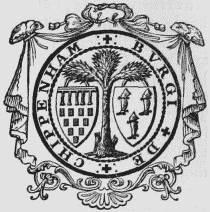
Seal and Arms.
The town is pleasantly situated on the side of a hill, on the south bank of the Avon. The river here expands into a noble sheet of water, over which, terminating the western extremity of the principal street, is a handsome stone bridge of 22 arches, for the repair of which, and of a stone causeway nearly three miles in length, a considerable estate is vested in the corporation. Chippenham consists of one spacious street, half a mile in length, and well paved, containing many respectable houses, and of several smaller streets: it is lighted with gas, and well supplied with water from the river, by which it is bounded on three sides. In 1834, an act for lighting, watching, paving, and improving the town was obtained. A literary and scientific institution, and a harmonic society consisting of more than 200 members, have been formed. The manufacture of woollen goods, consisting chiefly of the finer broad cloths, and kerseymeres, formerly flourished to a considerable extent; but at present there is only one factory. There are a few grist-mills and tanneries; also a silk-manufactory; and the town is benefited by the trade arising from its situation on the road to Bath and Bristol. The Wilts and Berks canal passes close to it, and the Great Western railway, on which is a station here, passes within a quarter of a mile of the market-place. An act was passed in 1845, for the construction of a railway from near Chippenham to Salisbury and to Weymouth. The market is on Friday: fairs are held on May 17th, June 22nd, Oct. 29th, and Dec. 11th, for horses, cattle, and sheep; and there is also a monthly market for the sale of cattle and cheese. A new market-house has been built.
Chippenham is a borough by prescription. The corporation, under the charter of Queen Mary, which after its surrender to Charles II. was renewed in the reign of James II., consisted of a bailiff, and twelve burgesses, assisted by a town-clerk, sub-bailiff, and subordinate officers; but, by the act of the 5th and 6th of William IV., cap. 76, the government is now vested in a mayor, four aldermen, and twelve councillors, with a town-clerk and others. The county magistrates have jurisdiction in the town. It first sent members to parliament in the reign of Edward I., and made two returns in the reign of Edward II., and four in that of Edward III., from which period it discontinued till the 2nd of Richard II.; after the 12th of that reign it again ceased to make any return till the first of Henry VI., since which time it has regularly sent two members. The right of election was formerly in the resident burgage-holders, but by the act of the 2nd of William IV., cap. 45, the franchise was extended to the £10 householders of an enlarged district, comprising 6710 acres: the mayor is returning officer. The petty-sessions for the division are held here: the powers of the county debt-court of Chippenham, established in 1847, extend over the registration-district of Chippenham. The living is a discharged vicarage, valued in the king's books at £13. 19. 4.; net income, £284; patrons and appropriators, the Dean and Canons of Christ-Church, Oxford. The church is a spacious building with portions in different styles of English architecture, the tower and spire being in the early style; it contains several interesting monuments. At Tytherton-Lucas is a chapel of ease; and there are places of worship in the town for Baptists, Independents, Wesleyans, and Primitive Methodists. The union of Chippenham comprises 29 parishes or places, and contains a population of 23,297. At the distance of about two miles is the site of Stanley Abbey, founded in 1154, by the Empress Matilda and Henry II., who removed hither a society of Cistercian monks, established at Lockswell three years previously; its revenue, in the 26th of Henry VIII., was estimated at £222. 19. 4.: there are no visible remains, but fragments are occasionally found. Monkton, the name of an estate on the north bank of the river, seems to indicate the remote existence of some religious establishment, of which no vestige or historical account remains. The ancient forest of Chippenham and Pewsham has been destroyed, although the latter place is still called "the Forest;" the road leading to it from the town is named Woodlane. There are two chalybeate springs in the parish, formerly in great repute; one of them is now occasionally used, but the other is entirely closed up.
Chipperfield
CHIPPERFIELD, a hamlet, in the parish of King'sLangley, union of Hemel-Hempstead, hundred of Dacorum, county of Hertford; containing 569 inhabitants.
Chipping (St. Bartholomew)
CHIPPING (St. Bartholomew), a parish, in the union of Clitheroe, Lower division of the hundred of Blackburn, N. division of the county of Lancaster; containing, with the township of Thornley with Wheatley, 1675 inhabitants, of whom 1168 are in the township of Chipping, 12 miles (N. E. by N.) from Preston. "Chepyn" was one of the three parishes which were separated from that of Whalley, some years before the reign of Edward the Confessor. In Edward III.'s reign, John de Chepin granted the homage and service of thirteen vassals to Richard Knolle; and, with a short interval, in which the property was seized into the hands of the crown for felony, it continued in the Knolle family until the 7th of Henry VIII., when a female heir brought the estate to the knightly family of Sherburne, of Stonyhurst, from whom it passed to the Welds, and recently to the Earl of Derby. The parish is picturesquely situated in the ancient forest of Bowland, and is inclosed by Whitmoor hills and Longridge Fell. It comprises 8763a. 1r. 26p., whereof about 836 acres are arable, 5439 meadow and pasture, 90 wood and plantations, and a great part of the remainder common and waste: the township of Chipping contains 5582a. 2r. 24p. The soil is rather light, in some parts inclining to moor and peat, and the lands are watered by two rivulets called Lunde and Chipping brooks: limestone, in which fossils are found, is obtained in abundance. There are two cotton-mills, of which one, belonging to John Evans, Esq., has been established more than half a century, and is propelled by water and steam power; the other is the property of Simon Bond, Esq., and began working in 1806, water-power only being used.
The living is a discharged vicarage, valued in the king's books at £36. 13. 4.; patron, the Bishop of Chester, as appropriator of the rectory, which is valued at £24. 16. 5½. The income of the vicar is £120; it is derived, in part, from lands in Dutton and Whittingham, producing £38, and includes £33. 13. 4. assigned in lieu of tithes. The great tithes of Chipping township have been commuted for £399; and the bishop's glebe consists of 13 acres. The church was built in 1520; it is in the early English style, with a tower, and contains a polygonal font, of ancient date, with a carved inscription: in the churchyard is a stone cross, dated 1705, and surmounted by a dial. There are places of worship for Independents and Presbyterians; also one for Roman Catholics, built in 1827, on a site given by George Weld, Esq., of Leagram Hall. In 1684, John Brabbin left lands in Chipping, now producing £68 per annum, to clothe and educate 24 boys; and an estate now yielding £45 per year, to place them out as apprentices. He also founded an almshouse for six aged females, who each receive 12s. per month, and coal; and there are several minor charities.
Chipping-Campden.—See Campden, Chipping.
CHIPPING-CAMPDEN.—See Campden, Chipping.—And all places having a similar distinguishing prefix will be found under the proper name.
Chippinghurst
CHIPPINGHURST, a hamlet, in the parish of Cuddesden, union of Headington, hundred of Bullington, county of Oxford, 7¼ miles (N. by W.) from Bensington; containing 18 inhabitants.
Chipstable (All Saints)
CHIPSTABLE (All Saints), a parish, in the union of Wellington, hundred of Williton and Freemanners, W. division of Somerset, 3 miles (W. by S.) from Wiveliscombe; containing 389 inhabitants. It is situated on the road from Taunton to Barnstaple, through Bampton, and comprises nearly 2200 acres: the meadows are irrigated by the waters flowing from Hedon and Byballs Hills, causing the growth of a luxuriant herbage; and the river Tone runs through the parish. Stone of the greywacke kind is quarried for the repair of the roads. The living is a rectory, valued in the king's books at £11. 1. 8., and in the gift of James Templer, Esq.: the tithes have been commuted for £275, and the glebe consists of 35 acres, with a glebe-house. The church, with the exception of the tower, which is handsome, is in a very dilapidated state, through age. The remains of a Roman encampment may be seen.
Chipstead (St. Margaret)
CHIPSTEAD (St. Margaret), a parish, in the union, and Second division of the hundred, of Reigate, E. division of Surrey, 2¾ miles (N. by E.) from Gatton; containing 666 inhabitants. It consists of arable and woodland, with some upland pastures: chalk in general forms the subsoil. The London and Brighton railway passes a little to the east of the church. The living is a rectory, valued in the king's books at £17. 13. 11½.; patron, Sir W. G. Hylton Jolliffe: the tithes have been commuted for £410, and there is a glebe of 43 acres. The church was restored in 1827; on the north side is a fine Norman arch. Here is a school endowed by Mary Stephens, in 1746, with land producing £70 per annum. Sir Edward Banks, Knt., the great contractor for public works, lies buried in the churchyard, the quiet and beauty of which fixed his attention in early life while he was employed as a labourer on the Merstham railway; he died in 1835.
Chirbury (St. Michael)
CHIRBURY (St. Michael), a parish, in the hundred of Chirbury, S. division of Salop, 3¼ miles (E. N. E.) from Montgomery; containing 1593 inhabitants, of whom 278 are in the township of Chirbury. This is a place of considerable antiquity, and was distinguished during the heptarchy for its stately castle, erected by Ethelfreda, Countess of Mercia, to check the incursions of the Welsh. A priory of the order of St. Bennet was founded by Robert de Boulers, in the reign of John, or beginning of that of Henry III., at Snede; but it was shortly removed to this spot, where it continued to flourish until the 9th of Edward I., when the establishment was transferred to the place of its original institution, still retaining the name of Chirbury. The monks appear to have held considerable property in the neighbourhood; and in the 7th of Edward II. that monarch confirmed their rights and privileges. But few other notices of the priory occur until the Dissolution, when its revenue was returned at £87. 7. 4., and the site was given to Edward Hopton.
The parish is situated on the road from Montgomery to Shrewsbury, and comprises by measurement 10,648 acres; the largest stream is the Camblad. On the borders of the parish are some lead-mines: stone of a greyish green colour, and of very hard quality, is quarried for building and ornamental uses; and white spar is found at Wotherton, of which great quantities are shipped to America. The living is a vicarage, valued in the king's books at £9. 6. 8.; stipend of the minister, £179; patrons, the Bishop of Lichfield (ex officio visiter of Shrewsbury grammar school), the Earl of Powis, J. A. Lloyd, Esq., Sir A. V. Corbet, Bart., and R. A. Slaney, Esq., as trustees. The impropriation is vested in the governors of Shrewsbury school, and furnishes its chief endowment; the tithes have been commuted for £1000. The church is in the early English style, with a tower, surmounted by open battlements, and crowned with eight pinnacles. A chapel has been built, containing 280 sittings, of which 249 are free, the Incorporated Society having granted £150, and the Diocesan Society a like sum, in aid of the expense. There are places of worship for Independents and Wesleyans. An endowment in land, which is let for £95, was given in 1675, by Edward Lewis, for the maintenance of a schoolmaster, who has £20 per annum; the residue, after repairs, &c., being given to poor widows. The place confers the title of Baron on the Earl of Powis.
Chirdon
CHIRDON, a township, in the parish of Greystead, union of Bellingham, N. W. division of Tindale ward, S. division of Northumberland, 6 miles (W. by S.) from Bellingham; containing 60 inhabitants. The township comprises an area of 5361 acres, and extends along the east side of the Chirdon burn, which has its source on the borders of the county of Cumberland, and falls into the North Tyne about a mile to the east of Greystead.
Chirton
CHIRTON, a township, in the parish, borough, and union of Tynemouth, E. division of Castle ward, S. division of Northumberland, 1 mile (W. S. W.) from North Shields; containing 4360 inhabitants. This township comprises 1795 acres, abounding in coal; and the village, which forms the western suburb of North Shields, has greatly increased in extent and population, owing, chiefly, to the extension of the coal-works, from which tram-roads have been formed to the river Tyne. In the township are also iron-foundries on a large scale, for the manufacture of steam-engines, and various kinds of machinery. Waterville House, situated here, occupies the site of the Roman station of Blake Chesters. Chirton House was the seat of Lord Collingwood, the celebrated naval commander and distinguished negotiator; Chirton Hall, now in ruins, was a seat of the dukes of Argyll. The great tithes have been commuted for £217. There is a burying-ground belonging to the Jews.
Chiselhurst (St. Nicholas)
CHISELHURST (St. Nicholas), a parish, in the union of Bromley, hundred of Ruxley, lathe of Sutton-at-Hone, W. division of Kent, 11 miles (S. E.) from London; containing 1792 inhabitants. It comprises 2499 acres, of which 565 are woodland, and 95 common. The living is a rectory, valued in the king's books at £16. 3. 6½.; net income, £487; patron, the Bishop of Rochester. The church is built of flint, with a shingled spire. There is a place of worship for Wesleyans. A school is endowed with £15 per annum, and there are two schools for girls, supported by bequests and donations. Sir Nicholas Bacon was a native of Chiselhurst: here also was born, in 1500, Sir Francis Walsingham, secretary of state to Queen Elizabeth; and at this place, in 1623, died Camden the antiquary, from whom Camden Place, in the parish (whence Lord Chancellor Pratt took the title of Baron, and which now confers the title of Marquess on his descendants), derives its name. Viscount Sydney enjoys the title of Baron Sydney of Chiselhurst, conferred in 1783.
Chisenbury
CHISENBURY, a tything, in the parish of Enford, union of Pewsey, hundred of Elstub and Everley, Everley and Pewsey, and S. divisions of Wilts; containing 149 inhabitants.
Chisenbury-de-la-Folly
CHISENBURY-de-la-Folly, a tything, in the parish of Netheravon, union of Pewsey, hundred of Elstub and Everley, Everley and Pewsey, and S. divisions of Wilts, 9 miles (W. by N.) from Ludgershall; containing 42 inhabitants.
Chishall, Great (St. Swithin)
CHISHALL, GREAT (St. Swithin), a parish, in the union of Royston, hundred of Uttlesford, N. division of Essex, 5 miles (E.) from Royston; containing 466 inhabitants. It comprises 2480a. 1r. 38p. The village is situated on a hill of considerable elevation, commanding a fine view of the surrounding district, which is highly cultivated, and enriched with woodland scenery. The living is a discharged vicarage, valued in the king's books at £10; net income, £173; patron and impropriator, J. Wilkes, Esq. The tithes of Great and Little Chishall were commuted for land and cornrents, in 1811. The church is an ancient edifice, with a tower surmounted by a small spire.
Chishall, Little (St. Nicholas)
CHISHALL, LITTLE (St. Nicholas), a parish, in the union of Royston, hundred of Uttlesford, N. division of Essex, 5½ miles (E. by S.) from Royston; containing 96 inhabitants. It consists chiefly of low lands, and comprises 1167a. 1r. 37p., of which about 1058 acres are arable, 24 pasture, and 85 woodland; the soil is clay and chalk in some parts, and in others, especially the flat portions, a dry light gravel. The living is a rectory, annexed to that of Haydon, and valued in the king's books at £14. 10. The church is a small but lofty edifice of great antiquity, with a porch of freestone, and a tower partly of stone and partly of wood. John de Chishal or Chishull, Bishop of London, who died in the year 1279, took his name from the place.
Chisleborough (St. Peter and St. Paul)
CHISLEBOROUGH (St. Peter and St. Paul), a parish, in the union of Yeovil, hundred of Houndsborough, Barwick, and Coker, W. division of Somerset, 4 miles (N. N. E.) from Crewkerne; containing 540 inhabitants. It is intersected by the river Parret, and comprises about 730 acres, of which the surface is hilly and the soil sandy. A fair for horses, cattle, and toys, is held on the last Tuesday in October. The living is a rectory, with that of West Chinnock annexed, valued in the king's books at £14. 5. 7½., and in the patronage of the family of Wyndham: the tithes have been commuted for £246. 17., and the glebe comprises 36 acres.
Chisledon (Holy Cross)
CHISLEDON (Holy Cross), a parish, in the union of Highworth and Swindon, hundred of Kingsbridge, Swindon and N. divisions of Wilts, 3½ miles (S. E.) from Swindon; containing, with the tythings of Badbury and Hodson, 1176 inhabitants. The living is a discharged vicarage, valued in the king's books at £8. 8. 9.; net income, £173; patron and impropriator, T. Calley, Esq.
Chislehampton (St. Katherine)
CHISLEHAMPTON (St. Katherine), a parish, in the union of Abingdon, hundred of Dorchester, county of Oxford, 6 miles (N. by W.) from Bensington; containing 153 inhabitants. This parish, which is situated on the Thame, comprises 901a. 39p.: the surface is varied, rising into hills in some parts, and being in others level; the soil is clayey but fertile. Chislehampton Lodge is a handsome residence, in the grounds around which is one of the largest and finest elm-trees in the county. The living is a perpetual curacy, with that of Stadhampton; net income, £135; patron and impropriator, Charles Peers, Esq.
Chislet (St. Mary)
CHISLET (St. Mary), a parish, in the union of Blean, hundred of Bleangate, lathe of St. Augustine, E. division of Kent, 7 miles (N. E.) from Canterbury; containing 1097 inhabitants. It comprises 6675 acres, of which 1054 are in wood. The living is a vicarage, valued in the king's books at £29. 19. 9½.; net income, £231; patron and appropriator, the Archbishop of Canterbury. The church is in the early English style: the parsonage-house was rebuilt by the incumbent, in 1834. In 1811, the archbishop demised certain land, which lets for £40 per annum, for the education of children; the income is applied to a national school.
Chiswick (St. Nicholas)
CHISWICK (St. Nicholas), a parish, in the union of Brentford, Kensington division of the hundred of Ossulstone, county of Middlesex, 4½ miles (W. by S.) from London; containing 5811 inhabitants. This place is pleasantly situated on the margin of the Thames, to the left of the great western road from London, and contains many elegant seats belonging to the nobility and gentry, the principal of which, Devonshire House, is adorned on each side with fine rows of cedars: in this mansion died Charles James Fox, in 1806, and George Canning, in 1827. Here are the extensive gardens belonging to the Horticultural Society of London, incorporated by charter in 1808, for the improvement of horticulture in all its branches. The living is a vicarage, in the patronage of the Dean and Chapter of St. Paul's, London (the appropriators), valued in the king's books at £9. 18. 4.; net income, £601. In the churchyard are some ancient tombs, and a monument to the memory of Hogarth. At Turnham-Green is a second church. The late Rev. H. F. Cary, the translator of Dante, was for some time curate, and afterwards lecturer, of Chiswick, where he resided in the house once occupied by Hogarth, which he had purchased.