A Topographical Dictionary of England. Originally published by S Lewis, London, 1848.
This free content was digitised by double rekeying. All rights reserved.
'Eltham - Ely', in A Topographical Dictionary of England, ed. Samuel Lewis (London, 1848), British History Online https://www.british-history.ac.uk/topographical-dict/england/pp167-173 [accessed 1 May 2025].
'Eltham - Ely', in A Topographical Dictionary of England. Edited by Samuel Lewis (London, 1848), British History Online, accessed May 1, 2025, https://www.british-history.ac.uk/topographical-dict/england/pp167-173.
"Eltham - Ely". A Topographical Dictionary of England. Ed. Samuel Lewis (London, 1848), British History Online. Web. 1 May 2025. https://www.british-history.ac.uk/topographical-dict/england/pp167-173.
In this section
Eltham (St. John the Baptist)
ELTHAM (St. John the Baptist), a parish, in the union of Lewisham, hundred of Blackheath, lathe of Sutton-At-Hone, W. division of Kent, 8½ miles (S. E. by S.) from London; containing, with the hamlet of Mottingham, part of which is in the parish of Chiselhurst, 2310 inhabitants. This place, in Domesday book called Alteham, is supposed to have derived its name from the Saxon, Eald, old, and Ham, a dwelling. It formed part of the royal demesnes in the reign of Edward the Elder, by whom it was given to Odo, Archbishop of Canterbury; and at a very early period became a favourite retreat of the English kings. Henry III. kept a grand festival in 1270, attended by his queen and the whole court, in the palace of Eltham, which was enlarged by Anthony Beck, Bishop of Durham, about the close of the thirteenth century. Edward II. resided here for some time, and at this place also his son was born, from this circumstance called John of Eltham, and the palace, erroneously, King John's Palace. Edward III. held parliaments here in 1329 and 1375, and in 1364 sumptuously entertained his prisoner, King John of France, in the palace. Richard II. here celebrated the festival of Christmas, in 1384 and 1386, as did Henry IV. in 1405, on which occasion the Duke of York was accused of an attempt to surprise and murder the king. Edward IV. repaired the palace, and inclosed one of the parks. Henry VII. built a front to it, and otherwise improved the building; and it continued to be the occasional residence of the sovereign till the reign of Henry VIII., who celebrated two splendid festivals in it, after which time it began to yield in importance to Greenwich, which, in the reign of Elizabeth, obtained the ascendancy. During the civil war in the reign of Charles I., Eltham was occupied by the Earl of Essex, the parliamentary general, who died here in 1646. Of the extent of this once magnificent pile, some idea may be formed from the parliamentary survey, in which it is described as having "one fair chapel, one great hall, forty-six rooms and offices, below stairs, with two large cellars; and above stairs, seventeen lodging-rooms on the king's side, twelve on the queen's side, and nine on the prince's side; thirty-five bayes of building, or seventy-eight rooms in the offices round the court-yard, which contained one acre of ground." The principal remains are the great hall, 100 feet long and 36 wide, having ten windows on each side and a finely ornamented roof, and which had for many years been used as a barn, but is now partially restored. The area is inclosed by a stone wall of great thickness, from 18 to 20 feet in height: the moat by which it was surrounded was from 70 to 80 feet in breadth, and from fourteen to fifteen in depth; it is quite dry, and though converted into a garden its original form may be distinctly traced.
The village is irregularly built, but contains many handsome houses, and the environs abound with noble mansions and elegant seats. Near the road from Eltham to Shooter's Hill, is Savendroog Castle, a square building with angular turrets rising above the battlements, erected in 1784 to commemorate the taking of the castle of that name, on the coast of Malabar, in the East Indies, by Sir William Daines, Bart., commander of the company's marine forces in those seas, on the 2nd of April, 1755. It forms a conspicuous and romantic feature in the scenery. Shooter's Hill, so named from its having been anciently used for the practice of archery, and on which a singular triangular tower was erected, by his lady, to the memory of Sir William Daines, is celebrated for the extent and variety of its prospects. The parish comprises 4350 acres, of which 449 are in wood. The living is a discharged vicarage, valued in the king's books at £3. 2. 6.; net income, £355; patrons, the Fryer family; impropriators, the Provost and Fellows of Oriel College, Oxford. The church is a plain edifice, with a spire: in it were interred the remains of Dr. Horne, Bishop of Norwich, who died in 1792; and in the churchyard, those of Sir William Daines, and Dogget, the comedian, partner with Wilks and Cibber. There is a place of worship for Independents. A school was built in 1634, and endowed in 1714 by Elizabeth Leggatt, with lands producing more than £30 per annum. An almshouse was founded in 1680, by Thomas Phillipot, for six aged persons, and endowed with land now yielding an income of £165. 12.; there are four other almshouses, and among the benefactions to the poor are, a grant of land by Henry VII. in 1492, and another in 1509 by John Passey. On the summit of a hill, south-by-east from the town, are the remains of a Roman camp. Dr. William Sherard, the celebrated botanist, resided here in the early part of the eighteenth century, and cultivated a botanical garden, assisted by the German botanist, Dillarius, who published a catalogue of the plants in two volumes folio, under the title of Hortus Elthamensis, in 1732. The learned herald and Kentish historian, John Phillipot, also resided here.
Eltisley (St. Pandiania & St. John the Baptist)
ELTISLEY (St. Pandiania & St. John the Baptist), a parish, in the union of Caxton and Arrington, hundred of Longstow, county of Cambridge, 2½ miles (N. W. by W.) from Caxton, and on the road between Oxford and Cambridge; containing 372 inhabitants. This place appears to have been yielded up to General Desbrowe, who married a sister of Oliver Cromwell, and whose family resided here above 100 years. The parish comprises about 1938 acres, chiefly arable; 113 acres are common or waste: the surface is level, and the soil heavy. A nunnery, in which St. Pandiania, the daughter of a king of Scotland, is said to have been buried, stood near the vicarage-house, but was destroyed about the time of the Conquest. The living is a discharged vicarage, valued in the king's books at £7. 16. 8.; net income, £51; patron and impropriator, Samuel Newton, Esq., whose tithes have been commuted for £216. 9. The church, which is very ancient, is in the early English style, with later insertions; the whole was repaired in 1841. There is a place of worship for Wesleyans. Near the church, on the south side, was a famous well, still called "St. Pandiania's," which has been filled up by rubbish of many years' accumulation.
Elton
ELTON, a township, in the parish of Thornton, union of Great Boughton, Second division of the hundred of Eddisbury, S. division of the county of Chester, 5¼ miles (W. S. W.) from Frodsham; containing 225 inhabitants. The township comprises 1051 acres; the soil in the uplands is a strong marl, and in other parts sandy. As a commutation for the tithes, a rent-charge of £108 has been awarded; and there is a glebe of nearly 25½ acres.
Elton
ELTON, a township, in the parish of Warmingham, union of Congleton, hundred of Northwich, S. division of the county of Chester, 2¼ miles (W. by S.) from Sandbach; containing 570 inhabitants. It comprises 1009 acres, of a clayey, sandy, and mossy soil. The Sandbach station of the Manchester and Birmingham railway is in the township. The tithes have been commuted for £134.
Elton
ELTON, a chapelry, in the parish of Youlgrave, union of Bakewell, hundred of Wirksworth, S. division of the county of Derby, 1¼ mile (W.) from Winster; containing 536 inhabitants. The manor was held by the Bardolfs, as lords paramount, by the rendering of a pair of gilt spurs. It passed from them to the Tibetots, and afterwards to the Stevensons, from one of whose coheiresses a moiety came to Hylton Joliffe, Esq.; the other coheiress sold her moiety to William Brittlebank, Esq. The township comprises 1408 acres of land: the village is on the summit of a bleak eminence. The living is a perpetual curacy; net income, £98, partly arising from £200 benefactions, £200 Queen Anne's Bounty, and £200 parliamentary grant; patrons, the resident Freeholders: a parsonage-house, a neat stone building, was erected in 1838. The tithes were commuted for land, under inclosure acts, in 1763 and 1809. The chapel is dedicated to All Saints, and, with its square tower, can be seen at a great distance.
Elton
ELTON, a parish, in the union of Stockton, S. W. division of Stockton ward, S. division of the county of Durham, 3 miles (W. S. W.) from Stockton; containing 92 inhabitants. This parish, which derives its name from Eld, old, and the adjunct town, comprises by measurement 1300 acres; and is situated on rising ground, facing the south, and presenting fine views of the Cleveland hills: stone is quarried for the roads. The living is a discharged rectory, valued in the king's books at £7. 1. 5½., and in the gift of the Rev. Albany Wade, and T. Jefferson Hogg, Esq., the former having two turns, and the latter one: the tithes have been commuted for £170, and the glebe comprises 70 acres. The church, rebuilt in 1841, in the later English style, by the Rev. Albany Wade, at a cost of £500, has a fine Anglo-Norman arch, preserved from the old edifice, separating the nave from the chancel, in which latter is an effigy of Sir William Gower, a crusader.
Elton (St. Mary)
ELTON (St. Mary), a parish, in the union of Ludlow, hundred of Wigmore, county of Hereford, 4¾ miles (S. W. by W.) from Ludlow; containing 99 inhabitants. It is situated on the road from Wigmore to Ludlow, and comprises about 1500 acres, of which the portions of arable and pasture land are nearly equal; the scenery is very fine, and the plantations are largely stocked with oak. The living is a perpetual curacy; net income, £50; patron, E. H. K. Davies, Esq. The church is a small handsome edifice.
Elton (All Saints)
ELTON (All Saints), a parish, in the union of Oundle, hundred of Norman-Cross, county of Huntingdon, 4¾ miles (N. E.) from Oundle, and 8 (N. W.) from Stilton; containing 844 inhabitants. It is situated on the river Nene, near the Peterborough and Northampton railway, and comprises about 3520 acres, whereof two-thirds are arable, and about 90 acres woodland. The surface is undulated, rising into hills about twohundred feet above the level of the river; the soil on the elevated grounds is a strong argillaceous loam. An iron-foundry employs about twenty hands. The living is a rectory, valued in the king's books at £23. 9. 2.; net income, £478: patrons, the Master and Fellows of University College, Oxford. The church is in the decorated English style, with a fine tower in the later English; it has lately been restored. The Wesleyans have a place of worship. A school, now conducted on the national system, was founded and endowed by Francis and Jane Proby, in 1712, when the former gave land, and the latter £600 in South Sea annuities, together producing £40 per annum. An almshouse for four poor women, endowed with an estate near Lincoln, yielding £165 per annum, was founded by the Rev. John Cooper in 1663. The old tower of Elton Hall, a monastic building, is a fine specimen of the embattled style of the 15th century; there are a rich groined roof in the kitchen of the Hall, and other remains of a chapel, still to be seen.
Elton
ELTON, an ecclesiastical district and a township, in the parish, union, and parliamentary borough, of Bury, hundred of Salford, S. division of Lancashire; containing 5202 inhabitants. This township extends on its south-eastern side into the town of Bury, and is separated by the river Irwell from the township of Walmersley. The surface of the land is undulated, the soil alluvial near the Irwell, and clay in other parts, and the scenery picturesque: from the higher grounds most extensive views are obtained. Two collieries and three stone-quarries are in operation. The inhabitants are chiefly employed in the cotton and woollen mills on the banks of the river, and in the extensive bleaching-works of John Whitehead, Esq., whose family have been located here for more than two centuries. The cotton-works at Wood-Hill have two water-wheels of 140-horse power, but when the river is low, steam-power is used. At Hinds are logwood-works, with two water-wheels of 40horse power; and these also are worked by steam, when the stream fails. The Wood-Hill and Hinds mills are the property of Messrs. Thomas Calrow and Sons, who have mills also in Walmersley township: the whole of the persons employed are resident on the premises, and their habitations form quite a village, on the banks of the Irwell. Brandlesholme Hall, the ancient seat of the Greenhalghes, with its gabled front, apparently of the age of Elizabeth, is built in the usual ornamental style, of wood, stone, and brick; but its splendour is eclipsed by the more modern mansions which surround it. The living is a perpetual curacy, in the patronage of the Rector of Bury; net income, £150, with a house. The church, All Saints', was erected in 1843, on a site presented by the Earl of Derby; it is in the Norman style, with a square tower, and cost £3000, entirely raised by subscription. The tithes of the township have been commuted for £84. There is a place of worship for Wesleyans; also a national school; and a Sunday school: the latter was established in 1806, and a house for it was recently built, at a cost of between £300 and £400.
Elton (St. Michael)
ELTON (St. Michael), a parish, in the union, and N. division of the wapentake, of Bingham, S. division of the county of Nottingham, 4¼ miles (E. by S.) from Bingham; containing 81 inhabitants. The living is a rectory, valued in the king's books at £8. 0. 5.; net income, £286; patron, W. F. N. Norton, Esq. The tithes were commuted for land in 1807.
Eltringham
ELTRINGHAM, a township, in the parish of Ovingham, union of Hexham, E. division of Tindale ward, S. division of Northumberland, 13½ miles (W. by S.) from Newcastle; containing 87 inhabitants, of whom 11 are residents in an extra-parochial place called Masters Close. It comprises 320 acres, and is on the south side of the river Tyne. About half a mile west of the village is a fire-brick manufactory. The Carlisle railway passes through the township. The impropriate tithes have been commuted for £56. 2. Thomas and John Bewick, eminent wood-engravers, were born here.
Elvaston (St. Bartholomew)
ELVASTON (St. Bartholomew), a parish, in the union of Shardlow, hundred of Morleston and Litchurch, S. division of the county of Derby, 4½ miles (S. E. by E.) from Derby; containing 518 inhabitants. This place was the scene of depredations committed by the parliamentarian forces, under Sir John Gell, in 1643, when Elvaston Castle, the seat of Lady Stanhope, was partly destroyed. The parish is situated on the river Derwent, and intersected by the road from Derby to London; and comprises about 2600 acres, of which oneseventh is arable. The soil is a rich loam resting upon gravel, inclining in those parts near the river to a stiffish clay; a mile from the river, the depth of the soil is from three to five feet: the surface is a dead level. There are some mines of plaster, but not now wrought. The Burrow-Ash station of the Midland railway abuts on the parish. The living is a discharged vicarage, valued in the king's books at £5. 3. 9.; net income, £155; patron, the Earl of Harrington, who is lord of the manor, and owner of nearly the whole parish. The glebe comprises 43¾ acres, situated in Draycott, three miles distant; with three acres around the glebe-house, which is a good residence. The church is an ancient structure, with the original screen and rood-loft between the nave and chancel still remaining. There is a place of worship for Wesleyans.
Elvedon, or Elden (St. Andrew)
ELVEDON, or Elden (St. Andrew), a parish, in the union of Mildenhall, hundred of Lackford, W. division of Suffolk, 3½ miles (S. W. by W.) from Thetford; containing 240 inhabitants. It comprises by measurement 5552 acres, chiefly arable, with a portion of woodland. The living is a rectory, valued in the king's books at £12. 17. 6.; net income, £298; patron, W. Newton, Esq., proprietor of the parish. The church is in the early English style, with a tower of flints, but has undergone much alteration and repair. This place conferred the title of Viscount on Admiral Keppel, who had a seat here.
Elvetham
ELVETHAM, a parish, in the union of HartleyWintney, hundred of Odiham, Odiham and N. divisions of the county of Southampton, 1¼ mile (S. S. E.) from Hartford-Bridge; containing 552 inhabitants. The parish comprises 3194 acres, of which 1182 are common land or waste. The surface is intersected from north to south by a range of gently rising hills, on the flat summit of one of which is Hartford-Bridge, and the vale beneath is watered by a small brook that frequently overflows its banks; the soil in the higher grounds is mostly gravel, and in the lower a rich loam, alternated with sand, and in some parts peat. Elvetham Park, the seat of Lord Calthorpe, was the residence of Lord Hartford, who in 1591 sumptuously entertained Queen Elizabeth for four days in his splendid mansion. The living is a rectory, valued in the king's books at £9, and in the gift of Lord Calthorpe: the tithes have been commuted for £300, and the glebe comprises 13a. 3r. 35p. The church is an ancient structure. Schools are chiefly supported by his lordship; and a fund arising from bequests made by the family, is applied in the distribution of bread, clothing, and blankets, among the poorer inhabitants of the parish.
Elvington (Holy Trinity)
ELVINGTON (Holy Trinity), a parish, in the wapentake of Ouse and Derwent, union, and E. riding, of York, 7 miles (E. S. E.) from York; containing 478 inhabitants. This place derives its name, according to some, from the ancient eel-fisheries in the district; according to others, from Aluf, a Saxon, to whom Elvington, then written Alvintone, is described in Domesday book as belonging: some, again, deduce it from the Latin Alveus. The parish comprises 2246a. 3r. 17p., of which 1426 acres are arable, 470 pasture and meadow, 172 inclosed, but uncultivated, moorland, and 177 wood and plantations. The surface is generally level, and the soil various, comprehending rich alluvial meadow-ground, locally called Ings, adjoining the river; a friable loam on the acclivity; and a strong clay suitable for wheat and beans; while a portion is poor sand and heath. The Derwent, which forms the eastern boundary of the parish and manor, abounds with fine salmon, for which, and lampreys, there is a fishery of very ancient establishment; large sturgeon, also, some weighing 14 stone, have occasionally been caught. The Hall was, for a considerable time anterior to the close of the last century, the property and seat of the Sternes, from a junior branch of which family was descended the author of Tristram Shandy, who was maintained at the university of Cambridge by his cousin, Sterne, of Elvington. The village is pleasantly built on an acclivity rising from the western bank of the Derwent, and contains several good and substantial houses, with about 70 neat brick cottages. The living is a discharged rectory, valued in the king's books at £5. 17. 2., with a net income of £280: the patronage is in the Lord Chancellor. The tithes were commuted for land and a small money payment, under an act of inclosure, in 1769; the glebe consists of 238a. 3r. 13p., of which 50 acres are wood. The church is a neat plain building, erected in 1803, by the Rev. A. Cheap, then rector, who contributed two-thirds of the expense, and by whom the glebe-house was also built. There is a place of worship for Wesleyans.
Elwick
ELWICK, a township, in the parish of Hart, union of Stockton, N. E. division of Stockton ward, S. division of the county of Durham, 9¼ miles (N. by E.) from Stockton; containing 238 inhabitants. Robert de Brus gave "Ailewic" in "Hertenes," in frank marriage with his daughter Agatha, to Ralph, son of Ribald, of Middleham; and from the descendants of this Ralph the manor passed to the Nevills, with whom it remained, though by means of remote heirs, till the 16th century. The township comprises about 1940 acres: the village is scattered on the western edge of the parish of Hart, separated by a deep dell from the church and parish of Elwick-Hall. The impropriate tithes have been commuted for £63, and the vicarial for £16.
Elwick
ELWICK, a township, in the parish of Belford, partly in the union of Belford, N. division of Bambrough ward, and partly in the union of Berwick-OnTweed, Islandshire, N. division of Northumberland, 2¼ miles (N. E. by N.) from Belford; containing 84 inhabitants. It is situated at the southern extremity of Islandshire, on Budle bay, on the sands of which are very large cockles, known by the name of Budle cockles. The tithes have been commuted for £93.
Elwick-Hall, or West Parish (St. Peter)
ELWICK-HALL, or West Parish (St. Peter), a parish, in the union of Stockton, N. E. division of Stockton ward, S. division of the county of Durham, 4 miles (N.) from Wolviston; containing 165 inhabitants. The parish is situated on the road from Stockton to Sunderland, and comprises 4321a. 3r. 18p., of which about 3250 acres are arable, 70 woodland and plantations, and the remainder meadow and pasture. The surface is boldly varied, rising into hills of considerable elevation, of which one to the north-west of the church, called the Beacon Hill, commands an extensive view of the Cleveland hills and the sea, with the mouth of the river Tees, and the bold headlands of Huntcliffe and Rowcliffe. The soil is generally a cold clay, and the principal crops are wheat and oats. The living is a rectory, valued in the king's books at £20. 18. 1½., and in the gift of the Bishop of Durham: the tithes have been commuted for £267. 15., and the glebe comprises 367 acres. The church, which is situated on an eminence rising from a narrow dell that separates it from the village of Elwick, in the parish of Hart, is an ancient structure with a low massive tower at the angle of the south aisle. In the churchyard is a vault containing the remains of Sir James Allan Park, judge of the court of common pleas from 1816 till his death, on the 8th of December, 1838.
Elworthy (St. Martin)
ELWORTHY (St. Martin), a parish, in the union of Williton, hundred of Williton and Freemanners, W. division of Somerset, 5¼ miles (N.) from Wiveliscombe; containing 210 inhabitants. It is beautifully situated within five miles of the Bristol Channel, and comprises by computation nearly 1600 acres. The living is a rectory, valued in the king's books at £6. 6. 8., and in the patronage of John Kendrick, Esq.: the tithes have been commuted for £230, and the glebe comprises 66 acres. The church is a neat structure. About a mile hence are the Elworthy Burroughs, a British encampment on the summit of Brendon Hill; and there are several tumuli near the site.
Ely
ELY, a city, and the head of a union, in the Isle of Ely, county of Cambridge, 16 miles (N. N. E.) from Cambridge, and 67 (N. by E.) from London; containing 6825 inhabitants. This place, which is the capital of an extensive district in the Fens, comprising the greater part of the northern division of Cambridgeshire, is supposed to have derived its Saxon name Elig either from the British Helyg, a willow, with which tree, from the marshy nature of the soil, it especially abounded, or, according to Bede, from Elge, an eel, for which fish it was equally remarkable. Ethelreda, daughter of Anna, King of the East Angles, founded a monastery here, in 673, for monks and nuns, which she dedicated to the Blessed Virgin Mary; and, though married to Egfrid, King of Northumbria, devoted herself to a monastic life, and became the first abbess. A great part of it was destroyed by the Danes in 870, but it was partially restored by some of the monks who escaped the massacre, and established themselves as secular priests, under the government of provosts, for nearly a century. In 970, Ethelwold, Bishop of Winchester, having purchased from Edgar the whole of the Isle of Ely, repaired or rebuilt and munificently endowed the monastery, placing in it an abbot and regular monks, to whom Edgar granted the secular jurisdiction of two hundreds within and five hundreds without the Fens, with many important privileges, which were confirmed by Canute, and increased by Edward the Confessor, who had here received part of his education.
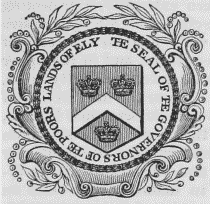
Seal.
Soon after the Conquest, many of the English nobility, unable to brook the tyranny of William, retired in 1071 to this place, whence, at the instigation of Edwin, Earl of Chester, and Egelwyn, Bishop of Durham, they ravaged the adjacent country, headed by Hereward, an English nobleman, who built a castle of wood in the marshes, and made a vigorous stand against the monarch. William besieged the Island, constructed roads through the marshes, built bridges over the streams, and erected a castle at Wiseberum (Wisbech); by which means he ultimately compelled his opponents, with the exception of Hereward and that leader's immediate followers, to submit to his authority. The camp occupied by William upon this occasion, and which Dr. Stukeley affirms to have been a Roman camp repaired by his engineers, is still visible in a field at Aldreth, which, in some records of the time of Henry III., is called Belasis, probably from one of William's generals, who was quartered on the monastery. On his conquest of the Isle, the king took possession of the abbey, but suffered the monks to remain, with certain restrictions, under an abbot of his own appointment, at whose intercession he subsequently restored the privileges they had previously enjoyed. Richard, the tenth and last abbot, a short time prior to his death, obtained from Henry I. permission to establish a see at Ely, which in 1107 was carried into effect, and Hervey, who had been driven by the Welsh from his see at Bangor, was made first bishop. To him and his successors Henry gave for a diocese the whole county of Cambridge, which had belonged to the Bishop of Lincoln, and they were invested with sovereign powers in the Isle. On the accession of Hervey, who superseded the abbot, a new division of lands belonging to the abbey took place, between the bishop and the prior and monks; the bishop's share was, in the 26th of Henry VIII., valued at £2134. 18. 6., and that of the prior and monks at £1301. 8. 2. A castle was built here by Bishop Nigel in the reign of Stephen, of which there are no remains, its probable site being only distinguishable by a mount to the south of the church. In 1216, William Bunk and a party of Brabanters, together with the Earl of Salisbury and others, taking advantage of a frost, entered the Isle of Ely, plundered the churches, and committed dreadful ravages, compelling the inhabitants to pay large sums of money for the ransom of their lives, and the prior 200 marks to save the cathedral from being burnt.
The city stands on elevated ground nearly at the southern extremity of the Isle, and on the river Ouse, which is navigable from Lynn; it consists of one long street, with smaller streets diverging from it, both in the upper and lower parts of the town, in the centre of which is a spacious market-place. With the exception of the cathedral and ecclesiastical buildings, the town has few claims to architectural notice; but it has rapidly improved of late years, and is now well paved, and lighted with gas. The ground in the vicinity, though flat and low, is extremely fertile, producing excellent herbage, and a considerable portion of it is cultivated by market-gardeners, who supply the neighbouring towns with vegetables: great quantities of fruit and remarkably fine asparagus are sent to the London market. From the improvement in the drainage of the Fens, the air of the city, and indeed of the whole Isle, has become as salubrious as that of any part of the county. The trade has very much improved of late: vessels now come up to the town; and a dock has been constructed, capable of accommodating 18 or 20 vessels of 70 or 80 tons' burthen, and which has been sold to the Eastern Counties Railway Company. The line of railway from London to Brandon runs by the town; and there are three other lines, namely, those from Ely to Downham and Lynn, to March and Peterborough, and to St. Ives and Huntingdon. Here is a manufactory for earthenware and tobacco-pipes. There is a good market on Thursday; and fairs are held on Ascension-day and Oct. 29th, for horses, cattle, hops, and Cottenham cheese, each lasting for eight days.
Under the Charter of privileges granted to the monastery by Edgar in the 13th of his reign, enlarged and confirmed by Edward the Confessor and William the Conqueror, the abbot continued to exercise temporal jurisdiction from the time of the re-establishment of the monastery till the erection of the see, from which period it became vested in, and was exercised by, the bishops of the diocese. The bishops had additional powers; and the royal franchise of Ely, in several statutes, was designated the County Palatine of Ely, till the 27th of Henry VIII., when, by act of parliament, the justices of oyer and terminer and gaol delivery, and justices of the peace for the Isle of Ely, were ordered to be appointed by letters-patent under the great seal, and all writs to be issued in the king's name. Certain jurisdiction, both in civil and criminal matters, was still vested in the bishops, who with their "temporal steward" of the Isle, were by the same act to be justices of the peace; and a general assize of oyer and terminer and gaol delivery was to be holden twice in the year, and a court of pleas for the trial of civil actions to any amount; also quarterly courts of session alternately at Ely and Wisbech. The bishop was likewise Custos Rotulorum of the Isle, which includes the three hundreds of Ely, Wisbech, and Witchford. All this temporal jurisdiction has, however, by a late statute, been abolished; and the Custos Rotulorum is now appointed by the crown, as are the magistrates, who hold their quarter-sessions alternately at Ely and Wisbech, as heretofore, though the assizes have been transferred to Cambridge. The bishop had also the appointment of the two coroners for the franchise, but these are, by the above statute, to be in future elected by the freeholders of the Isle. The powers of the county debt-court of Ely, established in 1847, extend over the registration-district of Ely. The court-house, erected in 1821, is a handsome and commodious building, with a portico of four columns, and two wings, of which the north is an infirmary, and the south a chapel. The house of correction is situated behind the court-house, and was erected at the same time.
At the dissolution of the monastery, which was dedicated to St. Peter and St. Ethelreda, Henry VIII. altered the ecclesiastical establishment of the See, and by charter converted the conventual into a cathedral church, which was dedicated to the Holy Trinity; he endowed it with the site and a portion of the revenue of the dissolved priory; and under his charter, remodelled by Charles II., the establishment consists of a dean, eight (to be reduced to six) canons or prebendaries, five minor canons, eight layclerks, eight choristers, a schoolmaster, usher, and twenty four king's scholars. The diocese comprises 539 benefices, of which 169 are in Suffolk, 167 in Cambridgeshire, 117 in Bedfordshire, and 86 in Huntingdonshire: the bishop has the patronage of the four archdeaconries, the chancellorship, and four canonries. The Dean and Chapter have the patronage of the minor canonries. The two first canonries that become vacant will be appropriated to the professorships of Hebrew and Greek in the University of Cambridge; and the two that next become vacant will be suppressed.
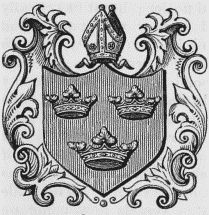
Arms of the Bishopric.
The Cathedral, begun in 1081, and not completed till 1534, is a splendid cruciform structure, displaying, through almost imperceptible gradations, the various changes which have characterised the progress of ecclesiastical architecture, from the earliest times of the Norman to the latest period of the English style. The plan differs from that of other cathedrals in the length of the nave, which is continued through an extended range of twelve arches, and in the shortness of the transepts, which have only a projection of three arches. The west front, though incomplete from the want of the south wing of the facade, is strikingly magnificent; the lower part is in the Norman style, with a handsome octagonal turret at the southern extremity, a projecting porch of early English architecture, and a lofty massive and highly-enriched tower with angular turrets, of Norman character in the lower stages, and in the upper of early English, formerly surmounted by a lofty spire, which has been taken down. From the intersection of the nave and transepts rises a noble octagonal lantern, which is considered one of the finest compositions in the decorated English style, and equally admirable for the excellence of its details and the beauty of its arrangement; it is eighty feet in diameter, and rests on piers which supported a tower that fell down in 1322. The interior of the cathedral is singularly elegant, and derives a simple grandeur of effect from the judicious arrangement by which the various styles of its architecture are made to harmonise. The nave and transepts are in the Norman style. The choir, partly in the early and partly in the decorated English style, is separated from the nave by three of the western arches, which were originally part of it, and now form an antechoir. The eastern part, or present choir, consisting of a range of six arches, is lighted by a double range of windows, and forms one of the richest specimens of the early English style extant; the roof is groined, and the intersections embellished with flowers and foliage; the east window is ornamented with a painting of St. Peter. The three western arches forming the ante-choir are of the decorated character, and assimilate with the beautiful lantern, with which the style of the nave and transepts is finely contrasted. A magnificent painted window, presented by the Rev. Edward Sparke, occupies the southeast angle of the lantern; it is forty feet in height, and is intended to commemorate the foundress of the church, St. Ethelreda. The Lady chapel is an elegant edifice, in the later decorated style; the groining of the roof, and the series of niches surrounding the interior, are of exquisite beauty. The chapels of Bishops Alcock and West are elaborately decorated with a profusion of architectural embellishments, but inferior in general effect to other portions of this beautiful structure. There are many interesting monuments, among which are, the tomb and effigy of Bishop Alcock, under an arch of stone, on the north side of his chapel: the monuments of several other bishops; and the tomb of Tiptoft, Earl of Worcester, and his two wives, erected in the time of Richard III.: a fine monument, also, has lately been erected in Bishop West's chapel, over the remains of Bishop Sparke. The length of the cathedral is 535 feet, from east to west; and the breadth 190, from the extremity of the north to that of the south transept. Extensive alterations and improvements have been made of late: since the accession of the present dean, Dr. Peacock, more than forty windows have been restored; some new painted windows have been raised, and at the west end especially, most important restorations have been effected. Of the cloisters and chapter-house there are scarcely any remains, and the refectory has been converted into a residence for the dean; but the prebendal houses retain many vestiges of ancient architecture, of which some are supposed to be of Saxon origin; and among these buildings is a chapel, erected by Prior Craunden, a curious composition in the decorated English style, of excellent design, and abounding with interest: the floor is of Mosaic pavement, still in a very perfect state, representing some of the earlier subjects of Scripture history. At some distance from the cathedral is the gate of the ancient monastery, in the later English style.
The city, exclusively of the extra-parochial liberty of the College, containing 64 residents, comprises the parish of St. Mary, which, with the chapelry of Chettisham, contains 2124; and the parish of Holy Trinity, which, with the chapelry of Stuntney, contains 4637, inhabitants. Both benefices are perpetual curacies, in the patronage of the Dean and Chapter; net income of each, £150. St. Mary's church is an interesting structure, partly Norman and partly early English, with a handsome tower surmounted by a spire: the nave is in the Norman style, with clerestory windows of later English architecture; the chancel is in the early English style, with insertions of a later date, and contains some remains of the ancient stalls: the north porch and door are early English. Holy Trinity church was formerly the Lady chapel of the cathedral, now fitted up for the parishioners. There are places of worship for Baptists, the Countess of Huntingdon's Connexion, Independents, and Wesleyans. The king's grammar school was founded in 1541, by Henry VIII., on the establishment of the cathedral, and is under the Dean and Chapter, who appoint the master: Jeremy Bentham, the late celebrated jurist and political writer, received the rudiments of his education in the school. A school was founded and endowed in 1730, by Mrs. Needham; Bishop Laney, in 1674, left lands and tenements for apprenticing boys of Ely and Soham, and there are several other charitable bequests belonging to the city. The poor law union comprises fourteen parishes or places, and contains a population of 20,077.