
A Topographical Dictionary of England. Originally published by S Lewis, London, 1848.
This free content was digitised by double rekeying. All rights reserved.
'Herringfleet - Heston', in A Topographical Dictionary of England, (London, 1848) pp. 491-497. British History Online https://www.british-history.ac.uk/topographical-dict/england/pp491-497 [accessed 27 April 2024]
In this section
Herringfleet (St. Margaret)
HERRINGFLEET (St. Margaret), a parish, in the hundred of Mutford and Lothingland, E. division of Suffolk, 6 miles (N. W. by W.) from Lowestoft; containing 197 inhabitants. This place was distinguished as the seat of a priory of Black canons, founded by Roger Fitz Osbert in the beginning of the reign of Henry III., and dedicated to St. Mary and St. Olave; it continued till the Dissolution, when its revenue was returned at £49. 11. 7., and the site and the lands pertaining to it were granted to Henry Jernyngham, Esq. The parish comprises 1200a. 24p., and is bounded on the south-west by the river Waveney, over which is a bridge called St. Olave's in honour of the patron saint of the priory. The living is a donative curacy, in the gift of J. F. Leathes, Esq. The church is an ancient structure in the Norman style, with a round tower; the interior has been restored in a very appropriate manner by Mr. Leathes, who has removed the pews, and placed open benches, ornamented with carved oak, in their stead, built a gallery, and presented a new pulpit and reading-desk, a handsome communion-table, and three beautiful windows of old stained glass. The late Mrs. Elizabeth Merry instructed her executors to purchase stock in the government funds sufficient to produce £20 per annum, and directed that the same should be applied to the education of twelve poor children. An allotment of 13a. 35p. of land was set out on the inclosure of the waste, for providing fuel for the poor; it produces £13. 15. per annum, which sum is laid out in coal.
Herringstone, or Winterbourne-Herringstone
HERRINGSTONE, or Winterbourne-Herringstone, a chapelry, in the parish of West Chickerell, union of Dorchester, hundred of Culliford-Tree, Dorchester division of Dorset, 2 miles (S. by W.) from Dorchester; containing 48 inhabitants.
Herringswell (St. Ethelbert)
HERRINGSWELL (St. Ethelbert), a parish, in the union of Mildenhall, hundred of Lackford, W. division of Suffolk, 3¼ miles (S. by E.) from Mildenhall; containing 219 inhabitants. The living is a discharged rectory, valued in the king's books at £9. 9. 9½.; net income, £200; patron, J. T. Hales, Esq. The tithes were commuted for land in 1807.
Herrington, East and Middle
HERRINGTON, EAST and MIDDLE, a chapelry, in the parish and union of Houghton-Le-Spring, N. division of Easington ward and of the county of Durham, 9 miles (N. E.) from Durham; containing 231 inhabitants. The township is on the road from Durham to Sunderland, and comprises 955a. 6p., of which 598 acres are arable, 200 grass-land, 11 wood, and 42 waste. A coal-mine here, called the Philadelphia, is the property of the Earl of Durham. The chapel was built in 1840, at the expense of the rector of Houghton-le-Spring, the Rev. E. S. Thurlow. There are places of worship for Primitive Methodists and Wesleyans.
Herrington, West
HERRINGTON, WEST, a township, in the parish and union of Houghton-Le-Spring, N. division of Easington ward and of the county of Durham, 4½ miles (S. W. by W.) from Sunderland; containing 343 inhabitants. The township comprises by admeasurement 937 acres, of which 603 are arable, 290 meadow and pasture, 32 woodland, and 12 waste.
Herstmonceaux (All Saints)
HERSTMONCEAUX (All Saints), a parish, in the union of Hailsham, hundred of Foxearle, rape of Hastings, E. division of Sussex, 4 miles (E.) from Hailsham; containing 1445 inhabitants. The parish is situated on the road from Lewes to Battle and Hastings. The manor belonged to the family of de Fiennes, of whom Sir Roger de Fiennes, treasurer to Henry VI., erected a residence here, which was regarded as one of the finest castellated brick buildings in England. In 1777, the interior was for the greater part destroyed, and the edifice was suffered to fall into dilapidation. A considerable portion of the walls, with the tower and gateway, is still remaining, surrounded on three sides by a wide and deep fosse. The living is a rectory, valued in the king's books at £20, and in the gift of Francis George Hare, Esq.: the tithes have been commuted for £339, and the glebe comprises 160 acres. The church is an ancient and spacious structure, in the early English style, with a tower surmounted by a low spire: on the north side of the chancel is a splendid monument of marble to Sir Thomas de Fiennes, second Lord Dacre, and his son Sir Thomas de Fiennes; and on a slab inlaid with brass is the effigy of an armed knight, under a canopy, to the memory of William de Fiennes. There are a place of worship for Independents, and a buryingground for the Society of Friends.
Hertford
HERTFORD, a borough and market-town, having separate jurisdiction, and the head of a union, locally in the hundred of Hertford, county of Hertford, of which it is the chief town, 21 miles (N.) from London; containing, exclusively of that part of the parish of All Saints actually within the hundred, 5450 inhabitants. Hertford is supposed by Sir Henry Chauncey to have been the Roman station called Durocobrivæ, which has by subsequent writers, with greater probability, been referred to Dunstable. The modern name is of somewhat doubtful etymology: according to Bede it is derived from Herudford, or "red ford," but Salmon deduces it from Here-ford, a "military ford," whence, by corruption, Hertford. The antiquity of the place, however, is unquestionable. So early as the year 673, Theodore, a native of Tarsus, in Cilicia, and then Archbishop of Canterbury, convened a council here; and about 905, Edward the Elder, to protect the inhabitants from the incursions of the Danes, erected a castle, the custody of which, and the government of the town, were given by William the Conqueror to Peter de Valoignes. In the reign of Henry III. William de Valence was governor, and at his death, the castle descended to Aymer de Valence; it was subsequently surrendered to the crown.
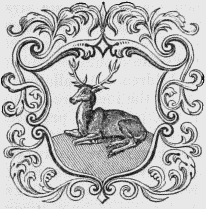
Arms.
The Town is pleasantly situated on the river Lea, in a dry valley surrounded by hills, and has three principal streets meeting obliquely in the centre, parallel with one of which is the high thoroughfare through the place; the buildings in general are so irregular that not one street presents an entire row of uniform houses. The inhabitants are amply supplied with excellent water. Over the Lea, which is navigable to Hertford for small vessels, is the toll-bridge: beyond, is an opening leading to Cow-bridge, a structure of brick, of two arches, across the river Beane, which flows into the Lea, as also does the Mimram, which runs through the castle grounds, and is crossed by a wooden bridge. About a quarter of a mile above the toll-bridge, in this direction, are some neat modern cottages, and on the north road is a handsome range of buildings, called the North Crescent. In Castle-street, on the site of the ancient castle, of which little remains except a line of embattled wall and a mound, is a brick edifice of castellated form, fitted up at considerable expense, by a late Marquess of Downshire, for his own residence; it is still occupied as a private dwelling. At a short distance from the town, on the river Lea, are the gas-works, erected in November, 1825, formerly under the direction of the International Gas-Light Company, but now the property of private individuals, who have purchased them of the company. A good trade is carried on in corn, malt, and flour, of which large quantities are sent to the metropolis. The Hertford and Ware branch of the Eastern Counties railway was formed under an act obtained in 1841, and opened to the public on the 31st of October, 1843; it leaves the main line at Broxbourn, and is about 5¾ miles long, making the railway distance of Ware from the terminus at Shoreditch about 24½ miles, and that of Hertford 26 miles: coaches run, in continuation of the trains, to various places in the vicinity. The market, by charter of Charles II., is held under the shire-hall every Saturday, and the business transacted in grain is scarcely equalled in any other provincial market: another, on Wednesday, is now disused. Fairs, chiefly for cattle, three of which are by charter of Mary, and one by charter of Charles II., are held on the third Saturday before Easter, May 12th, July 5th, and November 8th, with courts of pie-poudre attached. On the north side of Fore-street is the butchers' market, constructed at the expense of Alderman Kirby, and forming three sides of a quadrangle.
The inhabitants were first incorporated by Queen Mary, in the year 1554. A new charter was bestowed by Elizabeth in 1588; and one also by James I. in 1604, which continued to be the governing charter until the grant of that of Charles II. in 1680, under which the control was vested in a mayor, high-steward, recorder, ten aldermen, and sixteen assistants, with a town-clerk, chamberlain, &c. By the act of the 5th and 6th of William IV., cap. 76, the corporation now consists of a mayor, four aldermen, and twelve councillors; the municipal boundaries are co-extensive with the parliamentary, and the number of magistrates is nine. The borough sent two members to parliament from the reign of Edward I. to the 50th of Edward III., from which period elections were discontinued till the time of James I., when, on petition, the ancient right was restored; the mayor is returning officer. The corporation possess the tolls of the market, by virtue of their charter from Charles; and have authority to hold a court of record for pleas, actions, and suits, under the value of £60, every Wednesday, at which the mayor or his deputy, being an alderman, and the recorder or his deputy, preside: this court, after having been discontinued for many years, was revived in 1827. The usual Lent and Summer assizes are held in the shire-hall, and there is a gaol delivery in December: this is also the place of election for knights of the shire. The quarter-sessions for the county are held in the same place, always beginning on Monday; and at these sessions, business for the borough is also transacted, no separate quarter-sessions being now held for the latter. There are petty-sessions weekly, both for the county and borough, the former on Saturday, and the latter on Wednesday. The powers of the county debt-court of Hertford, established in 1847, extend over the registration-districts of Hertford and Ware, and part of the district of Hatfield and Welwyn. The shire-hall, a spacious edifice, erected in 1780, and situated in the market-place, contains, in addition to the courts of law, a handsome assembly-room. The common gaol for the borough, and the common gaol and house of correction for the county, are comprehended within the same walls, inclosing an area of about four acres.
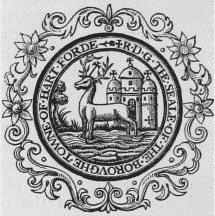
Corporation Seal.
Hertford comprises the united parishes of All Saints and St. John, containing 3726 inhabitants, including the liberties of Little Amwell and Brickendon within the parish of All Saints; together with the united parishes of St. Andrew, St. Mary, and St. Nicholas, containing 2135. The living of All Saints' is a vicarage, endowed with a portion of the rectorial tithes, with the vicarage of St. John's, valued together in the king's books at £10. 8. 6½., and in the alternate patronage of the Crown and the family of Townshend; impropriators of the remainder of the rectorial tithes, certain trustees under the will of B. Cherry, Esq. The church, which was repaired a few years since, is a spacious cruciform structure in the later English style, with a tower surmounted by a spire, and contains several ancient monuments, the inscriptions on which are nearly obliterated, and some of modern erection. The living of St. Andrew's is a rectory, with the vicarages of St. Mary's and St. Nicholas', valued together in the king's books at £12. 7. 3½., and in the patronage of the Crown, in right of the duchy of Lancaster: the tithes have been commuted for £279, and the glebe comprises 2½ acres. The church is a neat edifice, with a low embattled tower surmounted by a small spire. The churches of the other three parishes have fallen into ruins. There are places of worship for Baptists, the Society of Friends, Independents, the Countess of Huntingdon's Connexion, and Wesleyans.
At the entrance into the town from London, is a branch establishment in connexion with Christ's Hospital, London, appropriated to the reception of junior boys, who are sent from this to the parent institution, as vacancies arise. It includes three sides of a quadrangle, the two opposite sides being occupied by the several wards for the children, and the third by the reading and writing school, a spacious brick building capable of accommodating upwards of 250 boys, and affording a residence for the master. In a line with the writing-school, westward, is the dining-hall, and behind it the infirmary for about 100 patients: eastward of the great gates in front of the buildings is the grammar school, with the residence for the master; and on the opposite side, the porter's lodge, with a continuation of buildings within the walls for the girls, usually from 60 to 70 in number, and a residence for the governess and matron. A free grammar school for the children of the inhabitants was founded in 1617, by Richard Hale, Esq., of Cheshunt, and endowed by him with £800. Bernard Hale, D.D., gave £100 per annum to maintain seven poor scholars at St. Peter's College, Cambridge, each for seven years, the candidates to be appointed from this school: each scholarship is of the value of £14 per annum. A Green-coat school was erected in 1812. The principal charity, called Grass Money, produces a net income of about £250 per annum. A county dispensary was established in January, 1822. The poor-law union of Hertford comprises 18 parishes or places, and contains a population of 14,145. Eastward of the town was a monastery, founded by Ralph de Limesi, nephew of William the Conqueror, who, afterwards assuming the cowl, became its first prior, and was interred in the church: at the Dissolution it was valued at £86. 14. 2. The site is now occupied by a dwelling-house called the Priory, which was inhabited by Thomas Dimsdale, M.D., who spent the early part of his professional life here, and, having received his diploma in 1768, went to Russia, where he inoculated the Empress Catherine, for which he received £12,000 and a pension, with the title of Baron, which descended to his family; he died here in the year 1800, at the advanced age of 87. Hertford confers the title of Marquess on the family of SeymourConway.
Hertfordshire
HERTFORDSHIRE, an inland county, bounded on the north by the county of Cambridge, on the northwest by that of Bedford, on the west by that of Buckingham, on the south by that of Middlesex, and on the east by that of Essex. It extends from 51° 37' to 52° 4' (N. Lat.), and from 10' (E. Lon.) to 45' (W. Lon.); and contains 528 square miles, or 337,920 acres. Within its limits are 30,155 inhabited houses, 1321 uninhabited, and 186 in course of erection; and the population amounts to 157,207, of whom 77,617 are males.
The Celtic inhabitants of this portion of Britain were the Cassii or Cattieuchlani, whose territory, long before the first invasion by the Romans, was overrun by the Belgæ (who had previously established themselves in the south-western part of England), and their capital, Verulam, taken possession of by the conquerors. Of the military operations of Cæsar in the district forming the modern county of Hertford, and his capture of Verulam, little more is known than what may be collected from the succinct narrative by the conqueror himself. The result, however, was, that the British chief, Cassivelaunus, was obliged to sue for peace; which being granted, Mandubritius, the sovereign of the Cassii, was reinstated in his dominions, and Cæsar led back his army along the Watling-street to Richborough, where he embarked for the continent. In the Roman division of Britain, after its complete subjugation, this territory was included in Flavia Cæsariensis; under the Saxon heptarchy part of it was comprised in the kingdom of Mercia, and part in that of the East Saxons, or Essex.
The county formerly lay partly within the diocese of London, and partly in that of Lincoln, the whole being included in the province of Canterbury: by the act of the 6th and 7th of William IV., cap. 77, it is entirely in the diocese of Rochester, and co-extensive with the archdeaconry of St. Alban's. That portion once in the diocese of London comprises the deanery of Braughin, which contains 34 parishes; and the deanery of St. Alban's, containing 22 parishes. The part which was in the diocese of Lincoln comprises the deaneries of Baldock, Berkhampstead, Hertford, and Hitchin; containing 80 parishes. The total number of parishes in the county is therefore 136. For civil purposes it is divided into the hundreds of Braughin, Broadwater, Cashio (or the liberty of St. Alban's), Dacorum, Ed winstree, Hertford, Hitchin and Pirton, and Odsey; in which are the borough and market towns of Hertford and St. Alban's, and the market-towns of Baldock, Berkhampstead, Hatfield, Hemel-Hempstead, Hitchin, Hoddesdon, Rickmansworth, Standon, Stevenage, Bishop-Stortford, Tring, Ware, Watford, and parts of Chipping-Barnet and Royston. Under the act of the 2nd of William IV., cap. 64, three knights are returned to parliament for the shire, and two representatives for each of the two boroughs: the place of election for the county representatives is Hertford. Hertfordshire is included in the Home circuit; and the assizes are held at Hertford, where also are held the quartersessions, except for the hundred of Cashio, or liberty of St. Alban's, which take place at St. Alban's: the gaol is at Hertford.
The natural features of the county are of a gentle character, and there are various scenes of considerable beauty, much heightened by the mansions, villas, and ornamented grounds of rich proprietors, which are conspicuous in every direction. With respect to the soil it may be remarked, that the vales through which the rivers and brooks flow are invariably composed of sandy loam, with the exception only of a small quantity of peat and marshy moor; that the slopes of the hills descending to these vales are inferior qualities of the same loams, and at the same time dry and sound; and that the flatter surfaces of the higher lands are composed of a wet and strong loam, sometimes requiring hollowdraining. Arthur Young divides the soil into one district of loams, two of clay, one of chalk, and one of gravel; adding that the soils intermingle in a remarkable manner, so as sometimes to make it extremely difficult to draw the boundary line between them. The substratum of the whole is chalk, for obtaining which, for manure, pits are sunk all over the county. By far the larger part of the land is under tillage. The grass-land is in a great measure confined to a narrow border on the south side of the county, in the vicinity of Barnet. The artificial grasses are, clover (which has probably been cultivated in this county longer than in any other part of the kingdom, and, from the vicinity of the metropolis, yields a greater profit here than elsewhere), trefoil, sainfoin, and lucerne. The waste consists of small commons scattered over the county, the principal lying near Berkhampstead; compared with that of most other counties, it is very inconsiderable. There is much flourishing timber of fine growth around the seats of the nobility and gentry; and large tracts of coppice wood are situated to the south of Hertford, also between Hockerill, Ware, and Buntingford, and on the estate of the Marquess of Salisbury.
The principal rivers are the Lea, the Colne, and the Stort, formed by the junction of many minor streams which rise chiefly within the bounds of the county. The Lea has been made navigable from Hertford to its confluence with the Stort, about a mile to the east of Hoddesdon, where it takes a southern course, becoming the boundary of the county on the east, and continuing so until it reaches the border of Middlesex: the Stort becomes navigable at Bishop-Stortford, from which place to its junction with the Lea it forms the boundary between Essex and Hertfordshire. The smaller streams are the Mimram, the Rib, the Ash, the Gade, and the Verulam, Verlam, or Mouse river. At Ashwell, in the county, are the nine springs of the Cam, which flows past Cambridge. The Grand Junction canal, leading from Branston wharf on the Coventry canal to Old Brentford, where it opens into the Thames, enters Hertfordshire above Tring, and follows the course of the Bulburn and Gade rivers to Rickmansworth, and from that place the course of the Colne until it quits the county. The London and Birmingham railway enters the county a few miles to the south of Watford, and passes by that town, Berkhampstead, and Tring, near which last place it is joined by a branch from Buckinghamshire, called the Aylesbury railway. The Eastern Counties line runs along the whole of the south-eastern border of the county, and a branch has been constructed from it to Hertford and Ware, which is noticed in the article on Hertford. The females in the vicinity of Stevenage, Hatfield, Redburn, St. Alban's, Berkhampstead, Hitchin, &c., are much employed in making straw-plat: the manufacture of black lace, carried on time immemorially at Berkhampstead, has given place to that of straw-plat.
The British Watling-street, entering Hertfordshire on the south, passed to St. Alban's, and thence along the line of the turnpike-road to Dunstable. The Erminstreet, passing by Enfield, entered the south-eastern border of Herts near Little Hockgate, and ran between Standon and Puckeridge, near Braughin, and through Buntingford, to Royston, where it crossed the Ikeneldstreet. The line of the Ikeneld-street, entering the north-eastern border of the county at Royston, passes through Baldock, and, after crossing a small part of Bedfordshire and Buckinghamshire, re-enters Hertfordshire and continues for a short distance running a little to the right of Tring. The only Roman station of which the situation has been precisely ascertained, is the celebrated city of Verulam, contiguous to St. Alban's. Excepting the ancient British roads above mentioned, which appear to have been used and improved by the Romans, the only Roman road (of many that probably once intersected the county) now traceable with any degree of distinctness, is that which connected Verulam with the station at Chesterfield, near Sandy, on the banks of the Ivel, and which runs in the line of the present road through Stevenage, Gravely, and Baldock. Before the Reformation there were, according to Tanner, 34 religious houses and hospitals. Some remains exist of the ancient castles of Hertford, Bishop-Stortford, and Berkhampstead; and Hatfield House is a fine specimen of the style of domestic architecture which prevailed in the reign of James I. On the east side of the village of Great Amwell, at the foot of the steep bank whereon the church is situated, rises a considerable spring, which, with that of Chadwell, feeds the canal commonly called the New River, commenced in 1609, under the authority of an act of parliament, by Hugh Myddelton, for supplying the northern side of the metropolis with water, and completed in 1613. Its length is nearly 39 miles, about half of which is within the eastern border of this county, and near the line of the road from London to Ware.
Hertingfordbury (St. Mary)
HERTINGFORDBURY (St. Mary), a parish, in the union, hundred, and county of Hertford, 1¾ mile (W. S. W.) from Hertford; containing 737 inhabitants. It comprises by admeasurement 2586 acres, of which 650 are pasture, 200 woodland, 54 waste or common, and the remainder arable. The living is a rectory, valued in the king's books at £12. 15. 2½., and in the patronage of the Crown, in right of the duchy of Lancaster: the tithes have been commuted for £555, and the glebe comprises 35 acres.
Hesket-in-the-Forest (St. Mary)
HESKET-IN-THE-FOREST (St. Mary), a parish, in the union of Penrith, Leath ward, E. division of Cumberland; containing, with the townships of Calthwaite, Itonfield, Petteril-Crooks, and Plumpton-Street, 2018 inhabitants, of whom 883 are in the township of Nether and Upper Hesket, 9 miles (N. by W.) from Penrith. This place derives the adjunct to its name from its situation within the limits of Inglewood Forest, the courts for which are held on St. Barnabas' day, in the open air, under a tree called Court Thorn, between Upper and Nether Hesket, on which occasion the inhabitants of more than twenty townships attend, from whom a jury is balloted and sworn. Upper and Nether Hesket are two considerable villages on the road from Penrith to Carlisle. Near Aiketgate is a tarn, covering about 100 acres, and abounding with carp. Fine white and cream-coloured clay, containing shining particles of mica, and well adapted to the manufacture of porcelain, is found at Barrock. The Penrith and Carlisle railway passes through the parish, which comprises by computation 10,000 acres. The living is a perpetual curacy; net income, £150; patrons and appropriators, the Dean and Chapter of Carlisle, whose tithes in Nether Hesket have been commuted for £77. The church was built about 1530, and rebuilt in 1678, and again in 1760; a gallery was erected by subscription in 1827. At Armathwaite is a chapel, a neat structure in the early English style. In 1763, John Brown bequeathed £200 towards the support of a school.
Hesket-Newmarket
HESKET-NEWMARKET, a market-town, in the township of Caldbeck-Haltcliffe, parish of Caldbeck, union of Wigton, Allerdale ward below Derwent, W. division of Cumberland, 14 miles (S. S. W.) from Carlisle, and 297 (N. N. W.) from London. This is a small but neat and compact town, situated in a secluded and romantic district, on the south side of the river Caldew. The surrounding district is mountainous, and contains mines of lead, copper, and manganese; at Carrickbeck are smelting-works for the lead-ore. The market, which is held on Friday, is inconsiderable; but there are well-frequented fairs on the first Friday in May, and every alternate Friday till Whitsuntide, for cattle; and the last Thursday in August, and the second Thursday in October, for sheep. Here is a place of worship for the Society of Friends. Near the town is a petrifying spring, issuing from a rock on the margin of the river.
Hesketh, with Becconsall
HESKETH, with Becconsall, a parish, in the union of Ormskirk, hundred of Leyland, N. division of the county of Lancaster, 11 miles (N. by E.) from Ormskirk; containing 553 inhabitants. The family of Hesketh had possessions here early in the reign of Henry III., or previously; and between the reigns of Henry VIII. and William III., Becconsall was the property and residence of the Becconsalls. Anciently a beacon was placed near the confluence of the Douglas river with the Ribble, and the name "Beacon's Hill," or Becconsall, is supposed to be derived from this harbinger of approaching danger. The length of the parish is from two miles and a half to three miles, and the breadth, from Hesketh Bank on the north to Tarleton on the south, one mile; it comprises 1947 acres, whereof 938 are common, waste, and marshy land. The soil is sandy near the coast, and in other parts peaty, with a mixture of marl. At flood tide the Ribble is here in one part three miles wide; and both it and the Douglas are navigable, the former for vessels of above 100 tons' burthen as high as the town of Preston, and the latter for vessels of forty-five tons: salmon and flounders are taken near the mouths of the rivers. The grazing of sheep is carried on to a great extent on the marshes, the pasturage of which is rendered agreeable and nutritious to the flocks by the slight impregnation of salt. The living is a rectory, with a net income of £275; patrons, the family of Hesketh. The church, a plain brick fabric, erected in 1765, and generally called Becconsall chapel, stands one mile below Hesketh Bank; it became the parish church in 1821, when an act was passed separating Hesketh and Becconsall from Croston, and forming them into a distinct parish. The Primitive Methodists have a place of worship. The poor share in a bequest by Dr. Layfield, in 1710, to all the townships of Croston, for the distribution of clothing and books to persons not seeking parochial relief.
Heskin
HESKIN, a township, in the parish of Eccleston, union of Chorley, hundred of Leyland, N. division of Lancashire, 5½ miles (W. S. W.) from Chorley; containing 359 inhabitants. Heskin being a joint manor with Eccleston, descended with it from the Gernets and Dacres to the family of Molyneux, of Sefton. The Mawdesleys afterwards possessed the estate, which was purchased of the trustees of the Rev. Thomas Mawdesley by Alexander Kershaw, Esq., in 1739, and has continued with his descendants. The old Hall was taken down about forty years ago, and a farmhouse now occupies its site: the new Hall is a large brick gabled edifice. The township comprises 1189 acres of land, and the tithes have been commuted for £175. 4. In 1597, Sir James Pemberton endowed a free school with £50 per annum, and 11 acres of land; and Hannah Anderton, in 1806, gave a cottage as a schoolroom, with £10 per annum.
Heslerton, East
HESLERTON, EAST, a chapelry, in the parish of West Heslerton, union of Malton, wapentake of Buckrose, E. riding of York, 10 miles (E. N. E.) from Malton; containing 235 inhabitants. It comprises 3990 acres. The Wesleyans have a place of worship. There are remains of a Roman encampment.
Heslerton, West (St. Andrew)
HESLERTON, WEST (St. Andrew), a parish, in the union of Malton, wapentake of Buckrose, E. riding of York; containing, with the chapelry of East Heslerton, 563 inhabitants, of whom 328 are in the township of West Heslerton, 9 miles (E. N. E.) from Malton. The parish comprises 6170 acres, of which 2180 are in the township; and is mostly arable, with a small portion of pasture and meadow land. The surface is level at the base of the Wold hills, the soil light and sandy in some places, and in others marl; the river Derwent flows on the north, where in particular situations it forms a boundary. The living is a rectory, valued in the king's books at £21. 6. 8., and in the patronage of the Crown, with a net income of £465: the tithes were commuted for land and a money payment, under an act of inclosure, in the 10th George III.; a good glebe-house was built in 1820. The church is a neat structure.
Hesleton, Cold
HESLETON, COLD, a township, in the parish of Dalton-le-Dale, union of Easington, N. division of Easington ward and of the county of Durham, 8 miles (S.) from Sunderland, and 10½ (E. N. E.) from Durham; containing 83 inhabitants. This township, also called Cold Hesleden and Haseldon, comprises about 820 acres: the hamlet is situated on an eminence, and commands a view of the sea, by which the township is bounded on the east; in other respects the scenery is bleak and uninteresting. The South Hetton Coal Company have a fixed engine at this place, on their line of railway to Seaham harbour, for working the coal-waggons up the eastern and western ascents to the summit. The vicarial tithes have been commuted for £75. Henry Smith, of Silver-street, London, about 1627 bequeathed a portion of an estate called Long-Stock farm, in the county of Southampton, to the poor within the township: this portion now yields about £30 per annum.
Hesleton, Monk (St. Mary)
HESLETON, MONK (St. Mary), a parish, in the union of Easington, S. division of Easington ward, N. division of the county of Durham; containing, with the townships of Hulam, Hutton-Henry, and Sheraton, 935 inhabitants, of whom 490 are in the township of Monk-Hesleton, 2½ miles (E. by S.) from Castle-Eden. This parish, called also Hesleden, from its deep dene covered with hesles, is bounded on the east by the German Ocean; and the road from Stockton to Sunderland passes on the west. The township comprises about 2400 acres, of which 2000 are in equal portions of arable and pasture, and 400 wood on the slopes of the denes; the soil is of a clayey quality, and the land in its slope to the sea is much exposed to cold blasts. On the coast are some very romantic rocks, called "Black halls," scooped into deep caverns, and broken into isolated masses of rude and grotesque appearance. Limestone abounds, in some places of a quality suitable for building; and a pure magnesian limestone is quarried, and conveyed to the Tyne for chemical purposes. Coal is worked at Castle-Eden colliery, immediately adjoining the western boundary of the township, from which colliery the coal in Hesleton, which is of a superior description, will be worked. The Hartlepool railway passes for two miles through the township. The small village of High Hesleton is situated about half a mile to the north. The living is a vicarage, valued in the king's books at £7. 12. 6., and in the patronage of the Dean and Chapter of Durham, with a net income of £179. The great tithes of the township of Monk-Hesleton have been commuted for £165, and the small for £52: the vicar has a glebe of 5 acres. The church is modern.
Hesley-Hurst
HESLEY-HURST, a township, in the parish and union of Rothbury, W. division of Coquetdale ward, N. division of Northumberland, 4 miles (S. E. by S.) from Rothbury; containing 36 inhabitants. It lies between the Forest burn and the Maglin burn, which latter forms the southern boundary of the parish. The township is the property of the Duke of Northumberland.
Heslington (St. Peter and St. Paul)
HESLINGTON (St. Peter and St. Paul), a parish, in the wapentake of Ouse and Derwent, union and E. riding of York, 1½ mile (S. E. by E.) from York; containing 266 inhabitants, and comprising by computation 1200 acres of land. Heslington Hall, an ancient mansion in the Elizabethan style, is the residence of Major Nicholas Yarburgh, lord of the manor, whose family has long been seated here. The village, which is large and pleasant, is situated on the eastern side of the vale of the Ouse. The living is a perpetual curacy, in the patronage of the Archbishop of York; and has a net income of £63: the church is a small but neat edifice, with a tower at the west end. An almshouse for eight poor men and one woman was founded in 1608, by Sir Thomas Hesketh, who endowed it with a rent-charge, now £55 per annum, out of five corn-mills in the suburbs of York: the almshouse was re-erected by Henry Yarburgh, Esq., in 1795, in which year, also, a school, and a house for the master, were built by subscription. In a gravel-pit, about ten years since, two stone coffins, two glass urns, and several gold rings, bracelets, and other antiquities, were found, supposed to have been the incasement of a Danish prince.
Heslington
HESLINGTON, a township, in the parish of St. Lawrence, York, wapentake of Ouse and Derwent, union and E. riding of York; containing 265 inhabitants. It comprises 1371 acres, of which 285 are common land. Major Yarburgh is lord of the manor.
Hessett, or Hedgessett (St. Ethelbert)
HESSETT, or Hedgessett (St. Ethelbert), a parish, in the union of Stow, hundred of Thedwastry, W. division of Suffolk, 6 miles (E. S. E.) from Bury St. Edmund's; containing 417 inhabitants. This place formed part of the possessions of the family of Bacon, ancestors of the celebrated Lord Bacon, who were settled here in the reign of Henry II. The parish comprises 1618a. 3r. 36p., of which 73 acres are common or waste land; the soil is heavy but fertile, and the surface generally level. The living is a rectory, valued in the king's books at £12. 17. 11., and in the gift of M. E. Rogers and C. Fingling, Esqrs.: the tithes have been commuted for £344. 12., and the glebe comprises 18 acres. The church is a handsome structure, in the decorated and later English styles; the chancel is filled with monuments to the memory of the Bacon and Le Heup families, the latter of whom were patrons of the living. There are several charitable bequests.
Hessey
HESSEY, a township, in the parish of MoorMonkton, Ainsty wapentake, W. riding of York, 5¾ miles (W. by N.) from York; containing 149 inhabitants. It comprises by computation 1203 acres of land, held by various proprietors: the moor was inclosed in 1830. The village is south of the road to Knaresborough. There is a place of worship for Wesleyans.
Hessle (All Saints)
HESSLE (All Saints), a parish, in the union of Sculcoates, county of the town of Hull, locally in the E. riding of York, 4 miles (W. S. W.) from Hull; containing 1388 inhabitants. This place was anciently called Hest, and its church was the mother church of the Holy Trinity, in Hull, which town was separated by act of parliament, in 1661; previously to that date, the incumbents were styled vicars of Hest and Hull, from the combination of which the village most probably derived its name. The parish comprises 2410 acres of land; and has some extensive quarries of chalk, and several mills for the manufacture of whiting. The village is on the river Humber, across which is a royal ferry to Barton, on the opposite shore; the first station on the line of the Hull and Selby railway is also situated here. The living is a vicarage, valued in the king's books at £10. 7. 1., and in the patronage of the Crown; net income, £303. The church is an ancient structure in the early English style, with a square embattled tower surmounted by a lofty spire; the interior has been much improved within the last few years, from a fund of more than £100 per annum for keeping the building in repair. There are places of worship for Methodists of the Old and the New Connexion. An hospital for three aged women, and a school for boys, are supported by Chamberlain's charity; and £30 are distributed among the poor on St. Thomas' day, from the charitable funds of the parish.
Hest, with Slyne.—See Slyne.
HEST, with Slyne,—See Slyne.
Hestercombe
HESTERCOMBE, a hamlet, in the parish of Kingston, union of Taunton, hundred of Taunton and Taunton-Dean, W. division of Somerset, 3¼ miles (N. by E.) from Taunton; containing 14 inhabitants.
Heston (St. Leonard)
HESTON (St. Leonard), a parish, in the union of Brentford, hundred of Isleworth, county of Middlesex; containing 4071 inhabitants, of whom 1386 are in that portion forming part of the town and chapelry of Hounslow. The parish is situated in a fertile district, and the inhabitants are principally employed in agriculture; the soil is remarkable for the production of excellent wheat, and according to Norden and Camden, the bread for the supply of the royal table in the reign of Elizabeth, was made of wheat grown exclusively in Heston. There is a manufactory for oil of vitriol. A pleasure-fair is held in the village on the 1st of May. Within the parish is Osterley Park, once in the possession of Sir Thomas Gresham, who entertained Queen Elizabeth here; the house was rebuilt in 1760 for the Child family, and now belongs to the Earl and Countess of Jersey. The living is a vicarage, valued in the king's books at £11; net income, £654; patron and appropriator, the Bishop of London: the tithes were commuted for land in 1813. The church has been enlarged, and 400 free sittings provided: the tower is one of the finest in the county, and the west window is very splendid, and rich in details. Sir Joseph Banks, president of the Royal Society, and his lady, are buried in the church; and there is a monument to Anthony Collins, the free-thinker, and author of various works, who was a native of the parish.