
A Topographical Dictionary of England. Originally published by S Lewis, London, 1848.
This free content was digitised by double rekeying. All rights reserved.
'Huish - Hulme-Walfield', in A Topographical Dictionary of England, (London, 1848) pp. 574-580. British History Online https://www.british-history.ac.uk/topographical-dict/england/pp574-580 [accessed 30 April 2024]
In this section
Huish (St. James)
HUISH (St. James), a parish, in the union of Torrington, hundred of Shebbear, Black Torrington and Shebbear, and N. divisions of Devon, 5½ miles (N.) from Hatherleigh; containing 141 inhabitants. The living is a discharged rectory, valued in the king's books at £7. 19. 10., and in the gift of Lord Clinton: the tithes have been commuted for £117, and the glebe comprises 63 acres. Pipe-clay and potters'-clay are found.
Huish, county of Wilts.—See Hewish.
HUISH, county of Wilts.—See Hewish.
Huish-Champflower (St. Peter)
HUISH-CHAMPFLOWER (St. Peter), a parish, in the union of Dulverton, hundred of Williton and Freemanners, W. division of Somerset, 2¾ miles (W. by N.) from Wiveliscombe; containing 454 inhabitants. The parish comprises by measurement 2909 acres, of which 638 are hills, road, and waste; the river Tone has its source within its limits. An act for inclosing lands was passed in 1842. The living is a rectory, valued in the king's books at £13. 9. 4½., and in the gift of Sir J. Trevelyan, Bart.: the tithes have been commuted for £254. 6. 9., and the glebe comprises 152 acres.
Huish-Episcopi (St. Mary)
HUISH-EPISCOPI (St. Mary), a parish, in the union of Langport, E. division of the hundred of Kingsbury, W. division of Somerset, ½ a mile (E.) from Langport; containing, with the hamlets of Coombe, Langport-Westover, Pebsbury, Wearne, and part of Paradise, 713 inhabitants. It is situated on the road from Bristol to the north of Devonshire, and consists principally of pasture land, with portions of arable and orchard ground. The rivers Parret and Yeo or Ivil unite here, and after heavy rains frequently overflow the grounds in the southern part of the parish. The living is a discharged vicarage, with that of Langport united, valued in the king's books at £14. 10. 5.; net income, £210; patron and appropriator, the Archdeacon of Wells, as Prebendary of Huish in the Cathedral of Wells. The tithes were commuted for corn-rents in 1797. The church has a handsome tower, ornamented with battlements and pinnacles.
Huish, North
HUISH, NORTH, a parish, in the union of Totnes, hundred of Stanborough, Stanborough and Coleridge, and S. divisions of Devon, 7 miles (W. S. W.) from Totnes; containing 483 inhabitants. This parish is situated on the river Avon, which separates it from the parish of Diptford, and falls into Bigbury bay; it comprises by measurement 2662 acres. The Avon, though a small stream, is famous for its trout and salmon. There are several quarries of stone, which is raised for building; and a quarry of limestone. The living is a rectory, valued in the king's books at £29. 18. 11½., and in the gift of John Allen, Esq.: the tithes have been commuted for £410, and the glebe comprises 76 acres. The church is a neat plain edifice, in the later English style, with a spire. A house and two plots of land, producing £25 per annum, are appropriated to the poor. An almshouse was endowed in 1517.
Huish, South
HUISH, SOUTH, a parish, in the union of Kingsbridge, hundred of Stanborough, Stanborough and Coleridge, and S. divisions of Devon, 3¾ miles (S. W.) from Kingsbridge; containing 368 inhabitants. The fishing cove in Bigbury bay, called Outer and Inner Hope, is within the limits of the parish. The living is endowed with the vicarial tithes, and annexed, with the livings of Marlborough and South Molton, to the vicarage of West Alvington.
Huish-Road
HUISH-ROAD, a chapelry, in the parish and hundred of Carhampton, union of Williton, W. division of Somerset, 4 miles (S. E.) from the town of Dunster; containing 146 inhabitants.
Hulam, or Holom
HULAM, or Holom, a township, in the parish of Monk-Hesleton, union of Easington, S. division of Easington ward, N. division of the county of Durham, 12¾ miles (N.) from Stockton-upon Tees; containing 11 inhabitants. This place, anciently styled Holme, which is the term used to designate it in the Boldon book, formerly belonged to a family of the same name, and more lately to the Claxtons, of whom notices occur in the records of the 14th, 15th, and 16th centuries; among subsequent landed proprietors, have been the families of Perkinson, Strode, Evans, Carr, and Wilkinson. The township comprises 565 acres, forming one estate, and is united with Sheraton as far as regards the maintenance of the poor, and two places making one constablewick; it abounds with coal and limestone. The turnpike-road from Stockton to Sunderland passes along the west side.
Hulcote
HULCOTE, a hamlet, in the parish of Easton-Neston, union of Towcester, hundred of Cleley, S. division of the county of Northampton, 1½ mile (N. E. by E.) from Towcester; containing 133 inhabitants.
Hulcott (All Saints)
HULCOTT (All Saints), a parish, in the union and hundred of Aylesbury, county of Buckingham, 3 miles (N. E. by E.) from Aylesbury; containing 133 inhabitants. It is situated on the river Thame, and comprises by measurement 700 acres, nearly the whole of which is pasture; the soil is generally a heavy clay, and the surface flat. The Aylesbury railway passes through the parish. The living is a rectory, valued in the king's books at £10. 0. 2½.; net income, £181; patrons, the family of Langston. The church is a small structure, with a wooden steeple.
Hull, with Appleton.—See Appleton.
HULL, with Appleton.—See Appleton.
Hull, or Kingston-upon-Hull
HULL, or Kingstonupon-Hull, a sea-port, borough, and county of itself, situated on the borders of the East riding of York, 39 miles (S. E.) from York, and 170 (N.) from London; comprising the parishes of St. Mary, the Holy Trinity, Drypool, and Sculcoates, the extra-parochial district of Garrison-Side, and part of the parish of Sutton; and containing in the whole 65,670 inhabitants. Ancient writers have generally ascribed the foundation of this town to Edward I., but Mr. Charles Frost, in his elaborate work on its early history, has proved its existence as a port more than a century prior to that period. Its original name was Wyke. Being at the time of the Norman survey only a portion of the manor of Myton, it is not noticed in that record. Its importance, both as a town and place of trade, in the 6th of Edward I. (1278), is shown by the petition of the abbot of Meaux, praying that he and his successors might have a market on Thursday at "Wyke near Miton upon the Hull," and a fair there on the vigil, day, and morrow of the Holy Trinity, and twelve following days. The king, contemplating the advantages of its situation, for a fortified town and great commercial port, subsequently effected an exchange for other lands with the monks, who, by a deed of feoffment, in 1293, conveyed the place to him, which he immediately dignified by the appellation of Kingstown; and having constituted it a manor independent of Myton, he built a manorhouse, and issued a proclamation inviting settlers to the town, which he placed under the government of a warden and bailiffs, and, in 1299, made a free borough. From this period its increase and prosperity have been remarkable. A ferry was soon after established over the Humber, and in 1316, vessels began to sail at fixed periods between Hull and Barton, for the conveyance of passengers, cattle, and articles of traffic; which intercourse has continued to the present day. Ten years afterwards, the town was fortified; and so rapid was its improvement, that, in the reign of Edward III., it supplied 16 sail of ships and 466 men towards an armament for the invasion of France. In the reign of Richard II., when the Scots were making incursions into England, and threatening the country between the Tweed and the Humber, the fortifications of Hull underwent considerable repairs, and a strong castle, for the security of the town and harbour, was erected on the east side of the river.
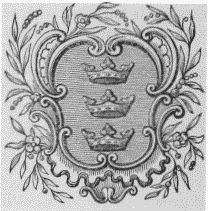
Arms.
During the contest between the houses of York and Lancaster, the inhabitants continued faithful to the latter, whose cause they resolutely maintained in the battles of Wakefield and Towton. Such, indeed, was their loyalty, that when the public treasury of the borough was exhausted by the expenses of the war, the corporation took down a stately market-cross, which had been erected at a great expense about 30 years before, to raise money by the sale of the materials for the support of the cause. At different periods in the 15th and 16th centuries the place suffered greatly, in common with many others, from pestilential diseases, which swept away vast numbers of the inhabitants; yet it continued to prosper, and extend its commerce. On the suppression of monasteries, a strong spirit of discontent manifested itself at Hull; and at the time of the insurrection called the Pilgrimage of Grace, in 1537, while one division took Pontefract, and the other entered York, a third took Hull by surprise, and reinstated the monks and friars who had been ejected. The triumph of the insurgents, however, was but transient; for the main body of them, under Aske, having been dispersed in the neighbourhood of Doncaster, the magistrates of Hull seized Hallam, the ringleader of the insurrection here, and many of his associates, who, being soon after tried by a special commission, were convicted of rebellion, and executed. Not long after, another insurrection broke out, in consequence of the alterations made by Henry VIII. in the established religion, when the town was besieged by the insurgents, and taken by stratagem; but the successful party, with Sir Robert Constable at their head, after keeping possession of the castle during 30 days, were compelled to surrender it into the hands of the mayor. Many of the rebels were tried for high treason, under a special commission, and, being convicted, were hanged and quartered; among whom was their leader, Sir Robert Constable, whose body was exposed on Beverley Gate. In the year 1541, Henry VIII. visited Hull, where he was most hospitably received by the body corporate, who presented him with a purse of £100: after taking an accurate survey of the town, the king gave directions for building a castle and two strong block-houses, with other fortifications.
On the accession of Charles I., in 1625, Hull cheerfully contributed its quota for the prosecution of the war with France; and though the plague, by which it was visited in this monarch's reign, swept away in the space of three years nearly 3000 persons, or one-half of its population, it rose superior to this check, and soon regained its former prosperity. Charles, on his way towards the Scottish border, in 1639, visited Hull, which had been made a depôt for arms and military stores; on the 29th of March he inspected the fortifications, and afterwards having received the homage of the inhabitants, proceeded to Beverley, and thence to York. At the commencement of the parliamentary war, each party became anxious to obtain possession of the town, it being at that time not only a place of considerable strength by nature, but surrounded with walls and strongly fortified by art; and its importance was still further augmented by the immense magazine of arms, ammunition, and military stores, which had been collected in it. The king, who was then at York, relying upon the assurances of loyalty and attachment which he had received from the mayor, aldermen, and burgesses, on his visit to the town, sent the Earl of Northumberland with a party of royalists to take possession of it; but the mayor refused to receive the king's general, and, after a short consultation, admitted Sir John Hotham, who had been sent down to take upon himself the office of governor, for the parliament. On the 23rd of April, 1642, the king, with his son, Prince Charles, attended by many gentlemen of the county, advanced to Hull, and despatched an officer to inform the governor, Sir John Hotham, that he would dine with him that day; to which the governor replied, that he could not, without betraying the trust reposed in him by the parliament, open the gates to the king's retinue. Charles then retired with his party to Beverley, where he passed the night; and on the following morning sent a herald to the governor to demand entrance into the town, threatening to proclaim him as a traitor in case of his refusal, and promising indemnity for the past in the event of his compliance; but the herald returned without success, and the king returned to York. Having assembled a force of 3000 infantry and 800 cavalry, and procured a supply of arms and ammunition from Holland by the sale of the crown jewels, the king resolved upon the reduction of the town by force; but after several ineffectual attempts the siege was abandoned, and the royal forces retired. It appears that in the siege the king relied for success less upon the efficiency of his troops than upon the treachery of Sir John Hotham, with whom he had previously entered into a private treaty for surrendering the town; but the plot being discovered, the governor and his son, Captain Hotham, were sent prisoners to London, where they were executed, and the custody of the town was then entrusted to the mayor and eleven commissioners appointed by the parliament, who retained it till the arrival of Lord Fairfax, who was afterwards appointed governor. The Marquess of Newcastle, having subsequently made himself master of Gainsborough and Lincoln for the king, and driven Sir Thomas Fairfax from Beverley with considerable loss, appeared before Hull. He cut off all supplies of provisions from the adjoining part of Yorkshire; diverted the supply of fresh water; and succeeded, under a heavy fire from the walls, in erecting a battery called the king's fort, within half a mile of the town, mounted with heavy ordnance, and provided with a furnace for heating balls, which, being fired red-hot into the town, threw the inhabitants into the greatest consternation. The precautions of the governor, however, counteracted their efficacy, and he compelled the assailants to abandon the greater part of their works; the marquess soon after raised the siege, and, destroying the bridges and breaking up the roads in the line of his retreat, to prevent pursuit, retired with his forces to York. From this time Hull remained in a state of tranquillity till 1645, when the Liturgy of the Church of England being abolished, the soldiers entered the churches; collected the prayer-books, and burnt them amidst the acclamations of the spectators. After the decapitation of Charles I., the Protector visited Hull, and was received by the corporation with a congratulatory address.
The town is situated at the confluence of the rivers Hull and Humber; the older streets are narrow and incommodious, but in other parts the thoroughfares are spacious and regularly formed. The houses in general are of brick, for making which Hull has long been celebrated: the streets are well paved, and lighted with gas by two companies, one established in 1821, the other in 1826. The inhabitants are supplied with water from springs that rise near Kirk-Ella, about four miles distant; an act for a better supply was passed in 1843. The whole town consists of three unequal divisions. That portion first built is completely insulated by the docks, which have been constructed on the site of the ancient military works: on the north side of the old dock is the parish of Sculcoates, in which are several handsome streets; and of still more recent date is that part westward from the Humber dock, occupying the site of the ancient hamlet of Myton, which name it still retains. The Garrison side is extra-parochial, and is connected with the principal part of the town by a bridge of four arches, with a drawbridge in the centre, over the river Hull.
The Exchange is a neat building with a portico in front. The Subscription library was established in 1775, and the present building in Parliament-street, having a spacious reading-room, was erected in 1800; it contains 21,000 volumes, and the limited number of subscribers is 450. The Lyceum library was instituted in 1807, and the members, in 1830, completed the erection of a hall in St. John's street; there are about 200 subscribers. The Theological library contains many scarce volumes of great value; a building on the south side of Trinity Church, originally a chapel, was appropriated to its use in 1669. The Literary and Philosophical Society, established in 1822, has a museum attached, comprising a good collection of specimens in natural history and the arts. The Public rooms, of which the first stone was laid on the day on which His late Majesty William IV. was proclaimed, form a handsome edifice. The principal floor contains a splendid public room, fitted up for assemblies, concerts, and public meetings; also a dining-room, an elegant drawing-room, and a committee-room, all of which have communication with the large room: the upper floor contains the lecture-room of the Literary and Philosophical Society. A Mechanics' Institute was founded in 1825, and in 1829 a building was erected in Charlotte-street, comprising a spacious lecture-room, a library, reading-room, and large class-room. The Botanic Garden, opened in June 1812, is in the environs, and comprises about five acres of land, suitably laid out in compartments for alpine, aquatic, and other plants; it is entered by a neat gate, with two good lodges, one of which is the dwelling of the curator. The Hull and East Riding School of Medicine and Anatomy was established in the year 1821, and originally held in the infirmary: in 1832 a chaste building in the Grecian style was erected on the west side of Kingston-square, affording accommodation for lectures and for prosecuting practical anatomy; attached is a valuable museum containing specimens of human and comparative anatomy, with preparations of morbid structure. Wallis's museum, in Myton-gate, comprises many natural and artificial curiosities, collected by the proprietor during the last 60 years. There is also a Florists' and Horticultural Society, of recent origin. A Chamber of Commerce was established in April, 1837; and a new suite of public rooms, called the Victoria Rooms, was opened for public meetings, assemblies, and concerts, on Her Majesty's attaining her majority in May, 1837. The theatre royal is a wellarranged building, in Humber-street, erected in 1809; there is an olympic circus in the same street. Public salt-water baths are situated on the bank of the Humber; and in Dock-street are fresh-water baths, including two medicated vapour baths. In 1845, public baths were opened for the working classes.
Hull has long been famed for its trade and shipping, for which its situation is peculiarly favourable. The port is on the northern shore of the estuary of the Humber, and on the western bank of the river Hull. It carries on a considerable trade with Russia, Norway, Sweden, Holland, Hamburgh, France, Spain, and America, to which it exports manufactured goods and produce from the counties of York, Nottingham, Derby, Stafford, Lancaster, and Chester, with which it has great facility of intercourse, by means of railways, and of the Aire, Calder, Ouse, Trent, and other large rivers that fall into the Humber, and the numerous canals communicating with them. The goods and produce brought to the port from Lancashire and the West riding of York are estimated at more than seven millions sterling per annum. It carries on also a very extensive coasting-trade in corn, wool, manufactured goods, and other articles of merchandise. The number of vessels of above 50 tons' burthen registered at the port is 323, and their aggregate tonnage 67,795. The number of British vessels which entered in 1842, was 963, of the aggregate burthen of 186,081 tons; and the number of foreign vessels that entered in the same year, was 930, of the burthen of 101,791 tons. The total tonnage in 1842 was 595,000; in 1845 it had increased to 710,000. The principal imports are wool, timber, iron, rape and linseed, flax, hemp, and whale and seal oil; and the chief exports, woollen and cotton goods, cotton-twist, hardware and other articles of manufacture. Hull is stated to possess one-fifth of the export trade of Great Britain, and in the extent of its coastingtrade is inferior only to London. The number of steamboats frequenting the port has rapidly increased within the last few years, and those actually belonging to it, including steam-tugs, now amount to about 80. Steamvessels sail in summer thrice, and in winter twice, a week, to Hamburgh and to Rotterdam; several sail every week to London, Newcastle, Leith, Dundee, and other places. Smaller steam-boats start daily for Gainsborough, Selby, Goole, Thorne, and York; and others ply constantly between this port and New Holland and Barton, on the Lincolnshire side of the Humber. The whale-fishery originated here in 1598, when the merchants fitted out two vessels for Greenland; the fishery was attended with progressive increase, and soon formed a considerable part of the staple trade. In 1765, it had declined, and was nearly monopolised by the Dutch; it was then revived by a Hull merchant, and continued to increase till 1819. At that period, out of about 160 ships which sailed from England, 63 belonged to Hull; and though the trade is now on the decline, this port continues to enjoy the principal share.
The harbour was granted to the corporation by Richard II. At present, the chief source of the commercial prosperity of the town arises from the capacious docks with which it is provided. In 1774, a subscription was opened for making a Wetdock on the north side of the town, and an act of parliament was obtained for carrying the project into execution, by which act the shareholders were incorporated, and received from the crown a grant of the military works of the town, and a vote from parliament of £15,000, towards defraying the expense of the undertaking. The first stone was laid October 19th, 1775, and the whole was completed in four years. Originally the number of shares was 120, but the trade of the port requiring further accommodation, other acts of parliament were procured in 1802 and 1805, by which the company were empowered to increase the number to 180, and the money arising from the 60 additional shares, amounting to £82,300, was appropriated towards making a new dock, which was completed at an expense of £220,000, and opened on the 30th of June, 1809. It is called the Humber dock, and communicates with the river from which it takes its name by a lock of excellent construction, large enough to admit a 50-gun ship. These two docks, which are capable of holding 170 ships, are united by the Junction dock, completed in 1829, capable of containing 60 sail of ships, and which enables vessels to pass round the Old Town. Besides these wet-docks, are the Old dock basin and the Humber dock basin; and an act was passed in 1844 for making new docks. The docks have two entrances, one from the river Humber on the south, and the other from the river Hull, or the harbour, on the east; and are provided with extensive quays and commodious warehouses. Of the ancient Fortifications there remain only two of the forts erected by Henry VIII., by which, and by several batteries on the east side of the river, the town and harbour are protected. The citadel commands the entrance of the Hull roads and the Humber; the magazine is capable of containing 20,000 stand of arms, and ordnance stores for twelve or fifteen sail of the line, defended by a regular garrison under the command of a governor, who is generally a nobleman of high military rank. The Custom-house is a large and handsome edifice, in Whitefriar-gate, originally built by the Corporation of the Trinity House, for an inn. The Pilotoffice, opposite the ferry-boat dock, is under commissioners appointed by the Humber Pilot act.
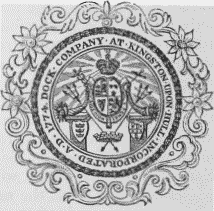
Seal of the Dock Company.
Among the articles of manufacture are, turpentine and tar, white-lead, soap, starch, tobacco and snuff, sails, sailcloth, rope, and chain-cables. Several mills are worked by steam and by wind, for the extraction of oil from linseed and rapeseed, and the preparation of the residuum of the former for feeding cattle; there are also mills for grinding corn. An extensive sugar-refinery has been conducted by the Thornton family for 130 years, employing about 80 persons, a large portion of the produce being exported to Germany, Prussia, and the Mediterranean shores. There are several breweries, a pottery, and some tile and brick kilns; and in the suburb called the Pottery, is a manufactory for steamboilers, lately established by the St. George's Steam-Packet Company. A company, also, has been formed for the spinning and manufacture of cotton in the town, with a capital of £100,000, and extensive mills have been erected, which are worked by steam-engines of 200-horse power. The Hull and Selby Railway extends from the Humber dock to Selby, to meet the Leeds and Selby railway, by means of which and of other lines, a communication across the whole of the northern part of England has been opened, between this port and that of Liverpool. The Hull station and depôt comprise an engine-house, smiths'-shops, and spacious warehouses. The railway is carried west of the town for one mile on an embankment, faced with stone on the side sloping to the edge of the river; and the whole line, which was opened in July, 1840, is thirty-one miles in length to the terminal station at Selby, passing in its course by the stations of Hessle, Ferriby, Brough, Staddlethorpe, Broad Lane, Eastrington, Howden, and Cliff. At Hessle is an excavation, through rock and gravel, of 230,000 cubic yards; at Broad Lane is a reservoir capable of containing 1,250,000 gallons of water. A railway was opened to Bridlington in 1846. The Market days are Tuesday and Friday, the former for corn, which is sold by sample in the corn exchange; and there is a customary market for provisions, on Saturday. In the market-place is a statue of William III.
The town was incorporated by charter of Edward I., in which the inhabitants are styled "Free Burgesses," and the chief magistrate "Warden." The charter was confirmed and extended by Richard II., who placed the government in a mayor and four bailiffs; and Henry VI. erected the town and liberties into a county of itself, and empowered the inhabitants to elect thirteen aldermen, one of whom was to be mayor. Under the charter, which was ratified, with additional privileges, in succeeding reigns, the control was vested in a mayor, recorder, twelve aldermen, sheriff, chamberlain, &c., assisted by a town-clerk, sword-bearer, two mace-bearers, and subordinate officers. By the act of the 5th and 6th of William IV., cap. 76, the corporation now consists of a mayor, fourteen aldermen, and forty-two councillors, constituting the council of the borough, which is divided into seven wards. The mayor and late mayor are ex officio justices of the peace, and the total number of magistrates is 31; the council appoint a sheriff, town-clerk, treasurer, and the usual other officers, and a recorder is chosen by the crown. The freedom is inherited by birth or acquired by servitude: every son of a burgess, born after the father has taken up his freedom, is entitled to be admitted at the age of twenty-one, whether a native of the borough or not; and an apprentice, who has served his time to a burgess, is entitled, though the master reside without the limits of the borough. The town returned burgesses to parliament in the 33rd of Edward I., but from that time omitted sending till the 12th of Edward II., since which the borough has regularly returned two members. Its limits were enlarged in 1832, for parliamentary purposes, so as to contain (by estimation) 3373 acres, which extent, by the Municipal Corporations' act, in 1836, was adopted for the town and county of the town. The sheriff is returning officer. The corporation hold general quarter-sessions of the peace, and every Friday a court of record for civil actions to any amount; also a venire for the trial of causes four times in the year, immediately after the quarter-sessions. Assizes for the county of the town were formerly held by the judges occasionally when on circuit; but an arrangement was long since entered into, by which the criminal business was transferred to York. The powers of the county debt-court of Hull, established in 1847, extend over the registration-district of Hull, and part of the districts of Skirlaugh and Sculcoats. The townhall was originally a private house; in the rear is a handsome and spacious court-house, erected some years since, behind which a court of requests was built in 1834. The old guildhall, which stood in the marketplace, was removed prior to the erection of the present meat-shambles. A new gaol and house of correction, situated on the Humber Bank, was lately erected, at an expense of £22,000. In the parish of Sculcoates, adjoining the Public Rooms, is a neat Hall for the administration of justice, and for other public purposes, where petty-sessions for the Hunsley-Beacon division and other parts of the East riding are held every Tuesday.
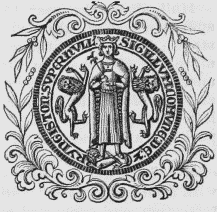
Corporation Seal.
Hull, about the year 1534, was made the seat of a suffragan bishop, who had a stately palace in the Highstreet; but it did not long retain that distinction, as the office was abolished on the death of Edward VI. The ancient borough comprises the parishes of Holy Trinity and St. Mary, the former containing 35,553, and the latter 5597 inhabitants. The living of Holy Trinity parish is a vicarage not in charge, in the patronage of a body of resident gentlemen; net income, £605. The church is an ancient and spacious cruciform structure, with a lofty and very beautiful tower rising from the intersection, and supported on piers and arches of elegant proportions: the east end is in the decorated English style, and the transepts are fine specimens of the earliest period of that style; the window in the south transept is filled with tracery, and enriched with mouldings of curious character. The edifice was re-opened, after judicious restoration, in December, 1845. The living of St. Mary's is a perpetual curacy; net income, £276; patron, J. Thornton, Esq. The church, of which the greater part was demolished in the reign of Henry VIII., consists principally of the chancel of the original structure, which was enlarged in 1570, and to which a steeple was added in 1696; it contains some good windows in the later English style. The church dedicated to St. John, in Trinity parish, was completed in 1792, at the expense of the Rev. Thomas Dykes, LL.B., and is a neat edifice of brick with stone dressings, to which a tower has been subsequently added: the living is a perpetual curacy, the right of presentation to which, on the demise of the founder in 1847, passed to the Vicar; net income, £205. The church dedicated to St. James, in that part of the town called the Pottery, was erected in 1831, at an expense of £7000, and is a very neat building of white brick and stone, in the early English style, with a square tower; it was erected by a grant of £3560 from the Church Commissioners, and by subscription, and contains 1200 sittings, of which one-half are free. The living is a perpetual curacy; net income, £300; patron, the Vicar. A church in the early English style, with a tower and spire, was erected in 1843; it contains 1272 sittings, of which 610 are free. The churches in Sculcoates, Drypool, and Sutton, are noticed in the articles on those places. There are meeting-houses for Wesleyans, Independents, Baptists, Unitarians, Swedenborgians, Methodists of the New Connexion, and Primitive and Church Methodists; also a Roman Catholic chapel, and a synagogue. The Mariners' church, on the east side of the Junction dock; and a floating chapel in the dock, are supported by contributions. A public cemetery was consecrated by the Bishop of Bangor, in October 1847.
The Grammar school was founded in 1486, by Dr. Alcock, a native of Beverley, and successively Bishop of Rochester, Worcester, and Ely; the present schoolhouse was built by subscription in 1578. An exhibition to Oxford or Cambridge was founded in behalf of the school by Thomas Ferres, alderman, in 1630; and a scholarship in one of the colleges at Cambridge, by Thomas Bury, in 1627; which have been for a long time consolidated. Among the distinguished masters of the school may be enumerated, John Clarke, M.A., author of the Essay on Study, and translator of some of the classics; and Joseph Milner, M.A., author of the History of the Christian Church. Of the eminent men educated here may be noticed, Andrew Marvel; Mason, the poet; Isaac Milner, D.D., late Dean of Carlisle; W. Wilberforce, Esq., the senator and philanthropist; and Archdeacon Wrangham. Two proprietary schools have been erected in the vicinity of the town; one called Kingston College, situated on the Beverley road, and the other Hull College, near the Spring Bank. Kingston College, established on the principles of the Established Church, was opened on the 31st of July, 1837, and Hull College on the 14th of August, 1837: the latter is a handsome structure of stone, with a boldly projecting portico of eight lofty Corinthian columns, supporting an entablature and cornice surmounted by a pediment with statuary on the apex. The Vicar's school was founded about 1737, by the Rev. William Mason, vicar of Trinity parish, and father of the poet; the sum of £400 was originally raised for its endowment, and several legacies have since been added. The Marine school, near the Trinity House, was established in 1786, and is supported by the funds of that fraternity. Cogan's charity school for girls was founded in 1753, by an alderman of that name, who endowed it with about £2000 three per cent. consols., and in 1760 added a further sum of £500 in the same stock; the property produces annually upwards of £400.
The Guild of the Holy Trinity, established by the masters, pilots, and seamen of the Trinity House in Hull, in 1369, for the relief of decayed seamen and their widows, and for maritime purposes, was incorporated by charter of the 20th of Henry VI., which has been renewed and confirmed by several others, the last of them obtained in the 1st of Victoria. The corporate body consists of twelve elder brethren, and an indefinite number of younger brethren, who are pilots of a superior class; from the former two wardens, and from the latter six assistants and two stewards, are annually chosen. The corporation has the conservancy of the Humber from Hull to the sea, as regards the navigation; and under its direction, several lighthouses and beacons have been erected on the banks of the river. The property given by Alderman Ferres, of which the brethren of the Trinity House are trustees, produces about £1660 annually: a levy of sixpence per month on the wages of all seamen employed in vessels belonging to the port yields an additional sum of £700, which is appropriated to the relief of distressed members of the Merchant Seamen's hospital; and the remainder of the income arises from funded property and other sources. The average annual expenditure exceeds £11,500. The Trinity House was built in 1457, and rebuilt in 1753; the building forms a handsome quadrangle. A chapel was completed in 1843, for the corporation and their pensioners: the interior presents the appearance of a Grecian temple, and is exceedingly chaste and elegant. Robinson's hospital, containing six rooms for younger brethren and their wives, was granted to the corporation in 1682, by the founder, William Robinson, Esq., then sheriff of Hull, and in 1769 was rebuilt, and enlarged with six rooms for the reception of widows. Watson's hospital affords accommodation for six widows; and Ferres' hospital, erected in 1822, at an expense of £2000, has 20 or 30 inmates. The Merchant Seamen's hospital supplies accommodation for 20 seamen and their wives; there are also several out-pensioners of various classes, and temporary relief is afforded to poor shipwrecked mariners and their families. Trinity hospital, in Postern-gate, is a handsome range in the Grecian-Doric style, surmounted by a colossal figure of a river god representing Humber; it was built in 1828 by the corporation, for 23 decayed younger brethren. The Master Mariners' hospital also forms a good range of building in the Grecian style, recently erected, in Carr-lane, by the corporation; and immediately adjoining it another range has been built by the same body, under whose control are the whole of the hospitals or almshouses above noticed.
The Charter-house was founded in the year 1384, by Michael de la Pole, first earl of Suffolk of that name, and, having been destroyed in the time of Charles I., was rebuilt at the end of the civil war; it was taken down in 1780, and a handsome structure erected in its stead, which was enlarged in 1803, and now furnishes accommodation for 28 men and 29 women. The revenue of the hospital, which in 1660 was not more than £54, now amounts to above £5000, arising from the rental of land, and a share in the Hull Dock Company's concerns. Gregg's hospital was founded in 1416, for twelve women. Harrison's, founded in 1550, for ten women, was enlarged in 1795, by Mrs. Mary Fox, who increased the number to fourteen. Gee's hospital, built about the year 1600, affords an asylum to ten aged women. Sir John Lister, alderman, and M.P. for Hull, founded an hospital in 1641, for the reception of twelve aged persons, with suitable apartments for a lecturer. In 1775, Mr. John Buttery assigned to the mayor and burgesses three mortgages, amounting in value to £410, in trust for the benefit of Weaver's hospital, which is occupied by six women. Crowle's hospital was established in 1661, for twelve women of the age of fifty and upwards. Dr. Thomas Watson, Bishop of St. David's, about 1687, erected almshouses for fourteen aged persons, which were endowed with £300 by his brother, William, in 1721. The hospital in Salthouse-lane contains rooms for six persons; and the indigent generally, receive extensive benefit from sums bequeathed for the purpose of employing them, for putting out apprentices, and for occasional distributions in money and bread. The General Infirmary, in Prospect-street, is a spacious brick building with stone dressings, erected in 1782, at an expense of £4126; on the lawn in front is a statue of Dr. John Alderson, erected by subscription in 1833, at a cost of £300. A few religious houses existed in the town; but their remains have all been swept away by the tide of modern improvement. In 1331, Guildford de Hotham founded a priory for Black monks, in the street called Blackfriar-gate.
Hull has been the birthplace of several persons of distinction, among whom are, Dr. Thomas Johnson, physician and botanist; Sir John Lawson, a naval officer in the reign of Charles II.; Mason, the poet; and the late William Wilberforce, to whose memory a handsome Doric column, 100 feet high, surmounted by his statue, was erected by subscription, in 1835, near the Junction bridge, at an expense of £1500. Of other natives, may be named, Charles Frost, Esq., F.S.A., author of an elaborate work on the early history of Hull, and of some tracts on legal subjects; A. H. Haworth, Esq., F.R.S., author of Lepidoptera Britannica; William Spence, Esq., F.L.S., author of some tracts on political economy, and an Introduction to Entomology; Thomas Thompson, Esq., author of tracts on the Poor Laws; P. W. Watson, Esq., the author of Dendrologia Britannica; and B. B. Thompson, translator of Kotzebue's Stranger and the German Theatre, and author of various works. Andrew Marvel was M.P. for the borough in the reign of Charles II., and the last representative who received pay from his constituents. The titles of Duke of Kingston and Earl of Kingston-upon-Hull, belonging to the Pierrepoint family, in 1773 became extinct.
Hull, Bishop's (St. Peter and St. Paul)
HULL, BISHOP'S (St. Peter and St. Paul), a parish, in the union of Taunton, hundred of Taunton and Taunton-Dean, county of Somerset, 1½ mile (W.) from the town of Taunton; containing 1263 inhabitants. The living is a perpetual curacy; net income, £192; patron, the Rev. H. W. Rawlins; impropriators, the landowners.
Hulland
HULLAND, a township, in the parish of Ashbourn, hundred of Appletree, S. division of the county of Derby, 4½ miles (E.) from Ashbourn; containing 204 inhabitants. It comprises 900 acres of land, and has a village pleasantly situated on an eminence on the Ashbourn road. Hulland Old Hall, erected in 1692, is now a farmhouse. The district church here, built in 1837–8, and dedicated to Christ, is of stone, and cost, with the endowment, £2300; it contains 300 sittings, of which 138 are free. John Bradburne, and Anne his wife, founded a chantry chapel at Hough, in the township, in 1485, and endowed it with land, then producing £5 per annum: it was standing in 1712. There are places of worship for dissenters; and a school, with a residence for the master.
Hulland-Ward
HULLAND-WARD, a township, in the parish of Ashbourn, union of Belper, hundred of Appletree, S. division of the county of Derby, 5 miles (E. by N.) from Ashbourn; containing 355 inhabitants. It comprises 1405 acres, and is intersected by the road between Ashbourn and Belper. The township formerly included an extensive, open, and partly extra-parochial, district, which, at the inclosure, was allotted to eight parishes.
Hulland-Ward-Intacks
HULLAND-WARD-INTACKS, a township, in the parish of Ashbourn, hundred of Appletree, S. division of the county of Derby, 6½ miles (E. by S.) from Ashbourn; containing 57 inhabitants. It comprises 436 acres; a portion belongs to Lord Scarsdale, and 16 acres to an ancient chapel in which divine service is performed every fortnight. This chapel was built, and endowed with land, by Francis Brown, who died in 1731, directing that it should be annexed to Mugginton for ever, after the death of his widow and certain other relatives: it is a small substantial building.
Hullavington (St. Mary)
HULLAVINGTON (St. Mary), a parish, in the union of Malmesbury, partly in the hundred of Chippenham, but chiefly in that of Malmesbury, Malmesbury and Kingswood, and N. divisions of the county of Wilts, 4¾ miles (S. W. by S.) from Malmesbury; containing, with the tything of Surrendral, 634 inhabitants. This parish, which is situated on the road from Malmesbury to Bristol, comprises according to measurement 3098 acres: common stone, of suitable quality for the rougher kinds of building, is quarried to a small extent. The living is a discharged vicarage, valued in the king's books at £6. 13.; patrons and impropriators, the Provost and Fellows of Eton College. The great tithes have been commuted for £455, and the vicarial for £165; the glebe contains 52 acres. A place of worship has been built for dissenters.
Hulme, with Kinderton.—See Kinderton.
HULME, with Kinderton.—See Kinderton.
Hulme
HULME, a chapelry, in the parish of Manchester, union of Chorlton, hundred of Salford, S. division of Lancashire; containing 50,886 inhabitants. It is separated from the city of Manchester by the river Medlock; the Irwell flows on the west, and the Duke of Bridgewater's canal passes through. The area comprises 440 acres of land. There are several cotton-mills, employing a large number of hands; and here are situated a depôt in connexion with the Manchester gas-works; and the Cavalry Barracks, built prior to the year 1804, and which will accommodate 500 men. An act was passed in 1834 for the regulation and improvement of the township. It is within the parliamentary and corporate borough of Manchester, and is divided into two wards. The living is a perpetual curacy, with a net income of £300; the patronage and appropriation belong to the Dean and Canons of the Cathedral of Manchester. The chapel, dedicated to St. George, a handsome edifice in the later English style, with a tower 135 feet high, was built in 1828, at an expense, including furnishing &c., of £15,000, provided by grant from the Church Commissioners. The interior is elegantly arranged, and has a grand and imposing effect; the roof is elaborately groined, and enriched with bosses and flowers, and the altar highly decorated, having above it three stainedglass windows, recently inserted at an expense of £280. Hulme also contains a church called the Holy Trinity; and in 1846, a district named St. Mark's was formed by the Ecclesiastical Commissioners, the living of which is a perpetual curacy, in the patronage of the Crown and the Bishop of Chester, alternately. There are places of worship for Independents, Wesleyans, and other denominations of dissenters; and numerous daily, Sunday, and infant schools. Among the public institutions are, the workhouse for the Chorlton union; and an asylum for female penitents, for which the present edifice was built in 1837. Sculptured stones of early date have been discovered in the chapelry.
Hulme, Stafford.—See Weston-Coyney.
HULME, Stafford.—See Weston-Coyney.
Hulme, Church
HULME, CHURCH, a chapelry, in the parish of Sandbach, union of Congleton, hundred of Northwich, S. division of the county of Chester, 3½ miles (E. by N.) from Middlewich; containing 1008 inhabitants. It comprises 807 acres, the soil of which is loam and sand. The Manchester and Birmingham railway has a station here, eight miles distant from the station at Crewe. The living is a perpetual curacy; net income, £120; patron, the Vicar. Tithe rent-charges have been awarded, of which £82. 1. 10. are payable to the vicar, and £19. 11. 7. to the impropriators.
Hulme-Walfield
HULME-WALFIELD, a township, in the parish of Astbury, union of Congleton, hundred of Northwich, S. division of the county of Chester, 2 miles (N. by W.) from Congleton; containing 121 inhabitants. The area comprises 922 acres, of a sandy soil. The tithes have been commuted for £137. 10.