
A Topographical Dictionary of England. Originally published by S Lewis, London, 1848.
This free content was digitised by double rekeying. All rights reserved.
'Longwood - Loughborough', in A Topographical Dictionary of England, (London, 1848) pp. 175-179. British History Online https://www.british-history.ac.uk/topographical-dict/england/pp175-179 [accessed 25 April 2024]
In this section
Longwood
LONGWOOD, a chapelry, in the parish and union of Huddersfield, Upper division of the wapentake of Agbrigg, W. riding of York, 2¼ miles (W.) from Huddersfield; containing 2418 inhabitants. The chapelry is situated on the north of the Colne, and comprises about 1000 acres, consisting chiefly of a narrow ridge rising rapidly from the banks of a rivulet. An eminence called Slack, is supposed, from the discovery of a Roman altar dedicated to Fortune, a bath, and hypocaust, with a tessellated pavement nearly a yard in thickness, and other antiquities, to have been connected with the station of Cambodunum, by most antiquaries placed at Almondbury. The soil is generally gravel, with a slight mixture of clay, and fine grit sandstone is abundant. The population is chiefly employed in the manufacture of woollencloth, for which there are several scribbling and fulling mills, and in the making of fancy goods, which is carried on extensively. The village is neatly built, and the surrounding scenery is in some parts boldly romantic: the road from Huddersfield to Manchester passes near, as does the canal from Huddersfield to Ashton. Here is a reservoir of 12 acres, for the supply of Huddersfield with water. The living is a perpetual curacy, in the patronage of the Vicar of Huddersfield, with a net income of £150. The chapel, now a district church, dedicated to St. Mark, is a small plain edifice with a campanile turret, erected in 1749, by subscription, and containing 420 sittings. There are places of worship for Wesleyans, and Methodists of the New Connexion. A free school was founded and endowed in 1731, by William Walker; the income is about £100.
Longworth (St. Mary)
LONGWORTH (St. Mary), a parish, in the union of Farringdon, partly in the hundred of Ganfield, and partly in that of Ock, county of Berks, 7 miles (W. N. W.) from Abingdon; containing 1063 inhabitants, of whom 550 are in the township. The parish comprises, with the chapelry of Charney and the hamlet of Draycot-Moore, 4312a. 6p.: the river Isis bounds it on the north; the surface in general is flat, and the soil in some parts sandy, and in others clayey. The living is a rectory, valued in the king's books at £27. 1. 10½.; net income, £682; patrons, the Principal and Fellows of Jesus College, Oxford: the glebe contains about 60 acres. At Charney is a chapel of ease, in the Norman style. In the parochial register is an entry, July 16th, 1625, of the baptism of Bishop Fell, whose father was rector of Longworth.
Longworth
LONGWORTH, a township, in the parish and union of Bolton, hundred of Salford, S. division of the county of Lancaster, 5¼ miles (N. by W.) from Bolton. This place, as its name imports, is an extended narrow tract of land, between two branches of the river Tonge, on the edge of dreary moors. The phenomenon, as it may almost be called in the manufacturing parishes of Lancashire, of a decrease of population, occurs in Longworth, the numbers having been reduced from 238, the amount in 1821, to 179, the number in 1831, and to 149 in 1841. The township comprises 1590 acres of land, principally moor, more or less cultivated, the whole the property of William Hulton, Esq., of Hulton Park.
Looe, East
LOOE, EAST, a sea-port and incorporated markettown, having separate jurisdiction, in the parish of St. Martin, union of Liskeard, locally in the hundred of West, E. division of Cornwall, 16 miles (W.) from Plymouth, and 232 (W. S. W.) from London; containing 926 inhabitants. This place was formerly the only sea-port in Cornwall of any note, excepting Fowey, and hence was derived its name Lo; in Cornish, signifying a port. In the reign of Edward III. it furnished twenty ships and 315 mariners towards the equipment of the English fleet for the siege of Calais. Its situation is romantic, on the eastern shore of Looe bay, near the mouth of the river Looe, over which is a narrow bridge of thirteen stone arches, 141 yards in length and only six feet wide, built about the year 1400, and connecting the boroughs of East and West Looe. The sea view is very fine, and the land scenery richly diversified; the air is salubrious, and the inhabitants are supplied with excellent water. On the beach is a fort mounted with ten guns; and opposite to the town is Looe Island, or St. George's, which is much frequented by flocks of sea-fowl during the spring. The pilchard-fishery is carried on to a considerable extent: the exports consist of tin, copper, and lead ore, bark, timber, salt, pilchards, and pilchard oil; and coal, culm, and limestone are imported. Here is a custom-house. Much advantage is derived from the Liskeard and Looe canal. The market is on Saturday; and fairs are held on Feb. 13th, July 10th, Sept. 10th, and Oct. 10th.

Seal and Arms.
East Looe, which is a borough by prescription, received a charter of incorporation from Elizabeth in 1587, which was confirmed by others of James I. and II. The corporation consists of a mayor, recorder, eight aldermen, and an indefinite number of burgesses, with a town-clerk, and four serjeants-at-mace. The borough, conjointly with Fowey, sent a representative to a great council at Westminster, in the reign of Edward I., but members were not returned to parliament until the 13th of Elizabeth, from which period two were sent; the inhabitants were disfranchised in the 2nd of William IV. The mayor, late mayor, deputy mayor, recorder, and deputy recorder, are justices of the peace. Sessions are held once or twice a year, at which prisoners charged with petty larceny are tried; and the charter of James II. gives the mayor and aldermen authority to hold a court of record every three weeks, for the recovery of debts not exceeding £100, but no business has been transacted in the court for many years. There is a common gaol for felons and debtors. The chapel here, dedicated to St. Kyn, was rebuilt in the year 1806, and is a small handsome structure; it was made a district church in 1845, for East and West Looe, and the patronage is now vested in the Bishop of Exeter. There are places of worship for the Society of Friends, and Wesleyans; and a school endowed by Col. Speccott in 1703.
Looe, West
LOOE, WEST, formerly a representative borough and a market-town, in the parish of Talland, union of Liskeard, hundred of West, E. division of Cornwall, 16 miles (W.) from Plymouth, and 231 (W. S. W.) from London; containing 616 inhabitants. This place, also called Port Pighan, a corruption of Port Vechan, the "Little Port," is situated on the bank of the river Looe, opposite to East Looe, with which it is connected by a bridge. The town is of inconsiderable size. The harbour is small but commodious, and defended by a strong battery; the river is navigable for vessels of 100 tons' burthen, and is in two branches just above the bridge. The pilchardfishery is carried on; and copper-ore is brought hither from the mines of Caraton, to be shipped in small vessels. A cattle-fair is held on May 6th. A charter of incorporation was granted by Elizabeth in 1573, under which the municipal body consists of a mayor and eleven burgesses, who are empowered to choose a steward, with a town-clerk, and other officers; the mayor and steward are justices of the peace. A court leet, with view of frankpledge, is held; and the charter authorises the mayor to hold a court for the recovery of debts under £5, every week, but no proceedings have taken place for many years. There is a small prison, called the Dark house. The borough first sent members to parliament in the 6th of Edward VI., from which period it returned two representatives; but it was disfranchised by the 2nd of William IV., cap. 45. The chapel here, dedicated to St. Nicholas, has been converted into a guildhall. There are places of worship for Independents and Bryanites. In the vicinity of West Looe are the remains of a mound, supposed to have been on the line of a Roman road, and some vestiges of military works.

Seal and Arms.
Loose (All Saints)
LOOSE (All Saints), a parish, in the union and hundred of Maidstone, lathe of Aylesford, W. division of the county of Kent, 2½ miles (S.) from Maidstone; containing 1416 inhabitants. The parish comprises by admeasurement 960 acres, of which about 278 are arable, 149 meadow and pasture, 216 in hop-grounds, and 48 wood. A very considerable improvement has been made by the formation of a new road, at a great expense, in order to avoid two steep and dangerous hills over which the former road passed. Fruit, particularly filberts, is produced for the supply of the London markets. Three paper-manufactories employ about 190 persons, and here is a quarry of ragstone. The lower grounds are watered by a stream which, in the space of two miles and a half, turns twelve mills. The living is a perpetual curacy, in the patronage of the Archbishop of Canterbury, the appropriator; net income, £492. The church has been enlarged.
Lopen (All Saints)
LOPEN (All Saints), a parish, in the union of Chard, hundred of South Petherton, W. division of Somerset, 2 miles (S. by W.) from South Petherton; containing 506 inhabitants. The parish is situated at a short distance south of the road from London to Exeter, through Ilchester and Ilminster; and comprises by computation 476 acres, about two-thirds of which are arable, and the remainder pasture and orchard-grounds. The village lies between two hills, gently rising on each side of it, and moderately wooded. The manufacture of coarse linen is carried on to a considerable extent. The living is a perpetual curacy; net income, £77; patron and impropriator, Earl Poulett, whose tithes have been commuted for £200. The church, which was built before the Reformation, has been frequently repaired, and was enlarged in 1834 by the erection of an aisle.
Lopham, North (St. Andrew)
LOPHAM, NORTH (St. Andrew), a parish, in the union and hundred of Guilt-Cross, W. division of Norfolk, 4 miles (S. E.) from East Harling; containing 815 inhabitants. It comprises 1957a. 1r. 8p., of which 900 acres are in Lopham Park, one of the seats of the Duke of Norfolk, who is lord of the manor. The manufacture of linen is carried on. The living is a rectory, with that of South Lopham annexed, valued in the king's books at £17. 0. 5.; net income, £619; patron, R. Barrow, Esq. The tithes of North Lopham have been commuted for £303, and the glebe consists of 6 acres. The church is an ancient structure in the decorated English style, with a square embattled tower. There is a place of worship for Wesleyans. Mary Williamson, in 1696, bequeathed land now producing £14 per annum, for apprenticing children.
Lopham, South (St. Nicholas)
LOPHAM, SOUTH (St. Nicholas), a parish, in the union and hundred of Guilt-Cross, W. division of Norfolk, 5½ miles (S. E. by S.) from East Harling; containing 724 inhabitants. The parish comprises 1932a. 2r. 27p.; and within its limits is Lopham Ford, where the river Waveney and the smaller Ouse have their source, within a few yards of each other. The hemp and linen manufacture is carried on. The living is a rectory not in charge, annexed to that of North Lopham. The church is chiefly in the decorated English style, with a Norman tower between the nave and chancel, and an enriched Norman south porch. Fiftythree acres of land were allotted at the inclosure of the parish, to the poor, and for the repair of the church.
Lopperwood
LOPPERWOOD, a tything, in the parish of Eling, poor-law union of New-Forest, hundred of Redbridge, Romsey and S. divisions of the county of Southampton; containing 176 inhabitants.
Loppington (St. Mary)
LOPPINGTON (St. Mary), a parish, in the union of Wem, hundred of Pimhill, N. division of Salop, 3 miles (W.) from Wem; containing 612 inhabitants. The number of acres is 3305; the river Rhoden runs through the parish, the surface of which is in general flat. The living is a discharged vicarage, endowed with a portion of the rectorial tithes, valued in the king's books at £6. 12. 1., and in the patronage of the Crown: the impropriate tithes have been commuted for £97. 18., and the incumbent's for £117. 13.; the glebe comprises 24 acres. There is a place of worship for Wesleyans.
Lorbottle
LORBOTTLE, a township, in the parish of Whittingham, union of Rothbury, N. division of Coquetdale ward and of Northumberland, 5½ miles (N. N. W.) from Rothbury; containing 114 inhabitants. It is situated in the southern extremity of the parish, and upon the Lorbottle burn, which runs into the Coquet river. Lorbottle House is a neat mansion.
Lorton (St. Cuthbert)
LORTON (St. Cuthbert), a parish, in the union of Cockermouth, Allerdale ward above Derwent, W. division of Cumberland; containing, with the townships of Brackenthwaite and Wythop, 635 inhabitants, of whom 394 are in the township of Lorton, 3¾ miles (S. E. by S.) from Cockermouth. The living is a perpetual curacy; net income, £76; patron, the Earl of Lonsdale. At Wythop is a second incumbency.
Loscoe, with Codnor.—See Codnor.
LOSCOE, with Codnor.—See Codnor.
Lostock
LOSTOCK, a hamlet, in the parish and union of Bolton, hundred of Salford, S. division of the county of Lancaster, 4½ miles (W.) from Bolton; containing 625 inhabitants. This place formed part of the barony of Manchester, and was held by Richard de Hulton; it subsequently passed into the family of Anderton, of whom Sir Francis Anderton having been involved in the rebellion of 1745, his estates went to the Blundells of Ince. Lostock Hall, an erection of the age of Elizabeth, has shared the fate of many of the old Lancashire mansions, the greater portion having been taken down between 1816 and 1824; nothing now remains to indicate its site or fix its antiquity, but the venerable gateway. The township is in the south-western part of the parish, and comprises 1364 acres of land. The tithes have been commuted for £2. 13. 6., payable to the Bishop of Chester. A Sunday school is partly supported by an endowment of £8 per annum.
Lostock-Gralam
LOSTOCK-GRALAM, a township, in the parish of Great Budworth, union and hundred of Northwich, S. division of the county of Chester, 2½ miles (E.) from Northwich; containing 574 inhabitants. The township comprises 1573 acres, of which the soil is clay and moss. The Grand Trunk canal passes westward of the place; and the road from Manchester, by Northwich, to Chester passes through. Here is a church, the living of which is in the gift of the Incumbent of Witton.
Lostwithiel (St. Bartholomew)
LOSTWITHIEL (St. Bartholomew), an incorporated market-town and a parish, having separate jurisdiction, locally in the E. division of the hundred of Powder, union of Bodmin, E. division of Cornwall, 6 miles (S.) from Bodmin, 26 (S.W.) from Launceston, and 236½ (W. S. W.) from London; containing 1186 inhabitants. This place is supposed by some to have been the Roman station called by Ptolemy Uzella, but this opinion does not appear to be warranted by the discovery of any certain traces of Roman occupation. According to tradition, Lostwithiel was so named from having been the residence of Withiel, anciently earl of Cornwall, who is said to have had a palace at Penknight, now part of the borough, but in the parish of Lanlivery. In the reign of Richard I., the town was held under the Earl of Cornwall, by Robert de Cardinham, who procured for it the privilege of a market; and Richard, Earl of Cornwall, brother of Henry III., made Lostwithiel, including Penknight, a free borough. His son Edmund, Earl of Cornwall, was a great benefactor to the town; he erected a shire-hall, an exchequer-office, and other handsome buildings, and ordered that the coinage and sale of the tin from the Cornish mines should take place at Lostwithiel only, and that all county meetings should be held here. These privileges, however, were not preserved inviolate, for, in 1414, the burgesses complained to the parliament that the men of Bodmin, Truro, and Helston had caused tin to be sold at those towns, and that the prior of Bodmin had then recently procured the county meetings to be held at Bodmin; and although these grievances were redressed, Lostwithiel was gradually deprived of its exclusive advantages. In the summer of 1644, the place was the head-quarters of the parliamentary general, the Earl of Essex; previously to which a battle had been fought near the town, in which a body of the king's troops, under Sir Richard Grenville, was defeated by Lord Robartes. Dugdale asserts that the parochial church was profaned by the republican soldiers, and injured by an explosion of gunpowder.
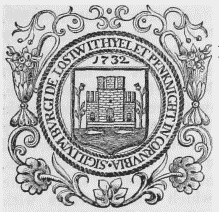
Seal and Arms.
The town is situated in a beautiful vale, on the banks of the river Fowey, and upon the road from Plymouth to Falmouth, and comprises two parallel streets, extending from the river to the foot of a steep hill; it is lighted and paved, and there is a good supply of water. The houses are chiefly built of stone, and covered with slate, which abounds in the neighbourhood. A regatta, and a ball, take place in August; and assemblies are held in the winter. The wool-combing business affords employment to about twenty persons, and there is a large tanyard; the chief trade, however, consists in the conveyance of the iron-ores and other mineral produce of the district to the port of Fowey, for shipment to Wales, and in bringing from that place timber, coal, lime, limestone, sand, and other articles, for the supply of the adjacent country. The increased number of mines has added greatly to the prosperity of the town. About three miles distant are the extensive mines of Lanescot and the Fowey Consols, surpassing, in the variety, extent, and power of their machinery, all others in the kingdom, their produce amounting to an eleventh part of all the copper-ore furnished by the mines of Cornwall. The river Fowey, over which is a commodious bridge, is navigable to the quay at spring tides. The market is held on Friday; and the establishment of a corn-market, free of toll, has been attempted, but only a very small quantity of corn is brought for sale: the market-house was erected at the expense of Viscount Mount-Edgcumbe, in 1781. Fairs for horses, cattle, and sheep are held on July 10th, Sept. 4th, Nov. 13th, and the Tuesday before the fourth Sunday in Lent.
The borough contains portions of the adjoining parishes of Lanlivery and St. Winnow. A charter of incorporation was granted by James I., in 1623, and renewed by George II., in 1738, under which the corporation consists of seven aldermen or capital burgesses, including the mayor and seventeen assistants or commoncouncilmen. The mayor, late mayor, and recorder are justices of the peace; and the first-named is also coroner. A court leet is held annually by the mayor, when presentments are made concerning matters relating to the borough and the river; and all persons having boats on the river are required to yield suit and service to the court. There are petty-sessions generally on Friday. The quarter-sessions for the county, formerly held here in the summer, were a few years since removed to Bodmin. In the old shire-hall erected by the Earl of Cornwall, in which the stannary parliaments were held, is the original stannary court-room, with a prison adjoining, which is the only one in the county belonging to the stannaries. The town-hall is a neat building with a prison underneath, erected in 1740, at the cost of Lord Mount-Edgcumbe. The borough first returned members to parliament in the 33rd of Edward I., and then ceased till the 4th of Edward II., from which time the returns were made regularly until the period of the Reform act in the 2nd of William IV., when it was entirely disfranchised.
The parish comprises 110a. 1r. 27p.; the soil is fertile. The living is a discharged vicarage, endowed with the rectorial tithes, valued in the king's books at £2. 13. 4., and in the gift of the Earl of Mount-Edgcumbe: the tithes have been commuted for £40, and some land purchased by Royal Bounty produces £42 per annum. The church is a handsome edifice in the early English style, with a lantern tower at the west end, surmounted by a fine octagonal spire erected in the fourteenth century; it contains an ancient stone font, on the sides of which are sculptured grotesque figures and armorial bearings, rudely executed, and now much defaced. There are places of worship for Bryanites, Independents, and Wesleyans. About a mile northward of the town, on the edge of a lofty hill, are the venerable ruins of Restormel Castle, supposed to have been erected by Robert, Earl of Montaigne, and anciently the residence of the earls of Cornwall. At the commencement of the great civil war, although then ruinous, it was garrisoned for the parliament, and was taken by the royalist general, Sir Richard Grenville, in August, 1644. The remains are comprised within a circular area, 110 feet in diameter: the walls are nine feet thick, surrounded by a deep moat, and at the southern entrance, where was a drawbridge, are two arches supporting a square tower; traces of suites of apartments and stone staircases are visible, and the whole, being richly overgrown with ivy, presents a very picturesque appearance. The chapel of the Holy Trinity, anciently appendant to the castle, is also in ruins.
Lothers, county of Dorset.—See Loders.
LOTHERS, county of Dorset.—See Loders.
Lothersdale
LOTHERSDALE, an ecclesiastical district, in the parishes of Carleton and Kildwick, union of Skipton, E. division of the wapentake of Staincliffe and Ewcross, W. riding of York; containing 955 inhabitants. This is a deep valley, with detached houses scattered irregularly on its acclivities. Some quarries are wrought, and a lead-mine is in operation. A church dedicated to Christ was erected in 1838, on a site of one acre given by the Earl of Burlington, lord of the manor; and was endowed with £1000 by the Rev. Walter Levett, vicar of Carleton, and a rent-charge of £20 on the glebe lands of the living: patron, the Vicar of Carleton; total net income, £100. There are places of worship for Methodists and the Society of Friends.
Lotherton
LOTHERTON, a township, in the parish of Sherburn, Upper division of the wapentake of BarkstoneAsh, W. riding of York, 6 miles (S. S. W.) from Tadcaster; containing 564 inhabitants. This township, which includes the eastern portion of the town of Aberford, comprises 1052 acres, whereof 57 are common or waste land. Lotherton Hall is a handsome mansion in a well-wooded demesne. The tithes have been commuted for £55. 18., of which £10 are payable to the vicar.
Lottisham
LOTTISHAM, a tything, in the parish of Ditcheat, union of Shepton-Mallet, hundred of Whitestone, E. division of Somerset; containing 132 inhabitants.
Loudwater
LOUDWATER, a chapelry, in the parish and union of High Wycombe, hundred of Desborough, county of Buckingham, 3¼ miles (S. E.) from High Wycombe. The living is a perpetual curacy; net income, £132; patrons, the Trustees of W. Davis, Esq., by whom the chapel was built and endowed, in 1788.
Loughborough (All Saints)
LOUGHBOROUGH (All Saints), a market-town and parish, and the head of a union, in the hundred of West Goscote, N. division of the county of Leicester; containing, with the township of Knight-Thorpe and the hamlet of Woodthorpe, 10,170 inhabitants, of whom 10,025 are in the town, 11 miles (N.) from Leicester, and 109 (N. W.) from London. The name is probably derived from Lough, a lake, or large extent of meadow occasionally overflowed. The noble family of Despenser, anciently possessors of the manor, obtained the grant of a market and fairs for the town. In 1564, the assizes for the county were held here, on account of the plague raging at Leicester. From its size and population this may be considered the second town in the county, and it was so reckoned even three centuries ago; it is a great thoroughfare, being situated on the road from London to Manchester, and having a station on the Midland railway. The buildings in general are of brick, and the fronts of many of the houses are modern; plaster, made of alabaster obtained from the quarries of Burton-on-the-Wolds, is mostly used for the floors of the lodging-rooms. The streets are paved, and lighted with gas, and the inhabitants are well supplied with water. A neat theatre was built in 1822, and there is a subscription library.
The manufactures comprise hosiery of all kinds, cotton goods, and bobbin-net lace. The manufacture of what is termed patent Angola hosiery is confined chiefly to the town: for this article (originally invented by Mr. Richard Cartwright in 1792) a patent was obtained by the manufacturer, and the machinery is worked here under his licence, giving employment to nearly 2000 persons. Among the articles lately introduced, are, silk velvet, broad and narrow figured satin, and elastic velvet cuffs and trimmings. In the town and its vicinity are an iron-foundry, a celebrated bell-foundry, several dyeing establishments, more than a dozen malt-kilns, several corn-mills, and some quarries of slate. The Loughborough navigation, which communicates with the Leicester canal, the river Soar, and the lime-works at Barrowhill, has been very beneficial, and abundantly profitable to the proprietors; the shares, which originally cost but £120 each, have been sold for £4500, and are now worth £1000. The market is on Thursday; and fairs are held on Feb. 14th, March 28th, April 25th, Holy-Thursday, Aug. 12th, and Nov. 13th, for horses, cows, and sheep; March 24th and Sept. 25th, for cheese; and Nov. 14th, a statute-fair for hiring servants. An ancient cross and the old market-house having been removed, the market-place is now open. The town is under the superintendence of a constable, a headborough, meadow-reeves, and street-masters, all chosen at the court leet and court baron of the lord of the manor, which are held annually. The powers of the county debt-court of Loughborough, established in 1847, extend over the registration-district of Loughborough, and part of the districts of Barrow and Shardlow. Pettysessions are held here weekly; and the town is the place of election for the northern division of the shire.
The living is a rectory, valued in the king's books at £40. 16. 3.; net income, £1848; patrons, the Master and Fellows of Emmanuel College, Cambridge: the tithes were commuted for land in 1759. The church is a handsome edifice in the later English style, and has a fine tower, built by subscription, towards the close of the sixteenth century. In 1837, a second church was erected, at a cost of £5600, the principal contributors being the Rev. William Holme, B.D., rector, and Miss Tate, of Burleigh, aided by the Commissioners for building Churches. This was the last church built by the deceased eminent architect, Mr. Rickman; it is of the ornamental pointed style of an early date, and contains 1203 sittings, of which 300 are appropriated to the poor. Loughborough was at the same time, or soon after, divided into two distinct parishes for ecclesiastical purposes, two-fifths of the whole population being assigned to the new church of Emmanuel; the income, at the decease of the present rector, to be divided in the same proportion. The new living will be a rectory, with glebe-land, &c., attached, and will be in the patronage of the College. There are places of worship for General and Particular Baptists, Independents, Wesleyans, and Unitarians; and a Roman Catholic chapel in the Grecian style, with a residence for the minister, erected from a design by Mr. Flint, at an expense of £2200.
The free grammar school is endowed with part of the produce of some land originally bequeathed by Thomas Burton, in 1495, for the maintenance of a chantry in the parochial church, but appropriated at the Reformation to the endowment of a free school, the repair of public bridges in the parish, and the relief of the poor; the rental is about £1400 per annum. The school comprises a Latin school, a school in which reading, writing, and arithmetic are taught, a national school for boys, and a similar school for girls. Two exhibitions of £30 each, or one of £60, to Jesus College, Cambridge, are attached to the institution: the school-house is a handsome building with a convenient play-ground, erected in 1830, at an expense of £1500. A free school for girls was founded in 1683, by means of a bequest from Bartholomew Hickling, and endowed with land; and in 1717, Joseph Clarke bequeathed land, directing the proceeds to be applied to instruction. Various other benefactions have been made at different periods, for apprenticing children, and for the poor; from which about £290 per annum are expended. The union of Loughborough comprises 24 parishes or places, 13 of them in the county of Leicester, and 11 in that of Notts; and contains a population of 24,606. An urn of Roman construction was dug up a short time since by one of the monks of St. Bernard's convent, near the town, filled with Roman coins, some of which were of the year 244. Dr. Richard Pulteney, a distinguished physician and writer on botany, was born here in 1730. Alexander Wedderburn, an eminent lawyer, on his elevation to the bench as lord chief justice of the common pleas, was created Baron Loughborough, in 1780.