A Topographical Dictionary of England. Originally published by S Lewis, London, 1848.
This free content was digitised by double rekeying. All rights reserved.
'Maidwell - Malmesbury', in A Topographical Dictionary of England, ed. Samuel Lewis (London, 1848), British History Online https://www.british-history.ac.uk/topographical-dict/england/pp216-221 [accessed 30 April 2025].
'Maidwell - Malmesbury', in A Topographical Dictionary of England. Edited by Samuel Lewis (London, 1848), British History Online, accessed April 30, 2025, https://www.british-history.ac.uk/topographical-dict/england/pp216-221.
"Maidwell - Malmesbury". A Topographical Dictionary of England. Ed. Samuel Lewis (London, 1848), British History Online. Web. 30 April 2025. https://www.british-history.ac.uk/topographical-dict/england/pp216-221.
In this section
Maidwell (St. Mary)
MAIDWELL (St. Mary), a parish, in the union of Brixworth, hundred of Rothwell, N. division of the county of Northampton, 10 miles (N.) from Northampton; containing 258 inhabitants, and comprehending Maidwell St. Peter's, formerly distinct. It is intersected by the road between Northampton and Harborough, and comprises 1763 acres, in nearly equal portions of arable and pasture, with 60 acres of wood: the surface is agreeably undulated, and the soil in some parts clayey, and in others suited to the growth of good corn. Limestone is quarried for building purposes and for burning into lime. Water is in great abundance, from excellent springs. The village is very pleasant. The living is a rectory, valued in the king's books at £10. 8. 1½.; net income, £218; patron, H. H. Hungerford, Esq., who is sole proprietor of the parish. The tithes were commuted for land and a money payment in 1696; the glebe altogether comprises 92 acres, with a glebe-house, built by the present rector in 1813. The church, a small handsome edifice, very neatly arranged, contains some monuments to the Hazlewood family, one of which is to the memory of Lady Gorges, who died in 1634; and in the church wall is a monument to Sir John Seyton, Knt., who died at Jerusalem in 1396, and was buried here. St. Peter's church having become dilapidated, was taken down in 1543. A rent-charge of £20 has been appropriated by Lady Trott to the foundation of a scholarship at Clare Hall, Cambridge. In a place called the Dales is a petrifying spring, and there is a chalybeate spring near Scotland wood.
Mainsforth
MAINSFORTH, a township, in the parish of Bishop's-Middleham, union of Sedgefield, N. E. division of Stockton ward, S. division of the county of Durham, 8¾ miles (S. S. E.) from Durham; containing 42 inhabitants. The township comprises about 810 acres; it is intersected by the little Skerne, and the ford or main way across a morass formed by the stream gives name to the village. Limestone abounds. Some years since, a pair of moose-deer horns was found in a hollow, upon the summit of a conical hill near the place. On an adjoining hill is an old house named the Swanhouse, where certain dues called Swan-oats were formerly paid to the convent of Durham, and afterwards to the chapter. The great tithes have been commuted for £57, and the small for £35. Mainsforth was the residence of the late Robert Surtees, Esq., the indefatigable antiquary and accomplished scholar, who published several folio volumes of an elaborate history of he county.
Mainstone (St. John the Baptist)
MAINSTONE (St. John the Baptist), a parish, in the union of Clun, partly in the hundred of Purslow, S. division of Salop, and partly in the hundred and county of Montgomery (North Wales), 4 miles (W. by S.) from Bishop's-Castle; the English portion containing 276 inhabitants, of whom 91 are in the township. The parish occupies a considerable area of hilly and undulated ground, and is surrounded by the parishes of Clun, Bishop's-Castle, Lydham, and Churchstoke. A small brook rises in, and flows through, the parish, which is also intersected by Offa's dyke; and the main road from Bishop's-Castle to Montgomery passes at the extremity of the township of Castlewright. The living is a rectory, valued in the king's books at £4. 13. 4., and in the patronage of the Crown; net income, £293. The church is 112 feet long, by 22 wide, and contains 140 sittings.
Mainstone
MAINSTONE, a tything, in the parish of RomseyExtra, union of Romsey, hundred of King's-Sombourn, Romsey and S. divisions of the county of Southampton; containing 144 inhabitants.
Maisemore (St. Giles)
MAISEMORE (St. Giles), a parish, in the Lower division of the hundred of Dudstone and King's-Barton, union, and E. division of the county, of Gloucester, 2¾ miles (N. N. W.) from Gloucester; containing 421 inhabitants. At the time of the Conquest, this place formed part of the parish of St. Mary-de-Lode, in Gloucester, but it was separated at a very early period, though the exact time is not known. The name is derived from Maes, a plain, and Mor, water; terms descriptive of its situation on the banks of the river Severn, which occasionally overflows the adjoining lands. The living is a perpetual curacy; net income, £89; patron and appropriator, the Bishop of Gloucester and Bristol: the tithes were commuted for land in 1793. The church is partly Norman, but principally in the decorated and later English styles.
Maisey-Hampton.—See Hampton, Maisey
MAISEY-HAMPTON.—See Hampton, Maisey.
Makeney
MAKENEY, a hamlet, in the parish of Duffield, union of Belper, hundred of Appletree, S. division of the county of Derby, 2 miles (S. by E.) from Belper. The river Derwent runs past the hamlet. Makeney House, the seat of Charles Mold, Esq., stands on a gentle eminence, and has a fine view of the vale.
Maker (St. Macra)
MAKER (St. Macra), a parish, in the union of St. Germans, S. division of the hundred of East, E. division of Cornwall, 2¼ miles (S. by W.) from Devonport; containing, with the tything of Vaultershome, 2725 inhabitants. This parish comprises by computation 2183 acres, of which 71 are common or waste land; and is bounded on the south-east by Plymouth Sound, for the defence of which a formidable battery has been erected on the heights above the village. Mount-Edgcumbe House, the noble seat of the Edgcumbe family, and from which its representative derives the title of Earl, was originally built in the reign of Mary, and, with the exception only of Salcombe, was the last garrison that held out for Charles I.; it occupies an elevated site, commanding an extensive prospect, and its domain presents a variety of beautiful scenery. At the populous village of Inceworth, and also at Millbrook (formerly market-towns), fairs for cattle are held annually, at the former on May 1st, and at the latter on September 29th. Courts leet are also held for those places, at which a portreeve, constables, and other officers are appointed. The living is a discharged vicarage, valued in the king's books at £23. 11. 0½., and has a net income of £223; the patronage and impropriation belong to the Crown. The church being on a hill between Mount-Edgcumbe and Ramhead, its steeple serves as a landmark, and in time of war is made a signal station. It contains some interesting monuments to the Edgcumbe family. At Millbrook is an episcopal chapel. There are places of worship for Wesleyans and Baptists.
Malborough
MALBOROUGH, a parish, in the union of Kingsbridge, hundred of Stanborough, Stanborough and Coleridge, and S. divisions of Devon, 4 miles (S. W. by S.) from Kingsbridge; containing, with the chapelry of Salcombe, 1951 inhabitants. This place is situated at the southern extremity of the county, on the coast of the English Channel. It was formerly defended by Ilton Castle, erected in 1336, of which there are some slight remains; and by another castle called Fort Charles, which, during the war in the reign of Charles I., was repaired by that monarch, at an expense of £3000, and was taken by the parliamentarian forces in 1645. The parish comprises 4635 acres, of which 1010 are waste, and the remainder arable and pasture; the soil is partly a white loam, partly red marl, and partly sand. The neighbourhood is remarkable for the mild temperature of its climate; and at Woodville, within the parish, lemon, orange, citron, and olive trees, flourish in the open air, requiring only temporary protection in very severe weather. The surface is hilly, and the scenery richly diversified. An estuary extends from Bolt Head, in the parish, to Kingsbridge quay, a distance of six miles. The Earl of Devon holds a court of admiralty here, the jurisdiction of which embraces an extensive line of coast. The living is annexed, with the livings of South Huish and South Milton, to the vicarage of West Alvington. The church, which has a spire, is situated on a commanding eminence near Bolt Head. A school is partly supported by the rent of parish lands.
Malden (St. John)
MALDEN (St. John), a parish, in the union, and Second division of the hundred, of Kingston, E. division of Surrey, 2½ miles (N. by W.) from Ewell; containing 232 inhabitants. At this place was the original establishment of the College of Merton, founded here in 1264, and removed in 1267 to Oxford: the site of the buildings is near the church. The parish comprises 1255a. 1r. 13p., of which 1053 acres are arable, 125 pasture, and 45 wood and common; the surface is varied, and a rapid stream called Hogsmill flows through the lands. Extensive powder-mills have been established. The living is a vicarage, with that of Chessington annexed, valued in the king's books at £8. 5.; net income, £417; patrons and appropriators, the Warden and Scholars of Merton College. The great tithes have been commuted for £240; and the vicarial for £75, with a glebe of 15 acres. The church is a small edifice, for the most part rebuilt in 1610.

Seal and Arms of Maldon.
Obverse.
Reverse.
Maldon
MALDON, a borough, port, and market-town, having separate jurisdiction, and the head of a union, locally in the hundred of Dengie, S. division of Essex, 10 miles (E.) from Chelmsford, and 38 (E. N. E.) from London; containing 3967 inhabitants. This place is supposed by Camden and by Horsley to have been the Camalodunum of the Romans, one of the earliest colonies established by that people in Britain. Other antiquaries, however, have satisfactorily proved the station to have been at Colchester; under which head its history is given. The town was called by the Saxons Meal dune, or Male dune, from which its present appellation is evidently derived. It is pleasantly situated on an eminence, near the confluence of the rivers Blackwater and Chelmer, and consists principally of one spacious street, extending for more than a mile from west to east, and intersected by a smaller street. The houses, which were in general ancient, have been much improved in their appearance, and within the last half century many ranges of handsome modern houses have been erected; the town is lighted with gas, partially paved, and amply supplied with water. A library was founded by Dr. Thomas Plume, who bequeathed all his valuable books and pictures, and £40 per annum as a salary to a librarian in holy orders, who should reside in the town; there are also some book societies. The haven, formed by the bay of the Blackwater river, affords safe anchorage to vessels not drawing more than eight feet of water; ships of heavier burthen anchor in the offing, and discharge their cargoes by lighters on the quay. The trade is chiefly in coal, of which not less than 90,000 chaldrons are, on the average, imported annually; also in corn, deals, and iron. The number of vessels of above 50 tons registered at the port is 58, and their aggregate burthen 4704 tons. There is an excellent fishery, extending for more than 20 miles along the coast; and oysters of a very superior quality, called the Wall-fleet oysters, are found in abundance. The customhouse is a neat brick building. An act was passed in 1846 for a railway to Witham and Braintree, in connexion with the Eastern Counties line; and a canal from Heybridge to Chelmsford passes within a mile of the town. The market, principally for corn, is on Thursday; and fairs take place on May 1st, and September 13th and 14th.
Maldon claims to be a borough by prescription. Its burgesses are mentioned in Domesday book, where it is recorded that "in the half hundred of Maldune the king has one honour and pasture for 100 sheep;" also "180 houses which the burgesses hold, and 18 demolished manses, 15 of which (burgesses) hold half a hide and twenty acres, and the other men hold no more than their own houses in the borough." The earliest known charter was granted in 1155, by Henry II., who gave to the burgesses all the possessions which they then held of the crown, and all their liberties, by tenure of free burgage, the service reserved being the supply of one ship for 40 days, when summoned by the king; to which liberties and customs, was then added a complete exemption from the county jurisdiction. This charter was afterwards confirmed several times. The borough is now governed by a mayor, four aldermen, and twelve councillors, under the act of the 5th and 6th of William IV., c. 76, and the number of magistrates is six. The freedom is inherited by birth, or obtained by servitude. The town first exercised the elective franchise in the 2nd of Edward III., since which time it has continued to return two members to parliament; the adjoining parish of Heybridge was, in 1832, added to the ancient borough for electoral purposes, comprising together an area of 5274 acres: the mayor is returning officer. The recorder holds quarterly courts of session on the day before those for the county; and the petty-sessions for the hundred of Dengie are held here weekly. The admiralty jurisdiction was totally abolished by the act of the 5th and 6th of William IV. The powers of the county debt-court of Maldon, established in 1847, extend over the registration-district of Maldon. The town-hall is an edifice of brick, built in the reign of Henry VI., and called D'Arcy's Tower.
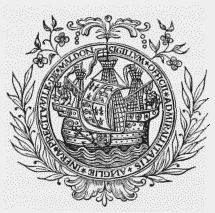
Admiralty Seal, now disused.
The old borough comprises the parishes of All Saints, containing 864; St. Peter, 1878; and St. Mary, 1225, inhabitants. The united parishes of All Saints and St. Peter contain by measurement 1430 acres, of which 40 are in the former. The living of All Saints' is a vicarage, with that of St. Peter's annexed, valued in the king's books at £10; net income, £319; patron, A. R. Prior, Esq.; impropriators, the landowners. The great tithes of St. Peter's have been commuted for £6, and the vicarial for £212. All Saints' church is a spacious structure, in the early Norman and early English styles, with a triangular tower surmounted by an hexagonal spire; in the south aisle are three chapels, or chantries, founded by Robert D'Arcy in the reign of Henry VI., and the church has various ancient monuments. For its repair, premises now producing £50 per annum were devised by Anastasia Wentworth, in 1630. The church of St. Peter has been demolished, with the exception of the tower, adjoining which is the library erected by Dr. Plume. The living of St. Mary's is a perpetual curacy, in the patronage of the Dean and Chapter of Westminster; net income, £165. The church, a large and very ancient structure, is said to have been founded prior to the Norman Conquest, by Ingelric, a Saxon nobleman; part of it was rebuilt in the reign of Charles I., and a gallery was erected in 1834. There are places of worship for the Society of Friends, Independents, and Wesleyans. Ralph Breder, in 1608, bequeathed £300 for the endowment of a free grammar school, to which several small bequests were subsequently added; a national school is partly supported by £25 per annum from Dr. Plume's charity, and there are some charitable bequests for distribution among the poor. The union of Maldon comprises 32 parishes or places, containing a population of 20,838.
Within less than a mile of the town are the remains of the Abbey of Beleigh, founded in 1180, by Robert Mantell, for Præmonstratensian canons, and dedicated to St. Nicholas; the revenue, at the Dissolution, was £196. 6. 5. The chapel, which is the most perfect portion of the ruins, is a small edifice in the early English style, with later insertions; the roof is groined, and supported on slender shafted columns and gracefully pointed arches. Henry Bouchier, Earl of Essex, and his countess, were interred in the chapel; and in digging for gravel in the ground adjoining, some coffins and skeletons have been discovered. A priory for Carmelite friars was established in 1292, by Richard Gravesend, Bishop of London, the revenue of which, at the Dissolution, was £26. 0. 8.; the only vestiges are the garden walls. An hospital for Lepers was founded by one of the monarchs, prior to the 16th of Edward II., and by Edward IV. was annexed to the abbey of Beleigh; the remains, now converted into a barn, exhibit a mixture of stone and of bricks and tiles, which appear to be of Roman origin. To the west of the town are the remains of a camp of quadrilateral form, including 22 acres, through which is the road to Chelmsford: on the north is a fine spring called Cromwell's. Dr. Plume, Archdeacon of Rochester, who founded the Plumean professorship of astronomy and experimental philosophy at Cambridge, was born at Maldon in 1630. The town gives the inferior title of Viscount to the Earl of Essex.
Malham
MALHAM, a township, in the parish of Kirkby-inMalham-Dale, union of Settle, W. division of the wapentake of Staincliffe and Ewcross, W. riding of York, 5½ miles (E. by S.) from Settle; containing 233 inhabitants. This township is situated in the fertile vale to which it gives name, and comprises about 3870 acres, principally the property of Lord Ribblesdale, who is lord of the manor. It is chiefly pasture and meadow land, with a substratum of limestone; the herbage is of the finest quality. Calamine and lead are found in the neighbourhood, and mines have been wrought by successive adventurers, but at considerable loss. The scenery is generally of the boldest and most romantic character, finely contrasting with some parts which possess softer features. At the head of the dale is Malham Cove, a gigantic mass of limestone rock nearly 300 feet in height, extending across the valley, and at the foot of which issues a rivulet that, in times of flood, not finding vent for its accumulating waters by its customary subterraneous passage, rises to the summit of this stupendous barrier, and precipitates itself with resistless fury into the vale beneath, forming a truly magnificent cataract. Near the village is Jennet's Cave, a dark and gloomy recess, overhung with ivy; and about a mile to the east is Gordale Scar, a huge cluster of limestone rocks, appearing as if torn asunder in some parts by a great natural convulsion, and projecting several yards over the line of their base. The village is in the most fertile part of the vale. A fair is held for lambs on the 30th of June, and continued on the 1st of July as a pleasure-fair; a fair for sheep is held on the 15th of October. There is a place of worship for Wesleyans. A free school was founded in 1717, by Rowland Brayshaw, Esq., who endowed it with property now producing £74 per annum.
Malham-Moor
MALHAM-MOOR, a township, in the parish of Kirkby-in-Malham-Dale, union of Settle, W. division of the wapentake of Staincliffe and Ewcross, W. riding of York, 5½ miles (N. E.) from Settle; containing 102 inhabitants. The township comprises about 8880 acres, the property of Lord Ribblesdale and others; it is chiefly high moorland, affording tolerable pasturage for sheep, and the scenery abounds with variety. Within an area inclosed by precipitous rocks of limestone, is a sheet of water called the Tarn, long celebrated for its trout and perch, and which, on one side overflowing its barrier, or forcing its way through some fissures in the rock, forms a picturesque cascade thirty yards in height. On an eminence commanding a fine view of the lake and its surrounding scenery, is Tarn House, the handsome seat of Lord Ribblesdale. The whole of the lands belonged to the abbey of Fountains, and on the Dissolution were granted to Sir Richard Gresham.
Malin's-Lee
MALIN'S-LEE, a township, in the parish of Dawley Magna, union of Madeley, Wellington division of the hundred of South Bradford, N. division of Salop; containing 2721 inhabitants. A chapel, now a district church, was built in 1805 by the executors of J. H. Browne, Esq., of Burton-on-Trent: the living is a perpetual curacy, in the gift of the Incumbent of Dawley Magna, with a net income of £150.
Mallerstang
MALLERSTANG, a chapelry, in the parish of Kirkby-Stephen, East ward and union, county of Westmorland, 3 miles (S. by E.) from Kirkby-Stephen; containing 223 inhabitants. The township comprises 4944 acres, of which 3006 are common or waste land. The living is a perpetual curacy; net income, £64; patron, the Earl of Thanet. The chapel, having fallen into ruin, was repaired in 1663, by the celebrated Countess of Pembroke, who endowed it with lands now producing £23 per annum, on condition that the curate should teach the children of the dale. At Castlethwaite are the ruins of a square tower that formed part of Pendragon Castle, built by Uter Pendragon, in the time of Vortigern; the walls are twelve feet thick. It was at one period the seat of the lords de Clifford, and was burned by the Scots about the year 1541, but was completely repaired in 1661 by the Countess of Pembroke, who also built the bridge across the Eden, and erected the stone pillar on the hill called Morrill's Seat. The castle was dismantled by the Earl of Thanet, in 1681. Near it is an ancient fortification, surrounded by a moat and vallum. At the southern extremity of the chapelry rises the lofty mountain called Wild-Boar Fell.
Malling, East (St. James)
MALLING, EAST (St. James), a parish, in the union of Malling, hundred of Larkfield, lathe of Aylesford, W. division of Kent, 4¾ miles (W. N. W.) from Maidstone; containing 1578 inhabitants. The parish comprises 2765 acres, of which 685 are in wood: the Medway bounds it on the north. The manufacture of paper is carried on to some extent. A fair for pedlery is held on July 15th. The living is a vicarage, valued in the king's books at £10. 8. 4.; patron, J. A. Wigan, Esq. The great tithes have been commuted for £210, and the vicarial for £800; the glebe comprises 19½ acres. The church is a handsome structure with a tower. The Rev. Edward Holme, in 1781, erected and endowed a school; and in 1829, Mrs. Elizabeth Smith founded and endowed five almshouses for widows.
Malling, South (St. Michael)
MALLING, SOUTH (St. Michael), a parish, in the union of Lewes, hundred of Ringmer, rape of Pevensey, E. division of Sussex, 1 mile (N.) from Lewes; containing 646 inhabitants. It is bounded on the west by the river Ouse. The living is a perpetual curacy; net income, £105; patrons, the Courthope family; impropriators, the principal landowners. The church, described as collegiate in Domesday book, and said to have been founded by Ceadwalla, King of the West Saxons, who died in 668, is a small neat edifice, built on the site of the former, and consecrated May 23rd, 1632; it was repaired and repewed by subscription in 1837: the chancel contains an altar-tomb to the memory of Sir William and Lady Kemp. The dean and prebendaries forming the college possessed, at the Dissolution, a revenue of £45. 12. 5. The archbishops of Canterbury had a palace here, the chapel of which has been converted into a cottage. In December, 1836, an avalanche of snow fell upon the workhouse buildings here from a hill above, by which eight persons were killed. Richard Russell, M.D., whose treatise on the sea water of Brighton, laid the foundation of the prosperity of that place, was buried at South Malling.
Malling, West, or Town-Malling (St. Mary)
MALLING, WEST, or Town-Malling (St. Mary), a parish, the head of a union, and formerly a markettown, in the hundred of Larkfield, lathe of Aylesford, W. division of Kent, 5¾ miles (W. N. W.) from Maidstone, and 29 (S. E. by E.) from London; containing 1784 inhabitants. In the year 1090, a Benedictine nunnery was founded here by Gundulph, Bishop of Rochester, in honour of the Blessed Virgin. About a century afterwards, the town and the nunnery were nearly destroyed by fire, but they were soon restored, and the revenue of the latter, at the Dissolution, was estimated at £245. 10. 2½.: the front of the nunnery, of Norman architecture, with later insertions, still remains, forming an interesting ruin. The town is neat and clean, and contains some good houses; the streets are wide, and well paved, and the walks adjacent and the scenery are pleasing. Petty-sessions for the upper south division of the lathe of Aylesford are held here on the first Monday in every month. The market was granted, with the fairs, in the reign of Henry III., and was held on Saturday: fairs take place on August 12th and October 2nd, for pedlery, and November 17th, for cattle. The parish contains 1366 acres, 584 of which are woodland. The living is a vicarage, valued in the king's books at £10; income, £400; patron and impropriator, T. A. Douce, Esq. The church is an ancient structure, with a fine Norman tower at the west end, and contains a splendid monument to Sir Robert Brett: the roof having fallen in 1778, through the decay of the main columns, the whole of the nave was rebuilt; the old spire of the tower has been removed, and an elegant one erected by subscription. Here is a place of worship for Baptists. The union of Malling comprises 22 parishes or places, containing a population of 17,933: the workhouse, calculated to receive 360 inmates, is situated on the road to Mereworth.
Malmesbury
MALMESBURY, a borough and market-town, having separate jurisdiction, and the head of a union, locally in the hundred of Malmesbury, Malmesbury and Kingswood, and N. divisions of Wilts, 42 miles (N.) from Salisbury, and 94 (W.) from London; containing, with the chapelries of Corstone and Rodborne, and the tythings of Burton-Hill, Cole with West Park, and Milbourn, 2367 inhabitants. This place is stated by Leland to have been a British town, called Caer Bladon; but its origin may; with more probability, be ascribed to the period of the Saxon heptarchy. A castle, named Ingelburne, existed before the middle of the seventh century; about 642, Maildulph, an Irish monk, founded a hermitage, and being joined by Aldhelm, nephew of Ina, King of Wessex, they, with the assistance of Lutherius, Bishop of Winchester, erected a monastery, styled, from the name of its founders, Mealdelmesbyrig, which term was gradually altered to the modern appellation of Malmesbury. The monastery belonged to the Benedictines: it was one of the most considerable in Wiltshire, and was splendidly endowed by several princes and noblemen; its abbot was made a mitred parliamentary baron by Edward III., and the revenue, at the Dissolution, amounted to £803. 17. 7. Buildings gradually arose round the abbey; and notwithstanding that the town suffered from the incursions of the Danes, who burned it in the reign of Alfred the Great, it became a place of so much importance as to obtain a charter from Edward the Elder, which was confirmed by Athelstan, who was a munificent benefactor both to the town and the monastery: he bestowed an extensive tract of land, called the Common of King's Heath, on the men of Malmesbury, who had assisted him in gaining a victory over the Danes. In the reign of Henry I., or Stephen, a strong castle was built here by Roger, Bishop of Salisbury, who was obliged to surrender it to the king; and on the invasion of England by Prince Henry, afterwards Henry II., he laid siege to this fortress, and took it after an obstinate defence. During the civil war in the reign of Charles I., Malmesbury was a royal garrison, and that prince lodged in the town one night, in 1643. Shortly after, the place was captured by Sir William Waller; but it was retaken by the royalists, who did not, however, long retain possession, for the parliament having recovered it, their troops were stationed here till June, 1646.

Seal and Arms.
The town is situated on a pleasant and commanding eminence, and is nearly surrounded by two streams, which unite at its southern extremity, and form the Lower Avon. The principal thoroughfare extends southward from the market-place, near which it is crossed by another street, leading to that part of the town called Westport. These streets are paved and lighted, under the authority of an act of parliament obtained in 1798, and the inhabitants are abundantly supplied with water from wells. In the centre of the marketplace is a fine market-cross, built in the reign of Henry VII., and ornamented with flying buttresses, pinnacles, and an octangular central turret. The manufacture of woollen-cloth was anciently carried on very extensively; and after it had entirely decayed, it was again introduced, in the latter part of the last century: it now constitutes the chief employment of the lower class. Some trade is carried on in tanning and brewing, and bone-lace is made by the women and children. The market, principally for butcher's meat, is on Saturday; and large cattle-markets are held on the last Tuesday in every month, except March, April, and May: fairs for horses, cattle, and sheep, take place on March 28th, April 28th, and June 5th.
The first charter of incorporation was granted by Charles I.; the charter now in force was obtained from William III., in 1696, and under it the corporation consists of an alderman, deputy-alderman, eleven capital burgesses, and 24 assistants, with a high steward, and deputy-steward. Besides these, are 52 landholders, and an indefinite number of commoners, or free burgesses. The alderman and steward, with their deputies, are justices of the peace; and the alderman is coroner, and clerk of the market. The borough has possessed the elective franchise ever since the reign of Edward I.: by the act of the 2nd of William IV., cap. 45, it was determined that it should thenceforward return only one member instead of two, as previously; and the right of election was extended to the £10 householders of an enlarged district, comprising 22,606 acres: the alderman is returning officer. The petty-sessions for the hundred of Malmesbury are held here once a month. The powers of the county debt-court of Malmesbury, established in 1847, extend over the registration-district of Malmesbury, and part of that of Tetbury. King's Heath, or Malmesbury Common, which has been inclosed, is subdivided into allotments averaging about one acre and a half each, assigned to the commoners as tillage or garden ground. To the east of King's Heath are the "Acres," one acre belonging to each of the assistant burgesses and landholders; and near them are other lands called "Burgess Parts," varying in extent from six to fifteen acres each, and belonging to the capital burgesses.
The old borough, which contains 130 acres, comprises part of the parishes of St. Paul and St. Mary Westport. The entire parishes consist of 5056a. 3r. 25p.; the lands are in meadow and pasture, with a portion of rich arable land, and 74 acres of common or waste. The living of St. Paul's is a discharged vicarage, valued in the king's books at £8. 2. 1½., and in the patronage of the Crown; net income, £265; impropriators, the family of Gaby. The original church is dilapidated; but the tower, surmounted by a lofty spire, is still standing, and contains the bells rung on public festivals, &c. The nave of the conventual church, dedicated to the Virgin Mary, was purchased at the dissolution of monasteries, by William Stumpe, a clothier of Malmesbury, and presented to the townspeople for a parochial church. This edifice is chiefly in the Norman style, and has a noble south porch, consisting of receding arches, with sculptured mouldings and other ornaments; the western porch was of a similar character, but only a small portion of it remains. In the interior, at the west end, is a sepulchral chapel, in which is a tomb with a recumbent crowned figure said to represent King Athelstan, who was interred near the high altar of the church. A few years since, the whole fabric was substantially repaired, and the vaulted roof and other parts of the interior restored: over the altar has been placed a painting of the Resurrection of Lazarus, presented by the Earl of Suffolk. There are chapels of ease at Corstone and Rodborne. The living of the parish of Westport is a vicarage, with the perpetual curacies of Brokenborough and Charlton united, valued in the king's books at £16. 17. 8½., and in the patronage of the Crown; net income, £310; impropriator, the Earl of Suffolk. There are places of worship for Baptists, Independents, Moravians, and Wesleyans. A free school, under the patronage of the corporation, is endowed with £20 per annum; and the town has another school, endowed with £30 per annum by Mrs. Elizabeth Hodges, in 1725: both are conducted on the national system. Here is also an almshouse, endowed with £20 a year. The union comprises 25 parishes or places, 24 of which are in the county of Wilts, and one in that of Gloucester, the whole containing a population of 14,716. Besides the monastery, Malmesbury contained a convent of the Knights Hospitallers, some small portions of which are still standing. Among the distinguished persons connected with the monastery were, St. Aldhelm, the second abbot, who died Bishop of Sherborne in 709; Ælfric, a learned abbot in the tenth century, who was made Bishop of Crediton; and William of Malmesbury, precentor to the monastery, the celebrated English historian in the reign of Stephen. Thomas Hobbes, author of the Leviathan and other philosophical works, was born here in 1588; Mrs. Mary Chandler, an ingenious poetess, was also a native of the town. It confers the title of Earl and Baron on the family of Harris.