A Topographical Dictionary of England. Originally published by S Lewis, London, 1848.
This free content was digitised by double rekeying. All rights reserved.
'Newbottle - Newcastle-upon-Tyne', in A Topographical Dictionary of England, ed. Samuel Lewis (London, 1848), British History Online https://www.british-history.ac.uk/topographical-dict/england/pp379-389a [accessed 30 April 2025].
'Newbottle - Newcastle-upon-Tyne', in A Topographical Dictionary of England. Edited by Samuel Lewis (London, 1848), British History Online, accessed April 30, 2025, https://www.british-history.ac.uk/topographical-dict/england/pp379-389a.
"Newbottle - Newcastle-upon-Tyne". A Topographical Dictionary of England. Ed. Samuel Lewis (London, 1848), British History Online. Web. 30 April 2025. https://www.british-history.ac.uk/topographical-dict/england/pp379-389a.
In this section
Newbottle
NEWBOTTLE, a township, in the parish and union of Houghton-le-Spring, N. division of Easington ward and of the county of Durham, 8 miles (N. E. by N.) from Durham; containing 1835 inhabitants. This place, the name of which in the Saxon signifies "new dwelling," comprises 1388a. 2r. 32p., whereof 945 acres are arable, 365 grass, and 78 waste. The village is considerable, and stands in a high exposed situation about a mile north of the village of Houghton; the population is principally employed in collieries and potteries. A division of the town-fields took place in 1691, when lands called the Hall-moor and Dobmire-moor were allotted, the chief claimants for which were the families of Wilson, Watson, Chilton, and Byers. The tithes have been commuted for £265. There is a place of worship for Wesleyans.
Newbottle (St. James)
NEWBOTTLE (St. James), a parish, in the union of Brackley, hundred of King's-Sutton, S. division of the county of Northampton, 4 miles (S. W. by W.) from Brackley; containing, with part of the hamlets of Astrop, Charlton, and Purston, 384 inhabitants. The parish comprises 1665a. 3r. of arable and pasture land, in nearly equal portions. The surface is undulated, and the scenery pleasingly diversified; the soil of the arable land is for the most part light, producing wheat and barley, with a few beans. The living is a discharged vicarage, valued in the king's books at £10. 0. 10.; net income, £120; patron and impropriator, W. R. Cartwright, Esq. The church is of various dates, with a tower of the 15th century: in the chancel is a rude and curious piscina, apparently semi-Norman. At Charlton Hill, in the parish, is an ancient fortification called Rainsborough Camp.
Newbourn (St. Mary)
NEWBOURN (St. Mary), a parish, in the union of Woodbridge, hundred of Carlford, E. division of Suffolk, 5 miles (S. by E.) from Woodbridge; containing 163 inhabitants, and comprising by computation 800 acres. The living is a discharged rectory, valued in the king's books at £7. 4. 2.; net income, £192; patron, Sir Joshua R. Rowley, Bart. The crag-pits here, at the depth of 20 feet, are full of shells, teeth of fish, &c.; and through the marine deposit, several copious springs rise up, even in the driest seasons.
Newbrough
NEWBROUGH, a parochial chapelry, in the union of Hexham, N. W. division of Tindale ward, S. division of Northumberland, 5½ miles (N. W. by W.) from Hexham; containing 547 inhabitants. This place was formed into a borough by the Cumin family, about the beginning of the reign of Henry III., when they obtained a charter for a market at Thornton, which was the name of the estate where the new burgh was situated. Its position on Carel-street and the road out of North into South Tindale, and on sheltered and fertile grounds, rendered it very suitable as a resting-place for travellers; here Edward I. and his court lingered, in their march westward, in 1306. The chapelry is on the north side of the South Tyne, and comprises about 6967 acres, of which 2500 are arable, 150 wood, and the remainder moorland and pasture; the soil in the valley of the Tyne is rich, but in the higher grounds of inferior quality. The Newcastle and Carlisle railway passes through. The old mansion-house was rebuilt by the late Richard Lambert, Esq., in a handsome style, and is embellished with a lawn and gardens: Newbrough Lodge was erected at the close of the last century by William Ord, Esq. The living is annexed to the vicarage of Warden: the chapel, dedicated to St. Peter, having become ruinous, was rebuilt in 1797, and is a plain edifice, but occupying a beautifully-sequestered situation, in a cemetery of more than two acres, surrounded by lands rich in herbage and trees.
Newburgh, Lancaster.—See Lathom.
NEWBURGH, Lancaster.—See Lathom.
Newburn (St. Michael)
NEWBURN (St. Michael), a parish, in the union, and chiefly in the W. division, of Castle ward, but partly in the E. division of Tindale ward, S. division of Northumberland; containing 4156 inhabitants, of whom 943 are in the township of Newburn, 5¼ miles (W. by N.) from Newcastle-upon-Tyne. At this place, which in the reign of John was styled a borough, Lord Conway, at the head of the royalists, in 1640, disputed the passage of the Tyne with the Scots under General Leslie; but the latter, after a violent conflict, at length succeeded. The parish consists of the townships of Butterlaw, Black Callerton, Dalton, East and West Denton, North and South Dissington, Newbiggin, Newburn, Newburn-Hall, Sugley, Throckley, Wallbottle, East and West Whorlton, and part of High Callerton. It abounds with coal, and stretches along the northern bank of the river, where are some coal-staiths, ironfoundries, crown-glass works, and brick and tile manufactories, chymical-works, and a paper-mill. The village occupies a picturesque situation on the Tyne, and consists of irregularly-built houses, with pleasant gardens attached. The living is a discharged vicarage, valued in the king's books at £16; net income, £230; patron and appropriator, the Bishop of Carlisle. The church, partly rebuilt and considerably enlarged in 1827, at an expense of about £1200, is a neat cruciform structure of stone, containing some ancient monuments to the Delavals; the east window exhibits in stained glass the figure of St. James, and the arms of those families who contributed to the renovation of the building. A national school was erected in 1822, by the Duke of Northumberland, who endowed it with £10. 10. per annum; and there are two chapels, respectively dedicated to the Holy Trinity and St. Saviour. Severus' Wall passed through the parish, but its course is not traceable.
Newburn-Hall
NEWBURN-HALL, a township, in the parish of Newburn, union and W. division of Castle ward, S. division of Northumberland; containing 665 inhabitants. The name is derived from an old mansion, now converted into a farmhouse, and the walls of which are in some places nearly seven feet thick. In this township, which comprises 741 acres, are the eastern suburb of Newburn, and the greater part of the village of Lemington, which see.
Newbury (St. Nicholas)
NEWBURY (St. Nicholas), a market-town and parish, having separate jurisdiction, and the head of a union, locally in the hundred of Faircross, county of Berks, 17 miles (W. by S.) from Reading, and 56 (W. by S.) from London, on the road to Bath; containing 6379 inhabitants. This place, which is said to have risen from the ruins of the ancient Spinæ, a Roman station whose site is occupied by the village of Speen, was, in contradistinction to the old town, called Newbyrig, of which its present name is only a slight modification. It was of some importance at the time of the Conquest, and was bestowed by William on Ernulph de Hesdin, whose grandson was killed in the battle of Lincoln, in the reign of Stephen. In the reign of Edward I. Newbury returned two members to parliament, and in the 11th of Edward III. sent three deputies to a grand council of trade held at Westminster. In the reign of Henry VIII. it was one of the most flourishing towns in the kingdom, and was particularly distinguished for its manufacture of woollencloth. At this period lived the celebrated John Winchcombe, commonly called Jack of Newbury, said to have been the most eminent clothier in England, and to have sumptuously entertained Henry VIII. and his queen Catherine on their visit to the town. When the Earl of Surrey marched against James IV., King of Scotland, who was ravaging the borders of the kingdom, this spirited man, at his own expense, armed and clothed 100 of his workmen, and at the head of this little band, accompanied the earl to Flodden-Field, where he greatly signalized himself by his intrepid conduct. On the termination of the war, he returned to his native place, and at his own charge built part of the parochial church, in which he was interred in 1519. During the parliamentary war, two battles occurred in the vicinity, in both which the king commanded in person: the first was fought on September 18th, 1643, on the common called the Wash; and the second on Oct. 27th, 1644, in the fields between Newbury, Speen, and Shaw. In this latter engagement the king, though he kept possession of the field, suffered the Earl of Essex to march with his army to London, and the royal cause sustained an irreparable loss in the deaths of many distinguished officers, among whom were the Earls of Sunderland and Caernarvon, and the celebrated Lord Falkland. The parliamentarians in the following year obtained possession of the town, which they fortified, and held till the close of the war.
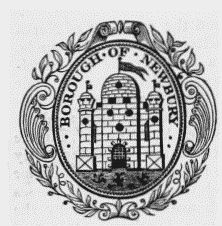
Corporation Seal.
The town is one of the largest in the county, and is pleasantly situated in a fertile plain, on the banks of the river Kennet, over which was an ancient wooden bridge of one arch, rebuilt of stone at the expense of the corporation in 1770. The houses are mostly of brick, generally well built and of modern appearance; the streets, diverging obliquely from the market-place, are spacious, well paved under an act lately obtained, and lighted with gas by a company, whose works are much admired: the inhabitants are amply supplied with water. In the hamlet of Speenhamland, adjoining the borough, is a small theatre, which is open for about two months in the year. The environs are pleasant, and afford many agreeable walks on the banks of the Kennet, and in the vicinity of the village of Speen. The trade is principally in malt and flour, for the latter of which are many large mills on the river: there are also a small paper-mill, and a mill for throwing silk; and in the parish of Speen, about a mile from the town, is a manufactory for ribbons and galloons. The river, which was made navigable to Reading in the reigns of George I. and II., and the Kennet and Avon canal, which commences at this place, afford great facilities to the trade; and the Reading and Hungerford railway runs by the town. The market is on Thursday, and is one of the most extensive in the county for corn, which is pitched in the market-place for sale. Fairs are held on HolyThursday, for horses and cattle; July 5th, for horses, cows, and hogs; and September 4th and November 8th, for horses and cheese: on the first Thursday after Oct. 11th is a statute-fair for hiring servants.
Newbury is said to be a borough by prescription. The earliest charter known is that bestowed by Elizabeth in 1596, wherein the place is styled an "ancient and populous borough, which had enjoyed divers liberties, franchises, and privileges, by the charters of many of her ancestors and predecessors, kings of England." This grant was confirmed by Charles I. and II., and another charter was conferred in the first of James I. The corporation now consists of a mayor, 4 aldermen, and 11 councillors, under the provisions of the act 5th and 6th of William IV., cap. 75, and the number of justices is four. The recorder presides at quarterly courts of session for the borough; petty-sessions take place as often as cases require, and a court leet once a year at Michaelmas. The Easter quarter-session for the county is held here, and the petty-sessions for the division every Thursday. The powers of the county debt-court of Newbury, established in 1847, extend over the registration-districts of Newbury and Kingsclere. The town-hall, or mansion-house, is a substantial brick building, erected in 1740, supported on piers and arches; the lower part affords an area for the market, and the upper consists of a handsome suite of rooms, in the largest of which the courts are held, and assemblies during the season. Part of the workhouse has been converted into a borough gaol; but the inhabitants being liable to the payment of the county rate, all prisoners committed by the borough magistrates are sent to the county gaol at Reading.
The parish comprises by measurement 1388 acres, of which 486 are arable, 267 pasture, 17 woodland, and 46 gardens; there is a large tract of uncultivated common, and some marsh land. The living is a rectory, valued in the king's books at £38. 16. 10½., and in the patronage of the Crown: the tithes have been commuted for £358, and the glebe comprises 13 acres. The church is a spacious edifice in the later English style, with a lofty embattled tower crowned by pinnacles: the tower and the western part of the nave were the portions built by John Winchcombe, whose effigy on a brass plate removed from over his tomb, is placed against the east wall of the north aisle; above the altar is some beautiful screen-work. There is an ancient chapel dedicated to St. Bartholomew; and the Baptists, Society of Friends, Independents, Wesleyans, and Unitarians, have places of worship. In 1847 an act was passed for a general cemetery. A Blue-coat school was founded in 1706, by the corporation, to whom, in 1624, John Kendrick had given the sum of £4000, for the purchase of a house and garden, the employment of the poor, and other charitable uses. A diocesan school was opened in January, 1840, for the instruction of youth in the doctrines and duties of Christianity, as taught by the Established Church, and in the classics and mathematics. St. Bartholomew's Hospital, supposed to have been founded by King John, and comprising houses for the reception of men and women, was by charter of Elizabeth vested in the corporation: ten houses have been added to the original establishment, and the endowment now exceeds £700 per annum. Opposite to St. Bartholomew's are some almshouses endowed in 1676 with £600, to be laid out in the purchase of land, by Philip Jemmett, Esq., and in 1709 with £400 by Lady Raymond: the income is £379. 10. Besides these, are some almshouses of less importance. The poor-law union of Newbury comprises 18 parishes or places, 17 of which are in the county of Berks, and one in that of Southampton, the whole containing a population of 19,963.
On both sides of the Kennet, extending 16 miles in length, are strata of peat half a mile in breadth, and varying in depth from one to eight feet: the peat sells for ten shillings per load, and in digging for it have been found oaks, alders, willows, and firs, indiscriminately mixed, which appear to have been torn up by the roots; also the horns, skulls, and bones of different kinds of deer; the horns of the antelope, the heads and tusks of boars, and the heads of beavers. In rebuilding the bridge, in 1770, a leaden seal of Pope Boniface IX., a pix, some knives of singular construction, and several coins from the time of Henry I. to William III., were discovered. Within a mile and a quarter of the town is the hamlet of Sandleford, where a small Augustine priory was founded about the year 1200, by Geoffrey, Earl of Perche, which was given by Edward IV. to the Collegiate Church of Windsor; the revenue at the Dissolution was £10. Newbury gives the title of Baron to the Marquess of Cholmondeley.
Newby
NEWBY, a township, in the parish of Irthington, union of Brampton, Eskdale ward, E. division of the county of Cumberland, 6 miles (E. N. E.) from Carlisle; containing 124 inhabitants.
Newby
NEWBY, a township, in the parish of Morland, West ward and union, county of Westmorland, 8 miles (S. E. by S.) from Penrith; containing 284 inhabitants. Coal and limestone are obtained, and there are limekilns at Towcett, in the township. Some tithes were commuted for land in 1806; and under the late act, rent-charges have been awarded of £174. 16. 10. to the Dean and Chapter of Carlisle, and £13. 19. 9. to the vicar. There is a glebe of 3¾ acres.
Newby, with Rainton, York.—See Rainton.
NEWBY, with Rainton, York.—See Rainton.
Newby
NEWBY, a township, partly in the parish of Seamer, and partly in that of Stokesley, W. division of the liberty of Langbaurgh, N. riding of York, 3 miles (N. by W.) from Stokesley; containing 132 inhabitants. The township is situated on the road from Stokesley to Stockton, and comprises about 1211 acres, of which 623 are in the parish of Seamer. The Meynells, of Whorlton, anciently held some land here of the Archbishop of Canterbury. The tithes have been commuted for £181. About midway between the villages of Newby and Seamer, is the remarkable tumulus named How Hill, in the vicinity of which, it is said, armour, swords, and human bones have been found, and near which was probably fought the battle wherein the Saxons were overthrown by Prince Arthur, called the battle of Badon Hill.
Newby
NEWBY, a township, in the parish of Scalby, union of Scarborough, Pickering lythe, N. riding of York, 3 miles (N. W. by W.) from the town of Scarborough; containing 54 inhabitants. It comprises by computation 1000 acres of land: the hamlet is on the road from Scarborough to Burniston.
Newby, W. riding of York.—See Clapham.
NEWBY, W. riding of York.—See Clapham.
Newby, with Mulwith
NEWBY, with Mulwith, a township, in the parish and liberty of Ripon, W. riding of York, 3¼ miles (S. E.) from Ripon; containing 41 inhabitants. It comprises about 800 acres, and is situated on the river Ure, which occasionally inundates and enriches the adjacent lands. Newby Hall was built by Sir Edward Blackett, from a design by Sir Christopher Wren, and was much enlarged by the late owner, Mr. Weddell, who built the wings, and by the present possessor, the Earl de Grey. Among its many elegant and spacious rooms is a fine gallery, in which, it is said, is the best private collection of ancient statuary in the kingdom.
Newby-Wisk
NEWBY-WISK, a township, in the parish of Kirby-Wisk, union of Thirsk, wapentake of GillingEast, N. riding of York, 4½ miles (S.) from Northallerton; containing 231 inhabitants. It comprises 1372 acres of fertile land. The village is on the west side of the Wisk, over which is a bridge of five arches. There is a place of worship for Wesleyans.
Newcastle
NEWCASTLE, a township, in the parish and union of Clun, hundred of Purslow, S. division of the county of Salop; containing 176 inhabitants.
Newcastle-Under-Lyme (St. Giles)
NEWCASTLE-UNDER-LYME (St. Giles), a borough, market-town, and parish, having separate jurisdiction, and the head of a union, locally in the N. division of the hundred of Pirehill, N. division of the county of Stafford, 16 miles (N. N. W.) from Stafford, and 149 (N. W. by N.) from London; containing 9838 inhabitants. It is supposed that this place was of some note even before the Conquest, but known by a different name, its present appellation of Newcastle being derived from a castle built here by Ranulph, Earl of Chester, probably about the year 1180, and so called in reference to an older castle, then fallen into decay, at Chesterton, within two miles. Its descriptive affix of Under Lyme, distinguishing it from Newcastle in Northumberland, appears to have arisen from the proximity of the place to the ancient and very extensive forest of Lyme, so designated from being on the limes or borders of Cheshire. A charter, now lost, was granted to Newcastle under its present name by Henry II. In the reign of John, the town had a market, and in 1203 was amerced for changing its market from Sunday to Saturday. It suffered much in the barons' wars, at which period the castle was demolished.
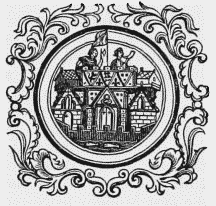
Seal and Arms.
The town is situated on a small stream tributary to the neighbouring river Trent, on the great road from London and Birmingham to Lancashire, and consists of several principal with smaller streets, which are paved (the foot-paths with brick), and lighted with gas, under the provisions of an act passed in 1819. The inhabitants are supplied with water by means of pipes leading from an ancient well called Browning's Well, near the Castle pool, the water being raised by a steam-engine: an act for a better supply of water was passed in 1847. Under the provisions of an act obtained in the year 1816, for inclosing the open town fields by which the town was then surrounded, extensive public walks or promenades, for the use of the inhabitants, were laid out and planted, which are under the management of trustees. The streets are wide; and the houses are generally good, but being mostly built of blue brick, they have rather a dull appearance. There are, a small handsome theatre, a concert or assembly room, a permanent subscription library, and a reading society: in the year 1836 a literary and scientific institution was established. The races are held in the first week in August, on an excellent course about two miles from the town, and are well attended. Among the manufactures of the place is that of hats. Silk throwing and weaving, cotton-spinning, tanning, malting, brewing, and the manufacture of tissuepaper for the potteries, are also carried on; considerable business is done in corn, and in the vicinity are extensive iron and coal works. Its commercial prosperity has been much promoted by the neighbouring potteries, which occupy a district above eight miles in length, whose centre is within a mile and a half of Newcastle. A branch canal, about four miles long, connects the town with the Trent and Mersey line at Stoke-upon-Trent; and another branch, communicating with a private canal, belonging to R. Edensor Heathcote, Esq., is chiefly used for the conveyance of coal for the supply of the town from the collieries of that gentleman, at Apedale. The Liverpool and Birmingham railway passes within five miles of Newcastle; and in 1846 an act was passed for a railway through the Potteries, with a short branch to Newcastle. The markets are on Monday and Saturday. Fairs are held on the first Monday after Twelfthday (or New Market), Shrove-Monday (for cattle), Easter-Monday, Whit-Monday, the Monday before July 15th (for wool), the Monday after September 13th, and the first Monday in November; and five additional fairs have been lately established.
The earliest charter of incorporation that has been preserved was granted in the 19th of Henry III., and was enlarged by several subsequent monarchs. Under the recent Municipal act, however, by which the borough was divided into two wards, the corporation now consists of 6 aldermen and 18 common-councilmen, out of whom the mayor is elected; the council is assisted by a town-clerk, two sergeants-at-mace, and a crier. The freedom, since the passing of the act, is confined to the sons of resident sworn burgesses, and to persons serving an apprenticeship of seven years within the borough. The town has returned members to parliament from the 27th of Edward III.; the elective boundaries were enlarged by the act of the 2nd and 3rd of William IV.: the mayor is returning officer. The borough has a court of quarter-sessions, of which the recorder is sole judge, with a clerk of the peace appointed by the council; the mayor and late mayor are justices of the peace, and there is a coroner. The powers of the county debt-court of Newcastle, established in 1847, extend over the registrationdistrict of Newcastle, and part of the two districts of Stoke, and Wolstanton and Burslem.
Newcastle was formerly a chapelry in the rectory of Stoke, but the incumbencies were separated by an act of parliament in 1807. The living is a rectory not in charge, in the patronage of the Trustees of the late Rev. Charles Simeon; net income, £285. The church, prior to the dissolution of monasteries, had a chantry annexed to it: the body is a modern edifice of brick, having been rebuilt in 1720, but the tower is of red sandstone, and very ancient. A handsome district church, in the same patronage as the parochial church, and dedicated to St. George, was completed in 1828, the Parliamentary Commissioners granting £4400 towards defraying the expense, the Rev. C. Simeon £1000, and the corporation £500. There are places of worship for Wesleyans, Methodists of the New Connexion, Primitive Methodists, Independents, Particular Baptists, and Unitarians; and a very large Roman Catholic chapel. The free grammar school originated in a benefaction from Richard Cleyton, Esq., in 1602, augmented by bequests from John and William Cotton, Esqrs., and others; the income is about £90, and the house has lately been rebuilt. An English school was founded in 1704, by means of a bequest from the Rev. Edward Orme; it has a revenue of about £160 per annum. A national school, in the Elizabethan style, was erected some years since, at an expense of £1400; and a commodious British school was built more recently on a spacious piece of land presented by the Duke of Sutherland, at a cost of about £1000. Almshouses for twenty aged widows were erected and endowed under the will of Christopher Monk, Duke of Albemarle, dated July 4th, 1687. The poor-law union of Newcastle comprises nine parishes or places, containing a population of 19,476. There was a small monastery at the bottom of Friars'-Lane, near a part of the town called the Friars' Wood, but no vestige of it can be traced; its site forms part of the southeastern corner of the Lower Street. John Goodwin, an eminent nonconformist divine and controversialist, was born here about 1593. The town also gave birth to the republican Major-Gen. Harrison, one of the regicides, who possessed the manor, and whose residence yet stands on the west side of the market-place; John Bradshaw, who presided at the trial of Charles I., was recorder of the borough. Newcastle confers the title of Duke on the family of Clinton.
Newcastle-Upon-Tyne
NEWCASTLE-UPON-TYNE, a borough, port, and market-town, a county of itself, and the head of a union, on the northern bank of the river Tyne (10½ miles from its mouth), locally in Castle ward, S. division of Northumberland, 276 miles (N. N. W.) from London, and 117 (S. E.) from Edinburgh; containing, within the town and county of the town, 49,860, and, including the environs, about 70,000 inhabitants. This place was anciently called Pons Ælii, from a bridge erected by the Emperor Adrian on his return from an expedition against the Picts and Scots, to whose incursions this part of the island was particularly exposed, and as a barrier against whom the Emperor Severus, in the year 207, constructed the wall called after his name. The wall extended from Bowness, on the south shore of Solway Frith, in the county of Cumberland, and, passing through this town, terminated at the village of Wallsend, about three miles to the east, on the north bank of the Tyne; it was more than 80 miles in length, and was defended by numerous stations and exploratory towers, one of which latter at Pandon-gate was remaining till the year 1796, when it was removed for the purpose of widening the street. During the heptarchy, the kings of Northumbria held their court here; and in 653, Peada, King of Mercia, on a visit to Osweo, whose daughter he obtained in marriage, was converted, with all his retinue, to the Christian faith, and baptized by Finan, Bishop of Lindisfarn. Being a fortified place, it afforded protection to numerous ecclesiastics from the neighbouring convents of Tynemouth, Jarrow, Lindisfarn, and Wearmouth, and thus obtained the name of Monkchester. It subsequently suffered severely from the Danes, who, under their chieftain Halfden, entered the Tyne in 876, destroyed the sacred edifices of the town, and massacred the monks and nuns who had found an asylum within the walls. From the union of the several kingdoms of the heptarchy under Egbert till the Conquest, it was the residence of the earls of Westmorland and Northumberland; and on the partition of the kingdom between Edmund Ironside and Canute, it fell, together with the rest of Northumbria, and with East Anglia and Mercia, into the hands of the latter.
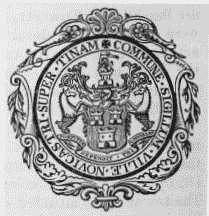
Seal and Arms.
In 1068, Edgar Atheling, and Malcolm, King of Scotland, with a numerous retinue of native troops and foreign auxiliaries, marched from the town to oppose the sovereignty of William the Conqueror, who, hastening to crush the league formed against him, met the northern forces at Gateshead Fell, and, entering the town after the defeat of his opponents, levelled it nearly with the ground. Robert Curthose, eldest son of the Conqueror, built a fortress here in 1080, which, in contradistinction to the old Roman castrum of Pons Ælii, was called the New Castle, whence the present name of the town. The barons who, under the conduct of Earl Mowbray, conspired to dethrone William Rufus, seized the castle; but it was besieged by that monarch, and taken by storm, in 1095. After the death of Henry I., the town was held by David, King of Scotland, in support of the claims of Matilda, and continued in the possession of the Scots till 1157, when it was restored by treaty to Henry II. In 1173, William of Scotland, surnamed the Lion, marching into England with an army of 80,000 men, was made prisoner by a small number of troops under the command of Ralph de Glanville, sheriff of Yorkshire, and brought into this place.
As a frontier station, Newcastle participated largely in all the border feuds, and was frequently selected as a place of rendezvous for the troops designed for the invasion of Scotland, and as a place of interview between the contending monarchs. Balliol, King of Scotland, in 1292 did homage for that crown to Edward I., in the hall of the castle, before a numerous assembly of nobles of both countries. To arrest the progress of the Scots under Wallace, who had pillaged the neighbourhood, Edward, having returned from Flanders, assembled the parliament at York in 1298, summoned the military force of the country, collected here in eight days an army of 100,000 men, and, marching into Scotland, defeated the enemy at Falkirk. During this reign the town was fortified with strong walls, which were begun by an inhabitant, on whose capture in an incursion of the Scots, they were completed by his fellow-townsmen, who, stimulated by his efforts, had joined him in the work. Edward II., in 1311, retired with his favourite Gaveston, from the pursuit of the exasperated barons, to Newcastle, where he remained till the arrival of the baronial troops headed by the Earl of Lancaster. In 1322, the town was besieged by the Scots, who, renewing their attempts a few years afterwards, were vanquished by Edward III. in their own territory. It was again attempted by David II., King of Scotland, during the absence of Edward in France; but his queen Philippa, assembling at Newcastle an army of 16,000 men, marched against the assailants, and defeated them at Nevill's Cross, near Durham, with the loss of 15,000 of their men and the capture of their king. In the reign of Richard II., a grand rendezvous of the military was appointed here, in 1388; and in the same year, the Scots, having again advanced to Durham, encamped on their return before this town, from which, after several skirmishes, they were compelled to retreat. In the reign of Henry IV., an army of 37,000 men was assembled here, in 1405, to oppose an insurrection under the Earl of Northumberland; and in that of Henry VI., commissioners met in the church of St. Nicholas, to arrange the terms of a treaty of cessation from hostilities between the English and the Scots, which was signed in August, 1451. Margaret, eldest daughter of Henry VII., was sumptuously entertained here, in 1503, on her way to Scotland, to celebrate her nuptials with James IV., to whom she had been affianced. In 1513, the Earl of Surrey passed through the place, with an army of 26,000 men, on his way to Flodden-Field.
In the insurrection of the Covenanters, during the reign of Charles I., the town was surprised and taken by the Scottish army, under Leslie, Montrose, and other disaffected leaders, who are said to have destroyed some of the public documents. At the commencement of the war between the crown and the parliament, the inhabitants declared for the former; and the town, being put into a state of defence, was held for the king, to whom the mayor and common-council presented a loyal address, with a loan of £700; also electing the Earl of Newcastle, the governor of the castle for the king, an honorary burgess. After frequent efforts of the parliamentarians to obtain possession of the town, it was besieged by the Earl of Leven, and, after a gallant resistance, was taken in October, 1644, and kept by that party till the conclusion of hostilities. In the beginning of 1646, Charles, having surrendered himself to the Scots at Newark, was conveyed to Newcastle, where he continued till the arrival of the parliamentary commissioners, to whose custody he was transferred in 1647, and by whose directions he was conducted to London. In the rebellion of 1745, Newcastle was the head-quarters of the king's forces under General Wade, prior to their advance into Scotland.
The town is situated on the acclivities and summits of three lofty eminences rising abruptly from the north bank of the river Tyne, along which it extends for nearly two miles in a direction from east to west. It is connected with the borough of Gateshead, on the opposite shore, by an elegant stone bridge of nine elliptical arches, erected in 1781, at an expense, including subsequent alterations, of £60,000, to replace the ancient bridge, which had been destroyed by a flood in 1771. In the more ancient portion of the town, the streets are inconveniently narrow, and the houses irregularly built, chiefly in the Elizabethan style; and in various parts are considerable remains of the walls that surrounded Newcastle. These walls, which were first raised in 1087, extended for more than two miles in circuit, were eight feet in thickness and twelve feet in height, and were defended by twenty-four embattled gateway and other towers, several of which, in a greater or less degree of preservation, are yet standing; they were encircled by a fosse twenty-two yards broad, now filled up. In the more modern parts of the town are spacious and well-formed streets, and uniform ranges of elegant buildings, with numerous streets erected since 1834, on a site formerly a field in the centre of the town, under the superintendence of Mr. Richard Grainger. The streets are well paved, and lighted with gas by a company whose works are situated in Manor-place, and in Forth-street. The whole supply of water was until lately brought from extensive reservoirs on the town moor and Car hill at the head of Gateshead, and from the Tyne at Low Elswick; an act, however, was passed in 1845 for supplying Newcastle and Gateshead with water from Whittle Dean, in the parish of Ovingham, and other places.
There are several public subscription and circulating libraries, exclusively of those belonging to the various literary and other institutions; also four subscription newsrooms, of which one forms part of the Exchange building, and another is in the building containing the assembly-rooms. The Literary and Philosophical Society was founded in 1793, and a handsome building was erected for its use in 1822-5, providing also accommodation for the New Institution, which had a few years previously been associated with it. The buildings, situated in Westgate-street, form a neat plain structure in the Grecian style, and comprise a library of about 15,000 volumes, a spacious theatre for the delivery of lectures, and the Natural History Society's museum of specimens and curiosities, among which is an Egyptian mummy. The principal entrance opens into a noble saloon, from which a handsome stone staircase, embellished with casts from the Elgin marbles, leads to the library, to the west of which is the museum, occupying two rooms, the larger of them 100 feet long. Beneath the museum, are two good rooms for the Society of Antiquaries (established in 1813), one in the early English and the other in the Egyptian style; and besides these, the building contains apartments for the Law and Medical Societies.
The Northumberland Institution for the Promotion of the Fine Arts was established in 1822; it is under the management of a president, treasurer, and secretary, and some elegant rooms have been erected in Nun-street, where an exhibition of paintings by the best masters, ancient and modern, annually takes place. The Mechanics' Institution was established in 1824, and consists of about 500 members; attached to it is a valuable library, and meetings are held for the discussion of scientific and philosophical questions monthly. The Botanical and Horticultural Society was established in 1824, and holds annually five meetings in the town, to award prize medals for the finest specimens of plants, flowers, and fruits. Assemblies are held periodically, in a handsome building erected in 1776, at an expense of £6700, raised by subscription; the centre of the principal front has a slight projection, and is embellished with a range of six Ionic columns, of which those at the angles are duplicated, rising from the parapet over the entrance to a considerable height above the wings, and supporting a pediment. The interior comprises a splendid ball-room, 94 feet in length, 36 feet wide, and 32 feet in height, lighted by seven brilliant cut-glass chandeliers; adjoining is an assembly-room for private parties, which, on public occasions, is used as a tea-room, with card and refreshment rooms, and beneath the large room is a supperroom, of equal dimensions, though less lofty.
The old Theatre, in Mosley-street, was a plain edifice, erected in 1787, at an expense of £6390, and had a neat portico in the centre of the front, above which, in an arched recess, were some dramatic emblems; this theatre proved an obstacle to Mr. Grainger's improvements, and he therefore erected an elegant building of stone in Grey-street, in exchange for that in Mosley-street, which was pulled down. The Circus, a spacious building in the Forth, was erected by the corporation, in 1789, and was opened for equestrian performances and pantomimes by a London company for some time; at present it is used chiefly as a riding-school. The Racket-court behind the assembly-rooms, was built in 1823, by subscription, at an expense of £3000; besides the court, which is 61 feet long and 32 feet wide, there are billiard-rooms and a bath on the premises. Races are held annually, in the third week of June; the course is two miles in circumference, and from the grand stand, a good building of stone, erected in 1800, a fine view of the whole is obtained. The Barracks and military depôt, on the town moor, were erected in 1806, at an expense of £40,000; they form a handsome range surrounded by a stone wall inclosing an area of 11 acres, and comprise a magazine and hospital, stabling for 200 horses, and extensive grounds for exercise and parade. The Forth was, till lately, a spacious and pleasant promenade, on the summit of an ascent from the Tyne, and was shaded with rows of lime-trees planted on each side; it comprised an area of 3 acres of fine meadow-land. The environs of Newcastle are agreeable, and afford walks and rides through tracts of picturesque and romantic character, among which are Jesmond and Heaton denes. Bridges have been thrown over the dells in several places; and at Scotswood, about three miles above the town, is a beautiful suspension-bridge across the Tyne, opened to the public on the 12th of April, 1831: it is 630 feet in length, the distance between the two points of suspension being 370 feet.
Newcastle has been one of the principal seats of trade from a very early period. The extensive mineral districts in the neighbourhood abound with coal, of which prodigious quantities are exported, not only to London and every part of Great Britain, but also to France, Holland, Germany, and other countries; and the numerous foundries and manufactories, for the establishment of which the abundance of coal has afforded the greatest facility, have contributed materially to the increase of its commercial prosperity and importance. The articles of manufacture are, every description of goods in cast and wrought iron, and brass; steel goods; sheet and pipe lead; patent-shot; white, orange, and red lead; paint; crown, flint, and bottle glass; earthenware and pottery of all kinds; alkali and other chemical preparations; copperas, soap, salt, and various other articles, for which there are numerous establishments. In the iron-works of Mr. William Shields are chiefly made anchors, chaincables, and Caldwell's patent self-acting windlasses, of which Mr. Shields is the sole manufacturer. In the Close are extensive iron-works and foundries for the manufacture of different kinds of machinery, and the conversion of iron into steel; and in the vicinity of Forth-street are other large establishments, also for various sorts of machinery, and for the construction of locomotive-engines, of which great numbers are shipped to different parts of England and the continent. There are other foundries and forges for the manufacture of steam-engines, machinery of all descriptions, and agricultural implements; and extensive works for building railway and other carriages. At Low Elswick are works for the manufacture of white, orange, and red lead, litharge, sheet and pipe lead, and patent-shot, the tower for which last, nearly 200 feet in height, forms a conspicuous object on the bank of the Tyne. There are similar works at Ouseburn and at Gallowgate, in which the process of separating the silver from the lead in a fluid state, by repeated crystallizations, under Mr. Pattinson's patent, is practised. The Newcastle CrownGlass works, on the Tyne, about a mile below the town, were originally established in the reign of James I., by Vice-Admiral Sir Robert Mansell, who brought over some workmen from Flanders for the purpose; they were for many years confined to the manufacture of a coarse glass for windows called broad glass, but the making of this, from the great increase of the excise duty, was discontinued, and the works are at present exclusively for crown glass. The Northumberland FlintGlass works, on the Forth bank, were formerly carried on in conjunction with the Crown-Glass manufactory at Lemington, under the designation of the Northumberland Glass-works, but are now limited to the making of flintglass in all its branches, of which immense quantities are manufactured for the home and foreign trades. Messrs. Cookson and Cuthbert have large plate-glass works; and there are two establishments for ornamental stained glass, in which many windows of elegant design have been executed. The manufactory for glass bottles, belonging to Messrs. Ridley, affords occupation to nearly fifty men; in the same establishment, alkali is made to a considerable extent. An establishment for the manufacture of earthenware, belonging to Messrs. Fell, furnishes employment to 200 persons; all kinds of Staffordshire ware are produced in great perfection. There are, in addition, very extensive potteries, brick and tile kilns, numerous tanneries, roperies, and mills for the manufacture of brown paper; flax and spinning mills, on a large scale, at Ouseburn; sailcloth manufactories; and breweries, among which is a joint-stock brewery. Ship-building, also, is carried on, for which there are several yards, with extensive docks and slips at St. Peter's, belonging to Messrs. Smith, who have built nnmerous first-class vessels, which rank among the best in the mercantile navy.
The chief trade of the port consists in the export of coal, grindstones, and the produce of the manufactories in the vicinity. The quantity of coal shipped annually averages about 1,500,000 tons; and previously to the remission of the duty on coal carried coastwise, and the reduction of that on coal shipped for foreign ports, a revenue was paid to government of £500,000. The Spital-Tongues colliery, the property of the mayor and free burgesses of Newcastle, produces coal of excellent quality for steamers, which is conveyed to the shipping-staiths by a subterranean railway two miles in length. The produce of the lead-works is estimated at 20,000 tons annually; and the value of the glass manufactured in the town and neighbourhood is not less than £500,000. The chief imports are, wine, spirituous liquors, and fruits, from the southern parts of Europe; corn, timber, flax, tallow, and hides, from the Baltic; and various articles from the opposite coasts. A considerable trade is carried on with North America, and a few vessels sail annually to the whale-fisheries at Davis' Straits. The number of vessels of above fifty tons registered as belonging to the port in a recent year, was 1372, of the aggregate burthen of 275,275 tons, and employing 13,905 men; there are also 119 steamers, of 2664 tons' aggregate burthen. The harbour was formerly accessible only to vessels of from 300 to 400 tons, on account of the shoals and sandbanks which impeded the navigation of the river; it now affords secure shelter, and has been rendered fully available to ships of the greatest burthen under an act of parliament obtained in 1839. The quay, also, reached only from Sandgate to the Tyne bridge, a distance of 450 yards, but, under the late improvements, has been extended from the bridge to Ouseburn, making its whole length 1540 yards. The custom-house, built in the year 1765, and subsequently enlarged by Mr. Sydney Smirke, at an expense of about £12,000, to render it adequate to the increased trade of the port, has a handsome stone front, and is in every respect well adapted to its use. An extensive warehouse erected by Mr. Sorsbie, in 1830, at an expense of £7000, is at present rented by government, as a bonding warehouse for tobacco; the building is 220 feet in length, and 60 feet in depth, and underneath it is a range of cellaring for bonded wines and spirits. Steam-boats sail every half hour to Shields, affording much accommodation, and many of the largest are employed in towing vessels up the river.
The Newcastle and Carlisle railway, which, crossing the northern part of the kingdom, connects the German Ocean with the Irish Sea, was begun by a company empowered to raise a joint-stock capital of £750,000, and a loan of £200,000; it is 62 miles in length, and was opened to the public in October, 1839. The company was authorised in 1846 to extend the line, half a mile, to Neville-street, Newcastle. The Newcastle and North Shields railway proceeds from the station in Pilgrim-street, through the coal districts north of the Tyne, to the town of North Shields, a distance of six miles and three-quarters, and forms in its progress a junction with the tramroads from the several collieries to the shippingstaiths on the river; it was opened in June, 1839. An act was passed in 1845 for the construction of a short branch from the line, to the quay at Newcastle; and in 1846 the railway was extended from North Shields to Tynemouth. The Newcastle and Berwick railway, formed under an act passed in 1845, proceeds by Morpeth and Alnwick to the station of the Berwick and Edinburgh line at Berwick. Newcastle also possesses, by means of the Newcastle and York line and other lines noticed in other parts of the work, ample facilities of communication in a southern direction, with the county of Durham, the manufacturing districts of Yorkshire and Lancashire, the Midland counties, and the metropolis. An iron railway-bridge, to connect the York line with the Berwick line, and in size and magnificence, perhaps, unequalled, is being erected across the Tyne, from Gateshead to Newcastle. The span of the arches is 125 feet, and they are supported on pillars 21½ feet high and 14 inches square; the approaches from Newcastle and Gateshead will be each 251 feet in length, and precisely similar. Two courses of three-inch planking will be placed beneath the rails, with a layer of Borrowdale's patent asphalted felt between the courses, to render them waterproof; and the carriage or common road beneath will be paved with wood to prevent vibration, and the footpaths planked. Every arch was completely erected on the contractor's premises, by itself, to enable the engineer to attest its strength and fitness. The total quantity of iron employed was about 6000 tons, and the contract is stated to have amounted to £120,000; the entire cost, exclusively of land and buildings, is estimated at £300,000. This stupendous undertaking is expected to be finished in the course of a few months, and will present the peculiar feature of a railway-bridge and a common carriage-road united in one work.
The Exchange, which also includes the guildhall, is a spacious structure, but, from repeated alterations, repairs, and enlargement, exhibits little uniformity of character in its style of architecture. That part appropriated as a fish-market, and as offices for the townclerk, forming the eastern portion, has recently been built; it is of semicircular shape, and is supported on eight massive pillars of the Doric order, inclosing an open area for the market. The entrance to the merchants' court, which is a handsome room thirty feet square, is at the east end of the guildhall, which is on the same floor; at the foot of the staircase is a statue in bronze of Charles II.: the interior of the merchants' court has been carefully preserved, and contains some fine specimens of carved oak. The exchange newsroom, on the ground floor, is a spacious apartment, in which the merchants of the quay meet. A Chamber of Commerce was established in 1815; it is under the superintendence of a president, vice-presidents, treasurer, and secretary, and a committee of twelve subscribers, and holds its meetings in the merchants' court. The Northumberland and Durham District bank, the Newcastle branch of the Bank of England, and the Union bank, are handsome edifices: the North of England Joint-stock bank, the post-office, the excise-office, and stamp-office, are situated in the Arcade, an elegant stone building, 250 feet in length, and 20 feet wide, of the Corinthian and Doric orders.
The market days are Tuesday and Saturday: the market for wheat, oats, and rye is held in the Corn Exchange, a large edifice of stone. The new market-places, one of the most distinguished features in the recent improvement of the town, occupy an area of more than two acres, and are inclosed with walls handsomely fronted with stone, towards Clayton, Grainger, Nun, and Nelson streets; the interior, to which are entrances by arcades, is 410 feet in length and 312 feet wide. The butchers'market consists of four spacious rows, in each of which are forty-eight shops, well ventilated and lighted; and in one of the arcades is a weigh-house, with apparatus of the most approved construction. This market-place is connected by an avenue with the vegetable-market, into which is an entrance from the adjacent streets by four arcades lighted by domes; the interior is surrounded with shops, inclosing an area 318 feet in length and 57 feet wide, in which are two elegant fountains of stone, after the model of one in the Borghese palace at Rome. The cost of these market-places, the stone for which was procured near the town, was £38,000, and the designs were by Mr. Dobson. Fairs commence on the 12th of August and 29th of October, and continue nine days each; on the first day great numbers of horses and cattle are exposed for sale, and on the second is a mart for leather. A fair, chiefly for fat-cattle, called the Stone's fair, is held on the 22nd of November; and within the last few years, another fair, also for cattle, has been appointed to be held on March 26th. Fatcattle and sheep are also sold in the cattle-market every Tuesday.
Newcastle, which is a borough by prescription, was first incorporated by Henry II., and was separated from Northumberland, and made a county of itself, by Henry IV. Queen Elizabeth in 1589 granted a new charter, under which, as ratified by succeeding sovereigns, the inhabitants continued to be governed until the passing of the act 5th and 6th of William IV., cap. 76, by which the corporation consists of a mayor, fourteen aldermen, and forty-two councillors, forming the council of the borough, which is divided into seven wards. The council appoint a sheriff, town-clerk, treasurer, and other officers; the recorder, appointed by the crown, is ex officio a justice of the peace, and the total number of magistrates is twenty-four. The freedom is inherited by all the sons of freemen, or obtained by servitude to a resi dent freeman: the old freemen are divided into several companies or fraternities, which have separate halls, some of them very handsome buildings. A copy of the seal of the fraternity of Ostmen, Hostmen, or Hoastmen, is annexed. The borough first exercised the elective franchise in the 23rd of Edward the First, since which time it has returned two members to parliament: the present electoral limits are co-extensive with those of the county of the town, comprising 5730 acres; the old boundaries, which were abrogated in 1832, included 2700 acres only. The number of electors is 5041, and the sheriff is the returning officer. Courts of assize and quarter-session for the town and county of the town are held for the trial of all offenders; also two courts of record weekly, for actions of every kind and to any amount, in both of which the recorder sits as judge. A guild is held thrice a year, for the purpose of proclaiming the names and trades of persons seeking admission to the freedom of the borough. The powers of the county debt-court of Newcastle, established in 1847, extend over the registration-districts of Newcastle and Castle Ward; the court of bankruptcy, established in 1842, embraces the counties of Northumberland, Durham, Cumberland, and Westmorland, and the town of Berwick.

Seal of the Ostmen.
The Guildhall, erected in 1658, was enlarged and partly rebuilt, and embellished with a new front in the Italian style, in 1809. The hall, in which the assizes, sessions, and other courts for the county of the town are held, is an elegant and spacious apartment: the floor is laid with chequered marble, and at the west end, over the magistrates' bench, are full-length portraits of Charles II., James II., and George III.; at the east end are, a portrait of Admiral Lord Collingwood, and fulllength portraits of Lord Chancellor Eldon and Lord Stowell. The Mansion House, formerly the residence of the mayor during his tenure of office, but, since the passing of the Municipal act, converted into a warehouse, is an extensive building of brick, situated in the Close. The Gaol and House of Correction for the town was erected in 1827, at an expense of £35,000, under the superintendence of Mr. Dobson; the site, inclosed by a stone wall 25 feet high, comprises an area of two acres, and the entrance is under a massive gateway-tower. The prison, which is constructed on the radiating principle, contains every requisite arrangement for classification; and in that part appropriated as the house of correction, are work-rooms, where the prisoners are employed in mechanical trades. The house for the governor of the prison, and also that for the master of the house of correction, are situated in the central tower, commanding a view of all the wards and airingyards; and in the upper story of the same building, is the chapel, lighted from the dome in the centre of the roof. The Court-house in which the assizes for the county and the Epiphany quarter-sessions are held, is situated within the precincts of the ancient castle, on a site which, by a special act of parliament, is included in the county of Northumberland; it was commenced in 1810, and completed in 1812, at an expense of £52,000, towards which the Duke of Northumberland contributed £3000. The buildings form a handsome range, 144 feet in length, and 72 feet in width; the north and south fronts are each embellished with a stately portico of the Grecian-Doric order, the former of four, and the latter of six lofty columns. On the right of the spacious entrance hall, is the crown court, and on the left the court of common pleas, both extending the whole breadth of the edifice; and in the wings are apartments for the judge, the grand-jury room, the petty-jury room, and rooms for the counsel and witnesses. Beneath the building are numerous arched cells well lighted and ventilated, for keeping prisoners during the assizes and sessions.
The town comprises only the civil parish of St. Nicholas, of which certain portions have been formed into the ecclesiastical parishes or districts of All Saints, St. John the Baptist, and St. Andrew. The living of St. Nicholas' is a vicarage, with that of Gosforth annexed, valued in the king's books at £50; net income, £753; patron, the Bishop of Carlisle, who, with the Dean and Chapter of Carlisle, is appropriator. The church, which was mostly rebuilt in 1359, is a spacious cruciform edifice, principally in the decorated style of English architecture, with a steeple in the later style. From the battlements of the tower rise octagonal turrets crowned with crocketed pinnacles, of which the central are lower than those at the angles; from these turrets spring four flying buttresses of graceful curve, meeting in a point, and supporting an elegant lantern turret, surmounted by a small crocketed spire terminating in a vane, forming altogether a structure unequalled for its light and beautiful proportions. The interior of the church retains much of its original character, though many of its ancient monuments were destroyed during the occupation of the town by the Scottish army, and others were removed during the alterations in 1783; the principal monuments at present are those of Sir M. W. Ridley, M.P., Vice-Admiral Collingwood, the Rev. Hugh Moises, A.M., Calverley Bewicke, Esq., and R. H. Williamson, Esq., recorder. On the south side of the church is a building erected in 1736, by Sir Walter Blackett, Bart., who assigned a salary to a librarian, for the preservation here of an ancient collection of works on divinity, bequeathed to the parish by Dr. Thomlinson.
The living of All Saints' is a perpetual curacy; net income, £333; patron, the Vicar of Newcastle. The church, situated on the summit of an eminence rising abruptly from the river, was founded prior to 1286, rebuilt in 1786, and consecrated on the 17th November, 1789, by the Bishop of Durham. It is a handsome structure in the Roman style, with a lofty tower surmounted by a light and elegant spire; the entrance is by a stately portico of four columns of the Doric order, supporting a pediment. In the vestry of the church, to which it was removed for greater security by the present incumbent, is a splendid monumental brass to the memory of Roger Thornton and Agnes his wife, of the date 1411, in excellent preservation. In the register, which commences in 1600, are the baptismal entries of William, Lord Stowell, in 1745, and his brother, John, Lord Chancellor Eldon, in 1751. A church district, called Byker, was formed out of All Saints' in 1844, by the Ecclesiastical Commissioners. The living of St. John the Baptist's is a perpetual curacy; net income, £244; patron, the Vicar of Newcastle. The church, founded prior to 1286, is a spacious cruciform structure in the early English style, with a square embattled tower and angular turrets; it contains several old monuments and an ancient font, and in the churchyard are the remains of John Cunningham, the pastoral poet, who died in 1773. On Arthur's Hill is a chapel of ease to St. John's, dedicated to St. Paul, a neat edifice erected in 1841, at a cost of £1600, and containing 700 sittings. At Benwell and Elswick are separate incumbencies. The living of St. Andrew's is a perpetual curacy; net income, £257; patron, the Vicar of Newcastle. The church is a very ancient structure, with a low embattled tower of large dimensions, and exhibits details in the various styles of architecture from the early Norman to the later English; it suffered greatly during the siege of the town in 1644, and has undergone many alterations and repairs. The chancel has been restored, and fitted up with stalls and open benches, by the present incumbent. A district church dedicated to St. Peter has been erected in St. Andrew's district, a very elegant structure after a design by Mr. Dobson, in the decorated English style: the interior consists of a nave 100 feet in length, with aisles, and a chancel of 40 feet; the nave is lighted by clerestory windows. Two handsome obituary windows of stained glass have been executed for the church by Mr. Wailes, of Newcastle; the one, raised by the present incumbent of St. Andrew's, to the memory of his father, the Rev. J. Dodd, late vicar of Newcastle; and the other, by the Ilderton family, to the memory of Miss Gothard. The living is a perpetual curacy in the gift of the Vicar, with a net income of £150. At Sighill is another incumbency.
The living of St. Anne's is a perpetual curacy, endowed with £150 per annum, and in the patronage of the Vicar. The church, erected by the corporation in 1768, at an expense of £4000, is in the English style, with a square embattled tower surmounted by a graceful spire, and contains 526 sittings. The ancient chapel near Tyne bridge, dedicated to St. Thomas, and annexed to the hospital of St. Mary Magdalene, was, after repeated alterations, taken down; and a new edifice, built in the Magdalene meadows at an expense of £7500, was consecrated by the Bishop of Carlisle, October 19th, 1830. It is an elegant structure in the early English style, with a lofty embattled tower strengthened by angular buttresses terminating in richly-canopied minarets of graceful elevation; the building contains 1600 sittings, of which 250 are free, and the duty is performed by the master of the hospital, and his chaplain, Fronting its south side is a handsome range of buildings in the Tudor style, called St. Mary's place, forming a terrace designed to harmonise with the chapel in picturesque effect. There are places of worship in Newcastle for Baptists, the Society of Friends, Independents, Wesleyans, Primitive Methodists, Methodists of the New Connexion, members of the Scottish Kirk, Sandemanians, Swedenborgians, Unitarians, Roman Catholics, and others. At Jesmond, in the vicinity of the town, a cemetery was completed in 1836, at a cost of £7000; it comprises about ten acres of ground, neatly planted, and has a handsome entrance, with a chapel on each side, in the Roman style. There is also a public cemetery on the west side of Newcastle, with a chapel, erected by the dissenters; and on the east of the town is another, which has been in use since the days of James I.
Of the schools, the principal is the free grammar school, which was founded by Thomas Horsley, mayor in 1525 and 1533, and was made a royal foundation in the 42nd of Elizabeth. Part of the buildings of the hospital of St. Mary the Virgin was, till lately, rented for its use by the corporation, by whom it is supported, and who appoint a head master, with a salary of £150; an usher, with £120; a mathematical master, with £100; and a writing-master, with £60. The school has, in common with others in the diocese of Durham, an interest in twelve exhibitions, of £20 per annum each, to Lincoln College, Oxford, founded by Bishop Crewe: two exhibitions of £10 per annum each, to either of the universities, were founded by Dr. Hartwell, for boys from this town and Durham; and a scholarship in Emmanuel College, Cambridge, was founded for boys from the same schools by Dr. Michael Smith. Bishop Ridley, the Protestant martyr, is said to have received the rudiments of his education in this school, though more probably in some similar establishment in the town prior to its foundation. In later times, Lords Eldon and Stowell, Vice-Admiral Lord Collingwood, Sir Robert Chambers, William Elstob, an eminent antiquary and divine, the poet Akenside, George Hall, Bishop of Dromore, and the Rev. John Brand, author of a History of Newcastle, and secretary to the Society of Antiquaries of London, received the early part of their education in the school. The Trinity House school was established in 1712, and rebuilt in 1753. A charity school was founded in 1705, by Mrs. Eleanor Allen, who endowed it with a certain sum, afterwards augmented; it was subsequently incorporated with the Clergy Jubilee school, founded in 1819 to commemorate the attainment of the 50th year of his prelacy by Shute Barrington, Bishop of Durham. St. Andrew's school was founded in 1705, by Sir William Blackett, who endowed it with the sum of £1000, which was augmented by his son, in 1728, with a rent-charge for clothing the children; a similar school for girls was established in 1792. St. John's school was founded in 1705, by John Ord, John Hewitt, and others, and the endowment, aided by subscriptions, now produces an income of £143. All Saints' charity school, commenced in 1709, has an annual income of £162, arising from bequests of George Whinfield and others, aided by subscriptions. The Royal Jubilee school was established in 1810, to commemorate the 50th anniversary of the accession of George III.; and a handsome building, in the Roman style, was erected for it in 1814, at an expense of £2195.
The Infirmary was instituted in 1751, and an extensive and handsome stone-fronted building, with a chapel attached, was erected in 1752, at an expense of £3700, on a piece of ground given by the corporation, who subscribe £100 per annum towards its support. The chapel, which is dedicated to St. Luke, was consecrated in 1754, and in 1801 a plan for enlarging the buildings was adopted by the governors, and the sum of £5329 was subscribed for the purpose. The yearly expenditure is about £3000. The Lying-in-Hospital was founded in 1760; the present building, a neat edifice in the Tudor style, was erected in 1829, at an expense of £1550. The house of recovery from Fever and other contagious diseases not admissible into the infirmary, was built in 1804, at an expense of £1800, on a site granted by the corporation. The Infirmary for Diseases of the Eye was established in 1822. The Lunatic asylum was built by subscription upon part of the Warden Close, which was granted for the purpose, in 1767, by the corporation, who greatly improved and enlarged the building in 1824, at a cost of £3000.
The Hospital of St. Mary Magdalene was founded for a master, who must have taken the degree of M. A.; three brethren, chosen from the single, aged, and decayed free burgesses of the town; and a chaplain to perform service in the chapel of St. Thomas à Becket, previously noticed as annexed to the hospital. After the dissolution of religious houses, it remained in the crown till the reign of James I., who incorporated the brethren, and vested the government of the hospital and the appointment of the master in the mayor and burgesses; the income is £983, but there is now no residence for the brethren. The Hospital of St. Mary the Virgin was founded for a master, who must have taken the degree of M. A., and six decayed, single, and aged men, appointed by the master; and the brethren were incorporated in the reign of James I.: the income is about £370, and there being no remains of the ancient building, the brethren reside in a building in Pudding Chare. The Hospital of the Holy Jesus was founded by the mayor and burgesses in 1683, for the relief of decayed freemen, and of their widows, sons, and daughters; and was incorporated under the designation of the "Master, Brethren, and Sisters of the Holy Jesus." Mrs. Davison's hospital was founded in 1715, for the support of a governess and five widows of Protestant clergymen, merchants, or freemen of the town; it is endowed with a rent-charge of £55. Another hospital was founded by Mr. Thomas Davison and his sisters, who gave £1200 to the corporation, for the maintenance of six unmarried daughters or widows of burgesses, for which purpose a building was erected by the corporation. Sir Walter Blackett's hospital was founded in 1754, for six unmarried and decayed burgesses, and endowed with £1200, given by that gentleman to the corporation, by whom the building was erected. These four institutions form a continuous range in the Manor Chare, of handsome appearance.
The Westgate hospital, a quadrangular building of stone, in the ancient Tudor style, was founded by the corporation, to celebrate the peace with France, in 1814; and in 1817 was augmented by 20 rooms. The Trinity almshouses were established by the guild or fraternity of the Blessed Trinity, which was originally incorporated in 1492, and was refounded in the reign of Elizabeth, in 1584, for the regulation of the pilotage of the harbour, and the erection of lighthouses on the coast. The buildings of the Trinity corporation comprise a hall for the transaction of business, a chapel, and two ranges of dwellings for thirteen aged men and thirteen widows; and the total number of brethren, including out-pensioners, is about 340. The Keelmen's hospital was founded in 1788, and is under the management of 21 guardians, who levy one penny per chaldron on the freight of all keels laden with coal at the port, and receive a payment of one farthing per chaldron on all coal exported from the Tyne by the owners or lessees of the mines. The buildings, which were erected in 1701, at an expense of £2000, on ground granted by the corporation of Newcastle, comprise an office, a club-room, and 60 apartments for the reception of poor keelmen. The Society of the Sons of the Clergy of the Diocese of Durham and Hexhamshire was instituted in 1709, and in 1725 was united with a similar institution for the deaneries of Alnwick and Bambrough. There are very considerable sums arising from various bequests, which are appropriated to the apprenticing of children, and as loans of money to young tradesmen; also numerous societies for the relief of the poor and indigent of every class; and benefit societies, comprising in the aggregate about 16,000 members. The poor-law union of Newcastle consists of the parochial districts of the town and their contiguous townships, with the exception of Cramlington; containing a population of 71,850.
Of the various Monastic Establishments anciently founded here, scarcely any vestiges exist; of several, the memorial is preserved only in the names which they have given to different parts of the town. In addition to the two hospitals of St. Mary Magdalene and St. Mary the Virgin, already noticed, there were, among others, a small Benedictine nunnery, founded in the reign of William the Conqueror, and dedicated to St. Bartholomew, the revenue of which at the Dissolution was £37. 4. 2.; a convent of Dominican friars, established in 1260, by Sir Peter Scot and his son; a convent of Franciscans, founded in the reign of Henry III.; a priory of brethren of the order De Pænitentia Jesu Christi, of which the first notice occurs in the year 1268; a priory of Carmelites, supposed to have been instituted in the reign of Henry III.; an establishment of Augustine friars, said to have been founded in 1290, by Lord Ros, Baron of Wark-upon-Tweed; and the priory of St. Michael, founded in 1360, for brethren of the order of the Holy Trinity, associated for the redemption of captives.
Newcastle has been distinguished as the birthplace of many eminent characters. Of these, are, Dr. John Scot, usually called Duns Scotus, who received his education in the Franciscan convent; his disciple and panegyrist, Hugh of Newcastle, a friar of the same convent; Dr. Nicholas Durham, a member of the convent of the White friars in 1360, and a zealous opponent of Wycliffe; William Elstob, a learned antiquary and divine, born in 1673, and his sister Elizabeth Elstob, born in 1683, and eminent for her knowledge of Saxon literature; the Rev. Henry Bourne, historian of the town, who died in 1733; Dr. Richard Grey, author of the "Memoria Technica," born in 1694; Mark Akenside, the poet, born in 1721; Sir Robert Chambers, judge of the supreme court of judicature at Calcutta, born in 1737; Dr. Charles Hutton, the eminent mathematician, born in the same year; John Scott, Earl of Eldon, and lord high chancellor of England, born in 1751; and Baron Collingwood, viceadmiral of the red. Thomas Bewick, the celebrated engraver on wood, resided at Newcastle from 1767 till his decease.