A Topographical Dictionary of England. Originally published by S Lewis, London, 1848.
This free content was digitised by double rekeying. All rights reserved.
'Newton', in A Topographical Dictionary of England, ed. Samuel Lewis (London, 1848), British History Online https://www.british-history.ac.uk/topographical-dict/england/pp404-407a [accessed 9 May 2025].
'Newton', in A Topographical Dictionary of England. Edited by Samuel Lewis (London, 1848), British History Online, accessed May 9, 2025, https://www.british-history.ac.uk/topographical-dict/england/pp404-407a.
"Newton". A Topographical Dictionary of England. Ed. Samuel Lewis (London, 1848), British History Online. Web. 9 May 2025. https://www.british-history.ac.uk/topographical-dict/england/pp404-407a.
In this section
Newton (St. Margaret)
NEWTON (St. Margaret), a parish, in the union of Chesterton, hundred of Thriplow, county of Cambridge, 6¾ miles (S.) from Cambridge; containing 183 inhabitants. The parish comprises 984 acres, of which 70 are common or waste. The living is a discharged vicarage, united to that of Hauxton. Some tithes were commuted for land and a money payment in 1798; a tithe rent-charge of £288 is paid to the Dean and Chapter of Ely, and one of £50 to the vicar of Thriplow, who also has a glebe here of 18 acres.
Newton (St. James)
NEWTON (St. James), a parish, in the union and hundred of Wisbech, Isle of Ely, county of Cambridge, 3¾ miles (N. N. W.) from Wisbech; containing 400 inhabitants. The living is a rectory, in the patronage of the Bishop of Ely, valued in the king's books at £18. 14. 9.: the tithes have been commuted for £667; there is a glebe-house, and the glebe contains 176¼ acres. A college, in honour of St. Mary, was founded here in the reign of Henry IV., by Sir John Colville, Knt.; it consisted of a warden, four chaplains, four clerks, and ten poor brethren, whose lands at the suppression were annexed to the rectory of Newton.
Newton
NEWTON, a township and ecclesiastical district, in the parish of Mottram-in-Longdendale, union of Ashton-under-Lyne, hundred of Macclesfield, N. division of the county of Chester, 8 miles (E. by S.) from Manchester; containing 7501 inhabitants, chiefly employed in the cotton manufacture. The manor was acquired in 1302, by Thomas de Newton, in marriage with the daughter and heiress of Thomas de Davenport. It was purchased of the representatives of Alexander Newton, the last heir male of that ancient family, who died about the year 1690, by Sir Charles Dukenfield, Bart., and has since passed with the Dukenfield estates. The township comprises about 800 acres, and stands high; the soil is clay, and coal and stone are wrought. The Manchester and Sheffield railway has a station here. The living is a perpetual curacy, in the patronage of the Vicar of Mottram; income, £150, with a house. The church, St. Mary's, was built in 1839, at a cost of £2500, and is in the Norman style. The Wesleyan Methodists have a place of worship; and there is a national school.
Newton
NEWTON, a township, in the parish of Prestbury, union and hundred of Macclesfield, N. division of the county of Chester, 5¼ miles (N. N. W.) from Macclesfield; containing 103 inhabitants. The manor seems to be an appendage of Butley. The township is bounded by the river Dean on the north, and by the Bollin on the south, and comprises 233 acres, the soil of which is partly clay and partly sand. According to Bishop Gastrell's Notitia Cestriensis, here was anciently a chapel of ease.
Newton
NEWTON, a township, in the parish of Middlewich, union and hundred of Northwich, S. division of the county of Chester, ¼ of a mile (W.) from the town of Middlewich; containing 1512 inhabitants. The manor was for a considerable time possessed by the family of Crewe, who sold it about the beginning of the present century to John Roylance, Esq., who built a mansion on the estate, called Manor Hall, for his own residence. The township comprises 844 acres, chiefly of a clay soil. The village is on the road from Middlewich to Northwich.
Newton, with Larton
NEWTON, with Larton, a township, in the parish of West Kirby, union, and Lower division of the hundred, of Wirrall, S. division of the county of Chester, 8¼ miles (N. N. W.) from Great Neston; containing 53 inhabitants. Newton formed part of the possessions of the old Lancashire family of Banastre, from whom it passed to the family of Venables, of Kinderton; after which, there is some difficulty in tracing the tenure of the lands until about the middle of the 17th century, when, partly by descent and partly by purchase, the greater portion of the township became the property of Thomas Bennett, who died in 1668. He left several claimants to dispute the manorial rights, bequeathing the New House estate, consisting of 252 acres, to the poor of his native parish, West Kirby. The manor is now claimed by the Jacsons, of Newton-Bank, near Preston-brook. Part of the township belongs to Sir William Stanley, Bart., whose ancestors, the Masseys of Puddington, are noticed in the reign of Elizabeth as holding lands in Newton. The township comprises 448 acres, of a clayey soil.
Newton (St. Petrock)
NEWTON (St. Petrock), a parish, in the union of Bideford, hundred of Shebbear, Black Torrington and Shebbear, and N. divisions of Devon, 7½ miles (S. W.) from the town of Great Torrington; containing 261 inhabitants. The parish comprises 1326 acres, of which 300 are common or waste land. The living is a rectory, valued in the king's books at £8. 5. 7½.; patron and incumbent, the Rev. F. D. Lempriere: the tithes have been commuted for £151, and the glebe comprises 76 acres. The church is an ancient structure. There is a place of worship for Baptists.
Newton, with Deanlane
NEWTON, with Deanlane, a district, in the parish of Hanley, union of Wimborne and Cranborne, hundred of Sixpenny-Handley, Wimborne division of the county of Dorset; containing 253 inhabitants.
Newton, with Northway
NEWTON, with Northway, a tything, in the parish of Ashchurch, union, and Lower division of the hundred, of Tewkesbury, E. division of the county of Gloucester; containing 230 inhabitants.
Newton
NEWTON, a township, in the parish of Clodock, union of Dore, hundred of Ewyaslacy, county of Hereford; containing 275 inhabitants. It is situated on the left bank of the river Eskley, and comprises 1571 acres. The vicarial tithes have been commuted for £30. 2., and the impropriate for £91. 10.
Newton, with Letton and Walford, county of Hereford.—See Walford.
NEWTON, with Letton and Walford, county of Hereford.—See Walford.
Newton
NEWTON, a township, in the parish of Croft, union of Leominster, hundred of Wolphy, county of Hereford; containing 104 inhabitants, and comprising 517 acres. The tithes have been commuted for £85.
Newton, with Scales
NEWTON, with Scales, a township, in the ecclesiastical parish of Lund, parish of Kirkham, union of the Fylde, hundred of Amounderness, N. division of Lancashire, 2 miles (S. E. by E.) from Kirkham; containing 324 inhabitants. Two carucates of land are mentioned as belonging to Newtune, in the Domesday survey. The Clifton family were lords of Scales before the 17th of Edward II. In inquisitions of the reigns of Henry VII. and VIII., Newton is named as a place within Scales. The township lies on the road from Kirkham to Preston, and comprises 1191 acres, of which 138 are roads, &c.; the cultivated land is equally divided between arable and pasture: the high land is strong clay, and the lower parts marshy; the surface generally is rather flat. Scales Hall is in the township; and a farmhouse now stands on the site of the ancient mansion of Newton Hall. The impropriate tithes have been commuted for £160, payable to the Dean and Chapter of Christ-Church, Oxford, and the vicarial for £90. A Blue-coat school was founded and liberally endowed by John Hornby, in 1707; and James Boys, in 1809, bequeathed £800 in furtherance of the charity, the annual income of which is at present about £481.
Newton, with Hardhorn.—See Hardhorn.
NEWTON, with Hardhorn.—See Hardhorn.
Newton
NEWTON, a parochial chapelry, in the parish and union of Manchester, hundred of Salford, S. division of Lancashire; comprising the townships of Bradford, Droylsden, Failsworth, Newton, and Moston; and containing 16,521 inhabitants, of whom 6127 are in Newton township, 2 miles (N. E. by E.) from Manchester. The manufacture of cotton, and the printing of calico, are carried on to a considerable extent, and silk-weaving upon a smaller scale. The village of Newton lies on the road from Manchester to Oldham; and the Manchester and Leeds railway and the Rochdale canal pass through the chapelry. The townships of Newton and Bradford are within the parliamentary borough of Manchester. The living is a perpetual curacy; net income, £155; patrons and appropriators, the Dean and Chapter of Manchester. The former chapel, dedicated to All Saints, and built prior to 1650, fell down on the 2nd of May, 1808: the present edifice was erected on its site, at an expense of £8000, defrayed by a rate on the inhabitants, and is a handsome structure in the later English style. The townships of Droylsden and Failsworth have lately been constituted ecclesiastical parishes, under the provisions of the act 6th and 7th Victoria, cap. 37; a church was consecrated in the latter in Nov. 1846, and one was erected in the former in 1847. There are several places of worship for dissenters; and numerous schools.
Newton (St. Botolph)
NEWTON (St. Botolph), a parish, in the union of Sleaford, wapentake of Aveland, parts of Kesteven, county of Lincoln, 2¼ miles (N. W. by W.) from Falkingham; containing 221 inhabitants. It comprises 1282 acres. There is a large quarry of stone, used for the roads and for building. The living is a rectory, valued in the king's books at £10; income, £340, arising from 227 acres of land allotted in 1767 in lieu of tithes; patron, Sir W. Earle Welby, Bart. The church is a modern structure, built at an expense of £900, raised by subscription. Here is a mineral spring.
Newton (St. Faith)
NEWTON (St. Faith), a parish, in the union of Kettering, hundred of Corby, N. division of the county of Northampton, 3¾ miles (N. by E.) from Kettering; containing 103 inhabitants. This place anciently included two townships, Great and Little Newton, each of which had a chapel of ease, subordinate to the church of Geddington. It formed part of the possessions of Pipewell Abbey. Newton is believed to be the spot where the Gunpowder Treason was hatched, and a small artificial island is pointed out near the church, as the actual scene where the conspirators held their meetings, in a summer-house, now destroyed. The island is marked by a fine yew and several cedar-trees. The parish comprises by measurement 1153 acres: limestone of good quality is abundant, and is quarried for burning into lime, and also for repairing highways. The roads from Stamford and from Uppingham to Kettering pass through; and the parish is watered by the Ise, a stream which falls into the river Nene near Wellingborough. The living is a donative; net income, £40; patron and impropriator, the Duke of Buccleuch. The two original chapels at Great and Little Newton were destroyed about the period of the great rebellion. The present church, which was probably at first the private chapel of the Tresham family, is in the decorated style, with a tower and spire: its appearance has been much injured by stucco on the walls, and by late repairs. The canopy work of the ancient piscina is still to be seen; and there is a brass bearing date Kalendas Maii anno d[omin]i m. cccc, to the memory of one of the Treshams and his wife Joanna: it represents two figures kneeling at the foot of a cross, at the head of which is a figure of St. Faith, with the inscription Sancta Fides, Virgo et Martyr. There are also fragments of a marble slab, with an engraved effigy in armour, to Richard Tresham.
Newton
NEWTON, a township, in the parish of Embleton, union of Alnwick, S. division of Bambrough ward, N. division of Northumberland, 10 miles (N. N. E.) from Alnwick; containing 488 inhabitants. The township is bounded on the east by the sea, and comprises about 1170 acres, of which 400 are pasture, and the remainder land well suited to the cultivation of wheat. There is abundance of coal and limestone; but the former, which is chiefly wrought on the lands of John Potts, Esq., of Benton Park, is of inferior quality, containing much sulphuret of iron and many other impurities. The beds of limestone in connexion with the coal strata abound with fossil shells, and one of them, much thicker than the rest, from the great number of cockle-shells found in it, is by the miners called the cockle-shell bed. Newton House, with 350 acres, is the property of Gordon Joseph Forster, Esq. At SeaHouses, in the township, a preventive station is maintained; the inhabitants are chiefly employed in taking turbot, lobsters, herrings, and other kinds of fish.
Newton
NEWTON, a township, in the parish of Chillingham, union of Glendale, E. division of Glendale ward, N. division of the county of Northumberland, 3½ miles (E. S. E.) from Wooler; containing 134 inhabitants. The Lill burn flows on the south of the hamlet, near which is an ancient cross, twelve feet high, called by the country people the Hurl Stone.
Newton
NEWTON, a township, in the parish of Bywell St. Peter, union of Hexham, E. division of Tindale ward, S. division of Northumberland, 7¾ miles (E. by N.) from Hexham; containing 127 inhabitants. It is about a mile north-west from Bywell, not far from the river Tyne. Considerable improvements have been made within the present century by repairing roads, and by rebuilding. A limestone-quarry is wrought.
Newton
NEWTON, a township, partly in the parish of Bingham, N. division, and partly in the parish of Shelford, S. division, of the wapentake of Bingham, union of Bingham, S. division of the county of Nottingham, 2 miles (N. N. W.) from Bingham; containing 149 inhabitants. There is a place of worship for Wesleyan Methodists.
Newton
NEWTON, formerly a representative borough, in the parish of Calbourn, liberty of West Medina, Isle of Wight division of the county of Southampton, 5¼ miles (W. by N.) from Newport; containing 95 inhabitants. This place was once called Francheville, which name occurs in a charter by Oymer, Bishop of Winchester, who bestowed such liberties and franchises on the burgesses of Newton as were enjoyed by those of Taunton, Alresford, and Farnham. This charter was confirmed by Edward II. and IV., and by Queen Elizabeth. The town was of considerable extent; it was burned by the Danes in 1001, and by the French in the reign of Richard II., and is now reduced to a very few cottages. The town-hall, now used as a Sundayschool, contained some curiously carved oak chairs, supposed to be of the time of Elizabeth, and which were removed to Swainston; it stands on an eminence overlooking one of the creeks of Newton harbour, which is formed by the junction of the river Newton with the sea, and which, at high water, will admit vessels of 500 tons' burthen. The borough had a titular mayor, chosen by the burgage-holders. It first sent representatives to parliament in the 27th year of the reign of Elizabeth, and was disfranchised by the act of the 2nd of William IV., in consequence of which the corporation property, including the town-hall, was sold, and the proceeds were applied to rebuilding the ancient chapel of Newton, retaining as much as possible its style of architecture. At the east end is a handsome window of stained glass, in which are the armorial bearings of the old corporation, with those of the Earl of Yarborough, Sir R. Simeon, and the Hon. Mr. A'Court; and on each side of the window are two niches preserved from the former chapel.
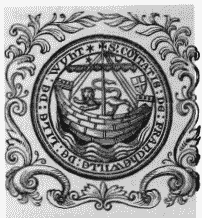
Corporation Seals.
Newton
NEWTON, a liberty, in the parish of Blithfield, poor-law union of Uttoxeter, S. division of the hundred of Pirehill, N. division of the county of Stafford, 3 miles (W. by N.) from Abbot's-Bromley; containing 214 inhabitants. It adjoins the spacious grounds of Blithfield Hall on the north-west.
Newton
NEWTON, with Biggin, a hamlet, in the parish of Clifton-upon-Dunsmoor, union of Rugby, Rugby division of the hundred of Knightlow, N. division of the county of Warwick, 3 miles (N. E.) from Rugby; containing 245 inhabitants. Newton is said to owe its name to a plantation which was then New, in comparison with the plantations in neighbouring places. A portion of the village belonged to the priory of Kenilworth; and in the reign of Richard II. the abbey of Combe held lands here, arising from several benefactions: the latter establishment retained its possessions till the Dissolution, when they passed to several proprietors. Biggin was anciently called Holme, and was a village in the Conqueror's time, though in the time of Dugdale little was left besides a mill: the modern name signifies a habitation. The hamlet or township is situated on the borders of Leicestershire, and bounded on the east by the ancient Watling-street; it consists of 1011 acres. Edward Cave, the founder and first editor of the Gentleman's Magazine, was born here in 1691.
Newton, N. riding of York.—See Leeming.
NEWTON, N. riding of York.—See Leeming.
Newton
NEWTON, a chapelry, in the parish, union, and lythe of Pickering, N. riding of York, 5 miles (N. by E.) from Pickering; containing 233 inhabitants. It comprises about 2000 acres. Denton Dale, here, is traversed by the Whitby and Pickering railway; and among its lofty and rugged acclivities is Killing Nab Scar, where a breed of large hawks have built their nests from an early period. There is a small chapel of ease; also a place of worship for Independents, and a free school.
Newton
NEWTON, a township, in the parish of Slaidburn, union of Clitheroe, W. division of the wapentake of Staincliffe and Ewcross, W. riding of York, 7 miles (N. N. W.) from Clitheroe; containing 461 inhabitants. It comprises by computation 3000 acres, including a hilly moorland district; the low land is very rich meadow and pasture. A lead-mine and smelt-mill here are the property of Peregrine Townley, Esq. The village is seated on the river Hodder, about a mile and a half south of Slaidburn; fairs are held in it on March 14th, April 14th, and September 16th. The tithes have been commuted for £90, and the glebe consists of two acres and a half. There is a place of worship for the Society of Friends, who have an endowed grammar school; and the Independents, also, have a place of worship. A national school was built in 1842, in which divine service is performed every Sunday. The township is entitled to send aged widows to Waddington Hospital.