
A Topographical Dictionary of England. Originally published by S Lewis, London, 1848.
This free content was digitised by double rekeying. All rights reserved.
'Raydon - Redditch', in A Topographical Dictionary of England, (London, 1848) pp. 645-652. British History Online https://www.british-history.ac.uk/topographical-dict/england/pp645-652 [accessed 26 April 2024]
In this section
Raydon (St. Mary)
RAYDON (St. Mary), a parish, in the incorporation and hundred of Samford, E. division of Suffolk, 3¼ miles (S. E. by S.) from Hadleigh; containing 592 inhabitants. The living is a rectory, valued in the king's books at £14, and in the gift of the incumbent, the Rev. Thomas Reeve: the tithes have been commuted for £500, and the glebe comprises 43 acres.
Raydon
RAYDON, a hamlet, in the parish of Orford, union and hundred of Plomesgate, E. division of the county of Suffolk; containing 14 inhabitants.
Rayleigh (Holy Trinity)
RAYLEIGH (Holy Trinity), a parish, and formerly a market-town, in the union and hundred of Rochford, S. division of Essex, 14 miles (S. E. by S.) from Chelmsford, and 34 (E. by N.) from London; containing 1651 inhabitants. This place, which was once the head of an honour or barony, was after the Conquest in the possession of Sweyn or Swene, who built a castle here, some ruins of which, with earthworks and ditches, yet remain. The parish is on the road from London to Southend, and comprises 2874 acres, whereof 55 are common or waste; the surface is elevated, and the soil stiff and heavy, with portions of poorer land. The town is situated upon the shore of Hadleigh bay; a brewing and malting establishment affords employment to about fifty persons; a cattle-fair takes place on Trinity Monday and Tuesday. The living is a rectory, valued in the king's books at £17. 17. 6.; net income, £774; patron, R. Bristow, Esq. The church is an ancient and stately structure in the early English style, with a lofty embattled tower surmounted by a shingled spire. There is a place of worship for Baptists.
Rayne (All Saints)
RAYNE (All Saints), a parish, in the union of Braintree, hundred of Hinckford, N. division of Essex, 1¾ mile (W.) from Braintree; containing 355 inhabitants. The parish anciently formed part of that of Braintree. The soil is chiefly a strong loam, and rests on clay, of which there are beds of great depth, worked for the manufacture of white bricks. The village is beautifully situated on the road to Dunmow, and contains several handsome houses; the scenery is enriched with a fine sheet of water. The living is a rectory, valued in the king's books at £14. 13. 4., and in the gift of the Earl of Essex: the tithes have been commuted for £500, and the glebe comprises 27 acres. The church, rebuilt in 1841, has a lofty tower surmounted by a small shingled spire.
Raynham (St. Helen and St. Giles)
RAYNHAM (St. Helen and St. Giles), a parish, in the union of Romford, hundred of Chafford, S. division of Essex, 4½ miles (N. W. by N.) from Purfleet; containing 777 inhabitants. This parish, which comprises about 3140 acres, is bounded on the west and south by extensive tracts of marsh land and by the river Thames; the surface is in some parts elevated, and the marshes afford luxuriant pasture in the summer months to numerous herds of cattle. The living is a vicarage, valued in the king's books at £10; net income, £412; patron and impropriator, J. C. G. Crosse, Esq. The great tithes have been commuted for £259, and the vicarial for £430. 15.; the glebe comprises 4 acres. The church is a small edifice, with a square tower of stone, and has some Norman remains.
Raynham, East (St. Mary)
RAYNHAM, EAST (St. Mary), a parish, in the union of Walsingham, hundred of Gallow, W. division of Norfolk, 4½ miles (N. E.) from Rougham; containing 124 inhabitants. The parish comprises 1635a. 1r. 9p., of which 574 acres are arable, 821 pasture and meadow, and 212 woodland. Raynham Hall, the admired seat of the family of Townshend, and which ranks as the third house in Norfolk, was built near the site of an ancient moated hall, in 1630, by Sir Roger Townshend, Bart., from the designs of Inigo Jones; it was enlarged and beautified by Charles, second Viscount Townshend, and further improvements were made by the first Marquess Townshend. The house is of brick and stone, on an eminence commanding delightful views; and contains some fine paintings, particularly the famous picture of Belisarius, by Salvator Rosa, presented to the second viscount by the King of Prussia. The living is a rectory, with that of West Raynham united, valued in the king's books at £18. 13. 4., and in the gift of the family of Townshend: the tithes of the parish have been commuted for £359. 10. The church, picturesquely situated in the park, is chiefly in the later English style, with a square embattled tower.
Raynham, South (St. Martin)
RAYNHAM, SOUTH (St. Martin), a parish, in the union of Walsingham, hundred of Gallow, W. division of Norfolk, 3½ miles (N. E.) from Rougham; containing 124 inhabitants. A Cluniac priory in honour of St. Mary and St. John, a cell to that of Castle-Acre, was founded here about 1160, by William de Lisewis. The parish comprises 1040a. 3r. 7p.; 701 acres are arable, 173 meadow and pasture, and 138 wood, exclusively of 28 acres of glebe land. The living is a discharged vicarage, united to that of Heloughton, and valued in the king's books at £6: the impropriate tithes have been commuted for £185. 5., and the vicarial for £106. 8. The church is chiefly in the early and decorated styles, and has a square embattled tower; the nave is lighted by clerestory windows. The mausoleum of the Townshend family is in the chancel; where are several monuments, one of which, of freestone, is beautifully sculptured, with recesses for figures, &c.
Raynham, West (St. Margaret)
RAYNHAM, WEST (St. Margaret), a parish, in the union of Walsingham, hundred of Gallow, W. division of Norfolk, 4½ miles (N. E.) from Rougham; containing 380 inhabitants. The parish comprises 1370a. 1r. 22p. About 984 acres are arable, 307 meadow and pasture, 39 wood, and 16 highway, together with a lake of 23½ acres, in the park belonging to Raynham Hall. The living is a rectory, united to that of East Raynham, and valued in the king's books at £13. 6. 8.: the tithes have been commuted for £345. 10., and there is a glebe of about 155 acres. The church, which has fallen into ruins, is crowned with ivy, and forms a very picturesque object in the village. The Rev. T. D. Whitaker, D.D., the antiquary, was born in the rectory-house in 1759.
Reach, with Heath, Bedford.—See Heath.
REACH, with Heath, Bedford.—See Heath.
Reach
REACH, a hamlet, partly in the parish of Burwell, hundred of Staploe, and partly in that of SwaffhamPrior, hundred of Staine, union of Newmarket, county of Cambridge, 5½ miles (W. N. W.) from Newmarket; containing 416 inhabitants. This was anciently a market-town, to which ships of considerable burthen had access before the draining of the fens; and it possessed a church. A large fair for horses, granted to the corporation of Cambridge by charter of King John, is held here on Rogation-Monday.
Read
READ, a township, in the parochial chapelry of Padiham, parish of Whalley, union of Burnley, Higher division of the hundred of Blackburn, N. division of Lancashire, 5 miles (S. S. E.) from Clitheroe; containing 467 inhabitants. In the reign of Edward III., the heiress of John Clogh de Read, whose family had for some time been proprietors here, married Sir Richard de Greenacres, who in the same reign gave a moiety of the manor of Read to the Nowell family. In this family it continued for 409 years, when, by order of the court of chancery, it was sold to J. Hilton, Esq.; and in 1799 it was again sold to the late Richard Fort, Esq. The township lies on the road from the village of Whalley to the town of Burnley, and comprises 866 acres of land. A court baron is held yearly in October, at Padiham Bridge, for the manor of Read. A Baptist meeting-house was built in 1788; and there is a national school with a small endowment. Dr. Alexander Nowell, the distinguished dean of St. Paul's, was born here in 1508; he died, aged 94, in 1602. Laurence Nowell, his brother, was dean of Lichfield, and a learned Anglo-Saxon antiquary. The late excellent Reginald Heber, Bishop of Calcutta, was maternally descended from the Nowell family, his mother Mary being the grand-daughter of Roger Nowell, Esq., who died without male issue in 1734.
Reading
READING, a borough and market-town, having separate jurisdiction, locally in the hundred of Reading, county of Berks, 26 miles (S. E. by S.) from Abingdon, and 39 (W. by S.) from London, on the road to Bristol; containing 18,944 inhabitants. This place is unquestionably of great antiquity, but whether it owes its foundation to the Romans or to the Saxons is a matter involved in great doubt. Its name rather tends to strengthen the supposition that its origin is to be attributed to the latter people, the term Reading being most probably derived from the Saxon words Rhea, "a river" or "an overflowing," and Ing, "a meadow." It is noticed in 871, by Asser, the biographer of Alfred, as a fortified town which was seized by the Danes, and to which, after their defeat at Englefield by Earl Ethelwolf, they retired and were pursued by that Saxon nobleman, who was killed in attempting to take the town. During the reign of Alfred, and occasionally in the time of his successors, the Danes appear to have again held possession of the place; and on the invasion of Sweyn, King of Denmark, to avenge the massacre of his countrymen in the reign of Ethelred, it was burnt to the ground in 1006, together with the nunnery founded here by Elfrida in expiation of the murder of her step-son, Edward the Martyr. From this calamity, however, it seems to have recovered prior to the Conquest, for in the great Norman survey Reading is noticed as forming part of the royal demesne.

Arms.
In 1121, Henry I. founded a magnificent monastery for monks of the Benedictine order, which he endowed with an ample revenue, and dedicated to the Holy Trinity, the Virgin Mary, and St. John the Evangelist; he invested it with the dignity of a mitred abbey, and bestowed on the abbots the privilege of coining money, that of conferring the honour of knighthood, and many other immunities. Henry was a frequent visiter here, and was interred in the abbey church, as was also his consort Adeliza. Stephen, who succeeded him, erected a strong castle at Reading, which after having been one of his garrisons during the contest with Matilda, was in 1153 given up to her son Henry, who, on ascending the throne, ordered this and several other fortresses that had been erected in the preceding reign, to be demolished. This monarch, in 1163, presided at a judicial combat which took place here, on an island to the east of Caversham Bridge, between Henry de Essex, the royal standard-bearer, and Robert de Montfort, who had accused his antagonist of treasonable cowardice in a battle with the Welsh, near Chester; Essex was vanquished, and his estates were forfeited to the crown, but his life being spared, he became a monk in the abbey. Henry II. visited the town on several other occasions, and in 1185 had an interview here with Herodius, patriarch of Jerusalem, who presented to him the keys of the holy sepulchre, and the royal banner of Jerusalem, and endeavoured, but without success, to induce him to undertake an expedition to recover Palestine from the Saracens.
In 1209, the professors and students of Oxford, disgusted with the severity with which they had been treated by the king's officer, in a dispute with the townspeople, retired to Reading, where they continued to prosecute their studies, till, on expiation being made, they returned to their ancient seat. In 1212, a council was held by the legate of the pope, for the purpose of effecting a reconciliation between King John and the bishops, whom he had driven into exile; and various other councils, civil and ecclesiastical, took place here in this and the following reign. Edward III. held a grand tournament at Reading in 1346; and in 1359, his son, John of Gaunt, was married in the abbey church, to Blanche, daughter and co-heiress of Henry Plantagenet, Duke of Lancaster. In 1389, a reconciliation was effected between Richard II. and his barons, through the mediation of John of Gaunt, who assembled here a great council with that object. In 1440 and 1451, parliaments were held in the town; and in 1452 and 1466, the grand parliament adjourned to the place from Westminster, on account of the plague. Henry VIII. often visited Reading, and in 1541 took up his residence for some time at the abbey. Edward VI., and the queens Mary and Elizabeth, were also frequent visiters, and the last-mentioned had a canopied pew appropriated to her use in the parochial church of St. Lawrence. In the beginning of the reign of Charles I., the courts of chancery, king's bench, and common pleas, with the court of exchequer, and the courts of wards and liveries, were held at Reading, in Michaelmas term, 1625, and again in 1635, in consequence of the plague which was then raging in the metropolis; and a commission under the great seal, for putting in force the laws against the popish recusants, was read in the courts here.
At the commencement of the civil war, the town was garrisoned for the parliament, but it was abandoned by the governor on the approach of the royal forces in 1642; after which it was held by the king's troops, till taken by the Earl of Essex, in the following year, after a siege of eight days. After the battle of Newbury, Essex marched to Reading, where he remained for two days; and on his departure it was again garrisoned for the king, who, on a visit in 1644, ordered the military works which had been erected to be demolished: there are still, however, many extensive remains of the outworks in the Forbury. The inhabitants suffered severely from the contributions levied by both parties. In 1688, some Irish and Scottish troops belonging to the army of James II. were posted at Reading, from which they fled on the approach of the Dutch troops under the Prince of Orange; but returning soon after, a skirmish took place in the town, in which the only officer in the prince's army who lost his life in the expedition, was killed. The anniversary of the battle, which was called "Reading Fight," was annually commemorated till about the year 1788, when the ceremony was discontinued.
The town is situated on the bank of the Thames, which separates it from Oxfordshire; and the river Kennet passes through it, and falls, about a quarter of a mile below, into the former river. The houses are in general well built, chiefly of brick, but the more modern generally of Bath stone; the streets are mostly wide, airy, and pleasant, are well paved, lighted with gas, and amply supplied with water. Within the last fifteen years, the town has been considerably extended westward on the road to Oxford, and also towards the east, and houses are still rapidly springing up. The surrounding country, thickly wooded and highly cultivated, is delightful from its rich and beautiful scenery, and its numerous seats. South-east of the town is Whiteknights, with its celebrated gardens, so long the favourite residence of the Duke of Marlborough. This picturesque domain, including the Botanic and American gardens, and the wilderness, and comprising altogether more than 284 acres, was sold in numerous lots by auction, in July 1846: villa residences will be erected on parts of the site. Early Court was the retreat of the late Lord Stowell, and Caversham Park the family seat of the earls of Cadogan; Englefield House is the princely residence of Richard Benyon de Beauvoir, Esq. The Literary Institution, comprising a library, readingrooms, and a residence for the librarian, is supported by a proprietary of £30 shareholders; the Philosophical Institution was established in 1831. There is a newsroom in High-street; and commodious baths have been formed in London-street. The theatre is a small building, opened for five or six weeks in the year, by a very respectable company.
From its situation near the confluence of two rivers, Reading at an early period became a place of commercial importance. The manufacture of woollen-cloth was introduced in the reign of Edward I.; and in the legendary history of the town, Thomas Cole, called Thomas of Reading, a rich clothier, is said to have obtained from the crown the standard measure for cloth, the yard being fixed to the precise length of the king's arm. John Kendrick, another eminent clothier in the town, in 1624 bequeathed £7500 in trust to the mayor and burgesses, part of it for building a house for the employment of the poor, which was soon afterwards carried into effect at an expense of £2000. The edifice forms a quadrangle, with a handsome gateway entrance; it was once a great ornament to the town, and from some unknown cause obtained the appellation of the "Oracle." In this establishment the woollen manufacture was conducted for a considerable period, with success; but during the parliamentary war the building was converted into a depôt for military stores. Afterwards, various other branches were carried on at the Oracle, among which were pin-making; the weaving of sheeting, sailcloth, and sacking; and the manufacture of floor-cloth. The weaving of coarse linen is at present pursued to a small extent; and there are manufactories for silk-ribbons and galloons, which afford employment to from 200 to 300 persons, and for floor-cloth and sailcloth; also some iron-foundries, and several yards for building boats.
The trade of the town, however, is principally in flour, of which 20,000 sacks are annually sent to London; in wheat, oats, beans, peas, and various kinds of seeds; in malt, the business in which has been for some time declining; and in oak-bark, timber, hoops, wool, cheese, beer, &c. The river Thames is navigable for barges of 150 tons' burthen, but none of that size are now used; the Kennet is navigable for barges of 110 tons, and on its banks are wharfs for landing goods. These rivers with the Kennet and Avon canal, which runs from Newbury, and the Wilts and Berks canal, commencing at Abingdon, open a navigable communication with the principal parts of the kingdom. In 1800, a canal was designed by Mr. Rennie, in consequence of the difficult navigation of the Kennet, in part of its course, to the west of the town; but it has not been so far completed as to afford all the advantages anticipated. The Great Western railway, which passes between the town and the river Thames, has a station here; and to the east is one of its chief earthworks, a considerable cutting at Sonning Hill. A railway, called the Berks and Hants line, runs southward for a mile and a half, and then branches off in two different directions; the one portion, 24 miles long, leading to Newbury and Hungerford, and the other, 13½ miles long, leading to the Basingstoke station of the London and Southampton railway. In 1846 an act was passed for a railway to Guildford and Reigate. The market-days are Wednesday and Saturday, the former for fruit, vegetables, butter, and poultry, and the latter, which is very numerously attended, for corn and provisions. The corn-market is held in the market-place, a convenient area, of which three sides are occupied by shops, and the fourth by the church of St. Lawrence; the market for provisions is in a quadrangular building, with a portico, including shambles, shops, and stalls. There is also, on Saturday, a market for cattle and store-pigs; and a market is held every Monday for fat-cattle, at Loddon bridge, about four miles distant, on the road to Wokingham. The fairs are on Feb. 2nd, May 1st, July 25th, and Sept. 21st: the three first are principally for horses and cows, and the last for cattle and cheese, of which latter from 500 to 700 tons are annually brought for sale.
Reading is a borough by prescription. It received charters, and grants of valuable immunities, from various sovereigns; from Henry III. in 1253, Edward III. in 1345, Henry VII. in the 2nd year of his reign, Henry VIII. in the 34th, and Charles I. in the 14th of his reign. This last was the governing charter till 1836. By the provisions of the Municipal act, passed in that year, the corporation now consists of a mayor, six aldermen, and eighteen councillors; the borough is divided into three wards, and the number of magistrates is eleven. The council, under the powers of the act, petitioned the crown for a continuance of the court of quarter-sessions, which was granted, and the recorder is sole judge. The borough has returned two members to parliament from the 23rd of Edward I. to the present time; the mayor is returning officer. The inhabitants are exempt from the payment of county rates. The old town-hall was taken down in 1786, and a commodious building was erected over part of the free grammar school; the great hall is a handsome room, 108 feet long, 32 wide, and 24 high, and adjoining it is the council chamber, decorated with several portraits, including an original of Queen Elizabeth by Zucchero, and others of Archbishop Laud, Sir Thomas White, the Kendricks, Sir Thomas Rich, &c. The petty-sessions for the Reading division of the county are held in the town every Saturday; the spring assizes and the Epiphany sessions for the county take place here, and the Michaelmas sessions alternately here and at Abingdon. The powers of the county debt-court of Reading, established in 1847, extend over the registration-districts of Reading, Wokingham, and Bradfield, and part of the district of Henley. The borough bridewell is built among the remains of the chapel of the Franciscans or Grey friars, who were established here in 1233; and a very beautiful window of the chapel is still remaining in good preservation. A new county prison, on the plan of the model prison at Pentonville, London, was completed in 1844, at a cost of £33,000.
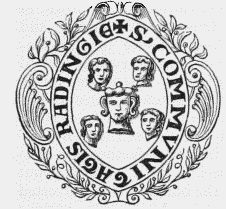
Corporation Seal.
The town comprises the parishes of St. Mary, containing, with the tything of Southcot, without the borough, 8431 inhabitants; St. Lawrence, 4285; and St. Giles, including the hamlet of Whitley, also without the borough, 6805 inhabitants. The living of St. Mary's is a vicarage, endowed with the rectorial tithes by Queen Elizabeth in 1573, valued in the king's books at £11. 12. 3½., and in the patronage of the Crown: the tithes have been commuted for £700, and the glebe comprises one acre. The present church, which is a plain massive structure in the later English style, with a square tessellated tower of stone and flint, was for the most part built about the year 1550, with materials supplied by the conventual remains; the spire of the previous church remained till 1594, when it was blown down by a violent storm of wind, and the present tower was erected. The living of St. Lawrence's is a vicarage, valued in the king's books at £10; net income, £276; patrons, the President and Fellows of St. John's College, Oxford. The church was rebuilt upon the same site, about the year 1434; the tower is a well-proportioned structure of flint: among the monuments is one with a bust of John Blagrave, an eminent mathematician, who died in 1611, and another in memory of the Rev. Dr. Valpy, for fifty years head master of the grammar school. The living of St. Giles' is a vicarage, endowed with the rectorial tithes, valued in the king's books at £14. 17. 3½., and in the patronage of the Crown: the tithes have been commuted for £512. During the siege of the town by the parliamentary forces in 1643, the church was much damaged. It was subsequently repaired and improved, although the present spire, which is of Riga fir covered with copper, was not erected until 1790; in 1827 the edifice was considerably enlarged, and an elegant window was opened over the altar. The parish of St. Lawrence formerly contained a chapel, founded and endowed in 1204, by Lawrence Burgess, bailiff of Reading, by permission of Abbot Halias, and dedicated to St. Edmund. In 1826, the Rev. George Hulme, at an expense of nearly £6000, erected a chapel in the parish of St. Mary, on the road to Oxford, capable of containing nearly 1200 persons. St. John's chapel, in St. Giles' parish, built by the Rev. Francis Trench at an expense of about £3000, was consecrated April 28th, 1837, and was endowed with £50 per annum by William Stephens, Esq. In Castle-street is a chapel, erected in 1798: it was originally in the Connexion of the Countess of Huntingdon; but in 1837 the majority of the congregation appointed a clergyman of the Church of England to be minister. There are places of worship for Baptists, Independents, Wesleyans, the Society of Friends, and Roman Catholics.
The Grammar School, which attained great celebrity under the late Dr. Valpy, was founded by Henry VII. about the year 1486, after the suppression of the old house of St. John, some of the buildings of which were appropriated to the use of the school, with a stipend of £10 per annum for the master, payable out of the crown rents in the town. Archbishop Laud, in 1640, gave £20 a year to the master, charged upon a farm, and this gift, from the increased value of the property, now amounts to about £40. There are two scholarships to St. John's College, Oxford, on the foundation of Sir Thomas White. The Blue-coat school was founded by Richard Aldworth, who in 1646 bequeathed £4000 to the corporation, in trust, for maintaining a schoolmaster, lecturer, and twenty boys; in 1666, Sir Thomas Rich, Bart., gave £1000 for six additional boys. In 1720, Mr. John West gave £1000, and some annual feefarm rents, for educating and apprenticing six boys. In 1723, Mr. Malthus left an annuity of £91 for the education of ten Green-coat boys; and in the same year, Mr. John Pottinger gave a sum of £15 per annum for the maintenance of two more.
The almshouses in St. Mary's Butts were founded and endowed in 1476, by John Kendrick, for eight aged persons, and were rebuilt by the corporation in 1775. Some houses in St. Giles' parish were established in 1617, by Barnard Harrison, and rebuilt by the corporation in 1796. In 1634 a house was founded by William Kendrick, for four aged men and one woman of the parishes of St. Lawrence and St. Giles. Certain houses erected in the same year by Sir Thomas Vachell, for six aged unmarried men, have a revenue of £40 per annum: a house for four aged widows of the parish of St. Lawrence was built in 1653, by John Webb, who endowed it with premises now let for £30 per annum; and some houses founded by John Hall in 1696, for five aged and unmarried women, have a rent-charge of £25. In 1624, Griffith Jenkins gave five houses for persons of the parishes of St. Lawrence and St. Mary. Thomas Cooks, Esq., by his will in 1810, bequeathed £1400 three per cent. consols. in augmentation of the allowance to John Kendrick's almspeople, £875 for William Kendrick's, £1050 for Vachell's, £875 for Hall's, £1400 for Harrison's, and £700 for Webb's; and Robert Hansons, Esq., in 1816 bequeathed a sum which was invested in £3112. 16. 9. three per cents., for the augmentation of the allowance to Harrison's and William Kendrick's almspeople. Archbishop Laud bequeathed £100 per annum, to be appropriated for two successive years to the apprenticing of ten boys, and every third year to be divided in marriage portions among five maidens, natives of Reading; and there are various bequests for other charitable uses. An hospital was lately erected by subscription, on ground presented by the late Viscount Sidmouth, at the entrance to the town from London, at a cost of about £12,000; it is designated the Royal Berkshire Hospital, and is a commodious building in the Grecian-Ionic style, with a light and elegant portico of six columns. The poor-law union consists of three parishes, and contains, with the out-hamlets, a population of 19,528.
Of the castle erected by Henry I. there is not the slightest vestige, and the only memorial is preserved in the name of Castle-street, near which it is supposed to have stood. Of the magnificent abbey, erected by the same king, and which, with the out-buildings, extended nearly half a mile in circuit, there remain the abbey gate, a fine specimen of the early Norman style, in tolerable preservation, and some vestiges in the abbey-mill: the walls were eight feet in thickness. A few years since, the site of the abbey was sold, and a great portion of the remaining walls demolished; but a small share, including part of the walls of the church, and the great hall, was purchased by subscription among the inhabitants, in order to preserve some at least of the ruins from destruction. A considerable portion of the materials of the church was, as before stated, used in erecting the parochial church of St. Mary; and a vast quantity has been employed in walls and buildings in various parts of the town. An hospital dedicated to St. Mary Magdalene, for twelve leprous persons and a chaplain, was founded in 1134, by Aucherius, second abbot of Reading; and in 1190, Hugh, the eighth abbot, established an hospital for 26 poor brethren, and for the entertainment of pilgrims and travellers, towards the maintenance of which he appropriated the church of St. Lawrence. Among the eminent natives of the town were, William of Reading, Archbishop of Bordeaux in the reign of Henry III.; and Archbishop Laud, who was born in 1573, his father being a clothier in Broad-street.
Reagill
REAGILL, a hamlet, and formerly a chapelry, in the parish of Crosby-Ravensworth, West ward and union, county of Westmorland, 3 miles (N. E.) from Shap; containing 163 inhabitants. This place, anciently Renegill, was granted by Robert de Veteripont to Shap Abbey, and after the Dissolution was given to Thomas, Lord Wharton, from whose descendants it passed by purchase to Sir John Lowther. There are no traces of the chapel, except in the names of certain inclosures, such as Chapel-Garth, Chapel-Lands, &c. The Rev. Randal Sanderson, in 1733, left £120 for the erection of a free school, to which the commissioners for the inclosure of the waste lands, in 1803, awarded an allotment now let for £25 per annum, for the support of the master, who also receives an annuity of £5, the donation of William Twaytes, Esq.
Rearsby (St. Michael)
REARSBY (St. Michael), a parish, in the union of Barrow-upon-Soar, hundred of East Goscote, N. division of the county of Leicester, 7½ miles (N. E. by N.) from Leicester; containing 471 inhabitants. The parish is situated on the river Wreke, and intersected by the road from Leicester to Melton-Mowbray. It comprises 1605a. 1r. 29p., of which 949 acres are arable: the soil is in some parts a strong clay, and in others of a light quality; the surface is in general level. Many of the inhabitants are engaged in the manufacture of hosiery. Here is a station of the Syston and Peterborough railway. The living is a rectory, valued in the king's books at £17. 9. 7.; net income, £645; patron, the Rev. N. Morgan. The tithes were commuted for land in 1761; the glebe altogether consists of 335 acres. The church is in the later English style.
Reasby
REASBY, a hamlet, in the parish of Stainton-byLangworth, W. division of the wapentake of Wraggoe, parts of Lindsey, union and county of Lincoln; containing 35 inhabitants.
Reaveley
REAVELEY, a township, in the parish of Ingram, union of Glendale, N. division of Coquetdale ward and of Northumberland, 7¼ miles (S. by E.) from Wooler; containing 74 inhabitants. It is situated on the north side of the river Breamish, at a short distance north-east from the village of Ingram; and the road between Morpeth and Wooler runs on the east.
Reculver (St. Mary)
RECULVER (St. Mary), a parish, in the union of Blean, hundred of Bleangate, lathe of St. Augustine, E. division of Kent, 10 miles (N. E. by N.) from Canterbury; containing 286 inhabitants. It comprises 1248 acres. The living is a vicarage, with that of Hoath annexed, in the patronage of the Archbishop of Canterbury (the appropriator), valued in the king's books at £9. 12. 3½.: the great tithes have been commuted for £575, and the vicarial for £128. The old church, a very handsome structure in the early English style, with two towers at the west end surmounted by spires, not being considered safe from the continued encroachments of the sea, which in Leland's time was more than half a mile distant, was partly taken down, and the materials employed in the erection of a new edifice at Hilborough, a hamlet about a mile off, in 1813. Little more of the ancient structure is remaining than the towers, which are kept in repair by the corporation of the Trinity House, whose property they now are. It was founded in the seventh century, together with a monastery for Black canons, by one Basse, upon some land granted to him by Egbert, King of Kent; and in 949, King Eadred annexed it to Christ-Church, Canterbury: it seems to have been afterwards of some note, and in 1030 was under the government of a dean. Here are also the remains of a flint wall supporting a raised platform, which may have been the ancient Regulbium, a Roman fort, within the wall of which a royal palace for Ethelbert and the monastery before mentioned were erected. Roman coins, cellars, cisterns, fibulæ, and a variety of trinkets, with some British and Saxon coins, have been discovered.
Redbourn (St. Mary)
REDBOURN (St. Mary), a parish, in the union of St. Alban's, hundred of Cashio, or liberty of St. Alban's, county of Hertford, 4 miles (N. W.) from St. Alban's; containing 2024 inhabitants. It comprises by measurement 4500 acres, of which about two-thirds are arable, and one-third pasture. Fairs are held on the Wednesday after New Year's day, the Wednesday in Easter-week, and Wednesday at Whitsuntide. The living is a discharged vicarage, valued in the king's books at £16. 5.; net income, £296; patron and impropriator, the Earl of Verulam. The church stands about a mile west from the village, and is approached by a fine avenue of elms. The Baptists, Independents, and Wesleyans have places of worship. Here was a cell of Benedictine monks from St. Alban's, dedicated to St. Amphibalus the Martyr and his companions.
Redbourne (St. Andrew)
REDBOURNE (St. Andrew), a parish, in the union of Glandford-Brigg, E. division of the wapentake of Manley, parts of Lindsey, county of Lincoln, 2½ miles (E. by N.) from Kirton; containing 377 inhabitants. The manor was anciently held by the Sothill family, and afterwards by the Carters, whose heiress carried it in marriage to Lord William Beauclerk, who in 1816 succeeded his nephew as Duke of St. Alban's, and died in 1825, when his titles and estates passed to his son, the present duke. A moated area here, called Tunstal, was the site of a small priory of Gilbertine nuns, founded in the reign of Stephen by Reginald de Crevequer, and given by his son Alexander to Bullington priory: another moated area, called the Castle Hill, was the site of a castellated mansion, the residence of the ancient lords of the manor. The parish lies on the road from Glandford-Brigg to Lincoln, near the river Ancholme; and a cut from the latter, about half a mile in length, affords the means of bringing coal within a mile of the village. It comprises 3827a. 31p., whereof 2751 acres are arable, 805 meadow and pasture, 145 wood and plantations, 72 in covers, 14 in nurseries and gardens, and 27 river, &c.: the soil is light and gravelly; the surface is level, and the scenery, though interspersed with wood, not of a striking character. Redbourne Hall, a large and handsome mansion near the village, in a finely wooded park, is the chief seat of the Duke of St. Alban's.
The living is a discharged vicarage, valued in the king's books at £5. 10., and in the gift of the Duke, whose tithes here have been commuted for £528: the vicarial tithes have been commuted for £250, and there is a small glebe; the glebe-house is an ancient, ivymantled residence. The present church, a remarkably beautiful structure in the later English style, was built, with the exception of some parts of the east end, in 1774, at the sole expense of the Rev. Robert Carter, then possessor of the estate; in 1785, the spire was taken down, and the tower considerably raised. A pillared porch of peculiar neatness forms the chief entrance. The interior of the building has been greatly beautified by the Duke of St. Alban's. In the nave are twelve finelypainted windows having full-length figures of the Twelve Apostles: the upper windows, also, are richly ornamented with stained glass; and over the communiontable is an illuminated window representing the Opening of the Sixth Seal; Rev. vi.; beautifully executed by Collins, from the celebrated picture by Danby. Over the entrance is a gallery, with an organ, built by Smith, and which, though small, is of excellent tone. The chancel contains several tablets in memory of the Carter family, and two of the last Duke and Duchess of St. Alban's; and on the north side is a tomb of an ancient knight, who died in the reign of Henry IV. A handsome schoolhouse and master's residence were built on the Castle Hill, in 1840; and juvenile and adult clothing-clubs have been established, to which the Duke and Duchess of St. Alban's are liberal contributors.
Redbridge
REDBRIDGE, a hamlet, in the parish of Millbrook, union of South Stoneham, hundred of Buddlesgate, Southampton and S. divisions of the county of Southampton, 3½ miles (N. W. by W.) from Southampton. This is an extensive and populous village of very remote origin. The early name, according to Bede's ecclesiastical history, was Reodford, afterwards changed to Rodbridge, and by corruption to Redbridge, probably from an ancient bridge which crossed the Test at this place. Here was a monastery in the infancy of the Saxon church; and in 687, Cynbreth, at that time abbot, converted and baptized the two brothers of Arvandus, Prince of the Isle of Wight, preparatory to their execution by command of Ceadwalla, King of Essex. Redbridge has always been a considerable resort for coasting-vessels; the trade inwards consists of coal, pinetimber, slates, and other articles, and the principal export is grain. The village is situated at the head of the Southampton Water, at the termination of the Andover canal; the adjoining country is rich and beautiful, and many strangers resort hither in summer for sea-bathing. The Southampton and Dorchester railway passes by. Ship-building affords employment to several persons; and there is a large brewery.
Redcar
REDCAR, a chapelry, partly in the parish of Upleatham, but chiefly in that of Marsk, union of Guisborough, E. division of the liberty of Langbaurgh, N. riding of York, 7 miles (N.) from Guisborough; containing, in 1841, 794 inhabitants. This place, which is on the sea-shore, has, from the advantages of its situation, risen from an obscure and humble village consisting of a few fishermen's huts, into a handsome wellbuilt town and fashionable bathing-place. It is seated in one of the most charming districts of which the county can boast, and overlooks the magnificent Tees bay, enlivened by the numerous vessels trading to the neighbouring ports. The landward prospect reaches to the range of the Cleveland hills, among which RoseburyTopping stands conspicuous; the easternmost of these hills terminate in beetling cliffs of from 500 to 700 feet in height, the most remarkable of which are Huntcliff, Roacliff, and Staiths Nab, the last forming the southeastern boundary of the bay. The shore of the bay is here composed of broad sands, extending five miles towards the east, and two or three towards the west, and of such firmness that the wheels of a carriage scarcely leave an impression upon them. The drives inward, amidst the lovely scenery of Kirk-Leatham and Wilton, and of the vale of Guisborough to Skelton and Upleatham, are rendered still more agreeable by the excellence of the roads, on which there is no turnpike impost for 18 miles in any direction. The town contains some good inns and lodging-houses, with several establishments of warm and cold baths; and in consequence of the formation of a line of railway to Redcar in 1846, parties desirous of enjoying the sea-breezes here, may at a moderate expense and in a few hours reach the town from the midland and even southern counties.
A considerable fishery is carried on, the fish taken being chiefly cod, ling, haddock, turbot, lobsters, crabs, and shrimps, of which great quantities are sent to various parts of the county; but the want of a convenient harbour renders the pursuit somewhat hazardous, and notwithstanding the fishermen's intimate knowledge of the coast, boats and lives are occasionally lost. Some protection, however, is afforded in landing, by the ridges of aluminous schistus rocks, called the Salt Scar and the East Scar, that extend into the sea opposite Redcar for above a mile, and form between them a capacious basin or natural harbour when the water falls below their level, which it does at half tide. These rocks, instead of being a series of irregular heaps, serve as piers, or breakwaters, and might readily be converted by the hand of man into a means of preventing the shipwrecks which are so frequent on this dangerous coast. Mr. Brooks, the civil engineer, conceived the idea of taking advantage of these natural features, and an application was made to parliament for a private bill, to form a harbour of 510 acres, having 30 feet at low water; but the proposition was rejected, on the principle that a measure so largely relating to the protection of life and property, should be undertaken by the nation. The subject is again attracting the attention of the legislature, from the strong recommendation of the committee on shipwrecks: and it is not unlikely that something will eventually be done, as there is no deep-water harbour, or harbour which can be entered at all states of the tide, in the long distance between the Frith of Forth and the Humber. An excellent life-boat establishment is supported by subscription; and here is a coast-guard station.
The chapelry comprises by computation 520 acres, of which about 150, including between 30 and 40 acres of inferior land called the sea banks, are pasture; the surface is level, and the soil various, being on the sea-side a sandy loam, and inland for the most part clay, producing excellent wheat. The Earl of Zetland is lord of the manor, and chief proprietor of the soil. Redcar House, a handsome mansion overlooking the sea, is the residence of James Ewbank, Esq. The chapel, dedicated to St. Peter, is in the later English style, with a square tower surmounted by four turrets, and contains 700 sittings, of which half are free; it was erected in 1828, at a cost of £2700, raised by subscription, aided by a grant of £500 from the Incorporated Society, and a donation of £600 from the late Earl of Zetland. The living is a perpetual curacy, in the patronage of the present Earl, with a net income of £56, and a neat parsonage-house, situated near the chapel. There are places of worship for Primitive Methodists and Wesleyans; and a parochial school, with a house for the master, built by the first Lord Dundas, is partly supported by the Earl of Zetland, and partly by subscription. The rocks in the vicinity of Redcar abound with fossil remains; and on the East Scar are found ammonites of 20 inches in diameter.
Reddal-Hill
REDDAL-HILL, an ecclesiastical parish, in the parish of Rowley-Regis, union of Dudley, N. division of the hundred of Seisdon, S. division of the county of Stafford, 3 miles (S. S. E.) from Dudley; containing, in 1841, about 6000 inhabitants. The district was formed in September 1844, under the act 6th and 7th Victoria, cap. 37; it is about two miles in length, and comprises numerous mines of coal and ironstone. The Dudley and Netherton canal forms one of the boundaries, and the line of the Stour-Valley railway passes through. The New British Iron Company have extensive iron-works here, and there are several chain-manufactories: the population is also employed in nailmaking. The living is a perpetual curacy, in the patronage of the Crown and the Bishop of Worcester, alternately; net income, £210. The church, of which the foundation stone was laid by Lady Ward in Oct. 1845, was consecrated in Feb. 1847, and is a stone structure in the early English style, built at a cost of nearly £3300, and having accommodation for 1216 persons. There are places of worship for Primitive Methodists, Baptists, and other dissenters. A school was built by subscription in 1790, on land given by Viscount Dudley and Ward, under the auspices of the Rev. Christopher Stephenson, for 24 years curate of Rowley-Regis, who left the interest of £300 for its support.—See RowleyRegis.
Reddenhall, with Harleston (The Assumption of the Virgin Mary)
REDDENHALL, with Harleston (The Assumption of the Virgin Mary), a parish, in the union of Depwade, hundred of Earsham, E. division of Norfolk, 1½ mile (E. N. E.) from Harleston; containing 1662 inhabitants, of whom 237 are in Reddenhall proper. The living is a rectory, valued in the king's books at £20, and in the gift of the Duke of Norfolk, on the nomination of the Bishop of Norwich: the tithes have been commuted for £990, and there are 34 acres of glebe. The church is in the later English style, with a lofty and handsome embattled tower; the nave is separated from the chancel by the remains of a beautifullycarved screen. On the north side of the chancel is a sepulchral chapel belonging to Gawdy Hall, in which is a splendid memorial to Mrs. Wogan; and the main building also contains several ancient monuments. The body of the church was built in 1311, by Thomas, Earl of Norfolk, and the tower in 1520; the latter was split by a tempest in 1616, but was braced with iron the same year.
Reddish
REDDISH, a township, in the parish of Manchester, union of Stockport, hundred of Salford, S. division of the county of Lancaster, 5½ miles (S. E. by S.) from Manchester; containing 1188 inhabitants. This township lies on the river Tame, which here separates the county from Cheshire. Its southern point touches upon the town of Stockport, and the Stockport canal passes through, in a direction from south to north.
Redditch
REDDITCH, a chapelry, in the parish of Tardebigg, union of Bromsgrove, Upper division of the hundred of Halfshire, Droitwich and E. divisions of the county of Worcester, 6 miles (E. S. E.) from Bromsgrove; containing about 4000 inhabitants. This flourishing place, which has the appearance of a small market-town, is pleasantly situated on a commanding eminence, near the Warwickshire border. The main street runs for a considerable length from north to south, having a very spacious triangular area near the centre; and on the east and west sides of this street are several other respectable streets and places, many of the houses being handsome and well built. Redditch has long been famous for the manufacture of needles, fish-hooks, fishing-tackle, bodkins, &c., here brought to the greatest perfection, and, with pin-making, lately introduced, affording employment to about 6000 persons in the town and neighbourhood. It has not been ascertained when the business was commenced in this quarter, but in 1770 it had already employed as many as a thousand persons. There are fairs for cattle, on the first Monday in August and third Monday in September. The powers of the county debt-court of Redditch, established in 1847, extend over the parishes of Tardebigg, Ipsley, Beoley, Alvechurch, and Coston-Hacket. The chapelry comprises 2132 acres of land. The living is a perpetual curacy; net income, £120; patron, the vicar of Tardebigg. The chapel, built in 1807, stands in the centre of the town, and is a plain but neat stone structure with a cupola, and contains 900 sittings. There are places of worship for Arminians, Independents, and Wesleyans; and a Roman Catholic chapel, a stately edifice, has been built at an expense of about £6000. A national school, the premises for which were rebuilt in the year 1845, is supported by a donation of £70 per annum from the Countess Amherst.