A Topographical Dictionary of England. Originally published by S Lewis, London, 1848.
This free content was digitised by double rekeying. All rights reserved.
'Shearsby - Shefford, Great', in A Topographical Dictionary of England, ed. Samuel Lewis (London, 1848), British History Online https://www.british-history.ac.uk/topographical-dict/england/pp58-66 [accessed 30 April 2025].
'Shearsby - Shefford, Great', in A Topographical Dictionary of England. Edited by Samuel Lewis (London, 1848), British History Online, accessed April 30, 2025, https://www.british-history.ac.uk/topographical-dict/england/pp58-66.
"Shearsby - Shefford, Great". A Topographical Dictionary of England. Ed. Samuel Lewis (London, 1848), British History Online. Web. 30 April 2025. https://www.british-history.ac.uk/topographical-dict/england/pp58-66.
In this section
Shearsby
SHEARSBY, a chapelry, in the parish of Knaptoft, union of Lutterworth, hundred of Guthlaxton, S. division of the county of Leicester, 7 miles (N. E.) from Lutterworth; containing 379 inhabitants. The chapel is dedicated to St. Mary Magdalene. Here is a saline spring, which has been found serviceable in scorbutic affections.
Shebbear (St. Lawrence)
SHEBBEAR (St. Lawrence), a parish, in the union of Torrington, hundred of Shebbear, Black Torrington and Shebbear, and N. divisions of Devon, 7¾ miles (W. N. W.) from Hatherleigh; containing 1160 inhabitants. It is bounded on the west by the river Torridge, and comprises 4577 acres, of which 1955 are common or waste land; the soil is of indifferent quality, the surface hilly, and the scenery enriched with wood. The living is a discharged vicarage, with the perpetual curacy of Sheepwash annexed, valued in the king's books at £11. 8. 4., and in the patronage of the Crown; net income, £243; impropriators of Shebbear, Messrs. Brent, Brand, and Snell. The church is an ancient structure, and has a Norman arch over the entrance, ornamented with foxes' heads in rough stone. There are places of worship for Bible Christians, Bryanites, and Wesleyans.
Sheen
SHEEN, a parish, in the union of Leek, S. division of the hundred of Totmonslow, N. division of the county of Stafford, 10 miles (E. by N.) from Winster; containing 402 inhabitants. The living is a perpetual curacy; net income, £63; patrons, alternately, J. Gould, Esq., and Captain Bateman. The church was nearly rebuilt in 1829, at the cost of £1100, raised by a parochial rate. Some children are educated for £12 a year, the produce of bequests.
Sheephall, Hertford.—See Shephall.
SHEEPHALL, Hertford.—See Shephall.
Sheepshead (St. Botolph)
SHEEPSHEAD (St. Botolph), a parish, in the union of Loughborough, hundred of West Goscote, N. division of the county of Leicester, 4 miles (W.) from Loughborough; containing 3872 inhabitants. The parish comprises 5171a. 2r. 28p. The soil is chiefly marl, clay, and a mixed loam; the surface is hilly, and the substratum contains blue granite, which is quarried for building and for the roads. The manufacture of hosiery affords employment to more than 500 families. The living is a discharged vicarage, valued in the king's books at £8. 10. 10.; net income, £350, arising from 181 acres of land; patron, C. M. Phillips, Esq. The church is an ancient structure in the early English style. There are places of worship for Baptists, Independents, and Wesleyans. John Lambert, Esq., bequeathed houses and land, now producing £60 per annum, for charitable uses.
Sheepstor
SHEEPSTOR, a parish, in the union of Tavistock, hundred of Roborough, Midland-Roborough and S. divisions of Devon, 7 miles (S. E. by E.) from Tavistock; containing 127 inhabitants. The parish comprises 3469 acres, of which 2550 are common or waste land. Sheepstor rock, one of the most remarkable granite heaps in Dartmoor Forest, is a conspicuous object from Roborough down: at the foot of it is situated the village, on the little river Mew. At Ailsborough, in the parish, a lofty eminence on Dartmoor, are very extensive tinmines. The living is annexed to the rectory of Bickleigh: the impropriate tithes have been commuted for £31. 3., and those of the incumbent for £61. 3.
Sheepwash (St. Lawrence)
SHEEPWASH (St. Lawrence), a parish, in the union of Torrington, hundred of Shebbear, Black Torrington and Shebbear, and N. divisions of Devon, 4 miles (W. N. W.) from Hatherleigh; containing 497 inhabitants. It comprises 1771 acres, of which 1360 are arable and pasture, and 230 woodland, coppice, and common; the soil is various, and the surface hilly. The river Torridge sometimes inundates the lower grounds of the parish. The village suffered great damage from a fire in 1743; it had formerly a market and three annual fairs. The living is a perpetual curacy, annexed to the vicarage of Shebbear: the impropriate tithes have been commuted for £110, and the vicarial for £99. The church is a neat structure with a tower. There is a place of worship for Baptists. In the parish are the remains of a large mansion called Upcott Avenel, to which a chapel was annexed.
Sheepwash, or Shipwash
SHEEPWASH, or SHIPWASH, with Ashington, a township, in the parish of Bothal, union, and E. division of the ward, of Morpeth, N. division of Northumberland, 4¾ miles (E.) from Morpeth; containing 76 inhabitants. Shipwash was once a parish of itself, and notice of a rector occurs in the 14th century ; the church was dedicated to the Holy Sepulchre, and the beautifully-formed basin of its font is still preserved. Connected with the church was an hospital for travellers passing the Wash, to which Bishop Hatfield in 1379 appointed a keeper, the office being at that time vacant. The lands are the property of the Duke of Portland and the rector of Bothal. The scenery is of pleasing character, enriched with plantations, and enlivened by the course of the river Wansbeck, which is navigable for keels and small boats as far as Shipwashbridge, an old structure of four arches. The ancient mansion of the Bulmer family, here, is beautifully situated amidst gardens, orchards, and shrubberies of great luxuriance; and the parsonage-house of the parish, which is within the township, surrounded by the windings of the river, is also a very interesting feature. The living is a rectory, consolidated with that of Bothal, and valued in the king's books at £3. 17. 1.
Sheepway
SHEEPWAY, a tything, in the parish of Portbury, union of Bedminster, hundred of Portbury, E. division of Somerset; containing 53 inhabitants.
Sheepy Magna (All Saints)
SHEEPY MAGNA (All Saints), a parish, in the union of Atherstone, hundred of Sparkenhoe, S. division of the county of Leicester, 3 miles (N. E. by N.) from Atherstone; containing, with the chapelry of Ratcliffe-Culey, 572 inhabitants, of whom 353 are in Sheepy Magna township. The parish comprises by measurement 1570 acres. The soil is a reddish marl in some parts, and in others a lighter loam, alternated with gravel; the surface is undulated, and the lower grounds are watered by the rivulet Sence, which falls into the Anchor. The living is a rectory, consisting of the North and South medieties, with the rectory of Sheepy Parva annexed, valued in the king's books at £13. 4. 9½. net income, £835; patron and incumbent, the Rev. T. C. Fell. The tithes were commuted for land and a money payment in 1810; the glebe altogether comprises about 550 acres. The church was rebuilt, with the exception of the tower, about 60 years since, when the stone coffins of several Knights Templars were mutilated. There is a chapel of ease at Ratcliffe-Culey; and at the Mythe, which belonged to the monks of Merevale, are some slight remains of an ancient chapel. About £18 per annum, arising from bequests, are distributed to the poor.
Sheepy Parva (All Saints)
SHEEPY PARVA (All Saints), a parish, in the union of Atherstone, hundred of Sparkenhoe, S. division of the county of Leicester, 3¼ miles (N. E.) from Atherstone; containing 104 inhabitants. It comprises rather more than 700 acres, and is separated from Ratcliffe-Culey by the Bosworth-Field brook. The living is a rectory, annexed to that of Sheepy Magna, and valued in the king's books at £13. 4. 9½.
Sheering (St. Mary)
SHEERING (St. Mary), a parish, in the union of Epping, hundred of Harlow, S. division of Essex, 3 miles (N. E.) from Harlow; containing 544 inhabitants. It is bounded on the west by the river Stort, and comprises about 1530 acres, of which 1249 are arable, 265 pasture, and 16 woodland; the soil is fertile, and under excellent cultivation. The living is a rectory, valued in the king's books at £13. 13. 4., and in the gift of the Dean and Canons of Christ-Church, Oxford: the tithes have been commuted for £507, and the glebe comprises 18 acres. The church is a small ancient edifice. A free chapel was endowed here by Christiana de Valvines, the site of which is still called Chapel Field.
Sheerness
SHEERNESS, a sea-port, market-town, and chapelry, in the parish of Minster, union of Sheppy, having separate jurisdiction, locally in the liberty of the Isle of Sheppy, Upper division of the lathe of Scray, E. division of Kent, 21 miles (N. E.) from Maidstone, and 50 (E. by S.) from London. This place, which is situated at the north-western point of the Isle of Sheppy, on the river Medway, at its junction with the Thames, was a mere swamp until the reign of Charles II., when the importance of its situation being appreciated, that monarch, early in 1667, directed the construction of a strong fort. In the same year, before the fortifications were in a very advanced state, the Dutch fleet entered the Thames, and made their memorable attack on the shipping in the Medway, having in their passage destroyed that portion of the works here which was completed, and landed some men, who took possession of the fort. In consequence of this, a regular fortification, with a line of heavy artillery, and of smaller forts higher up, on each side of the Medway, was formed; to which other works have since been added. A garrison is kept up, under the command of a governor, lieutenant-governor, fort-major, and inferior officers; and the construction of a royal dockyard, for repairing ships and building frigates and smaller vessels, has caused Sheerness to become a naval station of the first importance. In 1798, the mutiny of the fleet stationed at the Nore threatened the town with the most alarming consequences, and induced many of the inhabitants to make a precipitate retreat to Chatham and other places. In 1827 it suffered from a dreadful fire, which destroyed 50 houses, and property to the value of £60,000; the buildings were principally of wood, and have been replaced by others of brick.
Since the formation of the naval establishment, Sheerness has grown up into a considerable town, consisting of two divisions, Blue Town and Mile Town; and has of late years been much enlarged by the formation of some new streets. A pier and causeway extend from the town to low-water mark, a distance of about a quarter of a mile. The streets are paved and lighted under the authority of acts of parliament passed in the 41st and 49th of George III., and the inhabitants are supplied with water of excellent quality. Sheerness is the resort of much company, attracted by the facility of sea-bathing, which, however, is practicable only at certain states of the tide; the beach forms a delightful promenade. On the cliffs leading from the beach towards Minster is one of the most interesting views in the kingdom. The North Sea on the east; the rivers Thames and Medway, bearing innumerable vessels of all sizes, with the town and harbour of Sheerness, to the north and west; and the fertile valleys of Kent, with the Medway winding through them, and the towns and villages interspersed, towards the south; form a diversity of landscape rarely excelled. The harbour is safe and commodious, often presenting a splendid appearance, from the number of vessels in it. Passage-boats ply with every tide, and a steam-boat twice a day, to and from Chatham; and there is communication by steam-boats with London.
The dockyard has been extended and improved within the last thirty or forty years at an expense of about £3,000,000, and is now one of the finest in Europe, covering an area of 60 acres, surrounded by a well-built brick wall, which cost £40,000. The docks are sufficiently capacious to receive men-of-war of the first class, with all their guns, stores, equipments, &c, on board; and two steam-engines, each of 50-horse power are employed in pumping them dry. There is a basin, with a depth of water of 26 feet, which will hold six ships of the first class; and two of a smaller size are used for store ships and boats. The storehouse, which is the largest building in the country, is six stories high, with iron joists, beams, window-frames, and doors, and will contain at least 30,000 tons of naval stores: there are a victualling storehouse, a smithy, navy pay-office, masthouses, &c, The superintendent and principal officers of the establishment have handsome houses in the yard; and in the garrison is a noble residence for the portadmiral, in which are state-rooms for the reception of the royal family, the lords of the admiralty, &c. The chief establishment of the ordnance department has been removed hence to Chatham, where the stores for the fleet at the Nore, &c. are kept; and the ground formerly occupied by it has been added to the dockyard. An office connected with this department is still, however, retained here.
Considerable quantities of corn and seed, the produce of the isle, as well as large quantities of oysters (the beds of which extend all along the coast, as far as Milton,) are shipped for the London market. There are copperasworks within a few miles of the town; the pyrites, or copperas-stones, are collected in heaps upon the beach, from the falling cliffs, and carried away in vessels. The market is on Saturday; there is no regular market-place. The powers of the county debt-court of Sheerness, established in 1847, extend over the registration-district of Sheppy. The chapel, situated at Mile Town, and dedicated to the Holy Trinity, cost £3000, and contains 1070 sittings, of which 600 arc free, the Incorporated Society having granted £700 in aid of the expense: it was consecrated August 30th, 1836. At the east end of the dockyard, outside the wall, is a spacious chapel attached to the dockyard, the minister of which is appointed by the Board of Admiralty. There are places of worship for Baptists, Independents, Wesleyans, Primitive Methodists, and Roman Catholics; and a synagogue. Several reading societies are supported; also a mechanics' institute with an extensive library, where lectures are delivered during six months of the year. In sinking the wells here, the workmen, at the depth of 200 feet, discovered a complete prostrate forest, through which they were obliged to burn their way. Stones, well adapted for the composition of Roman cement, from being impregnated with copperas, are dredged up from the sea near the cliffs.
Sheet
SHEET, a tything, in the parish and union of Petersfield, hundred of Finch-Dean, Petersfield and N. divisions of the county of Southampton, ¾ of a mile (N. E.) from Petersfield; containing 390 inhabitants. It comprises 1549 acres, of which 276 are common.
Sheffield (St. Peter)
SHEFFIELD (St. Peter), a borough and parish, and the head of a union, partly in the N., but chiefly in the S., division of the wapentake of Strafforth and Tickhill, W. riding of York; containing 111,091 inhabitants, of whom 68,186 are in the township of Sheffield, 55 miles (S. W. by S.) fromYork.and 163 (N. N. W.) from London. This place, which is of great antiquity, derived its name, originally Sheaffield, from its situation on the Sheaf, near the confluence of that river with the Don. During the heptarchy, it formed part of the large manor of Hallam, which, though subsequently dismembered, and deprived of its jurisdiction, gave name to a still more extensive territory called Hallamshire, of which the limits are not accurately defined, but of which the district now forming the parish of Sheffield was the principal portion. At the Conquest, this district appears to have been divided among three Saxon lords, of whom Earl Waltheof, who married Judith, niece of the Conqueror, was suffered to retain possession of his lands. Afterwards, however, upon his entering into a conspiracy against his sovereign, the lands were confiscated, and his castle, a place of great strength and splendour, supposed to have occupied the bank of the river Riveling, was levelled with the ground. The manor of Sheffield, after the execution of Waltheof at Winchester, for this conspiracy, in 1075, was held under Judith, by Roger de Busli, a favourite of William's; and then, with other manors, by William de Lovetot, who erected a baronial castle, a church, and an hospital, which last was built on an eminence on the east side of the town still called Spital Hill. Thus, by rendering Sheffield the head of Hallamshire,' he laid the foundation of the prosperity and importance of the town.
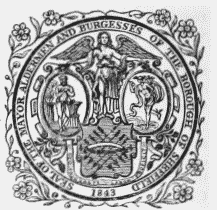
Seal of the Corporation of Sheffield.
On the death of William de Lovetot, the last lord without issue male, the manor and other possessions were conveyed by marriage, with Maude,his sole heiress, to Gerard de Furnival, in whose family they remained for many generations. Thomas de Furnival, in the reign of Edward I., contributed greatly to improve the condition of his tenants. He established a municipal court, with trial by jury; granted the inhabitants a market and fair, with other privileges; and on the 10th of August, 1297, bestowed on them a charter which has been called the Magna Charta of Sheffield, abolishing tyrannical exactions and services, for which fixed payments in money were substituted, and establishing a court baron for the more equitable administration of justice. William de Furnival, the last lord, died in 1383, at the family residence in London (an ancient mansion in Holborn, the site of which is now occupied by the buildings of Furnival's Inn); and the manor was transferred, by marriage with his only daughter and heiress, Joan, to Thomas de Neville, brother of Ralph, Earl of Westmorland, who was summoned to parliament by the title of Lord Furnival. On his decease, leaving only two daughters, the lordship passed by marriage with the elder, to the celebrated John Talbot, who, for his distinguished civil and military services, was created Earl of Shrewsbury. He was twice lord justice of Ireland: he commanded the English forces in the battle with Joan D'Arc, the Maid of Orleans; and was killed, with one of his sons, at the battle of Chatillon, in 1453. The manor continued for many years in the possession of his descendants, of whom George, the fourth earl, in the reign of Henry VIII. erected a splendid castle here, in which he afterwards received Cardinal Wolsey, who was given into his custody by the Earl of Northumberland, and whom he entertained for sixteen days, previously to his removal to Leicester Abbey. George, the sixth earl, was charged by Queen Elizabeth, in 1570, with the custody of Mary, Queen of Scots, who, after being confined for some time in the castle, was removed to the manor-house, in which she was detained as a prisoner till 1584. Gilbert, the last earl of Shrewsbury who was lord of Hallamshire, died leaving only three daughters, of whom the youngest married Thomas Howard, Earl of Arundel and Surrey, to whose descendant, on the death of the other sisters, the Countesses of Pembroke and Kent, without issue, the manor with all its appendages was conveyed. It has since that time been the property of the dukes of Norfolk.
During the war in the reign of Charles I., the inhabitants embraced the cause of the parliament, and Sir John Gell, with a part of the republican army, marching from Derbyshire, took possession of the castle in 1642; but the Earl of Newcastle, in the following year, advancing into Yorkshire at the head of 8000 men, the town and castle were surrendered to him without an effort to defend them. The earl, on his departure for York, appointed Major Beaumont governor of the castle, of which the royalists retained possession till the defeat of the king's army at the battle of Marston-Moor, in 1644, when the Earl of Manchester, who commanded the parliamentarian forces in this part of the country, sent Major-General Crawford with a detachment to reduce it. The garrison at this time consisted of 200 infantry and a troop of horse, and the town was strongly fortified; but after a protracted siege, the castle was surrendered upon honourable terms, and soon demolished. The lodge, or manor-house, was kept up for many years after the destruction of the castle, but it was at length abandoned as a residence by Thomas, Duke of Norfolk, in 1706, and the park of nearly 2000 acres was divided into farms. The remains of the mansion, which was formed into small tenements, are inconsiderable; the only tower left to indicate its former splendour, fell down in 1823.
The town is situated on the acclivities of a gentle eminence in a spacious valley. This valley, with the exception of an opening towards the north-east, is inclosed by a range of richly-wooded hills, beyond which rise others of greater elevation, forming a magnificent natural amphitheatre, commanding extensive prospects over the town and suburbs, diversified with pleasing villas, verdant fields, and thickly-wooded eminences. The rivers Sheaf, Don, and Porter, surround the town; while the mountain streams of the Riveling and Loxley form numerous reservoirs for the supply of the various factories, and appear like natural lakes, adding variety to the scenery. An ancient stone bridge of three arches across the Don, erected in 1485, and called Lady-bridge from a convent near it dedicated to the Virgin Mary, was widened in 1767, when the convent was taken down. Over the same river is an iron bridge of three arches; and an additional stone bridge, likewise of three arches, erected in 1828, affords a readier communication between the Rotherham and Barnsley roads and the corn and cattle markets. There is also a bridge across the Sheaf anciently of wood, rebuilt of stone in 1769, by the Duke of Norfolk, and widened and repaired in 1806; it is a neat structure of one arch. The town is above a mile in length from north to south, more than three-quarters of a mile in breadth, and consists of numerous streets, which, with the exception of some of the principal thoroughfares, are narrow and inconvenient; the houses are mostly of brick, intermixed with many of very ancient character. On the further banks of the three rivers are several extensive ranges of buildings.
Considerable improvements have taken place under an act obtained in 1818. The town is lighted with gas by two companies, now united; namely, a company whose works, at Shude Hill, were erected at a cost of £40,000; and a new company formed in 1836 for affording a supply on more moderate terms, for which they expended £80,000 in the erection of works on Blonk Island. The inhabitants were formerly furnished with water from springs in the neighbouring hills, by works erected in 1782, by a few private individuals; but the supply becoming inadequate to the increasing demands of the town, a company was formed in 1829, with a capital of £100,000, and incorporated by act of parliament. The service reservoir of this company's works has an elevation of more than 450 feet above the town, and covers an area of nearly six acres, containing about 20,000,000 gallons, supplied by a conduit from the Redmire reservoir, near the source of the river Riveling. The Redmire reservoir covers an area of 50 acres, and contains more than 200,000,000 gallons. The conduit is about 4½ miles in length, and passes for more than three-quarters of a mile through a tunnel of 3 feet diameter: for the remainder of the distance, it forms an open channel embanked with stone. It is conveyed over the valley of Tapton by an aqueduct supported on pillars of stone nearly 30 feet in height. From its great descent towards the town, the water acquires a force sufficient to raise it to the roofs of the highest houses. An act for a better supply of water was passed in 1845; and another act, for improving the streets, was obtained in 1846.
The Public Subscription Library was established in 1771, in Surrey-street, and removed in 1825 to the Music Hall, in which a convenient apartment is appropriated to its use: it now consists of more than 7000 volumes. The Literary and Philosophical Society was founded in 1822: the members hold their meetings in a room in the Music Hall, which contains their apparatus and a museum of fossils, shells, botanical specimens, and natural curiosities from the South Sea Islands; also a well painted full-length portrait of the poet Montgomery. The Mechanics' Library, in Watson's-walk, was established in 1824, and has nearly 5000 volumes; in the room is a marble bust, by Chantrey, of James Watt, the celebrated engineer. The Mechanics' Institution was established in 1832, for the improvement of scientific and mechanical pursuits, for which purpose lectures are delivered, and evening classes maintained under stipendiary teachers. A building has been just completed for it, at the corner of Tudor-street and Surrey-street: the rooms contain a museum and laboratory, with models of machinery, mechanical instruments, and a good collection of minerals. There arc also two large subscription newsrooms, one of them in a building specially erected in the East Parade, and the other in the Commercial-buildings. The Medical and Anatomical Society was established in 1829, and a handsome building has been erected for its use, at an expense of £2000, after a design by Messrs. Worth and Harrison; physicians and surgeons deliver lectures here to medical students in the town and neighbourhood. The Music Hall, in Surreystreet, erected in 1824, is a spacious Grecian structure, containing a good concert-room with a well-arranged orchestra; this is supported by an annual subscription of £1. 1., and concerts take place under the superintendence of the Philharmonic Society. The Assembly-rooms, in Norfolk-street, arc handsomely fitted up; and the Theatre, in Arundel-street, is a substantial building of brick, with a portico of stone surmounted by a pediment. The Circus, opposite the cattle-market, is in the Grecian style, with a stately portico of the Ionic order, rising from a rusticated basement, and supporting an enriched frieze and cornice. It was erected after a design by Mr. Harrison, in 1836, at an expense of £6000, by a proprietary of £25 shareholders; and is adapted both for dramatic performances and equestrian exercises. The exterior of the building is 110 feet in length, and 77 feet in depth.
The Barracks, situated about a mile from the marketplace, on the western bank of the river Don, contain accommodation for two troops of horse, with grounds for exercise j they were erected in 1794. The Public Baths, on the Glossop road, were built in 1836, by a proprietary of £20 shareholders, at an expense of £8000, including also the erection of several houses in the immediate neighbourhood for visiters. The buildings are fronted with Roman cement, and form an excellent establishment, consisting of two swimming baths, one 60 feet long and 30 wide, for public use, and the other, 48 feet long and 36 wide, with a fountain in the centre, for the use of subscribers; also two tepid plunging baths 12 feet square, with shower, vapour, and warm baths. The front of the building contains on the first floor a room for the delivery of lectures, or other public purposes. The Botanic and Horticultural Gardens, laid out in 1836, comprise 18 acres on a gentle declivity in the fertile vale of the river Porter. The principal entrance is through an elegant gateway of the Ionic order, on the model of the temple of Ilyssus at Athens; and the lower lodge, affording an entrance from the Ecclesall road, is in the style of a Swiss cottage. The range of conservatories, more than 100 yards in length, is ornamented with Corinthian pillars. A long and spacious walk leads from the central conservatory to a circular .shirt of water in which is a jet d'eau; the grounds are embellished with every variety of exotic plants, and disposed into numerous walks, parterres of flowers, shrubberies, and plantations. The land was purchased at a cost of £4000, and nearly £20,000 have been expended by the proprietors in bringing the gardens into their present state of perfection. On the opposite bank of the Porter, is the General Ctmetery, occupying an abrupt acclivity of nearly 6 acres in the vale of Sharrow, and completed at an expense of £13,000, by a body of shareholders, in 1836. The entrance lodge is of the GrecianDoric order, and a walk on the bank of the river leads from it to the lower catacombs, above which is a second range, with a terrace in front, and a parapet and balustrade. The chapel, situated on a greater elevation, is a handsome structure with a portico of fluted Doric columns; and the minister's house, which occupies a still higher portion of the acclivity, is of corresponding character. The grounds are tastefully disposed, and, in addition to the numerous catacombs, afford space for 7000 graves.
The principal manufacture is that of cutlery ware, for which the town appears to have been distinguished at a very early period, and for which the mines of coal and ironstone in its immediate vicinity render its situation extremely favourable. Chaucer, in his Canterbury Tales, notices the Sheffield "Thwytel," or "Whittel," a kind of large knife worn by such as had not the privilege of wearing a sword, and for the making of which, and also of iron arrow-heads, before the general use of fire-arms, the town had become celebrated. The principal articles subsequently manufactured here, were scythes, sickles, shears, and implements of husbandry. In 1570, many artizans from the Netherlands, driven from their country by the arbitrary measures of the Duke D'Alva, settled in various parts of England, under the patronage of Queen Elizabeth: such as were of the same occupation fixed their residence, by advice of her chamberlain, the Earl of Shrewsbury, in one spot; and most of them being artificers in iron, were placed on the earl's estates in Yorkshire, contributing greatly to promote the manufacture of cutlery in Sheffield. In the middle of the last century, considerable improvements were made, and the finer kinds of cutlery were introduced.
The superintendence of the trade was, in the sixteenth century, entrusted to twelve master cutlers, appointed at the court leet of the lord of the manor, and invested with powers to enforce the necessary regulations for the protection of the trade. In 1624, the cutlers were incorporated by act of parliament, "for the good order and government of the makers of knives, scissors, shears, sickles, and other cutlery wares, in Hallamshire, in the county of York, and parts near adjoining." Under this act the government was vested in a master, two wardens, six searchers, and 24 assistants, being freemen. The master, wardens, and assistants are chosen annually by the whole of the corporation: the master, on retiring from office, nominates the senior warden as his successor, and if his choice is objected to, he names another, till his election is confirmed by the whole body; the wardens are chosen from among the searchers. The corporation have power to make bylaws for the regulation of the trade, and to inflict penalties for the neglect of them; their jurisdiction extending over the whole of the district of Hallamshire, and all places within six miles of it. Several alterations were made in the constitution of the corporation by acts of parliament, in 1791 and 1801; but on account of their unpopularity, they were repealed in 1814 by an act granting permission to all persons, whether suns of freemen or strangers, to carry on trade any where within the limits of Hallamshire. This privilege, by encouraging men of talent from every part of the country to settle in the town, has tended greatly to its prosperity, and, by exciting a spirit of competition, has assisted to produce exquisite specimens of workmanship in the finer branches of the trade.
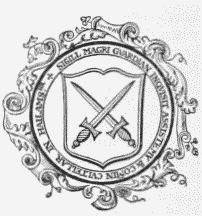
Seal of the Cutlers' Company.
The principal articles at present manufactured are table knives and forks, pen and pocket knives of every description, scissors, razors; surgical, mathematical, and optical instruments; engineers' and joiners' tools; scythes, sickles, files, and an endless variety of steel wares. Cutlery of cast steel was added about the commencement of the present century to the ancient articles of hammered steel. The manufacture of silver plate in all its branches, from the most minute to the most massive articles, is also carried on to a very considerable extent, and has obtained a high degree of celebrity for elegance of pattern and beauty of workmanship. The manufacture of silver-plated wares, which was introduced in 1742, has much contributed to the fame of the town, consisting of waiters, urns, tea-pots, candlesticks, and numerous articles previously made of solid silver. The rims, mountings, bosses, and other ornamental parts, are usually of solid silver; and as the Sheffield plate has a much thicker coating of silver on the other parts than the plated wares of other towns, it possesses a decided superiority, which opens for it a ready market throughout the world. The manufacture of numerous articles of a similar kind in Britannia metal, a sort of pewter composed of tin, antimony, and regulus, forms an important branch of foreign and domestic trade; and within the last few years much improvement has been effected by the substitution of the Albata or German silver, which is wrought into an infinite variety of useful and elegant articles. The manufacture of buttons and button-moulds, wire-drawing, and the refining of silver, are all largely carried on; and along the banks of the rivers are numerous iron and steel works, in which the heavier castings are produced; and extensive mills for slitting and preparing the iron and steel for the manufacturers. Among the manufactured iron goods are, stove-grates in every variety of pattern, fenders, fireirons, and boilers for steam-engines. A type-foundry was established in 1806, and in 1818 another on a more extensive scale, the proprietors of which purchased the business of a large house in London. There are several factories for the weaving of horse-hair seating for chairs, and various other establishments.
The Hall of the Cutlers Company, on the appointment of the master as returning officer of the borough under the Reform act, was taken down, and rebuilt in a style more adapted to the importance of the trade. It is a handsome structure of stone in the Grecian style, with a portico of the Corinthian order, supporting a pediment in the tympanum of which are the cutlers' arms in bold relief. The stately vestibule has a double flight of steps, leading to an elegant saloon, above which are, a banquetroom 80 feet long and 30 feet wide, lighted by a spacious and lofty dome; an assembly-room 53 feet long and 25 wide; and various other apartments. In the principal rooms are portraits of the late vicar of Sheffield, R. A. Thorpe, Esq., and Lord Wharncliffe; and three busts, one of the late Dr. Brown, by Chantrey, and the others of the late Earl Fitzwilliam, and John Rimington, Esq. The Commercial Buildings, in High-street, were erected in 1834, at an expense of £5000, by a company of £25 shareholders. They form a structure of the Doric order, and contain on the ground-floor some apartments for the post-office, in the rear of which are several offices for commercial purposes; and on the first story a reading-room, lighted by a dome.
The trade of the town is facilitated by its advantageous line of inland navigation. An act was obtained in 1726, for improving the river Don, and making it navigable for vessels of 20 tons' burthen to Tinsley, within three miles of the town. In 1739, another act was procured for bettering the navigation from Tinsley to Fishlake, near Thorne, whence a direct intercourse could be maintained with the river Humber and the German Ocean. This was accomplished in 1751; and in 1815, an act was passed for the construction of a canal from Sheffield to the Don at Tinsley. The head of this canal forms a basin at the eastern extremity of Sheffield, 200 yards long and 35 wide, which is approached from the town by a stone bridge over the river Sheaf, about 200 yards below the ancient bridge; adjoining the basin is a wharf, where vessels can load and unload under cover, with an extensive range of warehouses, and offices for the transaction of business. The basin is capable of containing more than 40 vessels of 50 tons' burthen. Vessels arrive from Hull, York, Gainsborough, Leeds, Manchester, and Thorne, at which last place those from London generally unload goods for Sheffield. Great facilities are also provided by railways to Manchester and to Rotherham. By the former, rapid intercourse is kept up with the counties of Lancaster and Chester, and the parts to the north and south of those districts; aud by the latter line, in conjunction with other lines, communication is had with various parts of the county of York, with the north of England, and with the midland and southern counties. The Sheffield and Rotherham railway, after much opposition, was commenced under an act obtained in 1836, authorising the proprietors to raise a capital of £100,000 in shares of £25 each, and a loan of £30,000 on mortgage; and the work was completed in October, 1838. It begins at the union of the Barnsley road with Saville-street. A short line was formed in 1846, connecting the Sheffield and Manchester railway with the Sheffield and Rotherham line; and in the same year an act was obtained for a railway to Worksop, East Retford, and Gainsborough, there to join the Gainsborough and Grimsby railway.
The market, originally granted in 1296, to Thomas de Furnival, is held on Tuesday and Saturday, the former day being chiefly for corn, and the latter for provisions of all kinds. The market-places have been enlarged and improved under acts passed in 1784 and 1827. The Corn Exchange is a spacious building with a portico of sixteen massive pillars in the principal front, erected on the site of the former Shrewsbury hospital, in the park, between the Sheaf and Canal bridges. Behind it are the cheese, poultry, and fish markets; and at some distance to the north, is the new cattle-market. The market for butchers' meat is held near Marketstreet, and the shambles, which are well arranged, have a covered walk in front. Beyond the shambles, is a market for butter, eggs, and poultry, around which are shops for the sale of vegetables; the entrance is by several gateways, one of which communicates with the shoe-market, and another with the vegetable and fruit market in King-street. A market for earthenware is held every Tuesday, in Paradise-square. There arc fairs annually on the Tuesday in Trinity-week, and the 28th of November, for cattle and toys; and a cheese-fair, held at the same times, has been established within the last few years, at which many hundred tons of cheese from the counties of Derby, Stafford, Chester, and Lancaster, are sold. An act for regulating the markets and fairs was passed in 1847.
The inhabitants received the elective franchise in the 2nd of William IV., with the privilege of returning two members to parliament; the right of voting is in the £10 householders, about 4200 in number, within the limits of the parish. The police establishment was formerly superintended by a body of commissioners comprising the town trustees, the master and wardens of the Cutlers' Company, and about a hundred of the principal inhabitants, who held their meetiugs in the townhall, and whose jurisdiction extended over the town and suburbs, and all places within three-quarters of a mile of the church. But on the 24th of August, 1843, Her Majesty, by charter, constituted the parish a municipal borough, to be governed by a mayor, 14 aldermen, and 42 councillors, and to be divided into nine wards. With regard to the administration of justice, the town is under the control of the mayor and the county magistrates for the district, who meet for the determination of misdemeanors, on Tuesday and Friday; and the October quarter-sessions for the West riding are held here, by adjournment. The county debt-court of Sheffield, established in 1847. has jurisdiction over the registrationdistricts of Sheffield, Ecclesall, and part of Wortley. The Town-hall was built in 1808, when the edifice previously appropriated to that purpose was taken down; it stands at the extremity of the Hay-market, on a site given by the town trustees, and is a neat substantial structure of stone, with a cupola. The building was considerably enlarged in 1833. On the grouud-floor are a large entrance hall and some offices; the first story comprises a spacious court-room, in which the quarter and petty sessions are held, and which is also adapted for public meetings. The basement contains a watch-house once used by the commissioners; and behind the building is the town gaol, containing a house for the keeper, and several cells for the temporary confinement of prisoners, who, after conviction, are committed either to the Wakefield house of correction, or to York.
The parish is about ten miles in length from east to west, and three in average breadth, comprising more than 22,000 acres. The lands are in a high state of cultivation, and the district abounds with mineral wealth. Coal and ironstone arc extensively wrought; of the former, which is of excellent quality, there are several mines in the Park and in the township of Attercliffe, and the upper strata being nearly exhausted, new pits have been opened for procuring coal from the lower beds. The ironstone is not usually of a kind adapted for the general purposes of the manufacturers of cutlery, and consequently, for finer works, large quantities are imported from Sweden, Germauy, and Russia. Sandstone and gritstone are quarried in several parts of the parish, and in others grey slate of good quality is found in considerable abundance.
The living is a vicarage, valued in the king's books at £12. 15. 2½.; net income, £500; patrons, P. Gell and A. Lawson, Esqrs. The tithes were commuted for land and annual payments in 1791. The vicarage-house is at the corner of St. James' street, and the glebe-land in its vicinity is covered with buildings. Three stipendiary clergymen, with an income of £400 per annum each, are appointed to assist the vicar, by a body called the "Twelve Capital Burgesses:" this body was incorporated by charter of Queen Mary, and holds certain lands and estates in trust, for the payment of the assistant ministers, the repairs of the church, and the relief of the needy poor. The church was erected in the reign of Henry I., and is a spacious cruciform structure, with a central tower and spire; but the edifice has been so altered by repairs, that, with the exception of part of the tower and spire, and a few small portions of the interior, very little of its original character can be distinguished. The chancel contains the first production from the chisel of Chantrey, a mural tablet with a bust of the Rev. James Wilkinson, late vicar, canopied with drapery, in Carrara marble, erected at the public expense. Many illustrious persons have been interred in the church, including Mary, Countess of Northumberland; Elizabeth, Countess of Lennox, mother of the unfortunate Lady Arabella Stuart; Lady Elizabeth Butler; four earls of Shrewsbury; and Peter Roflet, French secretary of Mary, Queen of Scots.
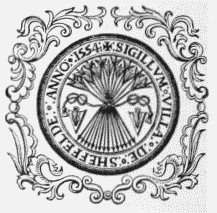
Seal of the Twelve Capital Burgesses.
St. Paul's chapel was erected in 1720, by subscription, towards which Mr. R. Downes, silversmith, contributed £1000. It is a handsome edifice in the Grecian style, with a tower surmounted by a well-proportioned dome, and a cupola of cast-iron; the interior is light, and elegantly ornamented, and contains a bust by Chantrey of the Rev. Alex. Mackenzie, with emblematical sculpture. The living is a perpetual curacy; net income, £136; patron, the Vicar. St. James' chapel, a neat structure in the Grecian style, with a campanile turret, was erected by subscription in 1788; the interior is well arranged, and the east window is embellished with a beautiful painting of the Crucifixion, by Peckett. The living is a perpetual curacy, also in the Vicar's gift; net income, £160. St. George's church, on an eminence at the western extremity of the town, erected in 1824, by the Parliamentary Commissioners, at an expense of £14,819, is a very handsome structure in the later English style, with a lofty embattled tower at the west end, rising to the height of 139. feet, and crowned with pinnacles. The interior is handsomely finished, and contains about 2000 sittings, 1000 of which are free; the large altar-piece is an admirable representation of Christ Blessing Little Children, painted and presented by Mr. Paris in 1831. The living is a perpetual curacy; net income, £365; patron, the Vicar. St. Philip's church, near the infirmary, was erected in 1827, by grant from the same commissioners, at an expense of £13,970, and is a neat edifice in the later English style, with a square embattled tower: the living is a perpetual curacy; patron, the Vicar; net income, £135. St. Mary's church, in Brammall-lane, of which the first stone was laid by the Countess of Surrey, in 1826, is also in the later English style, with a square tower, and a porch of elegant design. The exterior is enriched with a profusion of grotesque heads and other ornaments: the interior is well arranged; the nave is separated from the aisles by ranges of light clustered columns, which support the lofty and richly-groined roof. This church was erected by grant from the commissioners, at an expense of £12,650; the site and the cemetery being given by the Duke of Norfolk. The living is a perpetual curacy; net income, £350; patron, the Vicar. St. John's church, on Park-hill, was erected by subscription in 1837, on a site of three acres presented by his grace, at a cost of nearly £4000; it is a neat edifice, with a tower surmounted by a slender spire, and contains 1200 free sittings: the living is in the gift of Trustees. Five church districts have been formed in Sheffield under the act 6th and 7th Victoria, cap. 37, namely, Eldon, Holliscroft. Dyers-Hill, Moorfields, and Carver-Street: the incumbency in each is in the alternate gift of the Crown and the Archbishop of York. The district of Eldon, formed in 1846, comprises 45 acres, and contains a population of 5273; it is bordered by the GIossop or Manchester road on the north, and by the Chesterfield road on the south. The church is dedicated to St. Jude, and is a neat edifice, capable of accommodating 700 persons; the site was given by Samuel Younge, Esq., solicitor, of Sheffield. There are other incumbencies at Brightside, Pitsmoor, and Wicker, in the township of Brightside-Bierlow; at Fulwood, in the township of Upper Hallam; at Crookes, in that of Nether Hallam; and at Ecclesall-Bierlow, Attercliffe, Darnall, and Heeley: these are all noticed in other parts of the work. In the town are eleven places of worship for various denominations of Methodists, six for Independents, and one each for Baptists, Quakers, Roman Catholics, and Arians.
The Free Grammar school was founded in 1603, by Thomas Smith, who endowed it with £30 per annum; and in the following year letters-patent were obtained from James I., incorporating the church burgesses and the vicar, as governors. The old school occupied a low situation in Townhead-street; the present handsome edifice, in Charlotte-street, was built in 1825, at a cost of £1600, of which £1400 were raised by subscription. By augmentation of the original bequest, the endowment now consists of a farmstead and 6l¼ acres of land at Wadsley, yielding a rental of £140 per annum; and two houses with ten acres of land at Gilberthorpe, bequeathed by James Hill in 1709, and let for £20. 10. The Boys' Charity school, at the north-east corner of the parochial churchyard, was established in 1706; and the present school-house, a neat and commodious edifice of stone, was erected in 1825, on the site of the original building, at the cost of £3000. The school has an income of above £600, with which, aided by annual subscriptions, 90 boys are maintained, educated, and apprenticed. At the opposite corner of the churchyard is a similar school, in which 70 girls are maintained and educated, and afterwards placed out in service; a convenient house was erected in 1786, at an expense of £1500, by subscription. A school was also established in pursuance of the will of Mr. W. Birley, who, in 1715, bequeathed £900 in trust, for the purchase of an estate, one-third of the rental to be appropriated to the foundation of the school, one-third towards the maintenance of indigent tradesmen or tradesmen's widows, and the remainder towards the support of a minister to officiate in the chapel of Shrewsbury's hospital. The school is situated in School-croft, a little below the site of the old grammar school. The entire income of the charity is about £200 per annum. The Collegiate school, situated near Broom Hall and the Ecclesall New Road, was founded in 1835, by a company with a capital of £3000 in £25 shares; it is an elegant building in the later English style, with about 3½ acres of ground attached. There are four exhibitions of £25 each, for four years, to the universities of Oxford and Cambridge, and an annual prize of £25 to the first boy of his year, not intended for the university. The Wesleyan Proprietary Grammar school, in GIossop road, is on a very large scale, being intended for 300 boys.
Shrewsbury's Hospital was projected by Gilbert, Earl of Shrewsbury, in 1616, and completed in pursuance of his will, by the Earl of Norfolk, earl-marshal of England. It is amply endowed for eighteen men and eighteen women. The origiual buildings, erected in 1673, were lately taken down to make room for the marketplace, and the erection of the corn-exchange; and a neat range in the later English style has been erected on the southern side of the town, with a chapel in the centre. Hollis' hospital was founded in 1703, by Mr. Thomas Hollis, a native of the town, who, with some of his descendants, endowed it for sixteen aged women, widows of cutlers or of persons connected with the trade. The General Infirmary was first opened for the reception of patients in 1797, and has been deservedly regarded as entitled to the most liberal support. The premises, situated about a mile to the north-west of the town, and guarded against the too near approach of buildings by the purchase of 31 acres of surrounding land, were erected by subscription, at an expense of nearly £20,000, including the cost of the land. They are handsomely built of stone, and form a conspicuous ornament in the approach to the town.
Several extensive charitable benefactions have been made for the benefit of the inhabitants. The Town's Trust arose from a grant made by a member of the family of Furnival, about the year 1300, and consists of property in lands and tenements, shares in the Don navigation, &c., producing about £1400 per annum, for the improvement of the town. Mr. Thomas Hanby left £8000, of which the interest of £3000 was for the benefit of the Boys' charity school, and that of the remaining £5000 for distribution among housekeepers, members of the Church of England, and not under fifty years of age, two-thirds of the number to be men, and one-third women. The nomination is in the master and wardens of the Cutlers'Company, the past masters, the vicar and churchwardens, and the Town's Trust. Mrs. Eliza Parkins bequeathed £10,000, one-half of which is appropriated to the support of the Boys' charity school, and the interest of the remainder divided among such persons as the vicar, the three assistant ministers, and the churchwardens, shall select. Mrs. Mary Parsons bequeathed £1500 to be invested in the funds, and the proceeds annually divided among 48 aged and infirm silver-platers. Mr. John Kirby left £400, the interest of which is divided between two widows; and Mr. Joseph Hudson, of London, gave £200 in trust to the Cutlers' Company, to divide the yearly proceeds among sixteen of the most needy file-makers. There are several other bequests for distribution among the indigent; and various benefit societies. The workhouse for the township of Sheffield was erected in 1811 as a cottonmill, and converted to its present use in 1829, at a considerable expense. The poor-law union of Sheffield comprises three townships of the parish, together with the parish of Handsworth, the whole containing a population of 85,076.

Seal of the Town's Trust, or Sheffield Free Tenants.
On Spital Hill, near the town, stood an hospital founded in the reign of Henry II. by William de Lovetot, and dedicated to St. Leonard; but there is no vestige remaining; and of the ancient manor-house also, in which Cardinal Wolsey, and Mary, Queen of Scots, were confined, the ruins can but faintly be traced. In the year 1761, two thin plates of copper were ploughed up on a piece of land called the Lawns, each with an inscription commemorating the manumission of some Roman legionaries, and their enrolment as citizens of Rome. From the prevalence of iron-ore, the waters of the parish have a slight chalybeate property.
The Rev. Dr. Robert Sanderson, regius professor of divinity in the university of Oxford, and Bishop of Lincoln; and the Rev. Mr. Balguy, prebendary of North Grantham in the Cathedral of Salisbury, and an eminent disputant in the Bangorian controversy, were natives of Sheffield. It gives the title of Baron and Earl to the family of Holroyd.
Shefford, Bedfordshire.—See Campton.
SHEFFORD, Bedfordshire.—See Campton.
Shefford, Little or East
SHEFFORD, LITTLE or EAST, a parish, in the union of Hungerford, hundred of Kintbury-Eagle, county of Berks, 5¾ miles (N. E.) from Hungerford; containing 59 inhabitants. It comprises about 1130 acres, of which 30 are pasture, and the remainder arable. The soil is light, resting on chalk; the surface is diversified with hills, and the lower grounds are watered by the river Lambourne. The living is a rectory, valued in the king's books at £9. 11. 3.; patron, R. Harbert, Esq.: the tithes have been commuted for £371, and the glebe consists of 27 acres. The church contains some interesting monuments.
Shefford - Hardwicks
SHEFFORD - HARDWICKS, an extra - parochial liberty, in the union of Biggleswade, hundred of Clifton, county of Bedford; containing 13 inhabitants.
Shefford, Great or West (St. Mary)
SHEFFORD, GREAT or WEST (St. Mary), a parish, in the union of Hungerford, hundred of Kintbury-Eagle, county of Berks, 5 miles (N. E. by N.) from Hungerford; containing 562 inhabitants. It comprises 2246a. 22p., of which 2100 acres are arable, 50 pasture, and 60 woodland. Charles I. took up his quarters here on November 19th, 1644. The living is a rectory, valued in the king's books at £14. 3. 4., and in the gift of Brasenose College, Oxford: the tithes have been commuted for £833. 18., and the glebe comprises 110 acres. The church is principally in the Norman style, with a circular tower; near the north door is a niche for the figure of the Virgin, adorned with pinnacles, and the font is curiously carved with foliage. In the churchyard is the shaft of an ancient cross. There is a place of worship for Wesleyans.