A Topographical Dictionary of England. Originally published by S Lewis, London, 1848.
This free content was digitised by double rekeying. All rights reserved.
'Soughton - Southend', in A Topographical Dictionary of England, ed. Samuel Lewis (London, 1848), British History Online https://www.british-history.ac.uk/topographical-dict/england/pp139-149 [accessed 30 April 2025].
'Soughton - Southend', in A Topographical Dictionary of England. Edited by Samuel Lewis (London, 1848), British History Online, accessed April 30, 2025, https://www.british-history.ac.uk/topographical-dict/england/pp139-149.
"Soughton - Southend". A Topographical Dictionary of England. Ed. Samuel Lewis (London, 1848), British History Online. Web. 30 April 2025. https://www.british-history.ac.uk/topographical-dict/england/pp139-149.
In this section
Soughton, or Sychtyn
SOUGHTON, or Sychtyn, a township, in the parish of Llansillin, hundred of Oswestry, N. division of Salop, 3¾ miles (S. W. by W.) from Oswestry; containing 251 inhabitants.
Soulbury (All Saints)
SOULBURY (All Saints), a parish, in the union of Leighton-Buzzard, hundred of Cottesloe, county of Buckingham, 5 miles (W. N. W.) from LeightonBuzzard; containing, with part of the hamlet of Hollingdon, 615 inhabitants, of whom 499 are in the township of Soulbury. The London and Birmingham railway intersects the parish. The living is a perpetual curacy, with a net income of £116; the patronage and impropriation belong to Miss Lovett. Here is a place of worship for Wesleyans. Robert Lovett, in 1710, and the Rev. John Sambee, in 1728, endowed a school with property now producing an income of £77; and there are also some trifling bequests appropriated to charitable purposes.
Soulby
SOULBY, a township, in the parish of Dacre, union of Penrith, Leath ward, E. division of the county of Cumberland, 5 miles (S. W.) from Penrith; containing 61 inhabitants. The village is situated on the margin of the beautiful lake Ullswater.
Soulby
SOULBY, a chapelry, in the parish of KirkbyStephen, East ward and union, county of Westmorland, 4 miles (S. W. by W.) from Brough; containing 300 inhabitants. It comprises 2475a. 2r. 5p., of which about 936 acres are arable, and 1539 meadow and pasture. The village is considerable, and is situated on the rivulet Scandale, which is here crossed by a bridge of three arches, erected in 1819. Fairs for cattle and sheep are held on the Tuesday before Easter and on August 30th. The living is a perpetual curacy; net income, £78; patron, Sir George Musgrave, Bart.; impropriator, J. Wakefield, Esq. The chapel was erected in 1663, and the living endowed at the expense of Sir Philip Musgrave. Land was assigned in 1806, in lieu of all moduses and small tithes.
Souldern (St. Mary)
SOULDERN (St. Mary), a parish, in the union of Bicester, hundred of Ploughley, county of Oxford, 4 miles (E. by S.) from Deddington; containing 604 inhabitants. The Oxford and Birmingham canal passes through the parish, and the river Cherwell forms the western boundary. The soil on the lower grounds is clay, and stony on the hills: strong plank-stones are quarried here, and used extensively in the neighbourhood. The living is a rectory, valued in the king's books at £8. 14. 2., and in the gift of St. John's College, Cambridge: the tithes have been commuted for £428. 11.; there is a glebe-house, and the glebe contains 13¼ acres. The church is a curious ancient structure, with a tower in the Norman style; a Norman arch which separated the nave from the chancel was destroyed in rebuilding the latter, and other alterations and repairs have defaced the original character of the edifice. The churchyard and parsonage are the theme of Wordsworth's beautiful sonnet entitled A Parsonage in Oxfordshire. There is a place of worship for Wesleyans. In 1844 some sepulchral remains, believed to be Roman, were discovered in digging stone near the village; a description has been published by Sir H. L. Dryden, Bart., accompanied by drawings. Ploughley Hill, whence the name of the hundred, is in this parish.
Souldrop (All Saints)
SOULDROP (All Saints), a parish, in the hundred of Willey, union and county of Bedford, 5½ miles (N. E. by N.) from Harrold; containing 332 inhabitants. This parish, which was inclosed under an act passed in 1770, is situated in the north-western part of the county, upon the road between Bedford and Higham-Ferrers. A branch diverges from that road, in the immediate vicinity of Souldrop, to Harrold. The living is a discharged rectory, united in 1735 to that of Knotting, and valued in the king's books at £10. The tithes were commuted for land and a money payment in 1770, and under the recent Tithe act have been further commuted for a rent-charge of £8. 17. 4.; there are 68 acres of glebe. The body of the church has been rebuilt, but the ancient steeple remains, and, though not lofty, forms a conspicuous object for several miles round.
Soulton
SOULTON, a township, in the parish and union of Wem, Whitchurch division of the hundred of North Bradford, N. division of the county of Salop; containing 34 inhabitants.
Sound
SOUND, a township, in the parish of Wrenbury, union and hundred of Nantwich, S. division of the county of Chester, 3 miles (S. W. by S.) from Nantwich; containing 255 inhabitants. It comprises 1067 acres, of which 37 are common or waste: the soil is partly clay and partly sand. The impropriate tithes have been commuted for a rent-charge of £92. 5.; and the vicarial for £21. 3. 11., payable to the vicar of the parish of Acton. The Primitive Methodists have a place of worship in the township.
Sourton (St. Thomas à Becket)
SOURTON (St. Thomas à Becket), a parish, in the union of Oakhampton, hundred of Lifton, Lifton and S. divisions of the county of Devon, 4½ miles (S. W.) from Oakhampton; containing 732 inhabitants. The parish comprises about 3740 acres, exclusive of a large tract of common formerly belonging to Dartmoor; the surface is hilly. The village is on the road from Oakhampton to Tavistock. The living is annexed to the rectory of Bridestowe.
South Ambersham.—See Ambersham, South.
SOUTH AMBERSHAM.—See Ambersham, South. — And other places having a similar distinguishing prefix will be found under the proper name.
Southacre (St. George)
SOUTHACRE (St. George), a parish, in the union of Swaffham, hundred of South Greenhoe, W. division of Norfolk, 3½ miles (N. by W.) from Swaffham; containing 100 inhabitants. It comprises 2492a. 6p., of which 2066 acres are arable, 123 pasture, and 207 woodland. The river Nar runs along the northern boundary. The living is a rectory, valued in the king's books at £10. 18. 1½., and in the gift of A. Fountaine, Esq.: the tithes have been commuted for £510; there is a glebe-house, and the glebe comprises about 44½ acres. The church contains portions in the three styles of English architecture, with a square embattled tower; at the east end of the north aisle is a chapel, in which is the effigy of a Knight Templar, supposed to represent Sir Eudo Harsick, who died in 1292, and by whom it is thought the church was erected. At Racheness, in the parish, in the time of Henry II., was an hospital for lepers, subordinate to the priory of Castle-Acre. There are slight remains of the ancient Hall, the seat of the Harsicks.
Southall
SOUTHALL, a hamlet, in the parish of Hayes, union of Uxbridge, hundred of Elthorne, county of Middlesex, 9½ miles (W.) from London. A considerable market for fat-cattle is held every Wednesday; and the place is much benefited by the Great Western railway, which has a station here. A chapel dedicated to St. John was built and endowed at Southall Green, in 1839, by Henry Dobbs, Esq., in whose family the patronage is vested.
Southam, with Brockhampton
SOUTHAM, with Brockhampton, a hamlet, in the parish and hundred of Bishop's-Cleeve, union of Winchcomb, E. division of the county of Gloucester, 2½ miles (N. E.) from Cheltenham; containing 278 inhabitants, and comprising 1743 acres. The Birmingham and Gloucester railway passes through the hamlet.
Southam (St. James)
SOUTHAM (St. James), a market-town and parish, and the head of a union, in the Southam division of the hundred of Knightlow, S. division of the county of Warwick, 10 miles (E. S. E.) from Warwick, on the road to Banbury, and 84 (N. W.) from London; containing 1670 inhabitants. This town, anciently called Suthau, is of great antiquity, and possessed a mint. The monks of Coventry had a religious establishment here; and in Bury orchard, near the churchyard, foundations have been discovered, and many skeletons dug up. In an old mansion near the centre of the town, which appears to have been built before Queen Elizabeth's reign, Charles I. and his two sons are said to have slept, on the night before the battle of Edge-Hill, in which engagement a son of the Earl of Pembroke, who was buried in Southam church, was slain. The parochial register, under the year 1641, contains an entry of money paid to the royal footman for opening the church doors, which had been locked and sealed by the king's order, as a punishment to the inhabitants for not ringing the bells on his entering the place.
The town is situated on an eminence rising from the eastern bank of a tributary of the river Leam, and consists of two streets; the houses in general are modern and well built, the inhabitants are adequately supplied with water from springs, and the surrounding scenery is pleasingly diversified. The stream is crossed by a neat stone bridge of two arches, at the lower extremity of the town; and on rising ground on the opposite side, an antique mansion forms a striking contrast with the other buildings. The market is on Monday, and is well supplied with corn. Fairs are held for cattle and horses on the first Monday in every month: at the June fair is occasionally celebrated the procession of Lady Godiva, in imitation of that at Coventry. The powers of the county debt-court of Southam, established in 1847, extend over the registration-district of Southam. The parish comprises 2976 acres, whereof two-thirds are arable, and the remainder pasture; the surface is elevated, the soil a fertile clay: limestone of good quality is quarried for building purposes and agriculture.
The living is a rectory, valued in the king's books at £22. 17. 6., and in the patronage of the Crown; net income, £534. The church is a handsome structure in the decorated and later English styles, with a tower and fine spire; the chancel has some remarkably good windows in the former, and the clerestory is lighted by windows in the latter, style. The roof of the nave contains some remains of rich ornamental work; an old pulpit from a neighbouring church has been erected, and there is a new and handsomely-carved reading-desk. The Independents have a place of worship. A free school was founded in 1762, and endowed with land now producing about £60 per annum. The townlands estate produces £178. 15. per annum, for the relief of the poor, and the repair of bridges and highways; and £24. 10., left by the Rev. Henry Edmunds, go to the clothing of ten poor men. An infirmary for curing diseases of the eye and ear, established by Mr. Smith, a resident surgeon, in 1818, under the patronage of the nobility and gentry of the neighbourhood, is supported by subscription. The union of Southam embraces 19 parishes or places, and contains a population of 9907. Here is a mineral spring with the same properties as the waters at Leamington; also a spring called Holywell. Francis Holyoake, author of the first collection of English words published in the form of a dictionary, was rector of the parish in the seventeenth century.
Southampton
SOUTHAMPTON, a seaport, borough, market-town, and county of itself, locally in the S. division of Hampshire, 75 miles (S. W. by W.) from London; containing 27,744 inhabitants. This place probably derives its name from the ancient British Ant, the original appellation of one of the rivers which empty themselves into its fine estuary. To the north-east of the present town, on the opposite bank of the Itchen, the Romans had a military station called Clausentum, which was succeeded by the Saxon town of Hantune, on the site of the modern Southampton. In 838, the Danes with a fleet of 33 ships effected a landing on the coast, but were repulsed with considerable loss by Wulphere, governor of the southern part of the county, under Ethelwolf; in 860 they again penetrated into the county, and burned the city of Winchester. During the reign of Athelstan two mints were established here. In 981, a party of Danish pirates having made a descent from seven large vessels, plundered the town, and laid waste the neighbouring coast. In the reign of Ethelred II., Sweyn, King of Denmark, and Olave, King of Norway, landed here with a considerable force, burned the place, massacred the inhabitants, and committed the most dreadful depredations in the surrounding country, till Ethelred purchased peace by the payment of £16,000, on the receipt of which the invaders embarked at Hantune for the continent. Canute, after his establishment on the throne, made this town his occasional residence; and it was whilst seated on the beach here, at the influx of the tide, that he took occasion to make that memorable reproof of his courtiers, for their gross flattery, which has been recorded by historians.
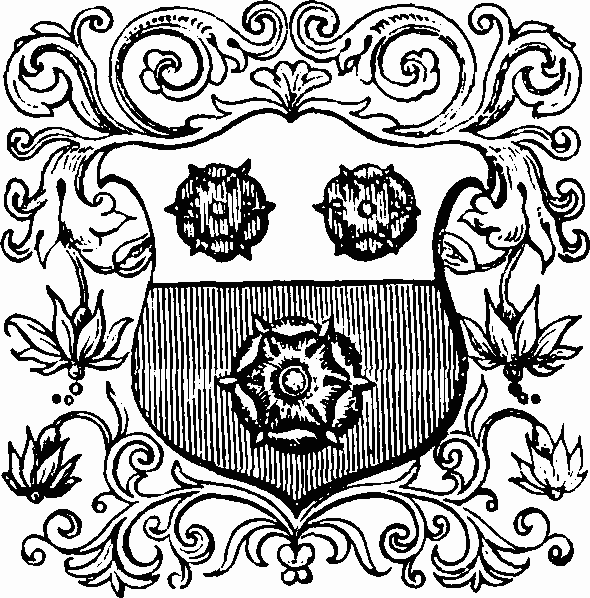
Arms.
At the time of the Conquest, the town had been so much reduced by the repeated incursions of the Danes, that King William had only 79 demesne tenants here. Henry II. and his queen landed at the port, on their return from France, in 1174. In the reign of John, Adam de Port was governor of the castle; in that of Edward III. the town was completely destroyed by the French and their allies, the Spaniards and Genoese, but they were at length repulsed, with the loss of the Prince of Sicily and other commanders. Richard II. enlarged the castle, and strengthened the fortifications that had been erected for the defence of the harbour. Henry V., previously to the battle of Agincourt, marshalled his army here; and during his stay in the town, detected a conspiracy formed against him by the Lords Cambridge and Scroop, and Sir Thomas Grey, who were at once executed at Southampton for treason, and buried in the chapel of an ancient hospital, still remaining, called God's House. In the reign of Edward IV., the town was the scene of a sanguinary contest between the partisans of the houses of York and Lancaster, in which the former gained the victory, and many of the Lancastrian chiefs were by the king's order executed with extreme barbarity. The place had so much increased in extent and importance, and its trade had become so flourishing, that, in the reign of Edward V., the lord mayor of London was appointed collector of the king's duties at the port. In 1512, Grey, Marquess of Dorset, embarked here with a force for the assistance of Ferdinand, King of Spain, and ten years later, the Emperor Charles V. sailed from Southampton, on his return to his own dominions, after having visited Henry VIII. Edward VI., in his tour through the western and southern parts of the kingdom for the benefit of his health, visited the town, and was sumptuously entertained by the mayor and corporation; and Philip, King of Spain, on his arrival in England to espouse Queen Mary, landed at the port, and was entertained at the sheriff's house by the mayor and his brethren, who sent him a present of wine, which he received on board his ship, the Grace de Dieu.
The town is situated on a peninsular tract of ground rising from the north-eastern shore of Southampton Water, and bounded on the east by the river Itchen, over which a floating or steam bridge, leading to the Gosport road, was constructed under an act obtained in 1834. On the south and west is a fine open bay formed by the confluence of the Itchen with the river Test. The shores of the bay, or estuary, are richly clothed with wood, and afford a succession of diversified scenery, the vicinity being studded with villages, mansions, and villas. Southampton Water, about two miles broad at its entrance near Calshot Castle, stretches north-westward from opposite the Isle of Wight for nearly seven miles; on the eastern shore are the ruins of Netley Abbey, forming an object romantically picturesque. The town, rising gradually from the margin of the water, is distinguished for the beauty of its situation; and the approach from the London road, through an avenue of stately elms and a well-built suburb, is exceedingly striking. The principal entrance to the old town is through Bar-gate, one of the ancient gates, on the north front of which are two gigantic figures representing Sir Bevois of Southampton and the giant Ascupart: according to a legendary tale, Bevois is said to have slain the giant in combat. From this gate, which is embattled and machicolated, a spacious street more than half a mile in length leads directly to the quay. The old town was inclosed with walls nearly a mile and a quarter in circuit, of which considerable portions, with their ruined circular towers, are still entire, the principal part being that reaching from the south-east of Westgate along the shore northward. Of the ancient gates, the chief now remaining are West-gate and South-gate, in addition to Bar-gate, in relation to which last, the more modern part of the town is distinguished by the appellation of Above-Bar, while the other part is called Below-Bar. In Above-Bar are many fine ranges of building, and a new street of handsome houses has been erected leading to the western shore, with a terrace commanding a view of the surrounding scenery. The town is well paved, lighted with gas, and supplied with excellent water. An act for its general improvement was passed in 1844.
A literary and philosophical society, established some years since by a proprietary of 30 members, is further supported by an unlimited number of annual subscribers of £1. 1.; and lectures are given periodically. In a central part of the High-street, during six months of the year, is an exhibition of paintings for sale, well known as the Hants Picture Gallery. A medical society was instituted in 1834. The principal library and readingrooms are in the High-street, and there are two circulating libraries and several reading-rooms in other parts of the town, together with billiard-rooms. The mechanics' institute, in Hanover-buildings, was established a few years since, and is very flourishing; there are nearly 400 members, and it contains a museum, library, and lecture-room. Near the Platform is a subscription bowling-green. There are two assembly-rooms, one called the Long Rooms, erected on the west side of the town in 1761; and the other recently built, termed the Archery Rooms. The theatre, in French-street, is well arranged; the season commences in August. Races are held in the autumn, continuing two days; the course, which is well adapted to the purpose, is pleasantly situated on Southampton Common, and was given by the corporation. The Archery grounds, on the west bank of the Southampton Water, form an agreeable promenade; and Mr. Page's botanic gardens adjoining contain a very extensive collection of indigenous and exotic plants, constantly keeping pace with the improved state of botanical science and discovery. The largest riding-school, it is said, out of London, has just been completed here; its length is 122 feet, and its breadth 43. A regatta takes place during the summer, at which prizes, given by subscription, are contested for on the Southampton river, than which none can be more favourably adapted to aquatic excursions, the bay being finely sheltered. The Royal Southampton Yacht-Club was established some years ago, and a handsome building in the Italian style, for the use of its members, was opened in Oct. 1846; it stands near the pier, and forms an ornament to the south part of the town.
The salubrity of the air, and the beauty of its situation, have made Southampton a resort for sea-bathing; and hot, cold, medicated, and vapour baths have been constructed. In addition to those previously established, a handsome and commodious building was lately erected in the Grecian style, at an expense of £7000, near the Platform on the beach; but this is now the Southampton dock-house, and stands in the centre of the dock land: the other baths, however, have been much improved, and the loss is therefore not much felt. Numerous respectable lodging-houses are let to visiters. On the beach is a causeway planted with trees, extending above half a mile: the Platform, which has been much enlarged, contains an ancient piece of ordnance, given by Henry VIII., and mounted on a handsome cast-iron carriage, the gift of John Fleming, Esq. The government have presented to the town six pieces of ordnance, to be used on public occasions of rejoicing, and these are also on the Platform. Some barracks erected during the late war, and occupying about two acres of land, were in 1816 considerably enlarged, and converted into a military asylum, under the patronage of the late Duke of York, for the orphan daughters of soldiers, and of girls whose mothers are dead and their fathers absent on service; the buildings are of brick, handsome, and commodious. At Itchen Ferry, and on the western side of the town, bathing-machines are kept. The environs are remarkable for the beauty of their scenery, and the number of elegant mansions and villas they contain; and in addition to the numerous attractions which the town itself possesses, and the facilities afforded for aquatic excursions, extensive rides may be taken through a country abounding with interest.
The port, whose jurisdiction extends from Langstone harbour on the east, to Hurst Castle on the west, and midway from Calshot Castle to the Isle of Wight, carries on a considerable foreign trade: the imports are, wine and fruit from Portugal; hemp, iron, and tallow, from Russia; pitch and tar from Sweden, and timber from other ports on the Baltic. There is also a good trade with Jersey and Guernsey; and by act of parliament of Edward III., making Southampton one of the staple ports for the exportation of wool, all cargoes of that material, not originally shipped to those islands from this port, must either be relanded here, or pay a duty at the custom-house. A coasting-trade is carried on with Wales, from which it imports iron and slates; with Newcastle, from which it obtains coal, lead, and glass; and with various other places. It is one of the most interesting of our sea-ports, on account of its connexion with the new overland route to India: a steamer leaves on the 20th of every month for Gibraltar, Malta (where the travellers and expresses from London viâ Paris and Marseilles are taken up), and Alexandria, whence the transit is continued to Cairo, across Suez, and down the Red Sea, to India. A West India mail steamer, also, leaves the port on the 2nd and 17th of each month, for Madeira, Barbadoes, &c. There is steam communication with Portugal, with Havre, New York, Bremen, New Orleans, and with the Channel Islands and Dublin; and steam-packets also afford a constant communication with the Isle of Wight.
The quay, on which stands a convenient custom-house, is accessible to vessels of 250 tons' burthen, and a spacious stone-faced quay has been added on the eastern side for smaller craft. A landing pier, for the convenience of passengers to and from the Isle of Wight, Guernsey, Jersey, and France, was constructed by act of parliament, in 1832. It is 900 feet in length, curving at the eastern extremity for the accommodation of the steam-packets; the carriage-road is 20 feet wide, and on each side of it is a foot-path protected by railing. The pier is of timber, is lighted with gas, and forms an agreeable promenade. In 1837 it was discovered to have been nearly destroyed by submarine insects, between high and low water mark; and in consequence, all the piles have been replaced by others thickly studded with nails. Some very extensive docks have been constructed here. The tidal-dock was commenced in 1838, and opened August 29th, 1842, having been completed at a cost of £140,000; it has always 18 feet water at low-water spring tides, and the entrance is 150 feet in width, thus admitting vessels of almost any tonnage. A graving-dock was opened in July 1846, having been completed in fourteen months at a cost of £60,000; it is 313 feet long, the width of the gates 66 feet, and at high-tide it has about 18 feet of water. A second graving-dock, completed in 1847, is 282 feet in length, and the width of the gates 51 feet. Buildings, likewise, have been erected for the storage of goods; and a tramway has been formed to the station of the London railway, distant about 300 yards. The number of vessels of above 50 tons registered at the port, is 65, and their aggregate burthen 7520 tons. The harbour is spacious, and affords good anchorage for ships, which may ride at any time in security, being sheltered from all winds.
The trade of the town principally arises from the wants of the inhabitants and visiters, and is facilitated by the Itchen canal navigation to Winchester, the river itself being navigable as far as Northam. At that village is an establishment for making boilers for steam-engines, where from 30 to 50 hands are also employed in iron ship-building. The London and South-Western railway, constructed under an act obtained in 1834, has its terminus here; the line is76¾ miles long, and has branches from Bishop's-Stoke, a few miles north of Southampton, to Gosport and Salisbury. A railway from Southampton to Dorchester was completed in 1847; its length is 62 miles, including a branch of two miles to Poole. The markets are on Tuesday, Thursday, Friday, and Saturday, that on Friday being for corn; they are well supplied with fish, eggs, poultry, and provisions of every kind. The fairs are on May 6th and 7th, for cows and pigs, and on Trinity Monday and Tuesday. The latter, a very ancient fair, is proclaimed by the mayor with particular ceremony on the preceding Saturday, and continues till the Wednesday noon following; it is principally for horses, cattle, and pigs, and is held on the eastern side of the town, near the site of an ancient hermitage which was occupied by William Geoffrey, to whom its revenue, arising from standings, &c., was originally granted. A court of pie-poudre is attached to it, and during its continuance all persons are free from arrest for debt within the precincts of the borough.

Corporation Seal.
Obverse.
Reverse.
The inhabitants were first incorporated in the reign of Henry I., whose charter was confirmed by Richard I., and by John, who assigned the customs of the port, together with those of Portsmouth, to the burgesses, for an annual payment of £200. Their privileges were extended and confirmed by numerous subsequent sovereigns, and were modified by Charles I. The corporation now consists of a mayor, 10 aldermen, and 30 councillors, under the act 5th and 6th of William IV., cap. 76; the borough is divided into five wards, comprising in the whole about 1970 acres, and the number of magistrates is 14. The town exercised the elective franchise in the 23rd of Edward I., since which time it has regularly returned two members to parliament: the mayor is returning officer. The recorder presides at quarterly courts of session for all offences not capital; and the corporation have the privilege of holding assizes, when the judges are travelling the Western circuit, to try for capital crimes committed within the limits of the town and county of the town. A court of record occurs every alternate Tuesday, for the recovery of debts to any amount; petty-sessions take place daily, and a court leet annually. The powers of the county debt-court of Southampton, established in 1847, extend over the registration-districts of Southampton, South Stoneham, and New-Forest. The inhabitants paying scot and lot have right of common on the Town Lands adjoining the town, the most extensive of which is the common, containing about 350 acres.
The audit-house, erected about 70 years since, is a handsome building, comprising in the upper story a spacious hall, where the business of the corporation is transacted, and the records and insignia are deposited; among the latter, which are very splendid, is a silver oar, borne before the mayor on public occasions. The guildhall is a room above the arches of the ancient Bar-gate, already mentioned, which is a beautiful and venerable structure in the Norman style. The principal archway is deeply moulded and enriched, and flanked by circular embattled turrets; the approach is ornamented with two lions sejant, cast in lead, presented to the corporation in 1744, in lieu of two which were decayed, by William Lee, Esq., on his being elected a burgess. The south side of the gateway is neatly faced with stone, with a niche in the centre containing a statue of George III., presented by the late Marquess of Lansdowne, to replace a decayed figure of Queen Anne. The common gaol for the borough comprises four rooms for 50 prisoners: the bridewell contains three rooms, capable of receiving ten prisoners, and a small chapel, hi which divine service is performed once a week; the sheriff's prison for debtors contains two wards, and is adapted for ten prisoners.
Southampton comprises the parishes of All Saints, containing 6901; Holy Rood, 2036; St. John and St. Lawrence united, 1132; St. Mary, 14,885; and St. Michael, 2149 inhabitants. The living of All Saints' is a discharged rectory, valued in the king's books at £8. 1. 10½., and in the patronage of the Crown; net income, £400. The church, rebuilt on the enlarged site of the ancient structure, is in the Grecian style, with a turret at the end rising from a square pedestal, and surrounded by six Corinthian columns, supporting a circular entablature surmounted by a dome. The area underneath the church is divided into arched catacombs, in one of which are deposited the remains of Captain Carteret, the celebrated circumnavigator, and of Bryan Edwards, author of the History of the West Indies. The living of Holy Rood parish is a discharged vicarage, valued at £12. 1. 10½.; net income, £379; patrons, the Provost and Fellows of Queen's College, Oxford. The church is an ancient structure in the High-street, with a tower and spire at the south-west angle, and has a portico in front; among the monuments is one by Rysbrach to Miss E. Stanley, sister of the Right Hon. Hans Stanley, with an epitaph written by the poet Thomson, who has immortalised her memory in his poem of the Seasons. The living of St. John's is a discharged rectory, united to that of St. Lawrence, and valued at £6. 13. 4.: the church has been demolished. The living of the parish of St. Lawrence is a discharged rectory, valued at £7. 10., and in the patronage of the Crown; net income, £148. The old church, a small building, was taken down, and a much larger edifice erected, which was consecrated March 31st, 1842, and is an ornamental feature in the High-street; it is in the later English style, and contains 600 sittings. St. Mary's is a rectory, in the precinct of the town, valued in the king's books at £37. 5. 5., and in the gift of the Bishop of Winchester. The church is modern; the churchyard is very large. St. Michael's is a discharged vicarage, valued at £12. 11. 10½., and in the gift of the Crown; net income, £150. The church is an ancient and spacious structure, chiefly in the Norman style, with a tower between the nave and chancel, surmounted by a lofty and well-proportioned octagonal spire. The massive circular columns that supported the roof have been replaced with lighter octangular pillars, and sharply-pointed arches. The tracery of the large west window has been carefully restored, and the upper compartments embellished with stained glass; a new window, also, of elegant design has been placed by the corporation in the chapel of the church, in which, from time immemorial, the mayors have been sworn into office. The font is highly enriched; there are some ancient monuments, and in the chapel is a cenotaph of Lord Chancellor Wriothesley, who passed sentence of death on Queen Anne Boleyn.
St. Paul's, a proprietary chapel in the parish of All Saints, erected about 1831, is a handsome edifice in the later English style, and has an east window adorned with stained glass. In the town are also, a chapel dedicated to the Holy Trinity, enlarged in 1847, and a free chapel dedicated to Our Saviour, the livings of both which are perpetual curacies; net income of the former, £110; patrons, certain Trustees: and of the latter, £150; patron, the Rev. W. Davies. The living of St. Peter's is a perpetual curacy, in the gift of the Rector of All Saints'; income, £200. There are places of worship for Independents, Baptists, the Society of Friends, Wesleyans, and Roman Catholics. A cemetery was consecrated in May 1846.
The Free Grammar school was founded in the reign of Edward VI.; the corporation have erected a convenient school-house, on the site of an ancient edifice called Westhall, and the endowment produces about £30 per annum. Among the eminent men who have been educated in the establishment, was Dr. Watts, a native of Southampton, whose father kept a boarding-school in the town. A charity school was instituted in 1760, for qualifying boys for the sea-service, by Alderman Taunton, who left considerable funds for charitable uses. The hospital of Domus Dei, or God's House, was originally founded in the reign of Henry III., as a convent for nuns, and as a chapel to a neighbouring friary, which was burned by the French in the reign of Edward III.; after various changes, it was established as an hospital for a warden, four brothers, and four sisters. The buildings are ancient, and retain much of their original character; the chapel was long used as a place of worship by French Protestants. The Hospital of St. John, on the site of which the theatre has been built, consisted of a master and six boys, and was sold in 1774, under an act of the 13th of George III., for the sum of £425, which was appropriated towards the erection of the present workhouse. Thorner's almshouses, a neat and commodious range of building, receive their name from Robert Thorner, Esq., who in 1690 bequeathed a sum to accumulate for the foundation; they were built in 1789, and have lately been enlarged. The same benefactor left considerable funds for apprenticing children. There is also a penitentiary, or refuge for destitute females, a spacious building with a handsome chapel attached to it, in front of Kingsland-place. Miss Elizabeth Bird bequeathed £1400 three per cents, to the corporation, in trust, for the annual payment of £5 each to six unmarried women, members of the Church of England, and upwards of sixty years of age; and the late Mr. Newman left nearly £3000 in the funds for the erection and maintenance of an infirmary, which was established in 1839. Southampton is one of the twenty-four corporations entitled to Sir Thomas White's lending charity; and there are various other bequests for distribution among the poor. Southampton gives the title of Baron to the family of Fitzroy.
Southampton, County
SOUTHAMPTON, COUNTY of, on the southern coast, bounded on the east by the counties of Surrey and Sussex, on the north by that of Berks, on the west by Wiltshire and Dorset, and on the south by the English Channel. Including the Isle of Wight, it extends from 50° 36' to 51° 23' (N. Lat.) and from 45' to 1° 53' (W. Lon.), and comprises an area of upwards of 1628 square miles, or 1,041,920 statute acres: it contains 66,617 houses inhabited, 3311 uninhabited, and 502 in course of erection; and the population amounts to 355,004 persons, of whom 175,023 are males.
At the period of the invasion of Britain by Cæsar, the southern parts of this district were a portion of the territory of the Regni, and the more northern tracts part of that of the Belgæ, who had come over from Gaul, and violently dispossessed the former inhabitants. Under the Romans it was included in the division called Britannia Prima. The Isle of Wight, called by that people Vectis, is mentioned by Suetonius as having been conquered by Vespasian; but no other traces of Roman occupation have been at any time discovered in it than a few coins. On the establishment of the kingdom of Wessex, by Cerdic, a great part of the county was included within the limits of that kingdom, while a portion of its southern shores, together with the Isle of Wight, was comprised in the Saxon kingdom of Kent. The ancient British name of the district was Gwent, or Y Went, a term descriptive of its open downs; and hence the appellation Caer Gwent, or the city of the Gwentians, now Winchester. When the Saxon dominions in Britain were divided into shires, the district received the name of Hamtunscyre, from the ancient name of the present town of Southampton; and this was afterwards corrupted into Hamptescyre, whence the modern appellations of Hampshire and Hants. The name of the Isle of Wight is considered by Mr. Whitaker and other antiquaries to have been derived from the British word Guith, or Guict, signifying the divorced or disjoined, and apparently indicating a supposition that the island was once connected with the main land: hence also arose its Roman name of Vectis, or the separated region. By the Saxons it was called Weet. William the Conqueror, on his accession to the throne of England, granted the lordship of the Isle of Wight, with a palatine jurisdiction, to his kinsman, William Fitz-Osbert. It afterwards several times escheated to, and otherwise became vested in, the crown, and was as often granted to different noble families. Sir Edward Widville, who, in the first of Henry VII., was made captain of the island, was probably lord also of it; but since the period of his death the lordship has remained in the possession of the crown, although some lands annexed to the castle at Carisbrooke continue to be holden by the governor jure officii. From the time that Edward I. purchased the lordship of Isabella de Fortibus, the defence of the island was generally entrusted to some person nominated by the crown, who was at first distinguished by the appellation of warden, afterwards by that of captain, and, in later times, by that of governor.
The county is included in the diocese of Winchester, and province of Canterbury; and the archdeaconry of Winchester, which is co-extensive with the county, comprises the deaneries of Alresford, Alton, Andover, Basingstoke, Droxford, Fordingbridge, Sombourn, Southampton, Isle of Wight, and Winchester, and contains 305 parishes. The Northern division includes the minor sessional divisions of Alton, Andover, Basingstoke, Droxford, Kingsclere, Odiham, Petersfield, and Winchester; and the Southern division those of Fareham, Lymington, Ringwood, Romsey, Southampton, and the town and county of the town of Southampton. The ancient hundreds are 39 in number, and besides them are the liberties of Alresford, Alverstoke and Gosport, Beaulieu, Bentley, Breamore, Dibden, Havant, Lymington, Soke (Winchester), and Westover; and the liberties of East and West Medina, in the Isle of Wight. The county contains the city of Winchester; the borough, market, and sea-port towns of Christchurch, Lymington, Newport, Portsmouth, and Southampton; the borough and market towns of Andover and Petersfield; the sea-port and market-town of Yarmouth; the sea-ports of Newtown, Emsworth (a dependency on the harbour of Portsmouth), and Brading; and the market-towns of Alresford, Alton, Basingstoke, Bishop's-Waltham, Fareham, Fordingbridge, Gosport, Havant, Kingsclere, Odiham, Ringwood, Romsey, Stockbridge, and Whitchurch. Under the act 2nd of William IV., cap. 45, the county was divided into the Northern and the Southern divisions, each sending two members to parliament; and the Isle of Wight was, for electoral purposes, constituted a county of itself, with one representative. Two members are returned for Winchester, and two for each of the boroughs, except Christchurch and Petersfield, which, under the Reform act, now send only one each. Hampshire is included in the Western circuit; and the assizes and quarter-sessions are held at Winchester.
In form the county, exclusively of the Isle of Wight, approaches to a square, with a triangular projection at its south-western corner. The Isle is separated from the main land by a strait of unequal breadth, formerly called the Solent Sea, now the Sound, or, more usually, the West Channel, the breadth of which, at its western extremity, is about a mile, and towards its eastern end as much as 7 miles. The form of the island is somewhat rhomboidal, the greatest diagonal being 23 miles from east to west, and the transverse diameter, from north to south, about 13 miles.
The surface of the county is beautifully varied by gently-rising hills and fruitful valleys, and, in some parts, with extensive tracts of woodland. In the southern districts, approaching the coast, the population is much more dense than elsewhere; the mildness of the seasons, the beauty of the landscapes, and the proximity to the ports, operating as strong inducements to the continued residence of many families besides those engaged in commercial pursuits. The agricultural report drawn up by Charles Vancouver, Esq., for the consideration of the Board of Agriculture, divides the main land into five districts. The First, called the woodland division, occupies the northern portion of the county, comprising an area of 103,944 acres, and includes the woodlands and wastes of Bagshot, &c. Its soil and substrata are various, but the great mass of the district has a strong brown and grey loam, resting upon a tough blue and yellow clay, and having generally an excess of moisture with numerous unsound and boggy places. The Second tract comprises the main body of the county from the borders of Wiltshire to those of Sussex and Surrey, and is computed to contain 454,295 acres. The higher parts of this large central district have much the appearance of an elevated plain, divided into many unequal portions, and intersected by deep hollows, through which brooks and rivulets descend, for the most part in a southern course, towards the sea. The more elevated tracts are almost wholly in open and extensive sheep-downs. The substratum is throughout a firm unbroken bed of chalk. The Third district is small, containing only 49,525 acres, and includes the forests of Woolmer and Alice-Holt; the hills of Binfield, Great and Little Worldham, Selborne, and Empshott; together with all the lower sides of the chalk hills surrounding the vale of Petersfield, the soil of which is, for the most part, a grey sandy loam of good staple, lying on a kind of soft sand rock. The Fourth division consists of the whole southern part of the county situated on the main land, excepting a tract of 26,895 acres at its south-eastern extremity; and comprises an area of 333,489 acres. This large area, besides many extensive wastes and commons, comprehends the Forest of Bere, the New-Forest, and Waltham Chase. Its soils are various, but consist chiefly of light sandy and gravelly loams, intermixed with clay and brick earth, and resting on substrata of argillaceous and calcareous marl. The Fifth district contains 26,895 acres. It includes Hayling Island, forming the south-eastern extremity of the county; and Portsea Island, containing the town of Portsmouth; together with the tracts on the main land immediately opposite to them. In the islands and the low grounds of the main land, a strong flinty and a hazel-coloured loam prevail. The soil and substrata of Portsdown Hill, in the different degrees of its elevation, are similar to those of the chalk district.
Through the centre of the Isle of Wight, from east to west, extends a range of lofty hills, affording pasturage for sheep, and commanding views over every part of the island, with the ocean on the south, and the beautiful shores of Hampshire on the north. On the coast of the isle, the land is in some parts very high, particularly on the south, where the cliffs are steep, and where vast fragments of rock, which the waves have at some time undermined, lie scattered below. Towards the Needles, also, at the western extremity, the rocks are bare, broken, and precipitous. The cliffs of which the Needles form the extreme point, are in some places 600 feet above the level of the sea; in some parts they are perpendicular, and in others overhanging: they contain many deep caverns. The Needles derive their name from a lofty pointed rock rising to the height of about 120 feet above low-water mark, and severed, with others, from the main land by the force of the waves: part of this rocky projection, about 80 years since, having been undermined by the sea, fell and totally disappeared. St. Catherine's Hill, the highest point in the island, rises 750 feet above the level of high-water mark, and commands magnificent prospects; as also do the Culver cliffs, at the eastern end of the island; Carisbrooke Castle; and Bembridge down. The soil and substrata of the isle are extremely various. The chalk downs of Brading and Arreton form an unbroken range from Culver cliff, on the eastern coast, to the valley that separates them from Staple's heath. Those of Gatcombe and Shorwell are bounded on the west by a highly cultivated valley, extending from Shorwell to Newport, and terminating northward in the waste called Parkhurst Forest. From the vale of Shorwell to the western extremity of the island the high chalk downs are broken only by three gaps, or carriage roads, one of which is the passage between the head of the Yarmouth river, and the innermost cove of Freshwater bay. The tract of down situated towards the southern extremity of the island terminates abruptly towards the sea, in a precipice of limestone rock, having the appearance, particularly when seen from a distance, of an immense stone wall, and overhanging the romantic tract called the Undercliff, which extends along the sea-shore for a distance of nearly six miles.
With regard to the agriculture of the county, the rotations of crops on the arable lands are various; the grain and pulse generally cultivated consist of wheat, barley, oats, rye, peas, and beans. The usual artificial grasses are the common broad clover, rye-grass, trefoil, sainfoin, and lucern. Burnet forms a large portion of the herbage of the downs; a much larger and stronger species is found on many of the low grounds, and upon the cold clay loams, where, as upon the downs, it has every appearance of being indigenous. In the parish of Alton and its vicinity, on the borders of Surrey, hops are grown to a great extent; the produce varies greatly, but may be estimated, on an average, at about five cwt. per acre. Their culture has been much encouraged by the reputation of the hops of Farnham, that town, in Surrey, being situated only at the distance of a few miles. The entire extent of hop plantations throughout the county is at present 1609 acres. Many cows are kept in different parts; and the markets of London, Chichester, Newbury, Reading, Salisbury, &c., are largely supplied with veal from Hampshire: the number of sheep is also remarkably great. Numerous hogs are fed for a few weeks, at the close of the autumn, upon the mast produced in the forest and other woodlands; and a superior mode of curing being practised, the Hampshire bacon has become famous for its excellence. Upon the heaths and forests vast numbers of light small horses are bred, provincially termed heath-croppers, which propagate indiscriminately on these wastes, where they succeed in maintaining an existence throughout the year. Gardening is largely carried on in the vicinity of all the populous towns, and Portsea Island is considered to produce the finest brocoli in the kingdom. The county has also long been celebrated for its honey, called heath honey and down honey, from the different districts in which the bees collect it; the latter being the more valuable.
The woods are numerous and extensive. The NewForest comprises a large tract in the south-western part of the county. Its boundaries, according to the oldest perambulation extant, which is dated 8th of Edward I., were, the Southampton river on the east, the Sound and the British Channel on the south, and the river Avon on the west; northward, it reached as far as North Charford on the west, and Wade and Ower bridge on the east. According to a perambulation made in the 22nd of Charles II., the forest then stretched from Godshill, on the north-west, south-eastward to the sea, a distance of about 23 miles; and from Hardley on the east, to Ringwood on the west, about 15 miles; and contained 92,365 statute acres. The extent of the wood and waste lands of the tract was, however, at that time, reduced to 63,845 acres, which belonged to the crown, and were subject to certain rights of commonage, pasturage, pannage, and fuel, possessed by the proprietors of estates within, or adjacent to, the forest. These rights, and those of the crown, are defined by an act of the 9th and 10th of William III., for the increase and preservation of timber in the forest. In consequence of this act, the woodlands, which, according to surveys made at different periods, had been long in a neglected state, received some attention; but that, after a time, was withdrawn from them, when the superintendence of the surveyor-general of the crown lands ceased, and the whole fell by degrees under the direction of the surveyorgeneral of the woods. By a return just presented to parliament, the New-Forest contains 57,684 acres of open land, 5605 under inclosure for the growth of timber, and 813 occupied as encroachments; also 2307 acres royal property, 25,830 freehold belonging to private persons, and 122 copyhold. The scenery is remarkable for its beauty, presenting magnificent woods, extended lawns, and vast sweeps of wild heath, unlimited by artificial boundaries, together with numerous river views and the prospect of distant shores. The oaks seldom rise into lofty stems; and their branches, which are more adapted to what the ship-builders call knees and elbows, are commonly twisted into the most picturesque forms. The advantage of water-carriage to the various royal or private dockyards in which its produce is employed, is superior to that of any other forest in the kingdom.
The Forest of Bere, situated in the south-eastern part of the county, and extending northward from the Portsdown hills, which, according to a perambulation made in 1688, are now considered the boundary, comprises about 16,000 acres, upwards of one-third being inclosed. North-westward of it is the chase of Bishop's-Waltham, containing about 2000 acres, and belonging to the see of Winchester. The forest of Alice-Holt and Woolmer, on the eastern border of the county, approaching the confines of Surrey and Sussex, and to the north-east of Petersfield, is divided into two parts by intervening private property. Its limits comprehend 15,493 acres, of which 8694 belong to the crown; the division called Alice-Holt contains about 2740 acres of crown land. Parkhurst or Carisbrooke forest, lying at a short distance to the north-west of Newport, in the Isle of Wight, occurs in Domesday book under the appellation of the King's park, and was afterwards called the King's forest; it includes about 3000 acres, nearly destitute of valuable trees. The total quantity of waste land in Hampshire, exclusively of the forests, falls little short of 100,000 acres.
The mineral productions are not numerous. On the southern shores of the county, particularly near the mouth of the Beaulieu river, ironstone, washed up by the sea, was formerly gathered, and conveyed to the iron-works at Sowley. It is also occasionally found in small quantities in other parts of the county, especially In the cliffs near Hordwell, which are upwards of 100 feet high, and abound with nodules of iron-ore, together with pebbles or flints, many of them containing fossil shells (or their impressions) of various and scarce species, found in a blueish kind of clay or marl. The range of chalk hills crossing the county from east to west, and occupying the central part of it, forms a portion of the vast formation that constitutes so considerable a feature in the geology of England. The strata of the southern part of the main land and the northern part of the Isle of Wight, lie upon a depressed portion of the chalk beds, which is termed the Chalk Basin of the Isle of Wight. Between Milton and Christchurch is found a hard reddish stone, of which several ancient structures in that part of the county are built. The strata in the Isle of Wight, being of various kinds and formations, and exhibiting great diversity of position, form a remarkably rich field of study for the geologist. At Alum bay, at the north-western extremity of the island, is a vein of white sand, in great demand for the glass-works of Bristol and Liverpool, as also for others situated on the western coast of Scotland, and in Ireland. Eastward of this, along the northern foot of the downs, grist or quarry stone, of a yellowish-grey colour and very porous texture, is found in detached masses, and used for building. A strong liver-coloured building-stone rising in cubical masses, encrusted with a brownish kind of ochre, and inclosing specimens of rich ironstone, occurs on the southern side of the island. Rough calcareous freestone is frequently found in the marl-pits, in loose detached pieces. Eastward of Staple's heath, and northward of Arreton downs, a close grey limestone is raised, the beds of which are separated from each other by small layers of marine shells, cemented together by alum, that substance being well known to pervade the western parts of the island. Freestone is sometimes found under marl in the northern districts of the isle: plum-pudding stone exists in large quantities near Sandown Fort, and is much used for paving and flooring. Potters'-clay occurs in great variety in different parts of the county; and ochres of divers colours in the Isle of Wight.
The manufactures are various, but not extensive; ship-building, however, in addition to the works of the royal dockyard at Portsmouth, is extensively pursued in most of the numerous creeks and harbours. The productions are chiefly woollen goods, bed-ticking, light silk articles, sacking, leather, and a coarse kind of earthenware. At Overton are very large silk-mills, and the young female peasantry in that vicinity are much employed in the straw-hat manufacture, which is also carried on at many other towns in the county. There are paper-mills in different parts, those near Overton being considerable. At Lymington is a manufacture of salt. The advantages for commerce are very great, and the shores of the county, especially of the Isle of Wight portion, are much resorted to for sea-bathing: the most frequented places on the main land are Christchurch, Muddiford, Lymington, and Southampton; and in the Isle of Wight, Cowes, Ryde, Shanklin, and Ventnor. Salmon are caught in all the rivers and creeks that discharge their waters directly into the sea; the fisheries of the Southampton Water are particularly extensive, and the boats engaged in them often make long coasting voyages to procure other fish, which are sent to the markets of London, Oxford, Bath, &c. Several persons are employed on the flat shores of the Isle of Wight in catching shrimps and prawns, and, on its bolder shores, in taking crabs and lobsters.
The principal rivers are the Test, the Anton, the Itchen, the Avon, the Boldre water, and the Exe. The Test expands below Redbridge, and forms the head of the Southampton Water, an arm of the sea which extends from the "Above Town" of Southampton to the Sound at Calshot Castle, and is rendered exceedingly picturesque by its woody and irregular shores: the general direction of the estuary is from north-west to south-east. The Itchen, also called the Arbre, was brought into a regular channel, and made navigable up to Winchester, by Godfrey de Lacy, Bishop of WinChester, in 1215: towards its mouth it expands considerably. The Avon, by an act passed in 1665, was made navigable up to Salisbury; but the works having been swept away by a flood, the navigation was destroyed. The Boldre water is formed by several small streams rising in the New-Forest, most of which unite above Brockenhurst, thence proceeding southward, by Boldre and Lymington, to the sea. The Exe, frequently called the Beaulieu river, has its sources in the same district, flows south-eastward, and, beginning to expand near Beaulieu, opens into a broad estuary to the sea, below Exbury. The principal river of the Isle of Wight is the Medina, anciently called the Mede, which rises near the botton of St. Catherine's down, in the southern part of the island, and, flowing directly northward, divides it into two equal parts, each constituting a liberty, which derives its name from its position on the eastern or western side of this stream: passing on the eastern side of the town of Newport, the Medina mingles its waters with those of the sea in Cowes harbour. The other main streams of the island are the Yar, the Wootton, and the Ear; and its shores are indented by various creeks and bays.
A navigable canal has been made along the valleys of the Test and Anton, to the head of the Southampton Water: its course is from Barlowes-Mill, near Andover, by Stockbridge and Romsey, to its termination at Redbridge, in the parish of Millbrook. From Redbridge a branch proceeds directly to Southampton, and a collateral branch extends from it in a western direction, up the valley between East Dean, Lockerley, and East Tytherley, to Alderbury common, within two miles of Salisbury; but neither of them is navigable. There is also a canal, made under the authority of an act of parliament obtained in 1778, from Basingstoke to the river Wey, in Surrey, by which stream the navigation is maintained to the Thames. The length of the canal is 37 miles and a quarter, and the cost of cutting it amounted to about £100,000, a large portion of this sum being expended in forming a tunnel through Grewell Hill, near Odiham, which is nearly three-quarters of a mile long. The Winchester and Southampton canal is one of the oldest in the kingdom, the act for its construction having been procured in the reign of Charles I.; but from the want of a suitable trade, it does not appear to have realised the expectations of the projectors. The London and South-Western railway enters the county from Surrey, at Farnborough, and passes by Basingstoke and Winchester to Southampton: a branch proceeds from it, at Bishop's-Stoke, about midway between Winchester and Southampton, to Gosport; and a second branch from Bishop's-Stoke proceeds by Romsey into Wilts. The same company owns the Southampton and Dorchester railway, which passes through the New-Forest, by Lyndhurst and Ringwood, into Dorset; and there is a railway from Portsmouth, by Havant, into Sussex, belonging to another company.
Within the limits of the county were the Roman stations of Venta Belgarum, supposed to have been at Winchester; Vindonum, at Silchester; Clausentum, at Bittern; Brigæ, at Broughton; and Andaoreon, at Andover. The principal remains of Roman occupation discoverable are at Silchester, approaching the confines of Berkshire, where gold coins and rings, bricks and pottery, &c., have been dug up. About three-quarters of a mile north of Lymington is Buckland Rings, the remains of a Roman camp. Traces of other encampments are visible in various parts; among the most extensive and remarkable are those of the camp on Danebury Hill, to the west and north-west of which are several barrows. Three Roman roads branch from Silchester, one of them proceeding to the northern gate of Winchester; another by Andover to Old Sarum; and the third, northward, across Mortimer heath: from Winchester also was a road leading to Old Sarum. The number of religious establishments was about fifty-three: there are still interesting remains of the abbeys of Hide, Netley, Beaulieu, and Quarr; and of the hospital of St. Cross, near Winchester. The castles of Hurst and Porchester, and that of Carisbrooke in the Isle of Wight, are still standing; also remains of the castles of Christchurch, Odiham, and Warblington. The modern seats and villas of the nobility and gentry are extremely numerous, more especially the villas.
Several chalybeate springs are found in different parts of the Isle of Wight; at Pitland is one impregnated with sulphur, and at Shanklin another slightly tinctured with alum. The water of the streams in the northern woodland part of the county is of a strong chalybeate quality, and that which issues from the bogs and swampy ground in the same district is charged with a solution of iron. In the strong loam, woodland clay, and chalk districts, the want of a regular supply of water during seasons of drought is severely felt. Fossil remains of different kinds are contained in some of the strata of the county. Among the chief natural curiosities may be mentioned the immense chasms near the sea-shore in the Isle of Wight, called Blackgang, Luccombe, and Shanklin Chines; and a large cavern at Freshwater Gate. Samphire grows plentifully on some of the high cliffs of the Isle.
Southay
SOUTHAY, a hamlet, in the parish of KingsburyEpiscopi, union of Langport, hundred of Kingsbury, W. division of Somerset; with 24 inhabitants.
Southborough
SOUTHBOROUGH, a chapelry, in the parish, union, and lowey of Tonbridge, lathe of Aylesford, W. division of Kent, 2¾ miles (S. by W.) from Tonbridge; containing 1217 inhabitants. It is situated about midway between Tonbridge and the Wells, and consists of a number of scattered houses. A district church in the early English style, has been erected and endowed at an expense of £8436, defrayed by subscription: the patronage is vested in five Trustees; net income, £153. In 1785, premises for a school were erected by the executors of the Rev. E. Holmes, and the school endowed with £1050 four per cents.
South-Burn
SOUTH-BURN, a township, in the parish of KirkBurn, union of Driffield, Bainton-Beacon division of the wapentake of Harthill, E. riding of York, 4¾ miles (S. W.) from Driffield; containing 97 inhabitants. It comprises about 1030 acres of land. The village is situated on the south side of the Kirkburn rivulet, between the roads from Driffield to Watton and from Tibthorpe to Bainton.
Southchurch
SOUTHCHURCH, a parish, in the union and hundred of Rochford, S. division of Essex, 3½ miles (S. E. by E.) from Rochford; containing 432 inhabitants. It is bounded on the south by the river Thames, and comprises 1882a. 1r. 31p., about one-sixth whereof is pasture, 15 acres woodland, and the remainder arable. A considerable portion of the shore is flat, and overflowed by the tide; large oyster-beds have for many years been preserved. The living is a rectory, in the gift of the Archbishop of Canterbury, valued in the king's books at £27. 0. 10.: the tithes have been commuted for £800, and the glebe comprises 60 acres. The church is a small edifice with a tower and spire.
Southcoates
SOUTHCOATES, a township, in the parish of Drypool, union of Sculcoates, Middle division of the wapentake of Holderness, E. riding of York, 1½ mile (N. E. by E.) from Hull; containing 1167 inhabitants. It comprises about 1050 acres of fertile land, chiefly in pasturage; and extends eastward from Drypool, along the Holderness road, and the shores of the Humber.
Southcot
SOUTHCOT, a tything, in the parish of St. Mary, Reading, union and hundred of Reading, county of Berks, 1½ mile (W. S. W.) from Reading; containing 66 inhabitants, and comprising 344 acres. It is situated a little south of the road to Newbury.
Southease
SOUTHEASE, a parish, in the union of Newhaven, hundred of Holmstow, rape of Lewes, E. division of Sussex, 4 miles (S. by E.) from Lewes; containing 120 inhabitants. This parish is bounded on the east by the river Ouse, and situated on the road from Lewes to Newhaven. It comprises 904 acres, of which 282 are arable, and 340 down pasture; the surface in some parts is hilly, and the soil a loam incumbent on chalk. The living is a rectory, valued in the king's books at £16. 0. 10., and in the gift of W. Allfree, Esq.: there is a glebe-house; the glebe contains 9½ acres, and the tithes have been commuted for £210. The church is principally in the early English style of architecture, with a circular tower.
Southend
SOUTHEND, a hamlet, in the parish of Prittlewell, union and hundred of Rochford, S. division of Essex, 1¾ mile (S. S. E.) from the village of Prittlewell, and 42 miles (E.) from London. This place is situated at the mouth of the Thames, directly opposite the river Medway, and at the southern extremity of the county, from which last circumstance it probably derives its name. Though formerly an inconsiderable hamlet, consisting only of a few fishermen's huts, it has within the last century grown into some repute for sea-bathing, and, being the nearest watering-place to London, is rising into importance. It comprises the lower or old town, and the upper or new town; the former on the beach, and the latter on an eminence fronting the sea or river. The old village consists principally of an irregular line of houses facing the water; some handsome dwellings have been lately added, and a parade formed and partly inclosed. Nearly in the centre is a commodious inn, and there are two others on a smaller scale; at the eastern extremity is a small theatre, which is opened every season, and on the beach are several bathing-machines. The new town, which is the more fashionable residence, is superior both in its situation and in the character of its buildings. It consists chiefly of the terrace, having a fine promenade; adjoining which is an hotel, containing several suites of apartments, a lofty assembly-room, and rooms for cards and refreshments. The library, a neat building in the later English style, has a good reading-room, and adjoining it is a billiard-room. In front of the terrace, and extending the whole length, is a shrubbery tastefully laid out in walks commanding a fine view of the sea; and within this inclosure are some baths, in the cottage style. In the vicinity are many pleasant walks and rides, the district abounding with richly-diversified scenery. The pier of frame-work was extended in 1845, and is now 1¼ mile in length. A district church has been lately built, of which the patronage is vested in Trustees; and there is a place of worship for Independents.