
A Topographical Dictionary of England. Originally published by S Lewis, London, 1848.
This free content was digitised by double rekeying. All rights reserved.
'Spurm-Head - Stagsden', in A Topographical Dictionary of England, (London, 1848) pp. 164-170. British History Online https://www.british-history.ac.uk/topographical-dict/england/pp164-170 [accessed 24 April 2024]
In this section
Spurm-Head.—See Kilnsea.
SPURM-HEAD.—See Kilnsea.
Spurshot
SPURSHOT, a tything, in the parish of RomseyExtra, union of Romsey, hundred of King's-Sombourn, Romsey and S. divisions of the county of Southampton; containing 31 inhabitants.
Spurstow
SPURSTOW, a township, in the parish of Bunbury, union of Nantwich, First division of the hundred of Eddisbury, S. division of the county of Chester, 4¼ miles (S. E. by E.) from Tarporley; containing 508 inhabitants. It comprises 1718 acres, of which the soil is three-fourths clay, and one-fourth sand. A mineral spring called Spurstow Spa was formerly much frequented, and baths were erected by Sir Thomas Mostyn, for the accommodation of visiters; but the waters are not at present in repute. The impropriate tithes have been commuted for £130, payable to the Haberdashers Company, London.
Stadhampton (St. John the Baptist)
STADHAMPTON (St. John the Baptist), a parish, in the union of Abingdon, hundred of Dorchester, county of Oxford, 5 miles (N.) from Bensington; containing 384 inhabitants, and comprising 609a. 1r. 27p. The living is a perpetual curacy, incorporated with that of Chislehampton. In the churchyard is a remarkably fine yew-tree. There is a place of worship for Particular Baptists. John Owen, D.D., the learned nonconformist, dean of Christ-Church, and vice-chancellor of the university of Oxford in the time of the Commonwealth, was born here; and Wilmot, Earl of Rochester, is supposed to have been also a native.
Stadmerslow
STADMERSLOW, a township, in the parish of Wolstanton, union of Wolstanton and Burslem, N. division of the hundred of Pirehill and of the county of Stafford, 4 miles (N.) from Burslem; containing 309 inhabitants, located principally at the village of Harrisey-Head. At Mowcop is a church dedicated to St. Thomas, to which a district has been assigned, consisting of parts of the parishes of Wolstanton and Biddulph: the living is in the gift of the Bishop of Lichfield; net income, £120. There is a place of worship for Wesleyans.
Staffield
STAFFIELD, a township, in the parish of KirkOswald, union of Penrith, Leath ward, E. division of Cumberland, l½ mile (N. N. W.) from Kirk-Oswald; containing 257 inhabitants. The village is situated in a deep vale, on the north side of the river Croglin; and near it are the remains of an old border fortification called Scarrowmanwick. Staffield Hall is distinguished for its walks and beautiful scenery.
Stafford
STAFFORD, a hamlet, in the parish of Barwick, union of Yeovil, hundred of Houndsborough, Berwick, and Coker, W. division of Somerset, 2 miles (S. by E.) from Yeovil; containing 321 inhabitants.
Stafford
STAFFORD, a borough and market-town, consisting of the united parishes of St. Mary and St. Chad, and forming the head of aunion, locally in the S. division of the hundred of Pirehill, N. division of the county of Stafford; containing 10,730 inhabitants, of whom 9245 are in the borough, 136 miles (N. W.) from London, on the road to Chester. This town, which is of great antiquity, was originally called Stadeford or Stadford, from the Saxon Stade, signifying "a place on a river," and from the trajectus or ford across the Sow, on which stream it is situated. It is said to have been in 705 the devotional retirement of St. Bertelin, the son of a Mercian king, upon whose expulsion from his hermitage, at a spot called Berteliney or Betheney, meaning "the island of Bertelin," several houses were built, which furmed the origin of the present town. In 913, Ethelfleda, Countess of Mercia, erected a castle on the north side of the river, and surrounded the town with walls and a fosse, of which the only remains are one side of a groove for a portcullis, at the entrance to Eastgate-street. Edward the Elder, brother of Ethelfleda, about a year after the erection of the castle, built a tower, the site of which Mr. Pennant supposes to have been the mouut called by Speed Castle Hill. From this period to the Conquest, the town appears to have increased considerably in extent and importance; and though it had received no charter of incorporation, it is in Domesday book called a city, the king having eighteen burgesses in demesne here, and the earls of Mercia twenty "mansions." William, out of all the manors in the county, reserved this only for himself, and built a castle to keep the barons in subjection, appointing as governor Robert de Toeni, the progenitor of the house of Stafford, on whom he bestowed all the other manors, with the title of Baron de Stafford. The castle, after having been rebuilt by Ralph de Stafford, a celebrated warrior in the reign of Edward III., remained standing till the civil war in the time of Charles. It was then garrisoned by the royal forces under the Earl of Northampton, was at length taken by the troops under the command of Sir William Brereton, and subsequently demolished by order of the parliament. The remains consisted chiefly of the keep, and were situated on the summit of a lofty eminence, about a mile and a half south-west of the town; the walls were eight feet thick, and at each angle was an octagonal turret, with a tower similarly shaped on the south-west side. About seventy years since, the only visible remains were part of a wall, which the late Sir William Jerningham underbuilt, to prevent it from falling; in doing which it was discovered that the basement story lay buried under the ruins of the upper parts. Sir George Jerningham (now Lord Stafford) afterwards began to rebuild the castle on the old foundation, but completed only the south front, flanked with two round towers, in which are deposited some ancient armour and other curiosities.

Arms.
The town is pleasantly situated on the north side of The river Sow, about six miles from its confluence with the Trent; the entrance from the London road is by a neat bridge, near which was one of the ancient gates. The houses are in general well built of brick, and roofed with slate, and many of them are modern; the streets are paved, and the inhabitants are amply supplied with water. An act for better supplying the town with gas was passed in 1845. There is a theatre; assemblies are held in a suite of rooms in the town-hall, and races take place in September on Marston-field. The environs are pleasant, abounding with noble mansions and elegant villas. The principal branch of manufacture is that of shoes and boots for the London market, and for exportation; the tanning of leather is carried on to a considerable extent; and Stafford, in common with the neighbourhood, is noted for the quality of its ale. The river Penk joins the Sow near Rutford bridge, an elegant structure of three arches, about a mile distant; the Staffordshire and Worcestershire canal passes near the town, and a principal station on the Liverpool and Birmingham railway is situated here. The Trent-Valley railway, which quits the Liverpool and Birmingham line near Stafford, was completed in 1847; it is 49½ miles in length, and runs by Lichfield, Tamworth, and Nuneaton, to Rugby. An act was passed in 1846 for a railway from Stafford to Shrewsbury. The market is on Saturday; and fairs are held on April 5th, May 14th, June 25th, October 3rd, and December 5th.
The inhabitants received a regular charter of incorporation in the fourth year of the reign of John, confirming all privileges previously enjoyed. This charter, after various additions in subsequent reigns, became forfeited in 1826, by the common council neglecting to fill up vacancies; and on petition a new charter was granted by George IV., in 1827. The corporation, under the act 5th and 6th of William IV., cap. 76, now consists of a mayor, six aldermen, and eighteen councillors; the number of magistrates, including the mayor, is five; the borough is divided into two wards, and the municipal and parliamentary boundaries are co-extensive, comprising an area of 600 acres. The town first exercised the elective franchise in the 23rd of Edward I., since which time it has regularly sent two members to parliament: the mayor is returning officer. Petty-sessions take place weekly; and the corporation have power to hold quarterly courts of session within the borough, for all offences not capital; but they transfer to the county quarter-sessions and the judges travelling the circuit all causes requiring the decision of a jury. The assizes and sessions for the county, which had previously been held here, were restored by Queen Elizabeth, the inhabitants having represented to her, on visiting the town in 1575, that to their removal its decay at that time was, among other causes, to be attributed. The powers of the county debt-court of Stafford, established in 1847, extend over the registration-district of Stafford, and part of that of Penkridge. The county-hall is a handsome modern building of stone, in the centre of the High-street, and occupying nearly the whole of one side of a spacious square, appropriated as a market-place, over part of which is a room for 1000 stand of arms, for the Staffordshire militia. Towards its erection the corporation contributed £1050. It is 120 feet in length, ornamented in front with finely-sculptured figures of Justice and Peace, and contains several good apartments, with an assembly-room in the centre, elegantly fitted up, and extending nearly the whole length. The county gaol and house of correction is a substantial edifice.
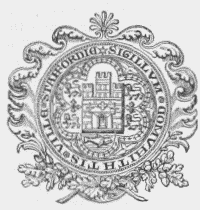
Corporation Seal.
The living of St. Mary's is a rectory not in charge, in the patronage of the Crown: net income, £401. The church, formerly collegiate for a dean and thirteen prebendaries, is an ancient and spacious cruciform structure in the early English style, with a lofty octagonal tower rising from the intersection, the upper part of which is of later date; the north entrance has delicate shafts and bold hollows, embellished with flowers and foliage. The interior is beautifully arranged. The piers and arches are of the early English, passing into the decorated style, and to the east of the transepts diminish gradually in height; the windows are generally in the decorated style, intermixed with others of the later English, of which the east window is an elegant specimen. The chancel is spacious, and the roof supported on finelypointed arches, and piers of clustered columns; in the north transept is the font, a work of great beauty, highly ornamented with sculptured figures and animals. There are many ancient and modern monuments, among which the most conspicuous are those of the family of Aston, of Tixall. The church in 1844 underwent a thorough course of external and internal restoration, at an expense of £11,000, of which £5000 were the gift of Jesse Watts Russell, Esq., of flam Hall, who also gave four painted windows which cost £1000; the remaining £5000 were raised by subscription under the auspices of the Rev. W. E. Coldwell, the rector. Attached to St. Mary's is a curacy, endowed by Queen Elizabeth, and now producing £170 per annum. The living of St. Chad's is a perpetual curacy; net income, £85; patron, the Prebendary of Prees in the Cathedral of Lichfield. The church is a small edifice, originally in the Norman style, with a later English tower between the chancel and nave: the chancel is still in good preservation, and, with the exception of a modern east window, retains its original character; the nave is of more recent date. Christchurch, of which the first stone was laid by the late Earl of Harrowby, in November, 1837, has been endowed as a district church with £1300 in the three and a half per cent, consols, by the rector, in whom the patronage is vested; it is a neat structure of cruciform shape, in the Norman style, containing 600 sittings, of which 300 are free. Churches have likewise been erected in the hamlets of Marston, Salt, and Whitgreave. There are places of worship for Presbyterians, the Society of Friends, Independents, and Wesleyans of the Old and New Connexion.
The free grammar school, which, according to Leland, was originally established by "Sir Thomas, Countre Parson of Ingestre-by-Heywodde, and Syr Randol, a chauntre presteof Stafford," and further endowed with subsequent benefactions, was refounded on petition of the inhabitants by Edward VI., who augmented the revenue, in 1550: the income is now about £350 per annum. An institution for the relief of the widows and orphans of poor clergymen of the county is supported by subscription, and has also property vested in old South Sea stock. A county infirmary, or hospital, was established in 1766, and the present building erected in 1772. A lunatic asylum was instituted in the year 1818, for paupers in the county, and for patients from all parts of the kingdom, upon moderate terms, regulated according to their circumstances: the buildings, erected at a cost of £30,524, are capable of accommodating 250 inmates; and the gardens and pleasure-grounds comprise 30 acres. Almshouses for twelve aged and infirm persons were erected in 1640, by Sir Martin Noel, at an expense of £1000: twenty families reside in them. The poor-law union of Stafford comprises 20 parishes or places, and contains a population of 20,293.
A priory of Black canons, dedicated to St. Thomas à Becket, was founded about two miles east of the town. by Richard Peeche, Bishop of Lichfield and Coventry, in 1181; the revenue at the Dissolution was £198. 0. 9.: a small portion of the buildings remains, converted into a farmhouse. A house of Friars Eremites, of the order of St. Augustine, was established in the suburb of Fortbridge, in Castle-Church parish, by Ralph, Lord Stafford; to which, on the abolition of the priory of Stone, the monuments of the family were removed: it continued till the suppression, at which time these splendid memorials were destroyed. A priory of Franciscan friars was instituted at the north end of the town walls by Sir James Stafford, of Sandon, in the reign of Edward I.; the income at the Dissolution was £35. 13. 10. In addition to these were, a free chapel in the castle, dedicated to St. Nicholas; the free chapel or hospital, of St. John, near the river, in Forebridge, for a master and poor brethren, the revenue of which was £10; and a free chapel dedicated to St. Leonard, of which the income was £4. 12. 4. Several silver coins of a later date than the reign of Edward VI., a silver cross, the lower portion of an ancient font or piscina, a cannon-ball, and two small mill-stones, were found on repairing the walls of the castle, some few years since.
Among eminent natives have been, John de Stafford, a Franciscan monk; Edmund Stafford, Bishop of Exeter, and chancellor of England, in the reigns of Richard II. and Henry IV.; Thomas Ashebourn, a strenuous opponent of Wycliffe; Thomas Fitz-Herbert, a learned Roman Catholic divine of the l6th and 17th centuries, and principal of the English college at Rome; and the wellknown Izaak Walton. Stafford gives the title of Baron to the Jerningham family.
Stafford, West
STAFFORD, WEST, a parish, in the union of Dorchester, hundred of Culliford-Tree, Dorchester division of the county of Dorset, 2½ miles (S. E. by E.) from Dorchester; containing 212 inhabitants. It is situated on the southern branch of the river Frome. The living is a rectory, valued in the king's books at £10. 8. 1½., and in the patronage of John Floyer, Esq.: the tithes have been commuted for £265, and the glebe comprises 39 acres. The church, according to a date over the porch, seems to have been rebuilt in 1640. Frome-Billet, in the parish, was once a parish of itself, but the church having been destroyed, and the place becoming almost depopulated, the living was united, about the middle of the 15th century, to that of West Stafford. It contains an ancient mansion, which formerly belonged to the family of Gould, now the property of Mr. Floyer.
Staffordshire
STAFFORDSHIRE, an inland county, bounded on the north and north-west by Cheshire, on the west by Salop, on the south by Worcestershire, on the south-east by Warwickshire, and on the east and north-east by Derbyshire. It extends from 52° 23' to 53° 14' (N. Lat.), and from 1° 33' to 2° 22' (W. Lon.), and includes an area of 1148 square miles, or 734,720 statute acres: within its limits are 97,777 houses inhabited, 5458 uninhabited, and 904 in course of erection; and the population amounts to 510,504, of which number 258,864 are males, and 251,640 females. Its ancient British inhabitants were the Cornavii, whose territory, on its subjection by the Romans, was included in the division called Flavia Cœsariensis. On the completion of the AngloSaxon heptarchy, the county was comprised in the powerful kingdom of Mercia, several of the principal towns of which were situated within its limits. It is in the diocese of Lichfield, and province of Canterbury; and forms an archdeaconry, containing the deaneries of Tamworth, Tutbury, Lapley, Treizull, Alveton, Leek, Newcastle-under-Lyme, and Stone; with 146 parishes. For purposes of civil government it is divided into the hundreds of Cuttlestone East and West, Offlow North and South, Pirehill North and South, Seisdon North and South, and Totmonslow North and South. It contains the city of Lichfield; the borough and market towns of Newcastle-under-Lyme, Stafford, Tamworth, Stoke-upon-Trent, Walsall, and Wolverhampton, the three last recently enfranchised; and the market-towns of Burslem, Burton-upon-Trent, Cheadle, Eccleshall, Hanley, Leek, Longnor, Longton, Penkridge, Rugeley, Stone, Uttoxeter, and Wednesbury. Under the act 2nd of William IV., cap. 45, the county was formed into the Northern and Southern divisions, each sending two members to parliament; two representatives are returned for Lichfield, and two for each of the boroughs, except Walsall, which sends only one. The county is included in the Oxford circuit; and the assizes and quarter-sessions are held at Stafford.
Its surface is various. The northern part rises into hills called the Moorlands, constituting the southern extremity of the long mountainous range which stretches hence through the north of Derbyshire, and along the western confines of Yorkshire, towards the borders of Scotland. These Moorlands are to the north of a supposed line drawn from Uttoxeter to Newcastle-underLyme, and comprise extensive tracts of waste and uncultivated land, appropriated almost entirely to the pasturage of sheep. A large portion of them has been inclosed with stone walls, almost the only fence to be seen in this part; but the inclosures have not been subdivided, and large breadths have never undergone the least improvement. The pleasant vale containing the town of Cheadle, in this part of the county, is bounded, in the vicinity of that town, by high barren hills composed of huge heaps of gravel: the wastes upon these hills, and upon others equally barren, extending both northward and westward of Cheadle, are extensive; and almost their only produce is heath, broom, whortleberries, and mountain cinquefoil. Eastward of the town, approaching the borders of Derbyshire, are similar desolate wastes, one of which, near the banks of the Dove, is called Oakmoor, from its being or having been nearly covered with dwarf oaks. A little to the north of this commences a large tract of limestone country, included between the rivers Dove and Churnet, extending westward as far as Ipstones, and northward as far as Longnor, and comprises an area of 50 or 60 square miles. This is the most valuable part of the Moorlands, the soil naturally producing a fine herbage. Many of the hills here, which are composed of immense masses of limestone, rise to a great height, and present huge perpendicular cliffs. The Weaver hills, in the southern part of the limestone district, of very considerable extent, rise, in common with some other of the highest peaks of the Moorlands, to an elevation of 1000 feet and upwards above the tide in the Thames at Brentford, and command remarkably extensive views, in which are included the Peak hills of Derbyshire. They are almost covered with irregular excrescences, clothed with moss or lichens. Many other parts of the Moorlands, notwithstanding their great superiority of elevation, are entirely wet peat moors, or moss; such are Morrage, Axedge, the Cloud heath, High Forest, Leek-Frith, and Mowcop or Mole-Cop. The middle and southern parts of the country are level, or diversified only by gentlyrising eminences. The following tracts, however, are exceptions to this observation, viz., the limestone hills of Dudley and Sedgley; the parish of Rowley-Regis, principally composed of an isolated mountain terminating in various peaks, the loftiest of them, called Turner's Hill, rising 900 feet above high water in the Thames at Brentford; Barbeacon rising 653 feet; and other hills of less elevation.
The quantity of land in the county devoted to Agricultural purposes is estimated at 600,000 acres, of which 500,000 are arable, the rest meadow or pasture. Of the arable lands, 200,000 acres are of the clayey, or of the more friable of the mixed loams; an equal quantity is of gravelly or sandy loam, or of the calcareous soils, and the remaining 100,000 acres are for the most part of light sandy or gravelly loams, suitable for turnips. The courses of crops are various: the Norfolk system including the rotation of turnips, barley, clover, and wheat, is in common practice on the light soils. The crops of grain and pulse usually grown are wheat, barley, oats, beans, and peas. On the Moorlands oats are almost the only grain ever cultivated, being generally sown for three succeeding years, after which the ground is laid down for grass: a considerable quantity of oaten bread is eaten in the Moorlands. Buck-wheat, here called French wheat, is sometimes cultivated, either as a crop or for ploughing under as manure. Hemp and flax are also grown, though upon a small scale; many leases are subject to restrictions, to prevent the cultivation of these plants. The common artificial grasses are red clover, white clover, trefoil, and rye-grass; burnet and ribgrass are also sown in considerable quantities. In the parish of Tettenhall, near Wolverhampton, great quantities are grown of a peculiar kind of pear, called from the name of the place where it is produced.
The woods, wastes, and impracticable lands, are supposed to occupy upwards of 100,000 acres. The county is well stocked with almost every species of English timber growing on the estates of the nobility and gentry. Plantations to a great extent have been made on various parts of the steep Moorland hills, particularly those of Dilhorne, Kingsley, and Oakmoor: from the underwood of these many rods and staves, to make crates for the use of the potteries, are cut. Needwood Forest, in the eastern part of the county, situated between the rivers Trent and Dove, before the passing of an act of inclosure about the commencement of the present century, was an entirely wild tract of nearly 10,000 acres, presenting much romantic and beautiful scenery, and affording pasturage to numerous herds of deer: it was also subject to a common right for cattle and horses. Of the wastes now remaining, Cannock Heath is by far the most extensive, containing upwards of 25,000 acres near the centre of the county, and chiefly to the north and east of the small town of Cannock. Although at present a bleak and dreary tract, devoid of trees, it is asserted to have been covered in former times with a profusion of majestic oaks, and to have been a favourite chase of the Saxon Kings of Mercia.
The mineral productions are numerous and valuable, consisting of coal, iron, lead, copper, marble, gypsum, and stone of various kinds. The coal strata occupy an area of more than 75,000 acres; the largest deposit extends in length from about one mile south of Rugeley to Stourbridge, in Worcestershire, a distance of 22 miles, while its breadth in some places is not much less than 9 miles. In its southern part, at various depths below the surface, is found the thick coal or ten-yard stratum, beneath which are valuable beds of ironstone, the clay ironore of mineralogists. The whole of the beds of coal, ironstone, sandstone, and shale in this district have suffered much dislocation from the action of volcanic rocks, which are found to occupy large areas underneath the surface, and to protrude through and form hills of basaltic rock of greater or less elevation at Rowley-Regis, Barrow Hill, and Powk Hill. The base rock of the coal-field is a limestone, known by its peculiar fossils to belong to the Wenlock formation of geologists: it rises to the surface in a ridge of hills from Dudley, in Worcestershire, to Sedgley; again round the town of Walsall; and in isolated patches in other places. In the north of the county, coal and ironstone are also raised in abundance; namely, in the neighbourhood of Newcastle and the Potteries, near Lane-End and Hollybush, and in the vicinity of Cheadle and Dilhorne. In the numerous mines of coal and iron, and in the foundries, blast-furnaces, slitting-mills, and other iron manufactories, an immense number of workmen are employed; the works on the banks of the Birmingham canal are particularly extensive.
The other metallic ores obtained are copper and lead, of both which considerable quantities are raised at Ecton, near Warslow, approaching the north-eastern border of the county: a copper-mine is also worked at Mixon, within a few miles of Leek; and a lead-mine near Stanton Moor, in the same part of the county. Limestone forms the substratum of a great part of the county: an immense quantity of stone is raised for burning into lime; and the limeworks on Caldon Low, and in the neighbourhood of the Weaver hills, are on a very large scale. The limestone, in different places, has some of the qualities of marble, and is susceptible of a high polish; in others it is composed, in a great measure, of petrified animal remains. The kind of marble called rancemarble, which is white, with red veins formed of shining gritty particles, takes so good a polish as to be frequently used for chimney-pieces and monuments; it is found in abundance in Yelpersley Tor and the adjoining hills. There is a considerable quantity of grey marble at Stansop. In the great limestone district of the Moorlands, particularly on the banks of the river Dove, are some veins of gypsum, which is also dug between Needwood Forest and Tutbury; many of the moulds used in the potteries are composed of this material, after it has been burned and ground. Quarries of excellent freestone are numerous; clays of almost every description are found, and potters'-clay, of several sorts, abounds in the vicinity of Newcastle, in which district the pottery wares were formerly manufactured from it. At Amblecoat, in the southern part of the county, is a clay of a dark blueish colour, of which glasshouse pots of a superior quality are made. Yellow and red ochre are also found; and a blue clay obtained at Darlaston, near Wednesbury, is used by glovers. A kind of black chalk exists in beds of grey marble, in Langley-close; and a fine reddish earth, little inferior to the red chalk of France, is obtained near Himley Hall.
The manufactures are various and extensive. That of hardware, in the southern district, is very important, and affords employment to many thousand persons. At Wolverhampton, and in its vicinity, are made locks of every kind, edge-tools, files, augers, japanned goods, and a great variety of other articles. The town and neighbourhood of Walsall are famous for the manufacture of saddlers' ironmongery, such as bridle-bits, stirrup-irons, spurs, &c, sent thence to every part of the kingdom. The making of nails employs many persons in the populous districts of this part of the county, particularly in those of Sedgley, Rowley, West Bromwich, Smethwick, Tipton, Wombourne, Pelsall, and the Foreign of Walsall: women and children are employed in making the lighter and finer sorts. The other kinds of hardware produced are chiefly plated, lackered, japanned, and some enamelled goods, toys, tobacco and snuff boxes, of iron and steel; and machinery for steamengines. Some places also partake of the manufacture of guns; and there are several works for making brass, and for preparing tin plates, chiefly in the northern part of the county. In those parts of Staffordshire situated in the vicinity of Stourbridge, Birmingham, and Dudley, are a number of glass-houses, where the manufacture is carried on to a great extent.
The manufacture of china and earthenware, in the north-western part of the county, is the most important of the kind in the kingdom: the district called the Potteries consists of numerous scattered villages, occupying an extent of about ten square miles, and containing about 20,000 inhabitants. This manufacture, though of very ancient establishment in this part of the country, was of inferior importance until the latter part of the eighteenth century. At that time, by the exertions of the late Josiah Wedgwood, Esq., it was raised to such a pitch of excellence, as confers great honour upon that gentleman's ingenuity and taste; and in consequence, several of the villages of this district, particularly Burslem and Hanley, have grown rapidly into populous market-towns. The several species of ware invented by Mr. Wedgwood, varied by the industry of the manufacturers into an infinity of forms, and differently painted and embellished, constitute nearly the whole of the fine earthenwares at present manufactured in England. Almost every part of the kingdom receives supplies of pottery from this district, yet by far the greater portion of its produce is exported to foreign countries; and the exports of earthenware and china to the United States alone amount to 60,000 packages annually.
The quantity of wool manufactured is small, nearly the whole of the produce of the county being sold to the clothing and hosiery districts. The cotton manufacture is considerable; and the works at Rocester and other places near the Dove are on a large scale, as are also those at Fazeley and Tutbury. The town of Leek and its neighbourhood have a considerable manufacture of silk and mohair, the articles being chiefly sewing-silk, twist, buttons, ribbons, ferrets, shawls, and handkerchiefs. Tape is manufactured at Cheadle and Tean, affording employment to many of their inhabitants. Stafford has manufactures of shoes and boots, for exportation and home consumption; and tanning and hatmaking are carried on largely in several of the towns. This county is also celebrated for its ale, particularly that made at Burton.
The principal rivers are the Trent, the Dove, the Tame, the Blythe, the Penk, and the Sow. The Severn also, though not considered a Staffordshire river, takes its navigable course by the parish of Upper Arely, at the south-western extremity of the county. The Trent, which ranks as the third largest river in England, becomes navigable at Burton, a little below which, being joined by the Dove, it enters Derbyshire, after a course, through this county and bordering upon it, of upwards of 50 miles. The Dove, which, throughout its course, forms the boundary between this county and that of Derby, not far from its source enters the beautiful and sequestered Dove-dale, flowing through it in a southern direction, to the vicinity of Ashbourn, in Derbyshire, whence it proceeds south-westward towards Uttoxeter, near which town it assumes a south-eastern direction, by Tutbury, to its junction with the Trent north-east of Burton. From the inclination of the bed of the river, its water flows with great rapidity, in some places dashing over rugged masses of rock, in others forming gentle cascades. Near the village of Ham, in this county, the Dove is augmented by the waters of the rivers Manifold and Hamps. The former, rising near the source of the Dove, takes a very circuitous route through a romantic vale in the north-eastern part of the county, and, sinking into the earth to the south of Ecton Hill, between the villages of Butterton and Wetton, is invisible for four miles, and emerges again at Ham, shortly before its junction with the Dove. The stream is joined during its subterraneous transit by the Hamps, which in like manner passes under ground for some distance.
The extent of artificial navigation for the ready transport of the produce of the mines, manufactures, &c, is remarkably great. The Grand Trunk canal, which was planned, and in a measure executed, by the celebrated engineer Brindley, enters this county from Cheshire, near Lawton, and almost immediately passes through the Harecastle tunnel, which is 2880 yards long. The highest level of the canal is at Harecastle, from which, on the south-eastern side, there is a fall of 316 feet. The Staffordshire and Worcestershire canal branches from this at Haywood, near the confluence of the rivers Sow and Trent, and quits the county, in its course to the Severn, a short distance to the south of Kinver: this canal, with the Grand Trunk, completes the communication between the ports of Bristol, Liverpool, and Hull. The Coventry and Oxford canal branches from the Grand Trunk at Fradley Heath, and near Fazeley enters Warwickshire; from Fazeley a branch called the Birmingham and Fazeley canal proceeds to Birmingham. The Wyrley and Essington canal, commencing at a place called Wyrley Bank, forms a junction with the Birmingham canal near Wolverhampton; its branches are, one from the vicinity of Wolverhampton to Stow Heath, another from Pool-Hayes to Ashmore Park, and a third from Lapley-Hayes to Ashmore Park. At Huddlesford commences a hranch from the Coventry canal, called the Wyrley and Essington Extension, which forms a junction with the Wyrley and Essington line near Bloxwich: on the western side of part of Cannock Heath a branch is carried southward by Walsall Wood, to the limeworks at Hayhead. The length of the Extension, including branches, is 34½ miles; and from Cannock Heath to the Coventry canal it has a fall of 264 feet. The Birmingham canal, from that town in Warwickshire, joins the Staffordshire and Worcestershire canal a little to the north of Wolverhampton, after a course of 22 miles. Of the numerous branches of this canal, one proceeds northward, over Ryder's Green, to the collieries of Wednesbury, and the vicinity of Walsall. Another, beginning about a mile from Dudley, passes south-westward by Brierley Hill, and to the left of Brockmore Green joins a canal which commencing in a large reservoir at Pensett's Chase, and passing nearly in a straight line by Wordsley, crosses the river Stour, and joins the Staffordshire and Worcestershire canal, a few miles to the west of Stourbridge, in Worcestershire, to which town there is a small branch. The cut which connects the Dudley canal with that of Birmingham, called the Dudley Extension canal, has part of its course in this county. Sir Nigel Gresleys canal extends from the Grand Trunk, near Newcastle-under-Lyme, past that town, to the coal-mine in Apedale. The Birmingham and Liverpool railway enters the county a little to the north-west of Birmingham, and passing by Wednesbury, Wolverhampton, Penkridge, and Stafford, quits it to the north-west of Madeley. The Birmingham and Derby railway crosses the county on its eastern side, and at Tamworth joins the Trent- Valley line which connects the towns of Stafford, Rugeley, Lichfield, and Tamworth, with the north-eastern part of Warwickshire.
The antiquities are of considerable interest. Some large single stones at Cannock are supposed to be Druidical; as also are the eight upright stones called the Bridestones, near Biddulph, on the north-western boundary of the county. On Drood or Druid heath, where are several singular earthworks, Mr. Shaw, the historian of the county, considers the chief seat of the Arch-Druid of Britain to have been situated. Thyrsis, or Thor's house, a cavern in the side of a lofty precipice in the vale of the Manifold, near Wetton, is also thought to have been the scene of Druidical rites. Some very ancient artificial caves have been discovered at Biddulph. The encampment of Billington, about three miles to the west of Stafford, and that on Castle Hill, near Beaudesert park, in the vicinity of Rugeley, are of British formation. Under the Roman dominion, the tract now constituting Staffordshire contained the stations of Etocetum, at Wall, near Lichfield; and Pennocrucium, now Penkridge. Sheriff-Hales, near the confines of Shropshire, is supposed by some antiquaries to have been the site of Uxacona or Usacona. Two of the great prætorian ways crossed Staffordshire: the Watling-street, entering it from Warwickshire, near Tamworth, proceeded westward across the southern part, and quitted it for Shropshire, on the west of the town ofBrewood. The Ikeneldstreet, which entered from Warwickshire, at the village of Handsworth, near Birmingham, proceeded thence, in a north-north-eastern direction, to a little beyond Shenstone; it there crossed the Watling-street, and afterwards pursued a north-eastern course, entering Derbyshire at Monks' Bridge, on the Dove. Roman domestic remains, and traces of roads, are discoverable in different places; and Roman earthworks are visible at Arely wood, Ashton heath, Ashwood heath, near Kinver, at Oldbury, near Shareshill, and in Tiddesley park. Near Maer are intrenchments supposed to have been thrown up by Cenred, in the progress of his hostilities against Osred, King of Northumbria; and on Sutton-Coldfield is a camp considered to be of Danish formation.
The number of religious houses in the county, including free chapels, hospitals, and colleges, was about 40; and remains of Burton and Croxden Abbeys, and of the priories of Rowton, Stafford, and Stone, are still visible. The chief remains of castles are those of Alveton, Caverswall, Chartley, Healy or Heyley, Tamworth, and Tutbury Castles; and among the most remarkable ancient mansions are Bentley Hall and Moseley Hall, in both which Charles II. remained concealed for some time after the battle of Worcester. Staffordshire contains numerous modern seats of the nobility and gentry, many of which are elegant, and several magnificent: among the most distinguished are, Trentham, the property of the Duke of Sutherland; and Beaudesert, that of the Marquess of Anglesey. The county gives the inferior title of Marquess to the family of Leveson-Gower, dukes of Sutherland.
Salt springs exist in different places, the principal being in the parish of Weston. Of the other mineral springs of various qualities, the most remarkable are, that near Codsall, formerly famous for the cure of leprosies; St. Erasmus' well, between Ingestrie and Stafford; and that at Willoughby. Numerous fossil remains occur in the strata of the county, more particularly in some of the limestone beds. At Bradley, to the east of Wolverhampton, a stratum of coal about four feet thick, and eight or ten yards below the surface, having been set on fire, burned for about fifty years, and has reduced a considerable extent of land to a complete calx, used for the mending of roads: sulphur and alum are found in its vicinity.
Stagbatch
STAGBATCH, a hamlet, in the parish and union of Leominster, hundred of Wolphy, county of Hereford, 2 miles (W. S. W.) from the town of Leominster: containing 37 inhabitants.
Stagsden (St. Leonard)
STAGSDEN (St. Leonard), a parish, in the hundred of Willey, union and county of Bedford, 4 miles (W. by S.) from Bedford; containing 632 inhabitants. It comprises about 3386 acres, of which 220 are arable, 1100 meadow and pasture, and about 80 woodland: the soil is chiefly clay, producing good wheat; the wood is oak and elm, with plantations of fir. The living is a discharged vicarage, valued in the king's books at £8; patron, the Hon. G. R. Trevor; impropriators, Trinity College, Cambridge. The great tithes have been commuted for £558, and the vicarial for £350; the glebe comprises 2 acres. The church is a handsome structure in the later English style, with an embattled tower. A school is endowed with £6 per annum.