A Topographical Dictionary of England. Originally published by S Lewis, London, 1848.
This free content was digitised by double rekeying. All rights reserved.
'Tatchbury - Taynton', in A Topographical Dictionary of England, ed. Samuel Lewis (London, 1848), British History Online https://www.british-history.ac.uk/topographical-dict/england/pp303-310 [accessed 30 April 2025].
'Tatchbury - Taynton', in A Topographical Dictionary of England. Edited by Samuel Lewis (London, 1848), British History Online, accessed April 30, 2025, https://www.british-history.ac.uk/topographical-dict/england/pp303-310.
"Tatchbury - Taynton". A Topographical Dictionary of England. Ed. Samuel Lewis (London, 1848), British History Online. Web. 30 April 2025. https://www.british-history.ac.uk/topographical-dict/england/pp303-310.
In this section
Tatchbury
TATCHBURY, a tything, in the parish of Eling, union of New-Forest, hundred of Redbridge, Romsey and S. divisions of the county of Southampton; containing 50 inhabitants. Tatchbury Mount is supposed to have been a British military station; and the tything is said by tradition to have subsequently contained a royal hunting seat.
Tatenhill (St. Michael)
TATENHILL (St. Michael), a parish, in the union of Burton-upon-Trent, N. division of the hundred of Offlow and of the county of Stafford, 3½ miles (W. S. W.) from Burton-upon-Trent, containing, with the chapelries of Barton-under-Needwood and Wichnor, and the township of Dunstall, 2229 inhabitants, of whom 435 are in Tatenhill township. The parish comprises 9435 acres, and is crossed by the Grand Trunk canal. Tatenhill is an ancient village, seated in a deep romantic glen, between two high hills which gradually descend from the eastern border of Needwood Forest. The hamlet of Callingwood is beautifully situated near the confines of the forest, and contains a wood called Knightley Park, and the site of an old moated house that belonged to a family of that name. The manor of Callingwood is the property of Sir Oswald Mosley, Bart., by purchase from the late Abraham Hoskins, Esq., of Burton. The living is a rectory, annexed, with the prebend of Adbaston, to the deanery of Lichfield, and valued in the king's books at £26. 1.8.: the tithes have been commuted for £1337, and the glebe comprises 123½ acres. The church is in the early English style, with a tower: the interior was renovated and new pewed in 1838. At Barton and Wichnor are separate incumbencies. A national, an infants', and a Sunday school, are supported by subscription. In 1786 a Roman urn was ploughed up at Knightley Park, which contained a number of gold coins of the twelve first emperors.
Tatham (St. James)
TATHAM (St. James), a parish, in the hundred of Lonsdale south of the Sands, N. division of Lancashire; containing, with the chapelry of Tatham-Fell, 677 inhabitants, of whom 324 are in Tatham township, 11 miles (N. E. by E.) from Lancaster. Whitaker explains Tatham to signify "the habitation of Tata." Before the reign of Richard I., a family of the local name possessed lands in Tatham, but the estate passed, before the 34th of Edward III., into the Dacre family. Elizabeth, co-heiress of Thomas Dacre, married Sir Thomas Harrington, of Hornby; and Tatham has since invariably passed with the honour of Hornby, not as an integral portion, but as an independent and distinct manor held by the lords of that place. The parish comprises 6343a. 2r. 16p., the soil of which is chiefly clay: the face of the country is in some parts extremely rugged; the scenery is frequently grand, and sometimes highly beautiful. The river Wenning flows through the north of the parish, which it partly bounds; and the Hindburn, a mountain torrent issuing from the moorland ravines south of Lowgill, mingles with the Wenning between the parishes of Tatham and Melling. A few mines of coal are in operation; and there is a good freestone-quarry: a bobbin-mill employs about 20 hands. The North-Western railway, from Lancaster into Yorkshire, intersects Tatham. A fair for cattle is held on March 12th, in the village of Lowgill. The living is a rectory, valued in the king's books at £12. 5.; net income, £195, with a house; patron, Pudsey Dawson, Esq., of Hornby Castle. The church is a small neat edifice of ancient date, with a tower built in 1722. At Tatham-Fell is a chapel, which was restored in 1840: the living is a perpetual curacy, in the patronage of the Rector of Tatham; net income, £125. A school is endowed with £26 per annum. A Roman road passes through the parish.
Tathwell (St. Vedast)
TATHWELL (St. Vedast), a parish, in the union of Louth. Wold division of the hundred of Louth-Eske, parts of Lindsey, county of Lincoln, 3¾ miles (S. by W.) from Louth; containing 365 inhabitants, and comprising about 4350 acres. Tathwell Hall, erected by the Hanby family, from whom the estate passed in the latter part of the seventeenth century to the Chaplins, was rebuilt in 1841, by Charles Chaplin, Esq., the present lord of the manor and impropriator. The living is a discharged vicarage, valued in the king's books at £10, and in the gift of the Bishop of Lincoln, with a net income of £345. The church contains monuments to the Hanby and Chaplin families. On Bully Hill, in the parish, are six barrows, in a line from east to west; and on another eminence, situated at the distance of about half a mile from the barrows, are the remains of two encampments.
Tatsfield, or Tattesfield
TATSFIELD, or Tattesfield, a parish, in the union of Godstone, Second division of the hundred of Tandridge, E. division of Surrey, 3 miles (N. W. by W.) from Westerham; containing 172 inhabitants, and comprising 1280a. 12p. The manor belonged to Odo, halfbrother of William the Conqueror, and is mentioned in Domesday book under the appellation of Tatelefelle; among later proprietors may be named the Uvedales, Greshams, and Gowers. The living is a discharged rectory, valued in the king's books at £5. 0. 5.; net income, £150; patron, William L. Gower, Esq. The church is principally in the early English style; the body was almost entirely rebuilt in 1838, by subscription, and the tower and south porch, which are elegant specimens of that style, at the expense of the Rev. Thomas Streatfeild, the curate.
Tattenhall (St. Alban)
TATTENHALL (St. Alban), a parish, in the union of Great Boughton, Lower division of the hundred of Broxton, S. division of the county of Chester; containing, with the townships of Golborn-Bellow and Newton, 1119 inhabitants, of whom 904 are in Tattenhall township, 5¾ miles (S. W. by W.) from Tarporley. The township is intersected by the Chester and Crewe railway, and comprises 2759 acres, the soil of which is chiefty clay. The living is a rectory, valued in the king's books at £13. 17. 6.; patron, the Bishop of Chester: the tithes have been commuted for £282, and the glebe consists of 23 acres. Besides the church, are places of worship for Independents and Wesleyans. Dr. Paploe, rector, who died in 1781, gave a sum of money, which was afterwards vested in the purchase of £334 three per cents., for education.
Tattenhoe
TATTENHOE, a parish, in the union of Winslow, hundred of Cottesloe, county of Buckingham, 3¾ miles (W.) from Fenny-Stratford; containing 15 inhabitants. The living is a donative curacy, held by institution as a rectory; net income, £50; patron and impropriator, W. S. Lowndes, Esq. The church was rebuilt in 1540; but the parish containing only a few inhabitants, it fell into disuse, until the rector of Shenley claimed the tithes, in 1636, when it was consecrated anew.
Tatterford (St. Margaret)
TATTERFORD (St. Margaret), a parish, in the union of Walsingham, hundred of Gallow, W. division of Norfolk, 4 miles (W. by S.) from Fakenham; containing 59 inhabitants. It comprises 959a. 2r. 37p., of which 817 acres are arable, 131 pasture, and 11 woodland. The living is a discharged rectory, consolidated with that of Tattersett, and valued in the king's books at £6. 6. 8.: the tithes of the parish have been commuted for £204, and the glebe contains nearly 53 acres. The church is a small ancient structure, with a belfry rising from the western gable.
Tattersett (St. Andrew)
TATTERSETT (St. Andrew), a parish, in the union of Walsingham, hundred of Gallow, W. division of Norfolk, 6 miles (W.) from Fakenham; containing 160 inhabitants. It comprises 1759a. 3r. 22p., of which 1474 acres are arable, 164 meadow and pasture, 40 woodland, and 81 common. The living is a discharged rectory, with that of Tatterford consolidated, valued in the king's books at £11. 1. 8., and in the gift of Sir Charles Chad, Bart. The tithes of the parish have been commuted for £474. 11. The church is an ancient structure in the early and later English styles, with a square embattled tower: near it are some vestiges of an old church dedicated to All Saints.
Tattershall (Holy Trinity)
TATTERSHALL (Holy Trinity), a market-town and parish, in the union of Horncastle, S. division of the wapentake of Gartree, parts of Lindsey, county of Lincoln, 9 miles (S. S. W.) from Horncastle, and 125 (N.) from London; containing, with the township of Thorpe, 907 inhabitants. This place was a Roman military post, as two encampments at Tattershall Park in its immediate neighbourhood indicate; and was granted at the Conquest to Eudo, one of William's followers, whose descendants erected a castle about 1440, south-westward from the town. The fortress stood on a moor, and was surrounded by two fosses, which received the waters of the Bain; the principal part was demolished during the parliamentary war. The northwest tower, still remaining, a rectangular brick structure 100 feet high, flanked by four embattled octangular turrets, was built by Sir Ralph Cromwell, treasurer of the exchequer in the reign of Henry VI. He likewise erected a lofty tower with a spiral staircase leading to its summit, about four miles northward, as an appendage to the larger structure: this is now in a very dilapidated state. The town is situated on the river Bain, near its junction with the Witham; it is much decayed, and the trade is inconsiderable. A canal from the Witham to Horncastle passes through it. The market, originally granted by King John to Robert Fitz-Eudo, is on Thursday; there is a market for pigs on Friday, and fairs are held on May 15th and September 25th. The parish comprises by admeasurement 1600 acres.
The living is a donative; net income, £110; patron and impropriator, Earl Fortescue: the tithes of Thorpe were commuted for land and corn-rents in 1796. The church is on the eastern side and in the outer moat of the castle. It was made collegiate in the time of Henry VI., for seven chaplains (one of whom was master), six clerks, and six choristers: at the Dissolution the revenue was estimated at £348. 5. 11. The collegiate buildings have been taken down, and the church alone remains, a venerable cruciform structure, consisting of a nave, transepts, and choir; the choir was of beautiful design, but since the removal of its fine painted windows to the chapel of Burleigh, the seat of the Marquess of Exeter, this part of the edifice has been allowed to fall into decay. There is a place of worship for Wesleyans. A national school, held in the south transept of the church, is partly supported by £20 per annum from the Gibson charity; and an almshouse, partitioned into ten separate apartments, originally established by the licence which raised the church into a college, has a small endowment from the same fund. Ammonites and other fossils are found in a stratum of blue clay.
Tattingstone (St. Mary)
TATTINGSTONE (St. Mary), a parish, in the incorporation and hundred of Samford, E. division of Suffolk, 6 miles (S. W. by S.) from Ipswich; containing 628 inhabitants, and consisting of 1637a. 39p. The living is a rectory, valued in the king's books at £6. 13. 4., and in the gift of C. Elliott, Esq.: the tithes have been commuted for £402; there is a parsonagehouse, and the glebe comprises 38 acres. The Wesleyans have a place of worship; and a national school has been established. This is the head of a union comprising twenty-eight parishes, and containing a population of 11,818. On the estate called the Place, in the parish, is a very thick deposit of marine shells.
Tatton
TATTON, a township, in the parish of Rosthern, union of Altrincham, hundred of Bucklow, N. division of the county of Chester, 2 miles (N.) from Knutsford; containing 69 inhabitants. The seat of the Egertons of Tatton is here. Tatton Park is one of the largest parks in England, and contains from six to seven hundred head of deer. The township comprises 1777 acres, of which 200 acres are in wood; the soil is stiff, and the surface level. The Egerton family are owners of the entire township.
Tatworth
TATWORTH, a tything, in the parish and union of Chard, E. division of the hundred of Kingsbury, W. division of Somerset, 1¾ mile (S.) from Chard; containing 383 inhabitants. A church has been erected; it is dedicated to All Saints, and the living is in the gift of the Vicar of Chard.
Taunton
TAUNTON, a borough and market-town, and the head of a union, in the hundred of Taunton and Taunton-Dean, W. division of Somerset, 11 miles (S. by W.) from Bridgwater, and 144 (W. by S.) from London; containing 12,066 inhabitants. This place was called by the Saxons Tantun, and subsequently Tawriton and Thoneton, from its situation on the river Thone or Tone. It is of great antiquity; and the discovery of several urns containing Roman coins, in the neighbourhood, has led to the conjecture that it existed in the time of that people. The earliest authentic accounts refer to the period of the heptarchy, when a castle was built here for a royal residence, by Ina, King of the West Saxons, who held his first great council in it, about the year 700. This castle was demolished by his queen Ethelburga, after expelling Eadbricht, King of the South Saxons, who had seized it. The manor is supposed to have been granted to the church of Winchester in the following reign; and another castle is said to have been built on the site of the former, in the time of William I., by the bishops of Winchester, who principally resided in the town for some years. At this period Taunton had a mint, some of the coins, bearing the Conqueror's effigy, being still in existence. In the reign of Henry VII., in 1497, Perkin Warbeck seized the town with its castle, which, however, he quickly abandoned on the approach of the king's troops. In 1645, it again participated in civil war, and became celebrated for the long siege it sustained, and the defence it made under Colonel (afterwards the renowned Admiral) Blake, who held it for the parliament against 10,000 royalist troops under Lord Goring, until relieved by Fairfax; on which memorable occasion a public thanksgiving was appointed by the commons, who voted £500 to the colonel, and £1000 to the men under his command. The inhabitants thus incurred the displeasure of the king, and at the Restoration, their charter was suspended, and the walls of the town ordered to be razed to the ground. James, Duke of Monmouth, was proclaimed king on the Cornhill of Taunton, June 21st, 1685; and many of his followers, including some inhabitants of this place, after his defeat at Sedgemoor, were put to death on the same spot, by the brutal Kirke, without form of trial, besides those who were condemned by Judge Jeffreys at the "bloody assize" which he held here the following September.
The town is situated in a central part of the singularly beautiful and luxuriant vale of Taunton-Dean, and is upwards of a mile in length. The principal streets, which terminate in the market-place, are spacious, well paved, and lighted with gas by a company established in 1821; the houses, mostly built of brick, are generally commodious and handsome, and supplied with excellent water. The respectability of the town, combined with the beauty of the surrounding country, renders it very attractive as a place of residence; and many improvements have been lately effected, amongst which are the erection of a neat crescent and terrace, and the removal of some old houses at East Gate. In 1833, an act was obtained for regulating the market, cleansing the streets, and preventing nuisances; and in 1840 another was passed for the improvement of the place, and for amending the provisions of the several acts for holding markets. In 1845, an act was passed for better lighting the town. The Parade, in the centre of Taunton, is a fine open triangular space, inclosed with iron posts and chains; on the east side of it is a wide street, built by the late Sir Benjamin Hammet, which forms a handsome approach to St. Mary's church. A substantial stone bridge of two arches crosses the Tone, connecting the town with the village of North-town, or Nurton; and several villas, commanding beautiful views, have been erected in the suburbs of Wilton, Staplegrove, West Monckton, and adjoining parishes. The Taunton and Somerset Institution, established in 1823, has a small but valuable library, and a museum, with a spacious public reading and news room. The theatre, in Silverstreet, is usually open two months in the year; and balls and concerts occasionally take place.
Taunton, formerly noted for its woollen manufacture, was one of the first towns into which that branch of trade was introduced. The manufacture eventually gave way to the silk-trade, which was begun here in the year 1778; the chief articles made are crapes, persians, sarsnets, and mixed goods, and the business furnishes employment to a great number of persons, principally females. Two patent-lace factories have also been established. The river Tone is navigable, but its course to Bridgwater being circuitous, and the navigation frequently interrupted, the Taunton and Bridgwater canal was constructed, which has given increased activity to trade, considerable quanties of Welsh coal being brought to the town, and, in return, the produce of the Vale of Taunton being exported to Bristol and other parts of England. The Grand Western canal, forming a communication with the river Exe, terminates here; and the Bristol and Exeter railway passes by the town. The markets are on Wednesday and Saturday, the latter day being the principal, and are well supplied with fish from both Channels, with every other kind of provisions, and with fruit in abundance. The old market-house, at the south end of the Parade, a lofty brick building supported on each side by an arcade, contains the guildhall, and a handsome assembly-room, in which is a full length portrait of George III. in his robes, presented by Sir B. Hammet. On the west side of the Parade is a building of freestone, erected in 1821, in the lower part and rear of which, and on the northern side, are the markets for meat, fish, pork, poultry, and dairy-produce; the upper being used as the library and reading-room of the institution before mentioned. It is of the Ionic order, the entablature supported by four columns, and forms a great ornament to this part of the town. Upon the last Saturday in every month is what is called the great market, including the sale of live-stock; there is a fair on June 17th, and in the suburb of North-town one on July 7 th, for horses and cattle.
The town was for several centuries under the jurisdiction of portreeves and bailiffs, chosen at the courts of the bishops of Winchester, as lords of the manor, which was formerly very extensive and valuable; the rental at the time of the Conquest appearing, from a document found amongst the court rolls, to have amounted to nearly £700 per annum. It was, however, divided by William, and portions of it distributed among his favourites. The manor of Taunton, thus diminished in extent, continued in the possession of the see until the year 1822, when it was sold by Bishop Tomline to Thomas Southwood, Esq. It is now the property of Robert Mattock, Esq., at whose annual courts, held in the castle, two portreeves, who collect the lord's rents, two bailiffs, two constables, and six tythingmen, are chosen. A charter was granted to the inhabitants in 1627 by Charles I., which continued in force until the year 1792, when, in consequence of the corporation having suffered a majority of the members to die without filling up vacancies, it became forfeited. The town is now under the jurisdiction of the county magistrates, who hold a petty-session on Wednesdays and Saturdays at the guildhall. The bailiffs usually convene and preside at public meetings, and the constables have the distribution of most of the public charities. The borough is by prescription, and first sent members to parliament in the reign of Edward I., in 1295; the boundaries comprise an area of 742 acres, and the bailiffs are returning officers. The Lent assizes for the county are held in the castle, as are also the Michaelmas general quartersessions. The powers of the county debt-court of Taunton, established in 1847, extend over nearly the whole of the registration-district of Taunton.
The castle, supposed to be part of a stately edifice erected by William Giffard, Bishop of Winchester, in the reign of Henry I., was thoroughly repaired by Bishop Langton, towards the end of the 15th century; and in addition to other improvements, the present assize hall was built by Bishop Home, in 1577, since which period various sums have been expended upon it. The building has a south front, with a gateway in the centre, over which are two escutcheons, one bearing the arms of Henry VII., with the motto Five le Roi Henri; the other the inscription Laus tibi Xte., and T. Langto Winto, 1495: at the east end is a circular tower. The inner courtyard is an irregular quadrangle, the east side being the shortest, and on the north side are the county courts, grand jury-rooms, &c.; the access to it is through an open court, called Castle Green, formerly inclosed with two gates, one of which still remains, surmounted with what was the porter's lodge, now occupied as a dwellinghouse. The moat was filled up, and the drawbridge removed, in 1785. Closely adjoining the town, at Wilton, is the house of correction: it was erected in 1754, and enlarged in 1815; and having again been improved, it was recently determined to make it the county gaol instead of that at Ilchester.
Taunton comprises the parishes of St. James and St. Mary Magdalene, the former containing 4047, and the latter 8019, inhabitants; but many houses extend into the adjoining parishes of Wilton and Bishop's-Hull. The living of St. James's is a perpetual curacy; net income, £254; patron, the Rev. Dr. Cottle; impropriator, Sir T. B. Lethbridge, Bart., whose tithes have been commuted for £420. The church, which was the church of the priory, was lately considerably enlarged and improved, at a cost of more than £2000, through the exertions of Dr. Cottle, formerly incumbent, and now vicar of St. Mary's; and is an elegant and commodious structure, containing 1400 sittings, upwards of 600 of which are free. The living of St. Mary Magdalene's is a vicarage, also in the gift of Dr. Cottle: the impropriate tithes have been commuted for £380. There is an afternoon lecture on Thursday, endowed by Thomas Poyntington, who bequeathed property in 1732, now producing about £50 per annum, which sum is paid to the vicar agreeably with the will of the donor. The church, standing near the centre of the town, was originally a chapel to St. James, but was made parochial in 1308, under Walter Huselshaw, Bishop of Bath and Wells, and is a magnificent edifice in the decorated and later English styles, consisting of a chancel, nave, and four aisles. At the west end is a quadrangular tower, an elegant structure in four compartments, containing thirteen windows, which, by the variety of their ornaments, add much to its lightness and beauty; it is 121 feet in height, exclusively of its pinnacles of 32 feet, which are richly adorned with carved work. The restoration of this church was completed at the close of 1845, at a cost of £7000, chiefly defrayed by the vicar. Another church has been erected in the early English style, dedicated to the Holy Trinity, and containing 1100 sittings; the stone is a beautiful white lias, and the structure has a neat tower. The living is a perpetual curacy, in the gift of the Bishop of Bath and Wells, with a net income of £150. There are places of worship for Baptists, the Society of Friends, Independents, Unitarians, and Wesleyans; and the Roman Catholics have a handsome chapel with a portico of two Ionic pillars, and also a convent of Franciscan nuns. The nuns emigrated from Brussels during the French revolution in the last century, and settled at Winchester, until they became possessed of their present residence, a noble building at the east end of the town, near the entrance from London, originally intended for a public hospital.
The free grammar school was established in 1522 by Richard Fox, Bishop of Winchester, and was endowed in 1554 by William Walbee, clerk, with about 96 acres of land in eight different portions, now producing about £100 per annum. The premises include a large and ancient schoolroom, situated within the castle-gate; and under the same roof is a dwelling-house for the master, who keeps the building in repair and pays the taxes, and who is allowed to take private pupils. The Wesleyan Collegiate Institution, about a mile from the town, in the parish of Trull, is a handsome structure whose principal front, 250 feet in extent, presents a regular elevation in the Tudor style: in the centre is a tower 80 feet in height. Some almshouses at East Gate, for ten women and seven men, were founded in 1635, by Robert Gray, a native of the town, and endowed by him with £2000, since augmented with other benefactions. The almshouses on the north side of Hammet-street were founded and endowed by Richard Huish, for thirteen men, one of whom is president, and reads prayers daily in a chapel attached to the building; the income is £350. Of the remaining charities, the principal is that arising from the Town Lands, consisting of some property to which no claimant appeared after a plague had raged in Taunton, and which, with land and houses purchased under bequests by John Meredith and Margery Acland, produces about £360 per annum. The income from the Town lands is distributed among the poor of the parish of St. Mary Magdalene; that from Meredith's bequest, in clothing; and that from Aclaud's to widows. The Taunton and Somerset hospital was founded in 1809, in commemoration of George III. entering upon the fiftieth year of his reign, and was opened on the 25th of March, 1812. An eye infirmary, established in 1816, is supported by voluntary contributions; and there is a society for the relief of lying-in women. The poor-law union comprises 38 parishes or places, all in the county of Somerset, except one which is in Devon; the whole containing a population of 33,422. Taunton is the birth-place of Samuel Daniel, the-poet, born in 1562; and of the Rev. Henry Grove, born in 1683, an eminent dissenting minister, who, in addition to other works, contributed some excellent papers to the Spectator. Amongst the bishops of Winchester who made it their occasional residence, were Cardinals Beaufort and Wolsey.
Taverham (St. Edmund)
TAVERIIAM (St. Edmund), a parish, in the union of St. Faith, hundred of Taverham, E. division of Norfolk, 5¾ miles (N. W.) from Norwich; containing 211 inhabitants. This parish, which is situated on the road from Norwich to Fakenham, comprises 2021a. 2r. 17p.; the scenery is exceedingly picturesque, and enlivened by the course of the river Wensum. N. Mieklethwait, Esq., who is lord of the manor, and proprietor of almost the whole parish, resides in a beautiful mansion surrounded by 500 acres of fine woodland. Part of the parish is included within the episcopal manor of Drayton. In the village is a large paper-mill. The living is a rectory, formerly in medieties, now united, each valued in the kings books at £4. 2. 8½.; net income, £300; patrons, alternately, the Bishop of Norwich and Mr. Micklethwait. The tithes were commuted in 1844 for a yearly rent-charge of £310: the glebe contains 42 acres, and there is a small parsonage-house. The church is chiefly in the decorated style, and consists of a nave, chancel, and south aisle, with a tower circular in the lower part and octagonal above; the nave is separated from the chancel by the remains of a carved screen: in the windows are considerable portions of ancient stained glass, and the font is curiously sculptured. A previous church, or part of the present building, was destroyed by lightning in 1458. In a plantation called Friars' Wood, are some slight remains of a friary.
Tavistock (St. Evstachius)
TAVISTOCK (St. Evstachius), a borough, market-town, and parish, and the head of a union, in the hundred of Tavistock, Tavistock and S. divisions of the county of Devon, 33 miles (W. by S.) from Exeter, and 204 (W. S. W.) from London; containing 6272 inhabitants. This place, which takes its name from its situation on the river Tavy, was the abode of Orgar, Earl of Devonshire, whose daughter Elfrida, surreptitiously obtained in marriage by Athelwold, favourite of King Edgar (for whom he had been sent to negotiate), became, on the subsequent discovery of the treachery, the wife of that monarch. The town appears to have derived its origin from the erection of an abbey of Black monks, begun in 961, by Orgar, who, according to tradition, had been admonished in a dream to found a monastery here. The abbey was completed in 981, by his son Ordulf, by whom it was endowed with ample possessions, and dedicated to St. Mary the Virgin and St. Ramon. After having been destroyed by the Danes, it was restored by the contributions of the neighbouring families, of whom the De Eggecombes were munificent benefactors. Henry I. granted to the abbots the entire jurisdiction of the hundred of Tavistock, and gave them a weekly market and annual fairs, with other privileges; in 1513 Henry VIII. conferred the right of a seat among the peers upon Abbot Banham, who also procured from Pope Leo X. an exemption from all episcopal and inctropolitical jurisdiction. Soon after the introduction of printing into England, a press was established in the monastery, from which issued a code of the Stannary laws, and a trauslation of Boëthius by Walton, the latter printed by Dan Thomas Rychard, one of the monks; perfect copies of both these are preserved in the library of Exeter College, Oxford. The monastery flourished till the year 1539, when it was surrendered to the king by the last abbot, John Peryn, on whom was settled a pension of £100 per annum for life: the revenue was £902. 5. 7.; and the site, with the borough and town, was assigned to John Russell, ancestor of the Duke of Bedford. A school for the study of Saxon literature was established here at a very early period, under the patronage of the abbots, and continued till the time of the Reformation. While the plague raged at Exeter, in 1591, the summer assizes were held in this town, and thirteen criminals were executed on the Abbey green. At a subsequent period, a market and a fair were held, in time of plague, above Merivale bridge, about three miles distaut from the town, where three long rows of stones may still be seen, pointing out the spot. After the defeat of the parliamentarians on Bradock Down, in 1643, the royalists were quartered here; and Charles I. visited the town on his route to Cornwall, subsequently to his unsuccessful attempt on Plymouth.
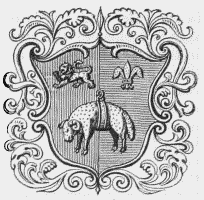
Arms.
The town is pleasantly situated in a valley, through which the river Tavy rushes with tumultuous impetuosity over an uneven and rocky bed, and which combines some of the most beautiful and picturesque scenery in this justly admired county. It is irregularly built, partly in the vale, and partly on the acclivities by which the vale is inclosed: the streets were first lighted with gas in the year 1832. The approaches are easy and commodious; those from the east of Cornwall, and from the roads over Dartmoor, underwent considerable improvement, under the auspices of the late Duke of Bedford, in 1839. On the right of the fine entrance into the town from Plymouth, and opposite to the church, are various embattled and turreted buildings originally belonging to the abbey; a part has been converted into the Bedford hotel, which has an extensive façade in the ancient English style. In a building over the grand archway of the old abbey is a public library, and adjoining it an edifice in which the members of a literary and scientific institution have lectures once a fortnight during the winter months: the library was fitted up, and the building for the institution was erected, by the late Duke of Bedford, in lieu of a structure in the Grecian style, which, not harmonizing with the venerable remains of the abbey, his grace was anxious to remove. Over the Tavy are two ancient bridges within the town, and a third of modern date about a quarter of a mile on the Plymouth road, near which is a bridge over the Tavistock canal. Races are held on Whitchurch Down.
The manufacture of serge and coarse woollen-cloths, which formed the principal employment of the inhabitants, has long been on the decline; and the miningtrade, once carried on to a large extent, has also materially diminished. An extensive iron-foundry is conducted in the town; and at a place called Crowndale, at the distance of a mile from it, is a tin-smelting establishment. The neighbourhood abounds with mineral productions, and in the section of a mining field between the rivers Tavy and Tamar, considerable quantities of porphyritic rock in alternate layers, called Elvan, are found. From the mines near the town, grey and ruby copper are produced; in the mine called Wheal Friendship, native rich yellow, red, and crystallized pyrites are to be obtained in profusion. Lead abounds in the district, and there are also silver, tin, manganese, iron, and the loadstone. The Tavistock canal, forming a junction with the Tamar at Morwell-Ham quay, was completed in June 1817, at au expense of £68,000, and flows in a tunnel at Morwell Down one mile and three quarters in length; the boats employed are chiefly of iron, and the principal articles conveyed are ore, coal, and lime. The market, which is noted for its ample supply of corn, is on Friday. Fairs are held on the second Wednesday in Jan., May, Sept., Oct., and December; and there are great cattle-markets on the second Wednesday in March, July, August, and November.
The inhabitants never received a regular charter of incorporation; the town is one of the four chief stannary towns, and is governed by a portreeve elected at the annual court lect of the manor. The borough, which exists by prescription, first sent members to parliament in the reign of Edward I. The elective franchise, formerly vested in the resident freeholders, in number about 30, was, under the act passed in 1832, extended to the £10 householders of the parish (except the detached manor of Cudliptown), which was constituted the new elective borough, comprising an area of 11,112 acres: the portreeve is returning officer. Among its representatives have been John Pym, the great opposer of Charles I.; and William, Lord Russell, who was beheaded in the reign of Charles II. The powers of the county debt-court of Tavistock, established in 1847, extend over the registration-district of Tavistock.
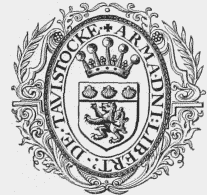
Seal of the Lordship.
The living is a discharged vicarage, valued in the king's books at £10. 17. 6.; net income, £298; patron and impropriator, the Duke of Bedford, whose tithes have been commuted for £364. The church is a neat, spacious, and ancient structure, with a lofty tower supported on arches, affording a thoroughfare underneath it for carriages; and contains some good monuments, including those to Sir John Fitzand Sir John Glanville, the latter of whom was judge of the common pleas, and died in 1600. There are places of worship for the Society of Friends, Independents, Wesleyans, and Unitarians. The grammar school is of very ancient though uncertain foundation, and under the auspices of the abbots was for many years pre-eminently distinguished. In 1552, John, Earl of Bedford, granted for 200 years the amount of dues claimed by him within the borough, for its support; and in 1649, Sir John Glanville, Knt., speaker of the house of commons, gave an estate at South Brent-Tor, producing £25 per annum, for the better maintenance of a scholar at either of the universities. Since the expiration of the earl's gift, his successors have allowed the master a residence, school-house, and garden, rentfree, and a stipend of £20. A new and handsome building was erected by the late duke, in 1838; and the school, which had fallen almost into disuse, has again begun to flourish. In 1674, Nicholas Watts bequeathed land and houses, the rent of which is £65. 18., for the benefit of poor persons, a part to be appropriated to the assistance of a scholar of Tavistock at the university. Several benefactions called the Ford-street charity, producing £120 per annum, were by act of parliament vested in the Russell family for various purposes, in fulfilment of which an almshouse has been erected for fifteen persons, who receive each £3 per annum in quarterly payments; the balance is chiefly distributed among the indigent. The poor-law union of Tavistock comprises 24 parishes or places, containing a population of 23,995.
The principal remains of the monastery are the gateway, the refectory (now used as a place of worship for Unitarians), some traces of the boundary walls, and an entire gateway near the canal bridge, probably forming a private entrance to the gardens and orchard of the abbey. They are chiefly in the later English style, and being in many parts mantled with ivy, have an interesting and picturesque appearance. Within the parish are the remains of Old Morwell House, the hunting-seat of the abbots; and in the woods attached to the mansion is a precipitous cliff, from whose summit is a fine view of the river Tamar winding through a valley of great beauty. Within a mile of the town, in the parish of Whitchurch, is Holwell House, the ancient seat of the Glanville family, of which the last male representative of the elder branch, by whose father the property had been alienated, died in 1830: the appearance of the mansion, which is in good preservation, bears testimony to its original magnificence. Among the eminent natives of Tavistock, have been, Sir Francis Drake; Judge Glanville; his son, Sir John Glanville; and William Browne, author of Britannia's Pastorals, the Shepherd's Pipe, and other works. The town gives the inferior title of Marquess to the Duke of Bedford.
Tavy (St. Mary)
TAVY (St. Mary), a parish, in the union of Tavistock, hundred of Lifton, Tavistock and S. divisions of Devon, 4 miles (N. E. by N.) from Tavistock; containing 1552 inhabitants. It is situated on the road from Plymouth to Barnstaple, through Tavistock and Oakhampton; and comprises about 1143 acres, exclusively of the glebe and of waste land. A lead and a copper mine are in operation, employing together 627 hands. The river Tavy runs through the parish. The living is a rectory, valued in the king's books at £14. 5. 7½., and in the gift of John Buller, Esq.: the tithes have been commuted for £207. 10., and there are about 30 acres of glebe land, independently of a field of 8 acres which has been rendered waste by mining operations. The church is partly in the later English style, and contains the staircase to the ancient rood-loft. Here are two places of worship for Wesleyans. Tungstate of lime has been found among other geological curiosities.
Tavy (St. Peter)
TAVY (St. Peter), a parish, in the union of Tavistock, partly in the hundred of Lifton, but chiefly in that of Roborough, Tavistock and S. divisions of Devon, 3½ miles (N. E.) from Tavistock; containing, with the hamlet of Willsworthy, 587 inhabitants. The living is a rectory, valued in the king's books at £17. 1. 8., and in the patronage of the Bishop of Exeter: the tithes have been commuted for £235, and the glebe contains 64 acres. The church contains a monument to the Rev. Mr. Pocock, a former rector; and, with the burialground, forms a strikingly picturesque feature in the scenery. At Willsworthy was a chantry chapel, which has been converted into a barn.
Tawney-Stapleford.—See Stapleford.
TAWNEY-STAPLEFORD.—See Stapleford.
Tawstock (St. Peter)
TAWSTOCK (St. Peter), a parish, in the union of Barnstaple, hundred of Fremington, Braunton and N. divisions of Devon, 2 miles (S.) from Barnstaple; containing 1429 inhabitants. It comprises 5000 acres, including 400 common or waste land. The manorhouse, which was garrisoned by Sir T. Fairfax in Feb. 1646, was almost consumed by fire in 1787, and was rebuilt by the late Sir B. Wrey, Bart., except the ancient gateway, which still remains, bearing date 1574. The living is a rectory, valued in the king's books at £69. 12. 1., and in the patronage of Sir B. Wrey: the tithes have been commuted for £930, and there are 93 acres of glebe. The Independents and Roman Catholics have places of worship.
Tawstock, county Suffolk.—See Tostock.
TAWSTOCK, county Suffolk.—See Tostock.
Tawton, Bishop's (St. John the Baptist)
TAWTON, BISHOP'S (St. John the Baptist), a parish, in the union of Barnstaple, hundred of South Molton, Braunton and N. divisions of Devon, 2 miles (S. by E.) from Barnstaple; containing 1827 inhabitants. On the division of the West Saxon see of Sherborne, this was made the seat of the Devonshire diocese by Werstan, its first bishop, soon after his consecration in 905. He was succeeded by Putta, and then by Eadulphus, who was installed at Crediton, to which place he removed the see, and who died in 931. Some remains of the episcopal palace are still discernible, and in the churchyard are the ruins of the deanery. The parish comprises about 4000 acres, of which 400 are common or waste. The living is a vicarage, valued in the king's books at £21; net income, £440; patron, the Dean of Exeter. The church is a neat ancient structure, with a handsome stone spire, and contains some monuments to the Chichester family.—See Newport.
Tawton, North (St. Peter)
TAWTON, NORTH (St. Peter), a parish, in the union of Oakhampton, hundred of North Tawton, South Molton and N. divisions of Devon, 12 miles (W. by N.) from Crediton; containing 1728 inhabitants. This place was anciently called Cheping-Tawton, "a market-town on the river Taw." Its market-charter was confirmed in the year 1270, and the market was held until about 1720; at the former period Tawton was a borough-town, and it is still governed by a portreeve, elected annually at the manorial court. The parish contains 3551 acres of fertile land, and 1088 of common or waste: the soil is a red gravelly earth; the surface is undulated, and comprises several well-watered meadows. Ashbridge, one of the most ancient demesnes in the county, has nearly 100 acres of woodland, containing a vast quantity of fine oak-trees. A quarry of good freestone is worked: here was formerly an extensive woollen manufacture, and a mill still employs 200 persons in spinning yarn. Cattle-fairs are held on the third Tuesday in April, October 3rd, and December 18th. The living is a rectory, valued in the king's books at £32.4.7.; net income, £751; patron and incumbent, the Rev. George Hole: there is a parsonage, with a glebe of 98 acres of good land. The Independents have a meeting-house. Chapels formerly existed at CrookBurnell, Nichols-Nymet, and Bath-Barton, in the parish; the last hamlet is the birthplace of Henry de Bathe, who was in 1238 made a justice of the common pleas, and in 1240 one of the justices itinerant. Henry Tozer, expelled from Exeter College for his loyalty, in 1648, and who was author of Directions for a Devotional Life, which passed through ten editions, was also a native of the parish. In the neighbourhood, a small brook sometimes issues out of a large pit ten feet deep, called Bathe Pool, and continues running for several days together.
Tawton, South (St. Andrew)
TAWTON, SOUTH (St. Andrew), a parish, in the union of Oakhampton, hundred of Wonford, Crockernwell and S. divisions of Devon, 3¼ miles (E. by S.) from Oakhampton; containing 1871 inhabitants. The living is a vicarage, valued in the king's books at £10; net income, £150; patrons and appropriators, the Dean and Canons of Windsor.
Taxall (St. James)
TAXALL (St. James), a parish, in the union and hundred of Macclesfield, N. division of the county of Chester; containing, with the township of Yeardsley with Whaley, 853 inhabitants, of whom 190 are in Taxall township, 4 miles (W.) from Chapel-en-le-Frith. The parish comprises 4933 acres, whereof 3667 are in Taxall township: the soil is various, clay, stony land, and common; and a large portion is plantation. There are several stone-quarries and coal-mines; some of these are not in operation, but the coal in Whaley is regularly worked, as well as the stone there: the quarries produce slate and good building and flag stone. The village occupies a pleasing situation on the bank of the river Goyt, which separates it from Derbyshire, and near which, in a parallel direction, runs the Buxton and Manchester road; the Peak-Forest canal passes through the parish to Manchester, and is met at Whaley by a tramroad to Cromford, near Derby. A small bleaching-mill in Taxall, and a wire-mill in Whaley, each employ about fifty persons. The living is a discharged rectory, valued in the king's books at £9. 5. 6,; net income, £250; patron, the Rev. J. Swain: there is a parsonage-house, and the glebe contains about 20 acres, Cheshire measure. The church, with the exception of the tower, was taken down and rebuilt on a larger scale, in 1825: against the north wall is a monument to Michael Heathcote, Esq., gentleman of the pantry to George II.; and in the chancel are several memorials to the Shallcross family. This family were patrons of the living in the early part of the last century, and resided at Shallcross Hall, in Derbyshire, which is on the east bank of the river, immediately opposite the church. There is a place of worship for Wesleyans.
Taynton (St. Lawrence)
TAYNTON (St. Lawrence), a parish, in the union of Newent, hundred of Botloe, W. division of the county of Gloucester, 3½ miles (S. S. E.) from Newent; containing 634 inhabitants. The living is a rectory, valued in the king's books at £9. 6. 8.; net income, £321; patrons, the Dean and Chapter of Gloucester. The church was rebuilt in 1647.
Taynton (St. John)
TAYNTON (St. John), a parish, in the union of Witney, hundred of Chadlington, county of Oxford, if mile (N. W.) from Burford; containing 381 inhabitants. It comprises about 2150 acres, a small portion of which stands detached in the forest of Wychwood; the soil is partly light, and partly a strong clay, and the river Windrush runs through the parish. There are considerable quarries of excellent freestone. The living is a discharged vicarage, valued in the king's books at £7. 9. 4½.; net income, £56; patron and impropriator, Lord Dynevor: the tithes were commuted for land and a money payment in 1821. The church is an elegant edifice in the later English style, and contains an ancient font highly enriched.