A Topographical Dictionary of England. Originally published by S Lewis, London, 1848.
This free content was digitised by double rekeying. All rights reserved.
'Tiverton - Tockwith', in A Topographical Dictionary of England, ed. Samuel Lewis (London, 1848), British History Online https://www.british-history.ac.uk/topographical-dict/england/pp366-369a [accessed 9 May 2025].
'Tiverton - Tockwith', in A Topographical Dictionary of England. Edited by Samuel Lewis (London, 1848), British History Online, accessed May 9, 2025, https://www.british-history.ac.uk/topographical-dict/england/pp366-369a.
"Tiverton - Tockwith". A Topographical Dictionary of England. Ed. Samuel Lewis (London, 1848), British History Online. Web. 9 May 2025. https://www.british-history.ac.uk/topographical-dict/england/pp366-369a.
In this section
Tiverton
TIVERTON, a township, in the parish of Bunbury, union of Nantwich, First division of the hundred of Eddisbury, S. division of the county of Chester, 1¾ mile (S.) from Tarporley; containing 687 inhabitants. It comprises 1488 acres, the soil of which is half clay, half sand. At Four-lane Ends, in the township, an old established corn-market is held every Monday. The Chester canal passes in the vicinity. The impropriate tithes have been commuted for £116, payable to the Haberdashers' Company, London. There is a place of worship for Wesleyans.
Tiverton (St. Peter)
TIVERTON (St. Peter), a borough, market-town, and parish, possessing exclusive jurisdiction, and the head of a union, locally in the hundred of Tiverton, Collumpton and N. divisions of Devon, 14 miles (N. by E.) from Exeter, and 175 (W. by S.) from London; containing 10,040 inhabitants, of whom 7769 are in the town quarter. This place, formerly Twy-ford, Twy-ford-ton, or Two-ford-ton, derives its name from its situation between two rivers anciently called Fords, the Exe and the Lowman. It was known as the village of Twyford so early as 872. A castle was erected here in 1106 by Rivers, Earl of Devon, which continued for many ages the head of a barony, and, with the lordship of the hundred and the manor, is now the property of Sir W. P. Carew, Bart. In 1200, the town had a market and three annual fairs; and in 1250, it was first supplied with water by means of a stream called the Leat, at the expense of Isabel, Countess of Westmorland. In the year 1353 the wool-trade was introduced, and about 1500 the inhabitants were extensively engaged in the manufacture of baizes, plain cloths, and kerseys. For this manufacture the town enjoyed considerable repute in the time of Elizabeth; and although in 1591 the plague greatly checked its prosperity, destroying nearly 600 of the inhabitants, and although a destructive fire occurred in 1598, Tiverton was regarded, in 1612, as the chief manufacturing place in the west of England. About this time, however, a second fire consumed 600 houses, and occasioned very great distress. During the contest between Charles and the parliament, the townsmen were much divided; in 1643 they were for a time subject to the king, but in 1645 the republican forces effected the entire subjugation of the town, and the castle, church, and outworks were taken, together with the governor and 200 men. In 1731, a third fire destroyed 300 houses; and ten years after, onetwelfth of the population was cut off by a severe epidemic fever. In 1745, the introduction of Norwich stuffs, and the subsequent establishment of a manufactory at Wellington, occasioned the decay of the woollen-trade, which in 1815 was entirely superseded by the patent-net manufacture, now the staple trade of the place.
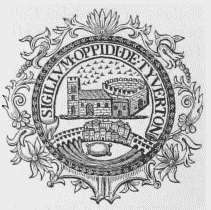
Corporation Seal.
The town is pleasantly situated on elevated ground between the rivers Exe and Lowman, which unite their streams a little to the south. It consists of several streets of respectable appearance, paved throughout under an act obtained in 1794, and lighted with gas by subscription; some of the houses are spacious, and the inhabitants are well supplied with water. At its eastern extremity is a wharf, whence a canal extends to Burlescombe, passing near the rocks of Canonsleigh, which yield excellent limestone. In 1845 an act was passed for a branch to Tiverton of the Bristol and Exeter railway, 4¾ miles in length. The lofty factories on the west side of the Exe have an imposing effect, and the river is crossed by a handsome stone bridge originally erected in 1590, by the munificence of Walter Tyrrel, a linendraper of the town, and lately rebuilt: from this bridge is a fine view of the castle and church. A subscription reading-room, a theatre, and assembly-room, are the chief sources of amusement. About 1500 persons are employed in the lace manufacture. The markets are on Tuesday and Saturday, the former being the principal; there are four great markets for cattle during the year, and fairs are held on the second Tuesday after WhitSunday and on Michaelmas-day.
The first charter of incorporation was granted by James I., in 1615; in 1723, the mayor absconding on the day of election, it became forfeited, and a second was bestowed by George I. in 1737. The corporation now consists of a mayor, six aldermen, and eighteen councillors, under the act 5th and 6th of William IV., cap. 76; the borough is divided into three wards, and the municipal boundaries are co-extensive with those for parliamentary purposes. The mayor, late mayor, and recorder are justices of the peace, and the total number of magistrates is nine. The town returns two representatives to parliament; the elective franchise was extended in 1832 to the £10 householders of the parish: the mayor is returning officer. The recorder holds a court of session quarterly, and a court of record occasionally for all pleas not exceeding £100; petty-sessions take place every alternate week. The powers of the county debt-court of Tiverton, established in 1847, extend over the registration-district of Tiverton and Dulverton, and the parish of Rackenford. The bridewell, a commodious edifice, was built about 50 years since: among the other public buildings are the guildhall, and a spacious market-place, erected in 1830. The parish comprises about 18,000 acres, the greater part of which is meadow and pasture, and the remainder arable, with a small portion of woodland.
At the close of the thirteenth century, the living was divided by Hugh Courtenay, Baron of Oakhampton and Earl of Devon, into the portions of Clare, Pitt, Tidcombe, and Pryors. The last of these was given to the monastery of St. James, Exeter, and having been subsequently assigned with the convent to King's College, Cambridge, that society, as owners of the impropriate rectory, appoint the curate. The Clare portion is valued in the king's books at £27; the Pitt portion, with Cove chapelry annexed, at £36; and the Tidcombe portion, at £27. These three, which are rectorial, are in the patronage of the Earl of Harrowby, Sir W. P. Carew, Bart., Sir R. Vyvyan, Bart., and the Rev. John Spurway: net income of Clare, £452; of Pitt, £675; and of Tidcombe, £735. The church has been rebuilt on an enlarged plan: the altar-piece, the subject of which is the Deliverance of St. Peter from Prison, was painted and presented by Mr. Cosway, the eminent artist, a native of the town. The churchyard occupies a commanding elevation, and forms an agreeable promenade. A handsome edifice in the Grecian style was erected in 1730, as a chapel of ease; it is dedicated to St. George, and each of the four portionists officiates in turn. St. Thomas' chapel, Chevythorne, was consecrated in June 1843; it was built by subscription, aided by a grant from the Diocesan Society. There are places of worship for Baptists, Independents, and Wesleyans.
The free grammar school was founded in 1604, pursuant to the will of Peter Blundell, a clothier of Tiverton, who gave £2400 for the purchase of ground and the erection of a building, and for its maintenance devised all his lands in Devon to 27 trustees, directing his executors to apply £2000 of the proceeds in the establishment and perpetual maintenance of six students at either of the universities. Certain exhibitions were added by John Ham, in 1678; by John Newte, in 1715; and by R. Downe, in 1806: there are likewise two exhibitions of £30 per annum each, founded by Benjamin Gilberd in 1783. The whole income is upwards of £1100 per annum. The building is a venerable edifice, having its north front cased with freestone; the facade exhibits two porches, and is of considerable extent, with a spacious quadrangular court opposite. The free English school, in Peter-street, was instituted in 1611, by Robert Comyn alias Chilcot, who gave £400 for its erection, and an annuity of £20 for the master's salary. Almshouses for nine men, situated in Gold-street, were established by John Greenway in 1529; a chapel is attached, which contains some good carved work. The Western almshouse, which has also a small chapel, was founded in 1579, by John Waldron; and another, in Peter-street, for six aged women, in 1613, by George Slee. A charitable fund was established pursuant to the will of Mary Rice in 1697, from which 67 persons receive life annuities; and other charitable benefactions are expended in various ways. The poor-law union comprises 27 parishes or places, and contains a population of 32,499. A few remains of the boundary wall of the old castle with its flanking and angular towers, are still perceptible, particularly a portion of the grand east entrance, and some fragments on the south-west; the site occupies about an acre of ground, on a level with the churchyard, and overhangs the river. Mrs. Cowley, the dramatic writer, was a native of the town.
Tivetshall (St. Margaret)
TIVETSHALL (St. Margaret), a parish, in the union of Depwade, hundred of Diss, E. division of Norfolk, 6 miles (N. E. by E.) from Diss; containing 368 inhabitants. The road from London to Norwich, by way of Bury, runs through the parish. The living is a rectory, annexed to that of Tivetshall St. Mary: the tithes have been commuted for £526. The church contains portions in the early and decorated English styles, with a tower; the nave has a handsomely-carved oak roof, and is separated from the chancel by an ancient screen. The Society of Friends have a place of worship.
Tivetshall (St. Mary)
TIVETSHALL (St. Mary), a parish, in the union of Depwade, hundred of Diss, E. division of Norfolk, 5¼ miles (N. E. by N.) from Diss; containing 331 inhabitants. It is situated on the road from London to Norwich, through Bury. The living is a rectory, with that of Tivetshall St. Margaret annexed, valued in the king's books at £20; patron, the Earl of Orford. The tithes have been commuted for £475. 3. 4.; and there is a glebe of about 28 acres, with a glebe-house much improved by the Rev. J. N. White. The church is partly in the early and partly in the decorated style, and has a square tower at the west end.
Tixall (St. John the Baptist)
TIXALL (St. John the Baptist), a parish, in the S. division of the hundred of Pirehill, union, and N. division of the county, of Stafford, 5 miles (W. by N.) from Rugeley; containing 209 inhabitants. It is situated between the once much frequented London and Liverpool, and London and Chester mail-roads; parallel to which, respectively, are the Trent-Valley railway and the North Staffordshire railway. The Staffordshire and Worcestershire canal passes through the parish for a considerable distance, and forms a junction with the Trent and Mersey canal within a mile of the village. The parish comprises about 2300 acres, in nearly equal portions of arable and pasture, with about 25 acres of plantation; the surface is undulated, the scenery very picturesque, and some of the prettiest in the vale of Trent. The whole is the property of Earl Talbot, who purchased it in 1844, together with 1700 acres in Colwich and Stowe parishes adjoining, of Sir T. A. Clifford Constable, Bart., for £240,000. Large quantities of freestone are quarried in the neighbourhood of Tixall Hall, and much of it has been used in the construction of the bridges and locks of the two canals, the stone being peculiarly adapted for resisting the action of water. The noble gatehouse in the park was erected in 1580. The living is a discharged rectory, valued in the king's books at £8. 0. 8.; net income, £200; patron, Earl Talbot: the tithes have been commuted for £190; and there is a parsonage-house, with about 40 acres of glebeland.
Tixover (St. Mary Magdalene)
TIXOVER (St. Mary Magdalene), a parish, in the union of Stamford, hundred of Wrandike, county of Rutland, 6 miles (N. W. by W.) from Stamford; containing 102 inhabitants. The parish is situated near the road from Wansford to Uppingham, and bounded on the south and east by the river Welland. It comprises about 900 acres of land, chiefly arable. The living is annexed to the vicarage of Ketton: the church is in the early Norman style.
Tockenham (St. John)
TOCKENHAM (St. John), a parish, in the union of Cricklade and Wootton-Bassett, hundred of Kingsbridge, Swindon and N. divisions of Wilts, 3 miles (S. W.) from Wootton-Bassett; containing 263 inhabitants. It comprises 761a. 2r. 26p., of which 154 acres are arable, 568 pasture, and 15 wood. The London and Bath road, the Wilts and Berks canal, and the Great Western railway, pass through. The living is a rectory, valued in the king's books at £6. 13. 4., and in the patronage of the Crown: the tithes have been commuted for £245; there is a parsonage-house, and the glebe contains 36 acres. In the church are handsome memorials to the Buxton family, proprietors of the parish.
Tocketts
TOCKETTS, a township, in the parish and union of Guisborough, E. division of the liberty of Langbaurgh, N. riding of York, 1¾ mile (N. by E.) from Guisborough; containing 43 inhabitants. This place, at the time of the Domesday survey, was called Toscutun, and belonged to the Earl of Morton; it afterwards came to the family of de Brus, and was more recently held by the Thwengs, Tocketts, and others. Here was a chapel dedicated to St. James, which was connected with the priory of Guisborough. The township is in the district called Cleveland, and comprises 584 acres, of which 384 are arable, 170 meadow and pasture, and 30 woodland and plantation; the soil is a rich loam, the surface undulated, and the high lands command a fine view of the sea and the Cleveland hills. The manufacture of tiles and bricks is carried on, for which there is abundance of excellent clay. The tithes have been commuted for £130, payable to the Archbishop of York.
Tockholes
TOCKHOLES, a township and chapelry, in the parish, union, and Lower division of the hundred, of Blackburn, N. division of the county of Lancaster, 3¾ miles (S. S. W.) from Blackburn; the township containing 1023 inhabitants. In the 14th of Henry VII. Sir Alexander Hoghton held lands here, and in the 17th of Charles I. Nicholas Wittone died seised of lands and messuages called " Green Tockholes in Livesey;" the family of Holinshed more recently held the lordship, and on the margin of a moor stands an old farmhouse called Holinshed Hall. Tockholes is a scattered tract, watered by the river Roddlesworth, or Moulder Water, and its branches issuing from the adjacent hills. It comprises 1926a. 3r. 13p., of mountainous surface, chiefly meadow and pasture: there are several coal-mines, which are partially worked; and sandstone of good quality is quarried for building purposes. Most of the inhabitants are employed in the hand-loom weaving of cotton, and in a cotton-factory. The chapelry hitherto consisted of Tockholes and Livesey; but by a recent order of the Ecclesiastical Commissioners, it now consists of the township of Tockholes, and parts of the townships of Livesey and Lower Darwen. The living is a perpetual curacy, in the patronage of the Vicar of Blackburn; net income, £150. The old chapel was dedicated to St. Michael: the present edifice is dedicated to St. Stephen; it was built in 1833, at an expense of £2567, and is in the early English style. The Independents have a place of worship. Cannon-balls have been found at various times; a twelve-pounder was discovered in the garden of the parsonage, and on clearing out an old pond in 1833, skeletons of 48 horses were found, from which it would appear that an action took place here, most probably between the royalists and parliamentarians.
Tockington, Lower
TOCKINGTON, LOWER, a tything, in the parish of Almondbury, union of Thornbury, Lower division of the hundred of Langley and Swinehead, W. division of the county of Gloucester, 3¾ miles (S. by E.) from Thornbury; containing 440 inhabitants.
Tockington, Upper
TOCKINGTON, UPPER, a tything, in the parish of Olveston, union of Thornbury, Lower division of the hundred of Langley and Swinehead, W. division of the county of Gloucester, 3 miles (S. by W.) from Thornbury; containing 769 inhabitants.
Tockwith
TOCKWITH, a township, in the parish of Bilton, W. division of Ainsty wapentake, W. riding of York, 5¾ miles (N. E.) from Wetherby; containing 557 inhabitants. It comprises 1692a. 1p., the property of various families, mostly resident: the village is situated about a mile south of the river Nidd, which flows in a very devious course. The tithes were commuted for land and annual money payments in 1792. There is a place of worship for Wesleyans.