A Topographical Dictionary of England. Originally published by S Lewis, London, 1848.
This free content was digitised by double rekeying. All rights reserved.
'Warter - Warwick-Bridge', in A Topographical Dictionary of England, ed. Samuel Lewis (London, 1848), British History Online https://www.british-history.ac.uk/topographical-dict/england/pp475-482 [accessed 30 April 2025].
'Warter - Warwick-Bridge', in A Topographical Dictionary of England. Edited by Samuel Lewis (London, 1848), British History Online, accessed April 30, 2025, https://www.british-history.ac.uk/topographical-dict/england/pp475-482.
"Warter - Warwick-Bridge". A Topographical Dictionary of England. Ed. Samuel Lewis (London, 1848), British History Online. Web. 30 April 2025. https://www.british-history.ac.uk/topographical-dict/england/pp475-482.
In this section
Warter (St. James)
WARTER (St. James), a parish, in the union of Pocklington, Bainton-Beacon division of the wapentake of Harthill, E. riding of York, 4¼ miles (E. by N.) from Pocklington; containing 439 inhabitants. This parish comprises 7830 acres, of which 7270 are under tillage, and the remainder in meadow and pasture. It embraces a large portion of the hills and dales of the Wolds, and the scenery in many parts, especially in the deep vale where the village is situated, is highly picturesque; the soil is flinty, but much improved of late by good cultivation. The air is very salubrious, and from the excellence of the water the place is supposed by some to have derived its name. The Wold road from Driffield to Pocklington intersects the parish. The living is a discharged vicarage, valued in the king's books at £4; net income, £100; patron and impropriator, Lord Muncaster. The church is an ancient edifice; the chancel was repaired in 1842. There is a place of worship for Wesleyans. A priory of Black canons, in honour of St. James, was founded here in 1132, by Geoffry Fitz-Pain, and at the Dissolution possessed a revenue of £221. 3. 10. In the vicinity are various tumuli.
Warthermask, Yorkshire.—See Swinton.
WARTHERMASK, Yorkshire.—See Swinton.
Warthill (St. Mary)
WARTHILL (St. Mary), a parish, in the wapentake of Bulmer, union and N. riding of York; containing 159 inhabitants, of whom 117 are in the township, 5 miles (N. E. by E.) from York. The parish consists of about 860 acres; the surface is generally flat, and the soil of rather inferior quality. The living is a discharged vicarage, in the patronage of the Archbishop of York, valued in the king's books at £3. 1. 8.; net income, £100. The tithes, with certain exceptions, were commuted for land in 1812, under an inclosure act. The church, a brick building erected in 1778 at the expense of Mr. Agar, stands in an elevated position on a ridge of gravel. The Wesleyan Methodists have a place of worship.
Wartling (St. Mary Magdalene)
WARTLING (St. Mary Magdalene), a parish, in the union of Hailsham, hundred of Foxearle, rape of Hastings, E. division of Sussex, 4½ miles (E. by S.) from Hailsham; containing 962 inhabitants. The parish comprises 4461 acres, of which 20 are common or waste; a considerable portion is employed as hopgrounds. The road from Lewes to Battle and Hastings passes through. The living is a vicarage, valued in the king's books at £16. 0. 2½.; patron, the Rev. Dr. Major; impropriators, the Rev. J. B. Hayley and Miss Rosarn. The great tithes have been commuted for £450, and the vicarial for £475; there is a parsonage-house, and the glebe contains 9 acres. The church is in the decorated style, with later additions, and has a spire rising on the west; the chancel contains handsome monuments to the Curteis family, of Windmill Hill. Here is a place of worship for Independents.
Wartnaby
WARTNABY, a chapelry, in the parish of Rothley, union of Melton Mowbray, hundred of East Goscote, N. division of the county of Leicester, 4½ miles (N. W.) from Melton-Mowbray; containing 107 inhabitants. The tithes for the fields of the chapelry were commuted for land in 1764. The chapel is dedicated to St. Michael.
Warton
WARTON, an ecclesiastical parish, in the parish of Kirkham, union of the Fylde, hundred of Amounderness, N. division of Lancashire; comprising the townships of Warton, Freckleton, and Bryning with Kellamergh; and containing 1669 inhabitants, of whom 522 are in Warton township, 3 miles (S. S. W.) from Kirkham. Warton appears to have belonged to the lord of WoodPlumpton, by intermarriage with whose heiress the Betham family became connected with the property. The last of the Bethams was Roger, whose daughter married Sir Robert Middleton, of Leighton, in the reign of Richard III. In the 7th of Henry VIII. the manor of Warton was held by Richard Singleton, of Broughton Tower, and Johanna Standishe. About threefourths of the township are now the property of Thomas Clifton, Esq., of Lytham Hall. The parish is situated on the estuary of the Ribble, which bounds it on the south: there are fine views of the opposite shore; and for the safe passage over the Ribble, a guide is stationed at Warton, who conducts strangers to HeskethBank. In the township are 1534a. 1r. 13p., whereof two-thirds are arable, and the remainder pasture. Warton Lodge is the residence of James Fair, Esq., agent to Mr. Clifton. The parish was formed in 1846: the living is a perpetual curacy, with a net income of £93. 15., and a house; patrons, the Dean and Canons of ChristChurch, Oxford. The great tithes for Warton township have been commuted for £198, and the tithes of the Vicar of Kirkham for £77. 12. 4. The church, dedicated to St. Paul, was consecrated as a chapel in 1725, and is a neat structure with a tower. A school is endowed with an annual income of nearly £100.
Warton (Holy Trinity)
WARTON (Holy Trinity), a parish, in the hundred of Lonsdale south of the Sands, union, and N. division of the county, of Lancaster; containing 2209 inhabitants, of whom 633 are in the township of Warton with Lindeth, 7 miles (N. by E.) from Lancaster. At the time of the Domesday survey, this was one of the twelve manors belonging to the Saxon chieftain Torfin. It is probable that it soon after became a member of the great barony of Kendal, and descended, through the de Lancasters, to Gilbert Fitz-Reinfrid, to whom King John, in the 1st year of his reign, granted a weekly market, on Wednesday, in his manor of Warton. The manor, it would seem, became royal property long before the reign of Henry VIII., and was held immediately under the crown until 1811, when it was purchased by Thomas Inman, Esq., who sold it shortly afterwards to John Bolden, Esq., of Hyning Hall.
The parish is bouuded on the west by Morecambe bay, and comprises by computation 25,000 acres, whereof 2684 are in the township of Warton with Lindeth. It includes the chapelry of Silverdale, and the townships of Borwick, Carnworth, Priest-Hutton, Yealand-Conyers, and Yealand Redmayne. The surface is hilly, with the exception of that portion contiguous to the sea, and is of pleasing and diversified appearance; the soil is in general a thin earth, resting occasionally on layers of gravel, but chiefly upon limestone. The mountainous ridge of Warton Crag, taken in the extended sense of the term, stretches through Warton, the Yealands, and Lindeth, whence the chain is continued by Silverdale Nab to Arnside Knot or Fell. The parish is watered by the river Keer or Keir, and the rivulets Leighton-Beck, Whitbeck, HerringSike, and Meerbeck; and the road from Lancaster to Kendal, the Lancaster and Kendal canal, and Lancaster and Carlisle railway pass through.
The living is a vicarage, valued in the king's books at £74. 10. 2½.; net income, £187, with a house; patrons, the Dean and Chapter of Worcester. The great tithes have been commuted for £1190. The church, situated on the declining ground at the foot of Warton Crag, is a good ordinary building of the 16th century, and consists of a nave, aisles, chancel, and a noble tower: the interior is very light, and large; and contains some ancient monuments. At Silverdale and Yealand-Conyers are separate incumbencies. A free grammar school and an hospital were founded and endowed in 1594 by Matthew Hutton, Archbishop of York; their income was subsequently increased by bequests from Robert Lucas and others. An estate in Borwick, left in 1700 by Thomas Mansergh, now producing £125 per annum, is appropriated to apprenticing poor boys. There is said to have been a British fortress on Warton Crag; and adjacent are three rocking-stones, probably Druidical. Adjoining the shore is a chalybeate spring.
Warton
WARTON, a township, in the parish and union of Rothbury, W. division of Coquetdale ward, N. division of Northumberland, 3¼ miles (w. by N.) from Rothbury; containing 74 inhabitants. It was formerly a member of the Hepple barony. The neighbourhood is called the "core of Coquet," from the excellence of its soil. The tithes have been commuted for £20.
Warwick (St. Leonard)
WARWICK (St. Leonard), a parish, in the union of Carlisle, partly in Cumberland ward, and partly in Eskdale ward, E. division of Cumberland; containing, with the townships of Aglionby and Little Corby, 645 inhabitants, of whom 225 are in Warwick township, 4 miles (E. by N.) from Carlisle. The parish is bounded on the north by the river Eden, and on the west by the Irthing; and, from some large earthworks still remaining, is supposed to be the site of the ancient Virosidum, where the sixth cohort of the Nervii was stationed. The village is pleasantly situated on the western bank of the Eden, which is crossed by a bridge of four arches, near the base of an eminence on which are the remains of trenches, probably thrown up to guard the pass during the border feuds. The living is a perpetual curacy, annexed to that of Wetheral. The church is a small stone edifice, of singular appearance, partly in the Norman style, with a semicircular chancel, and 13 lancet windows.
Warwick
WARWICK, a borough and market-town, having separate jurisdiction, and the head of a union, locally in the Warwick division of the hundred of Kington, S. division of the county of Warwick, of which it is the chief town, 90 miles (N. W.) from London; containing 9775 inhabitants. This place is said by Rous, the historian of the county, to have been a British town of considerable importance prior to the Roman invasion, and this statement is confirmed by Camden, Dugdale, and other writers. The same author relates that, after its devastation by the frequent incursions of the Picts, it was rebuilt by Caractacus, on whose defeat by Claudius, in the year 50, ihe Romans, in order to secure their conquests in Britain, erected several fortresses on the banks of the Severn and Avon, of which latter, Warwick Castle was one; but this is very doubtful, the nearest Roman station having, probably, been that at Chesterton. Upon the establishment of the Saxons in the island, the town being included in the kingdom of Mercia, fell under the dominion of Warremund, who rebuilt it, and, after his own name, called it Warre-wyke: it appears, however, from a coin of Hardicanute, that its Anglo-Saxon name was Werhica. From either of these sources its present name may be derived. The place was subsequently destroyed by the Daues, and according to the most authentic records, Ethelfleda, daughter of Alfred, and Countess of Mercia, restored it about the year 913, and built a fort, which evidently forms the most ancient part of the existing castle. At the time of the Conquest, this fortress was considerably enlarged, and the town was surrounded with walls and a ditch, of which there are still some vestiges, and of which a memorial is preserved in the appellation of a certain part of the town, called "Wall-dyke." In the reign of Edward I., the fortifications were repaired by Guy, Earl of Warwick, who in 1312, with the Earl of Lancaster, having taken Piers Gavestone, the favourite of Edward II., on his route to Wallingford, brought him to this castle; he was secured for the night under the barons' guard, and in the morning removed to Blacklow Hill, about a mile from the town, where he was tried and beheaded.
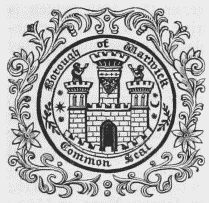
Corporation Seal.
In 1571, Robert Dudley, Earl of Leicester, celebrated in St. Mary's church the ceremony of the order of St. Michael, which, by permission of Elizabeth, had been conferred upon him by Charles IX. of France. William Parr, brother of Catherine, the last consort of Henry VIII., assisted at this ceremony, and, dying soon after, was buried in the chancel of the church. Queen Elizabeth visited Warwick in 1572, on her route to Kenilworth Castle; and in 1617, James I. was splendidly entertained in the great hall of the Earl of Leicester's hospital, in commemoration of which, a tablet, with an appropriate inscription, was inserted in one of the walls of that building. During the great civil war in the reign of Charles I., Robert Greville, Lord Brooke, who embraced the cause of the parliament, defended the castle against the king. Having occasion to repair to London in order to procure a supply of arms and ammunition, he deputed Sir Edward Peto governor during his absence. The supply being obtained, he was met on his return by the Earl of Northampton, with a considerable force, near Edge-Hill; an accommodation taking place, Lord Brooke deposited his artillery and ammunition in Banbury Castle, and returned to London. After his departure, the earl, having attacked Banbury Castle, and taken the military stores, advanced to Warwick, and laid siege to the castle, which was defended by the governor for fourteen days, till Lord Brooke, on his return from London, after a successful skirmish with the earl near Southam, came to Peto's assistance, and compelled the royalists to abandon the siege. William III., in 1695, visited the town, of which, in the preceding year, more than one-half had been destroyed by a dreadful conflagration, occasioned by a spark, from a lighted piece of wood in the hand of a boy, communicating with a thatched roof. A great quantity of goods, probably in a state of ignition, having been removed for safety into the collegiate church of St. Mary, set fire to that venerable pile, which, with the exception of the chancel, the Beauchamp chapel, and the chapter-house, was destroyed. In a few years, the town was rebuilt by means of a national contribution amounting to £110,000, of which £1000 were bestowed by Queen Anne.
The town is pleasantly situated on a rock of freestone, rising gently from the north side of the river Avon, which winds round its base; the approaches on every side are good, and the surrounding scenery is richly diversified. The entrance from Banbury is strikingly picturesque: a handsome stone bridge, of one noble arch 100 feet in the span, leads into the town, which rises gradually from the bauk of the river, and presents in succession the venerable castle on the left, the spire of St. Nicholas' church in the lower ground, and the lofty tower of St. Mary's in the distance. The entrance from the Birmingham road, after passing through the suburb called Saltisford, commands a view of the priory, the county-hall, and the fine tower of St. Mary's church. The approach from Stratford is through a long ancient arched gateway, with a lofty tower on the west; and that from the Emscote road through an archway, which supports the chapel of St. Peter. The streets are spacious and regularly formed, consisting chiefly of two running east and west, crossed by another inclining to the centre of the town; the houses are in general modern and well built, interspersed with elegant mansions, and houses affording specimens of the style that prevailed before the fire. The town is paved, lighted with gas, and supplied with water from springs about half a mile distant. Assemblies are held in the town-hall, and for larger meetings, and during the races, in the countyhall; the theatre is opened during the race-week, and occasionally at other times, by the Cheltenham company. The races take place in the first week of September, and continue for three days: the course is a fine level, with a little rising ground in one part, and has undergone such improvement as to make it one of the best in the kingdom; the grand stand is handsome and commodious.
The castle, which is on the south side of the town, is one of the most splendid and entire specimens of feudal grandeur in the kingdom, and is not less remarkable for its stately magnificence than for the elegance of its architecture and the beauty of its situation. It incloses within its walls an area of nearly three acres, and the plot surrounded by the moat is more than five acres and a half. A winding road cut through the solid rock, and the sides of which are covered with ivy and with shrubs, leads from the outer lodge to a massive gateway, flanked with two towers connected by an embrasure above, and defended by a portcullis. This gateway leads into the inner court, in the north angle of which is Guy's Tower, a lofty duodecagonal structure, with a projecting and embattled parapet resting upon corbels. The north-east tower, at the opposite angle, is called Cæsar's Tower; it consists of two half circles, a greater and a less, and is more ancient, with an exploratory turret rising from within the battlements. On the north-west side are two low embattled towers, in one of which bears were anciently kept, for the purpose of baiting. The range of state apartments on the south-east, as viewed from this side of the castle, is strikingly magnificent; the windows are in fine proportion, and every part is in the highest preservation. At the south-westeru extremity, and commanding, from its elevated site, an extensive view of the surrounding country, is the keep, erected by Ethelfleda as a place of security against any sudden irruption of the Danes, and also as an exploratory tower, from which their movements might be observed; the ascent is by a winding path, now richly planted with forest-trees, among which are some cedars of Lebanon. The facade of the castle, rising from the river Avon, is a long line of flat masonry relieved only by the number and variety of its windows. The broken arches of an ancient bridge, which formerly led into the town, are still preserved, and add greatly to the beauty of the scene. The state-rooms, the armoury, and the other various apartments, are maintained in a style of appropriate grandeur; the lawns and gardens are tastefully laid out, aud in the green-house, built expressly for its reception, is the beautiful Grecian vase of Lysippus, which was dug from the ruins of Adrian's palace, at Tivoli, near Rome, and brought to England by Sir William Hamilton, under the direction and at the expense of his nephew, the late Earl of Warwick.
Very little trade is carried on beyond what is necessary for the supply of the inhabitants: the cotton manufacture, which was introduced, has entirely declined; and a worsted-factory, subsequently established, is decreasing. There are several large malting-houses, and lime, timber, and coal wharfs on the banks of the Warwick and Birmingham, and Warwick and Napton canals. These two lines, which form a junction at Warwick, come up to the northern part of the town, and, communicating with the Oxford and Birmingham canal, afford every facility of inland navigation. The Warwick and Leamington branch of the London and Birmingham railway extends from Coventry to a point between the towns of Warwick and Leamington; it is rather more than nine miles in length, cost £135,000, and was opened in 1845. An act was passed in 1846 for a railway from Birmingham, by Warwick, to the Oxford and Rugby line. The market, which is abundantly supplied with corn and provisions of every kind, is on Saturday. Fairs are held on the second Monday in January and February, the first Saturday in Lent, the second Monday in March and April, the 12th of May, the second Monday in June, July, and August, the second Monday and last Tuesday in September, on Oct. 12th (which is a pleasure and statute fair, during which an ox is generally roasted in the market-place), the second Monday in November, and the Monday before St. Thomas's day. The market-place is an extensive area surrounded by respectable houses. In the centre is the market-house, a neat substantial building of stone, of which the upper story, surmounted by a cupola and dome, is occupied by the interesting museum of the Warwickshire Natural History and Archaeological Society.
Warwick was incorporated in the 37th of Henry VIII., and made a "mayor town" by Queen Mary, in 1553: the government is now vested in a mayor, six aldermen, and eighteen councillors, under the act 5th and 6th of William IV., cap. 76. The borough is divided into two wards, and the municipal and parliamentary boundaries are co-extensive; the mayor and late mayor are justices of the peace, and there are eight others. It first exercised the elective franchise in the 23rd of Edward I., since which time it has regularly returned two members to parliament; the right of election is vested in the £10 householders, and the limits of the borough comprise 5273 acres: the mayor is returning officer. The recorder holds quarterly courts of session, for all offences not capital; and a court of record occurs every Wednesday, except in the Christmas, Easter, and Whitsun weeks, for the recovery of debts not exceeding £40, at which the town-clerk generally presides: a court leet takes place annually before the same officer, as steward, and petty-sessions are held every Monday. The powers of the county debt-court of Warwick, established in 1847, extend over the registration-district of Warwick, and part of that of Stratford. The court-house, in which the borough sessions and courts of record are held, is a handsome stone building in High-street, ornamented with fluted Corinthian pilasters, and having over the entrance a sculptured figure of Justice, surmounted by the arms of the borough: in the upper story is an assembly-room. The assizes, and general quarter-sessions of the peace for the county, take place in the county-hall, Northgate street, an elegant building of freestone, in the Grecian style; the façade is embellished with pilasters of the Corinthian order, and with a central portico of Corinthian columns supporting a pediment. On the left of the county-hall is the judges' mansion, a neat stone edifice with a handsome portico; and on the right hand is the county gaol, a large structure also of stone, of the Doric order, with massive columns in front. Opposite to the side entrance of the gaol is the county bridewell, inclosed within a high stone wall.
The town comprises the parish of St. Mary, with 6328, and that of St. Nicholas, with 3447, inhabitants; the former consisting of 2744, and the latter of 2374, acres. The living of St. Mary's is a vicarage, valued in the king's books at £20; the vicar's stipend is £320, with surplice fees, and an assistant minister is paid £120 out of charity estates: the living is in the gift of the Crown, and the impropriation belongs to the corporation. St. Mary's church, formerly collegiate, of which the tower and the greater part were destroyed in the conflagration, and rebuilt in 1704, though comprising an incongruous mixture of styles, blending Roman and later English architecture, is, notwithstanding, a very stately and magnificent structure. The exterior, in many parts, is strikingly handsome; the eastern part, in particular, is elaborately embellished with panelled and richly-canopied buttresses. The tower, which rises in successive stages, variously embellished, to the height of 130 feet, is supported on four pointed arches, affording a spacious passage underneath, and is crowned with lofty pinnacles at the angles, aud with others in the centre, of less elevation. The chancel, which is in its original state, is an elegant and highly-enriched specimen of the later English style, and contains a fine altartomb to the memory of Thomas Beauchamp, Earl of Warwick, and his lady, Catherine, daughter of Roger Mortimer, first Earl of March. In the south transept is the entrance to the chapel of St. Mary, erected by Richard Beauchamp, Earl of Warwick, and thence called the Beauchamp chapel; it is of later English character, and both in its external and internal embellishments, is inferior only to the chapel of Henry VII. at Westminster. The roof is elaborately groined, and enriched with fan tracery, and the altar is adorned with a well-executed representation of the Salutation, in basso-relievo, by Collins. Behind the altar is an apartment within the buttresses, said, but on insufficient authority, to have been the library of John Rous, the historian; and on the north side is a chantry, from which an ascent of four stone steps, deeply worn, leads into an apartment supposed to have been used as a confessional. In the centre of the chapel is the splendid monument of the founder, in gilt brass, his effigy being recumbent on an altar-tomb decorated with shields of armorial-bearings and numerous figures, and surmounted by a canopy. On the north side is a large monument, in the Elizabethan style, to the memory of Robert Dudley, Earl of Leicester. Upon the north side of the church is the ancient chapter-house, which is entirely occupied by the stately monument of Sir Fulke Greville, the first Lord Brooke. The living of St. Nicholas' is a vicarage, valued in the king's books at £13. 6. 8., and in the patronage of the Countess of Warwick, by purchase from the corporation, who are impropriators; net income, £220, with surplice fees. The church was rebuilt in 1780, the tower and spire having been rebuilt about 40 years previously: it is a neat edifice in the later English style; the roof is groined and supported on clustered columns. A district church dedicated to St. Paul, in St. Mary's parish, was consecrated in July 1844. There are places of worship for Baptists, the Society of Friends, Independents, Wesleyans, and Unitarians; and a Roman Catholic chapel at Hampton Cottage, Grove Park.
The Free Grammar school is situated on the Butts, a place set apart for the young men of the town to exercise themselves in the use of the bow, prior to the invention of gunpowder. It was established by Henry VIII., to provide instruction in the learned languages for youths of the town and county of Warwick, and is endowed with a salary drawn from the estates formerly belonging to the collegiate church. There are two exhibitions, of £70 per annum each, to any college at Oxford, founded by Mr. Fulk Weale, of Warwick; and the school is entitled to two exhibitions to Trinity College, Cambridge, in failure of candidates from Combrook school, founded by Lady Verney. The premises occupy a quadrangle, with a cloister on two sides, and form an interesting specimen of old half-timber architecture. They were originally built by Richard Beauchamp, Earl of Warwick, or his executors, in the reign of Henry VI., for the canons of the collegiate church, and, according to the Charity-Commissioners' Report, were purchased from Sir Thomas Wagstaff, and appropriated to their present use, in 1699. The rules of the school have been lately revised by the Lord Chancellor, and to the usual classical education, arithmetical, mathematical, and general instruction has been added: the head master has £200, the second master £100, a French master £50, and a writing-master £40, per annum. A charity school, now held in the ancient chapel of St. Peter, was endowed by Lady Greville, Lord Brooke, and Mr. T. Oaken; the master's salary is £70.
Warwick Hospital, founded by Robert, Earl of Leicester, comprises the buildings that were used by the ancient guild of St. George, which, after being united in the reign of Richard II. with the guild of the Blessed Virgin and the Holy Trinity, became vested at the Dissolution in the corporation. By that body the buildings were conveyed to the earl, and he converted them into an hospital, which he endowed for a master and twelve aged brethren, especially such as had been wounded in the service of their country. The income is £2015 per annum. The premises, near the west end of High-street, form a quadrangle, on one side of which is the great hall, and on another the master's apartments, the two remaining sides being assigned to the brethren, who have separate dwellings, and a common kitchen. St. James's chapel, over the west gate of the town, annexed to and forming part of the hospital, is neatly fitted up, and is adorned with a painting of the Ascension, by Millar, a pupil of Sir Joshua Reynolds. Behind the quadrangle is a spacious and well-planted garden, bounded on one side by part of the ancient walls of the town. Those portions of the building which were embellished in the time of the guilds, were, during the Commonwealth, concealed with a covering of lath and plaster, to preserve them from mutilation by the emissaries of the parliament; in 1833, part of this covering, having fallen into decay, was blown down, and on the discovery of the ornamented parts, the original exterior of the edifice was restored by the master and brethren. Warwick is one of the towns included in Sir Thomas White's charity, by which young tradesmen are assisted with a free loan of £100 for nine years, to enable them to commence business. There are not less than 40 almshouses in various parts of the town, chiefly for aged women; and large funds for charitable uses and for distribution among the poor, are vested in trustees. The union of Warwick comprises 34 parishes or places, and contains a population of 37,209.
About a mile from Warwick, on the road to Kenilworth, is Guy's Cliff, the solitary retreat, for some years prior to his death, of the celebrated Guy, Earl of Warwick, of whom so many legendary tales are recorded. The cave in which he is said to have lived in retirement and devotion, and in which he was buried, is hewn in the rock, near the bank of the Avon. Near it is a range of cells, having the appearance of a nunnery, with some cloisters hewn in the rock, and rudely arched, called Phillis' Cloisters, after the countess, who survived her husband only a few days, and was buried near him. Under a Roman arch, built by the late proprietor to sustain an ancient pointed one that was falling to decay, are preserved two stone basins, called Guy's Well, covered with moss, into which a fine spring of clear water is constantly flowing. On this cliff, Richard de Beauchamp, Earl of Warwick, built a chapel dedicated to St. Margaret, in which he erected a colossal statue of Guy in armour, in the attitude of drawing his sword; the edifice, now dismantled, is in the later English style, with a very beautiful porch, the roof of which, like that of the chapel, is richly groined. The mansion built on the cliff by the late Mr. Greatheed, and now the seat of the Hon. Charles Bertie Percy, is a handsome modern structure, with a stately avenue of noble fir-trees in front; the Avon winds beautifully round the base of the cliff, and through the grounds, in which is a water-mill for grinding corn, erected prior to the Conquest. Nearly opposite to Guy's Cliff, on the other side of the road, is Blacklow Hill, a rocky eminence planted with foresttrees. In the hollow part of this rock, which appears to have been quarried, Piers Gavestone was beheaded; in commemoration of which event, a monument of four slender upright shafts, resting upon a pedestal with a suitable inscription, and supporting a flat stone surmounted by a cross, has been erected on the summit.
Numerous monastic establishments existed in the town. Warwick Priory was instituted by Henry de Newbury, Earl of Warwick, and completed by his son Roger, in the reign of Henry I., for Canons regular of the order of the Holy Sepulchre: its revenue, at the Dissolution, was £49. 13. 6. The remains have been converted into a private mansion, but retain very considerable portions of the ancient architecture; and are situated at the entrance into the town from Birmingham. The hospital of St. John the Baptist was established in the time of Henry II., by William, Earl of Warwick, for the reception of strangers and pilgrims, and had an income of £19. 17. 3.: the building, which is a fine specimen of the architecture of the time, is now occupied as a private boarding-school, and is situated near the extremity of the town, on the road to Leamington. Within the precincts of the castle was the collegiate church of All Saints, of which John Rous relates, that St. Dubricius made it an episcopal seat, about the latter end of the 6th century: the Secular priests, or canons, of the establishment were in 1125 united to the college of St. Mary. In the north-west part of the town was an abbey, which was destroyed in 1016 by Canute, who also reduced to ashes a nunnery, occupying the site of St. Nicholas' churchyard. In the north suburb was the chapel of St. Michael, to which was annexed an hospital founded about the close of the reign of Henry I., or the beginning of that of Stephen, by Roger, Earl of Warwick, for a master and leprous brethren, whose revenue was £10. 19. 10.: the remains are appropriated as an almshouse for aged women. Of the hospital of St. Thomas, stated by Rous to have been instituted by William, Earl of Warwick, not even the site is known. The convent of Dominican friars, situated in the western suburbs, was established in the reign of Henry III., by the Botelers, lords Studley, and the Montforts; the income was £4. 18. 6. Attached to the chapel of St. James, now forming part of the Leicester hospital, was a college for four Secular priests, founded in the reign of Richard II., which continued till the Dissolution; and there were also numerous churches in the town, that were suffered to fall into decay. Edward Plantagenet, son of George, Duke of Clarence, and the last male heir of that family, was born in Warwick Castle; he was beheaded in 1499. Warwick gives the title of Earl to the Grevilles.
Warwickshire
WARWICKSHIRE, an inland county, bounded on the east by Leicestershire and Northamptonshire, on the south by Oxfordshire and Gloucestershire, on the west by Worcestershire, and on the north-west and north by Staffordshire. It extends from 51° 58' to 52° 42' (N. Lat.), and from 1° 10' to 1° 57' (W. Lon.); and comprises an area of 902 square miles, or 577,280 statute acres. There are 81,321 inhabited houses, 6905 uninhabited, and 668 in progress of erection; and the population amounts to 401,715, of whom 195,679 are males, and 206,036 females.
At the period of the invasion of Britain by Julius Cæsar, the county was included partly in the territory of the Comavii, and partly in that of the Wigantes, or Wiccii; the former occupying the northern, and the latter the southern portion. It was first subjected to Roman sway by Ostorius Scapula, the second Roman governor of Britain, who entered it with his forces about the year 50, and constructed a line of intrenched camps along the Avon: the whole was afterwards included in the province called Flavia Ccesariensis. On the complete establishment of the Saxon heptarchy, it became part of the powerful kingdom of Mercia, whose sovereigns selected Warwick, Tamworth, and Kingsbury, as occasional places of residence.
Warwickshire was formerly partly in the diocese of Lichfield and Coventry, and partly in that of Worcester; but under the new ecclesiastical arrangements, made pursuant to the act 6th and 7th of William IV., cap. 77, it is now entirely within the latter diocese, in the province of Canterbury. It contains the deaneries of Arden, Coventry, Marton, and Stonely or Stoneleigh, in the archdeaconry of Coventry; and those of Kington and Warwick, in the archdeaconry of Worcester. For purposes of civil government it is divided into four hundreds; viz., Barlichway, having the divisions of Alcester, Henley, Snitterfield, and Stratford; Hemlingford, having those of Atherstone, Birmingham, Solihull, and Tamworth; Kington, having those of Brailes, BurtonDasset, Kington, and Warwick; and Knightlow, having those of Kenilworth, Kirby, Rugby, and Southam. In the county are the city of Coventry, the boroughs and market-towns of Warwick and Birmingham, and the market-towns of Alcester, Atherstone, Coleshill, Henleyin-Arden, Kenilworth, Kington, Leamington, Nuneaton, Rugby, Southam, Stratford-upon-Avon, and SuttonColdfield. Under the act 2nd of William IV., cap. 45, it was divided into two electoral portions, called the Northern and Southern divisions, each being empowered to send two members to parliament. Two citizens are returned for Coventry, and two burgesses for each of the boroughs of Birmingham and Warwick. The county is in the Midland circuit: the assizes and quarter-sessions are held at Warwick, where stand the common gaol and house of correction.
The general surface is undulated, and though seldom presenting romantic scenery, has, for the most part, a rich and pleasing appearance, greatly heightened by numerous small tracts of woodland. The banks of the Avon, though in some places flat and uninteresting, are in many, particularly near Warwick, highly beautiful and picturesque. The soils are generally fertile, comprehending almost every kind, except such as contain chalk or flints. The crops are various; those commonly cultivated are wheat, barley, oats, peas, beans, turnips, potatoes, and tares or vetches. This is a noted grazing county; the permanent meadow and pasture amount by computation to 235,000 acres, and the quantity of land under artificial grasses to 60,000, making a total of 295,000 acres. On each bank of the Avon, during the whole of its course through the county, there is much rich meadow and grazing land; and numerous other parts abound with fine old pastures. The middle, western, and northern parts of the county are those most abounding with timber, of which a large portion is oak of remarkable growth, the district having been formerly occupied by the extensive forest of Arden: there are numerous thriving plantations of different kinds of foresttrees in various parts. The extent of uninclosed land is inconsiderable: the commons of Sutton-Coldfield and Sutton-Park are the most extensive.
The chief Mineral Productions are coal, limestone, freestone, and a blue flagstone. The best coal in the county is found at Bedworth, between Coventry and Nuneaton, where the seam varies in thickness from three to four feet, and is worked to a considerable extent. Large quantities are also raised at Griff-hollow, Chilvers-Coton, Nuneaton common, Hunts-hall, and Oldbury, lying to the north of the first-mentioned place; and the same vein extends still further northward, by Merevale, to Polesworth and Wilnecote. Limestone is found to a great extent, and quarried at numerous places, where it is also burned into lime. Abundance of freestone exists in the neighbourhoods of Warwick, Leamington, Kenilworth, Coventry, and other places, chiefly where the soil is light and sandy. At Coton-End, near Warwick, a light-coloured sandstone is quarried, which is a bed of the upper new red-sandstone; the quarries here have recently attracted much notice from the discovery of fossil remains of an extinct genus of animals, which, from the structure of the teeth, Professor Owen has called Labyrinthodon, and has determined to belong to a gigantic Batrachian reptile of the frog or toad family. Blue flagstone, of the lias formation, suitable for paving and flooring, is found in many places, and is quarried in the neighbourhoods of Bidford and Wilnecote. There is ironstone at Oldbury and Merevale, near the former of which that mineral was anciently worked. The western part of the county abounds with marl of different colours and qualities, much of which is strong and excellent; and a peculiar kind of blue clay, having some of the properties of soap, exists in great quantities in the eastern part.
The hardware manufactures of Birmingham and its vicinity are the principal in the county; the next in importance is the manufacture of silk, ribbons, &c., at Coventry and the surrounding villages. That city is also noted for its watches. There are considerable flaxmills at Berkeswell and Balsall, and in the vicinity of Tamworth, where much linen-yarn is spun. At Kenilworth, horn combs of all descriptions are manufactured: at Alcester are made fish-hooks and needles; and at Atherstone are several factories for hats and ribbons, which latter are also manufactured at Nuneaton.
The principal rivers are the Avon and the Tame, of which the former, called the Upper Avon, to distinguish it from the river that flows past Bristol, was made navigable for vessels of 40 tons' burthen up to Stratford, in 1637. The county has an extensive artificial navigation; Birmingham is a grand centre from which several important lines of communication radiate, enabling that town to send the produce of its manufactures, by a direct and easy water-carriage, to the four great ports of the kingdom. The Birmingham Old canal affords a medium for the conveyance of coal and iron to Birmingham and other places, from the numerous mines on its banks, and for sending the manufactured goods of that town to Liverpool, Manchester, &c. The Birmingham and Worcester canal was formed principally for the conveyance of coal, and for opening a more direct communication between Birmingham and the Severn. The Dudley Extension canal branches from this a little before it enters the county near Birmingham. The Stratford-on-Avon canal commences at King's-Norton, in Worcestershire, and proceeds through this county to its termination in the navigable channel of the Avon at Stratford. This canal has a short branch to the village of Tanworth, and a longer one to the Grafton lime-works; it also communicates by a short cut with the Warwick and Birmingham canal, near Lapworth-street. The Birmingham and Fazeley canal, commencing in the Coventry canal at Whittington brook, was formed chiefly for conveying the produce of the Birmingham manufactures towards London and Hull, and for supplying Birmingham with grain and other commodities. The Coventry canal is an important line in the communication between London, Birmingham, Manchester, Liverpool, &c., and by means of it, great quantities of coal are conveyed from the pits in its vicinity, chiefly to the city of Coventry. It has a branch, about a mile in length, to the Griff collieries, and another, from which are several minor branches, to the collieries near Lees-wood, Pool, and Bedworth. The Ashby-de-la-Zouch canal begins in the Coventry canal at Marston Bridge, near Nuneaton, and, taking an irregular north-eastern course, soon quits the county near Hinckley. The Oxford canal commences at Longford, about four miles from Coventry, and finally quits for Oxfordshire a little to the south of Wormleighton; the Grand Junction canal commences in the last-mentioned line at Braunston, on the eastern border of Warwickshire, but in the county of Northampton. The Warwick and Birmingham canal, commencing in the Digbeth cut of the Fazeley canal at Digbeth, near Birmingham, proceeds south-eastward near Solihull to Warwick, whence the navigation is continued by the Warwick and Napton canal, which terminates in the Oxford canal near Napton-onthe-Hill.
The northern and central parts of the county enjoy excellent means of railway communication. The London and Birmingham line enters it at its eastern extremity, and, passing Rugby, Coventry, and Hampton, terminates at Birmingham: at Coventry a line branches out to Kenilworth, Warwick, and Leamington. At Birmingham and Hampton, respectively, commence two portions of the Midland railway, which unite near Coleshill, whence the line proceeds due north, quitting the county at Tamworth: another portion of the Midland railway begins at Rugby, and soon passes into Leicestershire. The Trent Valley line also commences at Rugby, and proceeds by Nuneaton and Atherstone to Tamworth, where it quits Warwickshire for the county of Stafford. Small portions of the Birmingham and Liverpool and the Birmingham and Bristol lines, are likewise within the county; and other important railways are in progress.
Warwickshire contained the Roman station of Manduessedum, situated on the Watling-street, at Mancetter; and that of Alauna, at Alcester; while another was probably fixed at Chesterton. It was traversed by the Watling-street, the Fosse-way, the Ikeneld-street, and the Ridge-way; and several vicinal ways diverged from the great roads. The Roman camps are not very numerous; the principal are situated along the course of the Fosse-way, and on the banks of the river Avon. In the vicinity of the camps and roads are found many tumuli and coins, and other vestiges of Roman occupation have been discovered in almost every part of the county. On Welcombe hills, to the west of Alveston, are extensive earthworks called the Dingles, supposed to be of Saxon origin. The number of Religious Houses, including hospitals and colleges, was about 57; and remains yet exist of the abbey of Merevale, comprising some interesting specimens of early Norman architecture; of the priories of Coventry, Kenilworth, and Maxstoke; and of the nunneries of Nuneaton, Pindley, and Polesworth. There are remains of Astley, Brandon, Kenilworth, Maxstoke, Tamworth, and Warwick castles: the last are particularly extensive, and form the chief part of the present magnificent residence of the Earl of Warwick. The most remarkable ancient mansions are Clopton House, Compton-Wyniates House, and Aston Hall, near Birmingham; and among the most distinguished modern seats of the nobility and gentry, are Ragley Hall, Combe Abbey, Packington Hall, and Stoneleigh Abbey. There are chalybeate springs at Birmingham, Ilmington, Newnham-Regis, and other places, but the waters of Leamington are by far the most celebrated, their reputation having converted this formerly obscure village into a place of fashionable resort.
Warwick-Bridge
WARWICK-BRIDGE, a township, in the parish of Wetheral, union of Carlisle, Eskdale ward, E. division of Cumberland, 5 miles (E.) from Carlisle; containing 439 inhabitants. The river Eden is here crossed by a fine stone bridge of four arches leading to the opposite village of Warwick. A strong party of royalists stationed to defend its passage, in June, 1648, was put to the rout by General Lambert. Some extensive cottonmills, bleaching-grounds, and dye-works, established by Messrs. Peter Dixon and Sons, employ more than 500 persons. Holme-Eden House, so called from its contiguity to the river, the residence of Mr. Dixon, is an elegant mansion of recent erection. A district church, called St. Paul's, was built by Mr. Dixon, and consecrated in 1845; it is in the transition style from Norman to early English, with a handsome spire, and contains 450 sittings, one-third being free. The cost of the church and parsonage-house was £2500; and the endowment, £100 per annum, was also supplied by Mr. Dixon, who is patron of the living. There is a Roman Catholic chapel.