
A Topographical Dictionary of England. Originally published by S Lewis, London, 1848.
This free content was digitised by double rekeying. All rights reserved.
'Wetheral - Weymouth', in A Topographical Dictionary of England, (London, 1848) pp. 529-534. British History Online https://www.british-history.ac.uk/topographical-dict/england/pp529-534 [accessed 25 April 2024]
In this section
Wetheral (Holy Trinity)
WETHERAL (Holy Trinity), a parish, in the union of Carlisle, chiefly in Cumberland ward, but partly in Eskdale ward, E. division of the county of Cumberland; containing, with the townships of Great Corby, Coathill, Cumwhinton, Scotby, and WarwickBridge, 2806 inhabitants, of whom 586 are in Wetheral township, 5 miles (E. by S.) from Carlisle. The Newcastle and Carlisle railway passes through the parish, and is here carried across the river Eden by a bridge, of five semicircular arches, each 80 feet in span; the height of the bridge, from the average summer level of the water, is 99½ feet, the breadth 25, and the whole length 564 feet. There are quarries of freestone and alabaster. The living is a perpetual curacy, with that of Warwick annexed; net income, £150; patrons and appropriators, the Dean and Chapter of Carlisle. The church, situated on an elevated piece of ground adjoining the river, was built in the reign of Henry VIII., and a handsome chapel was attached to it, as a burial-place, by Henry Howard, Esq., in 1791; it contains a beautiful monument to Mrs. Howard, executed by Nollekens. At WarwickBridge is a separate incumbency. A priory of Benedictine monks, dedicated to the Holy Trinity, St. Mary, and St. Constantine, was founded in the parish by Ranulph de Meschines, in 1088, as a cell to the abbey of St. Mary at York; at the Dissolution its revenue was estimated at £128. 5. 3. Of the conventual buildings, the gatehouse still remains; and near the site are three ancient cells, called Wetheral Safeguard, or Constantine's Hermitage, excavated in the rock, at the height of forty feet above the Eden, which flows at the base.
Wetherby
WETHERBY, a market-town and chapelry, in the parish of Spofforth, Upper division of the wapentake of Claro, W. riding of York, 12½ miles (N. E. by N.) from Leeds, 13 (W. by S.) from York, and 194 (N. N. W.) from London, on the great north road; containing 1433 inhabitants. The Saxon name of this town, whence the present is obviously deduced, was Wederbi, a term intended to designate its situation on a bend of the river Wharfe. During the civil war of the 17th century, it was garrisoned for the parliament, and successively repulsed two attacks made upon it by Sir Thomas Glenham. About three miles and a half below it is St. Helen's ford, where a Roman military way crossed the Wharfe. The town consists of several well-built streets, and has of late been improved by the removal of many of the older houses, and the erection of new buildings. Over the river is a handsome stone bridge, and a little above this a weir, formed for the benefit of some mills for grinding corn, and pulverizing bones for manure. There is an extensive brewery. The Harrogate and Kirk-Fenton railway, opened in August 1847, passes by the town. The market is on Thursday; fairs are held on Holy-Thursday and August 5th, and fortnight fairs for the sale of cattle: the market-place is spacious. Courts leet and baron are held on Lady-day and Michaelmas-day. The township comprises by measurement 1447 acres, of which 567 are arable, 860 meadow and pasture, and 20 woodland.
The living is a perpetual curacy; net income, £120; patron, the Rector of Spofforth: the tithes have been commuted for £246. 7. 8. The chapel, dedicated to St. James, and consecrated on the 1st of February, 1842, was built in lieu of the former small ancient edifice, on a site given by Edwin Greenwood, Esq., of Keighley. The cost, exceeding £4000, was defrayed by subscription, towards which the Ripon Diocesan and the Incorporated Societies granted respectively £300 and £230, and Colonel Wyndham, Richard Fountayne Wilson, Esq., lord of the manor, and Quintin Rhodes, Esq., each £300; Mr. Rhodes also presenting an organ. It is a handsome structure in the early English style, with a square embattled tower crowned by pinnacles, and contains 700 sittings, of which 180 are free. There are places of worship for Independents and Wesleyans.
Wetherden (St. Mary)
WETHERDEN (St. Mary), a parish, in the union and hundred of Stow, W. division of Suffolk, 4¼ miles (N. W.) from Stow-Market; containing 515 inhabitants, and comprising 1784 acres. The living is a discharged rectory, valued in the king's books at £6. 13. 4., and in the patronage of the Crown; net income, £371. The church is a handsome structure in the decorated English style, with a square embattled tower; the aisle is ornamented on the outside with numerous armorialbearings of the owners of the Hall, and many of the Sulyard family are buried in the church. There is a place of worship for Baptists.
Wetheringsett (All Saints)
WETHERINGSETT (All Saints), a parish, in the union and hundred of Hartismere, W. division of Suffolk, 2¼ miles (E.N. E.) from Mendlesham; containing, with the hamlet of Brockford, 1065 inhabitants. It comprises about 4000 acres; the soil is generally clay, alternated with loam, and the surface flat. The living is a rectory, valued in the king's books at £33. 9. 2.; net income, £604; patron, the Rev. R. Moore. The glebe comprises 64 acres, with a house. The church is a spacious and handsome structure in the later English style, with a square embattled tower. Richard Hakluyt, compiler of English Voyages, was rector of the parish.
Wethersfield (St. Mary Magdalene)
WETHERSFIELD (St. Mary Magdalene), a parish, in the union of Braintree, hundred of Hinckford, N. division of Essex, 7 miles (N. N. W.) from Braintree; containing 1685 inhabitants. It is bounded by the river Blackwater, on which are several extensive flour-mills. A pleasure-fair is held in July. The parish comprises 4212a. 2r. 23p., of which 3396 acres are arable, 361 meadow and pasture, 143 garden-ground, 137 in woods and plantations, 63 in hop-grounds, and 110 road and waste. The living is a vicarage, valued in the king's books at £12, and in the patronage of Trinity Hall, Cambridge; appropriator, the Bishop of London. The great tithes have been commuted for £1105, and those of the vicar for £376: there are 51 acres of appropriate glebe. The church is an ancient edifice, with a tower and spire, and contains some interesting monuments. The Independents have a place of worship. Bequests amounting to £45 per annum have been left for education, &c.
Wetley-Rocks
WETLEY-ROCKS, an ecclesiastical district, in the parish of Cheddleton, union of Cheadle, N. division of the hundred of Totmonslow and of the county of Stafford, 5 miles (S. by W.) from Leek; containing about 840 inhabitants. This district, which comprises about 350 acres, forms the south part of the parish, and has a long village of the same name, situated on the road from Leek to Lane-End, and in the neighbourhood of which are rocks composed of very durable stone for building purposes, and much used for steps and kerbstones. The living is a perpetual curacy; patrons, the Appointees of the late Mrs. Sneyd, of Ashcombe; incumbent, the Rev. H. Sneyd. The church, dedicated to St. John, was built in 1834, at the cost of about £1220, on a site given by Capt. Powys; the late Mrs. Sneyd contributed half the amount of its erection, and gave £1000 for the endowment of the benefice. A neat national school, having accommodation for 160 boys and girls, is attached to the church.
Wettenhall
WETTENHALL, a chapelry, in the parish of Over, union of Nantwich, First division of the hundred of Eddisbury, S. division of the county of Chester, 5½ miles (E. by S.) from Tarporley; containing 274 inhabitants. It comprises 1903a. 3r. 10p., of which 174 acres are arable, 1684 meadow and pasture, and 45 woodland; the soil is generally a stiff clay. The chapel is an ancient structure, containing 120 sittings, of which 20 are free: the living is a perpetual curacy; net income, £75; patron, the Vicar of Over. The great tithes of the chapelry have been commuted for £85, and the vicarial tithes for £7.
Wetton (St. Margaret)
WETTON (St. Margaret), a parish, in the S. division of the hundred of Totmonslow, N. division of the county of Stafford, 7½ miles (N. W. by N.) from Ashbourn; containing 485 inhabitants. The river Manifold runs through the parish, as far as Wetton-mill, then suddenly disappears through the fissures of its limestone bed, and, continuing a subterraneous course for about five miles, emerges within a few yards of the place where the river Hamps reappears in like manner from its channel underground. At Ecton Hill is a copper-mine, which was first wrought in the 17th century, and for many years produced a yearly profit of £30,000 to the Duke of Devonshire; but the ore becoming scarce, it was given up by his grace some time since, and let to a small company of working miners, who still find a tolerable remuneration for their labours. On the opposite side of the hill was a prolific lead-mine, now exhausted; and there are quarries of excellent marble in the parish. The living is a perpetual curacy; net income, £90; patron, M. Burgoyne, Esq.; impropriator, the Duke of Devonshire. The church was rebuilt in 1820, at a cost of £600, except the tower, which is very ancient. Within the parish is a cavern of large dimensions, termed Thor's House, in which the Druids, it is believed, sacrificed to their god Thor.
Wetwang (St. Michael)
WETWANG (St. Michael), a parish, in the union of Driffield, wapentake of Buckrose, E. riding of York; containing, with the chapelry of Fimber, 728 inhabitants, of whom 558 are in Wetwang township, 5¾ miles (W. by N.) from Driffield. The parish comprises by measurement 3900 acres, of which about 2500 are arable, and the remainder meadow and pasture, with a moderate portion of woodland. The living is a discharged vicarage, in the patronage of the Archbishop of York, valued in the king's books at £9. 7. 8½.; net income, £220. The tithes were commuted for land in 1803. The church is an ancient structure, restored in 1845-6. There is a chapel of ease at Fimber. The Wesleyans have a place of worship; and Sir T. Sykes, Bart., has built rooms for two parochial schools.
Wexcombe
WEXCOMBE, atything, in the parish of Great Bedwin, union of Hungerforp, hundred of Kinwardstone, Marlborough and Ramsbury, and S. divisions of Wilts; containing 141 inhabitants.
Wexham (St. Mary)
WEXHAM (St. Mary), a parish, in the union of Eton, hundred of Stoke, county of Buckingham, 2 miles (N. E.) from Slough; containing 175 inhabitants. It comprises 715a. 3r. 20p., of which 608 acres are arable, 91 meadow and pasture, and 16 woodland. The soil is partly a deep rich mould, and partly sandy, and the substratum chiefly ragstone; the surface has a gradual elevation, and commands a view of the Epsom downs. The living is a rectory, valued in the king's books at £5. 15., and in the patronage of the Crown; net income, £200. In the church is a vault in which several of the Godolphin family are interred. The learned Fleetwood, before his elevation to episcopal dignity, was rector of the parish from 1705 to 1708, during which period he published his Chronicon Pretiosum.
Weybourne, Norfolk.—See Waybourne.
WEYBOURNE, Norfolk.—See Waybourne.
Weybread (St. Andrew)
WEYBREAD (St. Andrew), a parish, in the union and hundred of Hoxne, E. division of Suffolk, 1¾ mile (S. S. W.) from Harleston; containing 771 inhabitants. The living is a discharged vicarage, valued in the king's books at £4. 15.; patron and incumbent, the Rev. T. K. Thomas; impropriators, the landowners. The great tithes have been commuted for £541, and the vicarial for £90; the glebe comprises 8 acres, and there is a glebe-house, which was greatly improved by the late incumbent. The church is an ancient structure, with a round tower.
Weybridge (St. Nicholas)
WEYBRIDGE (St. Nicholas), a parish, in the union of Chertsey, First division of the hundred of Elmbridge, W. division of Surrey, 4 miles (W.) from Esher, and 20 miles (S. W. by W.) from London; containing 1064 inhabitants. Weybridge is bounded on the north by the Thames, where that river receives the Wey, which is crossed by abridge, and thus gives name to the place. The Wey canal commences a little to the west of the village; and the London and South-Western railway, which passes through the parish, has a station on Weybridge Common: a branch line to Chertsey was opened in 1848. The parish comprises 1320a. lr. 36p.; about two-thirds are arable, pasture, and meadow, and one-third woodland. The neighbourhood is adorned with many elegant seats, the principal being Oatlands, which was the residence of His Royal Highness the late Duke of York, occupying the brow of an eminence, near a fine sweep of the Thames: a pillar has been erected in the village to the Duchess of York, by the inhabitants, as a mark of respect to her memory. The living is a rectory, valued in the king's books at £7. 0. 5., and in the patronage of the Crown; net income, £292: there are 60 acres of glebe. The church is a small neat edifice, and contains several monuments, among which is one to the Duchess of York, who was interred here. James Taylor, Esq., in 1836 built a Roman Catholic chapel, with a house for the clergyman, near his own residence, at a cost of £2000. Among the various relics of antiquity found in the parish, several curious wedges, or celts, were discovered in 1725, at Oatlands, about 20 feet below the surface; which circumstance seems to sanction the opinion that Cæsar attacked the Britons at the place now called Cowey Stakes, a short distance from bis camp at Walton.
Weycroft
WEYCROFT, a tything, in the parish, union, and hundred of Axminster, Honiton and Southern divisions of Devon; containing 56 inhabitants.
Weyhill (St. Michael)
WEYHILL (St. Michael), a parish, in the union and hundred of Andover, Andover and N. divisions of the county of Southampton, 2¾ miles (W. by N.) from Andover; containing, with the hamlets of Clanville, Nutbin, and part of Appleshaw-Bottom, 375 inhabitants, of whom 86 are in Weyhill hamlet. The parish, sometimes called Penton-Grafton, comprises by measurement 1840 acres, of which about 1660 are arable, 100 pasture aud meadow, and 80 woodland. The village is celebrated for a great fair, commencing October 10th, for horses and sheep, of the latter of which it is estimated that more than 140,000 are sold on the first day; it continues on the five following days, and is visited by persons from all parts of the kingdom: cheese, hops, and leather are also sold in considerable quantities. The living is a rectory, valued in the king's books at £26, and in the gift of Queen's College, Oxford: the tithes have been commuted for £496. 18., and the glebe comprises 22 acres. The interior of the church was mutilated by Cromwell's soldiers. Richard Taunton, in 1759, left the interest of £200 to purchase bread for labourers. Chaucer, the poet, had the manor and advowson, which were given by Charles I. to Queen's College, for services rendered during the civil war.
Weymouth and Melcombe-Regis
WEYMOUTH and MELCOMBE-REGIS, a sea-port, borough, and market-town, having separate jurisdiction, and the head of a union, in the Dorchester division of Dorset, 8 miles (S. by W.) from Dorchester, and 129 (S. W. by W.) from London; containing 7708 inhabitants of whom 2669 arc in Wey mouth. This borough comprises the towns of Weymouth and Melcombe, forming opposite boundaries of the harbour, in the conveniences of which they had their origin, and to terminate their mutual rivalry for the exclusive possession of which, they were united into one borough in the 13th of Elizabeth. Weymouth, which derives its name from its situation at the mouth of the river Wey, is the more ancient, and was probably known to the Romans, as in the immediate neighbourhood there are evident traces of a vicinal way, leading from one of the principal landing stations connected with their camp at Maiden Castle, to the via Icemana, where the town of Melcombe-Regis now stands. The earliest authentic notice of it occurs in a grant by Athelstan in 938, wherein he gives to the abbey of Milton "all that water within the shore of Waymouth and half the stream of that Waymouth out at sea, a saltern, &c." It is also noticed in the Norman survey, with several other places, under the common name of Wai, or Waia, among which it. is clearly identified by the mention of the salterns exclusively belonging to it.
Arms of Weymouth and Melcombe-Regis.
The ports of Weymouth and Melcombe, with their dependencies, were granted by charters of Henry I. and II. to the monks of St. Swithin, in Winchester, from whom, by exchange, Weymouth passed into the possession of Gilbert de Clare, Earl of Gloucester, who, in the reigns of Henry III. and Edward I., held it with view of frankpledge and other immunities. His successor Lionel, Duke of Clarence, obtained many privileges for the town, which he made a borough, and which, through his heir Edward IV., subsequently reverted to the crown, and formed part of the dowry of several queens of England. In the time of Edward II. it received the staple of wine, and collectors were appointed in the 4th and 6th years of that king's reign, to receive the duties. Weymouth, in the 10th of Edward III., had become a place of some importance, and, with Melcombe and Lyme, contributed several ships towards the equipment of the expedition to Gascony. In the year 1347, it furnished 20 ships and 264 mariners towards the fleet destined for the siege of Calais: in this subsidy, Melcombe, though not mentioned, was probably included. In 1471, Margaret of Anjou, with her son, Prince Edward, landed here from France, to assist in restoring her husband, Henry VI., to the throne; and in the 20th of Henry VII., Philip, King of Castile, on his voyage from Zealand to Spain, with a fleet of 80 ships, on board of which was his queen, being driven by a storm on the English coast, put into Weymouth for safety. This port, in 1588, contributed six ships to oppose the armada of Spain; and one of the enemy's vessels, having been taken in the English Channel, was brought into Weymouth harbour.
Melcombe-Regis, on the north side of the harbour, derived its name from being situated in a valley, in which was an ancient mill; and its adjunct Regis from its having formed part of the crown demesnes. The place is not mentioned in Domesday book, being included in the parish of Radipole, which at that time belonged to Cerne Abbey; it passed from the monks into the possession of the crown at an earlier period than Weymouth, and, in the reign of Edward I., became the dowry of Queen Eleanor, on which account it obtained many valuable privileges. In the time of Edward III., it was made one of the staple towns for wool, and flourished considerably j but in the following reign, having been burnt by the French, it became so greatly impoverished, that the inhabitants petitioned the king to be excused from paying their customs. Edward IV., in order to afford relief, granted them a new charter, conferring the same privileges as were enjoyed by the citizens of London.
In the reign of Elizabeth, the lords of the council, wearied by the continual disputes of the two towns, which were both boroughs and endowed with extensive privileges, by the advice of Cecil, lord treasurer, united them into one borough by an act of parliament (confirmed by James I.) under the designation of "The United Borough and Town ofWeymouth and Melcombe Regis." Weymouth afterwards gradually fell into decay, and suffered greatly during the civil war, being alternately garrisoned for both parties. In 1644, it was evacuated by the royalists, on which occasion several ships, and a great quantity of arms, fell into the hands of the parliament. The royalists soon after attempted to recover it, but the garrison sustained the attack for eighteen days, and finally obliged them to raise the siege. An additional fort was built in 1645, on the Weymouth side of the harbour, to defend it from the incursions of the Portlanders 5 and four years afterwards, the corporation petitioned for an indemnification for the destruction of their bridge and chapel (the latter, from its commanding situation, having been converted into a fort), and for assistance in the maintenance of the garrison. This application appears to have been disregarded. In 1666, however, a brief was granted to repair the damage; and in 1673, another was bestowed for the collection of £3000, to amend the injury the town had received from an accidental fire, whereby a considerable portion of it had been destroyed. The rise of Poole, which was rapidly growing into importance, the decay of the haven, and the loss of its trade, with various other causes, contributed to the decline of the town, which, from an opulent commercial port, had in the middle of the last century almost sunk into a mere fishing-town. Ralph Allen, Esq., of Bath, in 1763 first brought it into notice as a bathingplace; and the visits of the Duke of Gloucester, and afterwards of George III. and the royal family, with whom it was a favourite resort, laid the foundation of its present prosperity.
The town is beautifully situated on the western shore of a fine open bay in the English Channel, and is separated into two parts by the river Wey, which, expanding to a considerable breadth, in its progress to the bay, forms a small, but secure and commodious harbour. On the south side is Weymouth, at the foot of a high hill near the mouth of the river 3 and on the north side Melcombe-Regis, on a peninsula connected with the main land by a narrow isthmus which separates the waters of the bay from those formed by the estuary of the river, called the Backwater. A long stone bridge of two arches, with a swivel in the centre to admit small vessels into the upper part of the harbour, was erected by act of parliament in the 1st of George IV., and connects the two parts of the town. Since the place has become of fashionable resort for sea-bathing, various handsome ranges of building, and a theatre, assembly-rooms, and other places of public entertainment, have been erected. Among the former, Belvidere, the Crescent, Gloucester-row, Royal-terrace, Chesterfield-place, York-buildings, Charlotte-row, Augustaplace, and Clarence, Pulteney, and Devonshire buildings, are conspicuous 5 to which may be added Brunswickbuildings, a line of houses at the entrance of the town, and numerous villas in the vicinity. From the windows of these buildings, which face the sea, a most extensive and delightful view is obtained, comprehending, on the left, a noble range of hills and cliffs extending for many miles in a direction from west to east, and the sea in front, with the vessels, yachts, and pleasure-boats which are continually entering and leaving the harbour. The town, especially on the Melcombe side of the harbour, is regularly built. It has two principal streets, parallel with each other, intersected by others at right angles; is well paved and lighted, under the provisions of an act passed in 1766; and is supplied by a public company, incorporated by another act, with excellent water, conveyed by pipes from the Boiling Rock, in the parish of Preston, a distance of two miles. The houses not erected for visiters are in general roofed with tiles, and are low and of indifferent appearance.
About a mile to the south-west are the remains of Weymouth, or Sandsfoot, Castle, erected by Henry VIII., in the year 1540, on the threatened invasion of the Pope, and described by Leland as "a right goodly and warlyke castle, having one open barbicane." It is quadrangular in form. The north front is nearly destroyed, the masonry with which it was faced having been removed; the greater part of the south front fell into the sea in 1837. A low building, broader than the castle, flanks its east and west sides. The walls, in some parts, are of amazing thickness, but in a very dilapidated state, and rapidly falling to decay. On the south of the town are the cavalry barracks, a commodious range of building. The Esplanade, the finest marine promenade in the kingdom, is 30 feet broad, rising from the sands, and secured by a strong wall; it extends in a circular direction, parallel with the bay, a mile in length, and commands a beautiful view of the sea, and the mountainous range of cliffs by which the bay is inclosed. Among the buildings that adorn it is the Royal Lodge, where George III. resided when visiting the place, comprising several houses of handsome, though not uniform, appearance. Some flights of steps, of Portland stone, lead to the sands, to which also is a gently sloping descent from the Esplanade throughout its whole length: in the centre is the principal public library. The assemblyrooms form part of the Royal hotel, a handsome range with commodious stabling and other appendages, occupying an area 600 feet in length and 250 in breadth, the whole erected at an expense of £6000, advanced on shares of £100 each. The theatre is a neat and wellarranged edifice. Races were established in 1821, which take place in August, and are generally well attended; among the prizes contended for are the queen's plate of 100 guineas, the members' of 50 guineas, and the ladies' and tradesmen's plates. The course is situated a mile from the town. About the time of the races, a splendid regatta is celebrated.
The bay has a fine circular sweep of nearly two miles, and being sheltered from the north and north-cast winds by a continuous range of hills, the water is generally calm and transparent. The sands are smooth, firm, and level; and so gradual is the descent towards the sea, that, at the distance of 300 feet, the water is not more than five feet deep. Numerous bathing-machines are kept, and on the South Parade is an establishment of hot salt-water baths. At the south entrance of the harbour are the piers; two new quays have been erected of late years, and the harbour has been deepened. Part of the ground over which the sea formerly flowed has been embanked, and is now covered with buildings; other parts are inclosed with iron-railings, which form a prominent feature on the Esplanade. The bay almost at all times affords facilities for aquatic excursions, its surface being never disturbed, except by violent storms from the south or south-east; yachts and pleasure-boats are always in readiness, the fares of which are under strict regulations. The air is so mild and pure that the town is not only frequented during the summer, but has been selected by many opulent families as a permanent residence; and the advantages it possesses in the excellence of its bay, the beauty of its scenery, and the healthfulness of its climate, have contributed to raise it from the low state into which it had fallen, from the depression of its commerce, to one of the most flourishing towns in the kingdom.
The port formerly carried on an extensive trade with France, Spain, Norway, and Newfoundland, in the fishery of which last it employed eighty vessels; but the war with France, after the Revolution, put an end to its commerce with that country; the trade with Newfoundland was, in a great measure, transferred to Poole; and the accumulation of sand in the harbour, operating with other causes, considerably diminished its importance. A few vessels, however, are still engaged in the American and Mediterranean trade, in addition to which there is a tolerable coasting-trade. The principal imports are coal, timber, wine, brandy, geneva, tobacco, and rice, for which it was made a bonding-port by an order of council in 1817; and the chief exports are Portland stone, pipeclay, Roman cement, bricks, tiles, slates, corn, and flour. The number of vessels of above fifty tons registered at the port is 56, and their aggregate burthen 6037 tons. Ship-building is carried on to some extent; and many persons are employed in the manufacture of rope, twine, and cordage, and in making sails. The quay, on which is the custom-house, is well adapted to loading and unloading goods, but, from the accumulation of sand in the harbour, it is not accessible to ships of large burthen. Post-office steam-packets sail regularly, on Wednesday and Saturday, for Guernsey, Jersey, and the neighbouring islands; and arrangements have been lately made for establishing a communication by steam with Cherbourg, on the coast of France, twice a week. An act was passed in 1846 for making a line called the Wilts, Somerset, and Weymouth railway, to run from Weymouth northward to the counties of Wilts and Somerset. In 1847 an act was passed for reducing the harbour dues, and consolidating the harbour and bridge trusts. The market-days are Tuesday and Friday: the town is abundantly supplied with fish of every description, with the small mutton from the Isle of Portland, and with provisions of all kinds.
Weymouth and MelcombeRegis, which had been distinct boroughs, and had returned members to parliament, the latter since the 8th, and the former since the 12th, of Edward II., were united into one borough, as already observed, by charter of Elizabeth. The corporation now consists of a mayor, six aldermen, and eighteen councillors, under the act 5th and 6th of William IV., cap. 76, and the number of magistrates is six; the borough is divided into two wards, and the municipal and parliamentary boundaries, including 812 acres, are co-extensive. From its union, it continued to return four members to parliament until the 2nd of William IV., when it was deprived of two: the mayor is returning officer. There is a court of record every Tuesday, for the recovery of debts to any amount. The powers of the county debt-court of Weymouth, established in 1847, extend over the registration-district of Weymouth. A handsome town-hall, in the market-place, has been erected within the last few years, the old one having become dilapidated; under it are a small prison and watch-house.

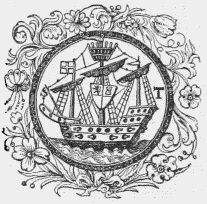
Corporation Seal.
Weymouth is a chapelry to Wyke-Regis: the tithes have been commuted for £20. The chapel, dedicated to St. Nicholas, and situated on the top of the hill, long since disappeared; but the site, called Chapel-Hay, is distinctly marked by large stones at the four corners. Under the hill, and nearly adjoining this site, a church dedicated to the Holy Trinity was built from a design by Mr. P. Wyatt, at the expense of the Rev. George Chamberlaine, late rector of Wyke: underneath it are catacombs capable of containing upwards of 1000 bodies. Melcombe was originally a chapelry to Radipole, from which it was separated in 1605, when a church was built on the site of the former chapel, and made parochial: the living is a rectory, with the living of Radipole annexed, valued in the king's books at £11. 5. 5.; net income, £298; patron, W. Wyndham, Esq. The church, dedicated to St. Mary, having become greatly dilapidated, an act of parliament was obtained in the 55th of George III., for rebuilding it, which was completed in 1817; it is a neat edifice containing upwards of 2000 sittings, including 500 sittings purchased by the Rev. G. Chamberlaine, at an expense of £500, for the exclusive use of the poor. The interior is neatly fitted up, and the altarpiece is embellished with a painting of the Last Supper, by Sir James Thornhill. There are places of worship for Independents, Baptists, Wesleyans, and Roman Catholics. Of the several bequests for education, are, one of £70 per annum, and another of £28, for six boys, left by Mr. Taylor in 1753. The poor-law union of Weymouth comprises eighteen parishes or places, and contains a population of 18,683.
In the centre of the town was a priory of Black canons, dedicated to St. Winifred, founded by some member of the Rogers family, of Bryanston: the buildings occupied a quadrangular area of nearly one acre. At Nottington, two miles and a half distant, on the Dorchester road, is a mineral spring, the water of which is considered efficacious in scrofula; and about a mile from the town is Radipole Spa, discovered in 1830 by John Henning, Esq. Five miles from Weymouth is the burning cliff at Holworth, which was first introduced to public notice by Mr. George Frampton, in 1827, and has since attracted the notice of naturalists. Certain masses of septaria, which, when sawn asunder, exhibit beautiful specimens of spar, cornua ammonis, &c, were discovered a few years since in the rear of Melcombe. Thornhill, the celebrated painter, was a native of Melcombe, and represented that borough in parliament. The late Mr. John Harvey, of Weymouth, projected the plan of a breakwater for Portland Roads, which has been matured and improved by his son, the present postmaster of the town. Melcombe conferred the title of baron on Bubb Doddington, with whom it became extinct; Weymouth gives that of Baron to the family of Thynne.