A Topographical Dictionary of England. Originally published by S Lewis, London, 1848.
This free content was digitised by double rekeying. All rights reserved.
'Widcombe - Wigborough, Little', in A Topographical Dictionary of England, ed. Samuel Lewis (London, 1848), British History Online https://www.british-history.ac.uk/topographical-dict/england/pp568-571 [accessed 30 April 2025].
'Widcombe - Wigborough, Little', in A Topographical Dictionary of England. Edited by Samuel Lewis (London, 1848), British History Online, accessed April 30, 2025, https://www.british-history.ac.uk/topographical-dict/england/pp568-571.
"Widcombe - Wigborough, Little". A Topographical Dictionary of England. Ed. Samuel Lewis (London, 1848), British History Online. Web. 30 April 2025. https://www.british-history.ac.uk/topographical-dict/england/pp568-571.
In this section
Widcombe, Somerset.—See Lyncombe.
WIDCOMBE, Somerset.—See Lyncombe.
Widcombe
WIDCOMBE, a tything, in the parish of ChewtonMendip, union of Clutton, hundred of Chewton, E. division of Somerset, 5 miles (S. W. by S.) from Pensford; containing 145 inhabitants. It comprises 705 acres, of which 39 are waste. The vicarial tithes have been commuted for £35, and the impropriate for £30.
Widdington (St. Mary)
WIDDINGTON (St. Mary), a parish, in the union of Saffron-Walden, hundred of Uttlesford, N. division of Essex, 8 miles (N. N. E.) from BishopStortford; containing 377 inhabitants. It comprises 2087a. 2r. 37p., of which 1375 acres are arable, 337 pasture, and 248 woodland. The living is a rectory, valued in the king's books at £25, and in the gift of W. J. Campbell, Esq.: the tithes have been commuted for £570, and the glebe comprises 42 acres. The church, a small edifice of stone, partly rebuilt with brick, retains several details in the Norman style.
Widdington
WIDDINGTON, a township, in the parish of Little Ouseburn, Upper division of the wapentake of Claro, W. riding of York, 8¼ miles (S. E. by E.) from Boroughbridge; containing 25 inhabitants. It is situated on the river Ouse, which passes on the north and east; and comprises 694 acres of land, in four farms.
Widdrington
WIDDRINGTON, a parochial chapelry, in the union, and E. division of the ward, of Morpeth, N. division of Northumberland, 8 miles (N. E. by N.) from Morpeth; containing 447 inhabitants. This place was long the seat of the Widdrington family, many of whom at various periods greatly distinguished themselves against the Scots, and on other occasions. Sir William Widdrington, in 1642, was expelled from the house of commons for raising forces in defence of Charles I., by whom, in the following year, he was elevated to the dignity of baron; after the battle of Marston-Moor, he left the kingdom, when his estates were confiscated by the parliament, but returning in the service of Charles II., he was slain at the conflict of Wigan. William, 4th lord Widdrington, was attainted in 1715, for his share in the rebellion of that year, and his property, to the amount of £100,000, was sold for the public advantage; thus consummating the downfall of a family that had flourished during a space of seven centuries. The ancient castle, which stood in a noble park of 600 acres, was razed to the ground about 60 years since, and a new edifice, now much out of repair and uninhabited, was built upon its site.
The district was separated from the parish of Woodhorn, and invested with distinct parochial rights, in 1768. It chiefly belongs to Lord Vernon, and comprises 4902a. 1r. 30p., mostly tithe-free, and of which a fifth is pasture land. The soil is a strong clay, producing fine crops of wheat and beans, and the surface is generally level, with a gentle elevation towards the village, which commands extensive views in every direction, and the vicinity of which formerly abounded in wood: on the cast is the sea. A small colliery is in operation, and there is a quarry of freestone. The living is a perpetual curacy, in the gift of Lord Vernon, with a net income of £67; the impropriation belongs to the Mercers' Company, and the incumbent of Hampstead, London. The chapel had parochial limits so early as 1307, and was originally dedicated to St. Edmund; at the Dissolution it was called Holy Trinity chapel, from which period it continued dependent on Woodhorn. The edifice was repaired by Sir George Warren, in 1768, and comprises a nave, chancel, and south aisle; the chancel has an oratory or chantry porch projecting from it on the south, lighted by two windows. There is a place of worship for Presbyterians. In 1843, a skeleton with the teeth perfect, and an urn, were found in ploughing a field.
Widecombe-in-the-Moor (St. Pancras)
WIDECOMBE-in-the-Moor (St. Pancras), a parish, in the union of Newton-Abbott, hundred of Haytor, Teignbridge and S. divisions of Devon, 5¾ miles (N. W. by N.) from Ashburton; containing 1106 inhabitants. It is bounded on the west and south by the river Dart, and comprises about 12,800 acres, of which one-half is open common; the soil is light and sandy, and the parish is more adapted to rearing live-stock than to the purposes of agriculture. The surface is varied, consisting of several valleys bordering on Dartmoor, inclosed with rugged hills, and watered by three streams which flow into the river Dart. Tin has been found, and there are remains of ancient stream-works of considerable extent; granite is also abundant on the commons. Many of the inhabitants are employed in weaving serges at their own dwellings. The living is a vicarage, valued in the king's books at £25. 13. 9.; net income, £268; patrons and appropriators, the Dean and Chapter of Exeter. The church was greatly injured by lightning during the performance of divine service, on Oct. 21st, 1638, when portions of the stone and woodwork fell in. There are places of worship for Calvinists and Wesleyans. The last Lord Ashburton, of the Dunning family, and the late Gilbert Dyer, of Exeter, who collected the most extensive library in the west of England, were natives of the parish.
Widford (St. Mary)
WIDFORD (St. Mary), a parish, in the union and hundred of Chelmsford, S. division of Essex, 1½ mile (S. W.) from Chelmsford; containing 362 inhabitants. This parish, which is supposed to have derived its name from a ford over the river Chelmer, comprises 690a. 3r. 29p.; the soil is rich, and around the village the lands are in a high state of cultivation. The living is a discharged rectory, valued in the king's books at £8, and in the gift of the Rev. W. Buswell: the tithes have been commuted for £250, and the glebe comprises 20 acres. The church is a small ancient edifice, partly in the early and partly in the decorated English style, situated on the west side of the road from London to Chelmsford.
Widford (St. John the Baptist)
WIDFORD (St. John the Baptist), a parish, in the union of Ware, hundred of Braughin, county of Hertford, 4½ miles (E. by N.) from Ware; containing 539 inhabitants, and comprising by measurement 1150 acres. A pleasure-fair is held about the middle of June. The living is a rectory, valued in the king's books at £12. 13. 4., and in the gift of W. P. Hamond, Esq.: the tithes have been commuted for £290, and the glebe comprises 27 acres. The church has a square embattled tower with a tall slender spire, and occupies a considerable eminence. There is a rent-charge of £5, for teaching three boys; and the poor have 13½ acres of land, given by an unknown benefactor, producing £18 per annum, and £370 in the 3½ per cents., given by Mrs. Mason, producing £13 per annum.
Widford (St. Oswald)
WIDFORD (St. Oswald), a parish, in the union of Witney, W. division of the hundred of Bampton, county of Oxford, 1½ mile (E. S. E.) from Burford; containing 45 inhabitants. The parish comprises 564 acres, including 98 common or waste. The living is a discharged rectory, valued in the king's books at £3. 14. 2., and in the gift of Lord Redesdale: the tithes have been commuted for £86.
Widley (St. Mary)
WIDLEY (St. Mary), a parish, in the union of Fareham, hundred of Portsdown, Fareham and S. divisions of the county of Southampton, 5½ miles (E. by N.) from Fareham; containing, with part of the hamlet of Potwell, 607 inhabitants. The parish comprises 1106 acres, of which 59 are common or waste; a very considerable portion is woodland, abounding with timber of stately growth. The soil is fertile, resting on chalk, of which there are several pits. The living is a rectory with the vicarage of Wymering annexed, valued in the king's books at £14. 11. 10½.; net income, £678; patrons, the Nugee family and Winchester College, alternately. The tithes of Widley have been commuted for £250, and the glebe comprises 11 acres. The church has been enlarged.
Widmer-Pool (St. Peter)
WIDMER-POOL (St. Peter), a parish, in the union of Bingham, S. division of the wapentake of Rushcliffe and of the county of Nottingham, 9 miles (S. S. E.) from Nottingham; containing 182 inhabitants. The parish comprises about 2000 acres. The village, situated on the road from Melton to Nottingham, nearly equidistant from those towns, has been almost entirely rebuilt, and is of handsome appearance. The living is a rectory, valued in the king's books at £14. 16. 0½.; net income, £232; patron, F. Robinson, Esq. The tithes were commuted for land in 1803; the glebe altogether comprises 450 acres. The church, with the exception of the tower and spire, was rebuilt in 1831: it was soon afterwards injured by lightning, which damaged the spire and part of the tower, with the roof; but was in 1836 restored, except the spire, by the patron, aided by a grant of £300 from the Incorporated Society. There is a place of worship for Baptists. The parish is bounded on the west by the old Fosse-road; and several Roman coins have been found, including a silver one of Adrian, and a copper coin of Claudius.
Widness, with Appleton
WIDNESS, with Appleton, a township, in the parish and union of Prescot, hundred of West Derby, S. division of Lancashire, 6¼ miles (W. by S.) from Warrington; containing 2209 inhabitants. Wydnes was anciently a barony, which, however, was of short continuance. It passed from Eustace Fitz-John to his son Richard, progenitor of the Lacy family, and from the Lacys to the dukes of Lancaster, who carried it into the crown. In the 9th of Elizabeth, Francis Alforde claimed the manor by grant from the queen: the manorial rights are now possessed by the Marquess of Cholmondeley. Appleton gave name to an ancient family, the last of whom left two children under the guardianship of one Hawarden, who was reported to have murdered them. The estate afterwards belonged to the Gellibrands, who succeeded the Hawardens; and was sold in 1811. The township is beautifully situated on the river Mersey, and comprises 3000a. 27p.: the soil is sandy, upon a redstone rock; and there are fine views of the Cheshire hills and Welsh mountains. The London and Northwestern railway has a station about a quarter of a mile from the village. The vicarial tithes have been commuted for £160; and the impropriate for £243. 5. 11., payable to King's College, Cambridge. There is a church, in the township, at Farnworth, which see; and the Wesleyans have a place of worship. At Appleton is a Roman Catholic chapel dedicated to St. Bede, built in 1847, at a cost of £2000; it is in the decorated style, with a tower, and the eastern window is of stained glass: the priest has an endowment of 13 acres of land, with a house. There are national schools, which are licensed by the bishop for divine service.
Widworthy (St. Cuthbert)
WIDWORTHY (St. Cuthbert), a parish, in the union of Honiton, hundred of Colyton, Honiton and S. divisions of Devon, 3½ miles (E. by S.) from Honiton; containing 257 inhabitants. The parish is situated on the road from Honiton to Axminster, and comprises 1407 acres, of which 205 are common or waste. Freestone of good quality for building is quarried, and chalk is burnt into lime for manure. A fair is held at Wilmington on the morrow of St. Matthew's day. The living is a rectory, valued in the king's books at £11. 16. 0½., and in the patronage of the Elton family: the tithes have been commuted for £200, and the glebe comprises 31 acres. The church, an ancient structure, contains the effigy of a knight in armour, and a fine monument by Bacon to the memory of James Marwood, Esq., a liberal benefactor to the parish. Benedictus Marwood, Esq., in 1742 gave £100, and the Rev. Joseph Somaster in 1770 left £50, to be applied to education; the latter also left £50, directing the proceeds to be distributed in bread among the poor. In 1831, the Rev. W. J. Tucker, then rector, gave £200 to his successor for charitable purposes. Near the church is an old earthwork, and in the north-cast part of the parish are vestiges of an intrenchment.
Wield (St. James)
WIELD (St. James), a parish, in the union of Alton, hundred of Fawley, Alton and N. divisions of the county of Southampton, 6 miles (W.) from Alton; containing 278 inhabitants. The living is a perpetual curacy; net income, £64; patron and impropriator, the Earl of Portsmouth, whose tithes have been commuted for £218. The church is very ancient, and contains a marble monument to Sir Richard Wallop, an ancestor of the earls of Portsmouth.
Wigan (All Saints)
WIGAN (All Saints), a parish, borough, and markettown, which has separate jurisdiction, and the head of a union, chiefly in the hundred of West Derby, S. division of the county of Lancaster; containing, with the chapelries of Abram, Billinge, Haigh, Hindley, Pemberton, and Up Holland, and the townships of Aspull, Billinge Higher End, Dalton, Ince-in-Makerfield, Orrell, and Winstanley, 51,988 inhabitants, of whom 25,517 are in the town, 18 miles (W. N. W.) from Manchester, and 199 (N. W. by N.) from London. This place is stated by Camden to have been originally called Wibiggin. The nucleus of the town is supposed by Whitaker to have been a Saxon castle, but its origin should perhaps be assigned to a still earlier period, as three Roman roads unite here. The vicinity is said to have been the scene of some sanguinary battles between the Britons, under their renowned King Arthur, and the Saxons; and the discovery, about the middle of the 18th century, of a large quantity of human bones, and the bones and shoes of horses, over an extensive tract of ground near the town, tends to confirm this opinion. During the great civil war, several battles were fought here, Wigan being the principal station of the king's troops commanded by the Earl of Derby. That leader was defeated and driven from the town by the parliamentary forces under Sir John Smeaton, early in 1643; and shortly afterwards, in the same year, he was again defeated by Colonel Ashton, who, in consequence of the devotion of the inhabitants to the royal cause, ordered the fortifications of the town to be demolished. From this time Wigan remained tranquil (with the exception of Oliver Cromwell pursuing through it, in 1648, the Scottish army under the Duke of Hamilton, whom he had driven from Preston) until 1651, when the Earl of Derby, having been summoned from the Isle of Man by Charles II., was again defeated here by a very superior force under Colonel Lilburne. To record the courage and loyalty of Sir Thomas Tyldesley, who was slain in this action, a monumental pillar was erected in 1679, by Alexander Rigby, Esq., then high sheriff of the county, on the spot where he fell, at the northern end of the town. In the year 1745, Prince Charles Edward marched through Wigan on his route from Preston to Manchester, and slept at Bishopsgate.
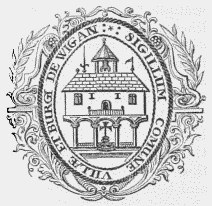
Corporation Seal.
The town is situated on the bank, and within eight miles of the source, of the river Douglas, which runs round three sides of it; and is described by Leland as "a paved town, as big as Warrington, but better builded;" a patent for paving it, and building a bridge over the Douglas, having been granted so early as the 7th of Edward III. The old and greater part of the town consists of irregular streets; the houses generally are of an inferior description, but some few are good and modern, and many of the shops present a handsome appearance. It is lighted with gas by a company established in 1823, and supplied with water by a company formed under the authority of an act in 1761. The town is favourably circumstanced for manufactures, owing to the facilities of communication afforded by canal and railway. The manufacture of calicoes, fustians, and other cotton goods, linens, and checks, and the spinning of cotton-yarn, are extensively carried on; and there are brass and iron foundries, pewter-works, several manufactories for spades and edge-tools, and some corn-mills on the river. In 1846, 26 cotton-mills were employed, having engines of 1417 horse-power, 292,172 spindles, and 1800 powerlooms. Wigan is situated in the very centre of one of the richest and most extensive coal-fields in England: the coal is of various qualities, adapted for all purposes, and here is found the best description of cannel-coal, so cheerful for domestic use and excellent for the production of gas. Under the authority of an act of parliament obtained in 1820, the Douglas was made navigable to its junction with the Ribble, but the river navigation has been since superseded by the canal between Leeds and Liverpool, which passes close to the town, and by its branches and various communications with Manchester, Kendal, and Hull on one side, and Liverpool on the other, affords every facility for the conveyance of the manufactures, and of the coal. The North-Union railway, which forms a link in the grand trunk line from London to the north, has a station at Wigan; and an act was passed in 1845 for a railway from Liverpool, by Wigan, to Bolton and Bury, to be constructed by the Manchester and Leeds (or Lancashire and Yorkshire) Company. A bridge of cast-iron beams, 46 feet long and 36 feet wide, supported on fluted columns of the Doric order, carries the former railway over Walgate. The market is on Monday and Friday, that on the latter day being the principal; and fairs are held on Holy-Thursday, June 27th, and Oct. 28th, on which days the Commercial-hall, a commodious brick building in the market-place, erected in 1816, is open for various purposes.
The first charter of incorporation was granted by Henry III. in 1246, and the privileges it bestowed were confirmed and augmented by succeeding monarchs; but the charter under which the corporation acted previously to the passing of the Municipal act, was conferred by Charles II. The corporation now consists of a mayor, ten aldermen, and thirty councillors, under the act; the borough is divided into five wards, and the municipal and parliamentary boundaries are co-extensive with the township. Wigan first sent members to parliament in the 23rd of Edward I., and again in the 35th of the same reign, after which period the privilege was not exercised until the 1st of Edward VI.: the mayor is returning officer. The corporation is authorised by its charter to try all civil actions (a power it never exercises), and holds a court of quarter-sessions for felonies not capital, committed within the borough. One of the county debt-courts established in 1847, is fixed here, with jurisdiction over the registration-district of Wigan; petty-sessions for the county take place every Friday, and for the borough every Monday, Wednesday, and Friday. The town-hall was rebuilt in 1720, by the Earl of Barrymore and Sir Roger Bradshaigh, then members of the borough. The gaol is used only for temporary confinement, the prisoners being committed to the county gaol at Kirkdale. The parish comprises 26,262 acres, of which 2161 are in the township of Wigan; of these latter, 109 are arable, and 2052 meadow and pasture.
The living is a rectory, valued in the king's books at £80. 13. 4.; net income, £2000; patron, the Earl of Bradford. The tithes of Wigan township have been commuted for £124. 11., and the glebe consists of 85 acres. The parochial church is a handsome edifice, with a square tower. The chancel having been rebuilt, was opened on All Saints' day, November 1st, 1847; it has a noble wiudow by Wailes of Newcastle, given by the Misses Kenyon, of Swinley, at a cost of £500, a screen and pulpit of white stone beautifully executed, and a reading-desk and stalls of massive oak, with other ornamental parts in strict accordance with the original fine design of the church. About the same time, a vestry meeting was held, at which it was resolved to restore or rebuild the body of the edifice, as the different portions might require: the cost of the additional works, according to the estimate of the architects, Messrs, Sharp and Paley, of Lancaster, will amount to £4410. A beautiful font by Carpenter, of London, valued at a hundred guineas, has been presented by the Misses Kenyon; and subscriptions have been raised for a west window corresponding with that in the chancel.
St. George's church, in the town, was erected as a chapel of ease, in 1781. St. Catherine's church, at Scholes, of which the first stone was laid on the 6th April 1840, was completed at an expense of £3225, by subscription, aided by a grant from Her Majesty's Commissioners; it is in the later English style, with a tower and spire, and contains 1113 sittings, of which 459 are free. Both these churches have districts assigned to them, St. George's comprising a population of 6000, and St. Catherine's a population of 9000: the living of each is a perpetual curacy; income, £150; patron, the Rector of Wigan. St. Thomas's church, in the Queen-street ward, was erected in 1848, at a cost of £2500, from the designs of John Hay, Esq.; it is in the middle pointed style, with a tower and spire. At Abram, Billinge, Haigh, Hindley, Holland, and Pemberton are other incumbencies, all in the Rector's gift. In the town are places of worship for Baptists and Independents, a handsome meeting-house for Wesleyans, and a Scottish church, in which the late distinguished Dr. Chalmers preached his first sermon. The Roman Catholics have two chapels; St. Mary's, in the early English style, erected at a cost of £7000, and having schools adjacent; and St. John's, in the Grecian style, built in 1819 at an expense of £6500, and to which schools for 1300 children were added in 1846 at an expense of £2000. In Scholes are St. Patrick's Roman Catholic schools and chapel.
The free grammar school, at Millgate, appears to have been founded in the 16th year of the reign of James I., when a benefaction was made to it of £6. 13. 4. per annum, by James Leigh: an act of parliament was passed in 1812, incorporating fifteen members of the municipal corporation as governors of the institution, with power to appoint a master and an usher. The number of scholars is fixed at eighty, and the income is about £200 per annum. A Blue-coat school wherein 40 boys were clothed and instructed, was established in 1773, but a building for a national school being erected in 1825, the former was united to it. Commodious infant and Sunday schools, in connexion with St. Catherine's district church, have been built by subscription, and schools have been established in connexion with St. George's church. There have also been recently erected by subscription, aided by public grants, schools in the Queen-street ward, where the principal part of the manufacturing population are located. Schools for the children of dissenters are supported; and the poor have many bequests, amounting in the aggregate to a considerable sum. The union of Wigan comprises 20 townships, and contains a population of 66,032.
Wigborough, Great (St. Stephen)
WIGBOROUGH, GREAT (St. Stephen), a parish, in the union of Lexden and Winstree, hundred of Winstree, N. division of Essex, 7 miles (S. S. W.) from Colchester; containing 479 inhabitants. This place, which is bounded on the south by a creek of the river Blackwater, called the Verley, was the scene of a great battle, probably with the northern pirates, to whose incursions it was, from its situation, peculiarly exposed. Near the church is a large tumulus, supposed to have been raised over the bodies of those who were slain on that occasion. The parish comprises 2585a. 3r. 34p., of which 2450 acres are under cultivation, 35 in roads and waste, and 100 covered at high water. The village is situated on the road from Maldon to Colchester. It was formerly of much greater importance, as is evident from several green lanes still retaining the appellation of streets; and there were once extensive salt-works in the immediate neighbourhood, from which circumstance the hamlet where they were carried on is called Salcot-Wigborough. A fair is held at that place on the 24th of August. The living is a rectory, valued in the king's books at £18. 17. 6.; net income, £591; patrons, H. Bewes, Esq., and the Rev. William Fookes. The church stands on a considerable eminence, commanding extensive views of the sea and adjacent country. There is a place of worship for Independents.
Wigborough, Little (St. Nicholas)
WIGBOROUGH, LITTLE (St. Nicholas), a parish, in the union of Lexden and Winstree, hundred of Winstree, N. division of Essex, 7¼ miles (S. by W.) from Colchester; containing 114 inhabitants. It comprises 1157 acres of land, all in good cultivation with the exception of 133 acres common or waste; and is bounded on the north by a creek of the river Blackwater, called Mersey channel, and on the south by another called Verley channel. The living is a discharged rectory, valued in the king's books at £10, and in the gift of the Governors of the Charter-House, London: the tithes have been commuted for £220, and the glebe comprises 20 acres. The church is a small edifice with a tower, romantically situated on the sea-shore.