A History of the County of Lancaster: Volume 5. Originally published by Victoria County History, London, 1911.
This free content was digitised by double rekeying. All rights reserved.
'The parish of Flixton', in A History of the County of Lancaster: Volume 5, ed. William Farrer, J Brownbill (London, 1911), British History Online https://www.british-history.ac.uk/vch/lancs/vol5/pp42-45 [accessed 30 April 2025].
'The parish of Flixton', in A History of the County of Lancaster: Volume 5. Edited by William Farrer, J Brownbill (London, 1911), British History Online, accessed April 30, 2025, https://www.british-history.ac.uk/vch/lancs/vol5/pp42-45.
"The parish of Flixton". A History of the County of Lancaster: Volume 5. Ed. William Farrer, J Brownbill (London, 1911), British History Online. Web. 30 April 2025. https://www.british-history.ac.uk/vch/lancs/vol5/pp42-45.
In this section
FLIXTON
Flixton; Urmston
The parish of Flixton, (fn. 1) a compact area of three plough-lands ancient assessment lying in the tongue between the Irwell and Mersey, appears to have been cut off from Barton; the boundary between them is a straight line running east and west, while the eastern boundary is merely a part of that between Barton and Stretford, also a straight line running south from the boundary of Whittleswick to the Mersey. Similarly the division between the component townships of Flixton is a straight line running southwards. The area is 2,581 acres, and the population in 1901 was 10,250. The geological formation consists of the Upper Mottled Sandstone (Bunter series) of the New Red Sandstone.
From its position the parish has had a quiet and uneventful history. It lies out of touch with the old main roads from Manchester to Warrington and to Chester, and only one of its local gentry has taken any prominent part in the movements of the day, namely Peter Egerton of Shaw, an active partisan of the Parliament during the Civil War.
To the ancient 'fifteenth' Flixton paid 14s. 6d. and Urmston 8s. 6d., the hundred in all paying £41 14s. 4d. (fn. 2) For the county lay of 1624 Flixton was assessed at £3 7s. 5¼d. when the hundred paid £100, the townships of Flixton and Urmston contributing in the proportions of seven and four. (fn. 3)
The parishioners of Flixton making the Protestation in 1641 numbered 171, being headed by the two squires and the curate. (fn. 4)
To the hearth tax of 1666 eighty-nine hearths were found liable in Flixton, where the only house with more than four hearths was that of Leonard Egerton, with eleven; and sixty hearths in Urmston, where the chief houses were those of Roger Rogers and Richard Starkie, with nine and six hearths respectively. (fn. 5)
There are at present 863 acres of arable land in the parish, 813 devoted to permanent grass, and 3 to woods and plantations.
Church
The church of ST. MICHAEL stands at the east end of the village on high ground about 250 yds. north of the River Mersey with a very extensive view from the churchyard southward over Carrington Moss. It consists of chancel 27 ft. by 17 ft., with north vestry and organ chamber, nave 36 ft. 6 in. by 17 ft. 6 in. with north and south aisles, and west tower 13 ft. square. These measurements are all internal. The south aisle extends the whole length of the nave and chancel, and is 61 ft. 4 in. long by 12 ft. 3 in. wide. The north aisle is the same width and 37 ft. 10 in. in length. Though the foundation is a very ancient one, and a church is known to have existed here since the 12th century, the present structure retains so little ancient work that little or nothing can be said of the development of the plan. Two fragments of what appear to be 12th-century stones with lozenge ornament are built into the east wall on the outside, but apart from these the oldest work in the building is contained in the chancel, which, in something of its present form, dates from the 15 th century. It has been so much rebuilt, however, that little or nothing of the original work remains except in the reconstructed walling, the lower part of which appears to be old or entirely rebuilt of ancient masonry.
The 15th-century church apparently occupied pretty much the same area as at present, with the exception of the north vestry, and stood in all probability till the 18th century. In 1731 the parish rebuilt the tower (fn. 6) in the style of the day, and in 1756 the nave and aisles. The chancel had to be partly rebuilt in 1815, when one of the piers gave way and the wall fell in. (fn. 7) In 1851 the north-east vestry was built; and in 1863, the tower, of which there had been a partial restoration in 1824, was declared unsafe, and the ringing of the bells was stopped. A general restoration took place in 1877, when the galleries which had been erected in the 18th century were removed, the ceiling opened out, new seats put in, and two doors, one at the west end of the north aisle and the other at the east end of the south aisle, were built up. In 1888 the tower was entirely rebuilt and the ringing of the bells resumed. The church is built of red sandstone, the roofs of the chancel, nave, and aisles being covered with stone slates, and that of the vestry with green slates.
The chancel of two bays is open to the nave without structural division and has an east window of late 15th-century style, of three cinquefoiled lights under a four-centred head in modern stonework. Its east wall stands slightly in front of those of the vestry and south aisle, and has diagonal buttresses at the angles. On the north are the vestry and organ chamber, and on the south an aisle. Before the building of the vestry the north wall was solid, with an external buttress, (fn. 8) but has now an arcade of two low arches of two chamfered orders springing from an octagonal shaft and responds with moulded capitals. The west respond is built against a 3 ft. length of old walling which marks the extent of the north aisle. The vestry and organ chamber are built in 15 th-century style, and are separated from the aisle by an arch constructed when the east wall of the aisle was taken down. On the south side the chancel has an arcade of two pointed arches of two chamfered orders, the crowns of which come immediately under the wall plate. They spring from octagonal shafts 21 in. in diameter with moulded capitals and chamfered bases, and are probably a modern copy of the original 15th-century arcade, erected after the accident of 1815. The height of the pillars to the top of the capitals is 7 ft. 9 in., but on the north side the pier to the new arcade is only 5 ft. 3 in., and the arch above of corresponding height, leaving a wide extent of wall space above, which has lately been decorated with a frieze of painted figures. This difference in height is accounted for by the roof of the vestry being considerably lower than the roofs of the chancel or aisle. The nave arcade of the 15th-century church was a continuation westward of that on the south side of the chancel, but in the 18th century it was swept away and the present classic nave and aisles erected between the newly-built tower and the older chancel. The nave has three semicircular arches on each side, springing from circular stuccoed columns of the Tuscan order standing on pedestals 3 ft. high. There are three columns on the north side and two on the south, with a half column against the upper part of the octagonal stone pier at the east end. The junction of the 18th-century work with that of the chancel is clumsily effected, and indicates the evident intention to carry the rebuilding eastward. The spacing of the bays on the north and south is unequal, the columns not coming opposite each other, and on the north the beginning of a fourth semicircular arch butts against the wall at the west end of the chancel. The north aisle extends slightly further westward than the south, and is lighted by three high roundheaded windows on the north side and one at the west, with moulded sills, architraves, imposts, and keystones. The south aisle is lighted along its side by four similar windows and one at each end. In the south-west corner is a semicircular-headed doorway with pilasters and pediment, and a smaller round-headed window over. The nave and aisles have open timbered roofs of plain king-post type
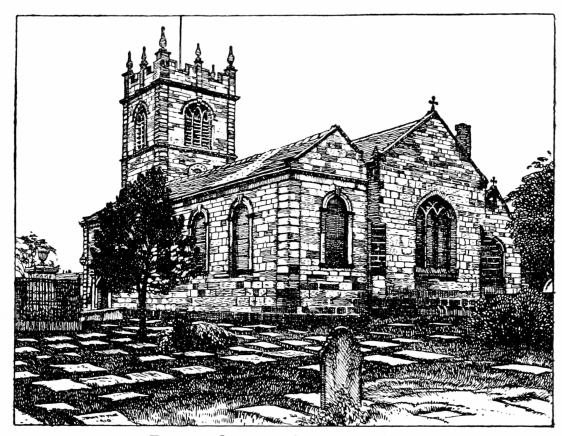
Flixton Church: South-East View
The tower, as previously stated, is a modern rebuilding of the 18th-century one, and has a round arch towards the nave. It is of three stages marked by string-courses, with a vice in its south-west corner entered from the outside, and is a mixture of classic and 18th-century Gothic detail of no particular architectural interest, but a fair example of its kind. The angles, like those of the aisles, have drafted quoins, and at the corners of the embattled parapet are urn ornaments. The lower stage has a round-headed west doorway with a three-light debased Gothic window breaking the string-course above, and over it the inscription recording the rebuilding of the tower in 1731. The upper stage on each side has a roundheaded three-light window with stone louvres and label over. The window head has a keystone round which the cornice above breaks, and which is carried up as an intermediate pilaster in the middle of the parapet surmounted by an urn. In the second stage on the north side is an inscription to the effect that the tower was rebuilt in 1888 in commemoration of Queen Victoria's Jubilee. There is a clock presented in 1889 in the second stage on the north and east sides.
There is a 17th-century oak chest in the vestry, but generally speaking all the fittings of the church are modern, mostly dating from 1877 or later. The font is under the tower, and an oak screen separating the baptistery from the nave was erected in 1903.
At the west end of the south aisle was formerly a brass to the memory of Richard Radcliffe of Newcroft (died 1602), but during a recent decoration of the church it has been removed to the vestry. It bears the figures of Radcliffe in armour and his two wives, kneeling at each side of a book desk, with the three sons of the first wife, and the two sons, three daughters, and three infants (swaddled) of the second. The first wife Bridget (Caryll) widow of W. Molyneux, kneels with her three sons opposite to Radcliffe, while the second wife and her children kneel behind him. Over the desk is a shield with the arms of Radcliffe of Ordsall with helm, crest, and mantling and on each side a shield with the arms of Radcliffe impaling those of his wives. (fn. 9)
There is no ancient stained glass.
Until 1806 there were four bells, of which one, known as the poor folks' bell, was subscribed for by the villagers. Three of them bore the motto 'Jesus be our speed,' and the fourth 'Leonard Asshawe, Peter Egerton, Esq. 1624.' (fn. 10) These were recast in 1806 by John Rudhall of Gloucester, and four new ones added by public subscription, the first peal being rung on 25 January 1808. On arrival at Flixton the tenor bell was placed mouth upwards in a field and ten guineas' worth of double strong ale put in for the populace to regale themselves with. (fn. 11) Some of the bells were recast by Taylor of Lough borough in 1887.
The curfew is rung between 29 September and 25 March, and a bell, locally called the 'Pudding bell,' is rung every Sunday at one o'clock and again at two, the origin of which is said to have been to let the people of Carrington know that there would be service at Flixton in the afternoon.
The plate consists of a flagon, 1776 (the gift of William Allan, esq., Davyhulme), a chalice and two patens, and a large almsdish, 1875.
The registers begin in 1570. There is a loose leaf of the churchwardens' accounts for the year 1690–91, but the account books do not begin till 1707. (fn. 12)
Additions to the churchyard were made in 1868 and 1887. The oldest gravestone is dated 1669, and there is a pedestal sundial on the south side of the church with the names of the churchwardens and maker (James Sandiford, a Manchester clock-maker), and the date 1772.
Advowson
The advowson of the church belonged to the Grelley moiety of Flixton, and was granted with it to Henry son of Siward. On the foundation of Burscough the church was granted to the priory, (fn. 13) and appears to have remained in its possession till far on into the 13th century. (fn. 14) Then, by some unknown means, the rectory was acquired by Bishop Roger Meuland about 1290 and transferred to the cathedral of Lichfield, becoming the portion of one of the prebendaries, who took his title from it. (fn. 15) William Burnell died possessed of the prebend of Flixton in 1303, (fn. 16) but nothing is stated as to any appropriation in the Taxation of Pope Nicholas in 1291, when the annual value was returned as £4 13s. 4d. (fn. 17) The prebendaries, who leased out the tithes, &c., (fn. 18) appointed a resident curate, this system continuing until the patronage was about 1860 transferred to the Bishop of Manchester, as representing the Bishop of Lichfield, who had collated to the rectory-prebend. (fn. 19) The incumbents are styled rectors, and have the tithe rent-charge and glebe. (fn. 20) The value of the ninth of the wool, &, in 1341 was £4. (fn. 21) In 1534 the prebend was valued at £7 or £10. (fn. 22) The Commonwealth surveyors in 1650 found that the farmer of the tithes, Peter Egerton of Shaw, had assigned a house to the curate, worth £20 a year, and also, by order of the Committee of Plundered Ministers, paid him the £16 rent due to the prebendary. (fn. 23) Bishop Gastrell, about 1717, recorded that the lessee paid the curate £30 a year, and surplice fees and other dues amounted to £4 more. (fn. 24) The present income is £300 with a house. (fn. 25)
The following have been curates (fn. 26) and rectors:—
| oc. 1541 | Nicholas Smith (fn. 27) |
| oc. 1547 | Ralph Birch (fn. 28) |
| oc. 1552–4 | Edward Smith (fn. 29) |
| oc. 1563 | Robert Radcliffe (fn. 30) |
| 1565 | Richard Smith (fn. 31) |
| oc. 1588 | Nicholas Higson (fn. 32) |
| oc. 1604 | William Hodgkinson (fn. 33) |
| c. 1610 | — Jones (fn. 34) |
| oc. 1613 | George Byrom (fn. 35) |
| oc. 1622 | Edward Woolmer, (fn. 36) B.A. (Oriel College, and All Souls, Oxford) |
| 1660 | Thomas Ellison (fn. 37) |
| oc. 1663 | — Barrett (fn. 38) |
| oc. 1664, 1691 | John Isherwood, B.A. (fn. 39) |
| oc. 1709 | Edward Sedgwick (fn. 40) |
| 1723 | John Jones, M.A. (fn. 41) |
| 1752 | Samuel Bardsley, B.A. (fn. 42) |
| 1756 | Humphrey Owen, B.A. (fn. 43) (St. John's College, Oxford) |
| 1764 | Timothy Lowten, M.A. (fn. 44) (St. John's College, Cambridge) |
| 1771 | Thomas Beeley (fn. 45) |
| 1807 | Samuel Stephenson, M.A. (Trinity College, Cambridge) |
| 1816 | Henry Burdett Worthington, (fn. 46) M.A. |
| 1823 | William Asteley Cave Brown Cave, (fn. 47) M.A. (Brasenose College, Oxford) (fn. 48) |
| 1842 | Arthur Thomas Gregory, (fn. 49) B.A. (Lincoln College, Oxford) |
| Rectors | |
| 1863 | Charles Barton, (fn. 50) B.A. (Dublin) |
| 1873 | Richard Marsden Reece, (fn. 51) B.A. (St. John's College, Cambridge) |
| 1906 | Arthur William Smith |
The ecclesiastical history calls for little comment. There were no chantries, and the curate appears to have been the only resident ecclesiastic. At the Reformation the prebendaries of Flixton were conformists, (fn. 52) but the curates seem to have changed with each visitation. The church was fairly well provided with 'ornaments' as late as 1552. (fn. 53)
In 1592 the only charges against the curate and wardens were that no collectors for the poor were appointed and that the 12d. fine for not attending church was not levied. (fn. 54) In 1641 the curate reported that there were no 'delinquents' in the parish, the people 'being all protestants and no papist' among them. (fn. 55) The curate in 1680 was suspended for three years for refusing to read the prayer for the queen, the Duke of York, and the royal family. (fn. 56)
Land for a schoolhouse was leased in 1643, but the school seems to have been built in 1662 upon a patch of land by the roadside. (fn. 57) It was sold in 1861. (fn. 58)
Charities
Each of the townships in the parish has some small charitable endowment, the total income being £11 11s. 8d., of which £ 15s. 2d. is for the poor. A few old benefactions have been lost. (fn. 59)