A History of the County of Lancaster: Volume 5. Originally published by Victoria County History, London, 1911.
This free content was digitised by double rekeying. All rights reserved.
'The parish of Radcliffe', in A History of the County of Lancaster: Volume 5, ed. William Farrer, J Brownbill (London, 1911), British History Online https://www.british-history.ac.uk/vch/lancs/vol5/pp56-67 [accessed 30 April 2025].
'The parish of Radcliffe', in A History of the County of Lancaster: Volume 5. Edited by William Farrer, J Brownbill (London, 1911), British History Online, accessed April 30, 2025, https://www.british-history.ac.uk/vch/lancs/vol5/pp56-67.
"The parish of Radcliffe". A History of the County of Lancaster: Volume 5. Ed. William Farrer, J Brownbill (London, 1911), British History Online. Web. 30 April 2025. https://www.british-history.ac.uk/vch/lancs/vol5/pp56-67.
In this section
RADCLIFFE
Radeclive,Dom.Bk., 1193,1202,1212,1311; Radclive, 1227; Radeclif, 1309, 1360. The place is said to take its name from a cliff of red sandstone on the side of the Irwell.
The township and parish of Radcliffe lies in a bend of the River Irwell, which bounds it on the east and south, except in a few places where the difference of boundary may be explained by changes in the course of the river or other causes. The principal ancient buildings, the church and the tower, are situated in the south-east corner, at which point the Roch, flowing from the east, joins the Irwell. The township measures 2½ miles from east to west, and has an area of 2,533 acres. (fn. 1) The highest land, about 500 ft. above sea level, is in the north-west, and from it the surface gradually descends to the east and south, the land by the river being of course the lowest. The population in 1901 was 20,590. (fn. 2) The Coal Measures underlie the entire parish. There is a large area in the valley of the Irwell, both above and below the confluence with the River Roch, covered by alluvial deposit. The principal road is that passing northwest through Pilkington and crossing the river by a bridge about a mile west-south-west of the church. Around this point a hamlet called Radcliffe Bridge gradually formed, and has in modern times become the centre of trade and population. The road, after crossing the bridge, goes northerly to join the Bury and Bolton road, passing through the hamlet called Black Lane. To the north of the Bury and Bolton road is the Radcliffe portion of Cockey Moor. From the bridge roads go eastward to the church, and then cross the Irwell to join the Manchester and Bury road. Other roads go west through Little Lever to Bolton.
The Lancashire and Yorkshire Company's Liverpool and Bury line crosses the north of the township, going east and north-east, and has a station at Black Lane. The company's East Lancashire section, with a station at Radcliffe Bridge, runs through the township, and is joined by the line through Prestwich to Manchester, which has a station called Radcliffe. The Bury Canal crosses the township on the north-west side of the town, and then goes west near the Irwell till it joins the Manchester and Bolton Canal in Little Lever. (fn. 3)
Dr. Aikin in 1795 found the 400 houses in the township for the most part 'of an inferior sort,' and the inhabitants chiefly weavers, crofters, or employed in the coal works which abounded in the neighbourhood; those who lived by farming being very few. (fn. 4) The village has now grown into a town, and gives a name to one of the Parliamentary divisions of the county. (fn. 5) Part of the area was incorporated in Bury in 1876, and the remainder was governed by a local board formed in 1866. (fn. 6) The town, together with a portion of Whitefield in Pilkington, is under the Act of 1894 governed by an Urban District Council of twenty-four members, elected from four wards—Radcliffe Hall, Radcliffe Bridge, Black Lane, and Stand Lane; the last is in Pilkington. (fn. 7) The council-room is at the public baths, built in 1899. The market house and market rights were purchased from Lord Wilton in 1897. Technical schools were opened in 1896, a public park in 1902, and a free library, the gift of Mr. Carnegie, in 1907. A museum has been given by the Literary and Scientific Society.
Gas is supplied by a company formed in 1846. Electric lighting works have been established recently. Tramways, constructed by the district council, are leased to the Corporation of Bury.
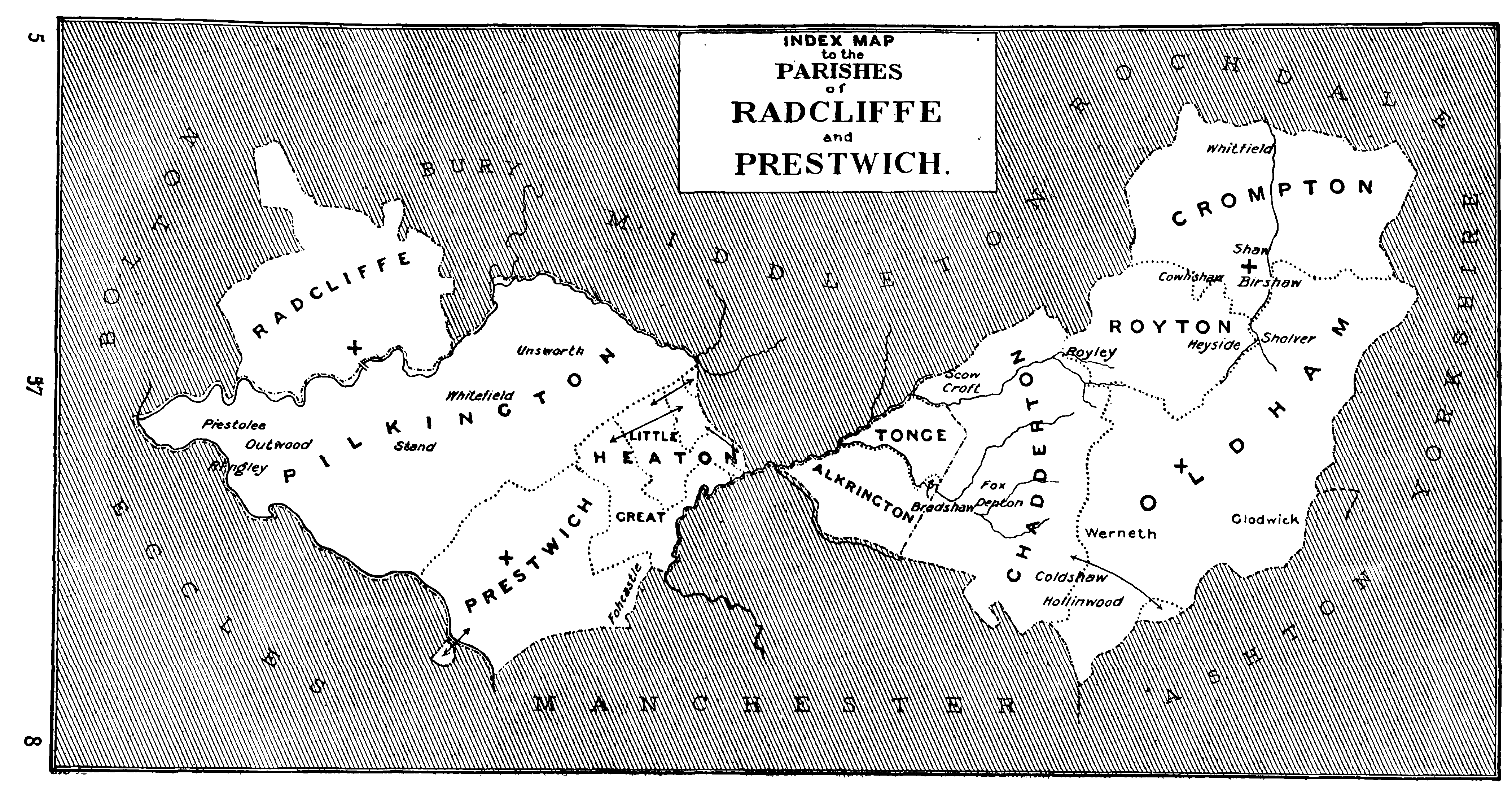
INDEX MAP to the PARISHES of RADCLIFFE and PRESTWICH
A market-house was erected by the Earl of Wilton in 1851; Friday is the market day. (fn. 8) The wakes begin on the third Saturday in August.
A convalescent hospital was presented to the town in 1903 by Mr. Adam Crompton Bealey in memory of his parents.
A weekly newspaper, The Radcliffe Times, founded in 1899, is printed at Bury.
A Roman road, commemorated by Blackburn Street, passed northwards through Radcliffe Bridge.
There was a cross to the north-west of the church. (fn. 9)
There were 108 hearths liable to the tax in 1666. The rectory had only five hearths, but there was one larger house, that of James Holland, with six. (fn. 10)
The following is the apportionment of agricultural land in the parish: Arable land, 561 acres; permanent grass, 1,221; woods and plantations, 75.
There are several collieries, with cotton mills and factories, the trades of the town including cottonspinning, the weaving of ginghams, scarves, handkerchiefs, sarongs, &, and the making of small-wares; bleaching, finishing, dyeing, paper-making, iron-founding, and machine-making; there are also chemical manufactories.
Manor
At his death in 1066 Edward the Confessor held RADCLIFFE as one hide. (fn. 11) The extent of the royal manor must have been much greater than that of the present township, which was in 1212 assessed as one plough-land only. Allowing for a reduction of the assessment by a third, it is clear that the later manor of Radcliffe can have been but a fourth part of the original one. At the later date mentioned it formed part of the Marsey fee, and was held of Ranulf son of Roger by William de Radcliffe. (fn. 12) William was in possession in 1193, when he proffered 5 marks for having the king's favour after the rebellion of John, Count of Mortain. (fn. 13) In 1199 he paid 10 marks for an inquiry concerning land in Hartshead, (fn. 14) and later he contributed to tallage and scutage. (fn. 15) In 1202 he secured an acknowledgement of his right to the advowson of Radcliffe Church. (fn. 16) He was one of the 'trusty knights' who made the great Survey of 1212, at which time he was found to hold, in addition to Radcliffe, 12 oxgangs in Edgeworth. (fn. 17) He died before 1221, when his widow Eugenia sued Adam de Radcliffe for her dower in a plough-land in Radcliffe, a plough-land in Edgeworth, and 4 oxgangs of land in Little Lever. (fn. 18)
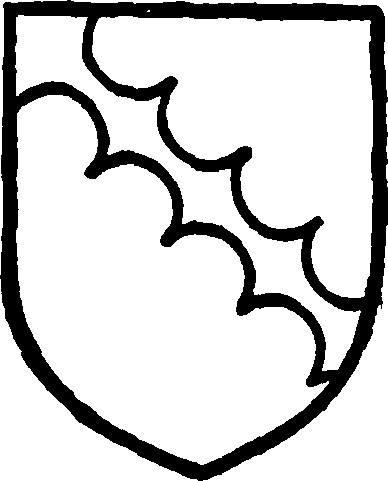
Radcliffe of Radcliffe. Argent a bendlet engrailed sable.
Adam de Radcliffe is mentioned in 1223, (fn. 19) and in 1227 acknowledged the service due to the lord of Manchester for Little Lever. (fn. 20) In 1246 as Adam son of William de Radcliffe he was acquitted of having disseised Adam son of Alexander de Radcliffe and Peter son of Adam of 4 acres of common of pasture in Radcliffe, where he had dug a mine; but he was convicted of other disseisin. (fn. 21) Adam had also to answer Cecily de Gorhull, who claimed an oxgang in Radcliffe, of which she alleged William father of Adam had disseised her, but he alleged that Hugh son of Spraging, Cecily's father, had exchanged that oxgang for other land in Gorhull. (fn. 22) Geoffrey son of Hugh de Gorhull in 1284 claimed a messuage and lands in Radcliffe against Richard son of Robert de Radcliffe. (fn. 23)
Richard de Radcliffe was in 1302 holding the eighth part of a fee in Radcliffe of the Earl of Lancaster. (fn. 24) Two years later he had from the king a grant of free warren in his demesne lands of Radcliffe and Quarlton. (fn. 25) William son of Richard de Radcliffe is next found in possession. He married Margaret daughter and heir of Adam de Hindley, and with her had Peasfurlong, a fourth part of Culcheth. (fn. 26) In 1324 he held the manor of Radcliffe by homage and the yearly service of 6s. for castle-ward and 2s. 6d. for sake fee, and by the service of the half and the tenth part of a knight's fee. (fn. 27)
Richard son of William succeeded, and in 1346 held Radcliffe by the half and tenth part of a knight's fee, the service of 2s. 6d. a year, and puture. (fn. 28) He occurs in various ways down to 1371, (fn. 29) and appears to have been followed by his grandson (fn. 30) James, who in 1403 received the king's licence to rebuild the manorhouse at Radcliffe, erecting a hall and two towers of stone, and fortifying them with crenellation and battlements. (fn. 31) He died in 1409, holding the manor of Radcliffe, the fourth part of Culcheth, and other lands; Richard his son and heir was thirty years of age. (fn. 32) Livery was at once granted to the heir, (fn. 33) who was knight of the shire in 1425. (fn. 34) He died in or before 1442, (fn. 35) and was succeeded by his son James, (fn. 36) whose son John followed and died in 1485, holding the manor of Radcliffe and the advowson of the church, and various other manors and lands; the heir, his son Richard, was thirty-one years of age. (fn. 37)
Richard Radcliffe died 8 June 1502, holding the manors of Radcliffe, Oswaldtwistle, and Moston, the moiety of Crumpsall, the fourth part of Culcheth, and the advowson of Radcliffe Church, with houses, mills, lands, and rents in those places, and in Lowton, Bolton, and Manchester. In 1500 he made a feoffment of his estates, with reversion after his male issue to his brothers John and Roger. The manor of Radcliffe was held of the king as Duke of Lancaster by the fourth part of a knight's fee and the yearly rent of 8s. 6d., and its clear annual value was £10. John his brother and next heir was forty years of age. (fn. 38) John Radcliffe, who thus succeeded, died 4 April 1513, leaving two daughters, and the manor passed to his nephew John son of Roger Radcliffe, fourteen years of age. (fn. 39) The wardship of the heir was early in the next year given to Queen Katherine, (fn. 40) but he died in 1517, before attaining his majority. (fn. 41) There upon the family manors, in accordance with the settlement made by his uncle John, came into the hands of Robert Radcliffe, Lord Fitz Walter, created Viscount Fitz Walter in 1525 and Earl of Sussex in 1529. (fn. 42) Radcliffe descended to his son Henry (fn. 43) and grandson Thomas, second and third earls, but the lastnamed, who died without surviving issue in 1583, (fn. 44) sold Radcliffe and the other Lancashire manors and lands. Radcliffe was in 1561 purchased from him by Richard Assheton, lord of the adjoining manor of Middleton, (fn. 45) and descended with the latter until 1765, when the Assheton estates were divided between the two daughters of Sir Ralph Assheton. (fn. 46) One of these, Eleanor, married Sir Thomas Egerton of Heaton, afterwards Lord Grey de Wilton, and the manor of Radcliffe appears to have been included in her share. (fn. 47) It has since descended with the Wilton estates, the present lord being Sir Frederick Johnstone, by demise of the Earl of Wilton. (fn. 48) A court-baron used to be held on the first Friday in April. (fn. 49)
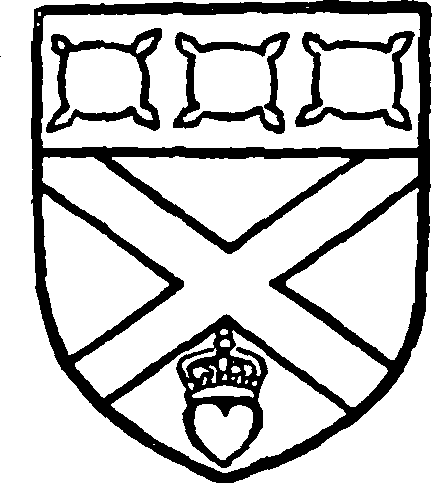
Johnstone, Baronet. Argent a saltire sable, on a chief gules three cushions or, in base a man's heart ensigned with an imperial crown proper.
The ruins of Radcliffe Tower stand about 200 yds. southwest of the church and inclosed within a farmyard. The house was of timber construction, and seems to have consisted of a main block standing east and west, with a west wing, which may have been an addition to the original building, and a stone tower at the east. No authentic record of the plan of the building, however, remains, the chief source of information concerning the structure being the description of it given by Whitaker in his History of Whalley, together with a view of the north or principal front of the hall made in 1781. (fn. 50) This latter shows a two-storied house of timber and plaster with gabled roofs of the usual type. The stone-built wing, or tower, then in a state of ruin, is the only part of the building now remaining. The rest of the house was allowed to fall into decay, and was taken down in the early part of the 19th century.
The position of Radcliffe Tower, like that of the church, is one naturally of defence, being built in the centre of a bend of the River Irwell. The ground within the bend is flat and low-lying, but the river itself, being on three sides of the house at a distance of only about quarter of a mile, would afford sufficient protection to account for the absence of a moat to the house. The present stone-built tower probably belongs to 1403, being erected in accordance with the licence recorded above, and had a contemporary timber building adjoining it on the west side. It is difficult to reconcile the provisions of the licence of 1403 with the existing remains, as it seems clear that there was no stone hall in connexion with this tower. Of the second tower nothing can be said, and if it was ever built, no trace or tradition of it remains.
The great hall, which was doubtless the building which left its roof-line on the ruined tower, occupied the east part of the main block, and according to Whitaker was 42 ft. 2 in. in length, and in one part 26 ft. and in another 28 ft. in width. (fn. 51) It had an open-timbered roof supported by two massive principals, which are described by Whitaker as the 'most curious specimens of carved oak work I have ever seen.' They appear to have been, however, of a not unusual type. At the east end of the hall was a door, which still remains, opening into the basement of the tower, and higher up in the wall another door, also still in existence, which led into the chamber above. At the west end of the hall were the kitchen and servants' apartments, and in Whitaker's time there were still to be seen 'the remains of a doorway opening into what was once a staircase, and leading to a large chamber above the kitchen, the approach to which beneath was by a door of massy oak pointed at the top. The kitchen and apartment above stood at right angles to the top of the hall, and are separated from it by a wall of oak work. The chamber is 38 ft. long by 18 ft. 5 in., and has two massy arches of oak without mouldings, but an oaken cornice mould like those in the hall, the floor of thick oaken planks.' On the south side of the hall were the remains of a square-headed window-frame in oak with Gothic tracery.
In 1833 the fabric, except the tower, was described as of 'brick inclosed in squares of wood, (fn. 52) and the large chamber above the kitchen had been converted into two rooms. The building was then supported by 'substantial buttresses'; but where such supports were wanting the walls had fallen. The great hall was then used as a hayloft and cowshed. The ancient timber framework had apparently by that time been filled in with brick, and the whole structure was in a state of ruin and dilapidation. It had been taken down before 1844, and the materials, described as 'chiefly beams and planks of solid black oak,' used for building purposes.
The stone tower, the bottom part of which is still standing, is 50ft. in length and 28 ft. in width. These measurements are external, the greater length being from north to south. The walls are 5 ft. thick all round above the plinth, which has a projection of 12 in. The tower was probably of two stories, with an embattled parapet; but the upper part has now almost entirely disappeared, only portions of the walls above the level of the first floor being still in situ, the rest having crumbled away in comparatively recent years. The walls being quite exposed to the weather at the top this process of gradual disintegration of the structure is likely to continue. The lower room of the tower was originally covered by a semicircular barrel vault, the springing of which at each side may still be seen. Some portion of this vault was standing as late as 1844, when Samuel Bamford, who visited the tower in that year, described it as hanging by a single stone, and 'unless it be protected from further wanton outrage must soon share the fate of the hall.' (fn. 53) The spring of the vault is about 5 ft. from the ground, which would make the height of the apartment about 15 ft. It was lit at each end by a window high up in the wall, and on the east side by two smaller windows nearer the ground. The entrance on the west side is through a pointed doorway, 4 ft. wide, the jambs and head of which have a continuous double chamfer. The chief feature of this lower room of the tower, however, consists of three large arched openings about 10 ft. in width, one at each end and the other in the middle of the east wall opposite the entrance. They have an inner and outer arch, 15 in. in thickness at the wall faces, with a space between of 2 ft. 6 in., from the centre of which a square flue is carried up in the thickness of the wall. The outer arch was built up on the outside, the plinth being carried across the blocking wall at the line of the springing, about 4 ft. 3 in. from the ground. From the evidence of the masonry this is part of the original work done at the time of building. The height to the top of the arch, which is pointed and built of voussoirs, is about 9 ft. It seems most reasonable to regard these openings as fireplaces, and that at the north end of the room is still in its original state. The other two have been opened out, and are now open archways, that in the south side forming the principal entrance to the tower, which is used for store purposes in connexion with the adjoining farm and roofed with wood. The east archway now gives access to a wooden shed built along that side of the tower. The north and south fireplaces are not in the middle of the end walls, but immediately against the west side of the building. The presence of three such fireplaces in so comparatively small an apartment would at first sight suggest that the room had been used as a kitchen, but this is unlikely if the tower were used, as it appears to have been, as the part of the house allotted to the family. The three square flues are still well preserved in the walls, the stones of that on the south side yet showing a calcined surface.
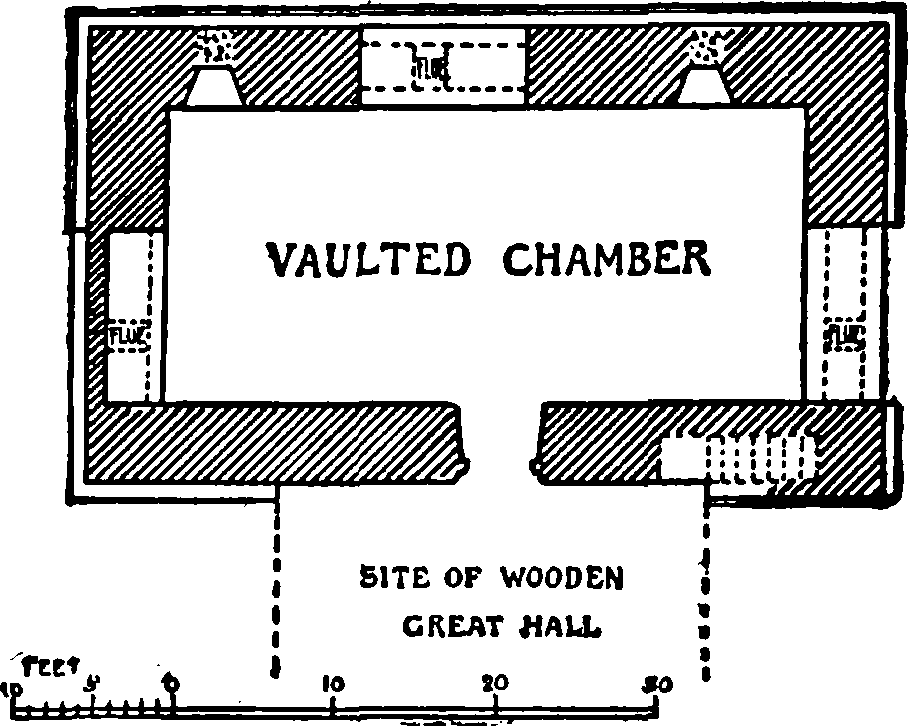
Plan of Radcliffe Tower
The room above was approached by a stone staircase in the thickness of the wall at the south end of the west wall, leading out of the great hall at a height of about 7 ft. 6 in. above the floor. The doorway to this staircase has a pointed head, and the wall is thickened to 6 ft. at this point to allow of room for the stairs. The steps are still in position, along with the sill of a small two-light window which lit the landing at their head. There is an ordinary fireplace opening on the first floor 7 ft. wide in the centre of the west wall.
The outer walls of the tower are constructed of heavy blocks of coursed stone on the north, south, and east sides, and for a distance of about 12 ft. on the north end of the west side. At this point the plinth stops, and the coursed masonry leaves off at the height of the sill of the doorway of the upper room. The point where the ashlar ceases marks the line of the front of the timber-built hall, the line of the roof of which may still be seen on the rough walling at the west side of the tower. On this side the centre portion of the wall yet stands nearly 30 ft. above the ground, though the end walls of the building are reduced to something like half that height. About midway in the height of the west wall, 15ft. 3 in. from the ground, and formerly the end wall of the great hall, is a projecting string-course, which stops at either end at the line of the ancient roof.
In 1592 the Earl of Derby sent certain widows, who were recusants, to prison in the tower, it being 'withinland and in the hundred where the people are well affected.' (fn. 54)
Junior branches of the local family occur from time to time. In 1357 Robert son of Adam de Radcliffe made a claim against Adam son of William de Radcliffe. (fn. 55)
Robert Radcliffe had messuages and lands in Radcliffe and Sharples in 1589, (fn. 56) and a further estate in the same places was the subject of agreement between James Radcliffe and Robert Radcliffe the elder in 1595. (fn. 57) The elder and younger Robert were freeholders in 1600. (fn. 58) It was probably the younger Robert who died in 1617, holding messuages in Radcliffe of Sir Richard Assheton in socage by 12d. rent, and having other property in Manchester and Salford. (fn. 59) Edward Radcliffe, the son and heir, was twelve years of age, and was living in 1665, when a pedigree was recorded—Radcliffe of Radcliffe Bridge. (fn. 60)
Alexander Radcliffe of Leigh, who recorded a pedigree at the same visitation, in 1680 purchased Edward Raddiffe's estate in Radcliffe, which his descendants continue to hold. (fn. 61) The land-tax return of 1788 shows that Mr. Radcliffe paid about a thirtieth of the tax. Lord Grey de Wilton paid nearly half. The rest of the land was in small holdings. (fn. 62)
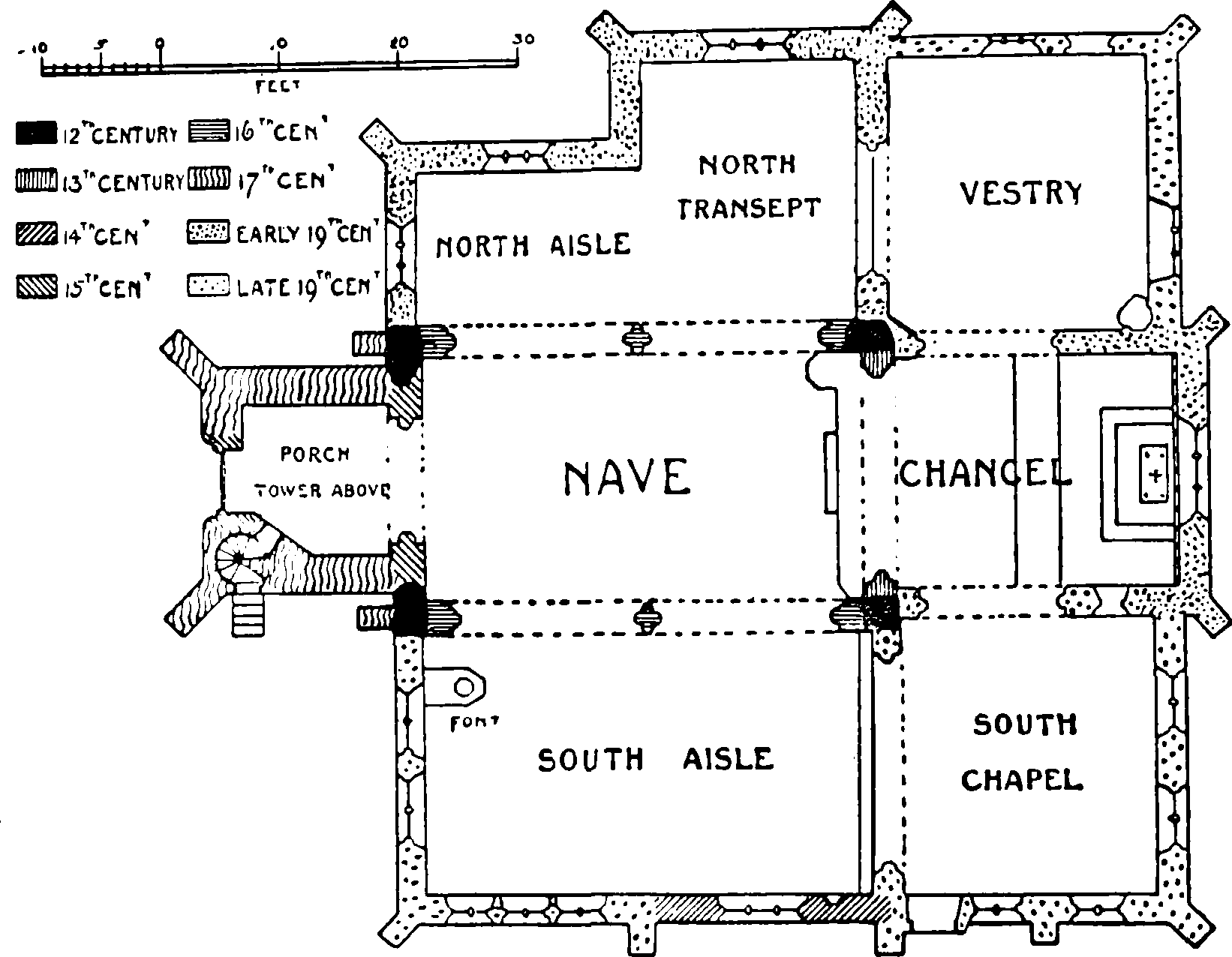
Plan of Radcliffe Church
A few other families occur from time to time— Openshaw, (fn. 63) Wroe, (fn. 64) and Hardman. (fn. 65) In 1688 the principal inhabitants were Gervase Staynrod, Henry Coulborne, John Allen, and Roger Walker. (fn. 66)
Land called Nickerhole in the south-west of the township was in the 16th century the subject of several disputes. (fn. 67)
An Inclosure Act for Radcliffe and Ainsworth was passed in 1809, and an award made in 1812. (fn. 68)
Church
The church of ST. BARTHOLOMEW (fn. 69) stands at the east side of the town in the centre of a bend of the River Irwell, the ground between which and the church on the south side still remains open as field and pasture. The building consists of chancel 23 ft. by 19 ft., with vestry on the north side and chapel on the south, each 22 ft. 6 in. by 21 ft.; nave 36 ft. by 20 ft., north and south transepts each 21 ft. 6 in. by 18 ft., north aisle 12 ft. 6 in. wide, south aisle 21 ft. wide, and western tower 12 ft. 6 in. by 12 ft. All these measurements are internal.
A great deal of alteration and rebuilding, done in the 19th century, has made the whole of the outside of the church, with the exception of the tower, of modern date; but it still preserves to a large extent its ancient appearance. The history of this later work may be thus summarized: In 1817 the chancel and vestry were rebuilt; in 1846 the north transept was reconstructed, an organ chamber built on the north side of the chancel, the south porch removed, and a west door opened out in the tower; in 1870–3 the building underwent a very thorough restoration, when the clearstory was taken down and rebuilt and a new roof constructed, the south aisle was enlarged, and a new chapel was added on the south of the chancel; in 1903 the north vestry was enlarged, the plaster stripped from the walls, and the interior refaced with Runcorn stone, the floor, which had been raised 19 in. in 1846, reduced to its original level, and the arches between the transepts and vestry and chapel reconstructed. Since then the outside wall of the south transept has been refaced in red sandstone and the tracery renewed. The exterior of the church is built of sandstone, with slated gabled roofs to all parts except the nave, the roof of which is of flat pitch and covered with lead. The clearstory, south aisle, and chapel are finished with square parapets, the north aisle, transept, and vestry having overhanging eaves.
The oldest details of the building are the piers supporting the chancel arch, which are of 13th-century date, but it is possible that the four angles of the nave may belong to an older church dating from the 12th century. The south wall of the south transept belongs to the 14th century, while the tower arch and west wall of the nave are probably a century later; the nave arcade is of 16th-century date, and the tower was rebuilt in 1665.
The original church may have been a rectangular 12thcentury building covering the area of the present nave, with a small square-ended chancel. In the 13th century a new chancel, of which the western arch still remains, was built round the former one, and in the 14th century transepts were added to the nave, their length suggesting that the nave may by this time have had aisles. A tower may have been built towards the end of the 14th or beginning of the 15th century against the end of the original nave. In the early years of the 16th century the present nave arcades of two bays, with the clearstory, were erected, and the tower, as before stated, having apparently become insecure, was rebuilt in 1665, many of the old stones being used.
The chancel has an east window of three lights with modern 14th-century tracery, and an open arch on the north and south sides to the organ chamber and the south chapel respectively. The chancel arch is of two plain chamfered orders with a label of 13thcentury masonry recently reset, and springs from half-round piers with a fillet on the face, the capitals of which have been renewed. The wall above the chancel arch is probably of 13th-century construction, and shows the line of the older roof, which strikes the side walls at the level of the crowns of the present nave arches.
The nave arcades are of two bays with pointed arches resting on responds, and central piers of 16thcentury date consisting of engaged clustered shafts with coarsely-moulded capitals and bases, the arch mouldings being composed of two rounds and a hollow. Over each arcade is a clearstory of squareheaded four-light windows, three on each side. The nave roof is modern, of flat pitch, but preserving the features of the older one. It consists of four principals, one against the tower wall, and one close to the chancel arch, with moulded ridge and wall pieces and intermediate ribs in the panels. The corbels carrying the roof have figures of eight prophets, and the four central bosses are carved with (1) a ship, (2) the five wounds, (3) a dove, and (4) a hand.
The north transept, which is entirely rebuilt, has a pointed window of three lights with curious tracery of flowing type with an external label. It is apparently original, or at any rate not of recent reproduction; but the jambs and head of the window have been restored. The transept has diagonal angle buttresses of two stages, with gabled heads. The north aisle has a modern three-light square-headed window on the north with net tracery, and a similar flatpointed window at the west end, also modern.
The south transept is now is open to the church for its full depth both on the east and west sides, but its south wall is of 14th-century date, and has a threelight pointed window with peculiar tracery into which two human heads are introduced. The whole of this wall has been refaced on the outside with red sandstone, and the window tracery renewed. On the interior the wall retains its ancient facing, and there is a 14th-century piscina in the south-east corner.
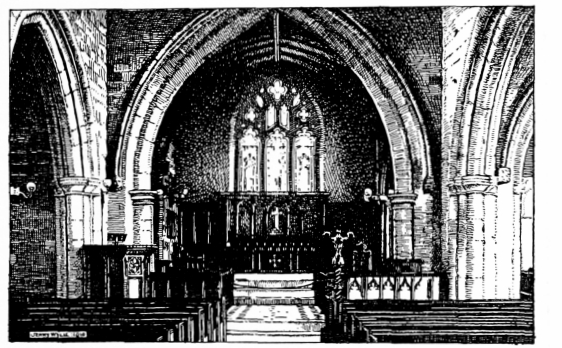
Radcliffe Church: Interior Looking East
The new south aisle replaces one about 10 ft. wide which was pulled down in the rebuilding of 1872, and had a south porch over its doorway. It is lighted at the west end by two two-light windows, and on the south side by three square-headed traceried windows of two lights each. Similar windows light the modern south chapel, and there is an external doorway at its south-west angle.
The tower, which has a vice in the south-west corner, was rebuilt in the 17th century, presumably carrying out more or less the style of the earlier tower. The internal arch is of 15th-century date, and consists of two plain chamfered orders, and the two-light west window appears to be old work retained in the rebuilding. Externally the tower has a rather stumpy appearance, and its three stages are unmarked by any horizontal line or string-course. It has diagonal buttresses of seven stages, with plain weatherings, and is finished with an embattled parapet with angle pinnacles, and a conical slated roof with a good 18thcentury vane. In the top stage on the north, west, and south sides are three-light windows. Over the west door is an ornamental panel with the date 1665, and the arms of Beswick (fn. 70) inscribed rector carolus beswicke. The north side has a two-light squareheaded window on the second stage, immediately above which is a stone inscribed edward ratcliffe 1665, and on the south side of the tower is a stone bearing the name of Sir Ralph Assheton with the same date. The clock-dials on the north and west sides dated 1786 were replaced in 1908. The putlog holes are a very conspicuous feature.
The fittings are all modern, but at the west end are two oak seats incorporating portions of the 17thcentury pulpit and reading desk. That on the south of the tower arch has five inlaid panels: (1) the date 1606 with the Assheton molet below, (2) the initials s. r. a. with the Assheton crest (a boar's head erased), (3) the Assheton molet with the letters L.S. P. R.W. (probably denoting Leonard Shaw and Robert Walkden, rectors during the 17th-century alterations), (4.) the initials I.I. with a molet between, and (5) the letters T.H. I.M. probably the initials of churchwardens. On the back of the seat on the north side are the initials R. C.B. and the date 1665, denoting Charles Beswick, rector, and the inscription, which probably ran along the upper part of the desk (now in two lines), 'All my words that I speak unto thee, receive into thine heart with thine ears. Ezekiel III Chap. 10 verse . . .' The font, which is early modern Gothic, has a canopy (dated 1858) raised by a chain pulley and cannon-ball weight. There is no ancient glass, but Baines, writing in 1833, notices in one of the north windows the arms of Radcliffe and the head of a queen. Another window on the north side had the head of a king, and one of the east windows had a boar's head in a shield, and in a window to the west was a painting of St. John the Evangelist with a chalice in his right hand and a palm in his left. (fn. 71) All this glass has now disappeared.
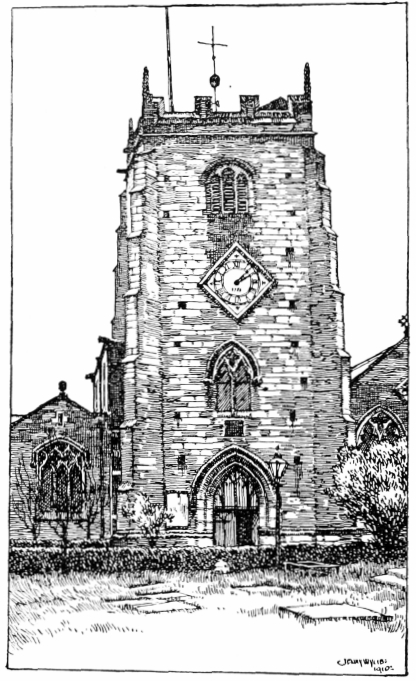
Radcliffe Church: From the West
Under the altar is an alabaster slab, now very much defaced, said to be that of James Radcliffe the builder of Radcliffe Tower, but probably that of the founder's grandson, the first of the line of Radcliffe of Langley. (fn. 72) The figures of a knight and lady with the heads of their children below can still be traced, and two shields in the upper part, but the inscription is illegible. The slab had been lost when Baines wrote in 1833, but was recovered in the restorations of 1870–3. One of the shields has the arms of Radcliffe, and the other is defaced, but is said to have had those of Langley. (fn. 73)
There are eight bells; six of these are by Rudhall, but were recast in 1861, and two more added. There is a tradition that they came from Middleton.
The plate consists of a chalice and flagon of 1754, with the maker's mark T.W.; and a Birmingham paten of 1898 and cruet of 1906. There is also a chalice similar in design to the first made by Oliver and Botsford of Manchester, and two silver-plated patens the gift of Anne Bealey, 1868.
The registers begin in 1559. (fn. 74) The tithe maps are kept in the vestry.
Advowson
The church existed in the 12th century, and is first mentioned in 1202, when William de Radcliffe, lord of the manor, secured from Roger de Middleton an acknowledgement of his right to present. (fn. 75) From this time the advowson appears to have descended with the manor. The only dispute recorded took place in 1514, when the feoffees of John Radcliffe were hindered in their right, probably because the wardship of the heir had been granted to Queen Katherine. (fn. 76)
The income being very small the benefice was omitted in the taxation of 1291, but fifty years later the value of the ninth of the sheaves, wool, &c., was returned as 33s. 4d. (fn. 77) In 1534 the gross value was found to be £21 2s. 4d., of which 2s. was paid to the archdeacon for synodals and procurations. (fn. 78) The Commonwealth Commissioners in 1650 found the income to be about £50 a year; in addition Colonel Assheton, lord of the manor and patron, had demesne lands worth £150 a year for which he paid no tithe. (fn. 79) At the beginning of the next century the value had risen to £90, of which more than a third was the rent of the glebe. (fn. 80) It is now £950 a year; (fn. 81) Sir Frederick Johnstone, by purchase from the Earl of Wilton, is at present the patron.
The following is a list of the rectors:—
| Institution | Name | Patron | Cause of Vacancy |
| c. 1240 | Robert (fn. 82) | — | — |
| oc. 1292 | John de Hulton (fn. 83) | — | — |
| 14 June 1310 | Richard de Radcliffe (fn. 84) | William de Radcliffe | d. J. de Hulton |
| 14 Jan. 1318–19 | Roger de Freckleton (fn. 85) | " " | exc. R. de Radcliffe |
| 18 May 1322 | Thomas de Clipston (fn. 86) | " " | d. R. de Freckleton |
| 21 Jan. 1363–4 | Robert de Newton (fn. 87) | Richard de Radcliffe | d. T. de Clipston |
| 1 Apr. 1367 | Alexander de Pilkington (fn. 88) | — | d. R. de Newton |
| 18 Feb. 1367–8 | Richard de Radcliffe (fn. 89) | Richard de Radcliffe | res. A. de Pilkington |
| oc. 1374 | Richard de Clipston (fn. 90) | — | — |
| — | John Fitheler (fn. 91) | — | — |
| 13 Nov. 1389 | Roger de Lache (fn. 92) | James de Radcliffe | exc. with J. Fitheler |
| 9 Mar. 1407–8. | Christopher Walker (fn. 93) | " " | d. R. de Lache |
| 31 Jan. 1437–8 | Richard Forth (fn. 94) | Richard Radcliffe | — |
| 23 May 1459 | Oliver Smethurst (fn. 95) | James Radcliffe | d. R. Forth |
| 6 Aug. 1481 | John Bendelouse (fn. 96) | John Radcliffe | res. O. Smethurst |
| 23 Feb. 1483–4 | Thomas Blakelowe (fn. 97) | " " | d. J. Bendelouse |
| 18 July 1486 | Hugh Radcliffe (fn. 98) | Richard Radcliffe | d. T. Blakelow |
| 7 Dec. 1496 | Roger Longworth (fn. 99) | " " | d. H. Radcliffe |
| ? 1514 | Richard Beswick (fn. 100) | — | — |
| 14 Nov. 1534 | Thomas Mawdsley (fn. 101) | Earl of Sussex | d. R. Beswick |
| 4 Apr. 1538 | Robert Ashton (fn. 102) | " " | res. T. Mawdsley |
| — 1559 | John Ashton (fn. 103) | — | — |
| 4 Feb. 1583–4 | Leonard Shaw (fn. 104) | Richard Assheton | d. Joh. Ashton |
| 24 May 1624 | Robert Walkden (fn. 105) | Robert Holt, &c. | d. Leon. Shaw |
| 4 Feb. 1637–8 | Peter Shaw, (fn. 106) M.A | Ralph Assheton | d. R. Walkden |
| c. 1644 | Thomas Pyke, (fn. 107) B.A | " " | — |
| 27 Oct. 1662. | Charles Beswick (fn. 108) | Sir Ralph Assheton | exp. T. Pyke |
| 8 June 1698 | Charles Pinkney, (fn. 109) B.A. | " " | d. C. Beswick |
| 23 Jan. 1698–9 | Roger Dale (fn. 110) | " " | depr. C. Pinkney |
| 5 Oct. 1716. | Edward King, (fn. 111) M.A. | " " | d. Roger Dale |
| 18 Mar. 1719 | Henry Lister, (fn. 112) M.A | " " | d. E. King |
| 14 July 1724. | William Lawson, (fn. 113) B.A. | " " | d. H. Lister |
| 6 Apr. 1757 | Richard Assheton, (fn. 114) M.A. | " " | d. W. Lawson |
| 15 Oct. 1757 | Richard Wroe (Walton), (fn. 115) M.A. | " " | res. R. Assheton |
| 1 Oct. 1784 | Thomas Foxley, (fn. 116) M.A. | Lord Grey de Wilton | res. R. Wroe Walt |
| 1 Feb. 1839 | Nathaniel Milne, (fn. 117) M.A. | Earl of Wilton | d. T. Foxley |
| —1867 | Henry Arthur Starkie, (fn. 118) M.A. | " " | res. N. Milne |
| 26 June 1896 | Stanley Swinburne, (fn. 119) M.A. | " " | res. H. A. Starkie |
As the benefice was of small value and the people few, it is probable that even before the Reformation the clerical staff consisted of the rector and his curate only. (fn. 120) There was no endowed chantry. Little is known of the rectors, but some of them may have been pluralists. The church does not seem to have been very well furnished in 1552. (fn. 121) About this time the rectors of Radcliffe were also rectors of Middleton, (fn. 122) but there seems usually to have been a resident curate. The later resident rectors seem to have managed without a curate. (fn. 123) As at Middleton a new rector, a Protestant, appears in 1559, but the reason is not ascertained. (fn. 124) The later history has been uneventful, with the exception of the Commonwealth period; at the beginning of this the rector, Peter Shaw, disappeared; at the end of it his successor, Thomas Pyke, was ejected.
There was a school of some kind in the 17th century, for the schoolmasters are mentioned. (fn. 125)
During the last century a number of places of worship were erected to accommodate the increasing population. For the Established worship St. Thomas's, Radcliffe Bridge, was built in 1819 and rebuilt in 1864, (fn. 126) and St. Andrew's, Black Lane, in 1877; (fn. 127) the patronage of the first is now vested, like that of the parish church, in Sir F. Johnstone, and that of the second in the rector of Radcliffe.
The Wesleyans, (fn. 128) Primitive Methodists, and Methodist New Connexion have chapels. The Congregationalists have a chapel, built in 1872. (fn. 129) The Baptist chapel dates from 1880.
The Society of Friends has a meeting-place, erected in 1892. (fn. 130)
The Roman Catholic church of St. Mary and St. Philip Neri was built in 1894. (fn. 131)
Charities
The principal charity is that founded by James Walsh Howarth in 1886; he bequeathed £3,000, partly for church purposes, but as to half for the benefit of the poor. (fn. 132) The poor also receive £7 from the benefaction of John Guest, (fn. 133) and the highways have 15s. from a quarry allotment. (fn. 134) Some older gifts have been lost. (fn. 135)