A History of the County of Lancaster: Volume 5. Originally published by Victoria County History, London, 1911.
This free content was digitised by double rekeying. All rights reserved.
'The parish of Prestwich with Oldham: Pilkington', in A History of the County of Lancaster: Volume 5, ed. William Farrer, J Brownbill (London, 1911), British History Online https://www.british-history.ac.uk/vch/lancs/vol5/pp88-92 [accessed 30 April 2025].
'The parish of Prestwich with Oldham: Pilkington', in A History of the County of Lancaster: Volume 5. Edited by William Farrer, J Brownbill (London, 1911), British History Online, accessed April 30, 2025, https://www.british-history.ac.uk/vch/lancs/vol5/pp88-92.
"The parish of Prestwich with Oldham: Pilkington". A History of the County of Lancaster: Volume 5. Ed. William Farrer, J Brownbill (London, 1911), British History Online. Web. 30 April 2025. https://www.british-history.ac.uk/vch/lancs/vol5/pp88-92.
In this section
PILKINGTON
Pilkiton, Pilkinton, Pulkinton, 1200; Pilketon, 1221; Pilkinton, Pynkelton, Pynkilnton, 1277; Pilkington, 1282. The forms with and without the g are common from this time.
This township is bounded on two sides, the southwest and north, by the River Irwell, which makes an acute bend at the western corner, and its tributary the Roch; on the north-east the Whittle Brook, running into the latter stream, cuts it off from Pilsworth and Heap. The southern boundary is formed by the high land towards Heaton, and the clough towards Prestwich. The highest ground is near the centre, a ridge about a mile from east to west reaching the 400-ft. level. The township measures about 4 miles by 2, and has an area of 5,469 acres. (fn. 1) The population in 1901 was 15,578, including 324 in the area added to Unsworth.
For a long time there were three recognized divisions, or hamlets, in the township—Unsworth (fn. 2) in the east, Whitefield in the centre, and Outwood in the west. Unsworth village lay in the centre of its division on the higher ground between two brooks running north to Whittle Brook and to the Roch. The hamlets of Hollins and Blackford Bridge are near the Roch. Whitefield, also centrally placed, has grown into a town, stretching along the high road from Besses o' th' Barn (fn. 3) on the south to the Irwell. To the north-west is a suburb of Radcliffe, at the bridge over the Irwell. To the south of these, on the highest ground, is the hamlet of Stand, with Pilkington and Stand Halls. Outwood still has the park on the border of Prestwich and a number of wooded doughs. At the west end are Cinder Hill, part of Ringley—the other part being across the river, in Kearsley—and Prestolee. (fn. 4)
The principal road is that from Manchester to Bury. Two branches of it unite at the southern border, and go north through Thatchleach, Besses o' th' Barn, Four Lane Ends, and Whitefield. Here the road divides again; one branch goes north to Bury, crossing the Irk at Wackford Bridge, and another goes north-west to Radcliffe Bridge. From Whitefield also roads branch off north-east to Unsworth,south-west to the Irwell, and west to Stand and Ringley, where there are bridges over the Irwell. The Lancashire and Yorkshire Company's Manchester, Raddiffe, and Bury Railway passes north and north-west through the centre, with a station at Whitefield, opened in 1879. (fn. 5) The same company's branch from Clifton to Radcliffe and Bury winds west and north through Outwood, with stations called Molyneux Brow and Ringley Road. The Manchester and Bolton Canal also passes through Outwood, crossing the Irwell from Clifton, keeping close to the river most of the way, and crossing it again near Prestolee.
A dragon story is told of Unsworth. (fn. 6)
Pilkington has since 1894 ceased to exist as a township. Whitefield, the central portion, which obtained a local board in 1866, (fn. 7) has been in part added to Radcliffe; a new township has been made on the south-west called Outwood, while Unsworth has given its name to a township on the other side, made up of the old Unsworth and Pilsworth, with the detached part of Heap which adjoined it. (fn. 8) The new townships are governed by parish councils.
In 1666 there were as many as 245 hearths liable to be taxed. The three hamlets showed the following:—Outwood, 70 hearths, no house having six hearths; Whitefield 135, Margaret Sergeant's house having eight; and Unsworth 40, no house having six hearths. (fn. 9)
The view from Stand Hall was thus described in 1806:—'The large town of Manchester spreads along the valley in front of the house at some miles distance, and the less one of Bury is seen distinctly to the left, surrounded by villages, with simple cottages dispersed along the plain. The hills of Lancashire, Derbyshire, Cheshire, and Yorkshire rising in succession, spread in a vast amphitheatre, till lost in the immensity of space; while the rugged tops of the Welsh mountains, which I gazed upon as old friends, hide their heads in the clouds, of which they seem to form a part. . . . The neighbourhood abounds with families of immense wealth, and reminds me of what Clapham Common is to London. The villas of the gentry are handsome, and their pleasure grounds are tastefully laid out. The rich woods and green park of Heaton House, the seat of the Earl of Wilton, appear from the terrace of Stand Hall to much advantage; but the most prominent feature in this landscape is the pretty church of Prestwich. (fn. 10)
Stand Hall, a large timber and plaster house, was taken down in 1835, and a new house built. (fn. 11) A large wooden barn belonging to the old house has been the subject of much attention because of an absurd theory that it was built of the timbers of a wooden predecessor of the present Cathedral church of Manchester.
Manor
The manor of PILKINGTON was held of the lords of Manchester by the fourth part of a knight's fee, (fn. 12) by a family which took the local name, and its dependence on Manchester continued, at least in name, till the 18th century. (fn. 13) The first of the local family known is Alexander de Pilkington, who appears about 1200 as contributing to the tallage; (fn. 14) he held the manor in 1212, (fn. 15) and was living in 1231. (fn. 16) He was followed by Roger de Pilkington, presumably his son. Roger was defendant in 1221, (fn. 17) and held the manor in 1242. (fn. 18) Alexander de Pilkington, who, it is reasonably conjectured, increased the family possessions by his marriage with Alice, sister and co-heir of Sir Geoffrey de Chetham, lord of Chectham and Crompton, (fn. 19) occurs between 1260 and 1290 as witness to charters; (fn. 20) he was the tenant of the manor in 1282. (fn. 21) His son Roger (fn. 22) succeeded, and obtained from the king a grant of free warren in Pilkington and his other manors in 1291; (fn. 23) a year before he had had a grant of £100 for his services in Gascony. (fn. 24) In other ways Roger took his part in the public affairs of the time, serving as knight of the shire in 1316. (fn. 25) He sided with the Earl of Lancaster, and after the battle of Boroughbridge was imprisoned and fined, dying shortly afterwards. (fn. 26)
In 1312 he had made a settlement of his manors of Pilkington and Cheetham in favour of his son Roger, with remainder to a younger son William. (fn. 27) Roger accordingly succeeded his father; (fn. 28) but little is known of him except his marriage with Alice, sister and heir of Henry de Bury, by which the important manor of Bury was acquired by the family. (fn. 29) He died about 1347, (fn. 30) being followed by his son, the third Roger in succession. The new lord, who was made a knight before 1365, attended John of Gaunt on the expedition to France in 1359; (fn. 31) he served as knight of the shire in six Parliaments between 1363 and 1384. (fn. 32) He died in 1407, holding the manor of Pilkington of the lord of Manchester by knight's service. His son and heir, Sir John, was thirty-four years of age. (fn. 33)
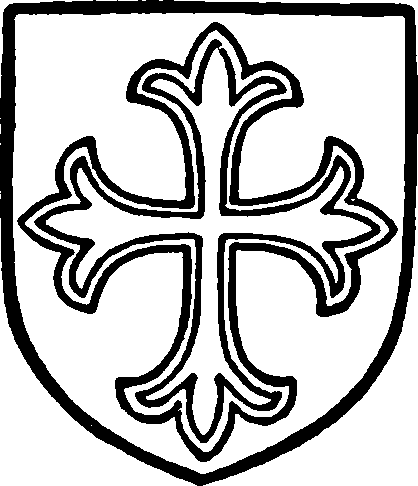
Pilkington. Argent a cross patonce voided gules.
Sir John de Pilkington, whose age must have been understated (fn. 34) at the inquisition just quoted, is first heard of as marrying Margaret, widow of Hugh de Bradshagh, and heiress of Sir John de Verdon; she was a ward of the duke, and her husband procured a pardon in 1383 for having married her without permission. (fn. 35) He was one of those who were appointed to attend the king in the Scottish expedition of 1400. (fn. 36) In 1413 he obtained a confirmation of the grant of free warren in Pilkington and other manors. (fn. 37) He was one of the Lancashire knights who fought at Agincourt, (fn. 38) and he continued to serve in the French wars, (fn. 39) dying early in 1421. His son and heir, Sir John, was then twenty-eight years of age. (fn. 40)
The younger Sir John also fought in the French wars. (fn. 41) He was knight of the shire in 1416, and in 1418, as a reward for his services, he was made escheator in Ireland; (fn. 42) this office was confirmed to him in 1423. (fn. 43) He died without issue in 1451, and his honours descended to Thomas, son of Edmund Pilkington. (fn. 44) The elder Sir John and Margaret his wife had a son Edmund, on whom the manor of Stagenhoe in Hertfordshire was settled in 1399 for his life; (fn. 45) Thomas was no doubt the son of this Edmund, who was living in 1438. (fn. 46) Thomas Pilkington enjoyed the favour of Edward IV; in 1469 he obtained licence to fortify his manor-house at Bury, (fn. 47) and was several times sheriff of the county. (fn. 48) He was made a knight of the Bath in 1475, and a banneret at the capture of Berwick in 1481. (fn. 49) As a zealous adherent of Richard III he fought on his side at Bosworth; (fn. 50) was attainted by the victorious Henry, and his confiscated manors in Lancashire were given to the newlycreated Earl of Derby. (fn. 51) Sir Thomas Pilkington does not seem to have become reconciled at once to the new king, for in 1487 he fought at Stoke for Lambert Simnel. (fn. 52) His son and heir Roger contrived to obtain or retain the manors of Brisingham and Clipston; (fn. 53) he left six daughters as co-heirs. (fn. 54)
Pilkington, as already stated, was granted in 1489 to Thomas Stanley, Earl of Derby, (fn. 55) and has descended with the title in the same manner as Knowsley to the present earl. (fn. 56) No courts are held, but 'suit and service' at the manor court still exist in name.
In 1541 there were no freeholders in the township contributing to the subsidy, but in 1622 Thomas Lever and Richard Fogg contributed. (fn. 57) Thomas Heape, a leaseholder under the Earl of Derby, compounded for his estate in Pilkington in 1649, his 'delinquency' being that he had borne arms against the Parliament. (fn. 58)
Though Unsworth gave a surname to a family which occurs in various other places, it does not seem to have had any prominent residents of that name. The estate of Rhodes (fn. 59) was held by the families of Foxe and Holland as heirs of Parr. (fn. 60) The families of Barlow, (fn. 61) Crompton, (fn. 62) Molyneux, (fn. 63) Seddon, (fn. 64) Sergeant, (fn. 65) Walworth, (fn. 66) and Wroe (fn. 67) occur in the 16th and 17th centuries.
The land tax returns of 1786 show the principal proprietors to have been:—In Whitefield, the Earl of Derby, the executor of Geoffrey Richardson, Benjamin Blinkhorn, and Richard Walker; in Outwood, — Smith, Mrs. Watson, — Tomkinson, James Fields, Egerton Cross; and in Unsworth, Thomas Butterworth Bayley, Thomas Chadwick, and Richard Meadowcroft. (fn. 68)
Philips Park, on the border of Prestwich, derives its name from Robert Philips, who bought it about 1800. (fn. 69)
Digging for coals in Pilkington is mentioned in 1599. (fn. 70)
Nathan Walworth, a native of Ringley in Outwood, built the chapel of St. Saviour in 1625, (fn. 71) in conjunction with his Puritan friends in the neighbourhood. It was consecrated in 1634, (fn. 72) and rebuilt in 1824. The patronage, by the founder's desire, is vested in the rectors of Prestwich, Bury, and Middleton, or the majority of them. The present church of St. Saviour was built in 1851, and consecrated in 1854. Holy Trinity Church, Prestolee, was built in 1863, and had a district assigned to it in 1883; (fn. 73) the Lord Chancellor presents. St. George's, Unsworth, was built in 1730, and rebuilt in 1843; the rector of Prestwich is patron. (fn. 74) All Saints', Stand, was built in 1826; Sir Frederick Johnstone is patron at present. (fn. 75) St. John the Evangelist's, Stand Lane, built in 1866, has also a small mission church; the patronage is vested in three trustees.
In addition to the chapel Nathan Walworth also founded a school at Ringley in 1626. (fn. 76)
There are Wesleyan chapels at Radcliffe Bridge and Unsworth—the former dating from 1815—and a Primitive Methodist one at Chapel Field.
The Congregational Church at Stand represents a division in the old Presbyterian congregation caused by opposition to the newly introduced Unitarian doctrine. The first chapel was built in 1791. It was demolished in 1885, and the present ornate church built; being on rising ground the spire can be seen for some distance. (fn. 77) There is another church at Besses o' th' Barn.
At the same place is a Swedenborgian Church called New Jerusalem.
The Unitarian chapel at Stand is said to owe its origin to a congregation formed after 1662 by Mr. Pyke of Radcliffe, and other ejected clergy. (fn. 78) After the toleration of Nonconformity Robert Eaton, who had been rector of Walton on the Hill till 1660, was registered as preaching in William Walker's barn at Pilkington; (fn. 79) and a chapel was built for him in 1693. (fn. 80) As in other cases the teaching became Unitarian towards the end of the 18th century. The building was restored in 1818, and a bell tower was added in 1867; the bell is dated 1709. (fn. 81) There is a school in connexion with it.