
A History of the County of Lancaster: Volume 5. Originally published by Victoria County History, London, 1911.
This free content was digitised by double rekeying. All rights reserved.
, 'The parish of Middleton', in A History of the County of Lancaster: Volume 5, (London, 1911) pp. 151-161. British History Online https://www.british-history.ac.uk/vch/lancs/vol5/pp151-161 [accessed 18 May 2024].
. "The parish of Middleton", in A History of the County of Lancaster: Volume 5, (London, 1911) 151-161. British History Online, accessed May 18, 2024, https://www.british-history.ac.uk/vch/lancs/vol5/pp151-161.
. "The parish of Middleton", A History of the County of Lancaster: Volume 5, (London, 1911). 151-161. British History Online. Web. 18 May 2024, https://www.british-history.ac.uk/vch/lancs/vol5/pp151-161.
In this section
MIDDLETON
Middleton; Pilsworth; Hopwood; Thornham; Birtle-With-Bamford; Ashworth; Ainsworth; Great Lever
This parish, originally a single manor, comprises 1 2,101 acres, and in addition to the central portion— Middleton proper, with Pilsworth, Hopwood, and Thornham—has a number of outlying portions, some distant several miles from the parish church. Great Lever, one of these detached parts, though like the others a 'hamlet' of Middleton, appears to have had an independent history, and was perhaps early added to Middleton to compensate for the loss of Radcliffe. The history of the parish is that of the lords of the manor until recent times, when coal-mining and manufactures have caused great changes. Formerly a large part of the area was moorland, and considerable portions are still used as pasture lands.
The 'hamlets' appear to have become 'townships' in the 18 th century. (fn. 1)
In 1624 the parish was assessed to the county lay as a single township, paying £5 16s. when Salford Hundred contributed £100. (fn. 2) In consequence of disputes, the proportions to be borne by the several hamlets had been agreed upon in 1590. (fn. 3) To the fifteenth Middleton contributed £2 out of £41 14s. 4d. paid by the hundred. (fn. 4)
Several distinguished men have sprung from the parish—Cardinal Langley, William Holt the Jesuit, Thomas Jones, Archbishop of Dublin, Ralph Assheton the Parliamentary leader in the county; William Assheton and Charles Burton, (fn. 5) divines; and Samuel Bamford. Sir Ralph Assheton, who acquired the manor with his wife, may also be mentioned, as also his descendant, Sir Richard, who fought at Flodden. In religious and political matters the people seem to have gone with the times, embracing Protestantism without reluctance and siding with the Parliament in the Civil War, though the lord of Ashworth and one of his tenants suffered for taking the other side. In more recent times the people became strongly Radical, as in other places where there was a large manufacturing population. Luddite riots occurred in 1812. Middleton gives a name to one of the parliamentary divisions of the county.
The following is the apportionment of agricultural land in the parish: Arable land, 1,394 acres; permanent grass, 5,060; woods and plantations, 142. The details are given thus:—
| Arable acres | Grass acres | Woods, &c. acres | |
| Middleton | 99 | 54 | — |
| Middleton | 604 | 777 | — |
| Middleton | 506 | 909 | 50 |
| Birtle-with-Bamford | 28 | 1,164 | 62 |
| Ashworth | 17 | 815 | 28 |
| Great Lever | — | 321 | — |
| Ainsworth | 140 | 1,020 | 2 |
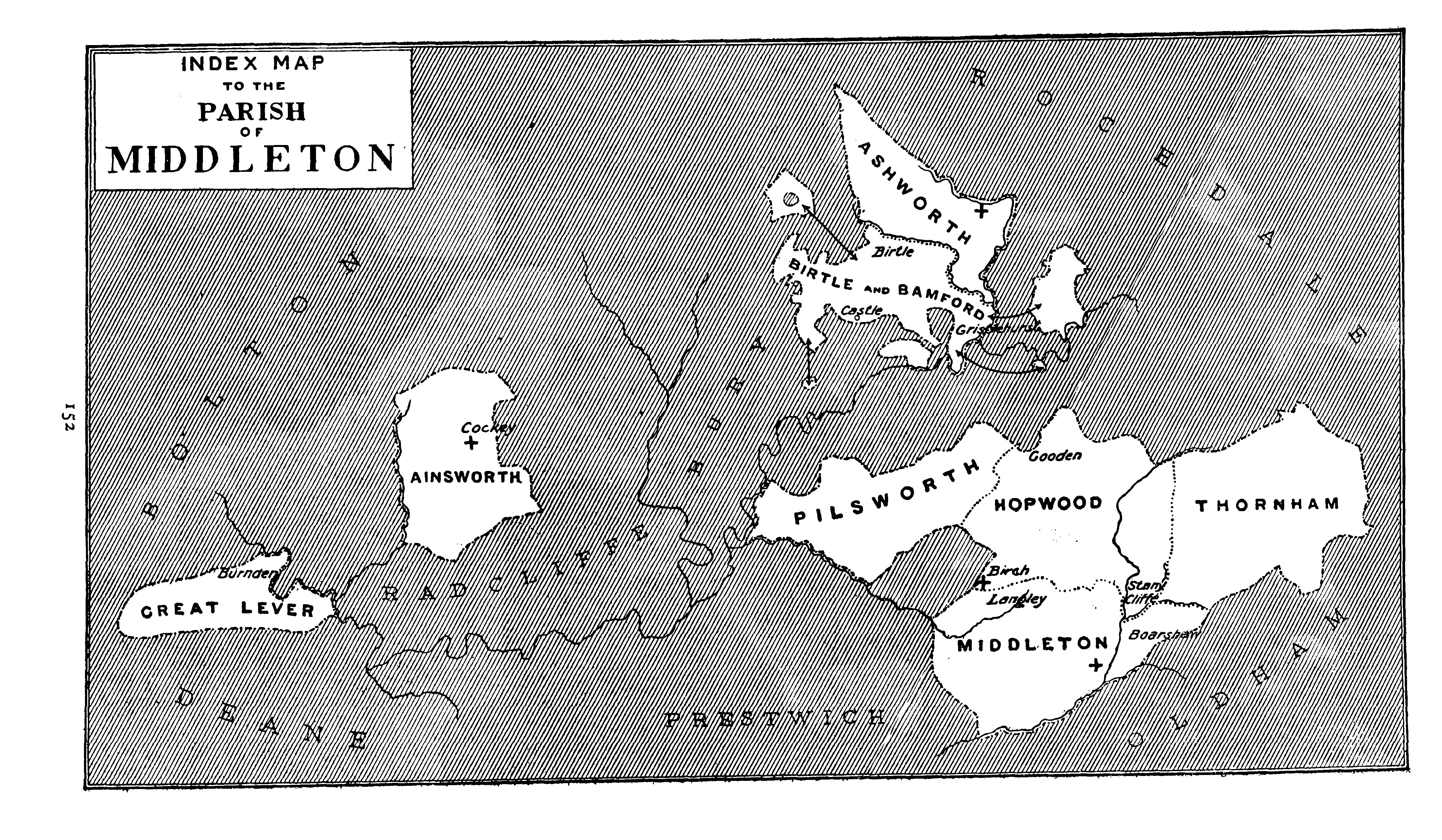
INDEX MAP of the PARISH of MIDDLETON
The Lower Coal Measures or Gannister Beds underlie the greater part of the parish, but a broad belt of the Coal Measures occurs from Heywood to Middleton, overlying the greater part of the townships of Middleton and Hopwood, whilst other areas are found at Bamford and over the eastern half of the township of Thornham.
Church
The church of ST. LEONARD (fn. 6) stands in a commanding position on the north side of the town, on high ground overlooking the valley of the Irk. It consists of chancel, with north and south chapels and south vestry, nave with north and south aisles, south porch and west tower. There is no structural division between the nave and chancel, the nave taking up the first five bays from the west, and the quire seats occupying the sixth. The sixth bay is inclosed by screens on the north and south, and a line of screens runs across the church on its west side. The east part of the chancel projects 16 ft. 6 in. in front of the line of the chapels and is lighted by a modern window of five lights, and by north and south windows of three and two lights respectively.
The greater part of the church was rebuilt in the 16th century, but there are remains of much older work, and the tower dates from the beginning of the 15th century. The earliest part is the tower arch, which is built up of 12thcentury masonry belonging to a former building. Other fragments of 12th-century masonry have also been used up in the later rebuilding. Of the extent of the 12th-century church no evidence remains, but its nave was most likely about 40 ft. long by 18 ft. wide, covering approximately the space occupied by the three western bays of the nave before its extension northward. This church appears to have stood till the beginning of the 15th century, when Thomas Langley, Bishop of Durham, pulled it down and built an entirely new structure 'of well hewn stone, with a roof of wondrous beauty. (fn. 7)
The new building was consecrated 22 August 1412, but the only part of it which can with any certainty be said to remain is the tower. The extent of Langley's church can only be surmised, but he seems to have retained the width of the 12th-century nave, lengthening it eastward and adding, or perhaps only rebuilding, the north and south aisles. Its plan is, however, only a matter of conjecture; it may be suggested that the nave was of about the length of the four existing western bays, and that the chancel was continued some 30 ft. eastward. The door now called Langley's door at the south-east end of the south aisle appears to be of older date than the rest of that part of the building, but it is very doubtful whether it is in its original position.
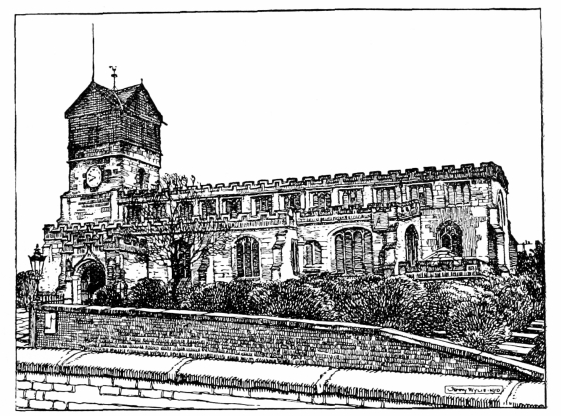
Middleton Church
Langley's work seems to have stood little more than a hundred years, for the greater part of the present building dates from 1524, when Richard Assheton reconstructed it, setting up the present nave arcades and clearstories, and the north and south aisles. The line of Langley's south arcade was retained, and the south aisle widened to its present extent; but the north arcade was pushed 5 ft. to the north, giving a nave 24 ft. 6 in. in width, and throwing the tower out of the centre. (fn. 8) The chancel now assumed its present shape, though its north wall was probably solid, being pierced with an arch at a later date, when the socalled rector's chapel (now the organ chamber) was built. The Assheton Chapel on the south side was founded at this time, though the fact that its east wall does not bond with that of the chancel suggests its having been an addition, or that this wall was rebuilt at a later time. The north chapel, by the evidence of its windows, as well as of the straight joint in the pier north of the chapel, which was evidently originally a respond, appears to be of later date than the north aisle, probably of the first half of the 17th century. To a later date than 1524, too, must be assigned the south-east vestry, which is below the level of the floor of the church, probably to avoid blocking the windows of the chancel and south chapel. The vestry walls, for which the ground had apparently to be lowered, are not bonded with those of the main building, and though their exterior detail is similar to that of the north aisle, they seem to be later work.
West and side galleries were erected at the end of the 18th century, (fn. 9) that on the south side being carried over the Assheton Chapel, but these were taken down in the restoration of 1868, when the church was reseated and a doorway, which formerly existed in the north wall of the tower, was built up. (fn. 10)
There were extensive alterations and restorations in 1846–7 and 1868–9.

Plan of Middleton Church
The walls of the building are constructed of rather rough masonry, except those of the tower, which still retain the more finely wrought work of Langley's time. The walls of both aisles and clearstories are embattled, and the roofs are covered with lead. The aisles have lean-to roofs, those of the north being of flatter pitch than the south, and the external detail of the north side of the building is generally plainer and poorer than that of the south, which has an elaborately panelled and moulded embattled parapet to the aisle. On the middle of the parapet of the south aisle is the inscription: ric. assheton et anna uxo. ei. anno d'ni movoxxiii,' and at its east end are two stones with inscriptions, the upper one of which is uncertain, and the lower has the initials SBB STD.
The chancel, 24 ft. 6 in. by 30 ft., preserves none of its ancient ritual arrangements. The east wall above the window sill was rebuilt in 1847, and the present five-light window substituted for a late window of seven lights with transoms, but no tracery. The window on the north has three trefoiled lights under a three-centred arch, and is the original 16thcentury one; that on the south side, which contains the 'Flodden' glass, is of two lights, and belongs to 1847. A doorway on the south side to the vestry was blocked up in 1872, and the entrance removed to the east end of the Assheton Chapel. The west half of the chancel has an arch north and south to the two chapels, that on the north, as already mentioned, being apparently a later extension eastward when the chapel was built or reconstructed. The north chapel is now used as an organ chamber, but was formerly known as the Rector's or Langley's Chapel, presumably from the fact that the altar of the Virgin and St. Cuthbert, endowed by Langley, was on this side of the nave. There is nothing to show, however, that a separate chapel existed on the present site before the existing one was erected. The east window is of five and the north window of four uncusped lights under three-centred heads. The windows to the Assheton Chapel have a similar number of uncusped lights, that on the south being under a segmental head, while the two-light window at the east end of the south aisle, together with the window over the 'Langley door,' are of similar plain detail. All the other windows to the north and south aisles have four-centred arched heads and cusped lights. There is a descent of seven steps from the Assheton Chapel to the south-east vestry, and the oak door is probably the original one brought from its old position on the south side of the chancel. There is what appears to be the remains of a piscina at the east end of the south wall of the Assheton Chapel under the window, about 3 ft. 3 in. from the floor. The vestry is lighted by a two-light window on its east and south sides, and a recess in the north wall shows the position of the original doorway.
The nave is 24 ft. 6 in. by 70 ft. in length, and has an arcade of five bays with octagonal piers and pointed arches of two plain chamfered orders. The capitals and bases are coarsely moulded, and the eastern arch on the north side has a line of 12th-century billet ornament in its outer order, a piece of detail from the former church. There is nothing to show why this particular arch should have been thus distinguished. The arcade is continued one bay eastward into the chancel, and the eastern pier on each side, between the chancel and the nave, has a cable-moulded necking which slightly distinguishes it from the others. The clearstory runs the whole length of nave and chancel, and has twelve uncusped three-light square-headed windows on each side. The roof to nave and chancel is of flat pitch with brackets carried down the wall resting on corbels between the clearstory windows, and is a modern restoration of the original oak roof of the 16th-century church. The weathering of a former roof remains in the east wall of the west tower, showing the centre line of Langley's nave. Above, on the south side, is a door which formerly led from the upper stage of the tower to the roof. The tower arch is pointed, but is constructed, as before stated, of 12th-century masonry, probably dating from about 1140. It is now of two orders, sitting rather awkwardly on the three shafts below, the inner order being plain, but the outer one made up of stones carved with cheverons with an outer ring of variously ornamented stones. The arch rests on three 12th-century shafts at either side with moulded capitals and bases, raised some height above the floor in the rebuilding. Of the six capitals five are of the scalloped type with cable-moulding under; the sixth is an ornamented variety of the cushion capital. The abaci are of different patterns, but the square billet ornament is much used.
The north aisle is 14 ft. wide, and has a narrow pointed door with moulded jambs and head and external label opposite the second bay from the west, with a three-light window to each of the other bays, and one at the west end which is entirely new, with three cinquefoiled lights under a pointed head. At the east end of the north wall, between the third and fourth windows from the west, is a recess in the wall 2 ft. 2 in. deep and 6 ft. 6 in. wide under a fourcentred arched head 4 ft. high, and raised above the floor 13 in., containing a coffin slab with a foliated incised cross. Above the recess is the indent of a small brass of a hooded female with inscription under. There is nothing to indicate whom the brass commemorated or whether it has any connexion with the recess underneath, but the latter is popularly styled the ' founder's tomb,' and there is a tradition that the original north aisle was built by Maud Middleton early in the 14th century, and that she was buried under the north wall. It is possible that the incised slab marked her burial-place, and that in the rebuilding of 1524 the recess was made to contain it, and a brass placed above to commemorate the lady whose remains it formerly covered. (fn. 11) There is also a plain corbel above the recess about 7 ft. from the floor.
The south aisle is 21 ft. 6 in. wide, but narrows to 15 ft. 6 in., the width of the Assheton Chapel, near its east end. It has three three-light windows in the south wall, in two of which the mullions have been renewed, and one at the west end. The east end of the wider part is occupied by the Hopwood Chapel or pew, which has a two-light window in the east wall, and is inclosed by a Jacobean oak screen with twisted balusters along the top. The pew is 10 ft. 6 in. by 12 ft. 6 in. and has four linen pattern panels inserted at its north-east corner. The walls on the east and south are likewise panelled, hiding a piscina at the south-east. There is a moulded bracket on the east wall 8 ft. from the floor. At the east end of the south aisle is the 'Langley door,' which has a squareshouldered lintel and a two-light window over. The door itself is ancient and nail-studded, and the masonry, as before stated, is older than that on either side of it, though the evidence of the head and jambs suggests that it has been moved. The east wall of the south aisle, however, does not bond with that containing the doorway, and it is just possible that the latter is part of the 15th-century church in its original position. It is to be noted that the south wall of the Assheton Chapel sets back 3 in. on the inside at a height of 6 ft. above the floor.
The south porch projects 11 ft. 6 in. in front of the aisle wall opposite the second bay from the west, and has a low pointed outer arch with ogee crocketed label over, flanked by canopied niches. Like the rest of the building it has an embattled parapet, and the whole of its south face has been elaborately panelled, though the detail is now much worn away and its beauty lost. Over the entrance are the initials A RA, seeming to imply that it is the work of Richard and Ann Assheton. There are also two shields, one of which shows the Assheton molet, but the other is defaced. The porch is an open one with seats on each side, and the inner doorway has a four-centred moulded arch and retains its old nail-studded door with wicket and wooden draw-bar.
The tower is 10 ft. 6 in. square inside, and is of three stages with diagonal buttresses and a vice in the south-west corner. The west window of the ground story is of two cinquefoiled lights with tracery over, and above this is a window of two trefoiled lights with a quatrefoil in the head. The jambs of both are old, but the mullions and tracery have been renewed. The upper stage of the tower contains a clock with faces on the north, south, and west sides, above which is a string-course crowned with an embattled parapet. The north and south sides of the tower are plain, but there are slits to light the vice in the south-west corner on both faces. In 1709 a further story was added in the shape of a wooden belfry stage with a roof gabled on all four sides, giving a curious and not very attractive finish to the tower. The original outside oak boarding, having decayed, has been replaced by pitch pine.
The rood screen, though damaged in the 18th century and probably also by repairs in the early part of the 19th century (c. 1835–44), is a good example of 15th-century work. The whole was repaired in 1898, when the rood was set up over it. It has a wide central opening with double doors,and four openings on each side, with traceried heads, and above are modern canopies with richly carved cornice and cresting. The lower part is filled with panels with carved shields on which are displayed in bad heraldry the arms of the Asshetons and their alliances. (fn. 12) The screen formerly extended across the full width of the church, but the parts in front of the two chapels appear to have been demolished when the galleries were erected. These have now been replaced by modern screens in character with the older work. The screen between the chancel and the north chapel (organ chamber) is ancient, and has nine openings with traceried heads and a four-centred arched doorway at the west end with carved spandrels. The cornice is carved with the vine trail, but the cresting is broken and mutilated. The screen opposite, between the chancel and Assheton Chapel, is modern and very plain, but retains a little old work in a leafpattern cornice on the chancel side.
There are four old stalls at each side of the chancel door, the misericordes being very simply carved with leaves, and in the quire are six old bench-ends—three on each side, now used as ends to the quire stalls. Otherwise all the fittings, including the font, pulpit, and seating, are modern. The font is at the west end of the south aisle, and was plain till 1846, when it was carved as at present. There is an old oak almsbox at the east end of the north aisle.
There are several brasses to the Asshetons within the altar rails, the most interesting being that of Sir Ralph Assheton and his wife Margery (Barton) with seven sons and six daughters, and a shield of Assheton quartering Barton. There is no inscription, but the details point to a date at the end of the 15th century. Other brasses are those of Edmund Assheton, rector, 1522, Richard Assheton, 1618, and Ralph Assheton, 1650, the Parliamentary General (his monument was removed from the Assheton Chapel in 1889), his sister Alice and her three husbands. (fn. 13)
The east window of the Assheton Chapel contains some fragments of 16th-century glass in the outer lights, including a shield in the west light (1 and 4 now blank, probably Assheton; 2 and 3 Middleton quartering Barton); and in the south light a fragment with the heads of a bishop and a priest. The three middle lights have each three shields of modern glass with the arms of various families connected with Middleton Church. (fn. 14) There is a fragment of ancient glass in the middle window of the south aisle, but the most interesting glass in the church is that known as the Flodden window on the south side of the chancel. Up to 1846–7 this glass was in a three-light window in the north aisle, but was at that time removed to its present position, suffering a good deal in the process. 'It contains the figures of some of the principal persons of Middleton and neighbourhood who accompanied Sir Richard Assheton to Flodden, and represents first himself and his lady in scarlet, in long garments, with an attendant squire in blue, his chaplain also in blue kneeling before an altar, and seventeen bowmen . . . also in blue with long hair, and the name of each man originally placed over each figure.' (fn. 15) In many parts the window is little better than a patchwork of mutilated fragments. The figures of the archers are fairly recognizable, but Sir Richard and Lady Ann are so broken up and mixed with other parts that it is difficult to trace them. (fn. 16) Most of the names can still be read,but some have become obliterated. The following can be read: Henricus Taylyer, Richard Kylw—, Hughe Chetham, James Gerrarde, John Pylkyngton, Philipe Werburton, William [Ste] le, John Scolefede, Wylliam—, James Taylier, Roger Blomeley, Crystofer Smythe, Henry Whitaker, Robart Prestwyche, Richard Bexwicke. The archers stretch across the upper portion of the two lights, and Sir Richard and other figures are below. These no doubt were originally in a third light, but of the exact disposition of the parts there is unfortunately no record. (fn. 17) In 1786 Philip de la Motte visited the church and made an engraving of part of the window, (fn. 18) which has preserved the names of the archers and the dedicatory inscription as it was in the latter half of the 18 th century. The inscription, which has since been transposed, is given thus: 'Orate pro bono statu Richardi Assheton et eorum qui hanc fenestra[m] fieri fecerunt quoru[m] no[m]ina et imagines ut supra ostenduntur anno d[omin]i mcccccv.' (fn. 19)
There is an interesting description of this window
in a poem called Iter Lancastrense written by the Rev.
Richard James, of Corpus Christi College, Oxford, in
1636:—
Now go we to ye church of Middleton
To find out there summe glorye of our owne.
At chardge of those good men, whoe went out far
In suite of our brave Ashton to the warre.
There stands à painted windowe, where I weene
The showe of their departure may be seene:
The Lord and Ladye first in skarlett; then
One neere attending of ye chiefest men;
Their garments long, his short and bliew, behinde
The chaplaine of ye warfare you may finde
In robe of ye same colour, for to say
Before an altar praiers of ye daye
On bended knees; him follow neighbours bould
Whoe doe bent bowes on their left shoulders hould,
Their girdle sheaft with arrowes; as the squire
So are they all, court mantells in attire
Of blewe; like Greeks in Trojan warre, their haire
In curles long dangling makes ye semblance faire
And sterne; each hath his name, and people tell
That on ye same lands now their children dwell
As yet so called. (fn. 20)
In 1869, during the restoration, a stone coffin containing human remains was found in the north side of the nave in the third bay from the west. (fn. 21) Part of a stone altar slab was formerly preserved in the church, but has now disappeared. (fn. 22)
In the Assheton Chapel are preserved a crested helmet, sword, banner, and three spurs, popularly associated with Sir Richard Assheton, the soldier of Flodden. The crest (boar's head) and banner were probably carried at the funeral of Sir Ralph Assheton in 1765, and afterwards deposited here. The banner was cleaned in 1895, and the arms of Assheton impaling Copley, together with the Ulster red hand, were disclosed, proving it to be not earlier than 1739. It is now inclosed between two sheets of glass. (fn. 23)
There is a ring of eight bells. Six were cast by Abraham Rudhall of Gloucester in 1714, and two were added in 1891, by Mears & Stainbank. (fn. 24)
The plate is all modern, and consists of two chalices, a paten, and an almsdish of 1843, and a paten of 1842. There is also a silver-plated flagon. The ancient plate (seven pieces) was stolen from the vestry in 1784.
The registers begin in 1541, (fn. 25) and the churchwardens' accounts in 1647. (fn. 26)
At the east end of the south aisle wall is a wooden sundial with the date 1788 and motto 'Lose no time.'
The churchyard is principally on the north and south sides of the building, with gates at the northwest and south-west. It is paved with gravestones laid flat. The modern graveyard or cemetery lies to the south of the church, separated from it by a road.
Advowson
The patronage has always been an appurtenance of the manor of Middleton. The church is mentioned early in the 13th century. (fn. 27) In 1291 the value of the rectory was given as £13 6s. 8d., (fn. 28) but fifty years later the ninth of sheaves, wool, &c., was worth only £4. 8s. 10d., for which Middleton answered. (fn. 29) About 1534 the income was estimated at £37 0s. 8d., to which the tithes of grain contributed £20. (fn. 30) The parsonage house and glebe were estimated as worth £40 a year in 1650, when the tithes and prescription rents amounted to £188 12s. 4d.; besides this Ralph Assheton, the squire and patron, had 300 acres of demesne lands on which he had never paid tithes. (fn. 31) Bishop Gastrell records that it was certified as worth about £250 a year, early in the 18th century. (fn. 32) The value is now £950. (fn. 33)
The former rectory was in 1840 described as 'a large and ancient structure, supported in part by buttresses; at a comparatively recent period it was surrounded by a moat with a drawbridge and a wooden bridge-house; part of the moat is perceptible, and in some walls loopholes for the discharge of arrows are visible. There was formerly much stained glass in the room called the Hall, and there is a very curious specimen of a carved oak. screen.' (fn. 34)
The following is a list of the rectors:—
| Instituted. | Name | Patron | Cause of Vacancy |
| c. 1180 | ?Adam (fn. 35) | — | — |
| oc. 1202 | ? Thomas (fn. 36) | — | — |
| c. 1230 | Peter (fn. 37) | — | — |
| — 1297 | John de Middleton (fn. 38) | Roger de Middleton | — |
| 21 July 1328 | Thomas de Newbold (fn. 39) | Agnes de Barton | d. J. de Middleton |
| 23 Dec. 1339 | Richard de Downton (fn. 40) | Agnes de Middleton | d. T. de Newbold |
| 8 Oct. 1340 | Robert de Radcliffe (fn. 41) | " | d. R. de Downton |
| 15 Oct. 1343 | Richard de Beckingham (fn. 42) | " | res. R. de. Radcliffe |
| 3 Dec. 1348 | Richard de Blythe (fn. 43) | — | exc. R. de Beckingham |
| 19 Feb. 1350–1 | Richard de Cudworth (fn. 44) | Bishop of Lichfield | — |
| 3 June 1351 | William de Langley (fn. 45) | Duke of Lancaster | res. R. de Cudworth |
| 29 Aug. 1386 | William de Preston (fn. 46) | Ralph de Barton | d. W. de Langley |
| 16 June 1390 | William de Ferriby (fn. 47) | Ralph de Barton | res. W. de Preston |
| 3 Apr. 1395 | Robert Collan (fn. 48) | Ralph de Barton | d. William |
| 14 Apr. 1402 | Robert de Hopwood (fn. 49) | The King | d. R. Collan |
| —1462 | John Barton (fn. 50) | Richard Barton | — |
| c. 1492 | Mr. Edmund Ashton (fn. 51) | — | d. J. Barton |
| ? 1522 | Mr. John Claydon (fn. 52) | — | — |
| 23 Feb. 1540–1 | Robert Assheton (fn. 53) | Edmund Hopwood | d. J. Claydon |
| — 1559 | John Assheton (fn. 54) | — | res. R. Assheton |
| 13 Jan. 1584–5 | Edward Assheton (fn. 55) | Will. Assheton | d. J. Assheton |
| 10 Oct. 1614. | |||
| 24 July 1618 | Abdie Assheton, B. D. (fn. 56) | Robt. Holt, &c. | d. E. Assheton |
| 10 Jan. 1633–4 | William Assheton (fn. 57) | Ralph Assheton | d. A. Assheton |
| — 1659 | ? Thomas Johnson, M.A. (fn. 58) | — | d. W. Assheton |
| 8 Nov. 1662 | Robert Simmonds (fn. 59) | Sir Ra. Assheton | — |
| 15 June 1682 | Richard Warburton, M.A. (fn. 60) | Sir Ra. Assheton | d. R. Simmonds |
| 16 Sept. 1701 | Henry Newcome, M.A. (fn. 61) | Sir Ra. Assheton | d. R. Warburton |
| 26 Mar. 1714 | Samuel Sidebottom, M.A. (fn. 62) | The Queen | d. H. Newcome |
| 17 July 1752 | Francis Pigot, M.A. | Sir Ra. Assheton | d. S. Sidebottom |
| 26 July 1757 | Richard Assheton, D.D. (fn. 63) | Sir Ra. Assheton | d. F. Pigot |
| 20 Jan. 1801 | Robert Walker | Lord Suffield | d. R. Assheton |
| 16 Mar. 1818 | John Haughton, M.A. | " | d. R. Walker |
| 30 Jan. 1829 | James Archer (fn. 64) | " | d. J. Haughton |
| 21 July 1832 | Charles John Way, M.A. (fn. 65) | " | d. J. Archer |
| 1 July 1835 | Richard Durnford, M.A. (fn. 66) | " | res. C. J. Way |
| 9 Aug. 1870 | Waldegrave Brewster, M.A. (fn. 67) | The Crown | prom. Bp. Durnford |
| 16 Oct. 1888 | Thomas Ebenezer Cleworth, M.A. (fn. 68) | A. Butterworth | d. W. Brewster |
| 2 July 1909 | Robert Catterall | " | d. T. E. Cleworth |
Before the Reformation the scattered parish was served by the rector, chantry priests, and some six or seven others. (fn. 69) The church appears to have been fairly well furnished, possessing an organ and 'regal.' (fn. 70) The visitation list of 1548, however, contains only five names beside the rector's, one of them being that of Thomas Mawdesley, who apparently remained there as schoolmaster, though decrepit, till his death. Two of the others reappear in 1554, with two more names; in 1562 there are still six names, but Mawdesley's is the only one of the old clergy; three years later the rector, newly appointed in 1559, was at Durham, his curate was in charge, and Mawdesley's and one other name appear. (fn. 71) After this time it is probable that the rector and one curate constituted the clerical staff, service being maintained at Cockey or Ainsworth Chapel, and perhaps at Ashworth also. (fn. 72) Bishop Bridgeman about 1630 built a domestic chapel at Great Lever, which appears to have been used by the neighbouring people for a time. (fn. 73) The Commonwealth surveyors of 1650 recommended a division of the parish and the building of new churches at Thornham and Pilsworth; (fn. 74) but nothing seems to have been done, and it was not till recent times that any new districts were formed.
There was an endowed chantry in the church— that of St. Mary and St. Cuthbert, founded in the north or 'Rector's Chapel' by Thomas Langley, CardinalBishop of Durham, for a priest to celebrate for the souls of the kings of England, the bishop and his family, and to keep a grammar school free for poor children. At the confiscation the incumbent was celebrating and teaching according to his foundation, the endowment amounting to £6 clear. (fn. 75) Another chantry chapel—that of St. Chad and St. Margaret, on the south side of the chancel—had no endowment, but is supposed to have been built by the lords of the manor, who subsequently used it as their own. (fn. 76)
The grammar school appears to have been coeval with the Langley chantry, 1412; it was continued after the Reformation, and re-endowed by an old pupil, Alexander Nowell, Dean of St. Paul's, in 1572. (fn. 77) The schoolhouse built after the re-endowment still stands, and is of the usual type, with a schoolroom in the middle in one story, lighted by large five-light mullioned and transomed windows, and living-rooms in two stories at either end. The roof is of low pitch, and covered with stone slates without parapets or copings, but on each gable-end is a small finial. The walling is of stone rubble, with wrought stone quoins and window dressings, and the windows are all square-headed with chamfered mullions, and labels formed by the weathered string-courses which run round the building.
Charities
In addition to the school the parish possesses several charities (fn. 78) applicable generally for the relief of the poor and for apprenticing children. (fn. 79) The township of Middleton has some benefactions for the poor, (fn. 80) and in conjunction with Thornham shares in the widows' gown charity. (fn. 81) Thornham has an educational fund, (fn. 82) and Ainsworth a small sum for the poor. (fn. 83) Some benefactions have been lost. (fn. 84)
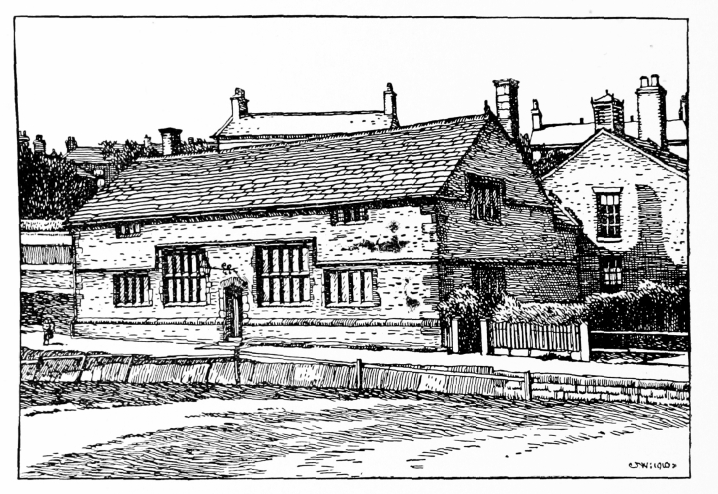
Middleton: The Grammar School