A History of the County of Lancaster: Volume 5. Originally published by Victoria County History, London, 1911.
This free content was digitised by double rekeying. All rights reserved.
'The parish of Rochdale', in A History of the County of Lancaster: Volume 5, ed. William Farrer, J Brownbill (London, 1911), British History Online https://www.british-history.ac.uk/vch/lancs/vol5/pp187-201 [accessed 30 April 2025].
'The parish of Rochdale', in A History of the County of Lancaster: Volume 5. Edited by William Farrer, J Brownbill (London, 1911), British History Online, accessed April 30, 2025, https://www.british-history.ac.uk/vch/lancs/vol5/pp187-201.
"The parish of Rochdale". A History of the County of Lancaster: Volume 5. Ed. William Farrer, J Brownbill (London, 1911), British History Online. Web. 30 April 2025. https://www.british-history.ac.uk/vch/lancs/vol5/pp187-201.
In this section
ROCHDALE
Castleton; Spotland; Butterworth; Hundersfield:—; Wuerdle and Wardle; Wardleworth; Blatchinworth and Calderbrook; Todmorden; and Walsden.
Recedham, Dom. Bk. ; Rachedale, 1242.
Excluding the large chapelry of Saddleworth, which lies entirely in Yorkshire, the parish of Rochdale has an area of 41,828½ acres, lying in a compact area, measuring 10½ miles from north to south, and 9 miles from east to west. (fn. 1) The high moorlands in the north and east are cloven by many streams, descending mainly to the south and west, among them being the Roch, (fn. 2) from which the parish takes its name. This stream rises near the Yorkshire border, and flows south-west to join the Irwell at Radcliffe. It is joined near the town of Rochdale by the Beal from the east and the Spodden Brook from the north.
The ancient divisions or townships of the parish were Castleton (in which also stood the parish church), Spotland, Butterworth, and Hundersfield. (fn. 3) Their boundaries were, speaking roughly, lines drawn to the four points of the compass from a point to the north of the church. Afterwards Hundersfield was parted into four townships; while in recent years the ancient divisions have been almost entirely obliterated, for the township of Rochdale has been formed in the south, Todmorden has, for administrative purposes, been taken into Yorkshire, and part of Brandwood into Bacup; the remainder of the parish is divided into the modern townships of Milnrow, Littleborough, Wardle, Whitworth, and Norden. (fn. 4)
The population of the part of Rochdale within the administrative county in 1901, comprising 32,532 acres, numbered 120,433; the districts separately were as follows:—Castleton, 40,699; Spotland, 19,137; Wardleworth, 20,272; Whitworth and Wardle, 20,918; Littleborough, 11,166; Milnrow, 8,017.
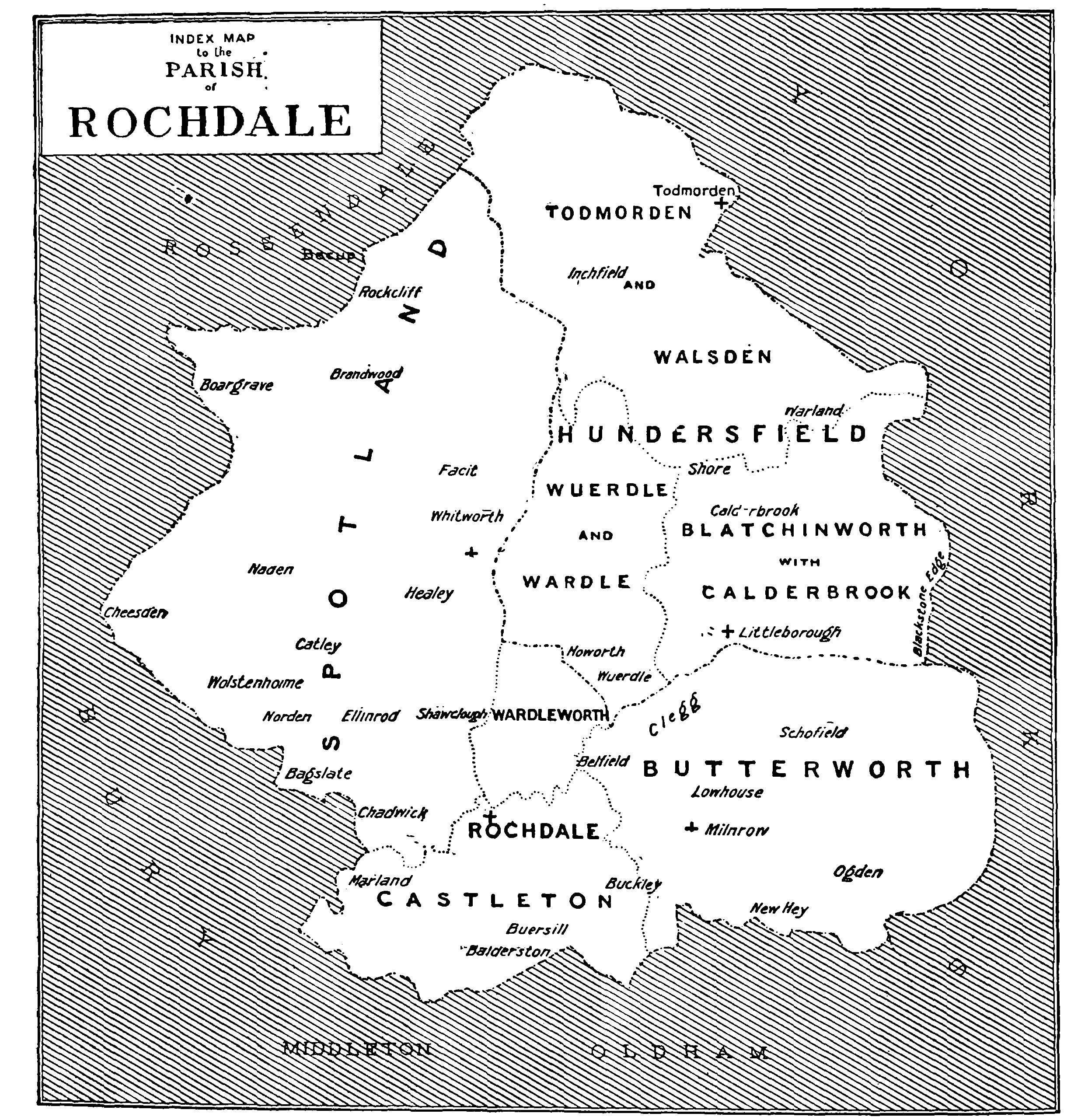
INDEX MAP to the PARISH of ROCHDALE
Various prehistoric remains have been found, chiefly in the hills; a Roman road over Blackstone Edge is still visible, and part of a silver statue of Victory, coins, &c, have been found. (fn. 5) The whole parish appears to have been a single lordship in 1066; the date at which Saddleworth (fn. 6) was separated from Lancashire does not appear; the Lacys added it to their forest. There seems to have been only one manor properly so called, but the Holts of Stubley once held a share of the inferior manor, and were the principal resident family. A considerable part of the land was held by the abbey of Whalley and other ecclesiastical bodies. Thus numerous minor families sprang up, generally ranking as yeomen, each hamlet or farm almost affording a surname, (fn. 7) and the history of the district during the mediaeval period was comparatively uneventful.
The 16th century introduced a great change. Rochdale was one of the towns in which the aulnager was to have a resident deputy, according to the Act of 1565. Camden in 1582 described it as 'a market town well frequented.' (fn. 8) Manufacturing and mining industries became important; (fn. 9) the confiscation of the Whalley lands and the general suppression of religious houses produced a new race of landlords, whose number was increased by the sale of Byron estates in the early part of the 17th century. (fn. 10) About that time also many wastes appear to have been inclosed. For the old tax called the fifteenth, the townships paid thus:—Castleton, 15s. 8d.; Spotland, £1 17s.; Butterworth, £1 1s.; and Hundersfield £1 12s. 4d., or £5 6s. for the parish —when the hundred of Salford had to contribute £41 14s. 4d. in all. (fn. 11) The county lay, fixed in 1624, provided that Castleton should pay £1 9s., Spotland and Butterworth each £2 18s., and Hundersfield £4 7s.—£11 12s. in all—when the hundred paid £100. (fn. 12)
The Protestation of 1641—2 was signed by nearly 2,100 inhabitants, 'none refusing.' (fn. 13)
In addition to those who recorded pedigrees in 1664–5 it appears that Joshua and Thomas Buckley and Edward Leigh were summoned. (fn. 14)
During the Civil War the people of Rochdale were generally on the side of the Parliament, (fn. 15) as might be expected in a Puritan district. A number of the gentry and others joined the king, but they seem to have made peace with the Parliament early. (fn. 16) The passage from Yorkshire was guarded, by the care of Colonel Rosworm, by a small force which could call upon a garrison at Rochdale; (fn. 17) but there was no fighting within the parish. Since that time its history is a history of the growth of its trade; (fn. 18) the invasion of 1745 did not touch it. A volunteer force was raised in 1794 on account of the war with France. (fn. 19)
Some notion of the importance of the parish may be gleaned from the hearth-tax returns of 1666. In Rochdale and Wardleworth there were 228 hearths liable; the largest houses were those of James Brearley (perhaps an inn), with ten hearths; James Scofield, nine ; Gabriel Gartside and Sarah Leach, seven each; Edward Lee, Robert Stringer, John Hamer, Joshua Stansfeld, Judy Roades, Edmund Holme, and Joseph Dearden, six each. In Spotland, nearer side, were 156 hearths; James Chadwick with seven, Ellis Haslam and Thomas Baskerville with six each, had the largest houses. In Spotland, further side, were 150 hearths taxable, but no house had as many as six. In Wuerdle, Wardle, and Blatchinworth were 199 hearths; the largest houses being those of Robert Holt, with eleven hearths; Alexander Kershaw, Mary Scholfield, and Samuel Hamer, eight each; and James Halliwell, six. In Todmorden and Walsden were 94 hearths in houses with less than six hearths. In Butterworth freehold side, 120 hearths were taxed; Alexander Butterworth's house had fourteen and Samuel Newbold's nine, but no other had more than five ; in the lordship side were 101 hearths, no house having as many as six. In Castleton were 219 hearths; Robert Holt had fifteen, Henry Pigot (the vicar), and Grace Harper seven each, and Matthew Hollas six. (fn. 20) The total for the parish was 1,267 hearths.
Celia Fiennes, writing about 1700, after describing the crossing of Blackstone Edge, from which she surveyed the country below, 'as a fruitful valley, full of enclosures and cut hedges and trees,' proceeds: 'From the foot of this Blackstone I went to Rochdale, four miles; a pretty neat town, built all of stone. Here I went to an acquaintance's house (Mr. Taylor) and was civilly entertained. Here is a good large meetingplace well filled; these parts religion does better flourish than in places where they have better advantages.' (fn. 21) Defoe about 1724 described Rochdale as 'a good market town, and of late much improved in the woollen manufacture, as are also the villages in its neighbourhood.' (fn. 22)
The first stage coach to Manchester began to run in 1790. The canal to Sowerby Bridge was opened in 1788, and the continuation to Manchester in 1804. (fn. 23) The Manchester and Leeds Railway was opened in 1838.
Rochdale led the way in co-operative trading, the Equitable Pioneers' Society having been founded in 1844. (fn. 24)
The woollen trade has long been the staple industry ; coatings, baize, flannel, friezes, and carpets being manufactured. Calicoes also are made, as well as silk plush and velvet. There are foundries and machine works. This applies chiefly to the town of Rochdale, and in a smaller degree to Littleborough and Todmorden; but cotton and woollen factories are spread all over the parish, the numerous watercourses having been utilized by manufacturers. Stone is obtained at Blackstone Edge, and Spotland contains extensive quarries of flags and freestone; there are collieries in Spotland, Butterworth, and near Littleborough, and chemical works at Walsden.
The following is the present apportionment of the agricultural land:—Arable land, 484 acres; permanent grass, 14,896; woods and plantations, 135. Details are as follows:—
| Arable | Grass | Woods, &c. | |
|---|---|---|---|
| acres | acres | acres | |
| Castleton | 352 | 1,527 | 8 |
| Milnrow | 12 | 2,966 | 1 |
| Littleborough | 6 | 2,929 | 80 |
| Wardle | 22 | 1,883 | — |
| Norden | 28 | 2,122 | 9 |
| Whitworth | 4 | 1,767 | 8 |
| Rochdale | 60 | 1,702 | 29 |
The Lower Coal Measures extend over the southern and central portions of the parish, with some patches of the Middle Coal Measures around the town of Rochdale. In the eastern and western portions large areas of the Millstone Grit Series protrude through the Lower Coal Measures.
Some of the Byrons, lords of the manor, attained distinction, and among the later vicars there have been noteworthy men, but the most conspicuous of the natives of the parish is John Bright, the famous Radical orator. He was born, in 1811, at Greenbank near Rochdale, where his father had a mill; entered Parliament in 1843, was a leader of the AntiCorn Law League, became President of the Board of Trade in 1868, and held other offices. He died at his residence, One Ash, near Rochdale, on 27 March 1889. (fn. 25) His younger brother, Jacob Bright, also took part in public affairs; he died in 1899. (fn. 26)
Roger Brerely or Brierley, founder of the 17thcentury sect of Grindletonians, is believed to have been a Rochdale man. He died at Burnley in 1637. (fn. 27) The Lancashire poet, Edwin Waugh, who wrote poems in the local dialect remarkable both for humour and pathos, 1817–90, is another celebrity. William Nuttall, d. 1840, wrote Rochdale, a fragment. (fn. 28)
'Tim Bobbin' lived at Milnrow, and the 'Whitworth doctors' were famous a century ago. Canon Raines of Milnrow was a distinguished antiquary.
The date of the rush-bearing was the third Sunday in August at Rochdale. (fn. 29) A custom of going to Knoll Hill or Blackstone Edge on the first Sunday in May used to prevail. (fn. 30)
A club, supposed to have been Jacobite, met at Rochdale from 1712 onwards, and called itself the 'Honourable Corporation of Rochdale.' (fn. 31)
Several tradesmen's tokens were issued at Rochdale and Milnrow in the 17th century. (fn. 32)
The first printer known was Mark Nield, 1796. (fn. 33) The first theatre was a little earlier. (fn. 34)
Two newspapers are now printed at Rochdale: Observer, 1856, and Times, appearing twice weekly. (fn. 35) A weekly paper, the News, is published at Littleborough, and three appear at Todmorden—Advertiser, News, and Herald.
Knoll Hill, Brown Wardle, Blackstone Edge, and other hill-tops formerly had beacons. (fn. 36)
The stocks at Rochdale used to be just outside the churchyard ; on the post are cut the letters W. W. and 1666. (fn. 37)
Manor
In 1066 ROCHDALE was held by Gamel, one of the twenty-one thegns of Salford Hundred, who was free of all customs except six; his holding was assessed as 2 hides or 12 plough-lands. (fn. 38) A reduction was afterwards made in this to 8 plough-lands. Before 1212 the whole manor had been given to the lord of Clitheroe and was held by Roger de Lacy. (fn. 39) It descended like Clitheroe, (fn. 40) and thus came to the Earls and Dukes of Lancaster and finally to the Crown. (fn. 41) Charles I, in 1625, sold the manor to trustees for the Earl of Holderness, (fn. 42) who immediately afterwards sold it to Sir Robert Heath, Attorney-General; (fn. 43) and Sir Robert first mortgaged and then sold it to Sir John Byron in 1638. (fn. 44) In this family it remained (fn. 45) until in 1823 Lord Byron the poet sold it to James Dearden, (fn. 46) whose grandson, Mr. James Griffith-Dearden, is the present lord of the manor. (fn. 47) Manor courts are still held at Whitsuntide. (fn. 48)
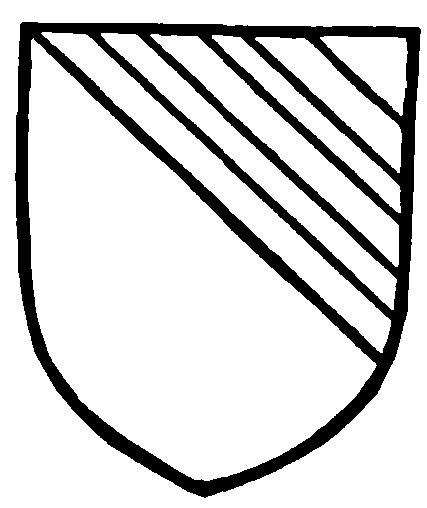
Byron. Argent three bendlets enhanced gules.
There appears to have been no manor-house in Rochdale, the house so called, a red-brick building of no architectural distinction, on the north side of the river opposite the town hall, being rightly styled the Orchard. (fn. 49) This house was described as a new building in 1702, and was the residence of the Deardens before they purchased the manor.
Of more interest was the structure known as the Great House, or Amen Corner, (fn. 50) a stone building (fn. 51) which stood a little to the east of the Orchard, but was pulled down in 1910 for street improvements. At the time of its demolition it was probably the oldest house in Rochdale, though in a very dilapidated state, and quite surrounded by modern buildings. It was of two stories and had a frontage facing west of about 45 ft., with a large projecting central bay window going up both stories with six mullioned and transomed lights in front and two lights on the returns on each floor. In the 17th century the Great House stood in a large garden which sloped down to the river. An account of the house is extant as it stood in 1692, at which time it was already let in several portions, one consisting of 'the porch, the body of the house, the kitchen, the brewhouse, the buttery, the little parlour, the great parlour, the staircase, the great chamber over the house, and the chamber over the little parlour,' together with 'a place to lay coals in' and 'a garden of eight falls.' A second portion contained 'three chambers in the Great House'; two other chambers formed a third, and the rest of the rooms a fourth. (fn. 52) It is clear, therefore, that the house was originally of some size, and that the building remaining in 1910 was but a fragment.
From the survey of 1212 it appears that the manor was held by a number of under-tenants. Hugh de Eland held 3 plough-lands and 2 oxgangs of land of Roger de Lacy, by a rent of 48s., and Roger had given the monks of Stanlaw 6 oxgangs in alms; thus one moiety of the manor is accounted for, and it appears from the later survey that Hugh de Eland paid a rent of 60s. in all. Of the other moiety one-third was granted by Roger to Robert de Flainsburch or Flamborough in marriage with the daughter of Robert de Liversedge, to be held by 20s. yearly; another third was granted by Roger at the same rent to Gilbert de Lacy with Agnes daughter of John de Himerum or Hipperholm; while the remaining third was held by Roger de Thornton and Thomas de Horbury by the same rent of 20s., making a total rent of 60s. from this moiety. (fn. 53)
Each of these estates might be called a manor. The moiety of Hugh de Eland (fn. 54) descended to the Savile family, (fn. 55) and was in 1587 sold to Sir John Byron; (fn. 56) it has presumably become merged in the superior manor purchased in 1638. The sixth part of Robert de Flamborough was about 1292 surrendered to his lord, Henry de Lacy; (fn. 57) the sixth part held by Thornton and Horbury probably reverted to the lord also, as nothing further is known of it; (fn. 58) while the remaining sixth descended for some time in the family of Lacy of Cromwellbottom, (fn. 59) being sold about 1353 to Geoffrey son of John de Holt, (fn. 60) ancestor of the Holts of Stubley, and has probably been dissipated in the sale of the estates of this family. (fn. 61)
Inclosures were made in the time of Queen Elizabeth. (fn. 62)
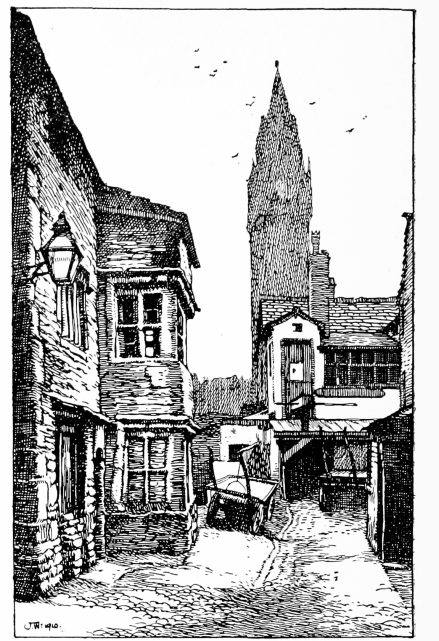
Rochdale: Amen Corner
The Hospitallers had rents of 2s. and 6d. from Rochdale mill-house. (fn. 63)
The town of ROCHDALE lies in three of the ancient divisions of the parish, having grown up near the church, on both banks of the Roch. The road from Oldham going north, joined south of the church by the old road from Manchester, reaches the river to the north-east of the church, where the ancient bridge is built; from the further side of the bridge roads spread out in all directions. One going north, called Toad Lane, was the boundary between Wardleworth and Spotland; the market-place is situated in it, near the bridge.
Borough
In 1251 Edmund de Lacy procured a charter for a weekly market at Rochdale on Wednesday, and an annual fair on the feast of St. Simon and St. Jude (28 October). (fn. 64) Probably about the same time a borough was created, but there were only twelve burgesses, and it quickly fell into decay. (fn. 65) The town continued to be governed through the manor court until 1825, when a Police Act was obtained. (fn. 66) As there was never any township of Rochdale, the area assigned to the new commissioners was a circle, with the old market-place as centre and a radius of three-quarters of a mile. In 1832 a parliamentary borough was created, one member being returned; (fn. 67) and in 1856 a municipal charter was granted, the powers and property of the old commissioners being conferred on the corporation in 1858. The town was divided into three wards— Castleton, with four aldermen and twelve councillors; Wardleworth, the same ; and Spotland, two aldermen and six councillors. (fn. 68) In 1868 the parliamentary boundary was extended to include Wardleworth, Spotland, Wuerdle, Belfield, Newbold, Buersill, and Marland; (fn. 69) and four years later the municipal boundary was extended so as to be almost conterminous with the parliamentary one, and the area was divided into ten wards, each with an alderman and three councillors. (fn. 70) The wards took their names from the townships, viz. Castleton (4), Spotland (2), Wardleworth (3), and Wuerdle. In 1894 the borough was constituted a township, the whole of Wardleworth being absorbed, with parts of Castleton, Spotland, and Wuerdle and Wardle. (fn. 71) In 1900 most of Castleton outside the borough was added, a new ward called Castleton Moor being thus formed; (fn. 72) so that the council now consists of a mayor, eleven aldermen, and thirty-three councillors. Under the Act of 1888 Rochdale became a county borough. It has a commission of the peace and a police force.
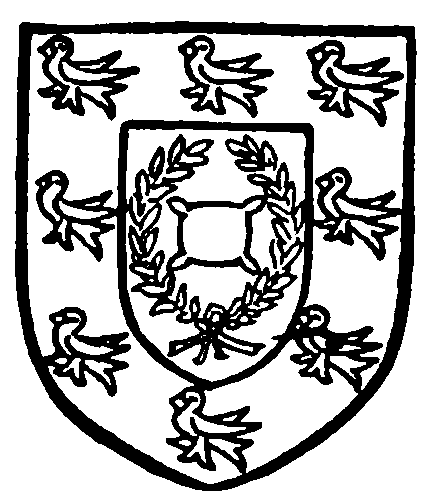
Borough of Rochdale. Sable on an escutcheon within an orle of eight martlets argent a woolpack within a wreath of laurel proper.
The town hall, by the Roch, to the north of the church, was built in 1870–1, and is a fine building, ranking high among modern examples of Gothic style; (fn. 73) a bronze statue of John Bright was erected in front of it in 1891. The free library was built in 1884. (fn. 74) An art gallery was opened in 1903. There is a public park near the town hall; Falinge Park was presented to the town in 1903 by Alderman Samuel Turner. The baths were built in 1868. The cemetery in Bury Road was opened in 1855. Waterworks were first established in 1809; (fn. 75) they were acquired by the corporation in 1866; the gas-works, begun in 1824, are also owned by the corporation, (fn. 76) as are the electric light works. An electric tramway system has been inaugurated. The market rights were purchased from Lord Byron in 1823; (fn. 77) the market hall, built in 1844, is still in the hands of a private company. The cattle market is in Manchester Road. A school board was formed in 1870.
The infirmary and dispensary, originally established in 1832, is now housed at the north side of the town, a new building having been given in 1883 and enlarged in 1896 and again in 1907. (fn. 78) Other public buildings in the town include union offices, county court offices, county police court, Temperance hall, Central hall, used for entertainments, and theatre. The 2nd V.B. Lancashire Fusiliers has its head quarters at Rochdale; there is a troop of yeomanry.
Church
The church of ST. CHAD consists of chancel with north and south aisles, nave with north and south aisles, south porch and west tower, with a vestry at the west end of each aisle north and south of the tower. It is finely placed on high ground about 80 ft. above the river, on the south side of the town, and is gained on the north side by a flight of 124 steps. These steps, reconstructed in 1810, were probably in existence in some form in the 17th century. (fn. 79)
The site is an ancient one, (fn. 80) but the oldest part of the present church belongs to the 13th century, though fragments of Norman masonry are said to have been discovered in the renovation of 1815. (fn. 81) Whatever the earliest church may have been, the structure seems to have been entirely rebuilt on a large scale during the 13th century, the present nave pillars being of that date and probably in their original position. Of the 13th-century chancel no traces now remain, but it was apparently the same width as the nave, and of three bays or more in length. (fn. 82) The church of this date would apparently be not very much less in area than the building as it existed previous to the modern additions at the east end, and consisted of a chancel 19 ft. 6 in. wide and about 35 ft. long, nave of equal width and 60 ft. long, with north and south aisles, and probably a western tower. (fn. 83) The first change seems to have been the rebuilding of the tower in the 14th century, but whether any other work was done at this time, or whether the 13th-century church stood down to the middle part of the 16th century, it is impossible to say. Trinity Chapel on the south side of the chancel existed in 1487, and the chapel of St. Katherine on the north side was founded probably about the same time or a little earlier (it is mentioned in 1514), and it is likely that many other changes had been effected in the structure before the middle of the 16th century when (c. 1558) the greater part was rebuilt, the piers to the nave and chancel and the west tower alone being retained. This building stood substantially without change till the beginning of the 19th century. (fn. 84)
In 1815 the building was in a ruinous condition, but a proposal to take it down and rebuild it was abandoned in favour of restoration. (fn. 85) The work then done was supplemented in 1835 by a further restoration of the interior, (fn. 86) and again in 1854–5 when the north aisle was taken down and rebuilt, the galleries removed (a new west gallery, however, was erected), and the organ, which had been in the west gallery, transferred to the east end of the north aisle, which was extended so as to be flush with the east end of the chancel. The vestry, which then occupied the site of St. Katherine's Chapel north of the quire, was transferred to the west end of the north aisle, and the north aisle of the chancel was opened out. The chief work of rebuilding, however, was not begun till 1873, when the south aisle as far as the chancel, together with the south porch, was pulled down and rebuilt, and the tower raised by the addition of a lofty belfry and otherwise altered. In 1885 the chancel was entirely reconstructed (fn. 87) and extended, along with both north and south aisles, 25 ft. eastward, all traces of the old work being lost. The whole of the east end of the church and nearly all the work on the exterior of the building are therefore modern, and apart from the nave arcade and the lower part of the tower the building has little antiquarian interest.
The church is built of wrought stone, but on the north side is faced with parpoints, and the walls in the interior are plastered. The east gable has a plain coping with cross and angle pinnacles, and the walls to chancel, nave, and aisles have embattled parapets. The chancel roof is slightly higher than that of the nave, and both are covered with green slates, while those of the aisles are lean-to roofs covered with lead.
The chancel consists of six bays with an arcade of pointed arches, on clustered shafts open to the north and south aisles. It has a lofty clearstory of six square-headed three-light windows on each side, and a rich double hammer-beam roof with angel terminations. The quire stalls occupy the first four bays from the west, those to the first and second bays being old. The sixth bay contains the sanctuary, the fifth being open at each side to the aisles. The whole of the east end of the church being new possesses no antiquarian interest except in certain fittings afterwards mentioned, but it is a very good example of modern Gothic. The extent of the former north and south aisles is marked on the outside by diagonal buttresses, and on the inside by a slight break in the wall. At the west end of the north aisle an organ-chamber was built in 1886, projecting northwards in front of the old St. Katherine's Chapel, which is now lost, but originally the wall ran straight through. Trinity Chapel, on the south side of the chancel, now occupies the four easternmost bays of the south aisle, its eastern end being therefore entirely modern. It is divided from the rest of the aisle at the west end by a screen. The outer wall of the old south aisle up to the diagonal buttress has been refaced since the rebuilding of 1815, though the windows are apparently of that date. In the second bay is a small door between two closely-spaced buttresses, which probably served the Trinity Chapel, and was called in the 17th century the 'little door.' The aisles of the chancel are separated from those of the nave by stone arches, and on the north side there is a screen. The Trinity Chapel passed to the Dearden family in 1823, (fn. 88) and was very much altered in 1847 by Mr. Dearden, who placed there numerous memorials to his imaginary ancestors, (fn. 89) including the effigies of a cross-legged knight and a bishop, incised slabs, and brasses.
The chancel arch (fn. 90) is modern and very lofty, the line of its springing being above the crowns of the arches of the chancel and nave arcades. There is no screen between the chancel and nave, the only division being a low stone wall.
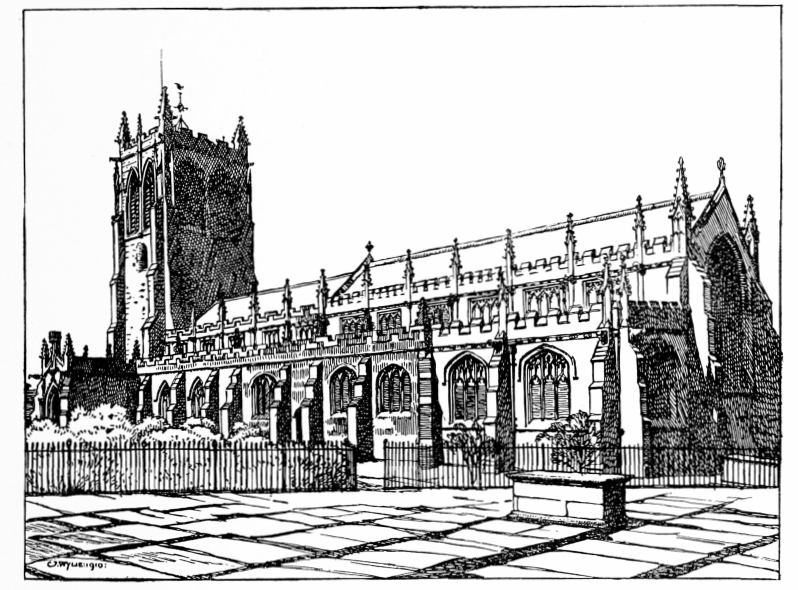
Rochdale Church
The nave piers, (fn. 91) as before stated, are of 13thcentury date, alternately octagonal and round, 18 in. in diameter, with moulded capitals and bases. The responds at each end are semi-octagonal, and the two eastern bays are less in width than the others. The details of the capitals and bases are unusually good for Lancashire work, the bases having the water-moulding and the capitals a moulded abacus and fillet. Four of the capitals, two on each side, in addition, have carving in the bell. The third pier from the west on the south side has good but rather flat stiff leaf foliage, and the first pier on the north side foliage of an apparently later date running round the bell. Two other capitals, one on each side, are carved with small human heads. One of these capitals is now very much mutilated. The floor of the nave was lowered 13 in. to the original level in 1885, and the pillars lengthened by about 10 in. of stone. (fn. 92)
The nave clearstory consists of five square-headed windows upon each side spaced without reference to the arcade beneath, and the roof is a good modern one put up a few years after 1855, with rich ornamental tie-beam and curved pieces under, carried down the walls between the windows and resting on brackets, but intersecting both the tower and chancel arches rather awkwardly. (fn. 93)
The west tower is 13 ft. square inside, with walls 5 ft. thick, and has a vice in the south-west corner. The tower arch is lofty and open to the nave, but an oak screen has recently been erected inclosing the baptistery. Though the original tower was retained in 1873 not very much ancient detail has been left, the west door and window above being new, and the old diagonal buttresses having been replaced by square ones of four stages, finishing with detached pinnacles at the new belfry stage. The clock, which was a conspicuous feature of the old tower, was removed, but the old two-light pointed belfry windows still remain on each face of the tower, those on the south and west sides being slightly out of the centre, occasioned no doubt by the space occupied by the vice in the south-west angle. On the south side, to the west of the 14th-century window, is an old sculptured stone built into the wall. The old tower finished above these windows with an embattled parapet and angle pinnacles, but was raised by a new belfry stage with two lofty stone louvred windows of three lights on each face. Above this it finishes with a new embattled parapet and angle pinnacles, and has a good 18th-century weather vane.
The screen at the east end of the north aisle and that at the north end of the Trinity Chapel are old, and perhaps belong to the restoration of 1558, with a series of coats of arms on the bottom panels. There are new oak screens at the west end of each aisle inclosing the vestries.
Some old fronts and bench-ends are worked into the chancel seats, and bear a number of heraldic shields in their panels. The arms are: a cross moline; a bend wavy; France and England quartered ; on a chief three roundels; eight martlets impaling a griffin, a cross moline, or a shackbolt; a fleur de lis with a chief ermine; the quartered coat of Byron and Colwycke ; four fusils in a border engrailed, and in chief two bars, impaling a cross moline.
The screen at the east end of the north aisle bears the cross moline and shackbolt, and an inscription: 'In te Domine speravi . Deus Deus meus . In Domino confido.'
The screen at the east end of the south aisle has carved panels on its east side as well as the west, with an inscription: ' Miserere mei Deus . Domine exaudi . inclina Domine . parce nobis Domine . Libera nos Domine.'
In the north aisle of the chancel (St. Katherine's Chapel) is a plate of copper to the memory of Susanna Gartside (d. 1668), with a skeleton at each side of the words, ' As you are, so were we ; as wee are, so you must be.'
The font now in use, which stands under the tower, was found buried in the vicarage garden in 1892, and consists of an octagonal sandstone bowl 2 ft. 8 in. in diameter at top and 1 ft. 10 in. in height, on a new base. It is entirely without ornament and of rough workmanship, and dates apparently from the latter part of the 15 th century. It is very much worn, but the top still shows the holes for fastenings. There is a modern cover. (fn. 94)
The churchyard is on the south and east sides of the church, and being paved with flat headstones, has a rather desolate appearance. On the north the ground drops suddenly, the church being built almost on the edge of the declivity. The churchyard contains some fragments from the old 16th-century church—pinnacles, gargoyles, &c.—and a new stone lych-gate has been erected on the south side opposite the porch. Amongst the graves is that of Tim Bobbin (John Collier, d. 1786) with a rhyming inscription. The oldest gravestone is dated 1656.
There is a ring of eight bells, two cast by John Rudhall in 1787, and four in 1752 by Abel Rudhall. The tenor, which bears the motto, 'Success to the town and trade of Rochdale,' was cast in 1719, recast in 1756, and again in 1812.
The plate consists of a paten of 1698–9, inscribed 'Ex dono Tho. Holden Filii Ric. Holden in usum Ecclesiae Rochdaliens. 1696,' (fn. 95) with the maker's mark S.H. under a crown; a chalice presumably of 17thcentury date, without marks and inscription, but with an engraved band under the rim ; a paten of 1702, inscribed 'Ex Dono Sarae Holden Filiae Richd. Holden in usum Ecclesiae Rochdaliensis 1702' ; an almsdish of 1722, 'The gift of Mrs. Sarah Chadwicke of Chadwicke to the parish church of Rochdale who dyed Aug. 21, 1722'; two flagons of 1724, inscribed ' Ex dono Alexandri Butterworth Armigeri,' and with the arms and crest of Butterworth, and bearing the mark of Jonah Clifton ; a tall flagon of 1772–3, inscribed 'The gift of Thos. Wray, D.D., vicar of this parish, 1773,' with the maker's mark I.C., probably that of John Carter ; two chalices of 1807 with the mark of William Abdy ; and a chalice of 1892, a replica of the 17th-century one.
The plate was twice stolen and recovered in the 18th century, in the years 1773 and 1779. In 1783 it consisted of the three present flagons, the two Holden patens, and the Chadwicke dish, together with five cups and chalices, one of which was marked on bottom M/H.B. and another R.B./M.H. In 1829 two of the old chalices were exchanged for two new ones. (fn. 96)
The registers begin in 1582. The earlier portions, 1582–1641, have been published. (fn. 97)
There are no tithe maps at the church.
A new archdeaconry of Rochdale was formed in 1910, the vicar being appointed.
The relics preserved in the church about 1200 are mentioned in a deed printed in the Whalley Coucher (fn. 98)
Advowson
The compact nature of the parish favours the supposition that its church is very ancient, but there is no record of it until near the end of the 12th century. Then Robert de Whalley, rector of the church of Rochdale, gave to Alexander de Spotland certain lands which Adam de Spotland had just given to St. Chad and the church of Rochdale. (fn. 99) As it appears that Geoffrey, Dean of Whalley, held the church in 1195, (fn. 100) the grant cited may be of a somewhat later date. The advowson, like the manor, was held by the lord of Clitheroe, and Roger de Lacy, who died in 1211, granted the church and the right of presentation to the abbey of Stanlaw. This grant was confirmed by his successor and by others interested. The Bishops of Lichfield also concurred, it being decreed that after the death of the rector in possession a vicarage should be instituted, to which a stipend and the 4 oxgangs of church land should be annexed, and the consent of three of the popes was obtained. (fn. 101) A later bishop in 1277 made a fresh decree regarding the vicarage; in addition to the 4. oxgangs, the vicar, who was to reside in his church, was to have a fit house and a stipend of 18 marks. (fn. 102) This arrangement was sanctioned by the capitular bodies (fn. 103) and the Archbishop of Canterbury. (fn. 104)
The value of the church was returned as £23 6s. 8d. in 1291, (fn. 105) but the ninth of sheaves, wool, &c, in 1341 amounted to no more than £10. (fn. 106) In 1535 the value of the rectory was estimated as £49 13s. 4d., (fn. 107) and that of the vicarage as £11 4s. 8d. (fn. 108) These sums were probably much below the actual value, for in 1650 the yearly value of the glebe lands, rents, and profits of the vicarage was stated as £160 a year, (fn. 109) and seventy years later was 'about £300.' (fn. 110) The glebe land having been utilized for building, (fn. 111) the income has greatly increased; but the land is now in the hands of the Ecclesiastical Commissioners, who pay £1,500 a year o the vicar. (fn. 112)
After the confiscation of the possessions of Whalley Abbey, the advowion of Rochdale came to the Crown, and Henry VIII gave it to Archbishop Cranmer in exchange for a much more valuable estate. (fn. 113) The tithes were sold in 1813, (fn. 114) and the right of presentation was in 1848 transferred to the new Bishop of Manchester, whose successor holds it.
The following is a list of the vicars:— (fn. 115)
| Institution | Name | Patron | Cause of Vacancy |
| c. 1210 | Geoffrey the Dean (fn. 116) | — | — |
| c. 1230 | William de Dumplington (fn. 117) | Whalley Abbey | res. Geoffrey |
| c. 1260 | John de Blackburn (fn. 118) | — | — |
| oc. 1304 | Richard (fn. 119) | — | — |
| oc. 1307 | Roger (fn. 120) | — | — |
| 9 Dec. 1312 | Richard de Parbold (fn. 121) | Whalley Abbey | — |
| 25 Oct. 1317 | Thomas de Bolton (fn. 122) | " | d. R. de Parbold |
| 22 May 1350 | Ralph de Dewsbury (fn. 123) | " | d. T. de Bolton |
| 1 Jan. 1361–2 | Ralph de Trumpington (fn. 124) | " | — |
| 11 Feb. 1369–70 | Roger son of William de Manchester (fn. 125) | Whalley Abbey | res. R. de Trumping-ton |
| 13 Nov. 1389 | John Fitheler (fn. 126) | — | exch. R. de Manchester |
| 17 Apr. 1402 | John Salley (fn. 127) | — | d. J. Fitheler |
| 3 May 1403 | Richard Twistfield (fn. 128) | Whalley Abbey | res. J. Salley |
| 31 July 1426. | Henry Marland (fn. 129) | " | res. R. Twistfield |
| 4 March 1455–6 | Richard Salley (fn. 130) | " | d. H. Marland |
| 23 Feb. 1471–2 | Thomas Brotherton (fn. 131) | — | d. R. Salley |
| 24 March 1473–4 | John Walton (fn. 132) | Whalley Abbey | res. T. Brotherton |
| 20 Sept. 1483 | William Ashton (fn. 133) | — | d. J. Walton |
| c. 1522 | Gilbert Haydock (fn. 134) | Whalley Abbey | — |
| 2 March 1553–4 | Richard Gorstilow (fn. 135) | The Queen | d. last vicar |
| 16 Nov. 1557 | John Hampson, M.A. (fn. 136) | Cardinal Pole | depr. R. Gorstilow |
| 17 March 1560–1 | — Huntington (fn. 137) | Abp. Parker | depr. J. Hampson |
| — 1561 | Richard Midgeley (fn. 138) | " | — |
| 21 Dec. 1595 | Joseph Midgeley (fn. 139) | Abp. Whitgift | res. R. Midgcley |
| 9 March 1606–7 | Richard Kenyon, M.A. (fn. 140) | Abp. Bancroft | depr. J. Midgeley |
| —Oct. 1615 | Henry Tilson, D.D. (fn. 141) | Abp. Abbot | d. R. Kenyon |
| 17 March 1635–6 | Robert Bath, M.A. (fn. 142) | Abp. Laud | res. H. Tilson |
| 18 Oct. 1662. | Henry Pigot, B.D. (fn. 143) | Abp. Juxon | depr. R. Bath |
| 27 Sept. 1722 | Samuel Dunster, D.D. (fn. 144) | Abp. Wake | d. H. Pigot |
| 3 Aug. 1754 | Nathaniel Forster, D.D. (fn. 145) | Abp. Herring | d. S. Dunster |
| 12 Nov. 1757 | James Tunstall, D.D. (fn. 146) | Abp. Hutton | d. N. Forster |
| 10 April 1762 | Thomas Wray, D.D. (fn. 147) | Abp. Secker | d. J. Tunstall |
| 6 July 1778 | Richard Hind, D.D. (fn. 148) | Abp. Cornwallis | d. T. Wray |
| 28 July 1790 | Thomas Drake, D.D. (fn. 149) | Abp. Moore | d. R. Hind |
| 14 Jan. 1820 | William Robert Hay, M.A. (fn. 150) | Abp. Sutton | d. T. Drake |
| 28 Dec. 1839 | John Edward Nassau Molesworth, D.D. (fn. 151) | Abp. Howley | d. W. R. Hay |
| —1877 | Edward Craig Maclure, M.A. (fn. 152) | Bp. of Manchester | d. J. E. N. Molesworth |
| —1890 | James Maurice Wilson, D.D. (fn. 153) | " | prom. E. C. Maclure |
| 31 Oct. 1905 | Arthur Frederic Clarke, M.A. (fn. 154) | " | res. J. M. Wilson |
During the mediaeval period there is little to record of the history of the church. (fn. 155) The vicars were men of no more than local note; for two short periods monks of Whalley held the benefice. (fn. 156) Though there were chapels of the Holy Trinity (fn. 157) and St. Katherine (fn. 158) at the south and north sides of the chancel, there does not seem to have been any regularly endowed chantry. (fn. 159) In 1541 there were, in addition to the vicar and his curate, seven priests in the parish, some no doubt serving the chapels of ease at Littleborough, Milnrow, and Whitworth. (fn. 160) The church seems to have been well furnished. (fn. 161) Eight names appear in the Visitation List of 1548, but the vicar and two others died before 1554, when four of the old clergy and two new ones were recorded. In 1563 the vicar, an assistant who did not stay long, and the three chaplains, two of them 'decrepit,' appeared, while two years later the staff had been increased by one name. (fn. 162)
Gilbert Haydock, vicar from about 1522 to 1554, was one of the scandal-giving clergy of the time, having acknowledged, though illegitimate, offspring ; his successor had to be deprived for not attending to his duties, and Hampson, vicar at Elizabeth's accession, though a conscientious man, was non-resident. Hence the people more readily attended to the active minister who was appointed just after his deprivation, and who for nearly thirty-five years laboured among them. (fn. 163) For a century, except for a brief interval, (fn. 164) the church was in the hands of Puritan clergy, and their successors, after the Restoration, do not appear to have been men able to counteract this teaching. (fn. 165) Hence the power of Nonconformity in the district is readily accounted for. (fn. 166)
The growth of the population as Rochdale became a manufacturing centre led to the enlargement of the parish church and the building of new ones. St. Mary's, Wardleworth, was consecrated in 1744; (fn. 167) St. James's, Wardleworth, in 1821; (fn. 168) St. Clement's, Spotland, in 1835; (fn. 169) and Christ Church, Healey, in 1850. (fn. 170) In the last half-century the following have been added: St. Alban's, 1856; (fn. 171) All Saints', Hamer, 1866; (fn. 172) St. Peter's, Newbold, 1871; (fn. 173) St. Mary's, Balderstone, 1872; (fn. 174) St. Edmund's, Falinge, 1873; (fn. 175) St. Luke's, Deeplish, 1892; (fn. 176) and the district of the Good Shepherd has been formed, though a permanent building is wanting. The Bishop of Manchester collates to St. Luke's, All Saints', St. Clement's, St. Edmund's, St. Peter's, and the Good Shepherd, and has the presentation of Christ Church alternately with the Crown; the vicar of Rochdale presents to St. Mary's, St. James's, and St. Alban's ; and trustees to St. Mary's, Balderstone.
The grammar school, now extinct, was founded by Archbishop Parker. (fn. 177) The income, £62 a year, is used to provide exhibitions at the universities.
Methodism was introduced into the town about 1746, and Wesley, on visiting the place in 1749, was received with ' shouting, cursing, blaspheming, and gnashing of teeth.' A chapel was built in Toad Lane in 1770, and after being sold in 1793 was used as a theatre. A new chapel was opened in this year in Union Street, and rebuilt in 1825. (fn. 178) TheWesleyans have now six other churches in the town; the New Connexion has one, built in 1867, but the story of this section of Methodists goes back to 1819; the United Free Methodists have ten churches, the largest, in Baillie Street, originated in 1837 in a secession from Union Street ; the Primitive Methodists, have four, but their earliest chapel, built in 1829, was afterwards a music hall. St. Stephen's Church was opened in 1812 for the Countess of Huntingdon'sConnexion, which still retains it. (fn. 179)
The Baptists began services in 1772, and in the following year nine persons were publicly baptized in. the Roch; a small chapel was built in 1775, replaced in 1833 by that in West Street. The original Ogden and Hope chapels date from 1785 and 1810 respectively, and there are now six churches of this denomination in Rochdale. (fn. 180)
The Congregationalists have four churches. Providence Chapel was acquired in 1814, having been built for a congregation gathered by Joseph Cooke, who had been expelled by the Wesleyans. Milton Church originated in a dispute in 1852. There are two more recent churches. (fn. 181)
The Salvation Army has a barracks, and there are several other places of worship belonging to less defined bodies. The Welsh Calvinistic Methodists have a church.
The Society of Friends has had members in Rochdale almost from its foundation, but the meetinghouse in George Street was not built until 1807–8. John Bright is interred in its burial-ground. (fn. 182)
The Unitarian Church in Blackwater Street represents the congregation formed by Robert Bath, the vicar ejected in 1662. A meeting-house was licensed during the temporary Indulgence of 1672, and Oliver Heywood preached there to 'a mighty auditory,' but no chapel seems to have been built until 1716. It was rebuilt in 1856. The congregation became Unitarian during the 1 8th century. (fn. 183) There was formerly another Unitarian chapel in Clover Street. (fn. 184)
The population rapidly became Protestant after the Reformation, (fn. 185) and it was not till 1815 that mass was said again in the town, in a hired room. St. John the Baptist's Church was opened in 1830, and St. Patrick's in 1861.
Charities
Apart from a number of educational endowments, (fn. 186) the principal charities of Rochdale are those founded by John Kenion in 1789 for the apprenticing of children, (fn. 187) and by Josiah Gartside in 1712 for clothing the poor, now utilized for providing nursing and other medical assistance. (fn. 188) In Spotland the gifts of Mary Shepherd (fn. 189) and Mary Hill (fn. 190) produce £27 a year, distributed to the poor in kind. There are a few others, chiefly for particular churches or districts. (fn. 191)