A History of the County of Lancaster: Volume 5. Originally published by Victoria County History, London, 1911.
This free content was digitised by double rekeying. All rights reserved.
'The parish of Bolton-le-Moors', in A History of the County of Lancaster: Volume 5, ed. William Farrer, J Brownbill (London, 1911), British History Online https://www.british-history.ac.uk/vch/lancs/vol5/pp235-243 [accessed 30 April 2025].
'The parish of Bolton-le-Moors', in A History of the County of Lancaster: Volume 5. Edited by William Farrer, J Brownbill (London, 1911), British History Online, accessed April 30, 2025, https://www.british-history.ac.uk/vch/lancs/vol5/pp235-243.
"The parish of Bolton-le-Moors". A History of the County of Lancaster: Volume 5. Ed. William Farrer, J Brownbill (London, 1911), British History Online. Web. 30 April 2025. https://www.british-history.ac.uk/vch/lancs/vol5/pp235-243.
In this section
BOLTON-LE-MOORS
Great Bolton; Little Bolton; Tonge-With-Haulgh; Sharples; Little Lever; Darcy Lever; Breightmet; Harwood; Bradshaw; Turton; Edgeworth; Entwisle; Quarlton; Longworth; Rivington; Anglezarke; Blackrod; Lostock
The ancient parish of Bolton has an area of 33,406 acres. A very large portion of it was formerly moorland, and much still remains in this condition in the high lands in the northern half of the district. Of the formation of the parish nothing is known. The lands within it were in the 12th century held by three distinct tenures, and as Lostock was intimately associated with Rumworth, though the latter township lies in another parish, it would appear that the delimitation of the area, and the adhesion to Bolton of the isolated portion—Blackrod and Lostock—goes back to a remote period. On the other hand there are indications that the township of Great Lever has been separated from this parish to become part of the manor-parish of Middleton.
For the old county lay, fixed in 1624, Bolton, together with the township of Aspull in Wigan, was divided into six portions contributing equally, viz.:— Bolton with its hamlets, Turton with Longworth, Edgeworth with its hamlets, Harwood with its hamlets, Blackrod with Aspull, and Rivington, Anglezarke, and Lostock; each £1 14s. 1½d. when the hundred paid £100. (fn. 1) To the more ancient fifteenth Bolton contributed 21s. 8d.; Turton, 15s.; Edgeworth, 12s. 6d.; Harwood, 12s. 7d.; Rivington, 10s.; Blackrod, 4s.; and Lostock was joined with Rumworth in 14s., out of £41 14s. 4d. paid by the hundred. (fn. 2)
Apart from the history of the town of Bolton, and the manufacturing villages which have grown up around it, there is nothing of historical interest to narrate. With the exception of the Pilkingtons of Rivington, the Bradshaws of Bradshaw, and the Orrells of Turton, the local landowners of the mediaeval period were either non-resident or obscure. 'Lusty lads, liver and light,' from Bolton-le-Moors are in an old ballad said to have fought at Flodden under Sir Edward Stanley. After the Reformation (fn. 3) the district became strongly Puritan, there being very few openly avowed recusants, (fn. 4) and it sided with the Parliament in the Civil War. There was a visitation of the plague in 1623. (fn. 5) Defoe, who visited the district early in the 18th century, 'saw nothing remarkable ' in the town of Bolton, but noticed that the cotton manufacture had reached it; the place did not seem so nourishing and increasing as Manchester. (fn. 6) The later history of the parish has been that of the growth of its trade and the inventions—particularly the local one of Crompton's mule—by which its manufactures were able to develop to their present magnitude.
The townships have (between 1894 and 1898) been greatly altered by consolidations, and the old parish now includes the following: Bolton, Little Lever, Belmont, Turton, Edgeworth, Rivington, Anglezarke, and Blackrod. The new township or civil parish of Bolton includes not only the old Great and Little Bolton, Tonge-with-Haulgh, Darcy Lever, Lostock, and the southern end of Sharpies, but also a considerable part of the adjacent parish of Deane.
The geological formation consists throughout the parish of the Carboniferous Series. For some distance around the town of Bolton the Coal Measures are in evidence; in the townships of Harwood, Bradshaw, and the southern portions of Turton and Sharpies the Lower Coal Measures, and in the remaining portions of the parish the same series intermixed with the underlying Millstone Grit.
The agricultural land in the parish is at present occupied as follows: Arable land, 1,369 acres; permanent grass, 17,003; woods and plantations, 218. Details are given thus:—
Many of the natives of the parish have achieved distinction in one way or another. Of these some are noticed in the accounts of the townships with which they were connected. In addition the following have found places in the Dictionary of National Biography: John Lodge, archivist, author of a Peerage of Ireland; died 1774. Lawrence Holden, 1710–78, was a Nonconformist divine. Moses Holden, an astronomer, was born at Bolton in 1777; he lived chiefly at Preston, and died there in 1864. John Henry Robinson, 1796–1871, was a line engraver. Sir Thomas Bazley, born at Gilnow in 1797, was a cotton spinner at Halliwell, making his factories models of good order; he was an earnest free trader, and represented Manchester as a Liberal in Parliament from 1858 to 1880. He was made a baronet in 1869, and died in 1885. William Lassell, 1799–1880, astronomer. John Clowes Grundy, 1806–67, print-seller and art patron. Abraham Walter Paulton, 1812–76, was educated at Stonyhurst for the priesthood, but became a journalist and politician; he died at Boughton Hall, Surrey, in 1876. Marshall Claxton, 1813–81, historical painter. Thomas S. Mort, 1816–78, was one of the pioneers of commerce in New South Wales. James Christopher Scholes, 1852–90, became an antiquary and genealogist; his book on Bolton Church has been used in the following account of its history.
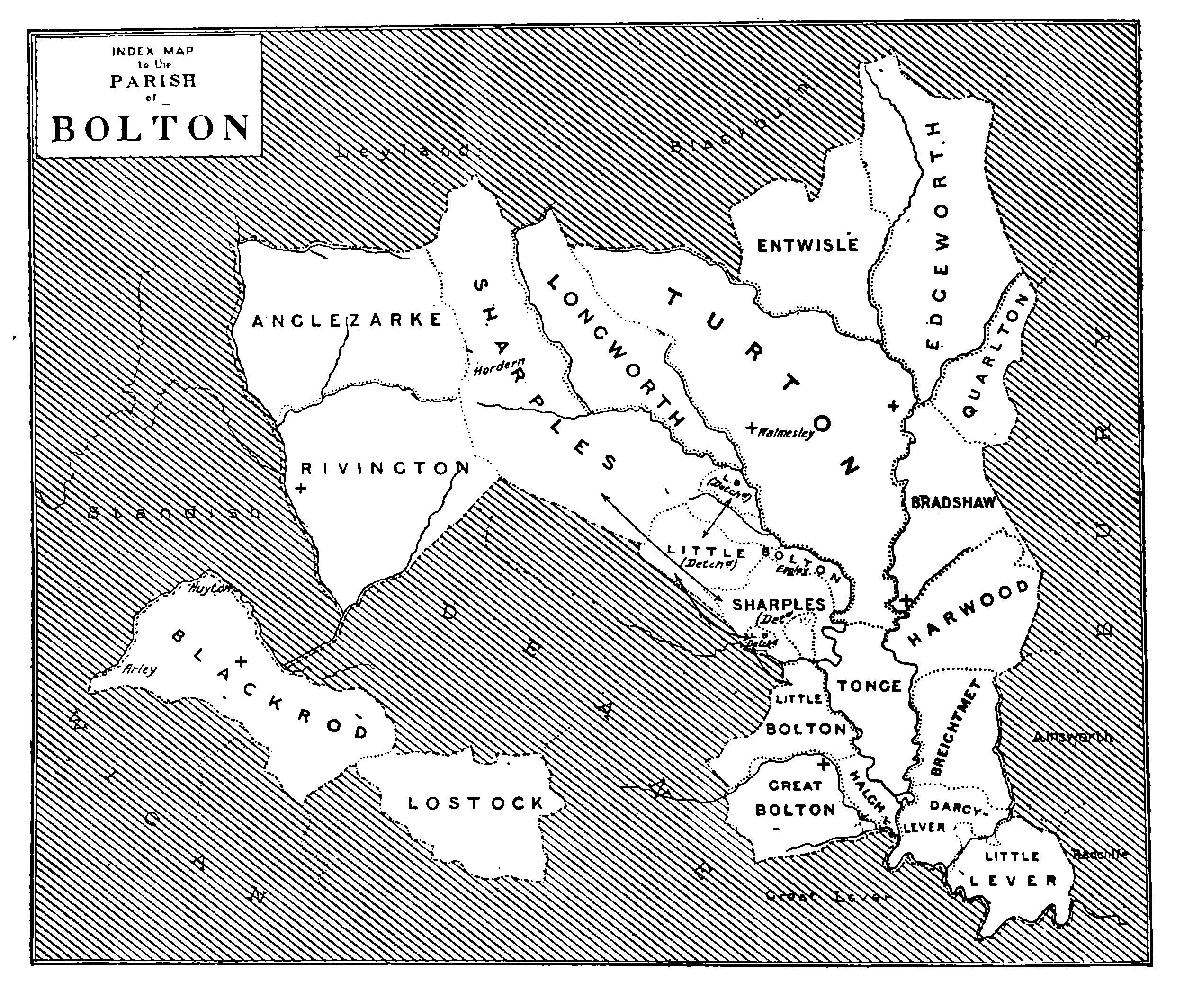
INDEX MAP to the PARISH of BOLTON
Church
The church of ST. PETER (fn. 7) stands on a steep eminence rising above the River Croal at the end of Churchgate, about 200 yards east of the old market-place, and is a handsome building in the style of the 14th century erected in 1867–71, at the charge of Peter Ormrod. (fn. 8) The former church, which stood on the same site, then at the extreme end of the town, was a low 15th-century building, consisting of chancel, nave with north and south aisles, south porch, and west tower. (fn. 9) The windows of the clearstory were square-headed, but most of the others had been altered, except that at the east end of the chancel, which had seven lights under a depressed arch. The tower had an embattled parapet, but there were no battlements to the nave. The south porch had been rebuilt in 1694, and the aisle walls bore evidence of work of apparently the same date. The east end of each aisle was inclosed by a screen, forming the Chetham Chapel on the north and the Bradford Chapel on the south side of the chancel, which contained several good stalls with heraldic carving. The erection of galleries in the 18th century, and their extension over the chapels, had necessitated the raising of the walls and roof of the chancel as high as the nave, their distinction being thus lost on the outside. The aisle walls had also been raised, and a second tier of squareheaded windows inserted to light the galleries. The appearance of the church immediately before its demolition was not such as to make its disappearance a matter of much regret. (fn. 10)
The old church was taken down in 1866. During the demolition several pre-Norman stones were found under the tower, including a cross in three pieces. (fn. 11) There were also fragments of two other crosses, part of another cross shaft, and two stones with rude carvings, probably belonging to the 11th century, together with fragments of 12th and 13th-century work, (fn. 12) a sepulchral slab, a stone coffin, and the remains of a recumbent female figure, apparently of the 14th century, showing that at least two stone churches of earlier date had existed on the same site. (fn. 13)
The present building, (fn. 14) which was consecrated in June 1871, consists of chancel of three bays 41 ft. by 31 ft., with north and south aisles, north and south transepts 25 ft. by 22 ft., nave of six bays 114 ft. by 33 ft. 3 in., with north and south aisles and lofty clearstory, (fn. 15) south porch, and tower on the north side forming a porch below. It is a very good example of modern Gothic work, and is built of Longridge stone, (fn. 16) the roofs being covered with green slates. The tower, which is 180 ft. high to the top of the vanes, has a square parapet and angle pinnacles, and forms a fine feature at the end of the main street of the town. The windows have all good tracery, that at the east of the chancel being of seven lights, and that at the west end of the nave of six.
In the chapel on the south side of the chancel are preserved three of the stalls of the old church with misericordes, one with the crest of the Bartons (acorn between two oak leaves), another with that of the Stanleys (eagle and child), and the third with an angel holding a plain shield. The end of the third stall has a poppy head, and is carved with two angels holding a book.
An organ was first erected in 1795; it was greatly enlarged in 1852 and replaced by another, which included some of the old pipes, in 1882. (fn. 17)
One of the tablets in the church was placed there by the townspeople to commemorate the bravery of Robert Knowles, a Bolton man who distinguished himself in the Peninsular War, and fell at the pass of Roncesvalles, 25 July 1813.
The churchyard lies chiefly on the south side of the church, (fn. 18) and since 1903 has been a public garden under the care of the corporation, who raised the ground and put the flat gravestones out of sight. It contains a monument to Samuel Crompton (died 1827), the inventor of the spinning-mule, who is buried there. The oldest stone in sight previous to the recent alterations was dated 1597. (fn. 19)
There is a ring of eight bells, five by Henry Bagley of Ecton, Northampton, 1699, and three by John Rudhall of Gloucester, 1806. The tenor bell has the motto, "I to the Church the living call, and to the grave doe summon all," and all have the name of the founder and date.
The plate consists of two patens of 1710, made by Richard Richardson of Chester, inscribed, 'This with another salver (a.d. 1712) of a chalice given to Bolton church by Mr. John Seede, of London, a.d. 1655'; two chalices of 1711, also of Chester make, inscribed, 'This and another chalice new made 1712 of a chalice given by Mr. Nath. Hulton, of London, to the parish of Boulton, Anno Dom. 1677'; (fn. 20) a credence paten of 1713, with the mark of John Edwards, London-; two flagons of 1716, inscribed, 'Hoc est Alterum Dono donavit Thomas Marsden, Armiger, 1716,' with the mark of John Fawdery; an almsdish of 1870, Birmingham make, given by Eliza wife of Peter Ormrod, in 1871; two silver-gilt chalices and patens of 1883, Birmingham make, the chalices inscribed 'Dedicated to the glory of God for the service of the parish church of Bolton by Henry Powell, vicar, St. Peter's Day 1884'; and a small visiting chalice of 1890.
There is also a beadle's staff with silver envelope and mountings, inscribed with the names of the borough-reeve and constable, 1812, and the arms of the family of Bolton and Bolton.
The registers begin in 1587. There are transcripts at Chester of the years 1573–4. They were in part printed in a local newspaper about 1883.
The tithe maps are kept in the vestry. (fn. 21)
The churchwardens' accounts date from 1656.
Humphrey Chetham left money for a church library, and some of the books are now at the grammar school. (fn. 22)
Advowson
The church of Bolton appears to have been given by the lord of the manor at an early date to the Gilbertine priory of Mattersey or Marsey, in Nottinghamshire, which was founded by Roger de Marsey before li92. (fn. 23) The prior's right to the advowson was formally acknowledged in 1236, (fn. 24) but a few years later the church was surrendered to the Bishop of Lichfield, the prior and convent reserving the right to present the vicars and receiving an annual payment of £10 down to the Dissolution. (fn. 25) The bishop founded a Bolton prebend in the cathedral of Lichfield, and annexed it to the archdeaconry of Chester; a small payment was also made to the vicars choral. (fn. 26) This arrangement continued until the see of Chester was formed by Henry VIII in 1541; the revenues of the archdeaconry, including the rectory of Bolton, were appropriated to the endowment of the bishopric, (fn. 27) to which the right of presenting the vicar was also given. (fn. 28) On the establishment of the bishopric of Manchester in 1847 the rectory was transferred to the new see. (fn. 29)
On the foundation of the prebend at Lichfield a rent of £10 was reserved to the vicar of the church, who was also to have a suitable dwelling-house. (fn. 30) In addition there were surplice fees, but in 1718 the certified income was only £36. (fn. 31) By a lease of the rectory granted in 1740 the pension of the vicar was raised from £10 to £36, and a sub-lease of the whole estate was made to the vicar. (fn. 32) More recently the Earl of Bradford endowed the vicarage with £100 a year, (fn. 33) and the annual value is now stated to be £770. (fn. 34)
The following is a list of the vicars:— (fn. 35)
| Institution | Name | Patron | Cause of Vacancy |
|---|---|---|---|
| oc. 1292 | Alexander (fn. 36) | — | — |
| oc. 1302, 1310 | Randle (fn. 37) | — | — |
| — | Ralph (fn. 38) | — | — |
| 30 Sept. 1320 | Richard de Warton (fn. 39) | Prior of Marsey | d. Ralph |
| 16 Oct. 1334. | Thomas Azari (fn. 40) | " | res. R. de Warton |
| — | Thomas de Prestwold (fn. 41) | — | — |
| 12 Oct. 1351 | Randle de Bolton (fn. 42) | Prior of Marsey | d. T. de Prestwold |
| 25 Nov. 1373 | Henry de Smetheley (fn. 43) | " | d. Randle |
| oc. 1436 | John de Coventry (fn. 44) | — | — |
| — Nov. 1469 | William Parsyvall (fn. 45) | Prior of Marsey | res. J. de Coventry |
| oc. 1474 | Giles Lever (fn. 46) | — | — |
| 19 Jan. 1503–4 | James Smetheley (fn. 47) | Prior of Marsey | d. G. Lever |
| c. 1514 | James Bolton (fn. 48) | " | — |
| 20 Oct. 1556 | Thomas Pendlebury (fn. 49) | H. Ditchfield, &c. | d. J. Bolton |
| c. 1560 | Edward Cockerell (fn. 50) | — | — |
| 7 Aug. 1582 | Alexander Smith (fn. 51) | Bernard Anderton | d. Ed. Cockerell |
| 10 June 1594 | John Albright, M.A. (fn. 52) | Bishop of Chester | d. A. Smith |
| —1595 | Zacharias Saunders, M.A. (fn. 53) | — | res. J. Albright |
| 29 Sept. 1598 | Ellis Saunderson, M.A. (fn. 54) | Bishop of Chester | res. Z. Saunders |
| 16 Dec. 1625 | Robert Parke (fn. 55) | Bishop or Chester | d. E. Saunderson |
| 27 Nov. 1630 | William Gregge (fn. 56) | " | res. R. Parke |
| — 1644 | John Harpur (fn. 57) | Parishioners | d. W. Gregge |
| 25 Nov. 1657 | Richard Goodwin, M.A. (fn. 58) | Trustees | d. J. Harpur |
| —1662 | Robert Harpur (fn. 59) | Bishop of Chester | ejec. R. Goodwin |
| 10 Aug. 1671 | Michael Stanford, M.A. (fn. 60) | " | res. R. Harpur |
| 16 June 1673 | John Lever (fn. 61) | " | res. M. Stanford |
| 1 Dec. 1691 | Peter Haddon, M.A. (fn. 62) | " | d. J. Lever |
| 14 Sept. 1721 | Thomas Morrall, M.A. (fn. 63) | " | d. P. Haddon |
| 23 Nov. 1737 | Edward Whitehead, M.A. (fn. 64) | " | d. T. Morrall |
| 4 May 1789 | Jeremiah Gilpin, M.A. (fn. 65) | " | d. E. Whitehead |
| 27 Nov. 1793 | Thomas Bancroft, M.A. (fn. 66) | " | d. J. Gilpin |
| 9 Mar. 1811 | John Brocklebank, B.D. (fn. 67) | " | d. T. Bancroft |
| 23 Sept. 1817 | James Slade, M.A. (fn. 68) | " | res. J. Brocklebank |
| 7 Feb. 1857 | Henry Powell (fn. 69) | Bishop of Manchester | res. J. Slade |
| — 1887 | James Augustus Atkinson, M.A. (fn. 70) | " | res. H. Powell |
| —1896 | Edwyn Hoskyns, M.A. (fn. 71) | res. J. A. Atkinson | |
| 21 Jan. 1902 | Henry Henn, M.A. (fn. 72) | " | prom. E. Hoskyns |
| — 1909 | Thomas Alfred Chapman, B.D. | " | prom. H. Henn |
The stipend assigned to the vicarage was a liberal one when it was fixed, but as time went on the income from fees and offerings probably became more important. It was contemplated from the first that the vicar should have at least one assistant, and the later foundations of a chantry at Blackrod and of chapels in other parts of the parish assisted in the increase of the staff of resident clergy. In 1541–2, in addition to the vicar, his curate, and the chantry priest, three names appear on the list. (fn. 73) Possibly there were others, for in 1548 eight were summoned to the bishop's visitation, and the same number in 1554. (fn. 74) The subsequent religious changes were accompanied by a marked reduction in the staff; in 1563 the vicar was absent, as also was the curate of Rivington, the curate of Turton was decrepit, and the only other name recorded is that of the curate of Walmsley. Two years later the vicar was assisted by a 'reader'; the curates of Turton and Walmsley are the others named, the former being ill and the latter apparently on the point of leaving. (fn. 75)
The extremer forms of Protestantism prevailed very quickly in the parish. (fn. 76) In 1592 there was no surplice even, but, in obedience to the bishop, one was purchased and worn by the vicar. (fn. 77) Ellis Saunderson, vicar from 1598 to 1625, was one of the Puritan ringleaders in the district. (fn. 78) He was a preacher himself, and had the assistance of a lecturer paid by the parishioners, and the chapels at Rivington and Turton were both 'well supplied with ministry' in his time. (fn. 79) A further improvement in the number of the staff was shown in 1650, when there were not only the vicar and endowed lecturer at the parish church, but ministers at each of the chapels at Turton, Bradshaw, Blackrod, and Rivington, though Walmsley Chapel was vacant. (fn. 80)
There was probably a relapse after the ejection of Richard Goodwin in 1662, sequestered ' delinquents'' estates having ceased to furnish incomes for a large staff of preaching ministers. (fn. 81) Nonconformity at the same time made its appearance. (fn. 82) In 1691 the vicar, his curate, and the curate of Turton were the only clergy appearing at the visitation; Rivington about that time seems to have been vacant frequently. (fn. 83) During the 18th century the growth of the population and the augmentation of the benefice appear to have been accompanied by a better and larger staff of clergy, (fn. 84) and in the last century great additions were made to the number of churches and their ministers.
The 'chapel of our Blessed Lady' is named in a will dated 1539, (fn. 85) and the 'chapel of Jesus' in 1581; (fn. 86) but there was no endowed chantry at the parish church.
In 1622 a lectureship was partially endowed by the Rev. James Gosnell, who had himself acted as curate or preacher at Bolton for forty years. (fn. 87) He was a decided Puritan, and his benefaction was towards the yearly stipend of £30 of 'a preacher, distinct from the vicar of Bolton, to preach in the parish church upon every Lord's Day and Monday.' Notwithstanding the proviso quoted, the vicar of Bolton has several times been lecturer also. An increase of stipend was secured by a bequest of 8 acres of land by William Hulme, 'the benefactor,' in 1691. The lecturers, who appear to have been usually nominated by the vicar, often acted as curates of Walmsley Chapel. In the last century the value of the 8 acres of the Hulme bequest very greatly increased, and in 1858 the Master of the Rolls sanctioned a scheme by which the salary of the lecturer was limited to £150 a year, the remainder being used for other ecclesiastical purposes. The lecturer is appointed by the vicar and the trustees of the Lectureship Estate. (fn. 88)
Charities
The endowed charities of Bolton are numerous and important. (fn. 89) For churches and chapels over £2,100 a year is distributed, the principal charity being the lectureship already mentioned. For schools £7,400 is available, including the grammar schools at Bolton and Rivington and Farnworth High Style School, Dr. and Mrs. Chadwick's Infant Orphan Asylum, founded 1868, with an income of £2,266, (fn. 90) and Eden's Orphanage, founded 1872, with £1,755. (fn. 91) Medical relief and nursing charities have £1,450 a year, the greater part of which is the endowment of the Blair Hospital in Turton. (fn. 92) In addition about £550 a year is given to the poor in money or in kind. In nearly every case (fn. 93) the endowments are applicable to particular townships or parts of the parish. For Great and Little Bolton the principal charities are those of Thomas Greenhalgh, (fn. 94) Stephen Blair, (fn. 95) and John Popplewell. (fn. 96) Mrs Lum's almshouses are for widows and spinsters. (fn. 97) For Great Bolton there are endowments for cloth for the poor and for money doles, (fn. 98) and the same is the case in Little Bolton, (fn. 99) while for Breightmet there is a coal charity. (fn. 100) For the poor of Tonge, Haulgh, and Darcy Lever is the charity of Lawrence Brownlow, founded to secure a supply of corn during scarcity, but distributed in blankets and cloth. (fn. 101) For Rivington's poor Alice Lowe and John and George Shaw have made benefactions. (fn. 102) For Blackrod is the gift of John Popplewell, and there are bread and calico doles. (fn. 103) For Turton are the charities of Abigail and Humphrey Chetham, John Popplewell, and Nathaniel Wilson; (fn. 104) while there are smaller sums for Entwisle (fn. 105) and Harwood. (fn. 106) A number of ancient endowments have been lost.