A History of the County of Lancaster: Volume 5. Originally published by Victoria County History, London, 1911.
This free content was digitised by double rekeying. All rights reserved.
'Townships: Great Bolton', in A History of the County of Lancaster: Volume 5, ed. William Farrer, J Brownbill (London, 1911), British History Online https://www.british-history.ac.uk/vch/lancs/vol5/pp243-251 [accessed 30 April 2025].
'Townships: Great Bolton', in A History of the County of Lancaster: Volume 5. Edited by William Farrer, J Brownbill (London, 1911), British History Online, accessed April 30, 2025, https://www.british-history.ac.uk/vch/lancs/vol5/pp243-251.
"Townships: Great Bolton". A History of the County of Lancaster: Volume 5. Ed. William Farrer, J Brownbill (London, 1911), British History Online. Web. 30 April 2025. https://www.british-history.ac.uk/vch/lancs/vol5/pp243-251.
In this section
GREAT BOLTON
Bothelton, 1212; Botelton, 1257; Boulton, 1288, and common; Bolton, 1307, and common.
This township, (fn. 1) which contains the parish church and about half the town of Bolton-le-Moors, has an area of 825½ acres, (fn. 2) and is bounded on the north and east by the River Croal, flowing east and southeast to join the Irwell. The surface is comparatively level, though rising towards the south-west, except for the clough or steep-banked valley through which the Croal flows. The population, including that of Haulgh, in 1901 was 53,506.
Formerly the south-western part of the township was occupied by the moor, and the first habitations sprang up along the course of the stream, the church standing above it at the point where its course changed from east to south. There were two noted wells, the memory of which is preserved in Silverwell Street and Spa Road. (fn. 3) From the church the road from Little Bolton leads westward by Church Bank, Church Gate, and Deansgate, from which the roads to Chorley and Deane branched off. This main street is crossed, about 200 yards from the church, by the road from Manchester leading north by Bradshaw Gate and Bank Street into Little Bolton. At their crossing was the old market-place, (fn. 4) with its cross. From Deansgate Bridge Street leads northward across the Croal, and in 1874–7 another high level road across was formed, further west, and called Marsden Street. The new market-place, 1824, more recently called Town Hall Square and Victoria Square, is to the south of Deansgate. (fn. 5) Here stands the new Town Hall, and close at hand are the markets and other municipal buildings. From the west end of Deansgate, Moor Lane leads south, and branches out west and south-west as Deane Road and Derby Street. To the west of Moor Lane are the districts called Bullfield, Gilnow, and Pocket. From the junction of Moor Lane and Derby Street, Weston Street and Great Moor Street lead north-east to Bradshaw Gate, and Crook Street and Trinity Street (fn. 6) eastward across the railway station to the bridge over the Croal, leading into Haulgh. To the south of Crook Street were the Lecturer's Closes, now chiefly occupied by a goods station. Rosehill lies to the south-east of the town, by the river.
Trinity Street Station of the Lancashire and Yorkshire Railway Company has been mentioned; it was opened in 1871. From it runs south the line to Manchester, with a branch to Bury through Rosehill; to the north and west the lines to Preston and Liverpool, with a branch turning north-west by the church to Blackburn. The London and North Western Company has a terminus in Great Moor Street; from this its lines run south to Worsley and Manchester, with a westward branch to Kenyon. (fn. 7)
Apart from the municipal buildings and churches the most noticeable are the Spinners Hall, theatre, Conservative Club, and infirmary. Near the southern boundary is a recreation ground; close by is the Pike. Bolton Park, opened in 1866, though on the north bank of the Croal, is mostly within Great Bolton; there is a recreation ground on the opposite or south bank. The infirmary adjoins the park. (fn. 8)
Digging sea coal at Bolton is named in 1374. (fn. 9) The woollen manufacture and other handicrafts seem there to have found a home early. Leland, about 1536, says:—'Bolton-upon-Moor market standeth most by cottons and coarse yarn. Divers villages in the moors about Bolton do make cottons [woollens]. Neither the site nor ground about Bolton is so good as it is about Bury. They burn at Bolton some cannel, but more sea coal, of which the pits be not far off. They burn turf also.' (fn. 10) A deputy aulnager was ordered to be appointed at Bolton in 1566, (fn. 11) and the town appears to have prospered.
In religion, though some few of the neighbouring gentry remained attached to the ancient faith, the people of Bolton soon became Protestant and inclined to the extreme party, so that in the 17th century the town was regarded as the Geneva of Lancashire. (fn. 12) During the Civil War, therefore, it naturally took sides against the king, giving assistance to Sir John Seaton, and suffered three different assaults from the Royalists. The first took place on 16 February 1642–3, when Colonel Assheton and his force, to the number of 500, were attacked by Lord Derby's forces from Wigan, by way of Bradshaw Gate. The outworks were taken, but the protection of a mud wall and chain sufficed for the defenders; though gallantly attacked again and again for four hours, they succeeded in driving off the Royalists, who returned to Wigan. (fn. 13) A year later a second attack was made. On the evening of 28 March 1644, Lord Derby, after summoning the town to surrender, made two assaults, but his men were each time compelled to retire. Two months later, 27 May, Prince Rupert and Lord Derby, with an army of 10,000 men or more, attacked the town, defended by Colonel Rigby, who had withdrawn his troops from Lathom. The first assault was repulsed with loss; but Lord Derby, eager to avenge the long siege of Lathom, led a second attack at the head of a body of picked men, while Prince Rupert attacked the town from another side. The defenders were outmatched and the town was taken, Colonel Rigby flying into Yorkshire. The Royalists were said to have used their advantage with great cruelty, refusing quarter (fn. 14) and desolating the town. It was on this account that the Earl of Derby's execution in 1651 was ordered to trke place at Bolton. He was accordingly beheaded there on a scaffold erected by the market cross. The people of the town appear to have sympathized with him, and a tumult had to be forcibly quelled by the soldiery. (fn. 15)
The Man and Scythe Inn, the house where the earl is said to have rested a little before his execution, still stands on the south side of Church Gate, near the old market-place: a low two-story building with modern blue-slated roof, substantially the same as when rebuilt in 1638, though in some degree modernized and repaired. The date of rebuilding, together with the initials A.W., occurs on a stone over the old kitchen fireplace. Two relics of the earl are preserved in the house—a triangular-seated chair on which, according to a brass plate on the back, the earl sat 'immediately prior to his execution,' and a two-handled tankard out of which he is said to have drunk, which also bears an inscription.
The cotton manufacture is said to have been introduced about 1650. Bolton soon revived, (fn. 16) and in 1673 was thus described:—'Seated on the River Irwell, a fair, well-built town, with broad streets, hath a market on Mondays, which is very good for clothing and provisions; and it is a place of great trade for fustians.' (fn. 17) Some Protestant artisans, driven from France by Louis XIV, are said to have settled in Bolton in 1685, to the advantage of its manufactures. (fn. 18) It was not directly affected by the Jacobite risings of 1715 and 1745. The people were rude and violent, (fn. 19) and the 'barbarous customs' of the place were noticed at the beginning of last century. (fn. 20) The improvement that had then taken place was attributed to the rise of the Sunday school, for in a place where even young children worked all the week round, Sunday was the only day for teaching. These schools began about 1770, that of the Wesleyans being famous. There were numerous charitable institutions, the dispensary being established in 1814. The Mechanics' Institution was founded in 1825. By that time the outward aspect of the town had also improved, the inclosure of the moor in 1792 enabling a great advance to be made. Horse-racing (fn. 21) and cockfighting were among the amusements. In 1793 and 1794 companies of Marines and Infantry Volunteers were raised in view of the national dangers. (fn. 22) The later volunteer movement readily found a response in the town, a company being formed in 1859—largely multiplied since then. (fn. 23)
The trade of the town continued to make advances in spite of occasional years of adversity. Dr. Aikin in 1795 wrote: 'This original seat of the cotton trade is still the centre of the manufacture of ornamental or fancy goods. It is only by emigrants from this place that any branches of this trade have been transplanted elsewhere; but the most ingenious part of the workmanship still remains rooted as it were to the soil, and flourishes even amidst present discouragements so far that the poor suffer less here than in any of the surrounding districts. The muslin trade is that which seems to answer best at present. Since the opposition of the populace to the use of machines for shortening labour has been quelled by convincing them of their utility, spinning factories have been erected throughout all the surrounding country, especially where water is plentiful. The streams near Bolton are too near sources to furnish the water that large works require; there are few, therefore, in the neighbourhood of the larger kind, though several of the smaller. Much water is also occupied by the bleachers, who have extensive crofts here. . . . The want of water in this district is made up by the ingenious invention of the machines called mules, or Hall-in-the-Wood wheels,' by Samuel Crompton. Sir Richard Arkwright, another great inventor, was for a time a barber in Church Gate, and there devised his improvements. (fn. 24)
In 1807 Bolton was described as 'noted for its medicinal waters, and more so for its manufactures of fustians and counterpanes, dimities and muslins. . . . It stands amid dreary moors. . . . Market on Monday.' (fn. 25)
Cotton-spinning and the various branches of the manufacture, together with bleaching works, have continued to prosper. Bolton Exchange was opened in 1829. The Bolton and Manchester Canal, for which an Act was obtained in 1791, helped in the development, as did the railways, already projected in 1825, and opened in 1828 and later years. At present, in addition to the many great cotton factories there are in Great Bolton important iron and steel works and machine factories, where boilers, steam engines, &c., are made; also breweries, saw-mills, leather works, and other industries.
The market is now open daily, but Monday remains one of the chief days for business. A number of fairs are held; the old fair in July is kept up on the last Wednesday in that month and the following day; another is held on the second Wednesday and Thursday in October; the dates of these were in 1824 31 July and 14 October, a cattle fair being held on the preceding days.
Beyond the fragments of crosses in the church, there are no remains of any great antiquity in the town. The market cross was removed in 1786. The pillory was last used in 1818. (fn. 26)
A printing press is said to have existed as early as 1761. (fn. 27) The first newspaper, the Bolion Herald, was established in 1813. (fn. 28) At present there are two daily evening papers, the Chronicle and Evening News; the former, founded in 1870, has a larger Saturday issue, and the latter (1887) also has one called the Journal and Guardian. The Cricket and Football Field is printed at Bolton, and there is a monthly paper, the British Skeaf.
Prince Albert visited some local mills in 1851, and King Edward VII, when Prince of Wales, opened the new town hall in 1873.
A statue of Samuel Crompton stands in Nelson Square, and one of Dr. Chadwick in Victoria Square.
Among the minor events in the town's history may be mentioned the activities of the Resurrection men about 1829; (fn. 29) appearances of the plague in 1623, cholera in 1832 and 1848–9, and typhus in 1847; the Murphy No-Popery riots of 1868; the antiRepublican riot of 1871; and the municipal scandal of 1875.
'Jannock,' a word of approval, is said to have been the name of the oat bread which was at one time the universal diet of the Bolton artisans.
Manor
Owing to the paucity of records it is impossible to give a full account of the descent of the manor of BOLTON. This formed part of the fee of the Marsey family, (fn. 30) as is shown by the descent of the advowson of the church, and so passed to Ranulf, Earl of Chester, and his heirs the Ferrers, Earls of Derby. (fn. 31) On the forfeiture of the latter in 1266 Bolton escaped, having been granted by Robert de Ferrers to his brother William, (fn. 32) after whose death in 1287 it was found to be held of Edmund, Earl of Lancaster, by doing suit to Salford Wapentake court from three weeks to three weeks and to the county court from six weeks to six weeks. (fn. 33) In the time of Henry VIII Bolton did suit to Penwortham. (fn. 34)
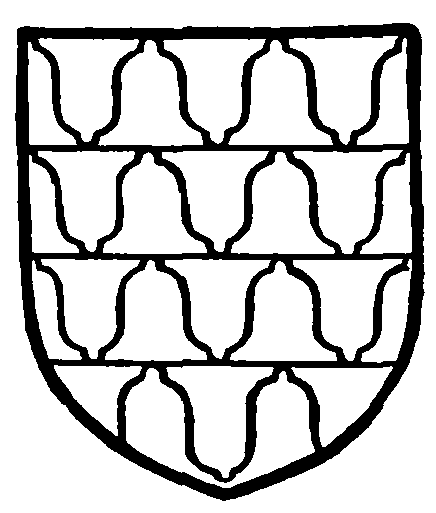
Ferrers, Earl of Derby. Vairy or and gules.
Shortly after 1287, but by what title is unknown, the manor was held by Margaret, sister of Sir Robert de Holland, and on her death divided among her four daughters and heirs. (fn. 35) The eldest, Alice, married Sir Robert de Shireburne, and the fourth part assigned to her descended with the Shireburne estates (fn. 36) till 1632, when it was sold by Richard son of Richard Shireburne and Elizabeth his wife, to Roger Lever, (fn. 37) descending in this family till the end of the 18th century. (fn. 38)
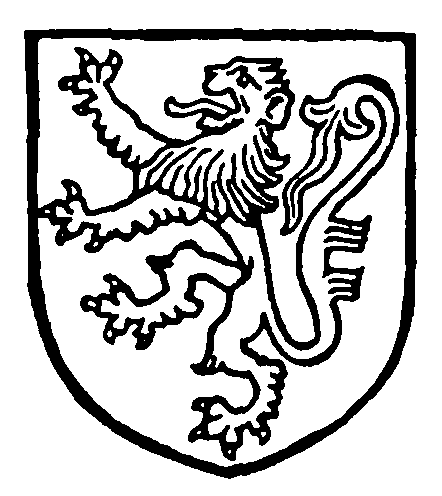
Shireburne. Argent a lion rampant vert.
The second daughter, Agnes, was twice married, but appears to have had no children; and in 1336 as a widow, she settled her share of the manor upon the children of her sister Katherine. (fn. 39)
The third daughter, Joan, married Sir Thomas de Arderne, and had issue; but the fourth part, which should have descended to the heirs of this family, seems to have been recovered about 1360 by the heir of the above-named William de Ferrers, (fn. 40) and descended in the line of Ferrers of Groby till the attainder of Thomas, Marquess of Dorset, in 1483. (fn. 41) It was in 14.84 given to the Stanleys, afterwards Earls of Derby, and has since descended with the earldom. (fn. 42)
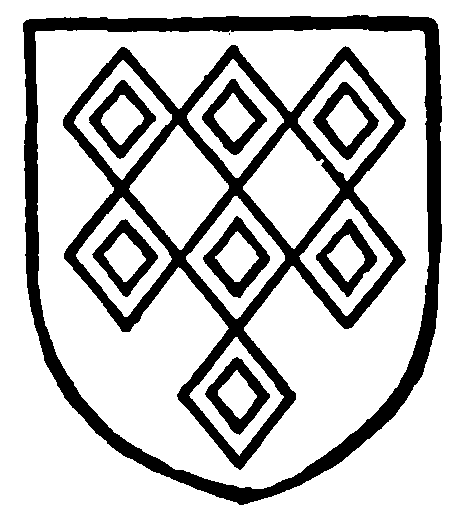
Ferrers of Groby. Gules seven mascles conjoined or.
The fourth daughter, Katherine, married Sir John de Harrington of Farleton in Lonsdale, and had three sons—Thomas, Robert, and Nicholas; (fn. 43) the inheritance, doubled by the gift of Agnes, descended with the issue of Nicholas to Sir Thomas Harrington and his son Sir John, both killed at the battle of Wakefield in 1460. (fn. 44) The moiety of the manor of Bolton was secured for himself by Sir Edward Stanley, created Lord Mounteagle, who married Anne, one of Sir John Harrington's daughters; (fn. 45) and it descended through his son by a second marriage to William, Lord Mounteagle, who in 1574 sold it to William Slinehead and Ellis Ainsworth. (fn. 46)
The estate was then divided. Ralph Assheton of Great Lever in 1588 died seised of a fourth part of the manor, (fn. 47) and his descendant, Sir Ralph Assheton, sold it in 1630 to John Bridgeman, Bishop of Chester, (fn. 48) with whose descendant, the Earl of Bradford, this part of the manor still remains.
From Ellis Ainsworth the remaining fourth part seems to have passed by the marriage of Jane Ainsworth to Ellis Hey of Monks Hall in Eccles, (fn. 49) and their descendant, another Ellis Hey, in 1658 sold it to Henry Houghton, (fn. 50) after which it cannot be clearly traced. (fn. 51)
At the present time the Earl of Derby and the Earl of Bradford are said to hold each a fourth part of the manor; the holders of the remainder are not known.
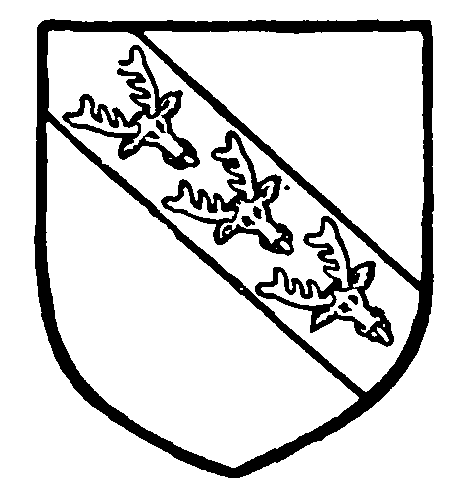
Stanley, Earl of Derby. Argent on a bend azure three harts' heads caboshed or.
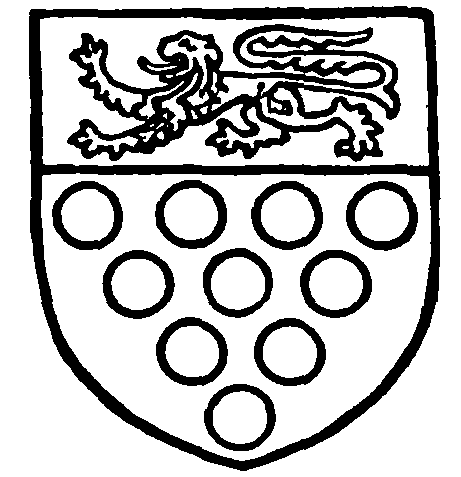
Bridgeman, Earl of Bradford. Sable ten plates, on a chief argent a lion passant ermines.
Many of the surrounding landowners have held burgages and lands in Great Bolton from an early period, (fn. 52) and the names of other owners occur in various pleadings and charters. (fn. 53) Among the more noteworthy of these were a branch of the Norris family of Tonge. (fn. 54) The returns of 'Papists' estates' in the time of George I include the name of Cope Brooks of Bolton. (fn. 55)
There was a case of treasure trove in 1560. (fn. 56)
The distinction between the trades of tanners and leather-dressers was insisted upon in 1445. (fn. 57)
Richard Rothwell, a Puritan exorcist of the beginning of the 17th century, is said to have been a native of Bolton.
Borough
At the beginning of 1253 William de Ferrers, Earl of Derby, then lord of Bolton, by his charter made the town a free borough, and granted the burgesses certain liberties. Each burgess was to have an acre of land, measured by the long perch of 24 ft., and to pay 12d. a year. A reeve was to be chosen each year by the burgesses from among themselves, and pleas were to be heard in the local halmote or portmanmote. The burgesses had rights of turbary, and might take timber from the grove between the great lane and the land of the church; they were to grind at the lord's mill to the twentieth measure, but if they were kept waiting more than two days might take their corn elsewhere. All pleas belonging to the borough were to be decided before the lord's bailiffs by view of the burgesses. (fn. 58) The earl had in December 1251 procured the king's charter for a market at Bolton every Monday, and a yearly fair on the eve, day, and morrow of St. Margaret, 19–21 July, as well as for free warren. (fn. 59)
The borough (fn. 60) did not develop into an independent community, but, like Manchester, was governed by officers appointed at the manor courts. (fn. 61) The growth of the town during the 18th century made a change desirable. In 1792 an Act was passed for the inclosure and allotment of Bolton Moor, for regulating the streets, securing a water supply, removing nuisances, and licensing conveyances. (fn. 62) The Commissioners under the Act had thus considerable powers of government; and a voluntary association for watching the town existed for some years. (fn. 63) In 1838 a charter of incorporation was granted under the general Act of 1835, the townships of Great and Little Bolton, with some alteration of boundaries, becoming the borough of Bolton. (fn. 64) A considerable party in the district, preferring the older order, protested that the charter was invalid, until the Boroughs Incorporation Act of 1842 confirmed it. (fn. 65) The borough was at first divided into six wards—Exchange, Bradford, Derby, Church, East, and West—each with two aldermen and six councillors. In 1839 magistrates were appointed for the borough, and a court of quarter sessions was granted. A number of improvement Acts have been passed; by that of 1847 the waterworks, formed by a private company in 1818, (fn. 66) were purchased, and have since been greatly enlarged; the gasworks, also owned by a private company formed in 1818–20, were acquired in 1872. (fn. 67) Electric lighting works were opened in 1894. Under an Act of 1850 the powers of the Great Bolton and Little Bolton Trusts (fn. 68) were transferred to the corporation, and the erection of a market was authorized; this was opened in 1855, and enlarged in 1894; a fish market was added in 1865, and a wholesale market in 1871. (fn. 69) A free library was inaugurated in 1853, (fn. 70) and this has constantly grown; a natural history museum building, the gift of Dr. S. T. Chadwick, was opened in 1884; the Mere Hall art museum was presented by Mr. J. P. Thomasson in 1890, and Halli' th'Wood by Mr. W. H. Lever in 1899. The baths were opened in 1846, and have been enlarged since. Parks and recreation grounds have been added, and a large part of Rivington has recently been presented to the town by Mr. W. H. Lever.
For a long time the council used the Little Bolton Town Hall, built in 1826, for its meetings; but in 1873 the new Town Hall was opneed. (fn. 71) At the same time the council was enlarged; in the preceding year Daubhill had been taken into the borough as Rumworth Ward, and in 1873 the wards were increased to eight, by constituting a portion of West Ward into an independent one, called North Ward; and the boundaries were rearranged. The two new wards had an alderman and three councillors each. (fn. 72) In 1877 the boundaries were again enlarged, part of Halliwell being included as a ninth ward, with two aldermen and six councillors. (fn. 73) Twelve years later the town became a county borough under the Local Government Act, and in 1898 a further extension of boundaries took place, so that the municipal borough now includes the old townships of Great and Little Bolton, and Tonge with Haulgh, and those of Halliwell, Heaton, Lostock, Rumworth, part of Over Hulton, Middle Hulton, Great Lever, Darcy Lever, Breightmet, and Sharpies. The town is governed by a mayor, twenty-four aldermen, and seventy-two councillors; there are seventeen wards, of which seven—Exchange, Bradford, Derby, Church, East, West, and Halliwell—have each two aldermen and six councillors; and the rest—North, Rumworth, Astley Bridge, Tonge, Darcy-Lever-cum-Breightmet, Great Lever, Hulton, Deane-cum-Lostock, Heaton, and Smithills—have each an alderman and three councillors. A grant of arms was obtained in 1890. (fn. 74) A school board was formed in 1870. Electric tram ways are worked by the corporation. (fn. 75) The cemeteries at Tonge and Heaton, opened in 1857 and 1879 respectively, are regulated by a burial board.
The Parliamentary borough was created by the Reform Act of 1832; the electoral area included Great Bolton, most of Little Bolton, and Haulgh, and was extended in 1868 to include Astley Bridge and Little Bolton Higher End. (fn. 76) It has always been represented by two members.
The parish church has been described above. There is a mission hall in connexion with it. The other churches in this district are:—Holy Trinity, Sweet Green, was erected in 1826 as a chapel of ease, and made the head of a separate parish in 1841; the Bishop of Manchester is patron. (fn. 77) Emmanuel was built in 1838, and made parochial in 1841; the vicar of Bolton presents the incumbent. (fn. 78) Christ Church was built in 1818 by the Methodists, and called Ebenezer; it was transferred in 1841 to the Church of England; the Crown and the Bishop of Manchester present alternately. (fn. 79) St. Paul's, which has a mission church, was built in 1865, and had a district assigned to it the following year; it is in the gift of five trustees. (fn. 80) St. Mark's was built in 1866, and was consecrated in 1871; the Bolton Lectureship Trustees and another body of four trustees present alternately. (fn. 81) St. Bartholomew's, built in 1879, had a district assigned to it in 1880; five trustees have the patronage. (fn. 82) The Saviour's was built in 1882; in this case also the patronage is vested in five trustees. (fn. 83) To St. Philip's, 1898, the Bishop of Manchester and the Bolton Lectureship Trustees present alternately. (fn. 84) Three of these churches have benefited by the Lectureship fund.
A small Methodist congregation was formed about 1742, but John Wesley, on his first visits in 1748 and 1749, met with a brutal reception. (fn. 85) Soon after this there broke out the dispute between Wesley and Whitefield as to Calvinism; the congregation divided, and the few Wesleyans proper kept up a meeting, and Wesley himself several times visited the town. The chapel in Ridgeway Gates, Deansgate, opened in 1777, represents this first congregation. There are now seven other Wesleyan churches in Great Bolton, (fn. 86) and the Victoria Hall, Knowsley Street, built in 1900, is the head quarters of the Bolton mission. The Methodist New Connexion formed a congregation as early as 1797; their first chapel, Ebenezer, built in 1818, has been mentioned above as Christ Church. (fn. 87) They have now no building in Great Bolton. The Primitive Methodists had a meeting-place in Newport Street in 1822, used till 1865; they have continued to increase, and have two chapels in the township. (fn. 88) The United Free Methodists have two chapels, Hanover Street dating from 1834. (fn. 89) The Independent Methodists also have two chapels. The Bible Christians are represented.
Congregationalism in Bolton (fn. 90) traces its origin to the above-mentioned dispute between Wesley and Whitefield. The latter great preacher visited the town in 1750, and the Calvinistic section of the Methodists soon afterwards began separate meetings, a chapel being built in Duke's Alley in 1754; it was in use till recently. (fn. 91) Mawdsley Street, opened in 1808, originated in a secession from the other congregations; it was rebuilt in 1870. There are two other churches of this denomination, (fn. 92) and a mission hall.
Baptist preaching began in 1777; a little chapel in King Street, on the bank of the Croal, was opened in 1793 and used for some years. A new start was made in 1818, as a result of which Moor Lane Chapel was opened in 1822; this was sold to the Primitive Methodists in 1866, and the denomination has now no place of worship in Great Bolton. (fn. 93)
The Moravians had preaching stations at Bolton and Haulgh in the latter part of the 18th century. (fn. 94)
The Society of Friends assembled for a century— from 1721 to 1820—in a meeting-house in Acresfield. (fn. 95)
The Presbyterian Church of England has St. Andrew's, opened in 1846. (fn. 96)
In Bolton, as elsewhere, the original Nonconformist chapel is now in the hands of Unitarians. Richard Goodwin, the vicar ejected in 1662, licensed a house in Deansgate in 1672, during the temporary 'indulgence,' and ministered there till his death in 1685. (fn. 97) He was succeeded by John Lever and Robert Seddon, also ejected ministers; the latter acquired a house in Windy Bank, now Bank Street, and the new chapel was opened in 1696, just after its founder's death. Unitarian doctrine began to prevail about 1750; a number of the members seceded, joining the Duke's Alley congregation. (fn. 98) A second Unitarian chapel, for secessionists, existed from 1821 to about 1840; and in 1868 Commission Street Chapel was opened, (fn. 99) replaced later by one in Deane Road.
There are some unsectarian religious agencies, as the Queen Street Mission and Gospel Union Mission. The Salvation Army has a citadel. There is also a Spiritual Church.
As might have been expected in so Puritan a town Roman Catholicism disappeared, and 'a hundred years ago a man dared scarcely proclaim himself a Roman Catholic in Bolton, so bitter was the popular sentiment against the principles of his church.' (fn. 100) Mass was once again said in the town about 1800 in an obscure room in the Old Acres, near the site of St. Patrick's, and after some years the church of St. Peter and St. Paul was built on Bolton Moor, and opened in 1803; it was rebuilt in 1897. Two other churches were opened in 1861—St. Edmund's and St. Patrick's. (fn. 101)
The original school, near the parish church, was founded in 1524. (fn. 102) It was united about 1656 with the foundation of Robert Lever in 1641, the present grammar school being the representative of both. (fn. 103) Dr. Lemprière, author of the Classical Dictionary, was one of the masters. (fn. 104)