A History of the County of Lancaster: Volume 5. Originally published by Victoria County History, London, 1911.
This free content was digitised by double rekeying. All rights reserved.
'Townships: Turton ', in A History of the County of Lancaster: Volume 5, ed. William Farrer, J Brownbill (London, 1911), British History Online https://www.british-history.ac.uk/vch/lancs/vol5/pp273-281 [accessed 30 April 2025].
'Townships: Turton ', in A History of the County of Lancaster: Volume 5. Edited by William Farrer, J Brownbill (London, 1911), British History Online, accessed April 30, 2025, https://www.british-history.ac.uk/vch/lancs/vol5/pp273-281.
"Townships: Turton ". A History of the County of Lancaster: Volume 5. Ed. William Farrer, J Brownbill (London, 1911), British History Online. Web. 30 April 2025. https://www.british-history.ac.uk/vch/lancs/vol5/pp273-281.
In this section
TURTON
Turton, 1212, and commonly; Thurton, 1277; Terton alias Torton, 1282.
This township, with an area of 4,614 acres, extends in a north and north-west direction for nearly 5 miles. A large part of the centre is occupied by lofty moorlands, known as Turton Heights and Turton Moor, rising to 1,100 and 1,280 ft. respectively. Along the northern and eastern boundaries flows the Cadshaw or Bradshaw Brook, on the upper part of which have been formed two large reservoirs for the Bolton Waterworks. The village of Turton, called Chapeltown, lies near this brook about the centre of the valley, close to the junction of the boundaries of Turton, Edgeworth, Quarlton, and Bradshaw. Billy Brook bounds Chapeltown on the west and south; to the south of it the ground rises again, forming a spur of the greater hills mentioned, and here stands Turton Tower at a height of 600 ft. above the sea. Still farther to the south, on the slope of the main elevation, is the hamlet of Bromley Cross. (fn. 1) Farther south again, on the tongue of land between Bradshaw and Eagley Brooks, lie the hamlets of Birtenshaw and Oaks. Eagley Brook forms the south-west boundary of the township. Proceeding north-west from Birtenshaw are in succession the villages and hamlets of Toppings, Dunscar, Coxgreen, Egerton or Walmsley, and Dimple.
In 1901 the census was taken in two portions; the population of the eastern half, together with Harwood and Bradshaw, was 1,611; and that of the western part, including Longworth, was 7,389.
The principal road, that from Bolton to Darwen, divides at the southern end of the township so as to pass round each side of the central hill; the eastern branch goes through Turton village to Edgeworth, and the western through Egerton, over Charters Moss, 916 ft. high, to Blackburn. The Lancashire and Yorkshire Company's Bolton and Blackburn railway passes through the eastern side of the township, and has three stations—the Oaks, Bromley Cross, and Turton and Edgeworth.
To the north of Toppings stands the Blair Hospital, built in 1886 from a bequest of Stephen Blair, formerly M.P. for Bolton. (fn. 2)
On the summit of the hill to the north-east of Walmsley is or was a Druidical circle. (fn. 3) The Hanging stone is near the extreme north-west boundary. The copper head of an old British standard has been found. Some notes of Turton Tower, Egerton Hall, and skulls found, are given in Harland and Wilkinson's Legends.
The 'old Turton acre' had 6½ yards to the perch. (fn. 4)
A token was issued at Walmsley Chapel in 1652. (fn. 5)
There were 138 hearths liable to the tax in 1666. The largest houses were those of James Chetham, with fourteen hearths, and Mrs. Walmsley six. (fn. 6)
The cross and stocks were formerly near the school at Turton.
A local board was formed in 1873; (fn. 7) this was replaced by an urban district council in I 894. Four years later the district was extended so as to include the adjacent townships of Harwood, Bradshaw, Quarlton, Edgeworth, Entwisle, Longworth, and the northern part of Sharples. (fn. 8) The council has twentyone members, elected by seven wards—Chapeltown, Bromley Cross, Eagley, Egerton, Bradshaw, Edgeworth, and Belmont. By the same Act the township or civil parish of Turton was extended to include Harwood and Bradshaw.
There are numerous cotton mills, print works, bleach works, dye works, and quarries. The land is chiefly in pasture. The Egerton spinning mills were formerly worked by a powerful water wheel. There is a disused paper mill at Chapeltown.
The cattle fair, formerly held on 4 and 5 September, now takes place on the first Monday in September. A poetical lament over the immorality which used to characterize the occasion was printed by William Sheldrake in 1789. (fn. 9)
Manor
The manor of TURTON, assessed as one plough-land, was from the earliest record of it a member of the barony of Manchester. In 1212 it formed part —later called a fourth or an eighth part — of the composite knight's fee held chiefly by Richard de Lathom, (fn. 10) and appears to have been granted to one of the junior members of the Lathom family, who also received the manor of Tarbock in Huyton. (fn. 11) There was, however, a family using Turton as a surname. (fn. 12) The manor descended with Tarbock until the beginning of the 15 th century. (fn. 13) John de Torbock, who died in 1420, left a daughter and heir Elizabeth, who married William Orrell of Orrell, near Wigan, and a partition of the estates was made, Tarbock being secured by the heir male, while Turton became the seat of the Orrells. (fn. 14) Each line from time to time laid claim to the whole of the estates, but without success. (fn. 15)
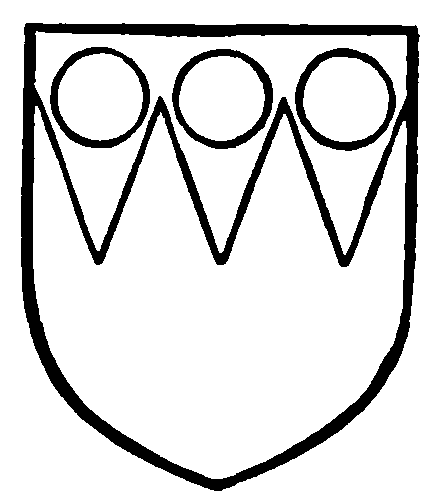
Lathom. Or on a chief indented azure three plates.
Apart from these lawsuits but little record of the family has survived. (fn. 16) Ralph Orrell died at Turton on 24 July 1533, holding the manor of Turton of Sir Thomas West, Lord La Warre, as of his manor of Manchester, the mesne lordship of Lathom having probably long been forgotten; the service was unknown to the jury, but a rent of 18d. was payable. Ralph Orrell also held lands in Dalton and Wigan, and left as heir his son John, then twenty-five years of age. (fn. 17) John Orrell died in 1581, (fn. 18) and his son William made a feoffment of the manor of Turton in that year. (fn. 19) William, who built Turton Tower in 1 596, (fn. 20) was followed by his son and heir John, (fn. 21) and the latter by his brother and heir William Orrell, (fn. 22) who in 1628 sold the manor to Humphrey Chetham, the founder of Chetham's Hospital and Library. (fn. 23)
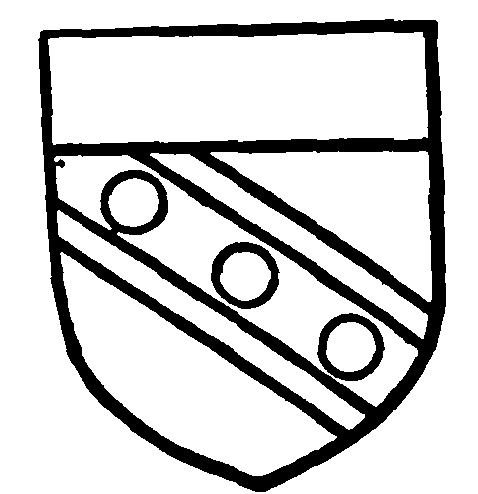
Orrell. Argent three torteaux in bend between two bendlets gules, a chief sable.
On Humphrey's death in 1653 he was succeeded at Turton by his nephew George, son of James Chetham. (fn. 24) George Chetham was alderman and sheriff of London in 1656, (fn. 25) and high sheriff of Lancashire in 1659— 60; (fn. 26) he died at Turton in 1664, and was succeeded by his son James, who held the manor till his death in 1697. His eldest son Samuel followed, and then in 1745 the third son Humphrey, who died unmarried in 1749. (fn. 27) Turton then by his will went to a cousin, Edward Chetham of Nuthurst, after whose death in 1769 a partition of the estates was made. Alice, his elder sister, who had married Adam Bland, received Turton. (fn. 28) She left an only daughter Mary, wife of Mordecai Greene, a Spanish merchant, (fn. 29) and their son James was in 1782 placed in possession of the manor of Turton, with Turton Tower, the water corn-mill, and other properties. (fn. 30)
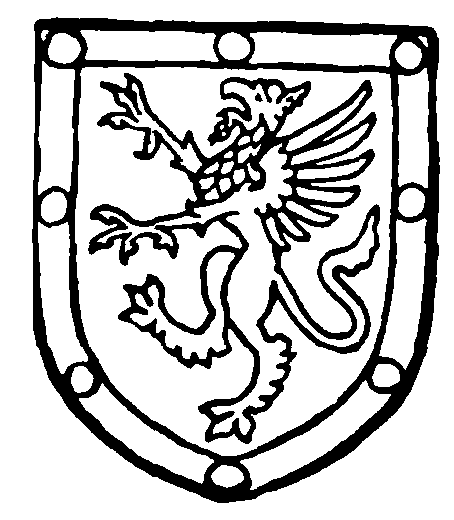
Chetham. Argent a griffon segreant gules within a bordure sable bezanty.
James Greene died in 1814, leaving five daughters as co-heirs, (fn. 31) and the estates were divided among them in 1833, Turton Tower and the reputed manor being assigned to the eldest, Mary Anne wife of Edward Frere of Clydach; they sold it in 1835 to James Kay. (fn. 32) The new lord was born at Edgefold in Entwisle, and was a successful cotton spinner at Preston and Pendleton. He resided at the Tower till his death in 1857. Robert, the eldest surviving son, was incapable of managing the estate, and his younger brother James was the acting owner. He died in 1876, and his son James succeeded, becoming lord of Turton on his uncle Robert's death in 1878. The trustees of James Kay, under his will of 1882, sold to Mrs. Appleton, from whose representatives the Tower and the lordship of the manor were in 1903 acquired by Sir Lees Knowles, bart., who resides at Westwood in Pendlebury, (fn. 33) and belongs to a family connected with the Turton district for several centuries. (fn. 34)
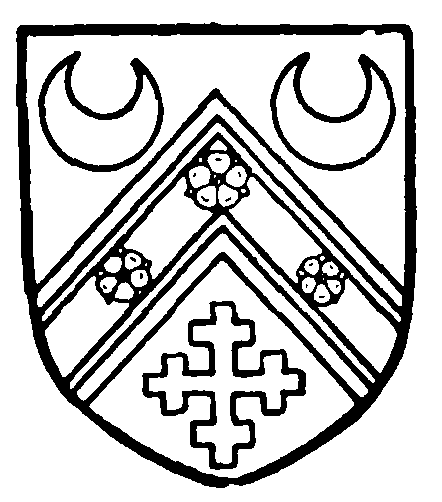
Knowles, baronet. Gules on a cheveron cotised between two crescents in chief and a crosslet in base argent three roses of the field.
TURTON TOWER stands on high ground in a situation described by Camden as 'amongst precipices and wastes,' about 4 miles north of Bolton. It is an exceedingly interesting building, the oldest part of which consists of a stone tower built square with the compass, measuring externally 45 ft. in length from north to south, and 28 ft. in width, with walls 4 ft. thick. There is no architectural feature remaining to determine the precise date of the original walls, which are of a somewhat rough order with large quoin stones; whether any part of the building is earlier than the first part of the 15 th century is very doubtful. The tower was altered and raised in the 16th century, when additions in stone and timber were made on its eastern and northern sides, and a range of buildings erected at right angles to it on the north-east. The plan thus formed, which is still that of the house, follows the lines of two sides of a court inclosed by buildings on the north and west. These later buildings were much altered in the first half of the 19th century, when they assumed their present appearance. The house therefore belongs to three main periods: the tower proper to the Middle Ages, the original north wing and additions to the reign of Queen Elizabeth, the alteration and refacing of the latter to the early years of Queen Victoria. The whole forms a very picturesque group of buildings, the stonework of the older part offering a strong but agreeable contrast to the irregular wood and plaster work set against it.
There is no trace of the building ever having been of larger extent than at present, and the original structure no doubt consisted simply of a single peel tower with wooden buildings adjoining. The masonry of the tower is in a very good state of preservation, and at the north-east corner are the remains of a projecting vice perfect still at the top, but cut away in recent times in the lower story. In the north-west corner is still the shaft of a garderobe projecting from the main structure, and there is a garderobe cut in the thickness of the wall, probably at a later date. The original tower would be about 35 ft. high, and consisted of three low stories, evidences of which still remain in the old blocked window-openings which can be seen from the outside—two on the ground floor, one on the upper floor, and five on the original top floor. These windows were of two lights on the two lower stories, and of one light above. There are also the remains of a window almost entirely destroyed on the north side, near what is now the pantry door, and further remains of another window above it, now internal, proving that at this time there were no buildings adjoining the tower proper on the north side.
These buildings were added in the 16th century, but whether they predated the rebuilding which Camden states took place in 1596 is not certain. Some of the older parts are stated to have been at that date of lath and plaster, showing that some additions must have been made to the stone tower probably at the beginning of the 16th century, and it is possible that the whole north wing may have been erected at that time. What the lath and plaster portions of the building prior to 1596 were like is not known, but they probably indicate some kind of addicion to the original structure before the more extensive additions which more than doubled the area of the plan. The north or kitchen wing is set at an irregular angle with the tower, being swung slightly to the south; it consisted originally of a two-storied stone building with heavily timbered pitched roof, with three detached chimneys in the centre and two corbelled from the north wall, and so continued till the alteration in the beginning of the last century. The room immediately north of the tower proper, which forms the junction between the original structure and the later wing, was no doubt built at the same time, though it may have been of larger extent, the north wall having been rebuilt in later times. Whether there were any buildings in the position of the present entrance and staircase on the east side of the tower before 1596, or, if so, what was the nature of them, cannot be stated, though it is probable that some kind of more convenient entrance would by this time have been found necessary. The present entrance and entrance-hall would seem to belong, however, to the rebuilding of 1596, though externally altered since. In that year vast changes were made in the building with a view of bringing its comfort up to the more luxurious standard of the times, and the tower proper then assumed practically its present appearance. The old floors were taken out, the stories raised so that two occupied nearly the whole space of the former three, and a new story was added, raising the height to 45 ft. to the top of the battlements. The old narrow windows were done away with or blocked up, and the present large three, four, and five-light mullioned and transomed windows with labels took their place, entirely altering the appearance of the old part of the building. The later story is of ashlar masonry, and is separated from the old rubble walling below by a moulded string-course, and the battlements have a continuous moulding round merlons and embrasures, with ornamental finials at the angles.
The building, as it was left by the Orrells in 1628, was substantially that which remained till the great changes which took place under James Kay after 1835, though it is probable that some alterations would be made by Humphrey Chetham when he purchased the property at the former date. (fn. 35) The present oak staircase, with flat pierced balusters, and square newels with balls, is most likely his work or that of his successor, replacing or modifying one erected not very long before, but there is no record of the Chethams having undertaken any building or alteration.
Some restoration, however, appears to have been done in the interior in the 18th century, but not such as materially affected the structure, and the arrangement of the top floor of the tower may belong to this period, together with the roof, which does not appear to be the original 16th-century one, the stone corbels which carried the beams being now in most instances unoccupied. From about 1809 to 1835 the building was occupied as a farm-house, as well as being used as a corn-mill for a considerable time, (fn. 36) and during this period it suffered a good deal (the lower part of the stone staircase no doubt being then cut away). It was in this condition when James Kay purchased the property and determined to restore it.
Illustrations of Turton Tower in the early years of the 19th century, (fn. 37) before the alterations took place, show three half-timbered gables on the east side of the tower, the middle one over the entrance and those on the south side of it being pretty much as now, but the staircase gable is very much narrower and of three stories, and there is an open space between it and the north wing, the low roof of the morning-room thus showing from the forecourt. Between 1835 and 1844 the staircase took its present form, being widened northward and recased in deal, and elaborate carving was introduced into the barge-boards rather out of keeping with the original more solid and monumental work. The whole of the north wing was at the same time reconstructed, and the west portion of it over the kitchen and offices raised a third story, assuming its present aspect, with a half-timbered gable at right angles to the staircase gable, into which it cuts rather awkwardly in the north-west corner of the forecourt. (fn. 38) The east end of the wing containing the servants' hall was refronted in stone, and two large carved Jacobean gables introduced on the south and east sides, with three large mullioned and transomed windows in the principal front. In all this modern work little regard was paid to the preservation of the original appearance of the building, the old chimneys of the north wing were lost, and the aspect of the house to the forecourt entirely changed. With the exception of a small portion of timber in the gable over the entrance, all the black and white work is therefore modern. All the barge-boards, which are elaborately carved and have finials and pendants, are new, and the work, if picturesque when seen at some little distance, is rather poor in quality, and presents few of the characteristics of the original structure. In this restoration also the sills of the two large mullioned windows of the dining and drawing rooms on the ground and first floor of the tower were lowered, and the ancient proportions of the windows destroyed. In more recent years a low one-story building, now a laundry, has been erected on the west side of the tower.
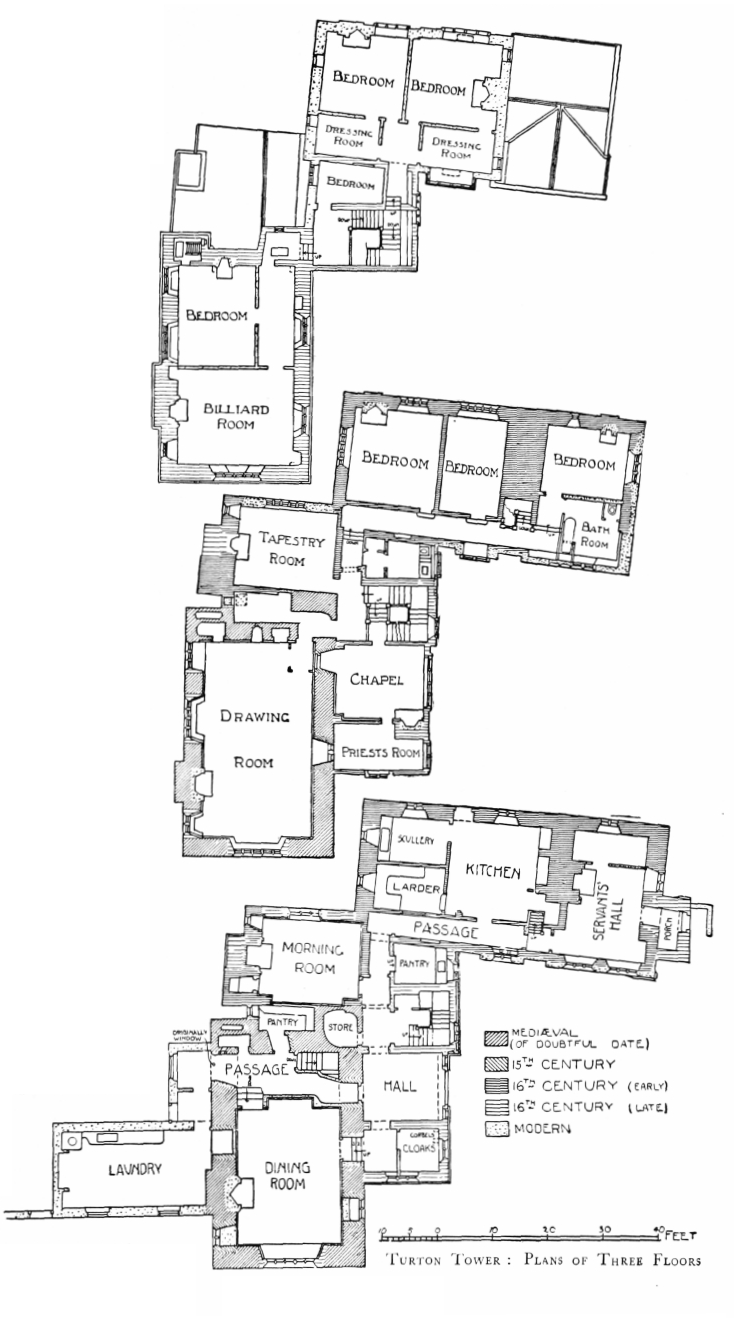
Turton Tower: Plans of Three Floors
The plan, as will be gathered from the foregoing description, follows no precedent; the original peel tower, having been retained and altered to suit later requirements, now contains the principal rooms of the house, the dining-room occupying the ground floor, and the drawing-room the floor above. The floor of the dining-room is about 2 ft. below the present level of the ground outside, and the room is entered from a lobby on the south side of the hall by a descent of three steps. It is 25 ft. long by 19 ft. in width, and 11 ft. 6 in. in height, and is lighted by a large fivelight window at the south end containing some good Swiss 16th-century painted glass in its upper lights. The walls are panelled their full height with 18th-century panelling brought here from Middleton Hall, near Manchester, on its demolition in 1845. The mantelpiece and ceiling are modern. Behind the panelling at the south end of the room are two small original twolight windows facing east and west, probably blocked up when the panelling was inserted, but retaining their glass and showing from the outside. (fn. 39) There is a blocked-up opening on the west wall. The diningroom does not extend the whole length of the tower, a flagged passage 8 ft. wide being taken across the north end at the level of the entrance hall, and separated from the room by a thin modern wall. From this passage steps go down to the cellar, and two doors on the north side open respectively into what was originally the bottom of the garderobe at the north-west corner, and through the thickness of the wall into a small room now called a pantry in the space between the outside of the tower north wall and the later morning-room, occasioned by the projection of the vice. The drawing-room occupies the whole of the first floor, being 36 ft. in length, and in addition to a five-light window on the south side has three windows of two, three, and four lights respectively on the west side, all of 16th-century date. The walls are panelled in oak to within 4 ft. of the ceiling, which is an elaborate restored Elizabethan one of plaster with panels and pendants. The oak wainscot is old, but adapted to the room, and some respect has been had for the old 15th-century window on the east side, which with its ancient shutters can be examined by withdrawing one of the panels. The fireplace and small vestibule in the north-east corner are modern. The second floor of the tower is divided into two rooms, one of which is used as a billiard-room, and a passage; but the original arrangement is not clear, the division walls being modern, and a fireplace in the present passage showing that alterations have taken place. The upper part of the single-light window of the original third story can still be seen at the floor level behind modern shutters. Access is now gained to the roof by means of a ladder and trap-door in the upper part of the garderobe turret. The roof is hipped from the angles, and covered, like all the roofs to the house, with stone slates. The top part of the vice is covered by a trap-door in the floor of the upper story, ten steps being quite perfect. The upper walls, which probably formed a turret, were destroyed in the raising of the tower and not rebuilt, the later battlements stopping short on each side, and the roof of the tower being continued over.
On the ground floor a passage runs north from the entrance-hall to the morning-room and kitchen wing. On the right is the staircase 10 ft. square, built within walls with an open well, and a door opposite opening into the bottom of the vice. Beyond the stairs is a modern pantry filling up the irregular space between the old narrow staircase gable and the north wing. The morning-room is panelled all round with wainscot, for the most part old, but made up with grained and varnished deal, and adapted to the walls. The mantelpiece is entirely so made up, and the shields have no antiquity. The room is lit on the north side by a new three-light window, and there is a small original window on the west side to the north of the fireplace. On the other side, in the thickness of the chimney, is a deep recess. Great changes seem to have taken place in this room, the north wall apparently being later than the rest, and perhaps not in its original position, while on the floor above it is entirely modern. The room over, known as the Tapestry Room, or sometimes Humphrey Chetham's room, is of the same dimensions, the walls being covered with original tapestry. This portion of the house being only of two stories, with the higher threestory buildings on two sides of it, is very much dwarfed in elevation, and this has necessitated the carrying up of the chimney-shaft to a great height (30 ft.) above the eaves of the gabled roof. The north wing contains the kitchen in the centre, with scullery and larder opening from it to the west, and the servants' hall at the east end, approached by a corridor along the south side, and from the outside by a one-story stone porch, apparently of 16th-century date, at the end. Old drawings, however, show the porch to have been two-storied at the beginning of the 19th century, and it is probable that in the rebuilding of 1835–44 it was pulled down and the present one erected from the old materials. The lower portion of the north elevation of the kitchen wing is little altered, preserving its original low mullioned windows, though the grotesque label terminations are modern. The new upper story, however, is of half-timber work like that in the front, and the gables facing west are slate hung. On the first floor of this wing great changes have taken place, the relative level of the rooms and passages has been falsified, and blind windows introduced, glazed on the outside. The house still contains some of the original 17th-century furniture, but the greater part was sold in 1890, and a bed belonging to Humphrey Chetham is now in the South Kensington Museum. A bell which used to hang on the exterior of the north-west corner of the tower was taken down in 1879, and is now at Westwood, Pendlebury. It bears the arms of Orrell with the initials W O N, R O, and the date 1587. The initials are clearly those of members of the Orrell family: William Orrell and his wife, and perhaps Richard Orrell.
At a short distance from the house to the east, on a prominence called Dove Hill, is a 17th-century watch tower or summer house of good design, 13 ft. by 13 ft. 8 in. square outside, with four stone gables with ornamental ball finials and central weather-vane, and to the south-east is a fine 17th-century barn with stone-slated roof.
Birtenshaw at one time gave a name to the family which occupied it, (fn. 40) but Walmsley and Eger ton (fn. 41) probably received theirs from their former owners. The Wood family was long resident in the township; pedigrees were recorded in 1613 and 1665. (fn. 42) Another family, named Green, also appear among the freeholders in the 16th century. (fn. 43) Several of the landowners of the district had small estates in Turton. (fn. 44) Birchwood gave a name to its ancient owners. (fn. 45) The names of John Horrocks (fn. 46) and John Yate (fn. 47) occur in the inquisitions. (fn. 48)
The freeholders in 1600 were William Orrell, Ralph Green, Richard Wood, and — Walmsley. (fn. 49)
The returns of 1788 show that the lands of Mordecai Greene paid more than half the tax; the other estates were small, those of John Orrell and the Rev. Thomas Rothwell being the most considerable. (fn. 50)
The court leet records begin in 1737; the last court is said to have been held in 1850. (fn. 51)
Church
There are two ancient chapels in the township, one at Turton itself, close to the eastern boundary, and the other at Walmsley, on the western border, to the north of the modern hamlet of Egerton. The free chapel of Turton was in 1523–4 in the gift of Ralph Orrell, and James Anderton was then incumbent. (fn. 52) The ornaments remaining in 1552 were claimed by John Orrell as heirlooms. (fn. 53) Arthur Pilkington was the priest in charge in 1542, 1548, and 1554; he was also there in 1563 and 1565, but was then 'decrepit' or 'sick,' (fn. 54) so that it is uncertain to what extent the chapel remained in use for a time; about 1610, however, it was ' well supplied with the ministry.' (fn. 55) Humphrey Chetham, on acquiring the manor, rebuilt the chapel in 1630, and bequeathed money for a small library; the books, chained to the shelves, are still there. (fn. 56) There was no endowment in 1650 beyond the interest on 20s. (fn. 57) Bishop Gastrell found an endowment of £4 14s. in existence, and a grant from Queen Anne's Bounty was secured in 1717. Mr. Chetham and his tenants gave about £30 a year. There was a chapel warden. The townships of Turton, Longworth, Edgeworth, Entwisle, and Quarlton were included in the chapelry. (fn. 58) Humphrey Chetham in 1746 left £1,000 for the chapel and school. (fn. 59) In consideration of their various benefactions the Chetham family obtained the patronage, and it has descended to Mr. Henry Seymour Hoare, as heir of Angelina Frances, one of the daughters and co-heirs of James Greene. (fn. 60) The net annual value of the benefice is £260. The church was rebuilt in 1779, and again in 1841. (fn. 61) The ecclesiastical parish was formed in 1837.
The following have been curates or vicars:— (fn. 62)
| oc. 1596 | Gilbert Astley (fn. 63) |
| 1628 | Richard Denton, B.A. |
| oc. 1647 | James Rigby (fn. 64) |
| 1648 | Michael Briscoe (fn. 65) |
| 1650 | James Livesey (fn. 66) |
| 1652 | [Timothy] Smith (fn. 67) |
| oc. 1671 | Richard Atherton (fn. 68) |
| oc. 1677 | William Richardson (fn. 69) |
| — | James Chetham |
| 1705 | John Boardman (Brasenose Coll. Oxf.) (fn. 70) |
| oc. 1716 | Henry Lawson, B.A. (fn. 71) (St. John's Coll. Camb.) |
| 1732 | Samuel Stead, B.A. (Brasenose Coll. Oxf.) |
| 1734 | Robert Hargreaves, B.A. |
| 1742 | William Sunderland (fn. 72) |
| 1761 | Amos Ogden, (fn. 73) LL.B. (Catherine Hall, Camb.) |
| 1815 | James Spencer (fn. 74) |
| 1859 | James Ogden King Spencer (fn. 75) |
| 1879 | John William Spencer, (fn. 76) M.A. (St. John's Coll. Camb.) |
| 1900 | James Odell Coleman (fn. 77) |
| 1904 | James Platt, M.A. (Dur.) |
Walmsley Chapel existed in 1532; (fn. 78) it had a bell and a few 'ornaments' in 1552. (fn. 79) Its fate for a century after the Reformation is unknown, (fn. 80) but in the time of the Commonwealth it was in use, being apparently worked with Turton, but having some separate endowments. (fn. 81) In 1717 there were no services held beyond prayers and two sermons on one Sunday each month. (fn. 82) The church was rebuilt nearly a mile to the south of the old site in 1839; it is called Christ Church. The ecclesiastical parish was formed in 1844. (fn. 83) The vicar of Bolton presents the incumbent. The benefice is worth £350 a year.
The following have been curates or vicars:—
| 1738 | Thomas Whitehead, M.A. (fn. 84) |
| 1748 | John Chisnall, M.A. (fn. 85) (St. John's Coll. Camb.) |
| 1756 | James Folds (fn. 86) |
| 1820 | Lowther Grisdale (fn. 87) |
| 1848 | John Richardson |
| 1860 | Ralph Calvert Williams Croft, (fn. 88) B.A. (T.C.D.) |
| 1877 | John Stott |
| 1894 | Walter Chetwynd Atkinson, M.A. (Keble Coll. Oxf.) |
There is a mission church at Toppings, opened in 1897, and services are also held in the school at Eagley Bridge.
Schools at Turton and Walmsley existed in 1718. (fn. 89)
The Wesleyan Methodists have chapels at Turton, Egerton, and Toppings or Birtenshaw. (fn. 90) There are Congregational chapels also at Turton and Egerton. (fn. 91)
At the latter village the old Nonconformist chapel, dating from 1713, is in the possession of the Unitarians. (fn. 92)
The Roman Catholic Church of St. Aldhelm at Turton was opened in 1903.