A History of the County of Lancaster: Volume 6. Originally published by Victoria County History, London, 1911.
This free content was digitised by double rekeying. All rights reserved.
'Townships: Mawdesley', in A History of the County of Lancaster: Volume 6, ed. William Farrer, J Brownbill (London, 1911), British History Online https://www.british-history.ac.uk/vch/lancs/vol6/pp96-100 [accessed 1 May 2025].
'Townships: Mawdesley', in A History of the County of Lancaster: Volume 6. Edited by William Farrer, J Brownbill (London, 1911), British History Online, accessed May 1, 2025, https://www.british-history.ac.uk/vch/lancs/vol6/pp96-100.
"Townships: Mawdesley". A History of the County of Lancaster: Volume 6. Ed. William Farrer, J Brownbill (London, 1911), British History Online. Web. 1 May 2025. https://www.british-history.ac.uk/vch/lancs/vol6/pp96-100.
In this section
MAWDESLEY
Moudesley, 1288; Moudeslegh, 1302; Maudsley, 1327.
This township, which was formerly closely connected with Croston, has an area of 2,934 acres, (fn. 1) and the population in 1901 was 969. In the west and north the moss-land is below the 25 ft. level, the surface rising to 160 ft. above the ordnance datum on the south-east border. The principal hamlet is at Hurst Green, near the centre; another, called the Nook, lies to the north-east. Black Moor is in the south-west.
The chief road is that passing north-east and north through the two hamlets mentioned; another road near the Douglas, which forms the western boundary, goes to Rufford, crossing the river at White Bridge. Near the same place the Lancashire and Yorkshire Company's railway from Liverpool to Preston passes through a corner of Mawdesley.
The soil is a stiff clay, with subsoil of marl and clay. Wheat, oats and beans are grown. Basketmaking and willow-growing have been important industries for some fifty years. Mawdesley grown rods, which are raised on dry, not marshy, land, have obtained a reputation in the trade for strength. (fn. 2)
Mawdesley is governed by a parish council.
There are remains of ancient crosses at Hurst Green and near the border of Eccleston. The latter is called Robin Hood's Cross, and has a well near it. (fn. 3)
Near the eastern boundary is a place called Blue Stone; about a mile to the south is a saline spring, known as Salt Pit. (fn. 4)
Charles Leigh about 1700 noticed a sulphur water spring at Humblescough Green in Mawdesley. (fn. 5)
In 1666 there were ninety-three hearths recorded in the hearth tax list. The chief house was that of Mr. Mawdesley, with eleven hearths; no other had as many as six. (fn. 6)
Manor
The manor of MAWDESLEY was anciently joined with that of Croston, (fn. 7) and had identically the same history until a century ago, when the moieties of both were held by Hesketh and Trafford. The moiety of Mawdesley, however, was not sold by Sir T. D. Hesketh together with his moiety of Croston; and thus the present lords of the manor are Sir Thomas George Fermor Hesketh of Rufford and Mr. Sigismund Cathcart de Trafford of Croston. Manor courts are held annually.
The townships having been thus closely connected, Mawdesley being sometimes described as a hamlet of Croston, (fn. 8) those who held land in the one usually held it in the other, but some of the resident freeholders seem to have assumed the local name. (fn. 9) One of these families about the 16th century became prominent, (fn. 10) and their house was known as Mawdesley Hall. Pedigrees were recorded in 1613 (fn. 11) and 1664. (fn. 12) The estate descended to the Rev. Thomas Mawdesley, who died in or before 1737, (fn. 13) and his executors then sold it to Alexander Kershaw, who resided in the adjacent township of Heskin. (fn. 14) In 1870 it was sold by the Kershaw trustees to William Bretherton, who died in 1890, and has descended to his son the Rev. H. W. Bretherton, rector of Eccleston. (fn. 15)
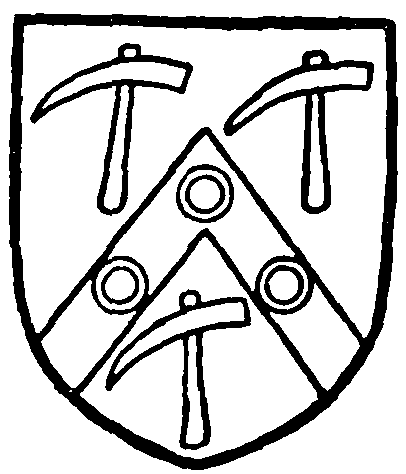
Mawdesley. Sable on a cheveron between three pickaxes argent as many annulets of the field.
Mawdesley Hall is situated at the north end of the village at the top of an outcrop of red sandstone rock, some 10 or 12 ft. above the road, from which it stands back a distance of about twenty yards. The house, which faces south, is of two stories, of the H type of plan, originally built in the 17th century, but much altered towards the end of the 18th or beginning of the 19th century, the central hall being of the first date and the two wings of the second. A low lean-to building has also been added in modern times at the back between the wings.
The central portion, which is of timber and plaster on a low stone base, measures about 30 ft. across outside, and like the rest of the house is of two stories, the upper one projecting and carried by carved brackets and a plaster cove. There is also a cove under the eaves, but the 'half timber work' in the upper part of the wall is paint on plaster, and the windows are modern casements. The ground floor, however, retains its original 17th-century timber framing and doorway, one-half of its length, on the west, being occupied by a large mullioned and transomed window. The west wing, which projects 8 ft., is built in red sandstone with yellow stone dressings and chamfered quoins, and the windows have architraves and keystones and corbelled sills. The east wing has a projection of 9 ft. and is of brick with stone quoins and plain square-headed windows, but the plainness of its appearance is concealed by ivy. The roofs, which are covered with stone slates, are hipped back from the wings on the front elevation with very good effect, but have gables at the back. The general appearance of the house is one of much picturesqueness, the contrast of colour in the materials used being very happy.
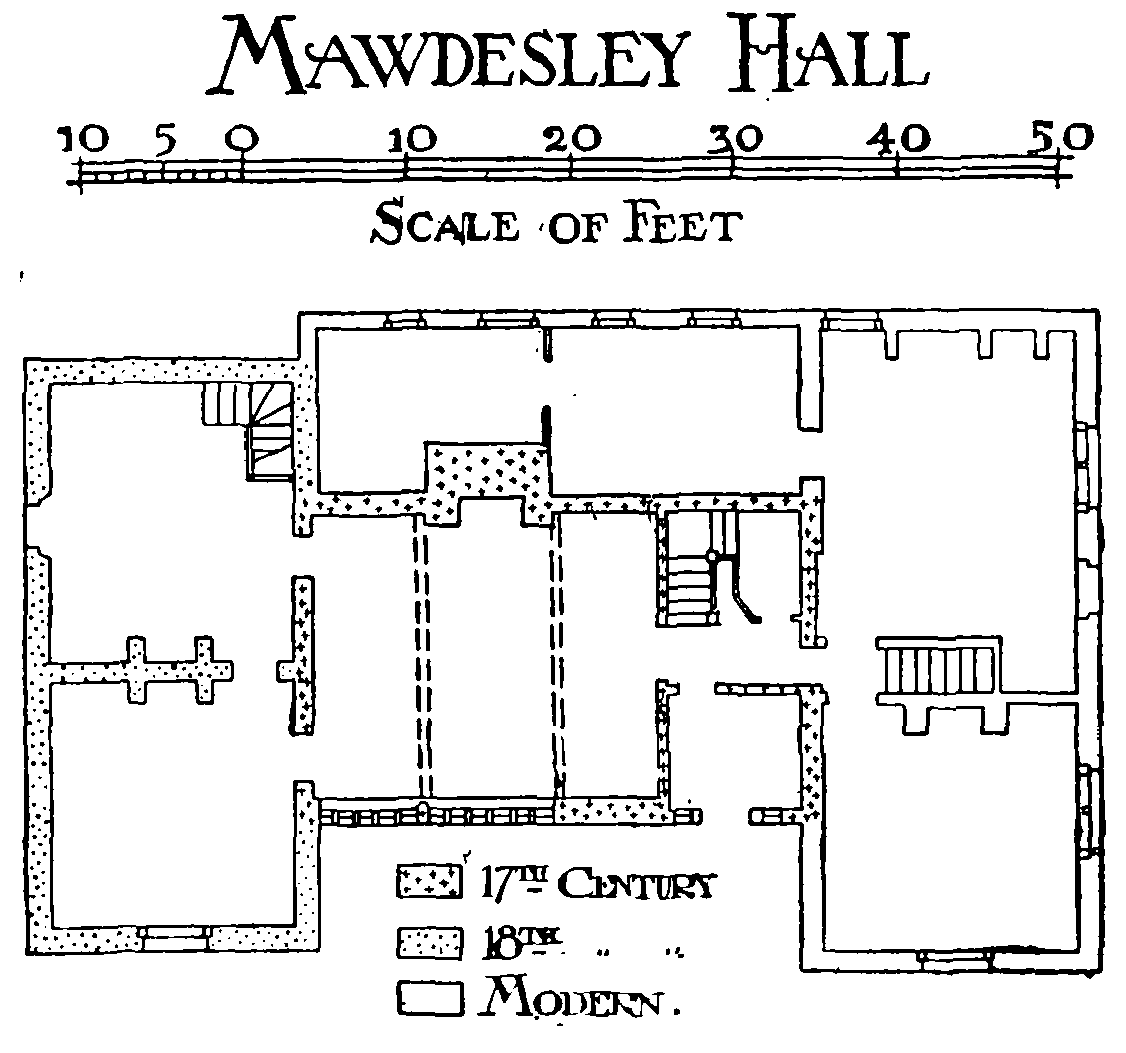
Mawdesley Hall
The central wing has a door at the east end opening into a lobby, beyond which are the staircase and the door to the hall on the left. The hall, which has a flagged floor, is 21 ft. 3 in. long, 17 ft. 8 in. wide, and 9 ft. 3 in. high, and is lighted on the south side by a long window of eleven lights. The ceiling is divided into three bays of unequal width by two round-chamfered oak beams, one at either side of the fireplace, with supporting brackets to the wall posts. The walls are wainscoted in oak on three sides to a height of 6 ft. 8 in. in three stages, the west wall alone being left plain, except for a panelled dado 2 ft. high. On the lintel of the doorway are the letters W.M. for William Mawdesley. The same initials with the date 1625 are cut in the stone head of the fireplace. The fireplace is 8 ft. 4 in. wide, making the middle ceiling bay of much greater width than the others. Over the fireplace is a large plaster panel of rather rough workmanship, (fn. 16) with a shield bearing the Mawdesley arms with helm, crest, and mantling, together with the date 1655 and the initials R.M. for Robert Mawdesley. The different dates and initials would seem to show that the hall was originally erected by William Mawdesley, and that alterations were being made before his death (1659) by his son Robert. Except for the hall, the interior of the house has little interest, the end wings being comparatively modern, though some of the old doors with their original furniture are retained. The timber framing of the central wing shows on the north elevation above the lean-to roof of the addition, together with the old stone chimney of the hall, but the framing is of a purely constructional character. The gables at the back are quite plain, without barge-boards.
The garden in front of the house has a stone fence wall with good moulded coping and is approached directly from the road by a rocky incline and a flight of eight steps leading to a small wooden gate, which has a semicircular stone recess on one side, with a stone bearing the initials of Robert Mawdesley and the date 1653. These steps and the built-up wall of the garden form a very picturesque feature.
On the north side is a large timber and plaster barn, probably of the same date as the house.
In addition to the local surname, the names of Bispham, Germain, Bamford and Rigby occur in the 14th century. (fn. 17) Another noteworthy family of long continuance was that of Nelson; a pedigree was recorded in 1613 by the Fairhurst branch. (fn. 18) Gilbert Nelson died in 1628 holding a messuage and land of Thomas Ashton, and leaving a son and heir Richard, seventeen years of age. (fn. 19) Others also occur in the inquisitions as holding lands of the lords of the manor. (fn. 20)
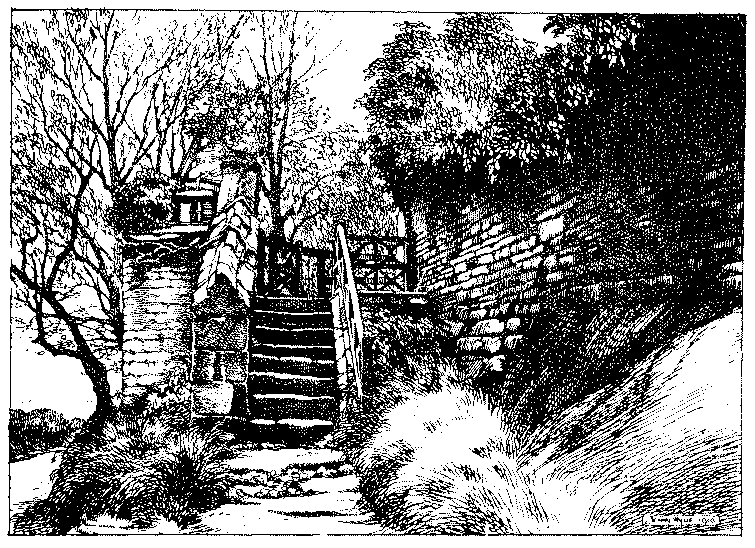
Steps to Mawdesley Hall
William de Ferrers died in 1288 holding 2 oxgangs of land in Mawdesley, occupied by John Banastre, who rendered 40d. yearly. (fn. 21) In later times the Banastres of Bank held land in the township of Lord Mounteagle (fn. 22); Henry Finch died in 1641 holding 10 acres of Lord Morley (fn. 23); and other land was held of the lords of Leylandshire. (fn. 24)
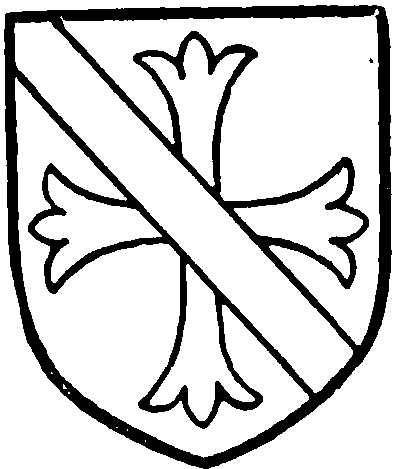
Nelson of Fairhurst. Or a cross patonce sable, over all a bendlet gules.
The freeholders named in 1600 were Robert Mawdesley, Gilbert Nelson and William Sharples (fn. 25); but the only landowner in the subsidy roll of 1628 was William Mawdesley. (fn. 26) A number of the inhabitants suffered the sequestration of their property under the Commonwealth, mostly on account of religion (fn. 27); Hugh Waterforth had his forfeited and sold. (fn. 28) A large number of yeomen 'Papists' registered estates in Mawdesley in 1717. (fn. 29) In 1789 the principal contributors to the land tax were the heirs of Alexander Kershaw and those of Mr. Hesketh. (fn. 30)
In the reign of Elizabeth there was a dispute as to turbary in the town fields of Croston and Mawdesley. (fn. 31)
For the Church of England St. Peter's was built in 1840, (fn. 32) and has since been enlarged; the rector of Croston presents.
There was a Wesleyan chapel built in 1844, (fn. 33) and replaced in 1905 by a larger edifice.
A school was founded by Thomas Crook of Abram about 1690. (fn. 34)
The adherents of the Roman Catholic religion remained numerous after the Reformation, (fn. 35) but no particulars are available as to means of worship. The church of SS. Peter and Paul was built in 1830–1.