| 1 |
In a pleading of that year (Assize R.
408, m. 21) the defendants alleged that
there was no vill called Brotherton in the
county, though there was one called
Bretherton. |
| 2 |
2,428 acres, including 3 of inland
water; Census Rep. 1901. There are also
13 acres of tidal water and 1 of foreshore. |
| 3 |
John Stones was the donor of the
font to Hoole Church in 1633. |
| 4 |
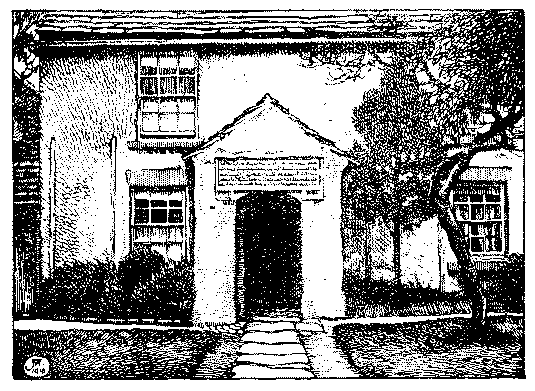
This is the room in which it is
commonly asserted that Horrocks made
his observation of the transit of Venus,
24 Nov. 1639. No sufficient authority,
however, has yet been brought forward
for accepting definitely the statement that
Horrocks was living at Carr House at
the time, though it is quite possible that
he did reside there as the guest or lodger
of Mr. Stones. |
| 5 |
J. E. Bailey in Palatine Note Bk.
vol. ii (Dec. 1882). |
| 6 |
Lancs. and Ches. Antiq. Soc. xvii, 12. |
| 7 |
Subs. R. Lancs. bdle. 250, no. 9. |
| 8 |
Lancs. Inq. and Extents (Rec. Soc.
Lancs. and Ches.), i, 36. |
| 9 |
Richard le Boteler (Pincerna) of
Bretherton granted the canons 16 acres
of his demesne there in Siverthesargh,
with exit for the man who should settle
upon the land; Cockersand Chartul. (Chet.
Soc.), ii, 471. The date is about 1200. |
| 10 |
As lord of Bretherton he gave to
God and St. Cuthbert a 'land' between
Arapul and Hortepul in alms; one side
extended to the water and the other
to waingate and the halfland to which
Carrbutts extended; Durham Cath. D.
2.2.4. Ebor. no. 48. Adam Banastre and
Adam his son were witnesses. |
| 11 |
Quenilda widow of Roger Gernet
and one of the heirs of Richard son of
Roger held in 1252 one plough-land in
Bretherton in chief of the Earl of Lincoln,
but 'received nothing therefrom except
wardship and relief'; Lancs. Inq. and
Extents, i, 190. Two years later Ralph
de Beetham, one of the heirs of Quenilda,
held a plough-land (probably the same) by
knights' service, 'but another has been
enfeoffed therein and pays nothing';
ibid. 195, 202. It is stated that here
nine plough-lands made a knight's fee.
In 1288 the vill of Bretherton paid
2s. 3½d. to William de Ferrers, who was
lord of Leylandshire; ibid. 271. |
| 12 |
It will be seen below that Sir
Nicholas le Boteler claimed wardship in
1358, and that as late as 1555 Bank was
said to be held of the heirs of Richard le
Boteler. |
| 13 |
Ibid. 149.
Some of the tenants (or their relatives) named in the text occur elsewhere.
Walter de Hoole gave three selions in
Bretherton to Lytham Priory; Kuerden
MSS. iii, B 15. He was also a benefactor
to Cockersand Abbey, giving a 'land' and
a half in Siverthesargh, a selion extending to the Asland (Douglas), another
between the high road and Ladpool, three
in Wetfield, &c.; Cockersand Chartul. ii,
477, 483. Richard de Brexes gave a
half selion stretching from the highway
to Elremurcarr in Bretherton field, and
another selion (in the same field) pertaining to his oxgang of land in Thorp;
ibid. 477. Maud wife (widow) of Simon
de Poole was also a benefactor; ibid.
475, 484.
It may be added that in 1355 the
tenants were: Thomas Banastre of the
Bank, Thomas son of Sir Adam Banastre,
John de Thorp, Ralph Bickersteth and
William son of William Banastre; Feud.
Aids, iii, 86. |
| 14 |
This branch of the family appears to
have descended from Adam Banastre,
who had sons Richard (named in the
text) and Thomas, the descent being thus
given by Dodsworth (MSS. cxlix, fol. 45):
Adam –s. Thomas –s. Thomas –s.
William –s. (Sir) Adam –s. (Sir) Thomas,
K.G.
The first step has to be proved. Margery daughter of Henry son of Sweyn
gave to Thomas Banastre land in Bretherton held in part from Adam Banastre and
in part from the Knights of St. John, in
exchange for lands in Scarisbrick which
Thomas held of the Abbot of Cockersand;
ibid. Richard son of Richard de Thorp
in 1293 granted Thomas son of Thomas
Banastre lands in Bretherton and Thorp;
ibid. fol. 37b. Maud widow of Thomas
le Boteler gave to Thomas son of Thomas
Banastre land in Hillcroft in Bretherton
formerly held by Adam his brother; Dods.
MSS. cxlix, fol. 44b. Thomas son of
Thomas le Boteler also made a grant to
him in 1293; ibid.
One Thomas Banastre (father or son)
in 1288 held a third part of Heath Charnock; Lancs. Inq. and Extents, i, 270.
The son Thomas married Joan de Singleton and thus acquired estates in the
Fylde; he died in or before 1303; Final
Conc. (Rec. Soc. Lancs, and Ches.), i,
201. The remainders were to William
and Adam Banastre, brothers. The
Adam Banastre who raised an insurrection in 1315 was almost certainly son of
the younger Thomas. Thus in 1307–8 Sir
Adam Banastre gave Sir William Banastre,
his brother, a rent of £16 11s. 6½d. from
his manors, &c., of Broughton, Salefield,
Heath Charnock, Adlington, Duxbury
and Shevington; Dods. MSS. cxlix, fol.
47b.
Thomas son of Thomas le Boteler
granted land in Bretherton on the
Hovenefurlong next Hallstudgreen to
William son of Thomas Banastre; ibid.
fol. 44b. William Banastre died in or
before 1323 holding lands in Singleton,
Claughton, &c.; Inq. p.m. 17 Edw. II,
no. 45. His son Adam, afterwards a
knight, was said to be sixteen years of
age; see Memo. R. (L.T.R.), 88, pt. ii,
m. 6 d.; Parl. R. ii, 31. As Adam son
of Sir William Banastre he in 1344
granted William de Stirzaker a messuage
and lands in the High moor with appurtenances in Bretherton for the celebration of divine service in a certain chapel
then newly built in Bretherton for the
welfare of the souls of the grantor, his
wife, his parents (William and Philippa),
&c.; Dods. MSS. cxlix, fol. 45b. He
married Pernell, afterwards wife of John
Trussell of Cublesden. His executors
(1346, &c.) were John and Nicholas
sons of Thomas Banastre; De Banco R.
348, m. 429; 350, m. 203, &c. In the
same year John Trussell of Cublesden
and Pernell his wife were suing for the
latter's dower in Bretherton; ibid. 347,
m. 165; 354, m. 300.
The wardship and marriage of Thomas
son and heir of Adam Banastre were in
1344 given by the Earl of Lancaster to
Sir Adam de Hoghton; Dods. MSS. cxlix,
fol. 44.
Thomas son of Sir Adam Banastre
appeared as plaintiff in 1365; he alleged
waste in his lands at Bretherton, naming
a hall, dovecote, &c., oaks, ash trees,
apple trees and pear trees; De Banco R.
419, m. 203 d. He purchased Thorp in
1369; Final Conc. ii, 177. He was
made a knight in 1360 and in 1375
elected K.G.; his plate is on his stall at
Windsor. He was lost at sea, 16 Dec.
1379. He held two parts of the manor
of Bretherton of Thomas Banastre of the
Bank, the other part being included in
the dower of Pernell widow of Sir Adam
Banastre. See Lancs. Inq. p.m. (Chet.
Soc.), i, 14, where there are references
to Froissart's Chronicle and to G. F.
Beltz's Memorials of the Order of the
Garter, 208; also Dep. Keeper's Rep.
xxxii, App. 358, 365; xl, App. 521.
|
| 15 |
Edward the son and heir of Sir
Thomas died in 1382, leaving a daughter
Constance, born in that year; Lancs. Inq.
p.m. (Chet. Soc.), i, 16. Pernell widow
of Sir Adam died in 1388, at which
time Agnes widow of Sir Thomas was
still living; ibid. 38.
Constance, the daughter and heir of
Edward Banastre, married William de
Balderston, and the Bretherton estate
descended in the same way as Balderston; see Abram, Blackburn, 414–15. |
| 16 |
The Sir James Harrington of Westleigh and Wolfage had lands in Bretherton, tenure unknown; his widow Isabel
held them in 1518 of Henry Banastre;
Duchy of Lanc. Inq. p.m. iii, no. 40;
v, no. 2. These were not forfeited. |
| 17 |
Pat. 4 Hen. VII. The moiety of
the manor of Bretherton is named in
the Inq. p.m. of Thomas second Earl
of Derby, 1521, but the tenure is not
separately stated; Duchy of Lanc. Inq.
p.m. v, no. 68.
See also for Edmund Dudley's interest
in 1509 ibid. iv, no. 13. |
| 18 |
See Pal. of Lanc. Feet of F. bdle.
201, m. 37; 276, m. 52; Pal. of Lanc.
Plea R. 487 (king's silver). Lord Ashburnham and others seem to have been
owners in 1725; Com. Pleas Recov. R.,
Mich. 12 Geo. I, no. 13, 28. In 1754
a Private Act of Parliament (27 Geo. II,
cap. 22) was passed for the sale of an
estate at Bretherton, pursuant to the
will of John late Earl of Ashburnham.
Edmund Lodge was plaintiff and James
Makon deforciant in a fine relating to a
moiety of the manor of Bretherton, &c.,
in 1777; Pal. of Lanc. Feet of F. bdle.
297, m. 74. |
| 19 |
Lands in Bretherton are named in
the Balderston estate of Thomas son of
Richard Radcliffe of Winmarleigh, 1521;
and of his son Thomas in 1538; Duchy
of Lanc. Inq. p.m. v, no. 3; viii, no. 26.
In 1561 the whole estate was said to be
held of John Osbaldeston; ibid. xi, no. 7.
A similar statement was made after the
death of Sir Gilbert Gerard in 1593;
ibid. xvi, no. 2.
Lands in Bretherton and Croston are
also named in the Inq. p.m. of Sir
Alexander Osbaldeston (1544) as part
of the fourth part of the manor of
Balderston; ibid. viii, no. 1. |
| 20 |
This is an inference only, but as
courts were held the lordship must have
been known. The Hesketh family had
long held lands in the township. In
1503 Thomas Hesketh purchased lands
in Croston, Tarleton, Bretherton and
Ulnes Walton from Thomas son and
heir of William Banastre of Wigan;
Final Conc. iii, 154. The Banastres
here named were probably descendants of
William, bastard son of Thomas Banastre
of Bank, to whom in 1397 were granted
a messuage and an acre of land in
Bretherton; Towneley MS. DD, no. 291.
Thomas Hesketh of Rufford died in
1523 holding seven messuages, 40 acres
of land, and 6 acres of meadow of the
Prior of St. John of Jerusalem in England
by the rent of 3d.; Duchy of Lanc. Inq.
p.m. v, no. 16. The same estate is
shown in later inquisitions; ibid. vii,
no. 14; xv, no. 56.
No moiety of the manor of Bretherton
is named in fines, &c., concerning Hesketh
settlements down to 1798. |
| 21 |
Information of Mr. John B. Selby. |
| 22 |
Lancs. Inq. and Extents, i, 34. It
was the only vill in Leyland Hundred
held of the king in chief. In 1176–8
Thorp had contributed to the aids;
Farrer, Lancs. Pipe R. 35, 38. |
| 23 |
Gamel de Thorp in 1203–4 contributed half a mark to a scutage; Lancs.
Pipe R. 179. He held a portion of
Bretherton also, and as Gamel son of
Cesar de Thorp granted part of it to the
canons of Cockersand, as also lands in
Thorp itself; Cockersand Chartul. ii,
478–9. Margaret wife of Gamel gave
them a 'land' on the High moor; ibid.
483. Adam son of Gamel gave a half
selion in Bretherton, near Ladepool;
ibid. 474. Reginald de Thorp was
also a benefactor, one gift being made
with the assent and will of Gamel lord
of Thorp; ibid. 480. A little later the
brothers Richard and Roger de Thorp
occur; ibid. 481–3, 485–6.
Richard de Thorp, son of Gamel, made
grants to Lytham Priory; Kuerden MSS.
iii, B 15. He also gave lands in Bretherton
to the Hospitallers; Dods. MSS. cxlix,
fol. 82. In 1226 he paid the 10s. rent
due from a plough-land in Leylandshire;
Lancs. Inq. and Extents, i, 141. He appears
again in 1242; ibid. 149. In 1276
John de Thorp complained that Thomas
Banastre had taken his goods at Thorp;
Coram Rege R. 20, m. 8. About the
same time David son of Richard de Thorp
claimed an oxgang of land in Thorp and
Bretherton, and John de Thorp had halt
an oxgang (or a share) in the same places;
De Banco R. 21, m. 86; 31, m. 20 d.
John de Thorp was a benefactor of
Burscough Priory, granting land on Hullcroft; Burscough Reg. fol. 54. A charter
of his, granting land 'with all liberties
of the vill of Thorp,' is in Towneley
MS. DD, no. 302. In the same volume
is a grant by Agnes widow of William the
White (Albi) of Thorp to Simon her son
of land within the bounds of Thorp and
of Bretherton, viz. upon the High moor;
no. 292.
William de Thorp in 1285 claimed the
service due from Thomas Banastre for
the latter's free tenement in Thorp; De
Banco R. 59, m. 71 d.
In 1288 it was found that William de
Thorp held the hamlet of Thorp of
William de Ferrers by the service of 10s.
yearly, and suit to the wapentake court
of Eccleston from three weeks to three
weeks; Lancs. Inq. and Extents, i, 270.
There were at least three Williams at the
time, one (probably the above-named William) the son of Richard, another the son of
John, and the other the son of Hugh. In
1292 William son of Richard de Thorp
acknowledged that he ought to find Alice
daughter of Warine de Thorp competent
maintenance in victuals and clothing for
her life in respect of a certain tenement of
hers which he held; Assize R. 408, m.
97 d. It appears that after Warine's death
Alice did homage to the Abbot of Cockersand, chief lord, and afterwards John de
Thorp received her custody. After John's
death his son William held the said custody, but he displeased Alice, who went
to William son of Richard de Thorp and
enfeoffed him of the tenement; ibid. m.
26. In 1293 William son of Hugh de
Thorp and Alice his wife sold land in
Bretherton and Thorp to Thomas Banastre; Final Conc. i, 177. In the same
year Richard son of John de Thorp agreed
to sell to Thomas son of Thomas Banastre
all his lands in Bretherton and Thorp;
Dods. MSS. cxlix, fol. 40b. The same
or another is called Richard son of Richard
de Thorp; ibid. fol. 37b.
Robert de Thorp attested charters in
1325–6 and 1344; Dods. MSS. cxlii, fol.
54; cxlix, fol. 45b. In 1345 he claimed
the custody of the lands and heir of Sir
Adam Banastre, alleging that Sir Adam
had held of him by a rent of 8s.; but it
was found that there was no knights' service; De Banco R. 343, m. 169 d.
In 1351 John de Thorp and Isabel his
wife received from the trustee lands, &c.,
in Thorp, Bretherton and Croston, the
remainder being to Roger Knoll of Bowland; Dods. MSS. cxlix, fol. 83. Twelve
years later Ralph de Thorp granted to Sir
Thomas Banastre the manor of Thorp
with its appurtenances, and lands in
Bretherton, Croston and Farington; ibid.
fol. 40. |
| 24 |
See the preceding note and Final
Conc. ii, 177. Of the vendors William
del Howe and Isabel his wife it appears
from a pedigree in Dodsworth (cxlix, fol.
40) that Isabel was the widow of John
de Thorp. |
| 25 |
In 1457 Richard Balderston was
found to have held the manor of Thorp
and lands in Croston and Farington of
the lords of Leylandshire by a rent of 12s.;
Lancs. Inq. p.m. (Chet. Soc.), ii, 63. |
| 26 |
The first of the line known was an
Adam Banastre, living about 1200. He,
like Gamel de Thorp, was witness to
Richard le Boteler's charter to Cockersand; Chartul. ii, 471. Richard son of
Adam Banastre gave land upon Hullcroft in Bretherton to Burscough Priory;
Burscough Reg. fol. 54. Stephen, son of
Roger le Boteler of Warton, released to
the canons of Cockersand the homage and
service of Richard Banastre from 2 oxgangs of land in Bretherton held of
Stephen by a rent of 12d.; Cockersand
Chartul. ii, 474. Richard Banastre gave
a piece of land on the Milnefurlong to
the canons; ibid. He gave land on the
High moor to the Hospitallers; Dods.
MSS. cxlix, fol. 82. Richard Banastre,
probably the same, appears again in 1242;
Lancs. Inq. and Extents, i, 149. Richard
son of Adam Banastre was defendant to
a claim for land made in 1246 by Adam
son of William son of Ulkelf, and his
title being assured he released his claim
for 'nativity' against Adam; Final Conc.
i, 96. Adam son of Richard Banastre
occurs in 1279 in a claim for the moiety
of Becconsall, which long descended with
Bank; see the account of Hesketh-withBecconsall.
About 1240 Robert Banastre of Mollington in Cheshire granted lands in
Newton near West Kirby to his brother
Thurstan, and in later times the moiety
of Newton was found to be held of the
heirs of Adam Banastre of Bank (1415
and 1460) and of Henry Banastre of Bank
(1495 and 1513); Ormerod, Ches. (ed.
Helsby), ii, 499, 574. |
| 27 |
Another line of Banastre has been
traced above; there were also the Banastres of Walton-le-Dale. In 1310 a grant
by Richard son of Adam Banastre to
William son of Master Richard Banastre
was attested by John Banastre of Bank
and John Banastre of Bretherton; Towneley MS. OO, no. 1558.
The Richard Banastre of 1246 may
have had a son of the same name, for by
an undated charter Richard Banastre
granted 2 oxgangs of land to his son
Richard; ibid. no 1555. A Richard son
of Richard Banastre was living in 1295,
perhaps the Master Richard mentioned;
ibid. no. 1557.
About 1292 Adam Banastre seems to
have been the principal man in the township. He was defendant in claims for
common of pasture in respect of lands
which had been inclosed; Assize R. 403,
m. 22, 23, 66. Richard and Thomas Banastre were defendants in other suits; ibid.
m. 34 d., 26, 21.
Adam Banastre in 1298 settled 8 oxgangs of land in Tarleton upon his sons
John, Thomas, William and Robert;
Final Conc. i, 184. Two years later he
settled two messuages, a mill, a ploughland, &c., in Bretherton upon John,
William and Robert; ibid. i, 189. This
was probably the Bank estate, the ploughland being a moiety of the manor. John
Banastre of Bretherton was a juror in
the same year (Lancs. Inq. and Extents,
i, 305), and, as stated above, attested a
charter in 1310.
Richard son of Adam Banastre of Bank
made a grant to William son of Master
Richard Banastre in 1313–14; Towneley
MS. OO, no. 1559. A settlement of an
oxgang of land, messuages, &c., in
Bretherton and Walton was made in
1306 by the said Master Richard in
favour of his son John, with remainders
to William son of John son of Richard
Banastre, and to John son of Adam
Banastre; Final Conc. i, 208. Master
Richard had other children, William,
Adam, &c.; ibid. 205.
Adam Banastre of Bank occurs in
1326; Cal. Pat. 1324–7, p. 291. He
was probably the son of the Richard son
of Adam of 1310 and 1313.
In 1332 Adam, William and John
Banastre contributed to the subsidy in
Bretherton; Exch. Lay Subs. (Rec. Soc.
Lancs. and Ches.), 43. In the same
year John son of Richard Banastre and
Avice his wife obtained land in Bretherton, which was to descend to their son
William; Dods. MSS. cxlii, fol. 84. The
witnesses included Sir Adam Banastre,
Adam Banastre of the Bank and William
son of Richard Banastre. In 1339 in a
grant by Richard de Bretherton to
Nicholas son of Sir Thomas Banastre
the witnesses included Adam Banastre of
Bank, William son of Master Richard
Banastre and William son of John
Banastre of the Moor; Towneley MS.
OO, no. 1561. Hugh son of William
Banastre of the Moor occurs in 1356;
Duchy of Lanc. Assize R. 5, m. 23 d.
Adam Banastre of Bank (? the elder)
died c. 1348, having an heir Thomas,
under age, whose wardship and marriage
were claimed by Sir Nicholas le Boteler;
De Banco R. 354, m. 232; 364, m. 89;
Duchy of Lanc. Assize R. I, pt. iii, m.
5 d.; 5, m. 7 d. In 1358 Sir Nicholas
complained that Thomas had refused to
marry Isabel daughter of William de
Radcliffe and had instead married Isabel
daughter of Sir John Fleming; Assize R.
438, m. 16 d. It appears that Adam
Banastre the younger had left a daughter
Emma, on whose death Thomas brother
of Adam became the heir. He appears
to have been son of the elder Adam;
see below.
Thomas Banastre of Bank remained in
possession till about 1400, when he was
succeeded by another Richard Banastre
(1409–46) and he by a Henry Banastre
the elder (1459 on), not the Henry
named in the text, it would seem. A
Richard son of Thomas Banastre of
Bank was a grantee as early as 1381;
Towneley MS. DD, no. 98. In an
extent made in 1445–6 it was recorded
that Richard Balderston and Richard
Banastre held one plough-land in Bretherton for the tenth part of a knight's fee,
the relief being 10s., of which Richard
Banastre paid half; Duchy of Lanc.
Knights' Fees, bdle. 2, no. 20. Henry
Banastre of Bank is named in 1459;
Dep. Keeper's Rep. xxxvii, App. 177.
Thurstan Banastre of Bank (sometimes
called son of Adam Banastre, at others
brother of Thomas Banastre) occurs in
many deeds from 1370 to 1395; Towneley MS. OO, no. 1580, 1588, &c. The
two brothers seem to have purchased
part or the whole of the inheritance of
the above-named William son of Master
Richard Banastre.
Another Banastre family—perhaps
descended from Thurstan—appears in
the same collection of deeds (no. 1592
on); thus in 1413 land in the vill of
Bretherton was settled on Hugh Banastre
and Ellen his wife, with remainders to
his brothers Ralph, Geoffrey (a chaplain)
and Edward and their sister Margaret
wife of Ralph Fairclough; to Thomas
Banastre of Bank, bastard, and to Richard
Banastre of Bank and his heirs; no.
1594. A grant was made to Ellen widow
of Hugh Banastre in 1442 with remainders to Henry son of Hugh for life,
and then to Thurstan son of Hugh; no.
1611.
A later Thurstan son of Hugh and
Agnes Banastre in 1518 sold to James
Anderton of Euxton all his hereditary lands
in Bretherton; Towneley MS. OO, no.
1612, &c.; Pal. of Lanc. Feet of F. bdle. 11,
m. 187. Thurstan Banastre married Isabel
Fulford, and after his death at Hadleigh in
Suffolk his widow in 1534 endeavoured to
recover, their son Hugh being then ten
years old; Duchy of Lanc. Dep. xxv,
B 1. Again in 1569 the son, described
as Hugh Banastre of 'Lyghe,' Somerset,
yeoman—he calls himself 'a poor serving
man'—made a further attempt; ibid.
Plead. lxxviii, B 11.
James Anderton died in 1552 holding
lands in Bretherton of William Banastre
by the rent of a pair of white gauntlets
yearly, and the estate (including a
windmill) descended to his son
Hugh, who held it at his death in
1566; ibid. Inq. p.m. ix, no. 14; xi,
no. 31. |
| 28 |
Ibid. vi, no. 34. Margery wife of
Henry survived him. |
| 29 |
Visit. of 1533 (Chet. Soc.), 125. |
| 30 |
Duchy of Lanc. Inq. p.m. ix, no. 33;
therein is recited the settlement on the
marriage (1541) of Henry son of William
son of Richard Banastre with Margaret
daughter of Richard Worthington of
Blainscough.
An abstract of the will of Richard
Ranastre (1548) is printed in Wills
(Chet. Soc. new ser.), i, 200. |
| 31 |
Ibid. x, no. 37. About 1555 a
servant of Henry Banastre complained
that Sir Thomas Hesketh denied him
right of fishery on Martin Mere; Ducatus
Lanc. (Rec. Com.), i, 297. |
| 32 |
He recorded a pedigree in 1567;
Visit. (Chet. Soc.), 67. A settlement
was made in 1565; Pal. of Lanc. Feet
of F. bdle. 27, m. 70. |
| 33 |
See pedigree in Visit. of 1613 (Chet.
Soc.), 23. A grant of the manors of
Bank Hall, Cuerden, &c., to Thomas
Marbury is in Pat. 6 Jas. I, pt. xxi. The
Preston Guild R. (Rec. Soc. Lancs. and
Ches.) gives some particulars of the
family. |
| 34 |
Lancs. Inq. p.m. (Rec. Soc. Lancs.
and Ches.), ii, 76. Christopher Banastre
(brother of Henry), described as 'of
Croston,' in 1631 paid £10 as composition on refusing knighthood; Misc.
(Rec. Soc. Lancs. and Ches.), i, 214. |
| 35 |
Croston Reg. The inquisition records that he held the Bank of the king
by 4½d. rent, also messuages, &c., and a
windmill in Bretherton, with other lands
in a dozen neighbouring townships.
Henry, the son and heir, was six years
old; his mother Elizabeth was living at
Worden, and his grandmother Ellen
Ireland, widow, at Wigan; Duchy of
Lanc. Inq. p.m. xxix, no. 15.
It is stated that the manor of Bretherton
was forfeited by Nicholas Rigby and
sold in 1653; Cal. Com. for Comp. iv,
3100. |
| 36 |
Dugdale's Visit. (Chet. Soc.), 23. |
| 37 |
Towneley MS. OO, no. 1639 (end).
Henry Banastre was buried at Croston
11 April 1665; Parish Reg. |
| 38 |
P.R.O. List, 73. Christopher
Banastre in 1683 made settlement of
the moiety of the manor of Bretherton,
&c.; Pal. of Lanc. Feet of F. bdle. 211,
m. 46. |
| 39 |
See pedigree in Baines' Lancs. (ed.
Croston), iv, 18. The marriage took
place at Penwortham 19 November 1683.
The younger daughter of Christopher
(Elizabeth) married Robert Parker, ancestor of Parker of Cuerden. |
| 40 |
In other pedigrees called Elizabeth. |
| 41 |
Henrietta Maria Fleetwood (born
1684) married Thomas Legh, second son
of Richard Legh of Lyme, and they lived
at Bank; the husband was member for
Newton in Makerfield from 1698 to
1710; Pink and Beaven, Parl. Repre. of
Lancs. 286–7. He died before 1723,
and his eldest son Fleetwood Legh,
leaving two daughters (s.p.) at his death
in 1726, was succeeded by his brother
Peter Legh, who in 1744 inherited the
Lyme and Newton estates on the death
of his uncle, Peter Legh of Lyme. The
younger Peter's heirs were his daughters
Henrietta Maria and Elizabeth; the
elder married (1763) Robert Vernon
Atherton Gwillym-Atherton of Atherton,
from whom Lord Lilford descends; while
the younger, who died about 1816, and
whose heir had the Bank Hall estate,
married Anthony James Keck of Stoughton Grange, Leic., member for Newton
1768–80 (ibid. 289), and their son
George Anthony Legh Keck inherited
Bank. See Earwaker, East Cheshire, ii, 306.
After his death without issue in 1860 it
passed by bequest to a cousin, the Hon.
Henry Littleton Powys, who took the surname of Keck, and then to his nephew,
the late Lord Lilford, father of the present
owner; Beamont, Warrington and
Bewsey, 162.
The Leghs of Lyme had held land in
Bretherton from a much earlier time, for
Peter Legh died in 1540 holding land
there of the heir of Balderston and of
Banastre of Bank; Duchy of Lanc. Inq.
p.m. viii, no. 10. |
| 42 |
Agnes widow of William de Tarleton in 1246 sued Richard Banastre for
dower in certain land; Assize R. 404,
m. 2.
Henry Tarleton of Bretherton, Thomas
his brother, and many others of the name
were in 1477 appealed of the death of
John Hodgkinson; Pal. of Lanc. Plea
R. 46, m. 5 d. In 1480 William Tarleton and Henry his son and heir made a
feoffment of a messuage and lands in
Bretherton; Towneley MS. DD, no.
276. |
| 43 |
William de Thorp in 1292 complained that William son of Ingott de
Bretherton and Geoffrey son of Richard
Banastre had disseised him of common
of pasture; Assize R. 408, m. 51 d.
Agnes daughter of John de Bretherton
was a defendant in 1295; De Banco R.
118, m. 43 d.
The following occur in Towneley's
MS. OO: 1339—Adam son of Richard
son of Roger Morisson (no. 1560);
1361—Thomas de Bretherton and Joan
his wife (no. 1568); 1373—William
Mareounson (no. 1575); 1387—Adam
son of William (no. 1585); 1409—
settlement by William Tomlinson (no.
1590–1); 1425–30—Richard son of
William Tomlinson (no. 1602–3);
1440—Thomas and Margaret widow of
Christopher (no. 1609).
A certain Henry de Bretherton and
Margery his wife about 1410 had lands
in Wigan, Ashton in Makerfield, Wrightington, Croston and Euxton, which descended to their daughter Alice wife of
John Standish and to Alice's son Christopher, and a new feoffment was made
in 1440 after Alice's death; Pal. of
Lanc. Plea R. 4, m. 21.
Isabel Bretherton, widow, in 1533
sought lands held by James Anderton;
Ducatus Lanc. ii, 47. |
| 44 |
James Scarisbrick died in 1502 holding an acre in Bretherton of the king as
duke by the hundredth part of a knight's
fee; Duchy of Lanc. Inq. p.m. iii, no. 10.
Gabriel Hesketh of Aughton died in
1573 holding lands in Bretherton partly
of the Earl of Derby by a rent of 9s. 2d.
and partly of Henry Banastre of Bank
by 1d. rent; ibid. xii, no. 32. Bartholomew the son of Gabriel appears to have
sold most of it soon afterwards to Richard
Taylor; Pal. of Lanc. Feet of F. bdle.
48, m. 24, 292. Richard Taylor of
Preston died in 1596 holding messuages,
&c., of the Earl of Derby and Henry
Banastre, and leaving a son Henry, aged
sixteen; Duchy of Lanc. Inq. p.m. xvii,
no. 25. A later Richard Taylor died in
1631 holding the same estate by a
similar tenure, and leaving a son Henry,
sixteen years old; ibid. xxvii, no. 63.
James Forshaw died in 1563 holding a
messuage of the queen as of the late
priory of St. John of Jerusalem by a rent
of 4d., and leaving a son William of full
age; ibid. xi, no. 41. John and William
Forshaw in 1595 sold their estate in
Bretherton, Penwortham and Preston to
William Farington of Worden, who died
in 1610 holding the land, &c., in
Bretherton of the Earl of Derby in
socage; Lancs. Inq. p.m. (Rec. Soc. Lancs.
and Ches.), i, 184. |
| 45 |
Subs. R. Lancs. bdle. 180, no. 106. |
| 46 |
Ibid. bdle. 131, no. 210. |
| 47 |
Misc. (Rec. Soc. Lancs. and Ches.),
i, 244. Richard Cliff paid £10 in 1631
on refusing knighthood; ibid. i, 214. |
| 48 |
Ibid. i, 166. |
| 49 |
Index of Royalists (Index Soc.), 41.
For Henry Snart see Cal. Com. for
Comp. iv, 2767; v, 3218; and Royalist
Comp. Papers (Rec. Soc. Lancs. and
Ches.), ii, 116. He died about 1645;
his daughter Jenet married Henry
Dandy.
John Hodges in 1649 compounded for
his sequestrated estate, held of the Earl
of Derby and Henry Banastre of Bank;
ibid. iii, 230. George Norris was another
who had to compound for his small
estate, sequestered for 'adhering to the
king in the beginning of the wars'; ibid.
iv, 223. |
| 50 |
Land tax returns at Preston. |
| 51 |
It is named in 1292; Plac. de Quo
Warr. (Rec. Com.), 375. Two grants
to the order have been cited above.
About 1540 the tenants and rents were:
Edward Earl of Derby, for Somner's
Croft, 12d., and another, 2s. 2d.;
Thomas Lord Mounteagle, 6d.; Sir
Robert Hesketh, 12d.; William Forshaw, 4d.; Richard Banastre, 12d.;
James Anderton (bought from Thurstan
Banastre), 12d.; Nicholas Todd, 8d.;
John Smith, chaplain, 4d.; Kuerden
MSS. v, fol. 83b.
|
| 52 |
The gift of Richard le Boteler has
been recorded above. Walter de Hoole
gave two 'lands' in Hullcroft and a third
in Rusfurlong; while Richard son of
Gamel de Thorp gave two 'lands' in
Thorp between the Hospitallers' land and
the highway, and other pieces; Durham
Cath. D. 2.2.4 Ebor. 49–51. |
| 53 |
Some grants have been quoted above.
Walter de Hoole gave land, and Blakelache, Markpool and Crossford are
named in the deed; Burscough Reg. fol.
53b. In 1536 Henry Banastre of Bank
held land of the priory, paying 12d. rent;
Duchy of Lanc. Rentals, bdle. 4, no. 6a,
6 b. |
| 54 |
The grants to Cockersand have
been quoted. For the tenants 1451–1537
see Cockersand Chartul. iii, 2160–1. |
| 55 |
Dods. MSS. cxlix, fol. 45b, quoted
above. |
| 56 |
Hewitson, Our Country Churches,
232. |
| 57 |
Baines, Lancs. (ed. 1836), iii, 407;
Nightingale, Lancs. Nonconformity, ii,
31–41. Preaching began about 1790 and
met with much opposition from the
rector of Croston and the people. |
| 58 |
For district see Lond. Gaz. 4 Apr.
1843. |
| 59 |
Ibid. 3 Apr. 1866. |
| 60 |
Gastrell, Notitia Cestr. (Chet. Soc.),
ii, 359. The founder, James Fletcher,
a London merchant, was born at Bretherton. He purchased part of the confiscated estates of James seventh Earl of
Derby; Royalist Comp. Papers, ii, 240. |