A History of the County of Lancaster: Volume 6. Originally published by Victoria County History, London, 1911.
This free content was digitised by double rekeying. All rights reserved.
'Townships: Standish-with-Langtree', in A History of the County of Lancaster: Volume 6, ed. William Farrer, J Brownbill (London, 1911), British History Online https://www.british-history.ac.uk/vch/lancs/vol6/pp192-199 [accessed 30 April 2025].
'Townships: Standish-with-Langtree', in A History of the County of Lancaster: Volume 6. Edited by William Farrer, J Brownbill (London, 1911), British History Online, accessed April 30, 2025, https://www.british-history.ac.uk/vch/lancs/vol6/pp192-199.
"Townships: Standish-with-Langtree". A History of the County of Lancaster: Volume 6. Ed. William Farrer, J Brownbill (London, 1911), British History Online. Web. 30 April 2025. https://www.british-history.ac.uk/vch/lancs/vol6/pp192-199.
In this section
STANDISH-WITH-LANGTREE
Stanedis, 1206; Stanediss, 1219; Standissh, Stanedich, Stanedissh, 1292; Standisch, 1330.
Langetre, 1206; Longetre, 1330.
The two portions of this township—Standish and Langtree—lie respectively in the south and north of the area; the former measures 1,696 acres, and the latter, which has two detached portions, 1,568, or 3,264 acres in all. (fn. 1) They were sometimes regarded as distinct townships. The Douglas forms part of the boundary on the eastern side, and again touches Standish after flowing round Wigan. The remainder of the eastern boundary is formed by Bradley Brook, while the western is Mill Brook; both flow into the Douglas. A ridge of higher land running north and south occupies the centre; it rises to 370 ft., while on the eastern and western boundaries the surface is from 120 to 160 ft. above sea level. The population in 1901 numbered 6,303. (fn. 2)
The village stands on the higher ground near the centre, having grown up along the principal road, that from Wigan to Preston. From this road a branch goes off northward to Chorley. The London and North Western Company's main line to Carlisle runs north through the township, near the eastern boundary; it has stations called Boar's Head and Standish, the latter nearly a mile from the village. From Boar's Head a branch line crosses the Douglas to join the Lancashire Union line, from which in turn a branch turns off to join the first-named near Standish station. There is a mineral railway from coal pits near the village to the main line. An electric tramway service connects the village with Wigan.
The soil is clay, with subsoil of clay, stone and coal; wheat and oats are grown. Valuable mines of coal are worked.
There were as many as 174 hearths chargeable to the tax in 1666. The largest houses were the halls of Standish, Langtree and Bradley and the rectory. (fn. 3)
About 1700 it is stated that goods were brought from London in wagons as far north as Standish, and thence distributed by carts. (fn. 4)
A local board was formed in 1872, (fn. 5) and this was in 1894 replaced by an urban district council of nine members.
The market cross is a modern one on the ancient steps; the stocks and well are adjacent. Sites of three other ancient crosses are known. (fn. 6) On the northern boundary is a well known as 'Hic Bibi.'
Henry Finch, the Puritan vicar of Walton, ejected in 1662, was born at Standish in 1633; he died in 1704. (fn. 7) Another distinguished native was Charles Walmesley, younger brother of the John who married the heiress of Ince, near Wigan. He was born at Wigan Lane House in Langtree in 1722, became a Benedictine monk in 1739, and finally Bishop of Rama (1756) and Vicar Apostolic of the Western district 1764 till his death in 1797. He gained a great reputation as a mathematician, publishing astronomical treatises, and being elected member of the Royal Society; he also wrote an explanation of the Apocalypse under the assumed name of Pastorini. (fn. 8) Leonard Calderbank, Vice President of Prior Park College, was born at Standish in 1809; he died in 1864. (fn. 9)
Manors
In the 12th century, if not earlier, STANDISH and Langtree were members of the Penwortham barony, and Richard Bussel, lord of Penwortham from about 1150 to 1164, (fn. 10) gave them to Richard Spileman, who had married the grantor's sister. They were assessed as one plough-land each. In 1212 Thurstan Banastre held them by the service of a sore hawk annually. (fn. 11) The Banastre lordship, which appears to be that held later by William de Ferrers Earl of Derby, and then by 'the lords of Leylandshire,' (fn. 12) was a mesne between the lord of Penwortham and the immediate tenants, who adopted the local surnames—Standish and Langtree—and are supposed to have descended from Richard Spileman, having perhaps married his daughters and co-heirs.
Ralph de Standish occurs in the time of Richard I, (fn. 13) and in 1206 agreed with Siward de Langtree as to the partition of the manor and advowson of Standish. (fn. 14) He died in 1219–20, and was succeeded, it is alleged, by a son Richard, a younger son, Alexander, having long held the rectory, and almost immediately succeeding his father in the manor. (fn. 15) His son Ralph followed, (fn. 16) and left three sons, who held the manor one after another—Edmund, Hugh and Jordan. (fn. 17) Jordan's eldest son, Ralph, died without issue in or before 1296, and a younger son, William, succeeded, (fn. 18) holding the manor for nearly thirty years. In 1311 it was recorded that the barons of Penwortham had an ancient custom of 2s. a year out of the townships of Standish and Langtree, the lords of which were bound to do suit to the court of Penwortham from three weeks to three weeks. (fn. 19)
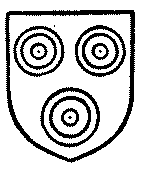
Standish of Standish. Sable three standing dishes argent.
William was, about 1322, succeeded by his son John, who lived till about 1350, (fn. 20) and whose eldest son William appears to have died before his father without issue. (fn. 21) The manor descended to a younger son Henry, (fn. 22) whose brother Ralph distinguished himself and was made a knight. (fn. 23) Henry de Standish died in 1396 holding the manor of Standish and the advowson of the church of the lords of Leylandshire, also the fourth part of the manor of Shevington. Ralph his son and heir was then of full age. (fn. 24) By that time the tenure of Standish and Langtree was said to be by the third part of a knight's fee. (fn. 25)
Ralph son and heir of Henry de Standish in 1398 procured a general pardon from the king. (fn. 26) He seems afterwards to have been appointed escheator in Ireland and to have died there. (fn. 27) He was succeeded about 1418 by his son Lawrence, (fn. 28) who revived the ancient family claim to the advowson of Wigan, and received certain compensation. (fn. 29) He died about 1434, (fn. 30) his son being Sir Alexander, to whom in 1423–4 an annuity of 20 marks had been granted by the Crown for his services. (fn. 31) He did not long survive his father, dying in 1445 holding the manor of Standish, the advowson of the church and various lands in Standish and Shevington, also a burgage in Ormskirk. (fn. 32) Ralph, his son, of full age, augmented the family inheritance by marriage with Margery daughter and co-heir of Richard Radcliffe of Chadderton (fn. 33); in 1452–3 he obtained general pardons from the Crown. (fn. 34)
Alexander, his son, succeeded him about 1468. (fn. 35) He was knighted in Scotland in 1482, (fn. 36) and died in 1507 holding the manor of Standish of Sir Edward Stanley, Sir Richard Shireburne and Lady Le Strange in socage by a rent of 5s. yearly, together with other manors and lands. Ralph, his son and heir, was twenty-eight years of age. (fn. 37)
Ralph also married an heiress—Alice, one of the daughters of Sir James Harrington of Wolfage. (fn. 38) He died in 1538 holding the manor of Standish, the advowsons of the church and the three chantries, with lands, &c., in Standish, Wigan, Shevington, Worthington and Coppull; a third part of the manor of Chadderton, and lands in Chadderton, Glodwick, Witton and Rochdale; lands, &c., in Duxbury, Chorley, Blackrod, Heath Charnock, Charnock Richard, Ormskirk and Wrightington. The manor of Standish was held of the Earl of Derby, Lord Mounteagle, and Richard Shireburne by a rent of 6s. 8d. Alexander son and heir of Ralph was then thirty-six years of age. (fn. 39) Alexander died within a year of his father, in 1539, leaving a son Ralph, only nine years of age, (fn. 40) who was taken into the king's wardship and died in 1546, (fn. 41) his younger brother Edward, born in July 1532, being the heir. (fn. 42)
Edward Standish thus grew up in a time of great religious and social changes, and, though notoriously hostile to the Reformation, (fn. 43) he seems to have been able to avoid conviction for recusancy. His method was thus described in 1577 by the Bishop of Peterborough: 'There is one Mr. Standish, supposed to be a man of 500 marks yearly revenue and worth £1000 in substance, that dwelleth some time at Wolfage, a house in Northamptonshire in the parish of Brixworth; but for the most part he dwelleth in Lancashire as I am informed—where he is said to be ever when I send for him, so that I could never get him to any conference as yet. But I am certified by very credible report, and do believe, he never came to the church since the queen's majesty's reign.' (fn. 44) He added to his estates by purchase, (fn. 45) and by the marriage of his son Alexander with Elizabeth daughter and heir of Adam Hawarden of Woolston secured another increase. (fn. 46) He died in 1610 holding the manors of Standish and Langtree, and the advowson of the church, of Richard Shireburne and Edward Rigby in socage by a rent of 6s. 8d., various other lands in Lancashire and the manor of Brixworth in Northamptonshire. Alexander his son and heir was over fifty years of age. (fn. 47)
Alexander resided at Woolston, and Standish was assigned to his son Ralph, who had married Frances Gerard, (fn. 48) and who succeeded to the whole inheritance about 1623. (fn. 49) Ralph Standish also avoided conviction for recusancy, and perhaps on account of his age took no part in the Civil War. (fn. 50) The eldest son Edward, described as of Woolston, took the king's side, and his estates were sequestered by the Parliament and sold. (fn. 51) A younger son, Alexander, was a colonel in the king's army, and part of the father's estate was sequestered in consequence. (fn. 52)
Edward Standish succeeded his father about 1656; he recorded a pedigree in 1664, being then fortyseven years of age, (fn. 53) and died in 1682, leaving a son and heir William, who died in 1705. (fn. 54) William's heir was his son Ralph, who joined the Jacobites in 1715, but secured his liberation and the restoration of his estates. (fn. 55) He died about 1752, (fn. 56) and his son having died before him without surviving issue the inheritance ultimately went to the issue of a daughter Cecilia, who had married William Towneley of Towneley. (fn. 57) Her second son, Ralph Towneley Standish, had Standish, but died without issue, and the manor went to his sister Cecilia's son Thomas Strickland of Sizergh, who assumed the name of Standish. He died in 1813, and on a division of his estates Standish became the share of his son Charles Strickland Standish, who died in 1864. (fn. 58) His son Charles Henry Widdrington Lionel Standish succeeded him, and dying in 1883 was in turn succeeded by his son, Mr. Henry Noailles Widdrington Standish, the present lord of the manor.
STANDISH HALL is situated to the south-west of the village, near the western boundary of the township, on high ground facing south, overlooking the valley of the Douglas. The house has been built at different periods, and consists of two main blocks at right angles to one another, the south front forming a kind of courtyard inclosed on its north and east sides The original building seems to have been of the usual H type, of timber and plaster on a stone base, facing east and west. The middle wing of this house, built about the year 1574, forms part of the east wing of the present building, but on its east side the external wall has been rebuilt in brick within the last few years and the lower part brought forward. To the north of this a brick wing has been added, probably towards the end of the 17th century, when many alterations appear to have been made in the original house, and the south wing was rebuilt as a chapel in 1742–3. In 1748 the present three-story square brick wing, which forms the principal part of the house, was built to the west, and there was a later addition in 1822, when a long one-story wing was built still further west, consisting of dining and drawing rooms. The appearance of the house with its variety of dates is interesting and not unpicturesque, the old black and white 16th-century wing—the upper part of which is carried on a plaster cove—grouping well with the 18th-century brick chapel and the later tall, plain building between which and the chapel it forms the connecting link. All the roofs are covered with stone slates and the half-timber front has quatrefoil panels on the ground floor, with a long window of nineteen lights above, between which and the cove are square panels with diagonal bracings. The great hall, which was originally about 36 ft. by 17 ft., is now used as a billiard room and has been so much altered and modernized as to preserve nothing of its original appearance. It appears always to have had a flat ceiling, and the three rooms and corridor over it, on the upper floor, probably preserve the old plan, though two of the rooms are modernized. The third, however, as well as the corridor, retains its old oak panelling, and a door at the end of the corridor has good Ionic pilastered jambs, probably of the same date as the later 17th-century wing to the north, which has several interesting rooms on the first floor with Renaissance wainscoting, and a good staircase with turned balusters. In one of the bedrooms, which has square oak panelling the full height of the walls, is a fine fireplace with a large plaster shield with the Standish arms (fn. 59) and crest, with cherubs' heads as supporters. A doorway in this room has bold Ionic pilaster architraves, and all the detail of the wainscoting is good. The room known as the library, also on the first floor, is wainscoted with tall boldly-moulded panels opening as doors to bookcases behind—a very good example of late 17thcentury woodwork. In the fireplace the Ionic pilaster with dentilled cornice is again used with good effect.
The chapel consists of a chancel 13 ft. 6 in. by 13 ft. and nave 29 ft. 8 in. by 19 ft. 6 in.; it is now very dilapidated, having been disused for a long period. It is built of brick with gabled ends and has a wooden turret at the west and clock in the gable. The windows are lofty and with semicircular heads, the whole being a rather dignified example of Renaissance brickwork. The old gallery at the west end with its shaped balustraded front remains, but the plaster of the ceiling and walls is broken and falling to pieces, and the sanctuary has been stripped of its ornamentation, though the carved rails and the classic altarpiece with Tuscan columns and broken pediment remain. High up in the north wall is a window from one of the upper rooms in the old building, which was at one time used by the priest in charge. In the south wall are two pieces of moulded oak about 6 ft. apart which appear to be of 16th century date and are very probably part of the old south wing of the house round which or on whose foundations the chapel may have been partially built. There is a spout head on the south side dated 1743. Originally the chapel was entered by a door at the west end of the north wall, approached from the house by a covered way along the outside of the 16th-century wing, but this is now built up, the only entrance being by the door on the north side of the sanctuary.
The later three-story block is without any external architectural features except in the doorway, which has a pedimented head and good detail. The window openings, however, are well proportioned and the windows retain their original barred sashes, and a plain parapet and hipped roofs give a certain dignity to the front, which is, however, destitute even of stone quoins to the angles. A spout head bears the date 1748 and the initials of Ralph and Mary Standish, and the interior contains two interesting 17th-century carved oak mantelpieces brought here from Borwick Hall. One is in the old drawing room, now the morning room, immediately to the right of the entrance and is an elaborate piece of work with two panels separated by carved figures supporting a cornice and strapwork frieze. The first panel contains the royal arms, (fn. 60) with garter and motto and lion and unicorn supporters. The other shield has the arms of Bindloss of Borwick impaling Eltofts, with the inscription 'byndlos 1603 eltofts.' The morning room is panelled all round with square-framed diamond-shaped 17th-century panelling, now painted white, and has a good 18th-century plaster ceiling. The mantel in the study is of somewhat similar type, with the royal arms in the first panel, but without the Scotch and Irish quarters, inclosed by the garter and surmounted by the crown, with motto and lion and griffin supporters. The other panel has the arms of Bindloss of Borwick impaling Dalton. The fireplace below is of 18th-century date and bears the arms of Standish impaling Howard. (fn. 61) The wide 18th-century staircase is built side by side with the earlier one, divided only by a wall, and has a substantial fretwork balustrade.
A spout head on the low west wing has the date 1822 and the initials of Charles Standish.
The moat encircling the hall is said to have been filled up in 1780, at which date much of the original building was removed. (fn. 62)
The descent of LANGTREE cannot be traced in full detail. The Siward de Langtree who had a moiety of the manor of Standish in 1206 (fn. 63) may have been the same as the Siward de Standish of 1177–8. (fn. 64) He was a benefactor of Cockersand Abbey, (fn. 65) and his son Richard, who succeeded in or before 1219, (fn. 66) was also a benefactor. (fn. 67) In 1246 a Henry de Standish appears to have been in possession, (fn. 68) and his son, Henry de Langtree, about 1270 acknowledged that he held by hereditary right three tenements in Worthington, Langtree and Shevington of the Abbot and convent of Cockersand, paying 12d. rent for each and ½ mark at death. (fn. 69) In 1288 he held Langtree of William de Ferrers by homage and a service of 5s. 8d. yearly. (fn. 70)
The next of the family found in possession (fn. 71) is Thomas de Langtree, in the time of Edward II, (fn. 72) from whom the descent can be traced, with but one break, to Richard Langtree, who died in July 1527 holding the manor of Langtree, with messuages and lands in the township, of the Earl of Derby, Lord Mounteagle, and Hugh Shireburne as of the manor of Chorley in socage by a rent of 5s. 8d. (fn. 73) John, his son and heir, who was then twentytwo years of age, (fn. 74) died in 1564 holding the manor as before and six burgages in Wigan (fn. 75); his heir was his son Gilbert, thirty-four years of age, who recorded a pedigree in 1567 (fn. 76) and made a settlement of his estates in 1588. (fn. 77)
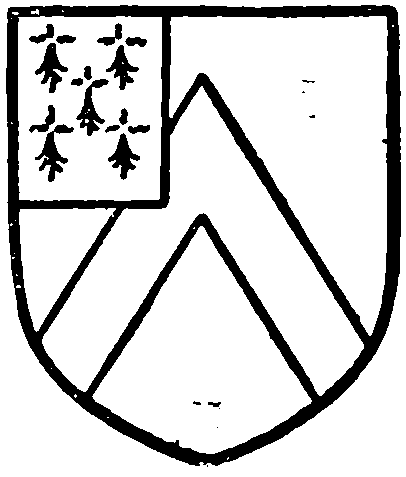
Langtree. Sable, a cheveron argent, a canton ermine.
The family seem to have acted a more consistent part than their neighbours of Standish, being found among the recusants convict.' (fn. 78) The heavy penalties resulting probably contributed to their ruin, for though Thomas Langtree, lord of the manor during the Commonwealth, did not take any active part against the Parliament, his lands were sequestered for recusancy, and he was overwhelmed with debt. (fn. 79) The estate was confiscated in 1652 and sold, (fn. 80) and the family disappears from view. (fn. 81) The manor also ceases to be named.
BRADLEY was formerly part of the Duxbury estate. (fn. 82) The hall was at one time the property of the Claytons of Adlington. (fn. 83) The Bradshaghs, (fn. 84) Gidlows, (fn. 85) Fords of Wigan (fn. 86) and other neighbouring families had lands in Standish. (fn. 87)
In addition to Cockersand, the Hospitallers (fn. 88) had lands in Standish. The holding of Thomas Fleetwood of Rossall in 1570 was perhaps a purchase of some of the old religious endowments. (fn. 89)
In 1542–3 the landowners contributing to the subsidy were the wife of Richard Langtree, John Langtree and Ralph Bradshagh, (fn. 90) and in 1564 Edward Standish, John Langtree and Seth Foster. (fn. 91) The sequestrations and confiscations of the Commonwealth period had their effects in Standish, (fn. 92) and a number of 'Papists' registered estates in 1717. (fn. 93) James Blundell, yeoman, incurred forfeiture for treason in 1715. (fn. 94) Edward Standish was the principal landowner in 1786, paying about a fifth of the land tax. (fn. 95)
The parish church has been described above.
The Wesleyan Methodists have a small church, built in 1897, and the Primitive Methodists one built in 1891.
The Society of Friends had a meeting place in Langtree in the 18th century. The burial-ground still remains. (fn. 96)
In a place where many of the inhabitants long adhered to the ancient religion with great resolution (fn. 97) it is probable that mass was said frequently during the severest times of proscription (fn. 98) at Standish or Langtree Hall or elsewhere. (fn. 99) The succession of priests is known from about 1715. (fn. 100) The existing church of Our Lady of the Annunciation was built in 1884, the chapel at Standish Hall, built in 1742, having been used till then. A pre-Reformation chasuble, with ancient chalice and altar stones, have been preserved.