A History of the County of Lancaster: Volume 6. Originally published by Victoria County History, London, 1911.
This free content was digitised by double rekeying. All rights reserved.
'The hundred of Blackburn: Introduction and map', in A History of the County of Lancaster: Volume 6, ed. William Farrer, J Brownbill (London, 1911), British History Online https://www.british-history.ac.uk/vch/lancs/vol6/pp230-234 [accessed 30 April 2025].
'The hundred of Blackburn: Introduction and map', in A History of the County of Lancaster: Volume 6. Edited by William Farrer, J Brownbill (London, 1911), British History Online, accessed April 30, 2025, https://www.british-history.ac.uk/vch/lancs/vol6/pp230-234.
"The hundred of Blackburn: Introduction and map". A History of the County of Lancaster: Volume 6. Ed. William Farrer, J Brownbill (London, 1911), British History Online. Web. 30 April 2025. https://www.british-history.ac.uk/vch/lancs/vol6/pp230-234.
THE HUNDRED OF BLACKBURN
containing the parishes of
Blackburn; Whalley; Mitton (part); Chipping; Ribchester (part)
At the date of Domesday Book the hundred consisted only of the parishes of Blackburn and Whalley, but early in the 12th century, owing to the territorial connexion of the parishes of Chipping and Ribchester with the honor of Clitheroe and the Lacy family, that part of the district of Amounderness which is comprised in the parish of Ribchester, except the township of Alston-with-Hothersall, and in the parish of Chipping, the township of Aighton, Bailey and Chaigley and part of the forest or chase of Bowland belonging ecclesiastically to the Yorkshire parish of Great Mitton were annexed to this hundred. Several small parts, such as Clitheroe Castle, were considered to be extraparochial. (fn. 1) Thus constituted the hundred is bounded on the north and east by the county of York, on the south by the hundred of Salford, and on the west by Leyland Hundred and the River Ribble until the township of Ribchester is touched, then the boundary passes north-west and west around the northerly side of Alston-with-Hothersall to the source of Savock Brook, thence in a northerly direction, ascending the River Loud for a short distance, between the forest of Bleasdale and Chippingdale over the summit of Parlick Fell to Wolfsty Fell, thence along the boundary of Yorkshire in an easterly direction to the River Hodder, and so descends that water to the confluence with the River Ribble. The hundred comprises a total area of 174,437 acres. Within or upon its boundary are the following elevations:—Pendle Hill, 1,830 ft.; Wolfsty Fell, 1,701 ft.; Boulsworth, 1,700 ft.; Wolfstones in Trawden, 1,455 ft.; Parlick, 1,416 ft.; Black Hameldon, 1,573 ft.; Longridge Fell, 1,149 ft.; Cribden Moor, 1,317 ft.; Cartridge Hill, 1,316 ft.; Thieveley Pike, 1,474 ft.; Great Hameldon, 1,343 ft.; Bunk Hill, 1,498 ft. The scenery of the vale through which the Ribble winds its course is in many parts of great beauty, and the same may be said of the Calder and Hodder valleys.
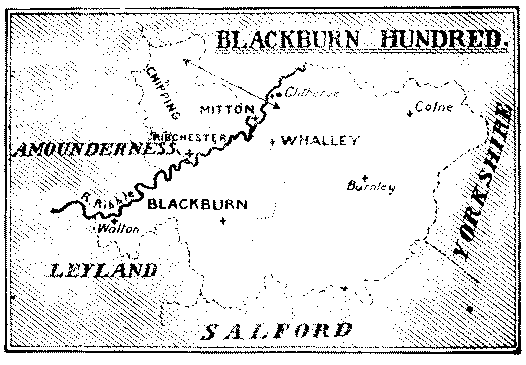
BLACKBURN HUNDRED.
Clitheroe Castle was the caput of the hundred, (fn. 2) and there the hundred court was held every three weeks. (fn. 3) The lord of Clitheroe took all the profits and was not accountable for them to the sheriff. This court was vulgarly termed 'the Wapentake court of Blackburnshire,' and dealt chiefly with small pleas of debt and trespass where the amount claimed was less than 40s., (fn. 4) but pleas of distraint resisted and other pleas of the Crown and pleas by return of the king's writ could not be dealt with. (fn. 5) The lord of Clitheroe had his own bailiff of the wapentake to make distresses and attachments, and also claimed to have suit of all trespasses committed within the hundred either at the suit of the complainant or by virtue of office if no suit were made, and to attach the trespasser to appear in court, and to punish him according to the offence, save in pleas of the Crown. Provided that the word Bloodwite was not named in court by the complainant he claimed also the right to punish a trespasser for violent assault and bloodshed. (fn. 6) Any thief or other malefactor taken in the fee for an offence which the lord was not competent to try was to be delivered to the king's bailiffs, but the king's bailiffs did not originally enter the fee to make distraint or levy attachments unless the lord's bailiffs went with them. In 1292 the Earl of Lincoln complained that this privilege had since the year 1278 been violated by the king's bailiffs. (fn. 7) The lord also claimed amends of the assize of bread and ale broken, infangenthef, utfangenthef, and waif in the hundred, and gallows at Clitheroe, and for himself and his free-tenants to be quit of the custody of felons and thieves arrested, and of common fines and amercements of the county and suits of the county court. (fn. 8) A little later the hundred occurs as a recruiting ground for men to take part in the war in Scotland. (fn. 9)
The office of king's bailiff of the wapentake of Blackburn was for a long time vested in the family of Singleton, who held the manor of Little Singleton by petty serjeanty by executing this office in this hundred and in Amounderness. (fn. 10) Henry Earl of Lancaster in the time of Edward III granted the bailiwick of the wapentake to the Abbot of Whalley, Gilbert de la Legh, Richard de Towneley and John de Altham. (fn. 11) During the Tudor period the hundred court ceased to be held regularly every three weeks and was ultimately held only a few times a year. During the same period two 'great or leet courts of the wapentake of Blackburnshire' were held for the king in April and October of each year, at which pleas of wounding or attempting to slay, rescues from the king's bailiffs, and trespasses committed on freehold lands held of the Crown in the hundred were presented and tried. (fn. 12)
About one-half of the total area of the hundred was demesne land of the lord, of which part was let to farm for term of years, part was in the hands of tenants at will, customary tenants and tenants holding in bondage, and a great part was forest or chase. (fn. 13) Of the remainder of the hundred about a half was in the hands of tenants holding by knight's service, and another half in the hands of free tenants holding in thegnage. (fn. 14) Owing to the destruction of the early halmote rolls of the honor of Clitheroe it is not possible to trace the evolution of the copyhold tenants of the Tudor period from the tenants at will, customary tenants and tenants in bondage of the 13th and 14th centuries, but a fragment of a halmote roll for the year 1377 shows that the predecessor of the later copyholder was then holding his land 'according to the custom of the manor' and was subject to by-laws similar to those found in force in the Tudor period. (fn. 15) In the demesne manors a great increase of value is observable between 1242 and 1346 owing to the improvement of land taken from the waste. The manors held in demesne were Colne, Great and Little Marsden, Briercliffe, Burnley, Ightenhill, Habergham, Padiham, Huncoat, Hapton, Accrington, Haslingden, Downham, Worston, Chatburn and Little Pendleton. (fn. 16) The forests or chases were Pendle, Trawden, Accrington, Rossendale, Hoddlesden and Ramsgreave. (fn. 17) The manors held in thegnage were Twiston, Chipping, Thornley, Wheatley, Ribchester, Dutton, Dinckley, Henthorn, Wilpshire, Clayton-le-Dale, Salesbury, Osbaldeston, Samlesbury, Read, Simonstone, Oswaldtwistle, Livesey, Birtwistle, Church, Cliviger and Worsthorne. (fn. 18) The manors held by knight's service have already been tabulated in the chapter on the Feudal Baronage. (fn. 19) A few small estates were held by serjeanty. (fn. 20)
In 1066 King Edward held the hundred with demesne lands rated at 3½ hides or 21 plough-lands. The remainder of the hundred, consisting of 28 manors, was held by 28 freemen or thegns and was rated at 73 ploughlands. After the Conquest Roger of Poitou gave the hundred in its entirety to Roger de Busli and Albert Grelley, (fn. 21) but afterwards, probably in the reign of Rufus, it was given to Ilbert de Lacy lord of Pontefract and of the region of Bowland which adjoins this hundred on the north-west.
The hundred with the honor of Clitheroe followed the descent of the barony of Lacy, as described in the chapter on the Feudal Baronage, until the termination of the Lacy family in the male line in 1311, when it passed by the terms of the settlement made in 1294 (fn. 22) to Thomas Earl of Lancaster, becoming an integral part of the earldom of Lancaster, and later the duchy of Lancaster. From the attainder of the earl in 1322 (fn. 23) until the beginning of the reign of Edward III it remained in the Crown. (fn. 24) That sovereign in 1327 granted the hundred with the honor of Clitheroe to Isabella, the queen dowager, for the term of her life. (fn. 25) In the extent of 1346 she was returned as holding the castle with its members, paying yearly for castle guard of Lancaster 50s. due from five knight's fees. (fn. 26) On 22 March 1660–1 Charles II in consideration of the eminent services rendered to him by General George Monck, whom the previous year he had created Duke of Albemarle with other titles, granted to the duke in fee the castle, honor and lordship of Clitheroe with the demesne manors and tenements appurtenant to it, and the wapentake or hundred of Blackburnshire with the manors and members belonging to the same. (fn. 27)
From George Duke of Albemarle the hundred descended to his son Christopher, who having no issue gave his estate to his wife, Lady Elizabeth Cavendish, eldest daughter and co-heir of Henry Duke of Newcastle, and died at Jamaica in the year 1688. His widow married in 1692 Ralph Montagu first Duke of Montagu, who died in 1709. She was well known as the 'mad Duchess,' and died possessed of the hundred 28 August 1734, aged eighty years. (fn. 28) John second Duke of Montagu, son of the first duke by a former wife, succeeded to the hundred and died in 1749. His daughter and co-heir, Mary, married George Brudenell fourth Earl of Cardigan, afterwards Duke of Montagu. He died without male issue 23 May 1790, aged seventy-seven, having been created in 1786 Baron Montagu of Boughton, co. Northampton, for life with a special remainder of that dignity to the second and every other younger son of his only daughter Elizabeth, who had married in 1767 Henry third Duke of Buccleuch, and their issue in tail-male successively. (fn. 29) She had issue besides the fourth Duke of Buccleuch a third son, Henry James second Baron Montagu of Boughton, on whom this hundred and the honor of Clitheroe were settled after the decease of his mother, who died in 1827. Upon his death in 1845 without male issue they became the property of his cousin Walter Francis fifth Duke of Buccleuch, being second but first surviving son and heir of Charles William Henry fourth Duke of Buccleuch. The fifth duke died in 1884, when he was succeeded in the hundred and honor of Clitheroe by his second son Henry John, created in 1885 Baron Montagu of Beaulieu. By royal licence in 1886 he took the name of Montagu in addition to and after those of Douglas-Scott. He died in 1905 and his son succeeded to the title, but the father had in 1898 transferred the hundred with the honor to the Clitheroe Estate Company, which now has the whole lordship.
The leet court or great wapentake court of Blackburnshire continued to be held twice a year at Clitheroe Castle until 1842, when the Act for the appointment and payment of parish constables rendered it useless. The wapentake or three weeks court for small debts was abolished in 1868; its working had then become a nuisance rather than a convenience. (fn. 30)
Court rolls of the wapentake between 1509 and 1515 are preserved at the Record Office. (fn. 31) As an example of their contents it may be stated that the business of the great wapentake or leet court of Blackburnshire in 1559 included the fining of several persons for keeping unreasonable ways between various points. Roger Nowell of Mearley was fined for killing two of his neighbours' hunting dogs, while another man was punished for keeping two dogs called 'sheep worriers,' and another for milking other people's cows on the common pasture. Unlawful games, viz. cards and dice, were also censured. Two persons were fined 1s. each for placing 'dunghills and middens' in the street of Blackburn. At later courts the unlawful games noticed included shuffleboard, tabling for ale, nogs, and bowls and bowling alleys.
A century ago the hundred was divided into two parts, the Lower and Higher. The former included Blackburn parish and all that part of the hundred north of the Ribble, together with the townships of Church, Clayton-le-Moors, Haslingden and Oswaldtwistle.
Ecclesiastically the two parishes of Blackburn and Whalley formed the deanery of Blackburn as early as 1291 (fn. 32); the inclusion of Chipping and parts of Ribchester and Mitton in the hundred did not affect the church arrangements, for they remained in the deanery of Amounderness just as they had formerly been in the hundred of that name. Some of the names of the deans have been preserved. (fn. 33) In 1535 the deanery was held by the Archdeacon of Chester, and was farmed by Gilbert Haydock; the value for probate of wills and other dues was estimated as about £4 6s. a year. (fn. 34)