A History of the County of Lancaster: Volume 6. Originally published by Victoria County History, London, 1911.
This free content was digitised by double rekeying. All rights reserved.
'The parish of Blackburn', in A History of the County of Lancaster: Volume 6, ed. William Farrer, J Brownbill (London, 1911), British History Online https://www.british-history.ac.uk/vch/lancs/vol6/pp235-244 [accessed 9 May 2025].
'The parish of Blackburn', in A History of the County of Lancaster: Volume 6. Edited by William Farrer, J Brownbill (London, 1911), British History Online, accessed May 9, 2025, https://www.british-history.ac.uk/vch/lancs/vol6/pp235-244.
"The parish of Blackburn". A History of the County of Lancaster: Volume 6. Ed. William Farrer, J Brownbill (London, 1911), British History Online. Web. 9 May 2025. https://www.british-history.ac.uk/vch/lancs/vol6/pp235-244.
In this section
BLACKBURN
Blackburn; Little Harwood; Ramsgreave; Salesbury; Clayton-Le-Dale; Mellor; Witton; Pleasington; Over Darwen; Lower Darwen; Eccleshill; Yate and Pickup Bank (Ex.-Parochial); Tockholes; Livesey; Walton-Le-Dale; Cuerdale; Samlesbury; Balderston; Osbaldeston; Billington; Wilpshire; Dinckley; Great Harwood; Rishton
The parish of Blackburn occupies a central position in the county. The River Darwen, anciently named Derwent, rises on Darwen Moor, at the southern border, and, flowing through the south-western part of the parish, joins the Ribble a short distance below Walton Bridge. A tributary called Knuzden Brook, rising on Oswaldtwistle Moor, and in its lower course known as the River Blackwater, which gave name to Blackburn, flows through that town to join the Darwen at Finniscliffe Bridge in Witton Park. At the head of the River Darwen and its tributary Hoddlesden Brook are the highest elevations in the parish, White Hill on Darwen Moor, rising 1,320 ft., and Hoddlesden Moss 1,087 ft., above mean sea level. From these hills the land falls towards the River Ribble, which forms the north-western boundary of the parish. The Yoredale Rocks occur in the centre of the parish, the New Red Sandstone or Trias and the Permian in the valley of the Ribble; elsewhere the subsoil consists of the Millstone Grit and the Coal Measures. The parish contains 48,281 acres, (fn. 1) with a population in 1901 of 235,702 persons, chiefly engaged in the cotton-spinning and weaving industries.
The early history of the parish is not marked by any great events. The presence of the Romans is shown by the station at Walton-le-Dale, (fn. 2) and the battle of Whalley in 798 may have taken place at Langho. (fn. 3) The great hoard of coins found at Cuerdale may point to another battle in the neighbourhood about 930. (fn. 4) Before the Conquest Blackburn was a royal manor and gave its name to the hundred, but this headship was lost afterwards, the Norman lord of the district fixing his seat at Clitheroe. Blackburn then seems to have become a retired agricultural community. Edward II passed through it on 12 October 1323 on his way from Yorkshire to Liverpool. (fn. 5) The Wars of the Roses led to the forfeiture of Balderstone in 1487, and 'lusty lads' from Blackburn fought at Flodden in 1513, according to the old ballad.
The suppression of the minor monasteries appears to have been resented in Blackburn, just as elsewhere in the north, (fn. 6) but there were no leaders, and, apart from the suppression of Whalley, which involved considerable changes in the tenure of land in the parish, no one seems to have suffered, though the vicar was under suspicion. How a population so disposed had a century later become quite Puritan in tone is a matter which deserves some attention. There was no disposition towards religious alterations before the Reformation, (fn. 7) and in the time of Elizabeth the parish had numerous recusants (fn. 8); still, even then there was little open refusal to conform outwardly to the new services, though the vicar of Blackburn in 1559 was quickly deprived of his benefice. The local gentry in many cases remained attached to the old religion, but the imprisonments and fines incurred by Sir John Southworth in the persecution of the latter part of Elizabeth's reign seem to have deterred others from open opposition. The mass of the people were probably neglected altogether, the new vicar of Blackburn resigning, after a tenure of eighteen years, on the ground, as is supposed, of his inefficiency. (fn. 9) By that time new conditions were effective. A fresh generation, knowing little of Roman Catholicism except that it was proscribed by law, had grown up; the Archbishop of Canterbury appointed a pastor who showed himself a sturdy Puritan, (fn. 10) and the missionary priests who then began to appear from the colleges at Douay and Rome had to minister in secret where they found friends willing to risk the entertaining of them, (fn. 11) and the best they could do was to encourage those who remained faithful.
This seems the explanation of the change. The old, to a great extent, died away under the repression of the law; and the new, encouraged by the State and fostered by a zealous vicar, grew into strength. Passing by minor incidents recorded (fn. 12) —the visits of Camden the antiquary, (fn. 13) the witchcraft trials of 1612 involving the Southworth family, (fn. 14) the working of an alum mine at Pleasington, (fn. 15) and visitations of the plague in 1623 and later (fn. 16) —the Civil War shows the disposition of the people. (fn. 17) For the Royalists Sir John Talbot and Radcliffe Assheton of Cuerdale were collectors for the hundred. (fn. 18) In October 1642 Sir Gilbert Hoghton, while conveying away the arms which had been stored at Whalley, was set upon at Blackburn by the clubmen of the hundred and his purpose defeated. (fn. 19) The town was then made a garrison for the Parliament, and an attack upon it by the same Sir Gilbert on the Christmas Day following was repulsed. (fn. 20) About the same time it was supposed that Sir John Talbot had prepared a trap for the local leaders for the Parliament, inviting them to a friendly conference, but having 100 armed men at hand to fall upon them. About 300 of 'the Manchester men' thereupon set upon his house, put him to flight and killed or drove into the river many of his men, and in the house itself 'they found good pillage.' (fn. 21)
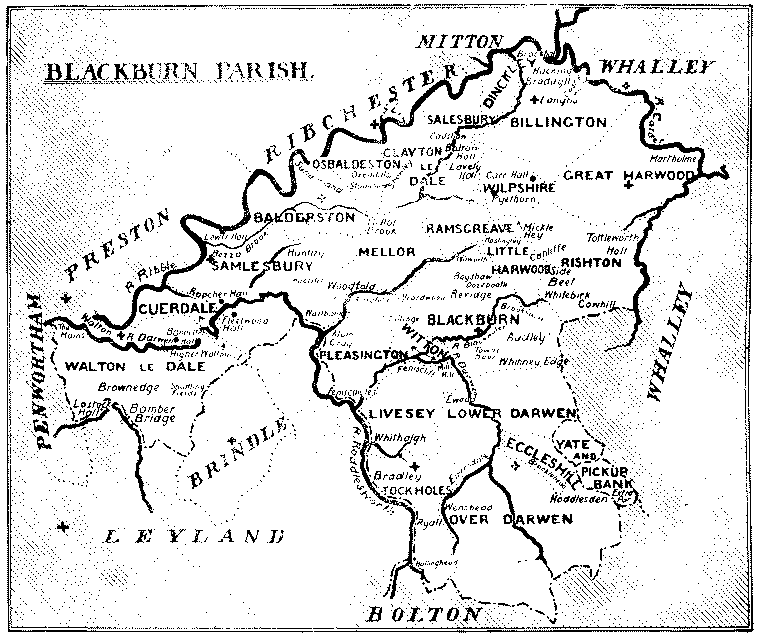
BLACKBURN PARISH.
In March 1643 the Royalists took Blackburn and rifled it, but were quickly compelled to give it up. (fn. 22) For more than a year it seems to have been left at peace, but in June 1644, when Prince Rupert was marching into Yorkshire after the relief of Lathom and the capture of Liverpool, he passed through the town, and some fighting took place, Colonel Shuttleworth being defeated by him. (fn. 23) Walton-le-Dale, from its position at the passage of the Ribble, saw a little more of the war in 1644 (fn. 24) and 1648. (fn. 25) The Parliamentary rule was accompanied by the sequestration or sometimes confiscation of the estates of those who had taken the king's side (fn. 26) or were Roman Catholics in religion (fn. 27); the number of these cases is larger than might have been expected, including not only some of the greater landowners, such as Sir John Talbot, but many of the smaller men, one case being dismissed because the 'delinquent's' estate was less than £200 value. (fn. 28)
The county lay of 1624, founded on the old fifteenth, required this parish to pay £29 19s. 7½d. when the hundred had to raise £100. (fn. 29) Meantime the foundations of the local manufacturing industry were being laid. In the time of Elizabeth Blackburn was one of the places where an alnager for certifying the woollen stuffs was needed (fn. 30); a linen manufacture is traced to the time of Charles I, (fn. 31) and the characteristic 'checks,' a combination of linen warp and cotton woof, are supposed to have been made first about 1650–60. (fn. 32) A fortnightly fair was begun about the same time. (fn. 33)
After the Restoration local affairs went on smoothly. The hearth tax returns of 1666 give some indication of the condition of the people. Apart from the houses of the local squires few had more than two hearths to be taxed, except in the leading townships of Blackburn and Walton-le-Dale. In the town of Blackburn itself there were 285 hearths liable. Mrs. Fleetwood's house had ten, those of Lawrence Haworth, Leonard Clayton, Randle Sharples and Richard Elston had six each, two houses had five, nine four and twenty-three three. (fn. 34)
Only one curate (fn. 35) was ejected in consequence of the Act of Uniformity, but Nonconformity was strong and a number of licences were taken out during the temporary Indulgence of 1672. It may be assumed, therefore, that the Revolution was welcomed here, and in 1715 the people appear to have been zealous for King George. (fn. 36) One of the local gentry, William Walmsley of Showley, was captured at Preston among the Jacobites, but he was acquitted. His father, Richard Walmsley, and a large number of 'Papists' registered their estates in 1717. (fn. 37) In the second half of the century Methodism was introduced and spread, but it was not till 1780 that Wesley himself preached in the town of Blackburn, and then he appears to have been welcomed by the townsmen in a body, all the chief men being present to hear him. (fn. 38) Cotton manufacture and calico printing were introduced about 1770. (fn. 39) Thomas Pennant thus describes Blackburn in 1773:—
The town is seated in a bottom surrounded by hills; it is at present rising into greatness, resulting from the overflow of manufactures in Manchester, for the artificers retreat to cheaper places and less populous. The manufactures are cottons: con siderable quantities are printed here; others are sent to London. The fields around are whitened with the materials which are bleached on them; the thread, which must be ranked with them, is brought from Ireland. The streets are irregular; but some good houses, the effect of wealth, begin to appear here and there in several places. . . . The ground about the town is very barren, and much of it sandy; coal is found in plenty in the south end of the parish, and in several parts much stone slate, which is used for a cover for the houses. (fn. 40)
The town grew rapidly and about 1793 contained the parish church and its chapel of ease and five places of worship for different persuasions of Dissenters. There was also a poor-house. The market was on Monday, but the chief supply of provisions was from Preston. 'Shelled groats' were bought by the townspeople about Michaelmas, ground to meal, and stowed in arks, where they were trodden down hard while new and warm to serve for the year's bread, which was chiefly oat cakes. There were an annual fair on May Day and a fortnightly cattle fair. Darwen, to the south, was a populous district manufacturing a large quantity of cotton goods. (fn. 41) The extension of trade led to a growth of buildings, facilitated by the leasing of the vicar's glebe, (fn. 42) and to the improvement of the roads, which went on rapidly from 1789 to 1825 (fn. 43); the Leeds and Liverpool Canal reached this place 1810–16. (fn. 44) The first railway, that from Blackburn to Preston, was opened in 1846. (fn. 45)
The introduction of machinery led to the usual disturbances. Hargreaves, the inventor, was born not far from Blackburn, and several of his 'jennies' were wrecked in a riot of 1768. (fn. 46) The Radical agitation of a century ago strongly affected Blackburn, and some of the local leaders were tried in 1820 for having taken part in a great meeting near Burnley. (fn. 47) In 1826 there was a loom-breaking riot, (fn. 48) and 'plugdrawing ' marked 1842. (fn. 49) The severe cotton famine of 1862–3, due to the Civil War in the United States, caused great distress in the district, and it is stated that in the town alone 30,000 persons were dependent on charity at the end of 1862. (fn. 50)
Under the Reform Act Blackburn became a Parliamentary borough, returning two members. The boundaries have been enlarged. The remainder of the parish is chiefly in the Darwen division of the county; a small part on the east is in the Accrington division.
Church
The parish church of ST. MARY CHURCH THE VIRGIN (fn. 51) stands on rising ground in the centre of the town close to the railway station. Since the covering in of the River Blackwater on the south side and the formation of a boulevard on the east the appearance of the churchyard, which is now grass-covered and planted with trees, has been much improved. It was formerly bare and neglected. The church is a modern Gothic stone-built structure, erected at the beginning of the 19th century, the foundation stone having been laid in 1820 and the consecration having taken place in 1826. The architect was John Palmer, (fn. 52) and considering the period at which it was built the design, which follows more or less the style of the 14th century, is not without merit. The building stands on the site of the old grammar school. The former church, which stood more to the north, (fn. 53) seems to have been a building originally of the 14th century, but much altered and renovated in the 16th. (fn. 54) A drawing from the south-east made by the Rev. S. J. Allen a few years before the demolition of the structure shows it to have consisted of a long chancel with north and south chapels, nave with south (and presumably north) aisle, south porch and west tower. The roofs of the chancel and nave had overhanging eaves, and the clearstory windows (six to the chancel and seven to the nave) were square-headed and of two lights. The east window was of four lights with tracery under a pointed head. The tower had an embattled parapet and short spire, and the walls of the chapel south of the chancel, known as the Walmesley chapel, (fn. 55) were also embattled. The north chapel belonged to the family of Osbaldeston of Osbaldeston, and was used as a private oratory and mortuary. A list of the principal monuments in these two chapels has been preserved. (fn. 56) The church probably took the place in the 14th century of a still older building, some of the materials of which were used in its erection; fragments of them, described as 'portions of arcuated stones with dog-tooth ornaments, the remains of a doorway, and sculptured Norman capitals,' were brought to light in 1820 when the fabric was demolished. (fn. 57) Whilst the new church was building a portion of the east end of the old church was left standing and used for baptisms, marriages and funerals. (fn. 58) The old tower stood in the churchyard till 1870. (fn. 59)
The present building consists of a short chancel with north and south vestries, nave with north and south aisles and west tower with north and south porches having stairways to the galleries. (fn. 60) The tower has a pierced parapet with angle pinnacles and the walls of both nave and aisles are embattled. The nave consists of six bays, the easternmost of which is now used as part of the chancel, the original chancel being little more than a recessed portion of the nave flanked by nine shafts receding towards the east window and carrying a similarly constructed pointed arch of nine orders. There are side galleries and the organ is in a separate gallery at the west end. In 1831, the roof being destroyed by fire, a reconstruction was necessary. The church was renovated and reseated in 1875, and a further renovation took place in 1905.
In the west porch, under the tower, are eight oak quire stalls from the old church with carved misericordes. Two of these have good leaf patterns, and the others represent an ape hunt, the fox preaching to geese, the temptation of Adam and Eve and the emblems of three of the evangelists—SS. Matthew, Mark and Luke. (fn. 61) In the galleries are preserved a number of old oak benches with shaped ends.
There is a ring of ten bells, six by Abel Rudhall of Gloucester, cast in 1737 from a former ring of five, (fn. 62) and four by Mears & Co., 1852. The tenor bell, being cracked, was recast in 1747. The curfew bell used to be rung at 8 p.m. (fn. 63)
The church plate consists of a chalice of 1630, with the inscription 'Ex dono Thome Smithe 1630'; another chalice, inscribed 'Ex dono Ed. Gellibrand. Dat. in us. Eclie Blackborne. Ano Dni. 1645'; a cylindrical cup, inscribed 'Ex dono Edwardi et Roberti Bolton Dat: Eclis: Blackburne. Anō. D[omi]ni 1653'; a breadholder of 1685–6, inscribed on foot '1686. Ad usum Eccl. de Blackburn in Com. Lancastriae. Ex dono Thurstani Maudsley de Ousbough'; another chalice without inscription but ornamented all over the bowl with arabesque chasing; a flagon of 1764–5, inscribed 'God knows who gave this'; a breadholder of 1807, and a modern Gothic chalice. There are also two small plated patens.
The registers begin connectedly in 1600, but there are a few detached entries for the year 1568. There is a gap between 1637 and 1651, but from this date onward the entries are continuous to the present time.
Advowson
In 1066 the church of Blackburn had an endowment of 2 oxgangs of land. (fn. 64) The lords of the manor, according to the tradition of Whalley, recorded at the beginning of the 14th century, then held the rectory also, this descending by hereditary right; these rectors would have to nominate priests to serve the church. (fn. 65) About 1170 more accurate testimony begins, but it is far from satisfactory. At that time Henry de Lacy, lord of Clitheroe, held the patronage of Blackburn Church, and granted the church in its integrity, viz. with the chapel of Walton and all rights and liberties, to Henry the clerk of Blackburn. (fn. 66) This was probably an innovation, though in what manner does not appear, for the new rector judged it necessary to obtain confirmation not only from the Bishop of Lichfield, (fn. 67) but also from the Archbishop of Canterbury. (fn. 68) In spite of the declaration as to the 'integrity' of the grant, Henry de Blackburn may have had but a mediety of the church, for Robert de Lacy, who died in 1193, granted to his clerk Adam de Blackburn that mediety of the church which Richard, his predecessor (antecessor), had held together with the benefice in the church of Whalley which belonged to Blackburn. (fn. 69) The 'benefice' refers to a fourth part of the revenues of the rectory of Whalley, which had been conferred on Blackburn.
The church thus appears to have been held in medieties from far back in the 12th century. In one place three rectors are named—Henry, Roger and Adam—but that is perhaps a mistake of copying. (fn. 70) The matter is involved in much confusion, owing to the similarity of names in undated charters, but the probability is that Henry was succeeded in his mediety by a son Adam, who is named as its holder about 1230 and as a recent holder about 1238 (fn. 71); while the former Adam was succeeded in his mediety by a son Roger, which Roger is likewise named as a late holder about 1238. (fn. 72) A local charter, which may be dated about 1213, was attested by Roger and Adam, rectors of Blackburn, (fn. 73) and somewhat later occurs Henry rector of Blackburn, (fn. 74) but it is difficult to see how he comes in.
These family arrangements probably offended the conscience of the time. Surrenders were made, and in 1238 both medieties were granted by John de Lacy to the monks of Stanlaw, so far as a layman could grant them, (fn. 75) and his son Edmund in 1251 confirmed the mediety formerly held by Roger de Blackburn. (fn. 76) With the latter mediety a moiety of the manor appears to have been joined, so that from that time the rectory has had half the manor. (fn. 77) Confirmations were obtained from the Bishops of Lichfield (fn. 78) and Pope Alexander IV in 1259–61, (fn. 79) and the abbey of Whalley remained in possession till the Suppression in 1536. The value in 1291 was £33 6s. 8d. (fn. 80); the ninth of sheaves was worth 2s. 3d. more in 1341 (fn. 81); in 1478 £89 16s. 9d. was received, (fn. 82) and in 1521 the value was £133 1s. (fn. 83); but in 1535 the rectory was returned as worth only £74 6s. 8d., out of which £10 13s. 4d. was paid to the vicar. (fn. 84)
The rectory was vested in the Crown till 1547, when by exchange it was granted to the Archbishop of Canterbury, (fn. 85) from whom it was held on lease by various farmers; of these the chief were the Fleetwoods in the 17th century and the Feildens later. (fn. 86) Surveys were made from time to time, (fn. 87) and Archbishop Sancroft, finding that the chapels of ease were badly served owing to the trifling stipends appropriated to them, purchased lands in Thornley, the rents of which he gave to the curates in 1688. (fn. 88) In 1853 the Ecclesiastical Commissioners obtained possession of the rectory estates, then called Audley and Brookhouse. (fn. 89) Some of the lands had been sold before this time, and further sales have since been made. Audley Hall, the seat of the rectory, was allowed to fall into decay. (fn. 90)
A vicarage was ordained when the rectory was appropriated to Stanlaw Abbey in 1259–60, (fn. 91) and in 1277 the Bishop of Lichfield decreed an augmentation; the vicar was to have a suitable dwelling-house, 2 oxgangs of land—the ancient endowment of the church—and a stipend of 40 marks. (fn. 92) The vicars afterwards complained that this allowance was too small, considering the due maintenance of hospitality and other burdens; but in 1289 William de Lench, who had threatened to appeal to Canterbury and to Rome, agreed to withdraw all claims in consideration of the benefits the monks had bestowed on him. (fn. 93) In 1535 the vicar's stipend, as above stated, was £10 13s. 4d., but it was reduced by various charges to £8 1s. 6d. (fn. 94) Afterwards the normal pension of £26 13s. 4d. was paid. In addition the vicar had the vicarage-house and 30 acres of land worth £20 a year in 1650, and other tenements then yielding £2 16s. 10d. of old rent. (fn. 95) The Committee of Plundered Ministers in 1649 granted an augmentation of £50 a year out of the Bishop of Chester's sequestered rectory of Bolton. (fn. 96) In 1651 a further grant of £50 was made to provide a weekly lecture at Blackburn, Mr. Michael Briscoe, a godly minister, being appointed. (fn. 97) These additions would cease at the Restoration, but Archbishop Juxon gave the vicar an additional £70 a year. (fn. 98) The income was about £150 a year in 1717. (fn. 99) An Act of Parliament obtained in 1796 enabled the vicars to grant leases of the glebe lands, which, being in the centre of the town, were desirable building sites. (fn. 100) At that time the value of the benefice was only £275 a year; the net value is now £1,452. (fn. 101)
The Abbot and convent of Whalley as rectors used to appoint the vicars, who were later appointed by the Archbishops of Canterbury. The patronage was in 1859 transferred to the Bishop of Manchester, (fn. 102) in whom it is now vested.
The following is a list of the vicars:—
| Instituted | Name | Patron | Cause of Vacancy |
|---|---|---|---|
| ? 1260 | John de Habindon (fn. 103) | — | — |
| oc. 1289 | William de Lench (fn. 104) | — | — |
| 16 June 1317 | Adam de Wallbank (fn. 105) | Whalley Abbey | d. W. de Lench |
| 6 July 1320 | Simon de Chester (fn. 106) | " | — |
| 26 May 1328 | John de Gresthwaite (fn. 107) | " | d. Simon |
| 15 Oct. 1362 | John de Lindley (fn. 108) | — | — |
| 27 Oct. 1369 | William de Wetherby (fn. 109) | Whalley Abbey | d. J. de Lindley |
| 3 June 1419 | Geoffrey Banastre, J.U.B. (fn. 110) | " | — |
| 8 Oct. 1458 | Bro. Robert Salley (fn. 111) | " | d. G. Banastre |
| 16 Dec. 1489 | Bro. Henry Salley (fn. 112) | " | d. R. Salley |
| 12 Mar. 1535–6 | Randle Linney (fn. 113) | " | res. H. Salley |
| 24 Oct. 1555 | James Hargreaves (fn. 114) | King and Queen | res. R. Linney |
| 18 June 1562 | John Hulton, B.D. (fn. 115) | Abp. of Canterbury | depr. J. Hargreaves |
| 10 Nov. 1580 | Edward Walsh (fn. 116) | " | res. J. Hulton |
| 23 Feb. 1606–7 | John Morres, M.A. (fn. 117) | ["] | [depr. E. Walsh] |
| 20 June 1628 | Adam Bolton, B.A. (fn. 118) | " | d. J. Morres |
| — May 1647 | Leonard Clayton, M.A. (fn. 119) | Election of the people The King | d. last incumbent |
| 6 Nov. 1662 | |||
| 5 Dec. 1677 | Francis Price, B.A. (fn. 120) | Abp. of Canterbury | d. L. Clayton |
| The King | |||
| 30 Apr. 1706 | John Holme (fn. 121) | Abp. of Canterbury | d. F. Price |
| 25 Aug. 1738 | John Potter, M.A. (fn. 122) | " | d. J. Holme |
| 16 Aug. 1742 | John Woollin, B.D. (fn. 123) | " | res. J. Potter |
| 7 Aug. 1772 | John White, B.A. (fn. 124) | " | d. J. Woollin |
| 27 Nov. 1780 | Thomas Starkie, M.A. (fn. 125) | " | d. J. White |
| 12 May 1813 | |||
| 7 Nov. 1818 | Thomas Dunham Whitaker, D.D. (fn. 126) | " | d. T. Starkie |
| 16 Feb. 1822 | John William Whittaker, D.D. (fn. 127) | " | d. T. D. Whitaker |
| 9 Aug. 1854 | John Rushton, D.D. (fn. 128) | Bp. of Manchester | d. J. W. Whittaker |
| 2 Apr. 1868 | Edward Birch, M.A. (fn. 129) | " | d. J. Rushton |
| — Mar. 1887 | Francis Alexander Randal Cramer-Roberts, D.D. (fn. 130) | " | d. E. Birch |
| 13 Apr. 1901 | Samuel Thornton, D.D. (fn. 131) | " | d. Bp. Cramer-Roberts |
| 1910 | Thomas Rawlinson Sale, M.A. | " | res. Bp. Thornton |
The earlier vicars are unknown men, and it will be noticed that the monks of Whalley appointed members of their own body in the century before the Reformation and seem to have paid a much lower stipend than was due. Randle Linney's sympathy with the Pilgrimage of Grace does not seem to have led to any penalty, and he remained vicar all through the time of Edward VI, though he was induced or compelled to resign in 1555. The proper service of the church, chantries and chapels of ease would require a large staff of priests, and the list of 1541–2 affords six names in addition to the vicar and cantarists, two being paid by the vicar and others by neighbouring landowners. (fn. 132) The visitation list of 1548 gives the vicar and thirteen others, three being marked mortuus by the registrar, two (or three) at Harwood and three (or two) at Walton-le-Dale, giving a staff of fifteen at least. (fn. 133) The confiscation of the chantries and the religious changes of the time naturally led to a considerable reduction, but in 1554 there were left at Blackburn the vicar and six others, at Harwood one (or two), and at Walton three (or four). The Roman Catholic revival, probably led by the new vicar, James Hargreaves, caused the erection or repair of chapels at Langho, Samlesbury and perhaps Darwen.
Hargreaves does not seem to have refused to appear before the queen's commissioners in 1559, but he soon made up his mind and in 1561 or early in 1562 he was deprived of his benefice (fn. 134) and spent the rest of his life in ministering in secret to those who remained constant to the old religion, (fn. 135) or in prison; it is supposed that he died in Salford gaol about 1584. (fn. 136) The visitation record of 1562 is defective for Blackburn and Harwood, but at Walton the old curate kept his place, (fn. 137) subscribing to the queen's supremacy in 1563, together with a new curate of Blackburn and the old curate of Harwood. (fn. 138) These with the vicar probably constituted the clerical staff that year as for long afterwards. (fn. 139) It is obvious that four ministers could do little to serve the large parish, and it is probable that the new statutory services were maintained fully at the parish church only, the chapels being visited in turn. Pilkington, Bishop of Durham, has provided a description of the state of things about 1564. Writing to the Archbishop of Canterbury, he says:—
Among many other things that be amiss here in your great cures ye shall understand that in Blackburn there is a fantastical (and as some think a lunatic) young man which says he has spoken with one of his neighbours that died four years since or more. Divers times he says he has seen him and talked with him and took with him the curate, the schoolmaster and other neighbours, which all affirm that they see him too. . . . It is too lamentable to see and hear how negligently they say any service there and how seldom. . . . The old vicar of Blackburn, Roger [Randle] Linney, resigned for a pension and now [liveth with Sir John Byron]. (fn. 140)
The lack of suitable ministers at the time is strikingly shown by the failure of a man like Archbishop Parker to place one at Blackburn. The vicars as a rule appear to have resided in the town. (fn. 141) Little is known of the story for some time, but in 1580 Hulton was induced or compelled to resign (fn. 142) and a strong Puritan was presented to the vicarage, (fn. 143) who refused to wear the surplice and was at last deprived in 1606. (fn. 144) From the later history he had probably the full sympathy of the Protestant population of the parish. His successor was more compliant, but in 1611 was censured for not wearing a hood and for receiving persons of other parishes to the communion at his church. (fn. 145) The next vicar's tendencies are shown by his acceptance of the Presbyterian discipline in 1646, when Blackburn became the head of a classis embracing the parishes in the hundred. (fn. 146) During the Commonwealth the various chapelries were fully served, stipends being provided out of royalist or episcopal sequestrations, but on the Restoration the old neglect returned. (fn. 147) This led to curious incidents in 1687, the chapel at Darwen being seized by the Protestant Nonconformists and that at Langho by the Roman Catholics. The vicar recovered possession, but appears to have taken more care afterwards for the serving of them, though it was not for a long time that each of the chapels of ease had its own curate. (fn. 148) The first additional church was built in 1789 in Blackburn, and since then with the growth of population church-building has gone on rapidly, both in renewing the old and in providing fresh places of worship. Most of the later vicars have been men of some distinction.
A Blackburn archdeaconry was formed in 1877 out of the archdeaconry of Manchester. (fn. 149)
Before the Reformation there were two endowed chantries in the parish church. A chapel of St. John Baptist 'le Soth' is named in the will of Henry Rishton of Dunkenhalgh, 1427; he desired to be buried there under his father's tomb. (fn. 150) The earlier of the chantries was founded at the high altar in 1454 by Geoffrey Banastre, then vicar, and in 1547 the incumbent, William Rishton, was celebrating according to his foundation statutes. His stipend of £4 13s. 4d. was derived from a charge on the rectory of Preston. (fn. 151) The second chantry was founded in 1514 by the Earl of Derby and the parishioners at St. Mary's altar in the south aisle of the church. The chaplain was to celebrate for the souls of the founders and others, 'to maintain the one side of the choir to the uttermost of his power every holy day,' and to keep a free grammar school or song school. Thomas Burgess was incumbent in 1547 and duly fulfilling his trust. His clear income was £5 8s. 8d., derived from lands in Burnley and elsewhere. (fn. 152) About the same time there was a 'rood service' before the principal crucifix in the church, lands in Ribchester being assigned for its maintenance in 1516–17. (fn. 153)
The grammar school is traced back to the chantry of 1514; it was refounded in 1567. (fn. 154)
Charities
Official inquiries were made concerning the charities in 1826 and 1904, but on the latter occasion the county borough of Blackburn was excluded. (fn. 155) The following details are taken from the reports:—
For the whole parish, apart from the school, there are few endowments. An ancient poor's stock of £30 and a gift of £2 from Widow Duckworth for bread on Good Friday for poor communicants, both existing in 1826, have been lost since. A gift of £10 for books, made by Vicar Woollin, has been lost or merged in Sarah Livesey's charity. This lady left £100 for binding poor children of Blackburn, Livesey and Pleasington to be apprentices. This form of charity having become useless, the income (£28) is, under a scheme made in 1887, devoted to providing 'Livesey exhibitions' tenable at higher-grade schools. Miss Nancy Derbyshire in 1893 founded six almshouses, building them and providing an income of about £220. There are twelve inmates, to be chosen from poor or infirm persons residing within 7 miles. An allowance of 4s. or 6s. a week is made to each; any surplus income is spent on out-pensions. The persons chosen are usually aged widows.
In 1826 the township of Blackburn had various benefactions for the poor invested in the purchase of estates called Lang House in Yate Bank and Southworth Green Farm in Mellor; the gross income was £64, out of which a distribution of money and blankets was made to the poor on New Year's Day. The vicar and two others were the trustees, and the estates were called the Poor's Lands. There was also a girls' charity school, founded by William Leyland in 1763. There were no endowments for Little Harwood, Ramsgreave, Witton and Clayton-le-Dale. At Pleasington there was a school; the township now shares in the Livesey exhibitions and has a small additional school endowment. At Salesbury Lady Bulkeley in 1823 left £500 for the poor; under a scheme of 1876 one moiety of the income (over £15 in all) was to be given in scholarships for poor children and the other moiety in various forms of relief, but most of the money continued to be given in money doles. At Mellor 7s. 6d. is given yearly to two aged widows, apparently from a gift by Thomas Guest in 1830. Miss Nancy Hargreaves left £1,000 for the poor; the interest (£31 10s.) is distributed by the vicar and churchwardens in money as occasion requires. There is an endowment for the Wesleyan chapel.
The charities belonging to the other townships are described under the several chapelries.