A History of the County of Lancaster: Volume 6. Originally published by Victoria County History, London, 1911.
This free content was digitised by double rekeying. All rights reserved.
'Townships: Walton-le-Dale', in A History of the County of Lancaster: Volume 6, ed. William Farrer, J Brownbill (London, 1911), British History Online https://www.british-history.ac.uk/vch/lancs/vol6/pp289-300 [accessed 30 April 2025].
'Townships: Walton-le-Dale', in A History of the County of Lancaster: Volume 6. Edited by William Farrer, J Brownbill (London, 1911), British History Online, accessed April 30, 2025, https://www.british-history.ac.uk/vch/lancs/vol6/pp289-300.
"Townships: Walton-le-Dale". A History of the County of Lancaster: Volume 6. Ed. William Farrer, J Brownbill (London, 1911), British History Online. Web. 30 April 2025. https://www.british-history.ac.uk/vch/lancs/vol6/pp289-300.
In this section
WALTON-LE-DALE
Waleton, xiii cent.; Waleton in le (la) Dale, usual since a.d. 1300.
The township lies on the south side of the River Ribble to the south-east of and almost opposite to the town of Preston; to the west and south it is bounded by the hundred of Leyland, the River Lostock and the tributary Clayton Brook forming the division on the latter side for some distance. The River Darwen flows through the north-eastern part of the township before falling into the Ribble, the two waters inclosing the village of Walton-le-Dale in a long peninsula. Ordinary tides flow a short distance above the point where the north-western boundary terminates in the River Ribble. The greater part of the township does not exceed 100 ft. in elevation above the ordnance datum; the highest ground reaches 300 ft. in the southernmost point. The area is 4,683 acres, and the population in 1901 numbered 11,271 persons, (fn. 1) of whom the larger part were at Bamber Bridge and Higher Walton. In the greater part of the township the subsoil consists of the Bunter pebble beds, but on the eastern side there are small areas of the Millstone Grit, Lower Coal Measures and Permian rocks. The soil is a rich loam.
Two main roads converge at the village and cross the river by Ribble Bridge, a stone bridge of three arches built in 1782, 50 yds. above the site of an older erection; the road from Manchester and Chorley crosses the River Lostock at Bamber Bridge and passes through the village of that name and Brownedge; that from Blackburn passes through Higher Walton. An inferior road connects with the main road from Preston to Clitheroe at Samlesbury. The Liverpool, Blackburn and Accrington line of the Lancashire and Yorkshire Railway Company passes through the southern part of the township, with stations at Lostock Hall and Bamber Bridge; from the latter place a branch line called the Bamber Bridge and Preston extension runs through Preston Junction to Preston, and from it a branch line passes over Walton Moss to connect with the main line of the London and North Western Railway Company; a branch of the Leeds and Liverpool Canal terminates on Walton Summit, and used to be connected with Preston by a tram line which passes through the village of Bamber Bridge.
The land consists principally of meadow and pasture; there is some arable, and in the lower ground a considerable amount of market gardening is carried on; there is a fair amount of woodland scattered over the township. (fn. 2)
A local board was formed in the year 1877, but under the provisions of the Act of 1894 the township is now governed by an urban district council of twelve members, and for urban purposes is divided into four wards.
The Working Men's Institute was erected in 1881 at the charge of Mr. Richard Calvert, who also furnished it with books and fittings.
The principal industry is cotton-spinning, carried on at Flats Mill in the village; there is also a water corn-mill.
Bamber Bridge is a populous village distant 2 miles south from Walton-le-Dale; it contains three extensive cotton manufactories. The hamlet of Brownedge, where there are iron-works, is a mile north on an eminence. School Lane is another hamlet. The village of Lostock Hall, formerly called Cuerden Green, is 2 miles west of Bamber Bridge. There is a cotton-spinning factory there also.
Higher Walton, formerly called Moon's Mill, is a village situated a mile east from Walton-le-Dale on the Blackburn road. There are two cotton factories, also yarn and piece dyeing works. Darwen Bank, standing in its own grounds of 70 acres, occupies an eminence near the village from which extensive and beautiful views of the neighbourhood may be obtained. Prospect Hill, the residence of Mr. William Gent, occupies a similar position.
Traces of a Roman station of minor importance were found here in 1855 by men employed in the repair of the highways during excavation for gravel of a large mound known as the 'Plump,' and two or three years later during excavations made in a garden 150 yds. to the south-west of the mound. A variety of miscellaneous articles were found, including pottery and coins. It has been suggested that the station was the Rigodunum of Ptolemy. (fn. 3)
In 1253 the boundaries of Walton against the township of Brindle, and in 1283 against Cuerdale, were for the first time properly defined by perambulation.
In answer to their petition pontage for five years was granted in 1302 to the bailiffs and good men of 'Walton-in-la-Dale' for building and repairing the bridges of Ribble and Derwent, to be collected from goods intended 'for sale passing over or under them.' A similar grant for two years was made to the commonalty of Blackburnshire in 1339 for the repair of Ribble Bridge. Again in 1400 pontage was granted for three years, renewed in 1403 for a similar period, for the repair of Ribble Bridge and for the construction of a stone bridge by the old one which had been broken by floods and ice. (fn. 4)
A number of Walton people were indicted and fined in 1323 for having stolen the goods and chattels of people fleeing from the Scots at Lostock Bridge about Midsummer the preceding year. (fn. 5)
The following field-names occur—Merstalknoll, Shuttlingfeld, Wyndebonkfeld, Nelfelt, Edolf Acre, Brounegge, (fn. 6) Mosvale, Suthale, Priding, Schipingflat, Alderthlegh and Huddefeld, possibly so called from one Huttemon, whose son Roger lived temp. Edward I; and these local features—Closbroke, Evesbroke, Bradleybroke, Holmesnape, Holynsnape, Thingeschawbroc and Bymbrig, the ridge or 'rigg' of one Bimme, whose son Roger held lands in the time of Robert Banastre on the north side of Burnulgate, the road leading to Brindle, and adjoining the Eves Brook and the oxgang lands. The name, being eventually applied to the bridge over the little River Lostock, took the form of Bamber Bridge, and has now extended to the district on the north side of the bridge.
The following seneschals of Walton have been
noted:—
Thomas Banastre, ante 1291
Gilbert de Haydock, temp. Edw. I
William de Hesketh, ante 1291
William de Blackburn, 11 Edw. II
Richard de Bradshagh, 13 Edw. II
Gilbert de Southworth, 17 Edw. II
Matthew de Haydock, temp. Edw. II
There are traces of four or five ancient crosses. (fn. 7) The folk-lore of the district has nothing distinctive. (fn. 8)
Leland writes of this district:—'Within a mile of Preston I cam over Darwent River, the which at Penwardine paroche, a celle to Evesham, goith into Ribil. This Darwent devidith Lelandshire from Anderness (sic) and a mile above, beyond the place wher I passid over Darwent, Mr. Langton dwellith at Walton-on-Darwent and is baron of Newton in Macrefeld. . . Half a mile beyond Darwent I passid over the great stone bridge of Rybill having a v great arches.' (fn. 9)
During the Civil War there were two skirmishes at Walton, the first on 15 August 1644, when the Parliamentary forces under Col. Nicholas Shuttleworth took prisoners Lord Ogilvy and Col. Huddleston of Millom Castle; the second on 15 August 1648, when Cromwell defeated the Royalist forces under the Duke of Hamilton and Sir Marmaduke Langdale. In this engagement the Royalists made a stubborn stand on Ribble Bridge, but were ultimately driven over Darwen Bridge and up the hill above Walton Town. Their artillery and transport with the duke's baggage were taken standing upon Walton Copp. Charles II also passed over Ribble Bridge in his march through Lancashire in 1651. (fn. 10)
In 1681 William Pulford, gent., obtained damages against the commonalty of Blackburnshire for trespass against the statute of hue and cry after he had been attacked by two malefactors in the lane leading between Walton and Bamber Bridge. (fn. 11)
Writing about 1685 Dr. Kuerden thus refers to the objects of interest on the highway between Bamber Bridge and Ribble Bridge:—
Passing the Lostoc Water at a fair stone bridge parting Leyland from Blackburn Hundred you meet with the other road from Chorley to Preston, and on your left the ancient seat of Walton of Little Walton, but now belonging to Mr. Ratcliff Ashton son of Mr. Ashton of Cuerdale. About half a mile further is another road from Brindle to Preston and shortly after you come to Walton, and leaving Walton Hall on the left, belonging to Sir Charles Houghton, you cross the Derwent at a large bridge which is 20 yds. between the springers, then enter Walton Cop for half a mile well rampyr'd with stone. On the right is a great road from Blackburn to Preston. At the end of the Cop you pass over a stone bridge where the Scotch army was first routed under Duke Hamilton by Cromwell. (fn. 12)
He describes Ribble Bridge as 'one of the statelyest stone bridges in the north of England.' It was the abandonment of the defence of this bridge which proved fatal to the Jacobite forces in 1715, and led to the surrender of the Earl of Derwentwater to Generals Wills and Carpenter.
The Mock Corporation of Walton founded in 1701 was not a Jacobite institution, but a social club patronized by those of the county gentry who sought occasions for convivial meetings. The officers included a mayor, deputy mayor, recorder, bailiff, chaplain, serjeant, physician, and mace-bearer; among other officers appointed during the early years of the institution were those of house-groper, jester, poet laureate, champion, huntsman or master of the hounds, sword-bearer, in 1708 a slut-kisser, and in 1711 a custard-eater, besides many others. Four staves covered with silver bands, on which are inscribed the names of the corporate officers for each year, and two silver-headed wands preserved at Cuerden Hall, remain of the once more numerous regalia. The 'moot hall' was held at the Unicorn Inn, near Darwen Bridge, and among the many notable persons who served the office of mayor were Thomas Duke of Norfolk (1709), James Earl of Derwentwater (1711), and Viscount Molyneux (1740). No records were kept after 1796. Many years later they were rescued from destruction at the hands of frequenters of the 'Unicorn' by Sir Philip Hoghton, bart., who removed records and regalia to Walton Hall, then his residence. In 1834 the regalia were removed to Cuerden Hall, the records remaining in the hands of Sir Henry de Hoghton, bart. (fn. 13)
Several noteworthy men have been natives of the township, including Edward Baines, the author of the history of the county, first issued in 1836. He was born in 1774, and became a journalist, editing the Leeds Mercury in 1801. He was M.P. for Leeds 1834–41, and died in 1848. (fn. 14) Roger Baxter, S.J., 1784–1827, was a missionary in Maryland, and wrote historical and controversial books. (fn. 15) Thomas Brindle, D.D., 1791–1871, established Prior Park College, near Bath. (fn. 16) Joseph Livesey, 1794–1884, was famous as a temperance advocate; he lived chiefly in Preston; his Autobiography was published in 1881. (fn. 17)
Alfred Borron Clay, 1831–68, attained distinction as an historical painter. (fn. 18)
Manor
WALTON, comprising two ploughlands, formed part of King Edward's demesne of Blackburn Hundred in 1066, and twenty years later of the demesne of Roger de Busli and Albert Grelley, who had leased the manor with the remainder of the hundredal demesne, having remitted the rent for three years to allow the farmers to re-stock and restore these lands to cultivation. (fn. 19) Soon afterwards the manor passed with the hundred to the Lacys of Pontefract and by Henry de Lacy (1146–77) was granted with Mellor, Eccleshill, Little Harwood, Over and Nether Darwen to Robert Banastre to hold by the service of one knight, rendering 10s. yearly at Midsummer for ward of Lancaster Castle, of which sum 4s. was contributed by this manor. (fn. 20)
The descent of the Banastres and of their successors the Langtons having been given in the Feudal Baronage, (fn. 21) it is only necessary to add here a few additional notes more immediately relating to Walton. In 1253 Robert Banastre brought proceedings in the King's Court against Peter de Burnhull for felling trees in Walton Wood, and in consequence a perambulation was ordered to fix the bounds between Walton and Brindle. (fn. 22) The abundance of wood in the northern and eastern parts of the township at this date indicates the aptness of the name 'weald tún.' Banastre obtained in 1257 a charter of free warren here, and in 1278 took action against four of the principal freeholders who had withdrawn their suit from Walton Mill, but they denied his title to the mill. (fn. 23) He married in 1269 Alesia relict of Philip de Legh of co. Stafford and daughter of Robert de Grendon of Grendon and Shenstone in the same county, and by this union acquired some small interest in that county. (fn. 24)
Many grants of land were made by Robert Banastre to free tenants in Walton between 1260 and 1291, creating the numerous free tenancies which distinguish this township. (fn. 25)
After the acquisition of the manor by his marriage with Alesia Banastre, (fn. 26) John de Langton obtained in 1301 a grant for a market on Thursdays at Walton and a yearly fair on the eve, day and morrow of St. Luke the Evangelist (17–19 October). From the Earl of Lincoln he obtained remission of the demand of puture for his foresters when passing through Walton, a privilege afterwards confirmed to John de Langton in 1318 by Thomas Earl of Lancaster. (fn. 27) Upon the collection of the subsidy levied in 1332 Walton was assessed at 46s., of which sum John de Langton paid nearly a third, whilst Henry, William and Geoffrey Banastre, John de Walton, James de Lostock and Adam de Balshagh each paid 3s., William de Colville, Alexander de Langley and John del Redding each 2s., representing the principal freeholders. (fn. 28) In 1342 Robert de Langton, kt., settled upon his son John the rents and services of all the free tenants and leaseholders in the manor, who at this time were required to do suit to his mill by grinding their grain there, to make four appearances yearly at the halmotes, to be subject to the 'birlagh,' and to be 'justisable' as they had always been before that time. (fn. 29) He died in 1361, having made a liberal provision for his younger son Robert, ancestor of the Langtons of Lowe in Hindley.
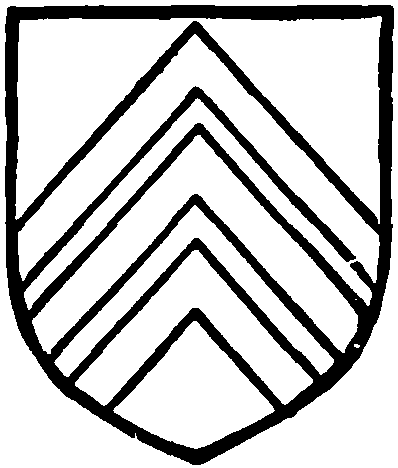
Langton. Argent three chevronels gules.
John de Langton, living in 1355, predeceased his father, leaving a son Ralph, who succeeded his grandfather in 1361, being then of full age. (fn. 30) He had licences for his oratory at Walton in 1367, 1372 and 1374, and as 'Rauf de Langeton, baroun of Neweton,' was a witness in the Scrope and Grosvenor case in 1386. (fn. 31) He had licence for oratories in his manor-houses at Newton and Walton in 1398, and died in 1406, leaving issue by his wife Joan daughter of William Radcliffe of the Tower, who survived him, a son Henry, then aged forty, upon whom he had settled lands in Walton in 1391 worth £20 a year on the occasion of his son's marriage to Agnes daughter of John de Davenport. (fn. 32) Henry died in 1419, leaving Ralph his eldest son, then twentythree years of age, who probably received knighthood after the fall of Meaux in 1422, in which year he is described as knight. (fn. 33) He married Alice, whose parentage is unknown, and died in 1431, Henry his son being then but twelve years old. (fn. 34) Henry died in 1471, his son Richard being of full age and married before 20 April 1467 to Isabella daughter of Peter Gerard of Brynn. (fn. 35)
Richard Langton was made a knight by Lord Stanley in Scotland in 1482 and died in 1500, Ralph his son being twenty-six years of age and already married during his father's lifetime to Joan daughter of Christopher Southworth of Samlesbury, kt. (fn. 36) Ralph Langton, esq., settled his estates in 1503 and by will bequeathed 20 marks 'towards the making and repairing of the Low church if the parishioners will build the same.' He died the same year, leaving Richard his eldest son, aged nine years, who died in 1511 during his minority, his brother Thomas being then aged fourteen years. Joan Langton, having acquired the wardship of her sons, sold it shortly before her death in 1504 to Edward Stanley, kt., (fn. 37) afterwards created Lord Mounteagle, who married Thomas Langton to his base daughter Elizabeth. (fn. 38) Thomas was made a knight in 1533, had licence with his second wife Anne, base daughter of Thomas Talbot, in 1545 for an oratory to be erected in their manor-house of Walton, and was sheriff in 1556 and 1567. (fn. 39) He died in 1569, Edward his eldest son and his issue having predeceased him before 1558, when the family estates were entailed upon Leonard, then his eldest son and heir. Leonard died before his father, leaving issue by his wife Anne daughter of Thomas Leyburn of Cunswick, co. Westmorland, and relict of William Singleton, an only son, Thomas Langton, heir to his grandfather in 1569, and then aged eight years. (fn. 40) Thomas was contracted in marriage during his minority to Margaret daughter of Richard Shireburne of Stonyhurst, from whom he was divorced in 1580 when he married Elizabeth second daughter of John Savage of Clifton, kt., by whom he had no issue. Owing to various encumbrances upon his estates he alienated the manor of Walton in 1597 to Messrs. Sweeting and Hobbes, clothworkers of London, (fn. 41) but this transference may have been connected with the fatal affray at Lea Hall in 1589 and the complications which that misfortune brought upon the last of the line of Langton, barons of Newton. (fn. 42)
After this fatal conflict Langton and some fortyseven other persons were arrested and indicted for murder before special sessions of the justices summoned for the purpose, but three jurors only appeared. (fn. 43) No presentment could therefore be made. After abortive proceedings extending over more than two and a half years the Earl of Derby recommended to Cecil Lord Burghley the petition of those indicted, praying for their release, and deprecated further proceedings on the ground that some of the defendants were illiterate and unable to plead, whilst others 'are so great in kindred and affinity and so stored with friends as, if they should be burnt in the hand, I fear it will fall out to be a ceaseless and most dangerous quarrel betwixt the gentlemen that any county of her Majesty's hath this many years contained.' (fn. 44) It is probable that Langton made peace with Mr. Hoghton's widow by the payment of a large sum of money, raised doubtless by a mortgage of estates already encumbered, and that this led to the subsequent alienation of the manor. (fn. 45) Thomas Langton was made K.B. at the Coronation of James I, and dying at Westminster in 1604 (fn. 46) was succeeded in the barony of Newton by his kinsman Richard son of Thomas Fleetwood of Colwick.
Soon after acquiring the manor Messrs. Sweeting and Hobbes appear to have conveyed it to Richard Hoghton with other dependent manors in the hundreds of Blackburn and Leyland, (fn. 47) and in this family it has descended to the present owner, Sir James De Hoghton, bart.
Walton Hall was pulled down in 1834. It had previously undergone alterations which gave it a modern appearance, being a large structure of brick and stone with projecting gabled end wings and classic porch in the centre, in the pediment of which was the Hoghton coat of arms. (fn. 48)
Court rolls of the manor have been preserved from 1625 to 1766, and rentals, &c., from 1659.
BANISTER HALL, also called Darwen Hall, lies in the northern part of the township towards Cuerdale and not far from the northern bank of the River Darwen. The estate probably represents a feoffment to a kinsman by one of the early lords of Walton. Henry Banastre had lands in Cuerdale and Walton in the early part of the reign of Henry III; Richard his son occurs in 1246 and 1248 and was the father of Henry, the elder, and Geoffrey, contemporaries of Robert Banastre, their chief lord. (fn. 49) Henry had sons, Henry the younger and William, both contributors to the subsidy levied in 1332, and Richard, who married Alice daughter of Roger son of Adam de Preston, and was ancestor of the Banastres of Preston. (fn. 50)
Henry Banastre frequently occurs as one of the principal freeholders here from 1318 to 1348, and was one of the overseers appointed in 1343 to prevent the taking of salmon in the close season in the waters of Lune, Wyre, Ribble and Mersey. (fn. 51) By his wife Matilda he had issue John his successor, who appealed John son of Henry de Blackburn of Walton in 1340 for the death of Ralph his brother, was pardoned for taking part in the great riot at Liverpool in 1345 on condition of serving in Gascony, was appointed one of the keepers of the peace in the county in 1350, and was returned the same year as one of the freeholders in Walton. (fn. 52) In 1367 he passed his estates to feoffees, who conveyed them in 1372 to John Banastre, apparently son of the last-named John. As John Banastre, esq., he contributed to the poll tax of 1377, and was father of Richard Banastre of Altham and probably of John Banastre of Walton, gent., who occurs from 1407 to 1432. (fn. 53) The descent of the family cannot be traced with certainty during the 15th century, but about 1460 John Banastre of Derwyne gave puture to the sheriff in respect of this estate. (fn. 54) According to Flower's Visitation Lawrence Banastre of Darwen Hall was the father of George, who contributed to the subsidy of 1523–4 upon lands here, and by Jenet daughter of Lawrence Ainsworth of Pleasington, gent., had Lawrence and other sons. (fn. 55)
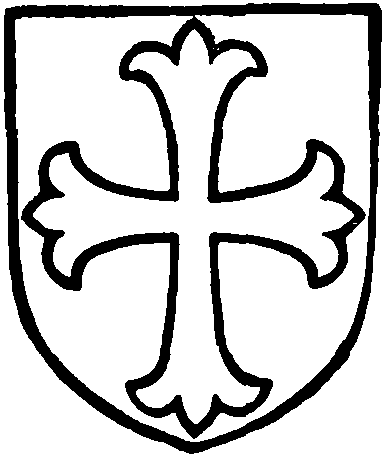
Banastre. Argent a cross patonce sable.
Lawrence Banastre of Darwen Hall married Jane daughter of Richard Hoghton, kt., and with his son and heir Richard is named among the out-burgesses at Preston gild in 1542. (fn. 56) He died in 1558, leaving Richard his second but eldest surviving son, then aged seventeen (sic) years. Richard married Isabel daughter of Piers Farington of Farington, gent., and attended Preston gild in 1562 as an out-burgess with sons Thomas, Lawrence, George and Henry. As 'Richard Bannister, gent., of Darwin Hall alias Bannister in Walton' he was named as a debtor of £15 in the will of his uncle Alexander Hoghton, esq., in 1581. (fn. 57) He died before the date of Preston gild in 1582, at which five of his sons were present, including Thomas the eldest, with his sons Richard and George. Thomas married Alice daughter of Peter Stanley of Bickerstaffe. In 1590 he joined his brothers Lawrence and George in the alienation of the estate to Edward Walmsley, gent., (fn. 58) younger son of Thomas Walmsley of Showley, esq., who died in 1604 seised of 'Darwyn Hall,' otherwise Banister Hall, which he held of Thomas Langton, kt., in socage, leaving Thomas his son aged nine and a-half years. (fn. 59) Thomas married Frances daughter of Edward Stanley of Moor Hall, by whom he had an only daughter Anne, the wife of Radcliffe Hoghton. She died in 1641 seised of this estate, her uncle Edward Walmsley being her heir. (fn. 60) In 1649 he obtained the discharge of the estate from sequestration, he having been in 'the first war'; his fine was £114. In 1655 he petitioned for the discharge of other lands in Walton sequestered for the recusancy of Frances wife of his brother Thomas Walmsley, she being then recently dead. (fn. 61) He held the hall and demesne in 1662 under a free rent of 18d. to the lord of the honor of Clitheroe, (fn. 62) and died in 1673, when his nephew William Winckley of Billington succeeded to the estate as eldest surviving son and heir of Thomas Winckley by his wife Rosamond eldest daughter of Edward Walmsley the elder. He married Isabel daughter of Robert and sister and co-heir of William Elston of Brockholes. Upon his death in 1703 he was succeeded by his eldest surviving son Edward, (fn. 63) who sold the estate in 1739 to John Atherton of Preston, who devised it by will in 1768 to his son John.
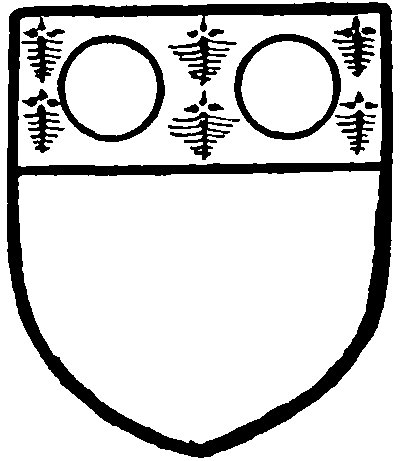
Walmsley. Gules on a chief ermine two hurts.
The estate was purchased about 1800 by William Assheton of Downham and Cuerdale, whose great-grandson Mr. Ralph Cockayne Assheton of Downham is the present owner.
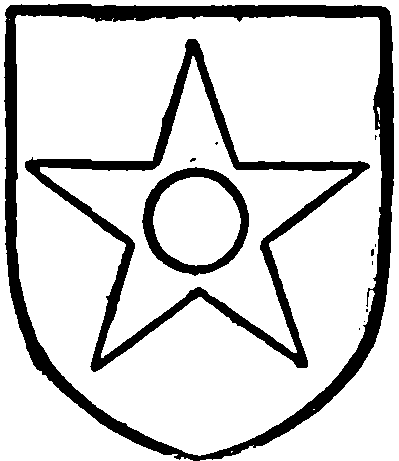
Assheton of Downham. Argent a mullet pierced sable.
The south front of the old hall has been rebuilt in brick, but the original exterior remains on the north side.
LITTLE WALTON. This estate was probably created by a feoffment of one of the early lords of Walton. William de Walton, (fn. 64) living in 1253, was father of Geoffrey, whose son John had a grant from William son of Gilbert de Brockholes of lands in Walton, which the latter held by the feoffment of Robert Banastre for 5s. 6d. rent. (fn. 65) In 1327 William son of Geoffrey de Walton was pardoned for the death of Richard Torbock. John de Walton contributed to the subsidy levied in 1332, (fn. 66) and died about 1348, leaving issue William his heir and Henry, clerk to Earl Henry of Lancaster and Archdeacon of Richmond from 1349 to 1359. William de Walton recovered possession of a third part of the manor of Huyton in 1358, was living in 1376, when he vested his lands in Walton and Cuerden in trustees, and left issue Henry —who contributed to the poll tax of 1379, had licence in 1383 for his oratory at Walton, (fn. 67) and died without issue—and John, who negotiated a marriage for his son William in 1396–7 to Emma daughter of Thomas Bradley of Chippingdale. (fn. 68) William the son was still a minor in 1401, and died without issue, his brother Henry continuing the succession. He was an out-burgess at Preston gild in 1415, brought a plea in 1448 against John Bradley of Chipping, gent., (fn. 69) and had issue James who married, before 1467, Joan younger daughter of Nicholas Singleton, and was an out-burgess at Preston gild in 1459. (fn. 70)
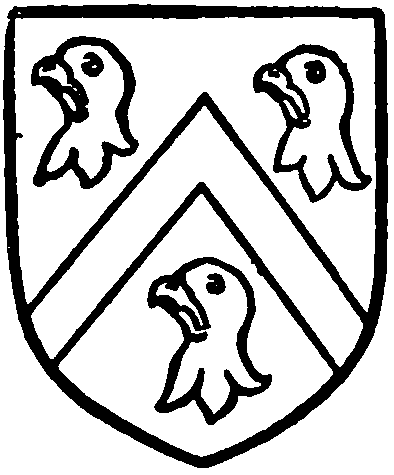
Walton. Argent a cheveron gules between three falcons heads erased sable.
Richard eldest son of James Walton married Elizabeth daughter of James Moresby before 1490 and died in 1519, when William his son and heir paid relief at the court of Walton for his lands in Walton and Cuerden. (fn. 71) He died about 1552, leaving by Joan his wife Thomas, his successor, who survived his father only a few years, and died about December 1555, having had issue by Jane his wife a son William, whose wardship was sold to Thomas Langton, kt., in January 1556. William Walton was an out-burgess at the Preston gilds in 1562, and, with sons Thomas and William, in 1582 and 1602; he was assessed to the subsidy granted in 1599 in respect of his lands here, (fn. 72) and died soon after 1610. Thomas his heir married Priscilla daughter and heir of John Cottam of Tarnacre, and died in 1619, leaving William, who was an out-burgess at the gild of 1622, with sons William, John and James, and grandsons Thomas and Christopher, sons of William the younger. (fn. 73) William Walton died shortly before 1626, when his heir was assessed to the subsidy granted I Charles I for his lands here.
William Walton was an out-burgess at Preston gild in 1642, with brother John, son Thomas and grandson John. He died a few years later. His son Thomas suffered the sequestration of his estates for recusancy, but obtained a lease of two-thirds from the county commissioners in 1653. (fn. 74) He paid hearth tax in 1666 upon five hearths. Mortgaging his estate in 1682 to John Leigh of Preston, he failed to redeem it and was obliged to alienate. (fn. 75) Dr. Kuerden, as quoted above, notes 'the ancient seat of Walton of Little Walton, but now belonging to Mr. Ratcliffe Ashton, son of Mr. Ashton of Cuerdale.' (fn. 76) The estate has since descended in the line of Assheton of Downham and Cuerdale, like Banister Hall.
The house at Little Walton, or Bamber Bridge, is an ancient structure with central porch and gabled wings, the walls showing traces of a timber framework. On the entrance gate-post is the date 1675.
There were numerous offshoots from this family, including the Waltons of Marsden Hall, of Midge Hall in Myerscough, of Preston, and of Little Hoole.
The family of Haydock and their successors, the Leghs, long held lands here. Thurstan Banastre gave Bradley in Walton to Henry de Bispham son of Warine de Walton, who regranted it to William son of Adam de Praers. Robert Banastre gave land by Bradley Brook to his clerk Philip of Chester, which Avice de Raby daughter and heir of John the clerk of Chester gave to William de Praers shortly before 1298, when Praers gave the whole estate to Matthew son of Gilbert de Haydock. (fn. 77) The estate descended like Haydock and Bradley in Burtonwood, and was held by the Leghs in the 16th century of the Langtons for 6s. 1d. rent and ½ lb. of cummin. (fn. 78) A John Legh was assessed to tax in 1666 upon three hearths, and in 1662 the heirs of Legh paid a puture rent of 1s. to the honor of Clitheroe. (fn. 79)
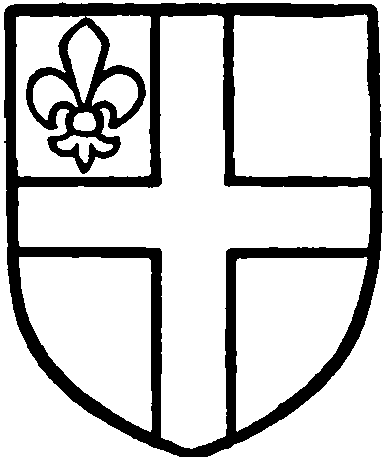
Haydock. Argent a cross sable, in dexter chief a fleur de lis of the last.
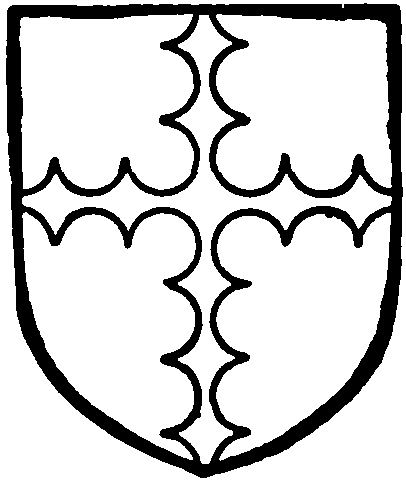
Legh. Gules a cross engrailed argent.
A portion of the estate appears to have passed to Richard le Serjeant of Walton, about 1400, by his marriage with Amabel daughter and heir of Hugh de Haydock. The estate of Law House was in the possession of the Serjeant family in 1461. (fn. 80) The name is of frequent occurrence until the middle of the 17th century. Before 1650 Richard Serjeant of Middleforth died possessed of Hanshaw Hall in Walton, which passed to his seven daughters and co-heirs. In 1662 the heirs of Richard Serjeant paid 14d. puture rent to the honor of Clitheroe for 'Manehouse'—that is, Mosney House. (fn. 81) Leonard Serjeant, descended from another branch of this family, died in 1640, leaving several daughters his co-heirs, of whom Katherine was the wife of Richard Sharrock. William Sharrock, probably a kinsman of Richard, suffered forfeiture for recusancy, but petitioned in 1653 for a reversal, alleging that 'God by His marvellous light has discovered to your petitioner the deep and erroneous ways of the Popish religion wherein he was bred.' He had taken the oath of abjuration, and was a frequenter at church. (fn. 82)
LOSTOCK HALL. An estate which took name from the River Lostock was in the possession of a family bearing the name temp. Edward II. It descended to James de Lostock, living 1332 and 1350, whose daughter Magote, or Margery, may have brought it in marriage to a Banastre, for John Banastre was described as of Lostock from 1402 to 1429, William and his sons John and Richard in 1459, John 1469 to 1479, and William in 1504. (fn. 83) In 1548 Richard Banastre conveyed tenements in Walton, Preston and Lea to Thomas Fleetwood, gent., and Barbara his wife. In 1561 Mr. Fleetwood passed the manor of Lostock in Walton to feoffees, who reconveyed it in 1574 to William Fleetwood son of Thomas by his second wife Bridget Spring. William Fleetwood sold the manor with a free fishery in Lostock Water to Roger Burscough, who conveyed it in 1595 to Peter Burscough, gent., (fn. 84) and he in turn in 1611 passed it to Thomas Burscough, who died in 1616 seised of Lostock Hall, holden of Richard Hoghton, bart., by 16s. rent, leaving issue an only daughter Elizabeth, aged eighteen months. (fn. 85) In 1662 Andrew Dandie paid a rent of 12d. to the lord of Clitheroe for his lands called Lostock, and in 1666 William Dandy paid tax upon three hearths here. (fn. 86) He died in 1676 described as of Lostock. Andrew Dandy of Lostock and William his son were out-burgesses at Preston gild in 1682.
The PEDDER HOUSE estate was the property of a family of the same name, of whom William Pedder held his tenement of Richard Langton in 1502 under a free rent of 3s. In 1662 John Jackson paid a rent of 12d. to the lord of Clitheroe for Pedder House, and in 1666 was taxed for four hearths. (fn. 87)
RIDING HOUSE was the home of the family of that name. John son of John del Ridding occurs temp. Edward I, John del Riding in 1332 and John son of Richard del Ridding in 1363. John Riding, the elder and younger, and William Ryding conveyed four tenements here to James Mason alias Stopford and William Stopford in 1582. William Stopford of Ulnes Walton died in 1617 seised of a tenement in Walton, held of Robert Banaster of Passenham, co. Northants, kt., as feoffee of Gilbert Hoghton, kt. William Stopford his son was aged twenty-three years. In 1622 he was an out-burgess at Preston gild with his two sons. (fn. 88) In 1662 Nicholas Norris paid 12d. rent to the lord of Clitheroe for Riding House.
LEMON HOUSE was the seat of an ancient family who were probably hereditary judges or law men of the court baron of Walton. Thurstan Banastre gave land here in the time of John or early Henry III to Kandelan son of Robert, and it afterwards passed to Adam son of the Laghmon who occurs in 1246. (fn. 89) Others of the line are Henry (1278 and 1292), Henry son of Henry Laghmon or Laweman (1332), Robert son of Henry (1347), Robert and Ralph sons of Richard son of Robert (1415–23). Robert Lemon had Ralph, and in 1504 John Lemon and Robert his brother occur. James Lemon of Walton, brother of Edmund of Preston, was father of William, an alderman at Preston gild in 1622; Henry his son was an in-burgess in 1642, and William son of Henry a councillor of the gild in 1662 and alderman in 1682. As William Lemon, gent., (fn. 90) he sold the Lemon House estate in 1663 to John Woodcock the elder, descended from the family of Woodcock of Cuerden Green. His grandson John Woodcock alienated the estate before 1742. (fn. 91)
Other estates that may be named were Stone House, owned in 1662 by Thomas Shawe, Knowles (probably Knowsley) House by Henry Catterall and Kellet House by Daniel Chaddock. (fn. 92) The Chorley, Hesketh, Cuerdale (later Osbaldeston) and Garston families held lands here from the 14th to the 16–17th centuries. In the 13th and 14th centuries lands in Balshagh were held by a family bearing that name. Woodley was in the possession of John de Blackburn of Woodley temp. Edward I. It descended through several generations of the family, and was granted by William de Blackburn of Mawdesley in 1371 to John de Blackburn of Garston. (fn. 93) Probably both these estates passed into the possession of the chief lord during the 14th or 15th century. The Colevill family were tenants of the Banastres from an early period. William son of Avice de Colevill occurs in 1246, John temp. Edward I, William contributed to the subsidy of 1332, whilst another William was the father of John, living until about 1428, whose daughter and co-heir Margaret married first Richard Maunsell before 1387 and subsequently Thomas de Estham, from whom descended Arthur son and heir of Richard Estham, who sold lands called Brodfeld and Schetylyngfeld to Thomas Langton, kt., in 1536, and six years later alienated his whole estate in Walton to Sir Thomas. (fn. 94) In 1666 Francis Eastham and Henry Serjeant paid tax for five hearths on behalf of 'Mr. Lees,' probably Richard Legh of Lyme. (fn. 95)
The Maynes were long the property of the Faringtons of Worden. The Chorleys of Chorley were the owners of two messuages known as 'Claughton's' and as 'Serjeant's' in the 16th and 17th centuries, which long descended with their other estates. (fn. 96)
Church
The church of ST. LEONARD stands in a picturesque situation on the crest of a tongue of high land between the Ribble and Darwen, three-quarters of a mile to the east of their junction. The road to Samlesbury passes close to the building on the north side, from which there is a fine prospect over the Ribble valley, and on the south the ground falls less precipitously to the village of Walton on the old high road between Preston and Blackburn in the valley of the Darwen. The building consists of a chancel 27 ft. by 18 ft., nave 60 ft. by 42 ft., with north and south transepts each 28 ft. by 16 ft., and west tower 13 ft. 3 in. square, all these measurements being internal. There are also a low vestry on the north side of the tower and shallow north and south porches at the west end of the nave. Only the chancel and tower, however, are ancient, and they belong to an early 16th-century building, (fn. 97) the nave of which was pulled down and rebuilt in 1798 in a poor Gothic style, (fn. 98) to which deep transepts were added in 1816. The building was restored in 1856, but the nave being in a more or less ruinous condition at the beginning of the present century it was pulled down and a new one erected in 1905. Owing to the graves being close on all sides the new structure had to be made almost exactly the same on plan as that which it replaced. (fn. 99)
The chancel is small and low, with a pointed window of three trefoiled lights and tracery over at the east end. The walls are built of gritstone in large blocks and have a moulded plinth, but there are no angle buttresses, and the work is of a very plain character. There is a segmental-headed window of three lights, the centre one cinquefoiled and the others trefoiled, north and south, and on the south side a priest's door with pointed head, now built up. The chancel was restored in 1864, when a new roof was erected, the floor tiled and new stalls inserted. It belongs jointly to the Assheton and De Hoghton families, the north side to the former and the south side to the latter. The chancel arch is modern.
The nave, being modern, has no antiquarian interest. The walls externally are of local Hoghton stone and internally are faced with Runcorn stone, and the roof, which is of one wide span with hammerbeam principals, is covered with green slates. The style is that of the 15th century with embattled parapets to the walls, the transepts having twin gables facing north and south. There is a gallery at the west end approached by a stone staircase from the north porch, and containing the organ and quire.
The tower, like the chancel, is built of gritstone, and has a moulded plinth and square buttresses of eight stages at its west angles, with a projecting vice in the south-east corner. The west door is pointed, with continuous mouldings to jambs and head, and above is a three-light four-centred pointed window with tracery and label. The belfry windows are of three plain lights with trefoiled tracery above under a four-centred arch and external label and the walls finish with an embattled parapet. The north and south sides are plain below the belfry windows, but there is a large clock-dial on the south and west. The tower arch is pointed, of two chamfered orders continuous to the ground.
On the north wall of the chancel is a plaster panel dated 1634 emblazoned with the arms of Assheton of Cuerdale (a shield of six quarters), with helm, crest, mantling and motto and the initials of Ralph Assheton. There is also a brass to Sarah wife of Ralph Assheton, who died in 1700. On the south side is a somewhat similar but smaller and undated panel with the arms of Hoghton, with helm, crest, mantling and motto. Below is the inscription: 'The south part of this chancel belongs to Sir Gilbt. Hoghton Knt & Barnt. Builder.' There is also a brass plate inscribed: 'By the appointment of Sr Charles Hoghton Brt Deceased this Plate of Brass is here affixed to intimate to all Persons whatsoever that it was his desire nobody for time to come should be buryed under this Seat or Pew belonging to the Hoghtons where his remains are interred. Except the Lady Hoghton his Relict if she so desire. Anno Dom. 1710.'
There is a separate monument to the said Sir Charles and his wife Mary, daughter of Viscount Massarene, who died in 1732, but the most interesting of the Hoghton memorials is a brass to Cordelia Hoghton, who died in May 1685, 'a pure virgin espoused to the man Ct Jesus,' with a long rhyming inscription. (fn. 100) There are also memorials to Sir Henry Hoghton, bart. (d. 1795), Major-General Daniel Hoghton, who died in battle at Albuera in 1811, Sir Henry Philip Hoghton (d. 1835), Sir Henry Bold Hoghton (d. 1862), buried at Anglesea near Gosport, Hants, and Sir Henry de Hoghton (d. 1876), buried in the Bold Chapel, Farnworth.
The old font is circular and apparently of 17thcentury date, with two bands of 'egg' ornament on the bowl, and a fluted stem. It has some interesting masons' marks. All the other fittings are modern.
The ancient peal of four bells was replaced in the 18th century by a ring of six bells, one dated 1760 and four 1761, all by Lester & Pack of London. The sixth is by Pack & Chapman, 1780, and is inscribed with the name of the minister and wardens of the year. (fn. 101)
The plate consists of two chalices, a paten and flagon of 1790, the paten inscribed 'The gift of William Assheton, esq., of Cuerdale, to the church in Walton, Anno Dom. 1790'; and a paten presented by the parishioners in 1889 to commemorate the incumbency of the Rev. J. C. Kershaw.
The registers begin in 1653.
The graveyard is principally to the east and south of the church, and extends down the south slope of the hill. The oldest dated gravestone is 1628. On the south side of the church is a pedestal sundial dated 1788.
Advowson
About the year 1166 Henry de Lacy, when granting to Henry the clerk of Blackburn the church of that place, included in the grant the chapel of Walton, which belonged to that church. Afterwards, when John de Lacy, constable of Chester in 1228, was about to confer upon the monks of Stanlaw the half of Blackburn Church which belonged to Adam son of Henry de Blackburn, the latter at the request of his superior lord resigned to the monks the chapel of Walton with the glebe, tithes and obventions pertaining to it, and secured for Richard son of the Dean of Whalley, who then possessed the chapel, a promise of preferment in lieu thereof. (fn. 102)
At least as early as the time of Richard I the right of sepulture belonged to it, with oblations on notable feast days, and both great and small tithes, as to a parish church. In 1236 the monks successfully petitioned for pontifical authority to take away these liberties and annex them to the mother church. (fn. 103)
In 1267 it is described as Low Chapel—'Capella de la Lowe' (fn. 104) —so named by reason of its striking position on a slight eminence overlooking the wooded slopes of Ribblesdale.
In 1347 John son of Robert de Langton, kt., and four other principal parishioners were farming the 'manor' belonging to the chapel under the abbey for £40 per annum. (fn. 105)
In 1459 a commission was directed by the Bishop of Lichfield to the vicar of Prescot to inquire and report about the alleged pollution of the burial yard of Low Chapel by violence and the effusion of human blood. The occasion of the pollution is not stated. (fn. 106) Four years later William Livesey bequeathed his body for burial in the cemetery of St. Leonard of Low, and his best beast for mortuary, directing that light and other emoluments should be paid to God and the church of Low on his burial day without delay or device. (fn. 107)
In 1526 the chief inhabitants of Walton issued a declaration that neither in their days nor their ancestors' were 'dede corse presaunts or mortuaryes' ever paid within the town or parish of the Low to the monastery of Whalley, as lately demanded by Abbot Paslew. (fn. 108) The accounts of the abbey for 1536 confirm this by recording one item of profit only from Low Church—'De stipite sancti Leonardi 6s. 8d.' (fn. 109) In 1537 at the suppression of Whalley the chapel with the tithes belonging to it was valued at £27 11s. 2d., and the following year was leased with the rectory of Blackburn to Richard Breame for a term of thirty years. In 1547 it passed with the rectory of Blackburn to Archbishop Cranmer and descended with it to his successors. (fn. 110)
In 1552 a chalice, vestment, cope and four bells, one being cracked, were delivered to the curate and church reeves. (fn. 111) The visitation lists record two names as serving the chapel in 1548 and three in 1554, but afterwards only one.
In 1559 the Earl of Derby, by direction of the Privy Council, ordered the arrest of Thomas Heavanson, the curate, for having publicly said mass, aided and abetted by more than forty parishioners. (fn. 112) This was during the time of Thomas French's ministration as curate, so that possibly the latter name has been incorrectly recorded. In 1563 as curate of Low he was one of the signatories to the Act of Supremacy, and in 1568 was admonished before the Earl of Derby as to his future conduct. (fn. 113) It does not then appear how the chapel was served for about thirty years. In 1592 the curate was censured for leaving the parishioners destitute of service because he was absent. In 1601 the chapel was served by a reader, and no sermon had been preached there for a twelvemonth. In 1622 there was a preacher, but he was unlicensed, did not wear a surplice, come to church on holy days, bow at the Name of Jesus, or stand up at the creed. (fn. 114)
During the Interregnum Richard Redman, the minister, received £40 a year from the Committee for Plundered Ministers. The commissioners of 1650 found 'Law,' a parochial chapel distant 9 miles from the parish church of Blackburn, with the townships of Walton and part of Cuerdale, containing over 200 families, annexed to it. The vicars of Blackburn had formerly paid the minister £4 per annum, which had been detained for three years, whilst the order of the committee made in 1647 had not been made effective, so that there was no maintenance and no minister. The inhabitants petitioned that it might be made a parish with competent endowment. The tithe of the chapelry was then worth £119 and the glebe £52 per annum. (fn. 115) The proposal to make Walton and Cuerdale a separate parish was still under discussion in 1658. (fn. 116)
In 1665 the incumbency was vacant; in 1671 there were nine Papists, and proceedings were in process against William Farington of Worden and several others for non-payment of church lays, which they subsequently acknowledged. Since the Restoration the chapels of Low and Samlesbury had been served by one curate, and in 1683 were said to be well and constantly served by a curate nominated by the vicar of Blackburn and licensed by the bishop, all the offices being performed every other Sunday for the inhabitants of Walton and Cuerdale at Low Chapel. (fn. 117) In 1689 the curate was in receipt of about £43 per annum 'by an extraordinary charity of my lord of Canterbury' and a maintenance out of the vicarage of Blackburn. (fn. 118) A report made to the Governors of Queen Anne's Bounty in 1714 states that the number of inhabitants in the chapelry lay 'between four and five thousand souls which daily increase by reason of the great manufacture of linen cloth in those parts'; there were four or five conventicles of Papists, one of Presbyterians, and one of Anabaptists. (fn. 119)
About 1720 Bishop Gastrell found that divine service was performed in the forenoon of one Sunday and afternoon of the next in summer time; on alternate Sundays in winter, the curate also serving Samlesbury Chapel. Sir Henry Hoghton, bart., elected one warden, the minister and principal inhabitants the other. (fn. 120) In 1834 the value was £156; it is now given as £310. (fn. 121) The vicar of Blackburn is patron. The chapelry was constituted an ecclesiastical parish in 1837, but has since been divided.
The following have been curates of Low Chapel:—
| to 1228 | Richard son of Geoffrey Dean of Whalley |
| c. 1250 | William, clerk of the Lawe (fn. 122) |
| oc. 1280 | Adam, chaplain, and William, clerk of the Lawe (fn. 123) |
| oc. 1322–30 | John del Lawe, chaplain (fn. 124) |
| oc. 1332 | William, clerk (fn. 125) |
| c. 1341–5 | Hugh de Pocklington (fn. 126) |
| oc. 1359 | Robert de Kirkham(?) (fn. 127) |
| oc. 1439–45 | Edward Farington (fn. 128) |
| oc. 1541–65 | Thomas French (fn. 129) |
| oc. 1592 | William Wall |
| oc. 1601 | Lawrence Waddington |
| oc. 1609 | Peter Makinson (fn. 130) |
| oc. 1622 | —Inskip |
| oc. 1629 | Robert Osbaldeston |
| 1646 | Richard Redman (fn. 131) |
| oc. 1651–3 | William Heald (fn. 132) |
| 1676 | Thomas Abbot, M.A. |
| 1688 | William Colton (fn. 133) |
| 1703 | John Hull (fn. 134) |
| 1721 | William Vaudrey, B.A. (fn. 135) |
| 1763 | John Shorrock, B.A. |
| 1803 | Edmund Stringfellow Radcliffe, B.C.L. (fn. 136) (Brasenose Coll., Oxf.) |
| 1826 | John Clay |
| 1827 | Randal Henry Feilden |
| 1832 | Henry Walter McGrath, M.A. (T.C.D.) (fn. 137) |
| 1838 | Robert Hornby, M.A. (fn. 138) (Downing Coll., Camb.) |
| 1853 | John Brookes |
| 1857 | James Clegg Kershaw, M.A. (fn. 139) (Emmanuel Coll., Camb.) |
| 1889 | Seymour Frederick Harris, B.C.L. (fn. 140) (Worcester Coll., Oxf.) |
| 1908 | Edward John Middlecott Davies |
There was anciently a small chapel or oratory at the bridge over the Ribble. In 1365 John, called the hermit of Singleton, had licence to have divine service in the chapel at the foot of Ribble Bridge, on the Walton side, for three years. (fn. 141) In 1383 the abbot and convent demised to Ralph de Langton and Thomas de Clayton, chaplain, for a term of thirty years the chapel standing on Ribble Bridge with all oblations and the books, vestments of the altar, a chalice, images, wax and other belongings, rendering 3s. 4d. yearly and prayers for the abbot and convent, for Ralph and Joan his wife, their ancestors, heirs, and children, and all benefactors of the chapel living and dead. Clayton received licence in 1387 to celebrate in the chapel at the end of Ribble Bridge 'beyond the bank of Ribble,' and in his oratory within his mansion house at 'Clecton,' probably Clayton-le-Dale, at the bishop's pleasure.
A story has been preserved how Edward Kelley (1555–95) the alchemist, a friend of Dr. John Dee, held converse with the corpse of a poor man which he and Paul Waring, his companion in such deeds of darkness, had disinterred a few hours after burial in Low churchyard, and from whom by incantations they elicited information as to passages in the life and the manner and time of death of a young nobleman, then in ward of the relater of the story. (fn. 142)
In 1689 Walton Hall was licensed as a meetingplace for Presbyterians under the ministration of Thomas Key. (fn. 143) A Presbyterian chapel existed here at the close of the 17th century; in 1719 Sir Henry Hoghton erected a new chapel, described in a return of Dissenting chapels made in 1772 as then Congregationalist, where the congregations of Preston and Walton met alternately. Soon afterwards the society became Unitarian, and early in the 19th century ceased to use the chapel, which was turned into cottages and attached to the endowment of the Unitarian chapel, Preston. The building stands in the rear of the main street of Walton village; the burial-ground attached has long been obliterated. (fn. 144)
In 1784, and again in 1790, during his last journey in this part of England, Wesley paid brief visits to Walton in connexion with members of the society who worshipped at the chapel in Little Walton, afterwards called Bamber Bridge. A Wesleyan school-chapel was opened in Walton-le-Dale in 1868 in a building converted out of cottages. It was replaced by a new building in 1882. (fn. 145)
The ecclesiastical parish of All Saints, Higher Walton, was formed in 1865 out of the parish of St. Leonard, Walton-le-Dale. (fn. 146) The church, standing on an eminence overlooking the village, upon a site given by Mr. Miles Rodgett, was erected in 1861–2 from the designs of Mr. E. G. Paley; a tower, containing seven bells, and spire were added in 1871. (fn. 147) In the church are several stained-glass windows erected to the memory of members of the Rodgett family. The registers date from the year 1862. The living is a vicarage in the gift of the Bishop of Manchester and vicar of Blackburn alternately.
There is at Higher Walton a Wesleyan chapel, built in 1869–70 to replace the preaching room opened as early as 1813. (fn. 148)
The ecclesiastical parish of St. Saviour, Bamber Bridge, was formed in 1842 as a district chapelry out of the ancient parish of Blackburn, (fn. 149) and was further enlarged in 1869 by the transfer of Cuerden township from the parish of Leyland for all ecclesiastical purposes. (fn. 150) The church was erected in 1836 upon land given by the late Robert Townley Parker, and was enlarged in 1882. The registers date from 1837. The living is a vicarage in the gift of the vicar of Blackburn. St. Saviour's Institute, erected in 1903, contains reading and recreation rooms. The ecclesiastical parish of St. Aidan was formed in 1897 from the parishes of St. Leonard, Walton-leDale, and St. Saviour, Bamber Bridge. The church was erected in 1895; the living is a vicarage in the gift of the Bishop of Manchester. The mission church of St. James, Lostock Hall, was built in 1891 as a chapel of ease to St. Saviour's.
A Methodist Society has existed at Bamber Bridge since 1763. Soon after that date services were held in the house of Mr. William Livesey, and about 1784 in the old hall at Little Walton, as this village was then called. In 1821 the Wesleyan chapel was built, in which services were held until the erection of the present Wesleyan Methodist chapel in 1877. (fn. 151) There is also a Wesleyan Methodist chapel at Lostock Hall, built in 1875.
The English Benedictines are known to have had missions in Walton and the adjacent Cuerden from the end of the 17th century. (fn. 152) These were partly broken up by a government seizure in 1718, but a priest is found at Little Mossna in Walton in 1724. The seat of the mission became finally settled at Brownedge, Bamber Bridge, about 1770 (fn. 153) and a chapel seems to have been built in 1780, succeeded by the present St. Mary's in 1826. (fn. 154) A schoolchapel of Our Lady and St. Patrick was opened at Walton in 1855–7, and the present church was built in 1880. There is a cemetery. (fn. 155) The chapel of St. Paulinus, Lostock Hall, was opened in 1892, and became an independent mission in 1902. The Benedictines still serve Brownedge and these offshoots. There is a convent of Sisters of Charity of St. Paul.
School
Before 1672 the children of Walton were taught in the chapel of Low, but in that year Sir Richard Hoghton gave land on which a school was erected, free only to the inhabitants of the town. Peter Burscough had given £100 in 1624, the interest to be applied to the master's salary. During a vacancy of the mastership in the time of the Civil War this sum was augmented to £130. Other benefactors were Mr. Andrew Dandy, citizen of London, £100; Thomas Hesketh of Walton, £20. The school in School Lane, near Bamber Bridge, stands on a site taken in exchange for the old premises in 1870, and is conducted as a public elementary school. (fn. 156)
Charities
Peter Burscough of Walton, yeoman, gave by will in 1624 £10 per annum, which is now paid out of the tithes of the township of Cuerden by the impropriators, for the relief of the poor of Walton. This charity, with which is now included another of £2, founded by Thomas Crook of Abram in 1688, is distributed to the aged poor on Good Friday, and is therefore called the Good Friday Dole. The number relieved averages seventy-two, and each receives 3s. The Shuttlingfields estate was devised by William Gradell in 1735, apparently for the use of the poor of Walton and Brindle, subject to certain life interests. The estate was sold in 1868, and out of the proceeds £1,300 consols were purchased as the share of Walton, of which the interest is applied yearly for the relief of certain pensioners chosen by the trustees, and at present numbering about twenty-six persons. The Red Lion trust was founded in 1874 to ensure to children in the parish thorough instruction in the Catechism, liturgy and principles of the Church of England. (fn. 157)